
Smith R., Minton R. Calculus
Подождите немного. Документ загружается.

P1: OSO/OVY P2: OSO/OVY QC: OSO/OVY T1: OSO
MHDQ256-Ch00 MHDQ256-Smith-v1.cls December 8, 2010 15:25
LT (Late Transcendental)
CONFIRMING PAGES
0-13 SECTION 0.2
..
Lines and Functions 13
DEFINITION 2.2
A function f is a rule that assigns exactly one element y in a set B to each element x
in a set A. In this case, we write y = f (x).
We call the set A the domain of f. The set of all values f (x)inB is called the
range of f , written {y|y = f (x), for some x ∈ A}. Unless explicitly stated
otherwise, whenever a function f is given by a particular expression, the domain of f
is the largest set of real numbers for which the expression is defined. We refer to x as
the independent variable and to y as the dependent variable.
REMARK 2.1
Functions can be defined by
simple formulas, such as
f (x) = 3x + 2, but in general,
any correspondence meeting the
requirement of matching
exactly one y to each x defines
a function.
By the graph of a function f, we mean the graph of the equation y = f (x). That
is, the graph consists of all points (x, y), where x is in the domain of f and where
y = f (x).
Notice that not every curve is the graph of a function, since for a function, only one
y-value can correspond to a given value of x. You can graphically determine whether a
curve is the graph of a function by using the vertical line test: if any vertical line intersects
the graph in more than one point, the curve is not the graph of a function, since in this case,
there are two y-values for a given value of x.
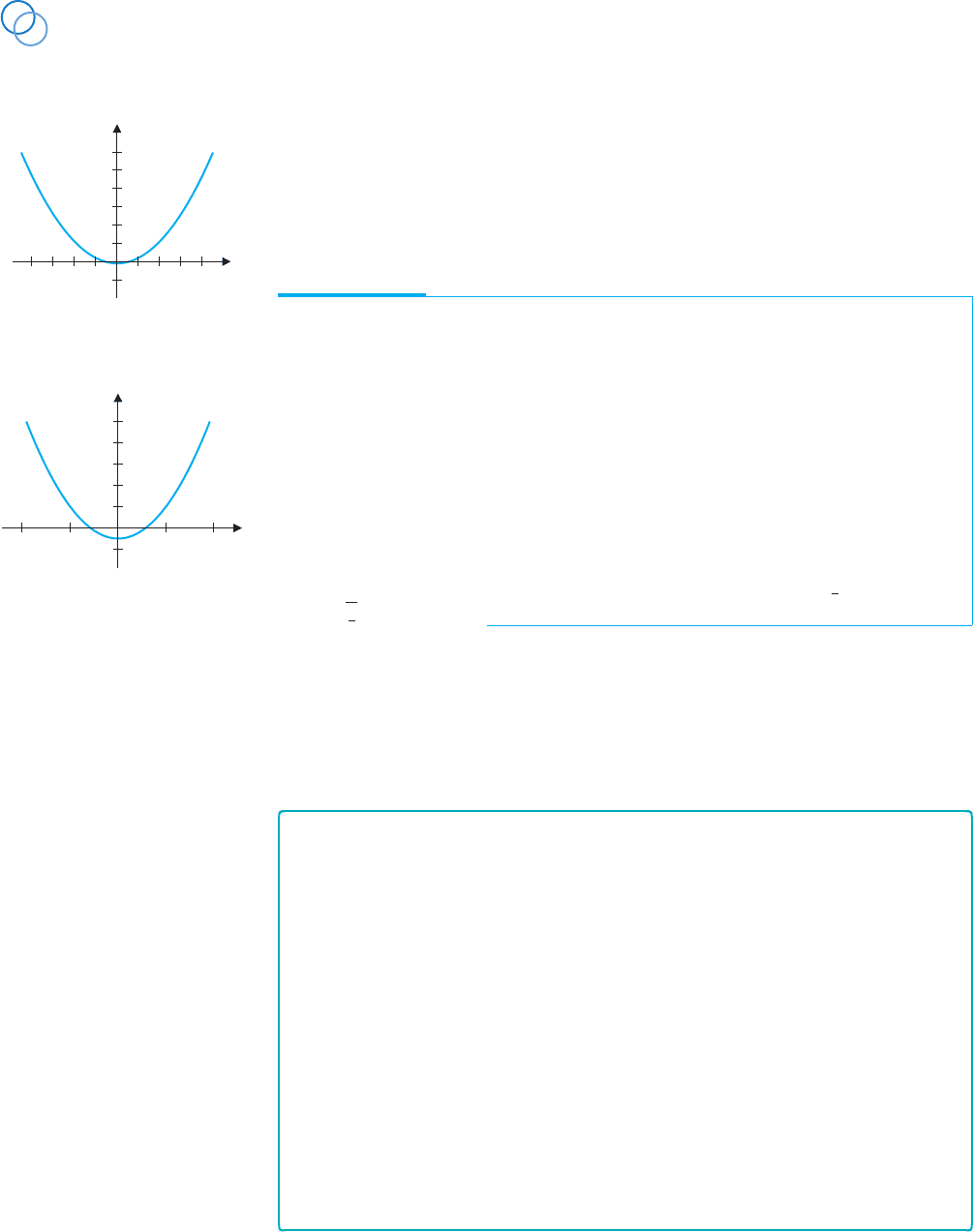
EXAMPLE 2.8 Using the Vertical Line Test
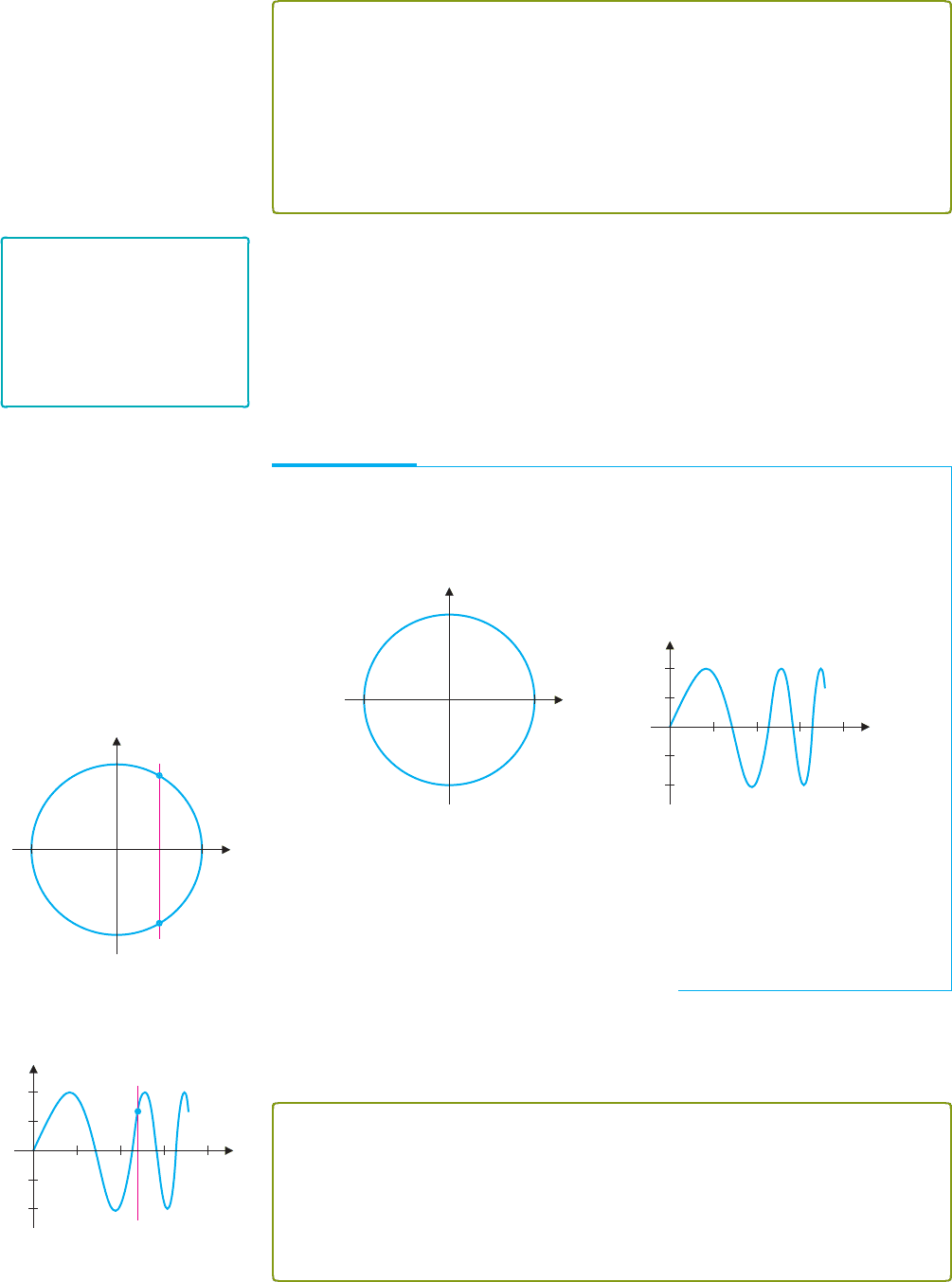
Determine which of the curves in Figures 0.21a and 0.21b correspond to functions.
y
x
11
y
x
0.5 21
1
1
FIGURE 0.21a FIGURE 0.21b
Solution Notice that the circle in Figure 0.21a is not the graph of a function, since a
vertical line at x = 0.5 intersects the circle twice. (See Figure 0.22a.) The graph in
Figure 0.21b is the graph of a function, even though it swings up and down repeatedly.
Although horizontal lines intersect the graph repeatedly, vertical lines, such as the one
at x = 1.2, intersect only once. (See Figure 0.22b.)
The functions with which you are probably most familiar are polynomials. These are
the simplest functions to work with because they are defined entirely in terms of arithmetic.
y
x
1
0.5
1
FIGURE 0.22a
Curve fails vertical line test
y
x
0.5 21
1
1
FIGURE 0.22b
Curve passes vertical line test
DEFINITION 2.3
A polynomial is any function that can be written in the form
f (x) = a
n
x
n
+ a
n−1
x
n−1
+···+a
1
x +a
0
,
where a
0
, a
1
, a
2
,...,a
n
are real numbers (the coefficients of the polynomial) with
a
n
= 0 and n ≥ 0 is an integer (the degree of the polynomial).
P1: OSO/OVY P2: OSO/OVY QC: OSO/OVY T1: OSO
MHDQ256-Ch00 MHDQ256-Smith-v1.cls December 8, 2010 15:25
LT (Late Transcendental)
CONFIRMING PAGES
14 CHAPTER 0
..
Preliminaries 0-14
Note that every polynomial function can be defined for all x’s on the entire real line.
Further, recognize that the graph of the linear (degree 1) polynomial f (x) = ax + b is a
straight line.
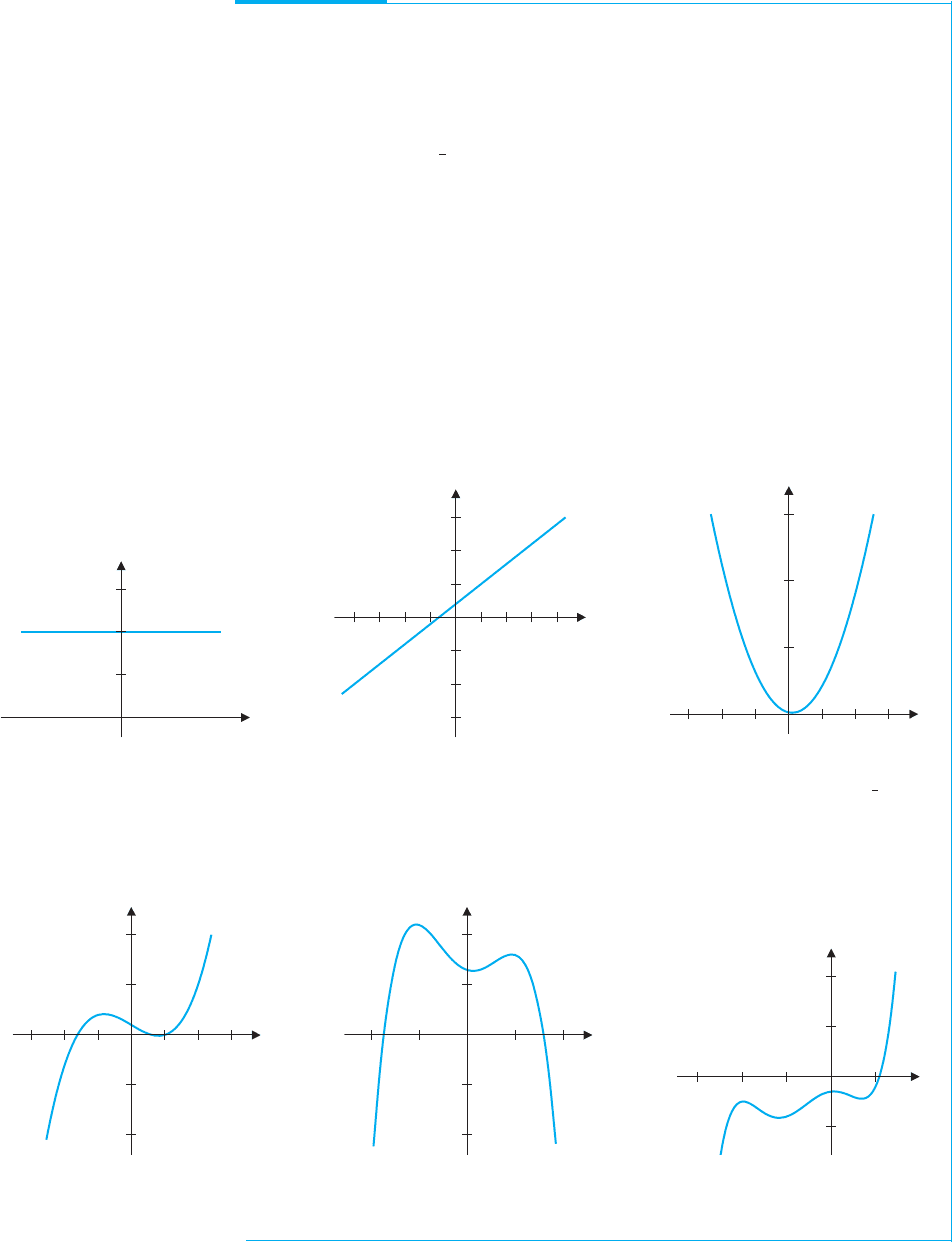
EXAMPLE 2.9 Sample Polynomials
The following are all examples of polynomials:
f (x) = 2 (polynomial of degree 0 or constant),
f (x) = 3x + 2 (polynomial of degree 1 or linear polynomial),
f (x) = 5x
2
− 2x +
2
3
(polynomial of degree 2 or quadratic polynomial),
f (x) = x
3
− 2x + 1 (polynomial of degree 3 or cubic polynomial),
f (x) =−6x
4
+ 12x
2
− 3x + 13 (polynomial of degree 4 or quartic polynomial)
and
f (x) = 2x
5
+6x
4
−8x
2
+x −3(polynomial of degree 5 or quintic polynomial).
We show graphs of these six functions in Figures 0.23a–0.23f.
y
x
1
3
y
x
4224
15
10
5
5
10
15
y
x
642246
40
80
120
FIGURE 0.23a
f (x) = 2
FIGURE 0.23b
f (x) = 3x + 2
FIGURE 0.23c
f (x) = 5x
2
− 2x +
2
3
y
x
321123
10
5
5
10
y
x
2112
20
10
10
20
y
x
1
3 2 1
10
10
20
FIGURE 0.23d
f (x) = x
3
− 2x + 1
FIGURE 0.23e
f (x) =−6x
4
+ 12x
2
− 3x + 13
FIGURE 0.23f
f (x) = 2x
5
+ 6x
4
− 8x
2
+ x − 3
P1: OSO/OVY P2: OSO/OVY QC: OSO/OVY T1: OSO
MHDQ256-Ch00 MHDQ256-Smith-v1.cls December 8, 2010 15:25
LT (Late Transcendental)
CONFIRMING PAGES
0-15 SECTION 0.2
..
Lines and Functions 15
DEFINITION 2.4
Any function that can be written in the form
f (x) =
p(x)
q(x)
,
where p and q are polynomials, is called a rational function.
Notice that since p and q are polynomials, they can both be defined for all x and so,
the rational function f (x) =
p(x)
q(x)
can be defined for all x for which q(x) = 0.
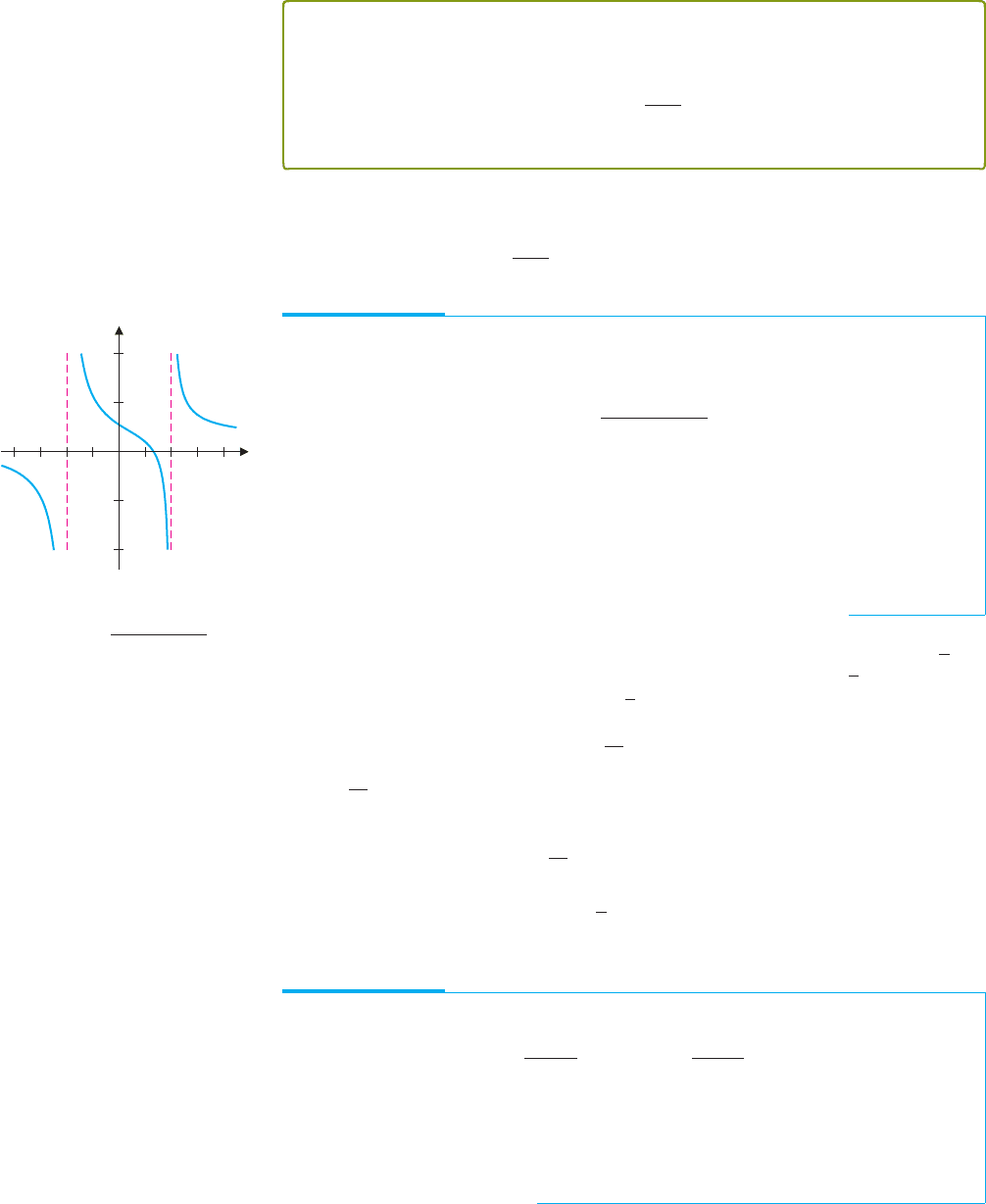
EXAMPLE 2.10 A Sample Rational Function
Find the domain of the function
f (x) =
x
2
+ 7x − 11
x
2
− 4
.
Solution Here, f is a rational function. We show a graph in Figure 0.24. Its domain
consists of those values of x for which the denominator is nonzero. Notice that
x
2
− 4 = (x −2)(x +2)
and so, the denominator is zero if and only if x =±2. This says that the domain of f is
{x ∈ R |x =±2}=(−∞, −2) ∪ (−2, 2) ∪(2, ∞).
y
x
1 313
10
5
5
10
FIGURE 0.24
f (x) =
x
2
+ 7x − 11
x
2
− 4
The square root function is defined in the usual way. When we write y =
√
x, we
mean that y is that number for which y
2
= x and y ≥ 0. In particular,
√
4 = 2. Be careful
not to write erroneous statements such as
√
4 =±2. In particular, be careful to write
√
x
2
=|x|.
Since
√
x
2
is asking for the nonnegative number whose square is x
2
, we are looking for
|x| and not x. We can say
√
x
2
= x, only for x ≥ 0.
Similarly, for any integer n ≥ 2, y =
n
√
x whenever y
n
= x, where for n even, x ≥ 0 and
y ≥ 0.
EXAMPLE 2.11 Finding the Domain of a Function Involving
a Square Root or a Cube Root
Find the domains of f (x) =
√
x
2
− 4 and g(x) =
3
√
x
2
− 4.
Solution Since even roots are defined only for nonnegative values, f (x) is defined
only for x
2
− 4 ≥ 0. Notice that this is equivalent to having x
2
≥ 4, which occurs when
x ≥ 2orx ≤−2. The domain of f is then (−∞, −2] ∪ [2, ∞). On the other hand, odd
roots are defined for both positive and negative values. Consequently, the domain of g is
the entire real line, (−∞, ∞).
Weoftenfindit usefultolabel interceptsandother significantpointson agraph.Finding
these points typically involves solving equations. A solution of the equation f (x) = 0is
called a zero of the function f or a root of the equation f (x) = 0. Notice that a zero of the
function f corresponds to an x-intercept of the graph of y = f (x).
P1: OSO/OVY P2: OSO/OVY QC: OSO/OVY T1: OSO
MHDQ256-Ch00 MHDQ256-Smith-v1.cls December 8, 2010 15:25
LT (Late Transcendental)
CONFIRMING PAGES
16 CHAPTER 0
..
Preliminaries 0-16
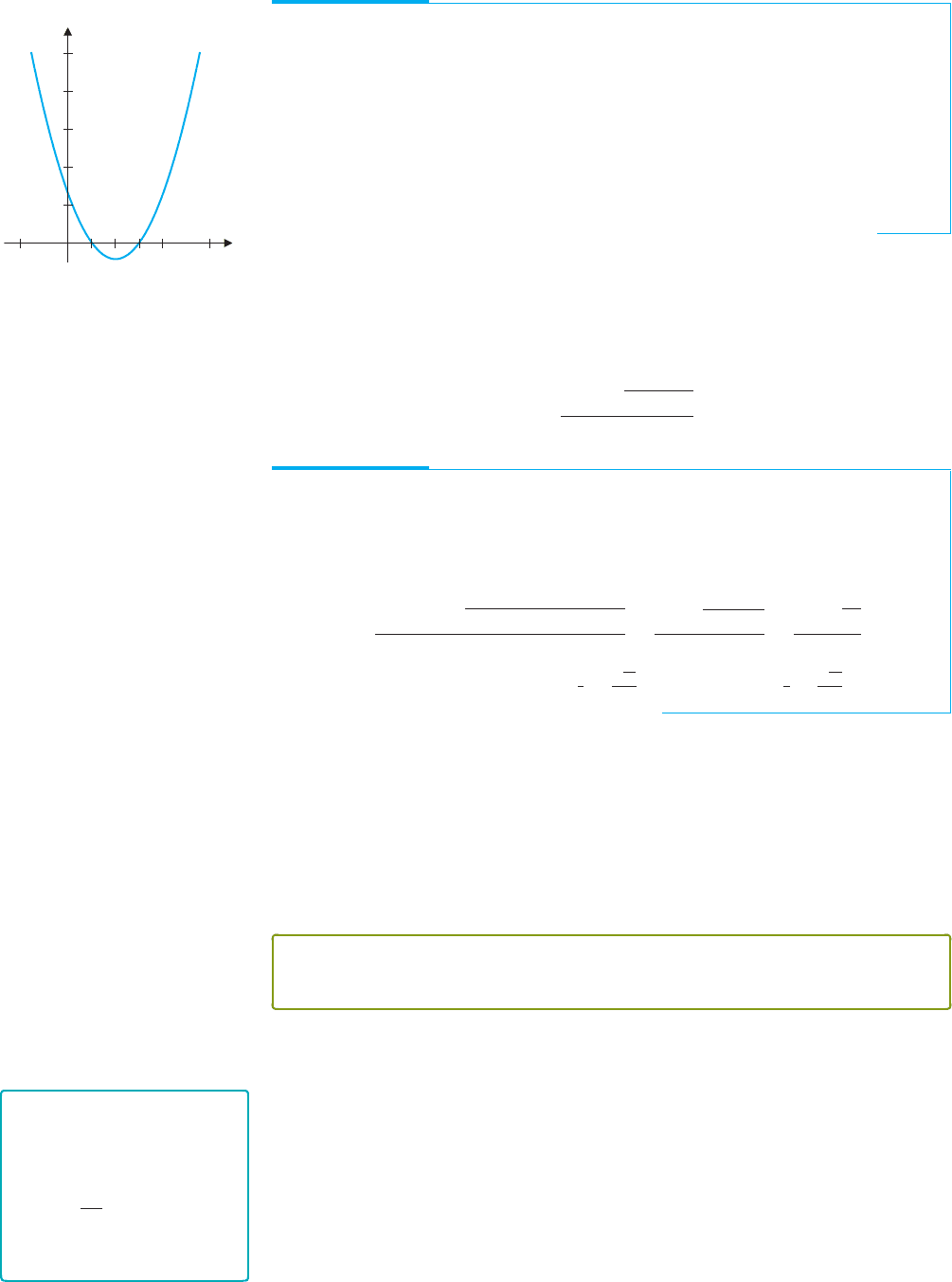
EXAMPLE 2.12 Finding Zeros by Factoring
Find all x- and y-intercepts of f (x) = x
2
− 4x + 3.
Solution To find the y-intercept, set x = 0 to obtain
y = 0 −0 +3 = 3.
To find the x-intercepts, solve the equation f (x) = 0. In this case, we can factor to get
f (x) = x
2
− 4x + 3 = (x −1)(x −3) = 0.
You can now read off the zeros: x = 1 and x = 3, as indicated in Figure 0.25.
y
x
2
4
6
8
10
321 4 62
FIGURE 0.25
y = x
2
− 4x + 3
Unfortunately, factoring is not always so easy. Of course, for the quadratic equation
ax
2
+ bx +c = 0
(for a = 0), the solution(s) are given by the familiar quadratic formula:
x =
−b ±
√
b
2
− 4ac
2a
.
EXAMPLE 2.13 Finding Zeros Using the Quadratic Formula
Find the zeros of f (x) = x
2
− 5x − 12.
Solution You probably won’t have much luck trying to factor this. However, from
the quadratic formula, we have
x =
−(−5) ±
(−5)
2
− 4 ·1 ·(−12)
2 · 1
=
5 ±
√
25 + 48
2
=
5 ±
√
73
2
.
So, the two solutions are given by x =
5
2
+
√
73
2
≈ 6.772 and x =
5
2
−
√
73
2
≈−1.772.
(No wonder you couldn’t factor the polynomial!)
Finding zeros of polynomials of degree higher than 2 and other functions is usually
trickier and is sometimes impossible. At the least, you can always find an approximation of
any zero(s) by using a graph to zoom in closer to the point(s) where the graph crosses the
x-axis, as we’ll illustrate shortly. A more basic question, though, is to determine how many
zeros a given function has. In general, there is no way to answer this question without the
use of calculus. For the case of polynomials, however, Theorem 2.2 (a consequence of the
Fundamental Theorem of Algebra) provides a clue.
THEOREM 2.2
A polynomial of degree n has at most n distinct zeros.
Notice that Theorem 2.2 does not say how many zeros a given polynomial has, but
rather, that the maximum number of distinct (i.e., different) zeros is the same as the degree.
A polynomial of degree n may have anywhere from 0 to n distinct real zeros. However,
polynomials of odd degree must have at least one real zero. For instance, for the case of a
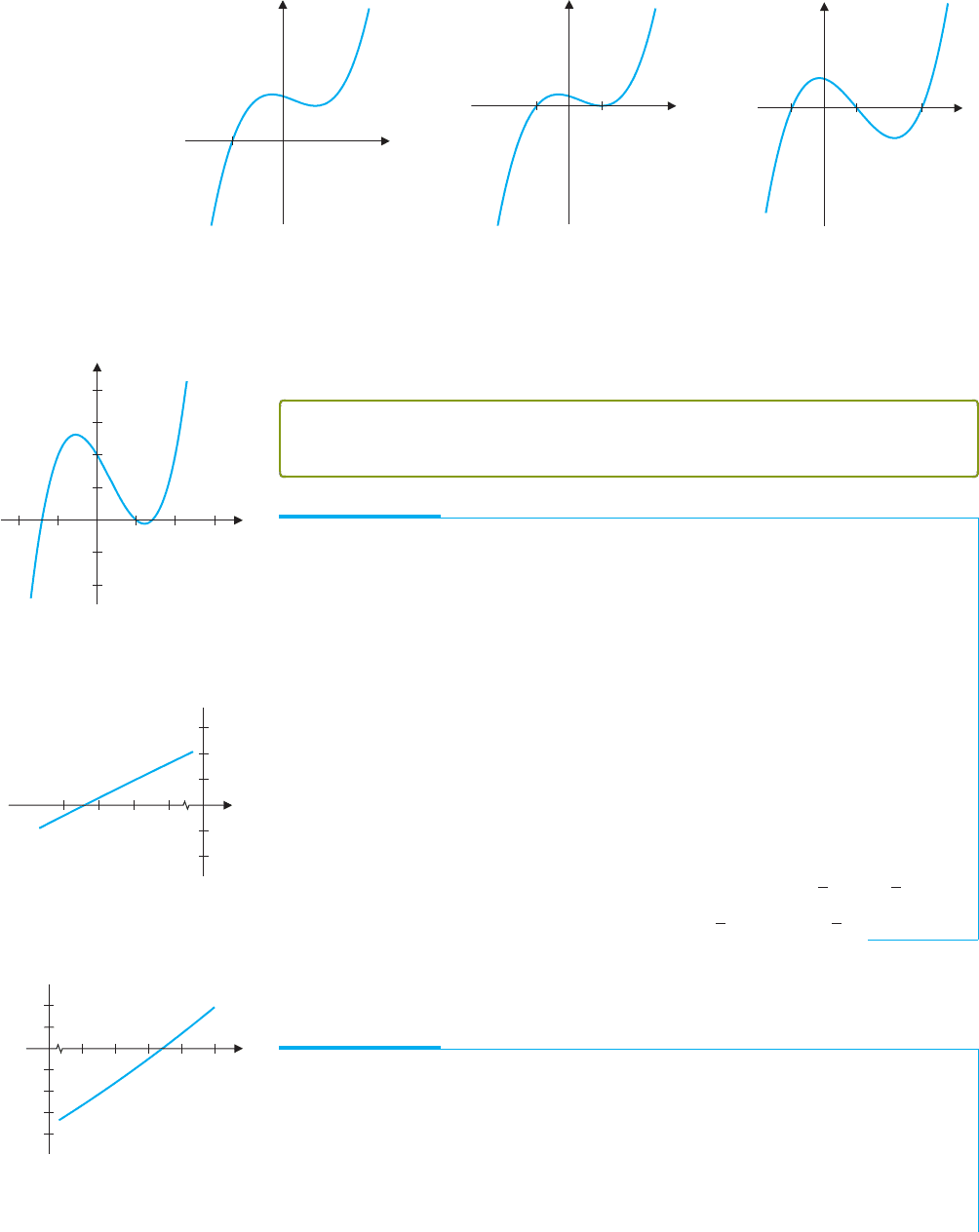
cubic polynomial, we have one of the three possibilities illustrated in Figures 0.26a, 0.26b
and 0.26c. These are the graphs of the functions
f (x) = x
3
− 2x
2
+ 3 = (x +1)(x
2
− 3x + 3),
g(x) = x
3
− x
2
− x +1 = (x +1)(x −1)
2
and h(x) = x
3
− 3x
2
− x +3 = (x +1)(x −1)(x −3),
REMARK 2.2
Polynomials may also have
complex zeros. For instance,
f (x) = x
2
+ 1 has only the
complex zeros x =±i, where i
is the imaginary number defined
by i =
√
−1. We confine our
attention in this text to real
zeros.
P1: OSO/OVY P2: OSO/OVY QC: OSO/OVY T1: OSO
MHDQ256-Ch00 MHDQ256-Smith-v1.cls December 8, 2010 15:25
LT (Late Transcendental)
CONFIRMING PAGES
0-17 SECTION 0.2
..
Lines and Functions 17
respectively. Note that you can see from the factored form where the zeros are (and how
many there are).
y
x
x
1
y
x
x
1
x
2
y
x
x
1
x
2
x
3
FIGURE 0.26a
One zero
FIGURE 0.26b
Two zeros
FIGURE 0.26c
Three zeros
Theorem 2.3 provides an important connection between factors and zeros of
polynomials.
THEOREM 2.3 (Factor Theorem)
For any polynomial function f, f (a) = 0 if and only if (x −a) is a factor of f (x).
y
x
2 3112
2
2
4
FIGURE 0.27a
y = x
3
− x
2
− 2x + 2
1.41 1.39
0.2
0.2
x
FIGURE 0.27b
Zoomed in on zero near
x =−1.4
1.40 1.42
0.02
0.04
0.02
x
FIGURE 0.27c
Zoomed in on zero near
x = 1.4
EXAMPLE 2.14 Finding the Zeros of a Cubic Polynomial
Find the zeros of f (x) = x
3
− x
2
− 2x + 2.
Solution By calculating f (1), you can see that one zero of this function is x = 1, but
how many other zeros are there? A graph of the function (see Figure 0.27a) shows that
there are two other zeros of f , one near x =−1.5 and one near x = 1.5. You can find
these zeros more precisely by using your graphing calculator or computer algebra
system to zoom in on the locations of these zeros (as shown in Figures 0.27b and 0.27c).
From these zoomed graphs, it is clear that the two remaining zeros of f are near
x = 1.41 and x =−1.41. You can make these estimates more precise by zooming in
even more closely. Most graphing calculators and computer algebra systems can also
find approximate zeros, using a built-in “solve” program. In Chapter 3, we present a
versatile method (called Newton’s method) for obtaining accurate approximations to
zeros. The only way to find the exact solutions is to factor the expression (using either
long division or synthetic division). Here, we have
f (x) = x
3
− x
2
− 2x + 2 = (x −1)(x
2
− 2) = (x −1)(x −
√
2)(x +
√
2),
from which you can see that the zeros are x = 1, x =
√
2 and x =−
√
2.
Recall that to find the points of intersection of two curves defined by y = f (x) and
y = g(x), we set f (x) = g(x) to find the x-coordinates of any points of intersection.
EXAMPLE 2.15 Finding the Intersections of a Line and a Parabola
Find the points of intersection of the parabola y = x
2
− x −5 and the line y = x + 3.
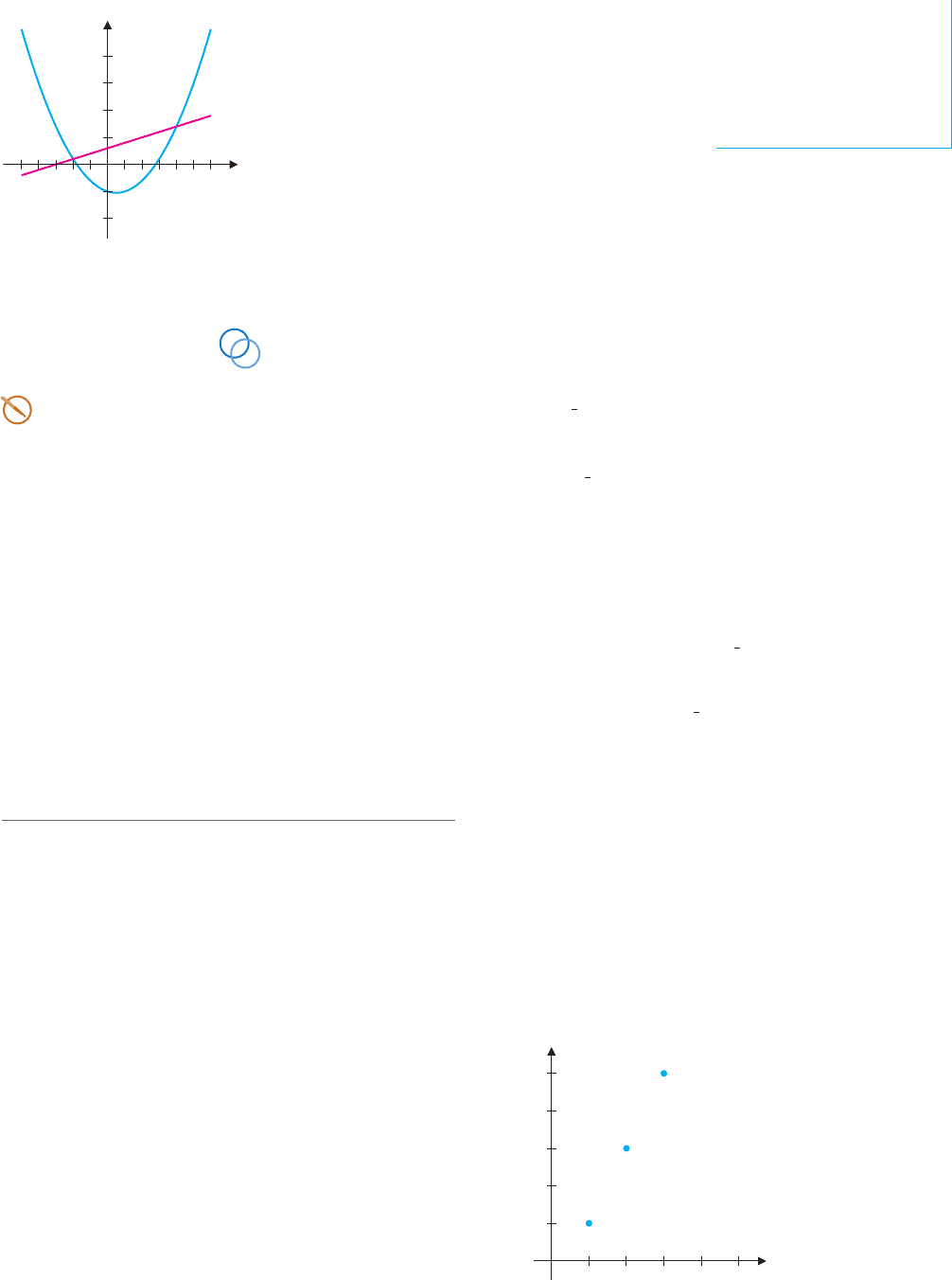
Solution A sketch of the two curves (see Figure 0.28 on the following page)
shows that there are two intersections, one near x =−2 and the other near x = 4.
To determine these precisely, we set the two functions equal and solve for x:
x
2
− x −5 = x + 3.
P1: OSO/OVY P2: OSO/OVY QC: OSO/OVY T1: OSO
MHDQ256-Ch00 MHDQ256-Smith-v1.cls December 8, 2010 15:25
LT (Late Transcendental)
CONFIRMING PAGES
18 CHAPTER 0
..
Preliminaries 0-18
Subtracting (x + 3) from both sides leaves us with
0 = x
2
− 2x − 8 = (x −4)(x +2).
This says that the solutions are exactly x =−2 and x = 4. We compute the
corresponding y-values from the equation of the line y = x + 3 (or the equation of
the parabola). The points of intersection are then (−2, 1) and (4, 7). Notice that these
are consistent with the intersections seen in Figure 0.28.
y
x
4624
10
10
20
FIGURE 0.28
y = x + 3 and y = x
2
− x − 5
Unfortunately, you won’t always be able to solve equations exactly, as we did in
examples 2.12–2.15. We explore some options for dealing with more difficult equations in
section 0.3.
EXERCISES 0.2
WRITING EXERCISES
1. If the slope of the line passing through points A and B equals
the slope of the line passing through points B and C, explain
why the points A, B and C are colinear.
2. If a graph fails the vertical line test, it is not the graph of a
function. Explain this result in terms of the definition of a
function.
3. You should not automatically write the equation of a line
in slope-intercept form. Compare the following forms of the
sameline: y = 2.4(x − 1.8) +0.4 and y = 2.4x − 3.92. Given
x = 1.8, which equation would you rather use to compute y?
How about if you are given x = 0? For x = 8, is there any ad-
vantage to one equation over the other? Can you quickly read
off the slope from either equation? Explain why neither form
of the equation is “better.”
4. Explain in terms of graphs (see Figures 0.26a–0.26c) why a
cubic polynomial must have at least one real zero.
In exercises 1–4, determine if the points are colinear.
1. (2, 1), (0, 2), (4, 0) 2. (3, 1), (4, 4), (5, 8)
3. (4, 1), (3, 2), (1, 3) 4. (1, 2), (2, 5), (4, 8)
............................................................
In exercises 5–10, find the slope of the line through the given
points.
5. (1, 2), (3, 6) 6. (1, 2), (3, 3)
7. (3, −6), (1, −1) 8. (1, −2), (−1, −3)
9. (0.3, −1.4), (−1.1, −0.4) 10. (1.2, 2.1), (3.1, 2.4)
............................................................
In exercises 11–16, find a second point on the line with slope m
and point P, graph the line and find an equation of the line.
11. m = 2, P = (1, 3)
12. m =−2, P = (1, 4)
13. m = 0, P = (−1, 1)
14. m =
1
2
, P = (2, 1)
15. m = 1.2, P = (2.3, 1.1)
16. m =−
1
4
, P = (−2, 1)
............................................................
In exercises 17–22, determine if the lines are parallel, perpen-
dicular, or neither.
17. y = 3(x − 1) +2 and y = 3(x + 4) −1
18. y = 2(x − 3) +1 and y = 4(x − 3) +1
19. y =−2(x + 1) −1 and y =
1
2
(x − 2) +3
20. y = 2x − 1 and y =−2x + 2
21. y = 3x + 1 and y =−
1
3
x + 2
22. x + 2y = 1 and 2x + 4y = 3
............................................................
In exercises 23–26, find an equation of a line through the given
point and (a) parallel to and (b) perpendicular to the given line.
23. y = 2(x + 1) −2at(2, 1) 24. y = 3(x − 2) +1at(0, 3)
25. y = 2x + 1at(3, 1) 26. y = 1at(0, −1)
............................................................
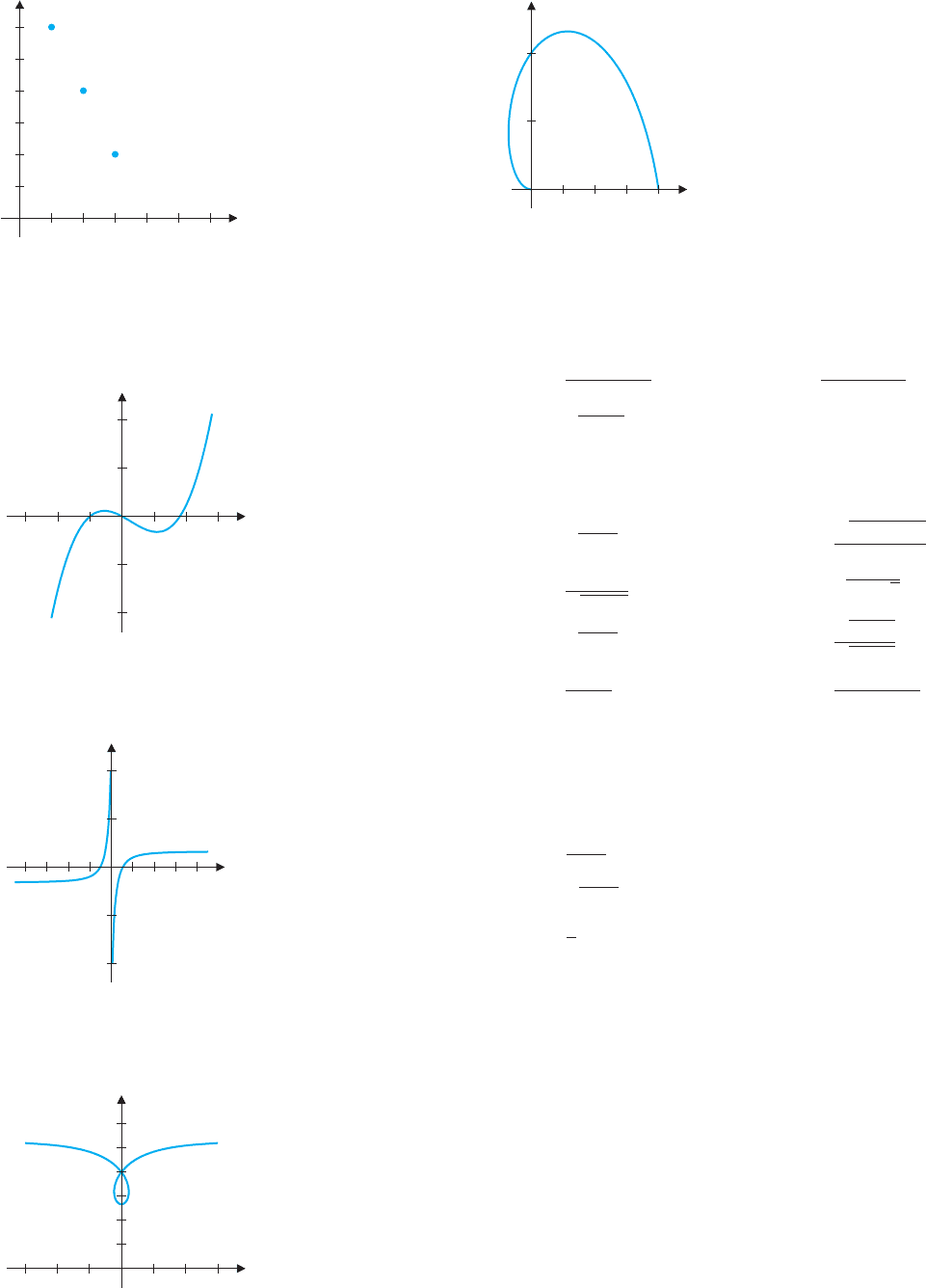
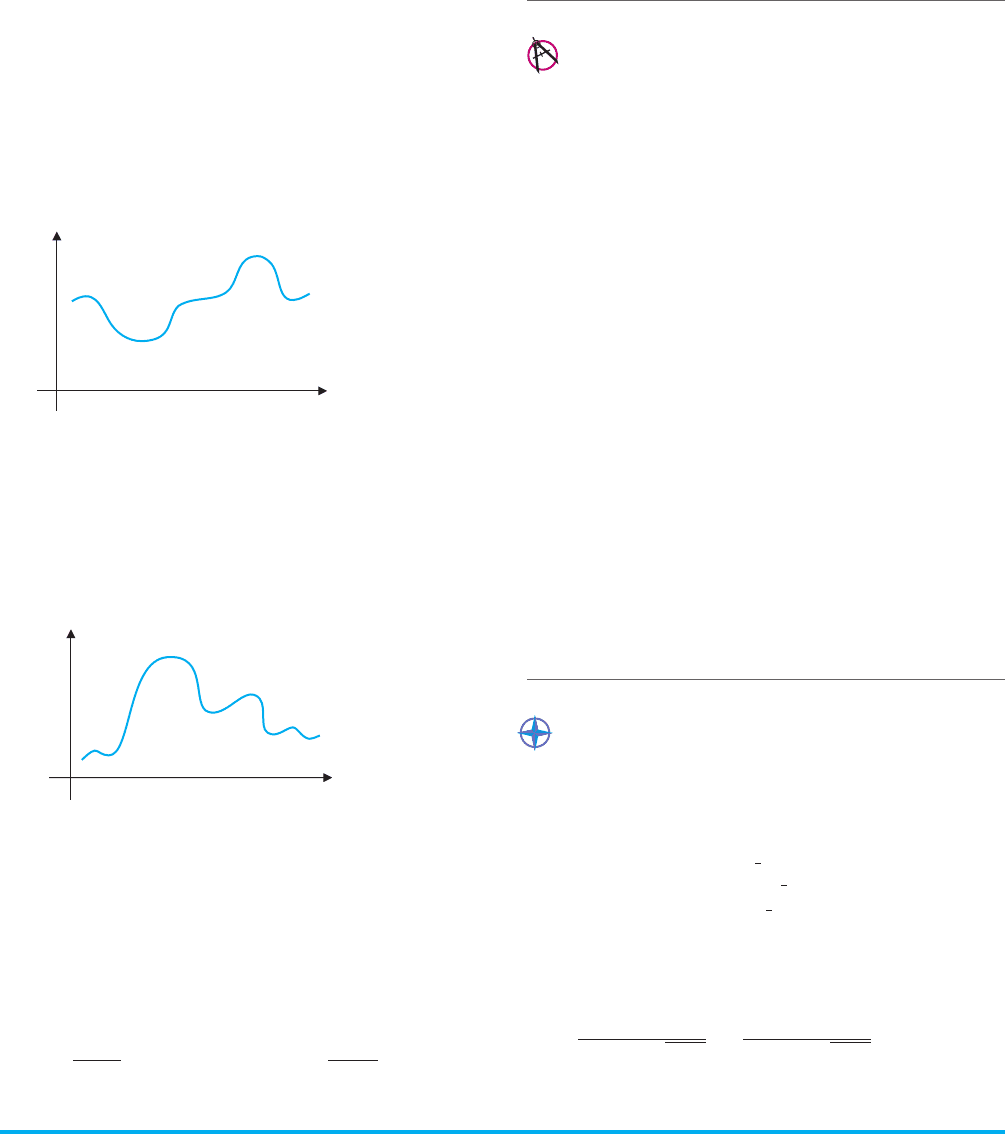
In exercises 27 and 28, find an equation of the line through the
given points and compute the y-coordinate of the point on the
line corresponding to x 4.
27.
y
x
2 3 4 51
1
2
3
4
5
P1: OSO/OVY P2: OSO/OVY QC: OSO/OVY T1: OSO
MHDQ256-Ch00 MHDQ256-Smith-v1.cls December 8, 2010 15:25
LT (Late Transcendental)
CONFIRMING PAGES
0-19 SECTION 0.2
..
Lines and Functions 19
28.
y
x
21 4356
2
3
1
4
5
6
............................................................
In exercises 29–32, use the verticalline test to determine whether
the curve is the graph of a function.
29.
y
x
2 323
10
5
5
10
30.
y
x
42
24
10
5
5
10
31.
y
x
321123
2
4
6
32.
y
x
21.510.5
0.5
1
............................................................
In exercises 33–38, identify the given function as polynomial,
rational, both or neither.
33. f (x) = x
3
− 4x + 1 34. f (x) = 3 −2x + x
4
35. f (x) =
x
2
+ 2x − 1
x + 1
36. f (x) =
x
3
+ 4x − 1
x
4
− 1
37. f (x) =
√
x
2
+ 1 38. f (x) = 2x − x
2/3
− 6
............................................................
In exercises 39–46, find the domain of the function.
39. f (x) =
√
x + 2 40. f (x) =
√
x
2
− x − 6
x − 5
41. f (x) =
1
√
3 − 2x
42. f (x) =
3
3 +
√
x
43. f (x) =
3
√
x − 1 44. f (x) =
√
x
2
− 4
√
9 − x
2
45. f (x) =
4
x
2
− 1
46. f (x) =
4x
x
2
+ 2x − 6
............................................................
In exercises 47–50, find the indicated function values.
47. f (x) = x
2
− x − 1; f (0), f (2), f (−3), f (1/2)
48. f (x) =
x + 1
x − 1
; f (0), f (2), f (−2), f (1/2)
49. f (x) =
√
x + 1; f (0), f (3), f (−1), f (1/2)
50. f (x) =
3
x
; f (1), f (10), f (100), f (1/3)
............................................................
In exercises 51–54, a brief description is given of a physi-
cal situation. For the indicated variable, state a reasonable
domain.
51. A parking deck is to be built; x = width of deck (in feet).
52. A parking deck is to be built on a 200
-by-200
lot; x = width
of deck (in feet).
53. A new candy bar is to be sold; x = number of candy bars sold
in the first month.
54. A new candy bar is to be sold; x = cost of candy bar
(in cents).
............................................................
P1: OSO/OVY P2: OSO/OVY QC: OSO/OVY T1: OSO
MHDQ256-Ch00 MHDQ256-Smith-v1.cls December 8, 2010 15:25
LT (Late Transcendental)
CONFIRMING PAGES
20 CHAPTER 0
..
Preliminaries 0-20
In exercises 55–58, discuss whether you think y would be a func-
tion of x.
55. y = grade you get on an exam, x = number of hours
you study
56. y = probability of getting lung cancer, x = number of
cigarettes smoked per day
57. y = a person’s weight, x = number of minutes exercising per
day
58. y = speed at which an object falls, x = weight of object
............................................................
59. Figure A shows the speed of a bicyclist as a function of time.
For the portions of this graph that are flat, what is happening
to the bicyclist’s speed? What is happening to the bicyclist’s
speed when the graph goes up? down? Identify the portions
of the graph that correspond to the bicyclist going uphill;
downhill.
Speed
Time
FIGURE A
Bicycle speed
60. Figure B showsthe populationof asmall countryas afunction
oftime.Duringthetime period shown,thecountryexperienced
two influxes of immigrants, a war and a plague. Identify these
important events.
Population
Time
FIGURE B
Population
............................................................
In exercises 61–66, find all intercepts of the graph of
y f (x).
61. y = x
2
− 2x − 8 62. y = x
2
+ 4x + 4
63. y = x
3
− 8 64. y = x
3
− 3x
2
+ 3x − 1
65. y =
x
2
− 4
x + 1
66. y =
2x − 1
x
2
− 4
............................................................
In exercises 67–74, factor and/or use the quadratic formula to
find all zeros of the given function.
67. f (x) = x
2
− 5x + 6 68. f (x) = x
2
+ x − 12
69. f (x) = x
2
− 4x + 2 70. f (x) = 2x
2
+ 4x − 1
71. f (x) = x
3
− 3x
2
+ 2x 72. f (x) = x
3
− 2x
2
− x + 2
73. f (x) = x
6
+ x
3
− 2 74. f (x) = x
3
+ x
2
− 4x − 4
APPLICATIONS
75. The boiling point of water (in degrees Fahrenheit) at ele-
vation h (in thousands of feet above sea level) is given by
B(h) =−1.8h + 212. Find h such that water boils at 98.6
◦
.
Why would this altitude be dangerous to humans?
76. The spin rate of a golf ball hit with a 9 iron has been measured
at 9100 rpm for a 120-compression ball and at 10,000 rpm
for a 60-compression ball. Most golfers use 90-compression
balls. If the spin rate is a linear function of compression, find
the spin rate for a 90-compression ball. Professional golfers
often use 100-compression balls. Estimate the spin rate of a
100-compression ball.
77. The chirping rate of a cricket depends on the temperature. A
species of tree cricket chirps 160 times per minute at 79
◦
F and
100 times per minute at 64
◦
F. Find a linear function relating
temperature to chirping rate.
78. When describing how to measure temperature by counting
cricket chirps, most guides suggest that you count the number
ofchirps in a 15-second time period. Useexercise77to explain
why this is a convenient period of time.
79. A person has played a computer game many times. The statis-
tics show that she has won 415 times and lost 120 times, and
the winning percentage is listed as 78%. How many times in a
row must she win to raise the reported winning percentage to
80%?
EXPLORATORY EXERCISES
1. Suppose you have a machine that will proportionally enlarge a
photograph. For example, it could enlarge a 4 ×6 photograph
to 8 ×12 by doubling the width and height. You could make
an 8 × 10 picture by cropping 1 inch off each side. Explain
howyou would enlargea 3
1
2
× 5 picture to an 8 ×10. A friend
returns from Scotland with a 3
1
2
× 5 picture showing the Loch
Ness monster in the outer
1
4
on the right. If you use your
procedure to make an 8×10 enlargement, does Nessie make
the cut?
2. Solve the equation |x −2|+|x − 3|=1. (Hint: It’s
an unusual solution, in that it’s more than just
a couple of numbers.) Then, solve the equation
x + 3 − 4
√
x − 1 +
x + 8 − 6
√
x − 1 = 1. (Hint: If you
make the correct substitution, you can use your solution to the
previous equation.)
P1: OSO/OVY P2: OSO/OVY QC: OSO/OVY T1: OSO
MHDQ256-Ch00 MHDQ256-Smith-v1.cls December 8, 2010 15:25
LT (Late Transcendental)
CONFIRMING PAGES
0-21 SECTION 0.3
..
Graphing Calculators and Computer Algebra Systems 21
0.3 GRAPHING CALCULATORS AND COMPUTER
ALGEBRA SYSTEMS
Therelationshipsbetween functionsand theirgraphsarecentraltopicsincalculus.Graphing
calculators and user-friendlycomputer software allowyou to explore these relationships for
a much wider variety of functions than you could with pencil and paper alone. This section
presents a general framework for using technology to explore the graphs of functions.
One of the goals of this section is for you to become more familiar with the graphs of
a number of functions. The best way to become familiar is through experience, by working
example after example.
EXAMPLE 3.1 Generating a Calculator Graph
Use your calculator or computer to sketch a graph of f (x) = 3x
2
− 1.
y
x
424 2
20
40
60
FIGURE 0.29a
y = 3x
2
− 1
y
x
2112
4
8
FIGURE 0.29b
y = 3x
2
− 1
Solution You should get an initial graph that looks something like that in
Figure 0.29a. This is simply a parabola opening upward. A graph is often used to search
for important points, such as x-intercepts, y-intercepts or peaks and troughs. In this
case, we could see these points better if we zoom in, that is, display a smaller range of x-
and y-values than the technology has initially chosen for us. The graph in Figure 0.29b
shows x-values from x =−2tox = 2 and y-values from y =−2toy = 10.
You can see more clearly in Figure 0.29b that the parabola bottoms out roughly at
the point (0, −1) and crosses the x-axis at approximately x =−0.5 and x = 0.5. Yo u
can make this more precise by doing some algebra. Recall that an x-intercept is a point
where y = 0or f (x) = 0. Solving 3x
2
− 1 = 0 gives 3x
2
= 1orx
2
=
1
3
, so that
x =±
1
3
≈±0.57735.
Before investigating other graphs, we should say a few words about what a computer-
or calculator-generated graph really is. Although we call them graphs, what the computer
actually does is light up some tiny screen elements called pixels. If the pixels are small
enough, the image appears to be a continuous curve or graph.
REMARK 3.1
By graphing window, we mean the rectangle defined by the range of x- and y-values
displayed. The graphing window chosen can dramatically affect the look of a graph.
Most calculators and computer drawing packages use one of the following two
schemes for defining the graphing window for a given function.
r
Fixed graphing window: Most calculators follow this method. Graphs are plotted
in a preselected range of x- and y-values, unless you specify otherwise. For
example, the Texas Instruments graphing calculators’ default graphing window
plots points in the rectangle defined by −10 ≤ x ≤ 10 and −10 ≤ y ≤ 10.
r
Automatic graphing window: Most computer drawing packages and some
calculators use this method. Graphs are plotted for a preselected range of x-values
and the computer calculates the range of y-values so that all of the calculated points
will fit in the window.
Get to know how your calculator or computer software operates and use it
routinely as you progress through this course. You should always be able to reproduce
the computer-generated graphs used in this text by adjusting your graphing window
appropriately.
Graphs are drawn to provide visual displays of the significant features of a function.
What qualifies as significant will vary from problem to problem, but often, the x- and
P1: OSO/OVY P2: OSO/OVY QC: OSO/OVY T1: OSO
MHDQ256-Ch00 MHDQ256-Smith-v1.cls December 8, 2010 15:25
LT (Late Transcendental)
CONFIRMING PAGES
22 CHAPTER 0
..
Preliminaries 0-22
y-intercepts and points known as extrema are of interest. The function value f (M)is
called a local maximum of the function f if f (M) ≥ f (x) for all x’s “nearby” x = M.
REMARK 3.2
To be precise, f (M) is a local
maximum of f if there exist
numbers a and b with
a < M < b such that
f (M) ≥ f (x) for all x
such that a < x < b.
Similarly,thefunctionvalue f (m)isalocalminimumofthefunction f if f (m) ≤ f (x)
for all x’s “nearby” x = m. A local extremum is a function value that is either a local
maximum or local minimum. Whenever possible, you should produce graphs that show all
intercepts and extrema (the plural of extremum).
y
x
y a
1
x a
0
FIGURE 0.30a
Line, a
1
< 0
y
x
y a
1
x a
0
FIGURE 0.30b
Line, a
1
> 0
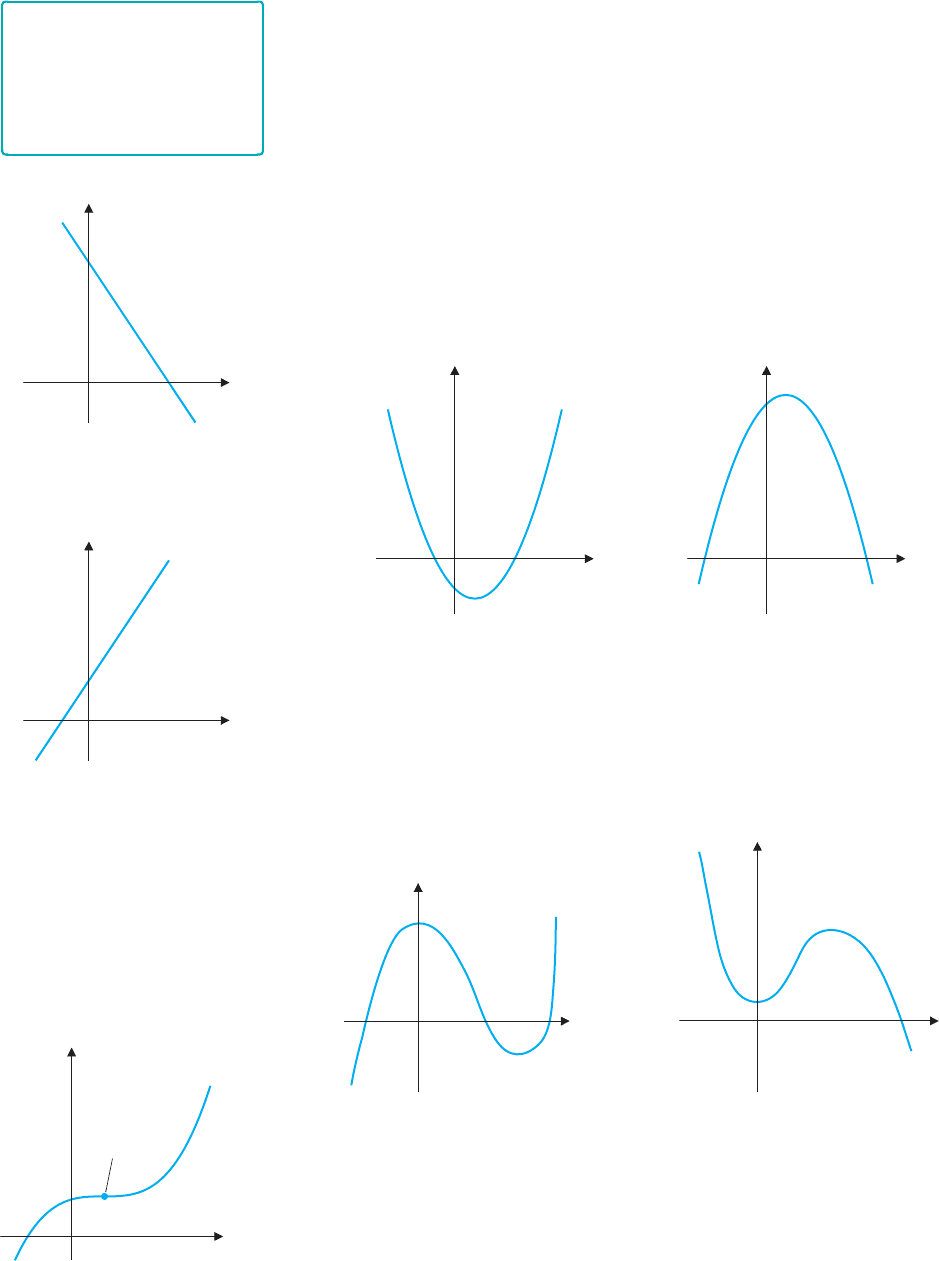
In the exercises, you will be asked to graph a variety of functions and discuss the
shapes of the graphs of polynomials of different degrees. Having some knowledge of the
generalshapeswill help you decide whether you havefound an acceptable graph. To get you
started, we now summarize the different shapes of linear, quadratic and cubic polynomials.
Of course, the graphs of linear functions [ f (x) = a
1
x +a
0
] are simply straight lines of
slope a
1
. Two possibilities are shown in Figures 0.30a and 0.30b.
The graphs of quadratic polynomials [ f (x) = a
2
x
2
+ a
1
x +a
0
; a
2
= 0] are parabolas.
The parabola opens upward if a
2
> 0 and opens downward if a
2
< 0. We show typical
parabolas in Figures 0.31a and 0.31b.
y
x
y a
2
x
2
a
1
x a
0
y
x
y a
2
x
2
a
1
x a
0
FIGURE 0.31a
Parabola, a
2
> 0
FIGURE 0.31b
Parabola, a
2
< 0
Thegraphsofcubic functions[ f (x) = a
3
x
3
+ a
2
x
2
+ a
1
x +a
0
;a
3
= 0]aresomewhat
S-shaped. Reading from left to right, the function begins negative and ends positive
if a
3
> 0, and begins positive and ends negative if a
3
< 0, as indicated in Figures 0.32a
and 0.32b, respectively.
y
x
y a
3
x
3
a
2
x
2
a
1
x a
0
y
x
y a
3
x
3
a
2
x
2
a
1
x a
0
FIGURE 0.32a
Cubic: one max, min, a
3
> 0
FIGURE 0.32b
Cubic: one max, min, a
3
< 0
Some cubics have one local maximum and one local minimum, as do those in Fig-
ures 0.32a and 0.32b. Many curves (including all cubics) have what’s called an inflection
point, where the curvechanges its shape (from being bent upward, to being bent downward,
or vice versa), as indicated in Figures 0.33a and 0.33b.
y
x
y a
3
x
3
a
2
x
2
a
1
x a
0
Inflection
point
FIGURE 0.33a
Cubic: no max or min, a
3
> 0
You can already use your knowledge of the general shapes of certain functions to see
how to adjust the graphing window, as in example 3.2.