
Smith R., Minton R. Calculus
Подождите немного. Документ загружается.

P1: OSO/OVY P2: OSO/OVY QC: OSO/OVY T1: OSO
MHDQ256-Ch00 MHDQ256-Smith-v1.cls December 8, 2010 15:25
LT (Late Transcendental)
CONFIRMING PAGES
0-33 SECTION 0.4
..
Trigonometric Functions 33
EXAMPLE 4.6 Writing Combinations of Sines and Cosines as a Single
Sine Term
Prove that 4sin x + 3cos x = 5sin(x +β) for some constant β and estimate the value
of β.
Solution Using equation (4.1), we have
4sin x + 3 cos x = 5sin(x + β)
= 5 sin x cosβ + 5sinβ cos x,
if 5cos β = 4 and 5sinβ = 3.
This will occur if we can choose a value of β so that cosβ =
4
5
and sinβ =
3
5
.By
the Pythagorean Theorem, this is possible only if sin
2
β + cos
2
β = 1. In this case, we
have
sin
2
β + cos
2
β =
3
5
2
+
4
5
2
=
9
25
+
16
25
=
25
25
= 1,
as desired. For the moment, the only way to estimate β is by trial and error. Using your
calculator or computer, you should find that one solution is β ≈ 0.6435 radians (about
36.9 degrees).
We next explore adding functions of different periods (one of the principles behind
music synthesizers).
EXAMPLE 4.7 Combinations of Sines and Cosines of Different Periods
Graph (a) f (x) = cos3x + sin4x and (b) g(x) = cosπ x + sin 4x and describe each
graph. Determine the period if the function is periodic.
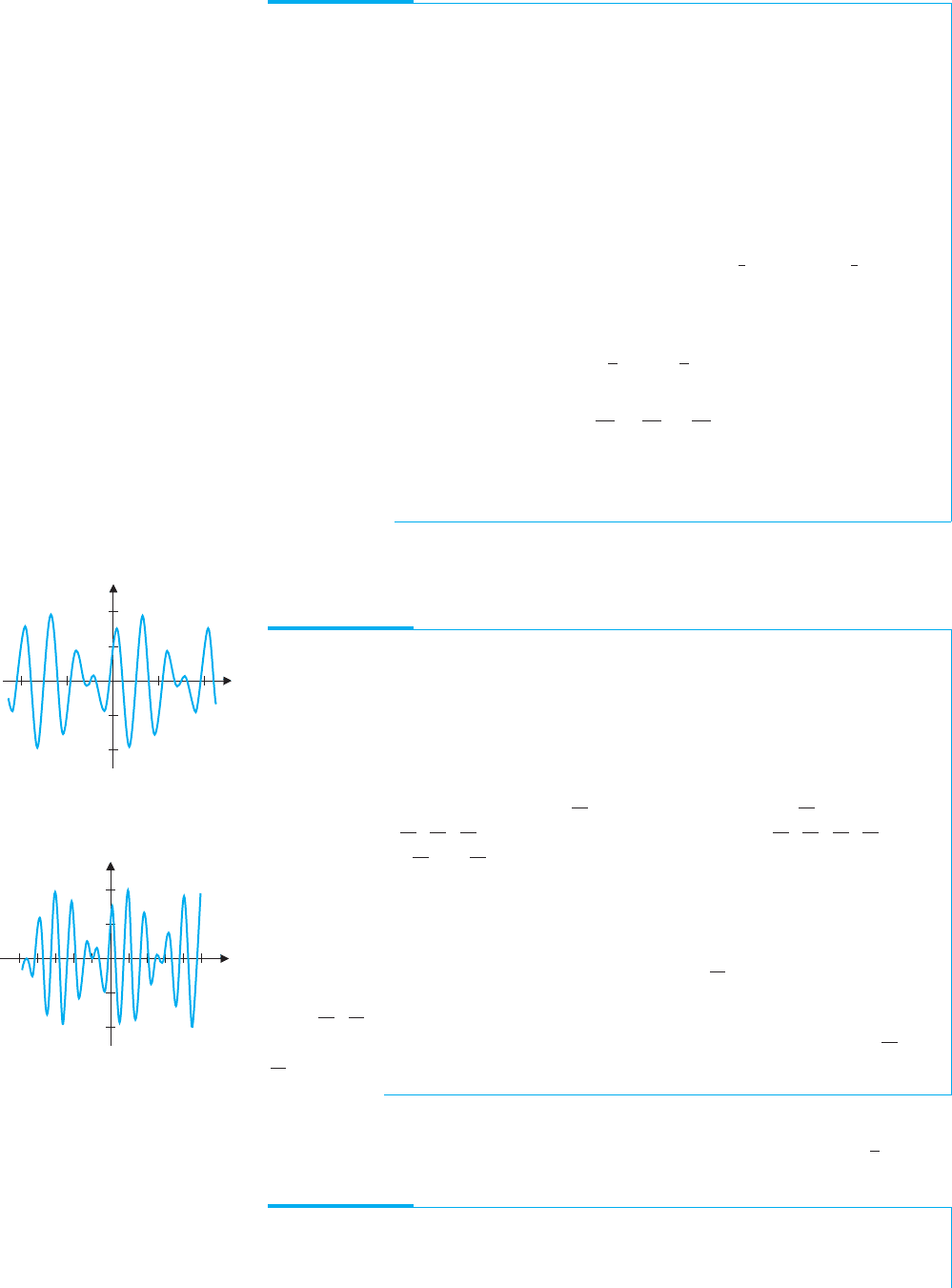
Solution (a) We give a graph of y = f (x) in Figure 0.48a. This is certainly more
complicated than the usual sine or cosine graph, but you should be able to identify a
repetition with a period of about 6 (which is close to 2π). To determine the actual
period, note that the period of cos3x is
2π
3
and the period of sin4x is
2π
4
. This says that
cos3x repeats at
2π
3
,
4π
3
,
6π
3
and so on. Similarly, sin4x repeats at
2π
4
,
4π
4
,
6π
4
,
8π
4
and so
on. Note that both
6π
3
and
8π
4
equal 2π. Since both terms repeat every 2π units, the
function f has a period of 2π.
(b) The graph of g is even more complicated, as you can see in Figure 0.48b. In the
graphing window shown (−10 ≤ x ≤ 10 and −2 ≤ y ≤ 2), this does not appear to be a
periodic function, although it’s not completely different from the graph of f. To try to
find a period, you should note that cosπ x has a period of
2π
π
= 2 and so repeats at
intervals of width 2, 4, 6 and so on. On the other hand, sin4x repeats at intervals of
width
2π
4
,
4π
4
and so on. The function is periodic if and only if there are numbers
common to both lists. Since 2, 4, 6,...are all rational numbers and the numbers
2π
4
,
4π
4
,...are all irrational, there can’t be any numbers in both lists. We conclude that g is
not periodic.
y
⫺2
⫺1
2
1
p 2p⫺2p ⫺p
x
FIGURE 0.48a
y = cos 3x + sin4x
y
⫺2
⫺1
2
1
10⫺10
x
FIGURE 0.48b
y = cos π x + sin 4x
In many applications, we need to calculate the length of one side of a right triangle
using the length of another side and an acute angle (i.e., an angle between 0 and
π
2
radians).
We can do this rather easily, as in example 4.8.
EXAMPLE 4.8 Finding the Height of a Tower
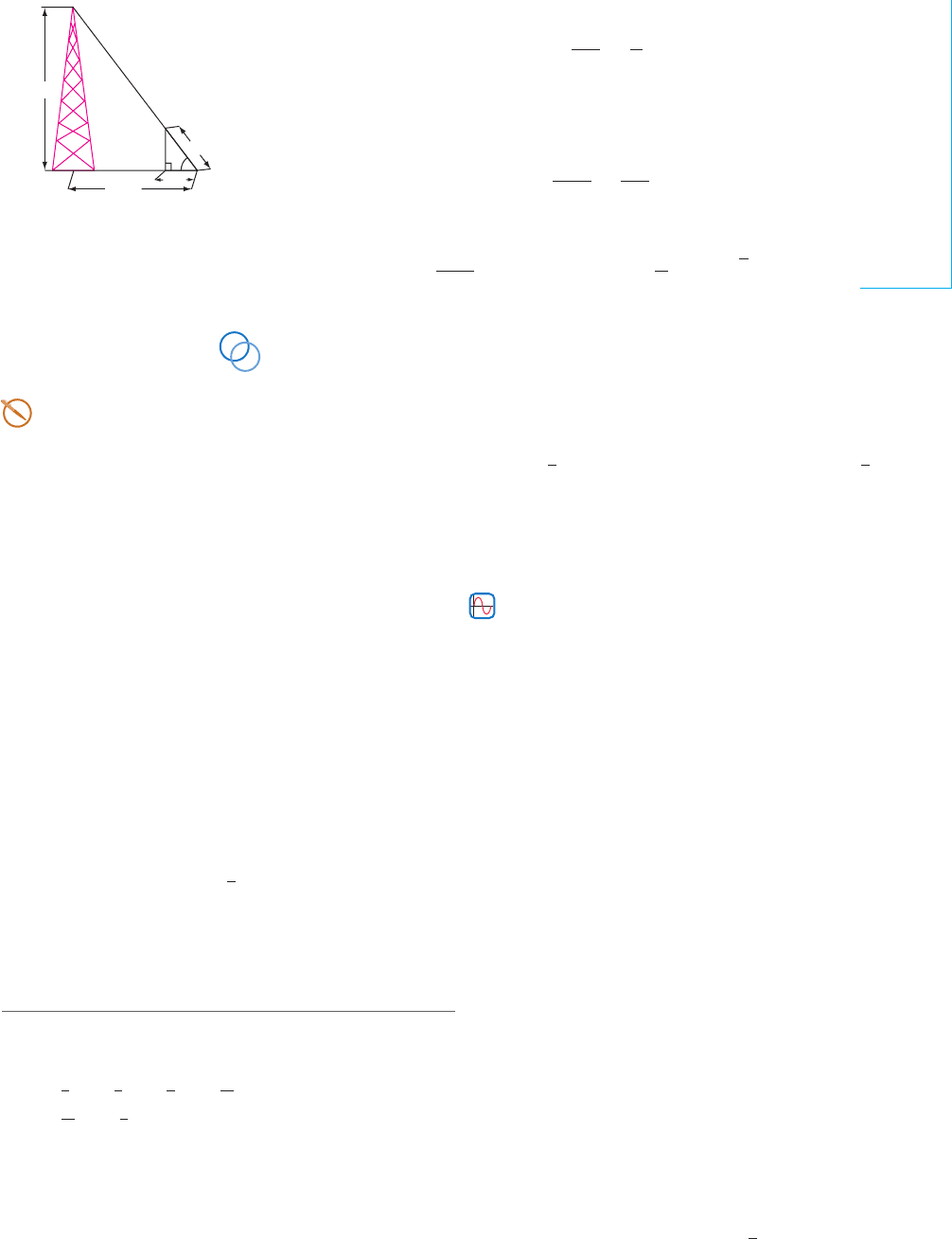
A person 100 feet from the base of a radio tower measures an angle of 60
◦
from the
ground to the top of the tower. (See Figure 0.49.) Find the height of the tower.
P1: OSO/OVY P2: OSO/OVY QC: OSO/OVY T1: OSO
MHDQ256-Ch00 MHDQ256-Smith-v1.cls December 8, 2010 15:25
LT (Late Transcendental)
CONFIRMING PAGES
34 CHAPTER 0
..
Preliminaries 0-34
Solution First, we convert 60
◦
to radians:
60
◦
= 60
π
180
=
π
3
radians.
We are given that the base of the triangle in Figure 0.49 is 100 feet. We must now
compute the height of the tower h. Using the similar triangles indicated in Figure 0.49,
we have that
sinθ
cosθ
=
h
100
,
so that the height of the tower is
h = 100
sinθ
cosθ
= 100tanθ = 100tan
π
3
= 100
√
3 ≈ 173feet.
h
sin u
l
100 ft
cos u
u
FIGURE 0.49
Height of a tower
EXERCISES 0.4
WRITING EXERCISES
1. Manystudentsarecomfortableusingdegreestomeasureangles
and don’t understand why they must learn radian measures. As
discussed in the text, radians directly measure distance along
theunitcircle.Distanceisanimportantaspectof manyapplica-
tions.In addition, we will see later thatmanycalculus formulas
are simpler in radians form than in degrees. Aside from famil-
iarity, discuss any and all advantages of degrees over radians.
On balance, which is better?
2. A student graphs f (x) = cos x on a graphing calculator and
gets what appears to be a straight line at height y = 1 in-
stead of the usual cosine curve. Upon investigation, you dis-
cover that thecalculator has graphingwindow −10 ≤ x ≤ 10,
−10 ≤ y ≤ 10 and is in degrees mode. Explain what went
wrong and how to correct it.
3. In example 4.3, f (x) = 4cos 3x has period 2π/3 and
g(x) = 2 sin (x/3) has period 6π. Explain why the sum
h(x) = 4 cos 3x + 2 sin (x/3) has period 6π.
4. The trigonometric functions can be defined in terms of the
unit circle (as done in the text) or in terms of right triangles
for angles between 0 and
π
2
radians. In calculus and most
scientific applications, the trigonometric functions are used to
model periodic phenomena (quantities that repeat). Given that
we want to emphasize the periodic nature of the functions,
explain why we would prefer the circular definitions to the
triangular definitions.
In exercises 1 and 2, convert the given radians measure to
degrees.
1. (a)
π
4
(b)
π
3
(c)
π
6
(d)
4π
3
2. (a)
3π
5
(b)
π
7
(c) 2 (d) 3
............................................................
In exercises 3 and 4, convert the given degrees measure to
radians.
3. (a) 180
◦
(b) 270
◦
(c) 120
◦
(d) 30
◦
4. (a) 40
◦
(b) 80
◦
(c) 450
◦
(d) 390
◦
............................................................
In exercises 5–14, find all solutions of the given equation.
5. 2cos x − 1 = 0 6. 2sin x + 1 = 0
7.
√
2cos x − 1 = 0 8. 2sin x −
√
3 = 0
9. sin
2
x − 4 sin x + 3 = 0 10. sin
2
x − 2 sin x − 3 = 0
11. sin
2
x + cos x −1 = 0 12. sin2x −cos x = 0
13. cos
2
x + cos x = 0 14. sin
2
x − sin x = 0
............................................................
In exercises 15–24, sketch a graph of the function.
15. f (x) = sin3x 16. f (x) = cos3x
17. f (x) = tan2x 18. f (x) = sec3x
19. f (x) = 3cos (x − π/2) 20. f (x) = 4 cos(x +π )
21. f (x) = sin2x − 2cos2x 22. f (x) = cos3x − sin 3x
23. f (x) = sinx sin 12x 24. f (x) = sinx cos 12x
............................................................
Inexercises25–32, identify the amplitude, periodand frequency.
25. f (x) = 3sin 2x 26. f (x) = 2cos 3x
27. f (x) = 5cos 3x 28. f (x) = 3sin 5x
29. f (x) = 3cos (2x − π/2) 30. f (x) = 4sin (3x + π)
31. f (x) =−4 sin x 32. f (x) =−2 cos3x
............................................................
In exercises 33–36, prove that the given trigonometric identity
is true.
33. sin(α −β) = sinα cosβ −sin β cosα
34. cos(α −β) = cosα cosβ +sin α sinβ
35. (a) cos (2θ ) = 2 cos
2
θ −1 (b) cos(2θ) = 1 −2 sin
2
θ
36. (a) sec
2
θ = tan
2
θ +1 (b) csc
2
θ = cot
2
θ +1
............................................................
37. Prove that, for some constant β,
4cos x − 3sin x = 5 cos (x + β).
Then, estimate the value of β.
38. Prove that, for some constant β,
2sin x + cos x =
√
5sin(x +β).
Then, estimate the value of β.
P1: OSO/OVY P2: OSO/OVY QC: OSO/OVY T1: OSO
MHDQ256-Ch00 MHDQ256-Smith-v1.cls December 8, 2010 15:25
LT (Late Transcendental)
CONFIRMING PAGES
0-35 SECTION 0.4
..
Trigonometric Functions 35
In exercises 39–42, determine whether the function is periodic.
If it is periodic, find the smallest (fundamental) period.
39. f (x) = cos2x + 3 sin π x
40. f (x) = sin x − cos
√
2x
41. f (x) = sin2x − cos 5x
42. f (x) = cos3x − sin 7x
............................................................
In exercises 43–46, use the range forθ to determine the indicated
function value.
43. sinθ =
1
3
, 0 ≤ θ ≤
π
2
; find cosθ.
44. cosθ =
4
5
, 0 ≤ θ ≤
π
2
; find sinθ.
45. sinθ =
1
2
,
π
2
≤ θ ≤ π; find cosθ.
46. sinθ =
1
2
,
π
2
≤ θ ≤ π; find tanθ.
............................................................
In exercises 47–50, use a graphing calculator or computer to
determine the number of solutions of each equation, and nu-
merically estimate the solutions (x is in radians).
47. 3sin x = x − 1 48. 3sin x = x
49. cos x = x
2
− 2 50. sin x = x
2
APPLICATIONS
51. A person sitting 2 miles from a rocket launch site measures
20
◦
up to the current location of the rocket. How high up is the
rocket?
52. A person who is 6 feet tall stands4 feet fromthe base ofa light
pole and casts a 2-foot-long shadow. Howtall is the light pole?
53. A surveyor stands 80 feet from the base of a building and
measures an angle of 50
◦
to the top of the steeple on top of
the building. The surveyor figures that the center of the steeple
lies 20 feet inside the front of the structure. Find the distance
from the ground to the top of the steeple.
54. Suppose that the surveyor of exercise 53 estimates that the
center of the steeple lies between 20
and 21
inside the front
of the structure. Determine how much the extra foot would
change the calculation of the height of the building.
55. In an AC circuit, the voltage is given by v(t) = v
p
sin(2π ft),
where v
p
is the peak voltage and f is the frequency in Hz. A
voltmeteractually measuresan average(calledthe root-mean-
square) voltage, equal to v
p
/
√
2. If the voltage has amplitude
170 and period π/30, find the frequency and meter voltage.
56. An old-style LP record player rotates records at 33
1
3
rpm (rev-
olutions per minute). What is the period (in minutes) of the
rotation? What is the period for a 45-rpm record?
57. Suppose that the ticket sales of an airline (in thousands of
dollars) is given by s(t) = 110 +2t + 15sin
1
6
πt
, where t
is measured in months. What real-world phenomenon might
cause the fluctuation in ticket sales modeled by the sine term?
Based on your answer, what month corresponds to t = 0?
Disregarding seasonal fluctuations, by what amount is the
airline’s sales increasing annually?
58. Piano tuners sometimes startby striking atuning fork andthen
the corresponding piano key. If the tuning fork and piano
note each have frequency 8, then the resulting sound is
sin8t + sin8t. Graph this. If the piano is slightly out-of-
tune at frequency 8.1, the resulting sound is sin8t + sin8.1t.
Graph this and explain how the piano tuner can hear the small
difference in frequency.
59. Many graphing calculators and computers will “graph” in-
equalities by shading in all points (x, y) for which the in-
equality is true. If you have access to this capability, graph the
inequality sin x < cos y.
60. Calculator and computer graphics can be inaccurate. Using
an initial graphing window of −1 ≤ x ≤ 1 and −1 ≤ y ≤ 1,
graph f (x) =
tan x − x
x
3
. Describe the behavior of the graph
near x = 0. Zoom in closer and closer to x = 0, using a win-
dow with −0.001 ≤ x ≤ 0.001, then −0.0001 ≤ x ≤ 0.0001,
then −0.00001 ≤ x ≤ 0.00001 and so on, until the behavior
near x = 0 appears to be different. We don’t want to leave you
hanging: the initial graph gives you good information and the
tightly zoomed graphs are inaccurate due to the computer’s
inability to compute tan x exactly.
EXPLORATORY EXERCISES
1. In his book and video series The Ring of Truth, physicist Philip
Morrison performed an experiment to estimate the circumfer-
ence of the Earth. In Nebraska, he measured the angle to a
bright star in the sky, then drove 370 miles due south into
Kansas and measured the new angle to the star. Some geome-
try shows that the difference in angles, about 5.02
◦
, equals the
angle from the center of the Earth to the two locations in Ne-
braska and Kansas. If the Earth is perfectly spherical (it’s not)
and the circumference of the portion of the circle measured out
by 5.02
◦
is 370 miles, estimate the circumference of the Earth.
This experiment was based on a similar experiment by the an-
cient Greek scientist Eratosthenes. The ancient Greeks and the
Spaniards of Columbus’ day knew that the Earth was round;
they just disagreed about the circumference. Columbus argued
for a figure about half of the actual value, since a ship couldn’t
survive on the water long enough to navigate the true distance.
2. Computer graphics can be misleading. This exercise works
best using a “disconnected” graph (individual dots, not con-
nected). Graph y = sin x
2
using a graphing window for which
each pixel represents a step of 0.1 in the x-ory-direction.
You should get the impression of a sine wave that oscillates
more and more rapidly as you move to the left and right. Next,
change the graphing window so that the middle of the original
screen (probably x = 0) is at the far left of the new screen.
You will likely see what appears to be a random jumble of
dots. Continue to change the graphing window by increasing
the x-values. Describe the patterns or lack of patterns that you
see. You should find one pattern that looks like two rows of
dots across the top and bottom of the screen; another pattern
looks like the original sine wave. For each pattern that you
find, pick adjacent points with x-coordinates a and b. Then
change the graphing window so that a ≤ x ≤ b and find the
portion of the graph that is missing. Remember that, whether
the points are connected or not, computer graphs always leave
out part of the graph; it is part of your job to know whether or
not the missing part is important.

P1: OSO/OVY P2: OSO/OVY QC: OSO/OVY T1: OSO
MHDQ256-Ch00 MHDQ256-Smith-v1.cls December 8, 2010 15:25
LT (Late Transcendental)
CONFIRMING PAGES
36 CHAPTER 0
..
Preliminaries 0-36
0.5 TRANSFORMATIONS OF FUNCTIONS
You are now familiar with a number of functions, including polynomials, rational functions
and trigonometric functions. One important goal of this course is to more fully understand
the properties of these functions. To a large extent, you will build your understanding by
examining a few key properties of functions.
We expand on our list of functions by combining them. We begin in a straightforward
fashion with Definition 5.1.
DEFINITION 5.1
Suppose that f and g are functions with domains D
1
and D
2
, respectively. The
functions f + g, f − g and f · g are defined by
( f + g)(x) = f (x) + g(x),
( f − g)(x) = f (x) − g(x)
and
( f · g)(x) = f (x) · g(x),
for all x in D
1
∩ D
2
(i.e., x ∈ D
1
, and x ∈ D
2
). The function
f
g
is defined by
f
g
(x) =
f (x)
g(x)
,
for all x in D
1
∩ D
2
such that g(x) = 0.
In example 5.1, we examine various combinations of several simple functions.
EXAMPLE 5.1 Combinations of Functions
If f (x) = x − 3 and g(x) =
√
x −1, determine the functions f + g, 3 f − g and
f
g
,
stating the domains of each.
Solution First, note that the domain of f is the entire real line and the domain of g is
the set of all x ≥ 1. Now,
( f + g)(x) = x − 3 +
√
x −1
and (3 f − g)(x) = 3(x −3) −
√
x −1 = 3x − 9 −
√
x −1.
Notice that the domain of both ( f + g) and (3 f − g)is{x ∈ R | x ≥ 1}.For
f
g
(x) =
f (x)
g(x)
=
x −3
√
x −1
,
the domain is {x ∈ R | x > 1}, where we have added the restriction x = 1toavoid
dividing by 0.
Definition 5.1 and example 5.1 show us how to do arithmetic with functions. An
operation on functions that does not directly correspond to arithmetic is the composition of
two functions.
DEFINITION 5.2
The composition of functions f and g, written f ◦g, is defined by
( f ◦g)(x) = f (g(x)),
for all x such that x is in the domain of g and g(x) is in the domain of f .
P1: OSO/OVY P2: OSO/OVY QC: OSO/OVY T1: OSO
MHDQ256-Ch00 MHDQ256-Smith-v1.cls December 8, 2010 15:25
LT (Late Transcendental)
CONFIRMING PAGES
0-37 SECTION 0.5
..
Transformations of Functions 37
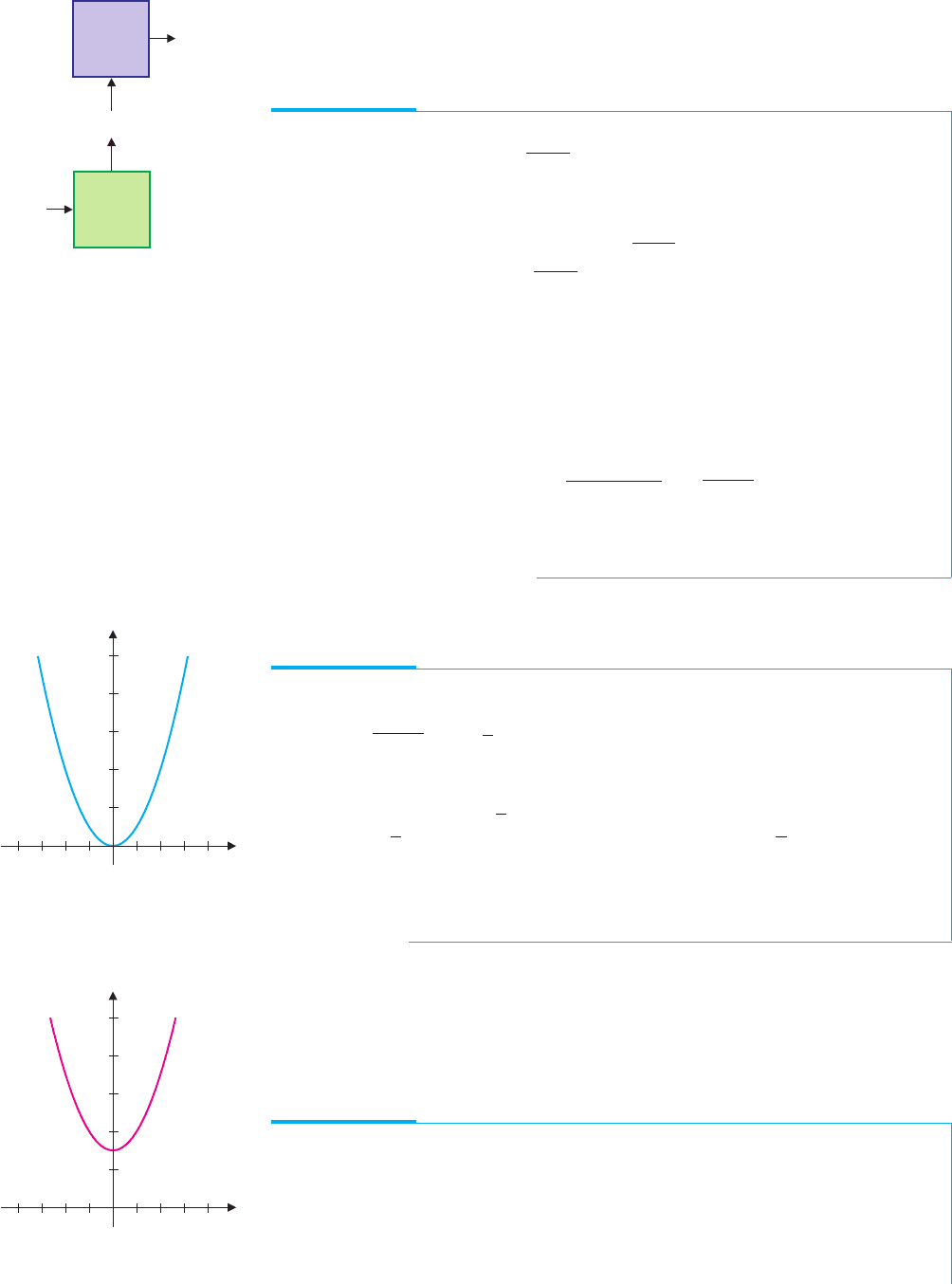
The composition of two functions is a two-step process, as indicated in the margin
schematic. Be careful to notice what this definition is saying. In particular, for f (g(x)) to
be defined, you first need g(x) to be defined, so x must be in the domain of g. Next, f must
be defined at the point g(x), so that the number g(x) will need to be in the domain of f.
f
g(x)
x
f(g(x))
g
( f ◦ g)(x) = f (g(x))
EXAMPLE 5.2 Finding the Composition of Two Functions
For f (x) = x
2
+ 1 and g(x) =
√
x −2, find the compositions f ◦g and g ◦ f and
identify the domain of each.
Solution First, we have
( f ◦g)(x) = f (g(x)) = f (
√
x −2)
= (
√
x −2)
2
+ 1 = x − 2 + 1 = x − 1.
It’s tempting to write that the domain of f ◦g is the entire real line, but look more
carefully. Note that for x to be in the domain of g, we must have x ≥ 2. The domain of
f is the whole real line, so this places no further restrictions on the domain of f ◦g.
Even though the final expression x −1 is defined for all x, the domain of ( f ◦g)is
{x ∈ R | x ≥ 2}.
For the second composition,
(g ◦ f )(x) = g( f (x)) = g(x
2
+ 1)
=
(x
2
+ 1) −2 =
x
2
− 1.
The resulting square root requires x
2
− 1 ≥ 0or|x|≥1. Since the “inside” function f
is defined for all x, the domain of g ◦ f is {x ∈ R
|x|≥1}, which we write in interval
notation as (−∞, −1] ∪[1, ∞).
As you progress through the calculus, you will often need to recognize that a given
function is a composition of simpler functions.
EXAMPLE 5.3 Identifying Compositions of Functions
Identify functions f and g such that the given function can be written as ( f ◦g)(x) for
each of (a)
√
x
2
+ 1, (b) (
√
x +1)
2
, (c) sin x
2
and (d) cos
2
x. Note that more than one
answer is possible for each function.
Solution (a) Notice that x
2
+ 1isinside the square root. So, one choice is to have
g(x) = x
2
+ 1 and f (x) =
√
x.
(b) Here,
√
x +1isinside thesquare. So, onechoice is g(x) =
√
x +1 and f (x) = x
2
.
(c) The function can be rewritten as sin(x
2
), with x
2
clearly inside the sine
function. Then, g(x) = x
2
and f (x) = sin x is one choice.
(d) The function as written is shorthand for (cosx)
2
. So, one choice is g(x) = cos x
and f (x) = x
2
.
y
x
2
4
6
8
10
2 424
FIGURE 0.50a
y = x
2
y
x
2
4
6
8
10
2 424
FIGURE 0.50b
y = x
2
+ 3
In general, it is quite difficult to take the graphs of f and g and produce the graph
of f ◦g. If one of the functions f and g is linear, however, there is a simple graphical
procedure for graphing the composition. Such linear transformations are explored in the
remainder of this section.
The first case is to take the graph of f (x) and produce the graph of f (x) + c for some
constant c. You should be able to deduce the general result from example 5.4.
EXAMPLE 5.4 Vertical Translation of a Graph
Graph y = x
2
and y = x
2
+ 3; compare and contrast the graphs.
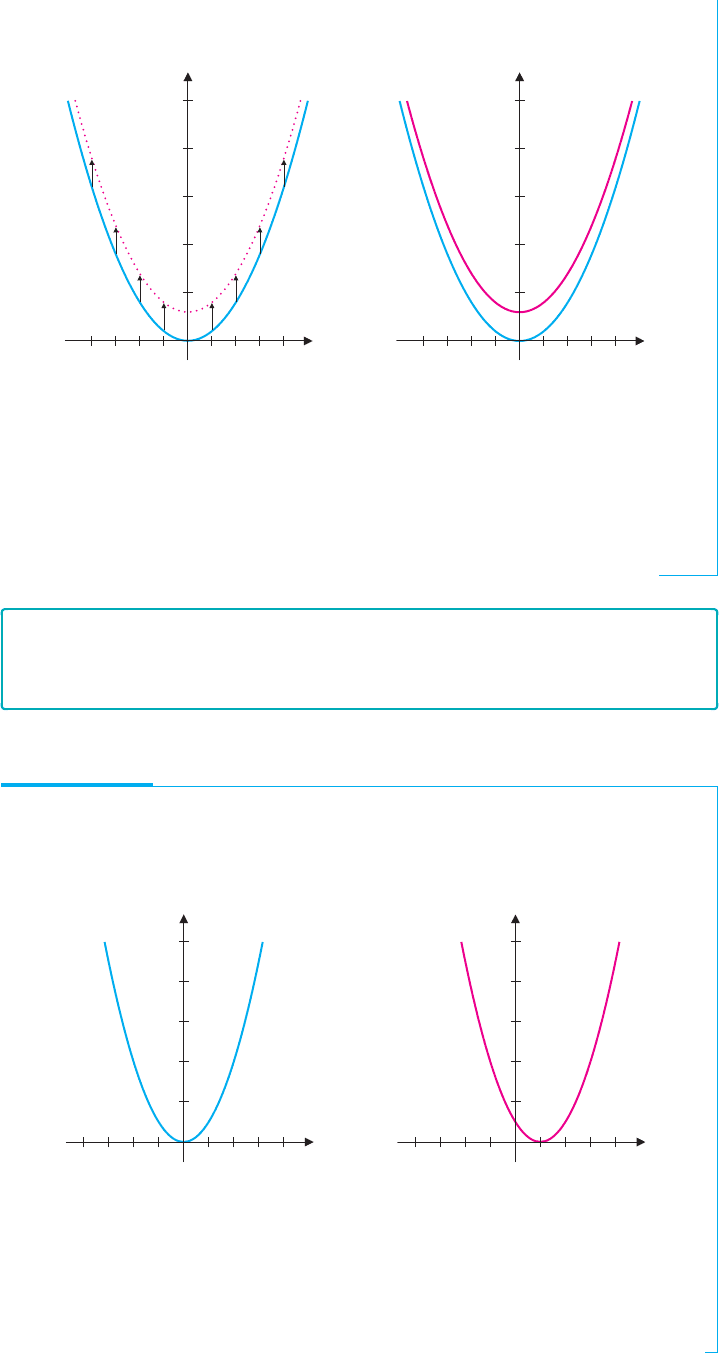
Solution You can probably sketch these by hand. You should get graphs like those in
Figures 0.50a and 0.50b. Both figures show parabolas opening upward. The main obvious
difference is that y = x
2
has a y-intercept of 0 and y = x
2
+ 3 has a y-intercept of 3. In
fact, for any given value of x, the point on the graph of y = x
2
+ 3 will be plotted
P1: OSO/OVY P2: OSO/OVY QC: OSO/OVY T1: OSO
MHDQ256-Ch00 MHDQ256-Smith-v1.cls December 8, 2010 15:25
LT (Late Transcendental)
CONFIRMING PAGES
38 CHAPTER 0
..
Preliminaries 0-38
exactly 3 units higher than the corresponding point on the graph of y = x
2
. This is
shown in Figure 0.51a.
x
4224
5
10
15
20
25
Move graph
up 3 units
y
x
4224
5
10
15
20
25
y
FIGURE 0.51a
Translate graph up
FIGURE 0.51b
y = x
2
and y = x
2
+ 3
In Figure 0.51b, the two graphs are shown on the same set of axes. To many people,
it does not look like the top graph is the same as the bottom graph moved up 3 units. This
is an unfortunate optical illusion. Humans usually mentally judge distance between
curves as the shortest distance between the curves. For these parabolas, the shortest
distance is vertical at x = 0 but becomes increasingly horizontal as you move away
from the y-axis. The distance of 3 between the parabolas is measured vertically.
In general, the graph of y = f (x) +c is the same as the graph of y = f (x) shifted up
(if c > 0) or down (if c < 0) by |c| units. We usually refer to f (x) +c as a vertical
translation (up or down, by |c| units).
In example 5.5, we explore what happens if a constant is added to x.
EXAMPLE 5.5 A Horizontal Translation
Compare and contrast the graphs of y = x
2
and y = (x − 1)
2
.
Solution The graphs are shown in Figures 0.52a and 0.52b, respectively.
y
x
2
4
6
8
10
2 424
y
x
4
6
8
10
2 424
FIGURE 0.52a
y = x
2
FIGURE 0.52b
y = (x − 1)
2
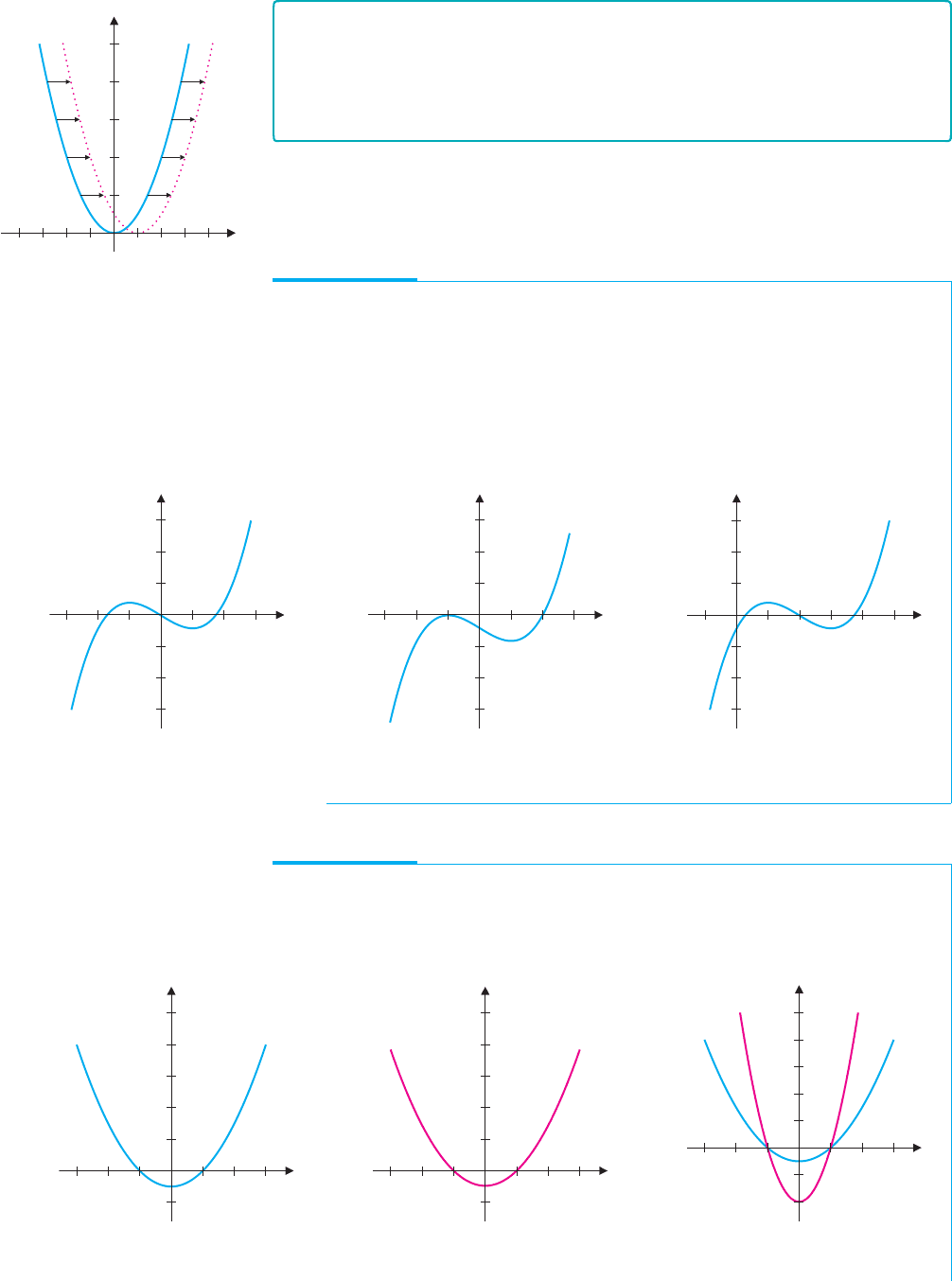
Notice that the graph of y = (x − 1)
2
appears to be the same as the graph of y = x
2
,
except that it is shifted 1 unit to the right. This should make sense for the following
reason. Pick a value of x, say, x = 13. The value of (x − 1)
2
at x = 13 is 12
2
, the same
as the valueof x
2
at x = 12, 1 unit to the left. Observethat this same pattern holds for any
x you choose. A simultaneous plot of the two functions shows this. (See Figure 0.53.)
P1: OSO/OVY P2: OSO/OVY QC: OSO/OVY T1: OSO
MHDQ256-Ch00 MHDQ256-Smith-v1.cls December 8, 2010 15:25
LT (Late Transcendental)
CONFIRMING PAGES
0-39 SECTION 0.5
..
Transformations of Functions 39
In general, for c > 0, the graph of y = f (x − c) is the same as the graph of y = f (x)
shifted c units to the right. Likewise (again, for c > 0), you get the graph of
y = f (x + c) by moving the graph of y = f (x) to the left c units. We usually refer to
f (x −c) and f (x +c)ashorizontal translations (to the right and left, respectively,
by c units).
x
424 2
4
6
8
10
y
Move graph to
the right one uni
t
FIGURE 0.53
Translation to the right
To avoid confusion on which way to translate the graph of y = f (x), focus on what
makes the argument (the quantity inside the parentheses) zero. For f (x), this is x = 0, but
for f (x −c) you must have x = c to get f (0) [i.e., the same y-value as f (x) when x = 0].
This says that the point on the graph of y = f (x)atx = 0 corresponds to the point on the
graph of y = f (x −c)atx = c.
EXAMPLE 5.6 Comparing Vertical and Horizontal Translations
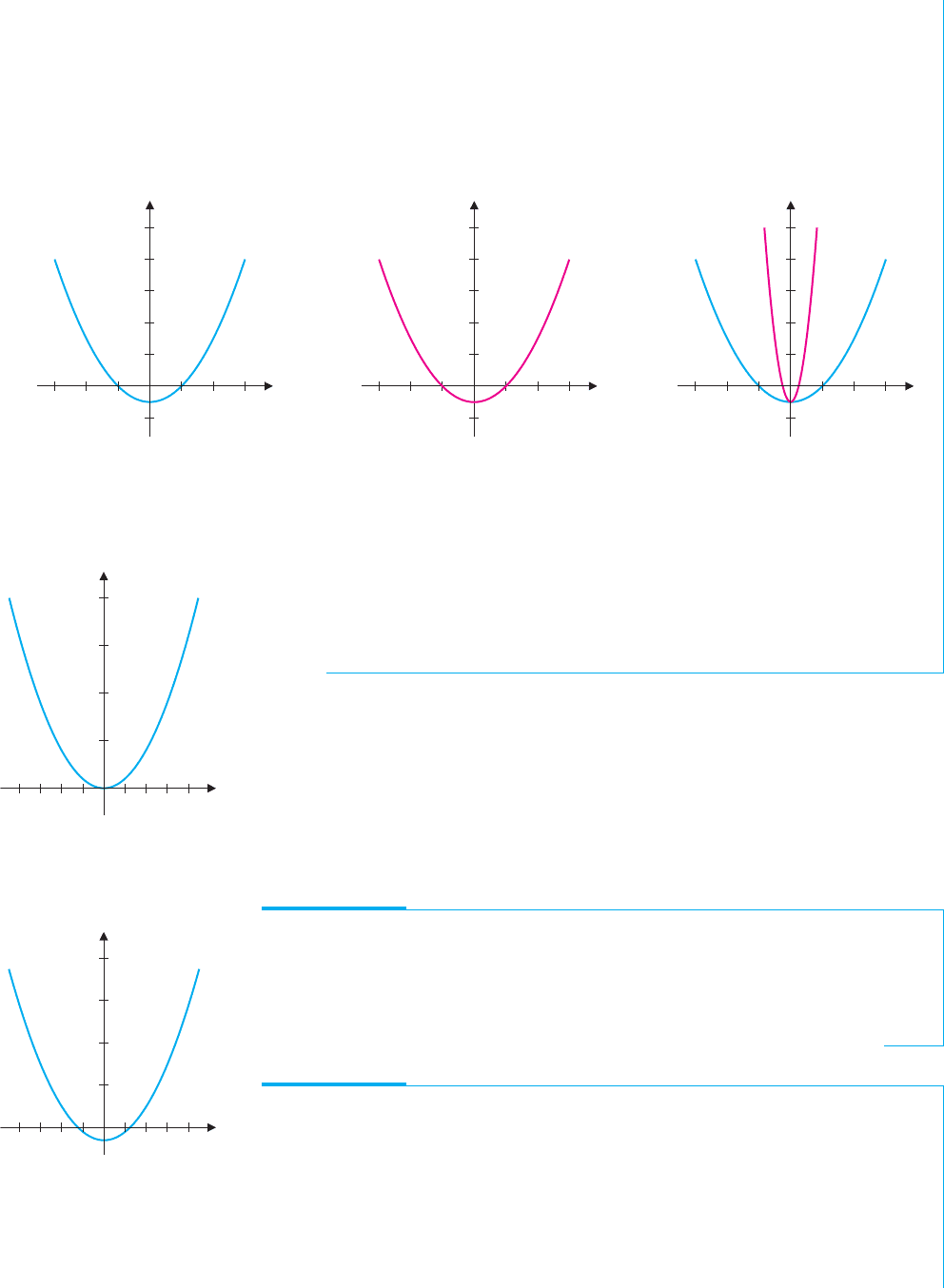
Given the graph of y = f (x) shown in Figure 0.54a, sketch the graphs of y = f (x) − 2
and y = f (x −2).
Solution To graph y = f (x) − 2, simply translate the original graph down 2 units,
as shown in Figure 0.54b. To graph y = f (x − 2), simply translate the original graph to
the right 2 units (so that the x-intercept at x = 0 in the original graph corresponds to
an x-intercept at x = 2 in the translated graph), as seen in Figure 0.54c.
y
x
2 33 1
15
10
5
5
10
15
y
x
2 3123 1
15
10
5
5
10
15
y
x
542311
15
5
10
15
FIGURE 0.54a
y = f (x)
FIGURE 0.54b
y = f (x) −2
FIGURE 0.54c
y = f (x − 2)
Example 5.7 explores the effect of multiplying or dividing x or y by a constant.
EXAMPLE 5.7 Comparing Some Related Graphs
Compare and contrast the graphs of y = x
2
− 1, y = 4(x
2
− 1) and y = (4x)
2
− 1.
Solution The first two graphs are shown in Figures 0.55a and 0.55b, respectively.
y
x
2 3123 1
2
2
4
6
8
10
y
x
2 3123 1
8
8
16
24
32
40
y
x
2 3123 1
4
2
4
6
8
10
y x
2
1
y 4(x
2
1)
FIGURE 0.55a
y = x
2
− 1
FIGURE 0.55b
y = 4(x
2
− 1)
FIGURE 0.55c
y = x
2
− 1and y = 4(x
2
− 1)
P1: OSO/OVY P2: OSO/OVY QC: OSO/OVY T1: OSO
MHDQ256-Ch00 MHDQ256-Smith-v1.cls December 8, 2010 15:25
LT (Late Transcendental)
CONFIRMING PAGES
40 CHAPTER 0
..
Preliminaries 0-40
These graphs look identical until you compare the scales on the y-axes. The scale in
Figure 0.55b is four times as large, reflecting the multiplication of the original function
by 4. The effect looks different when the functions are plotted on the same scale, as in
Figure 0.55c. Here, the parabola y = 4(x
2
− 1) looks thinner and has a different
y-intercept. Note that the x-intercepts remain the same. (Why would that be?)
The graphs of y = x
2
− 1 and y = (4x)
2
− 1 are shown in Figures 0.56a and
0.56b, respectively.
y
x
2 3123 1
2
2
4
6
8
10
y
x
0.75 0.75
2
2
4
6
8
10
0.25 0.25
y
x
2 3123 1
2
4
6
8
10
y x
2
1
y (4x)
2
1
FIGURE 0.56a
y = x
2
− 1
FIGURE 0.56b
y = (4x)
2
− 1
FIGURE 0.56c
y = x
2
− 1and y = (4x)
2
− 1
Can you spot the difference here? In this case, the x-scale has now changed, by the same
factor of 4 as in the function. To see this, note that substituting x = 1/4 into (4x)
2
− 1
produces (1)
2
− 1, exactly the same as substituting x = 1 into the original function.
When plotted on the same set of axes (as in Figure 0.56c), the parabola y = (4x)
2
− 1
looks thinner. Here, the x-intercepts are different, but the y-intercepts are the
same.
We can generalize the observations made in example 5.7. Before reading our explana-
tion, try to state a general rule for yourself. How are the graphs of y = cf(x)and y = f (cx)
related to the graph of y = f (x)?
Based on example 5.7, notice that to obtain a graph of y = cf(x) for some constant
c > 0, you can take the graph of y = f (x) and multiply the scale on the y-axis by c. To
obtain a graph of y = f (cx), for some constant c > 0, you can take the graph of y = f (x)
and multiply the scale on the x-axis by 1/c.
These basic rules can be combined to understand more complicated graphs.
y
x
2 424
10
20
FIGURE 0.57a
y = x
2
y
x
2 424
20
40
FIGURE 0.57b
y = 2x
2
− 3
EXAMPLE 5.8 A Translation and a Stretching
Describe how to get the graph of y = 2x
2
− 3 from the graph of y = x
2
.
Solution You can get from x
2
to 2x
2
− 3 by multiplying by 2 and then subtracting 3.
In terms of the graph, this has the effect of multiplying the y-scale by 2 and then
shifting the graph down by 3 units. (See the graphs in Figures 0.57a and 0.57b.)
EXAMPLE 5.9 A Translation in Both x- and y-Directions
Describe how to get the graph of y = x
2
+ 4x + 3 from the graph of y = x
2
.
Solution We can again relate this (and the graph of every quadratic function) to the
graph of y = x
2
. We must first complete the square. Recall that in this process, you
take the coefficient of x (4), divide by 2 (4/2 = 2) and square the result (2
2
= 4). Add
and subtract this number and then, rewrite the x-terms as a perfect square. We have
y = x
2
+ 4x + 3 = (x
2
+ 4x + 4) −4 +3 = (x + 2)
2
− 1.
P1: OSO/OVY P2: OSO/OVY QC: OSO/OVY T1: OSO
MHDQ256-Ch00 MHDQ256-Smith-v1.cls December 8, 2010 15:25
LT (Late Transcendental)
CONFIRMING PAGES
0-41 SECTION 0.5
..
Transformations of Functions 41
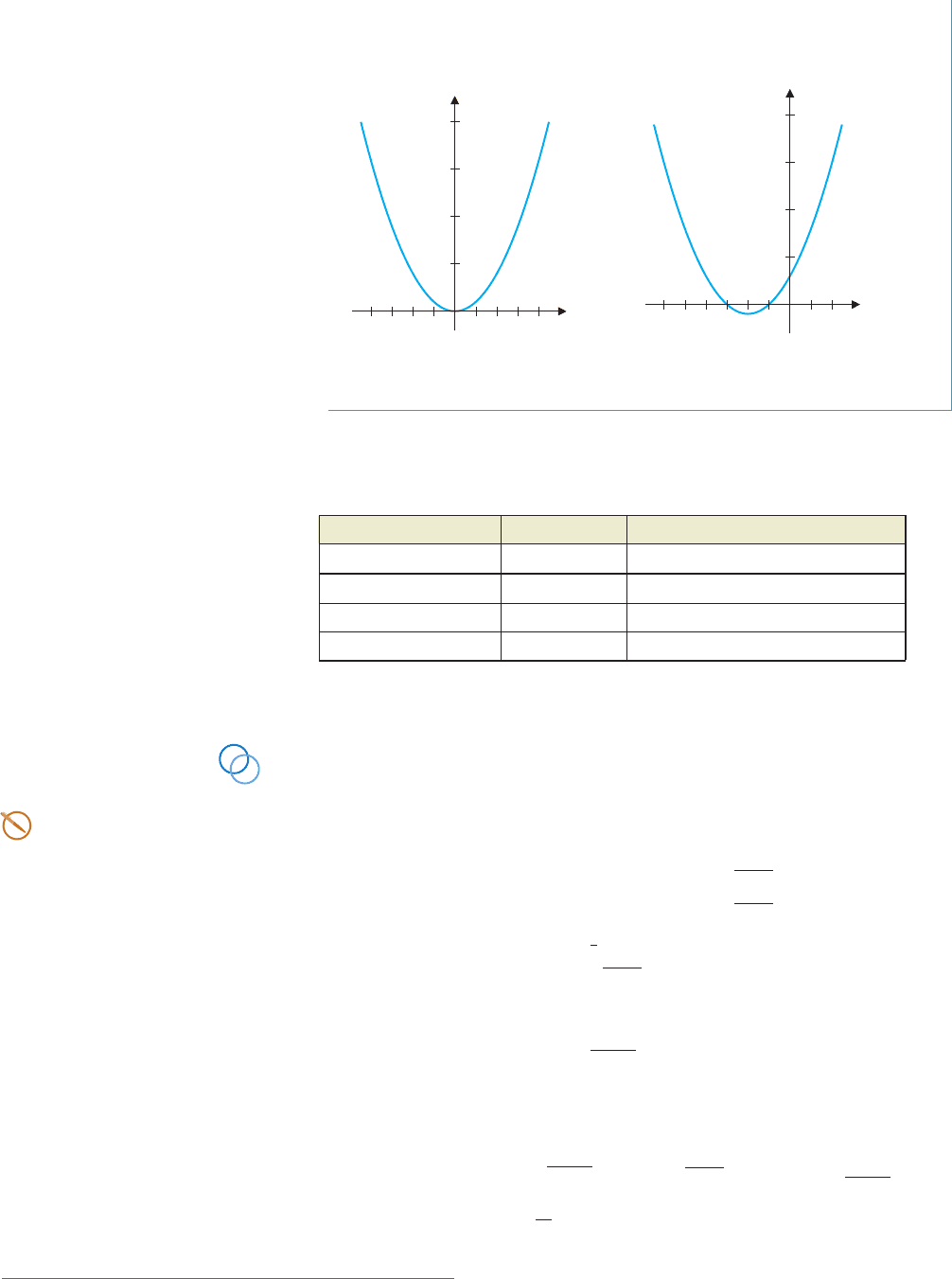
To graph this function, take the parabola y = x
2
(see Figure 0.58a) and translate the
graph 2 units to the left and 1 unit down. (See Figure 0.58b.)
y
x
2 424
10
20
y
x
24 26
10
20
FIGURE 0.58a
y = x
2
FIGURE 0.58b
y = (x + 2)
2
− 1
The following table summarizes our discoveries in this section.
Transformations of f (x)
Transformation Form Effect on Graph
Vertical translation f (x) +c |c| units up (c > 0) or down (c < 0)
Horizontal translation f (x + c) |c| units left (c > 0) or right (c < 0)
Vertical scale cf(x)(c > 0) multiply vertical scale by c
Horizontal scale f (cx)(c > 0) divide horizontal scale by c
You will explore additional transformations in the exercises.
EXERCISES 0.5
WRITING EXERCISES
1. The restricted domain of example 5.2 may be puzzling. Con-
sider the following analogy. Suppose you have an airplane
flight from New York to Los Angeles with a stop for refu-
eling in Minneapolis. If bad weather has closed the airport in
Minneapolis, explain why your flight will be canceled (or at
least rerouted) even if the weather is great in New York and
Los Angeles.
2. Explain why the graphs of y = 4(x
2
− 1) and y = (4x)
2
− 1
in Figures 0.55c and 0.56c appear “thinner” than the graph of
y = x
2
− 1.
3. As illustrated in example 5.9, completing the square can
be used to rewrite any quadratic function in the form
a(x −d)
2
+ e. Using the transformation rules in this section,
explain why this means that all parabolas (with a > 0) will
look essentially the same.
4. Explain why the graph of y = f (x + 4) is obtained by moving
the graph of y = f (x) four units to the left, instead of to the
right.
In exercises 1–6, find the compositions f ◦ g and g ◦ f , and
identify their respective domains.
1. f (x) = x +1, g(x) =
√
x − 3
2. f (x) = x −2, g(x) =
√
x + 1
3. f (x) =
1
x
, g(x) = x
3
+ 4
4. f (x) =
√
1 − x, g(x) = tan x
5. f (x) = x
2
+ 1, g(x) = sin x
6. f (x) =
1
x
2
− 1
, g(x) = x
2
− 2
............................................................
In exercises 7–14, identify functions f(x) and g(x) such that the
given function equals ( f ◦ g)(x).
7.
√
x
4
+ 1 8.
3
√
x + 3 9.
1
x
2
+ 1
10.
1
x
2
+ 1 11. (4x + 1)
2
+ 3 12. 4(x + 1)
2
+ 3
13. sin
3
x 14. sin x
3
............................................................
P1: OSO/OVY P2: OSO/OVY QC: OSO/OVY T1: OSO
MHDQ256-Ch00 MHDQ256-Smith-v1.cls December 8, 2010 15:25
LT (Late Transcendental)
CONFIRMING PAGES
42 CHAPTER 0
..
Preliminaries 0-42
In exercises 15–20, identify functions f (x), g(x) and h(x) such
that the given function equals [ f ◦ (g ◦ h)] (x).
15.
3
√
sin x + 2
16.
√
x
4
+ 1 17. cos
3
(4x − 2)
18. tan
√
x
2
+ 1 19. 4cos(x
2
) − 5 20.
[
tan(3x +1)
]
2
............................................................
In exercises 21–28, use the graph of y f (x) given in the figure
to graph the indicated function.
21. f (x) −3 22. f (x + 2) 23. f (x − 3)
24. f (x) +2 25. f (2x) 26. 3 f (x)
27. −3 f (x) +2 28. 3 f (x +2)
x
2 424
2
2
4
6
8
10
y
............................................................
In exercises 29–36, use the graph of y f (x) given in the figure
to graph the indicated function.
29. f (x − 4) 30. f (x + 3) 31. f (2x)
32. f (2x − 4) 33. f (3x + 3) 34. 3 f (x)
35. 2 f (x) −4 36. 3 f (x) + 3
y
x
2 424
10
5
5
10
............................................................
In exercises 37–42, complete the square and explain how to
transform the graph of y x
2
into the graph of the given
function.
37. f (x) = x
2
+ 2x + 1 38. f (x) = x
2
− 4x + 4
39. f (x) = x
2
+ 2x + 4 40. f (x) = x
2
− 4x + 2
41. f (x) = 2x
2
+ 4x + 4 42. f (x) = 3x
2
− 6x + 2
............................................................
In exercises 43–46, graph the given function and compare to the
graph of y x
2
–1.
43. f (x) =−2(x
2
− 1) 44. f (x) =−3(x
2
− 1)
45. f (x) =−3(x
2
− 1) + 2 46. f (x) =−2(x
2
− 1) − 1
............................................................
In exercises 47–50, graph the given function and compare to the
graph of y (x − 1)
2
− 1 x
2
− 2x.
47. f (x) = (−x)
2
− 2(−x)
48. f (x) =−(−x)
2
+ 2(−x)
49. f (x) = (−x + 1)
2
+ 2(−x + 1)
50. f (x) = (−3x)
2
− 2(−3x) − 3
............................................................
51. Based on exercises 43–46, state a rule for transforming the
graph of y = f (x) into the graph of y = cf(x) for c < 0.
52. Based on exercises 47–50, state a rule for transforming the
graph of y = f (x) into the graph of y = f (cx) for c < 0.
53. Sketch the graph of y =|x|
3
. Explain why the graph of
y =|x|
3
is identical to that of y = x
3
to the right of the
y-axis. For y =|x|
3
, describe how the graph to the left of
the y-axis compares to the graph to the right of the y-axis. In
general, describe how to draw the graph of y = f (|x|)given
the graph of y = f (x).
54. For y = x
3
, describe how the graph to the left of the y-axis
compares to the graph to the right of the y-axis. Show that
for f (x) = x
3
,wehave f (−x) =−f (x). In general, if you
have the graph of y = f (x) to the right of the y-axis and
f (−x) =−f (x) for all x, describe how to graph y = f (x)
to the left of the y-axis.
55. Iterations of functions are important in a variety of applica-
tions. To iterate f (x), start with an initial value x
0
and compute
x
1
= f (x
0
), x
2
= f (x
1
), x
3
= f (x
2
) and so on. For example,
with f (x) = cos x and x
0
= 1, the iterates are x
1
= cos1 ≈
0.54, x
2
= cos x
1
≈ cos0.54 ≈ 0.86, x
3
≈ cos0.86 ≈ 0.65
and so on. Keep computing iterates and show that they get
closer and closer to 0.739085. Then pick your own x
0
(any
number you like) and show that the iterates with this new x
0
also get closer and closer to 0.739085.
56. Referringtoexercise55, showthattheiteratesofafunction can
be written as x
1
= f (x
0
), x
2
= f ( f (x
0
)), x
3
= f ( f ( f (x
0
)))
and so on. Graph y = cos(cos x), y = cos (cos (cos x)) and
y = cos (cos (cos (cos x))). The graphs should look more and
more like a horizontal line. Use the result of exercise 55 to
identify the limiting line.
57. Computeseveraliteratesof f (x) = sin x (see exercise55)with
a variety of starting values. What happens to the iterates in the
long run?
58. Repeat exercise 57 for f (x) = x
2
.
59. In cases where the iterates of a function (see exercise 55) re-
peat a single number, that number is called a fixed point. Ex-
plain why any fixed point must be a solution of the equation
f (x) = x. Find all fixed points of f (x) = cos x by solving the
equationcos x = x.Compareyourresultstothatofexercise55.
60. Find all fixed points of f (x) = sin x (see exercise 59). Com-
pare your results to those of exercise 57.