
Smith R., Minton R. Calculus
Подождите немного. Документ загружается.

P1: PIC/OVY P2: OSO/OVY QC: OSO/OVY T1: OSO
MHDQ256-Ch05 MHDQ256-Smith-v1.cls December 14, 2010 20:15
LT (Late Transcendental)
CONFIRMING PAGES
5-59 CHAPTER 5
..
Review Exercises 373
Review Exercises
12. A swimming pool viewed from above has an outline given by
y =±(5 + x) for 0 ≤ x ≤ 2. The depth is given by 4 + x (all
measurements in feet). Compute the volume.
13. The cross-sectional areas of an underwater object are given.
Estimate the volume.
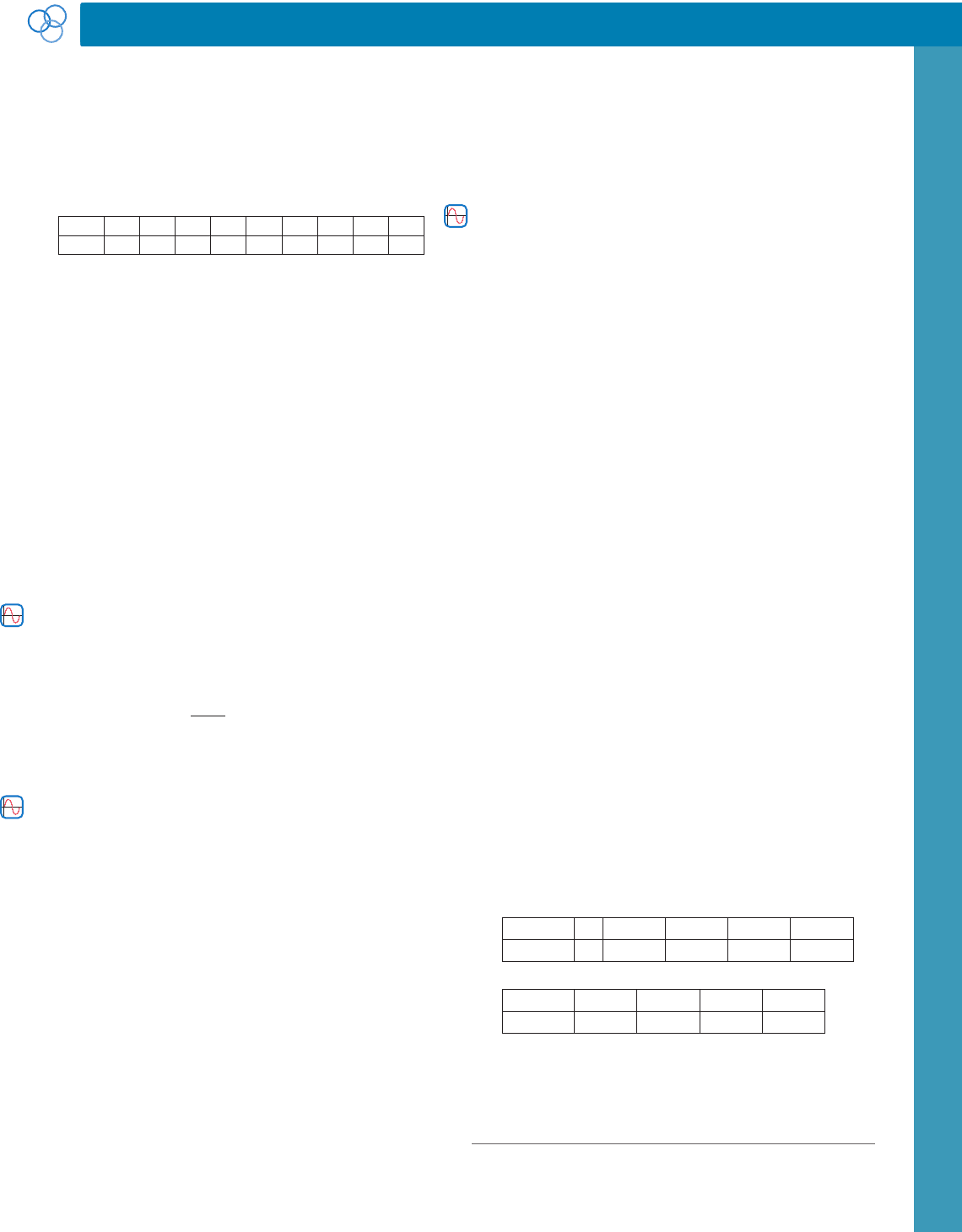
x 0 0.4 0.8 1.2 1.6 2.0 2.4 2.8 3.2
A(x) 0.4 1.4 1.8 2.0 2.1 1.8 1.1 0.4 0
............................................................
In exercises 14–18, find the volume of the indicated solid
of revolution.
14. The region bounded by y = x
2
, y = 0 and x = 1 revolved
about (a) the x-axis; (b) the y-axis; (c) x = 2; (d) y =−2
15. Theregionboundedby y = x
2
and y = 4revolvedabout(a)the
x-axis; (b) the y-axis; (c) x = 2; (d) y =−2
16. The region bounded by y = x, y = 2x and x = 2 revolved
about (a) the x-axis; (b) the y-axis; (c) x =−1; (d) y = 4
17. The region bounded by y = x, y = 2 − x and y = 0 revolved
about (a) the x-axis; (b) the y-axis; (c) x =−1; (d) y = 4
18. The region bounded by x = 4 − y
2
and x = y
2
− 4 revolved
about (a) the x-axis; (b) the y-axis; (c) x = 4; (d) y = 4
............................................................
In exercises 19–22, set up an integral for the arc length and
numerically estimate the integral.
19. The portion of y = x
4
for −1 ≤ x ≤ 1
20. The portion of y = x
2
+ x for −1 ≤ x ≤ 0
21. The portion of y =
√
x + 1 for 0 ≤ x ≤ 3
22. The portion of y = sin 2x for 0 ≤ x ≤ π
............................................................
In exercises 23 and 24, set up an integral for the surface area
and numerically estimate the integral.
23. The surface generated by revolving y = 1 − x
2
, 0 ≤ x ≤ 1,
about the x-axis
24. The surface generated by revolving y = x
3
, 0 ≤ x ≤ 1, about
the x-axis
............................................................
In exercises 25–32, ignore air resistance.
25. A diver drops from a height of 64 feet. What is the velocity at
impact?
26. If the diver in exercise 25 has an initial upward velocity of
4 ft/s, what will be the impact velocity?
27. An object is launched from the ground at an angle of 20
◦
with
an initial speed of 48 ft/s. Find the time of flight and the hori-
zontal range.
28. Repeat exercise 27 for an object launched from a height of
6 feet.
29. A football is thrown from a height of 6 feet with initial speed
80 ft/s at an angle of 8
◦
. A person stands 40 yards downfield
in the direction of the throw. Is it possible to catch the ball?
30. Repeat exercise 29 with a launch angle of 24
◦
. By trial and
error, find the range of angles (rounded to the nearest degree)
that produce a catchable throw.
31. Find the initial velocity needed to propel an object to a height
of 128 feet. Find the object’s velocity at impact.
32. A plane at an altitude of 120 ft drops supplies to a location on
the ground. If the plane has a horizontal velocity of 100 ft/s,
how far from the target should the supplies be released?
............................................................
33. A force of 60 pounds stretches a spring 1 foot. Find the work
done to stretch the spring 8 inches beyond its natural length.
34. A car engine exerts a forceof 800 +2x pounds whenthe car is
at position x miles. Find the work done as the car moves from
x = 0tox = 8.
35. Compute the mass and center of mass of an object with density
ρ(x) = x
2
− 2x + 8 for 0 ≤ x ≤ 4. Explain why the center of
mass is not at x = 2.
36. Compute the mass and center of mass of an object with density
ρ(x) = x
2
− 2x + 8 for 0 ≤ x ≤ 2. Explain why the center of
mass is at x = 1.
37. A dam has the shape of a trapezoid with height 80 feet. The
width at the top of the dam is 60 feet and the width at the
bottom of the dam is 140 feet. Find the maximum hydrostatic
force that the dam will need to withstand.
38. An underwater viewing window is a rectangle with width
20 feet extending from 5 feet below the surface to 10 feet
below the surface. Find the maximum hydrostatic force that
the window will need to withstand.
39. The force exerted by a bat on a ball over time is shown in the
table. Use the data to estimate the impulse. If the ball (mass
m = 0.01slug)hadspeed120ft/sbeforethecollision, estimate
its speed after the collision.
t (s) 0 0.0001 0.0002 0.0003 0.0004
F(t) (lb) 0 800 1600 2400 3000
t (s) 0.0005 0.0006 0.0007 0.0008
F(t) (lb) 3600 2200 1200 0
40. If a wall applies a force of f (t) = 3000t(2 − t) pounds to a car
for0 ≤ t ≤ 2,findtheimpulse. Ifthecar(massm = 100slugs)
is motionless after the collision, compute its speed before the
collision.

P1: PIC/OVY P2: OSO/OVY QC: OSO/OVY T1: OSO
MHDQ256-Ch05 MHDQ256-Smith-v1.cls December 14, 2010 20:15
LT (Late Transcendental)
CONFIRMING PAGES
374 CHAPTER 5
..
Applications of the Definite Integral 5-60
Review Exercises
EXPLORATORY EXERCISES
1. As indicated in section 5.5, general formulas can be derived
for many important quantities in projectile motion. For an ob-
ject launched from the ground at angle θ
0
with initial speed
v
0
ft/s, find the horizontal range R ft and use the trig iden-
tity sin(2θ
0
) = 2sinθ
0
cosθ
0
to show that R =
v
2
0
sin(2θ
0
)
32
.
Conclude that the maximum range is achieved with angle
θ
0
= π/4 (45
◦
).
2. Tofollowuponexploratoryexercise1,supposethattheground
makes an angle of A
◦
with the horizontal. If A > 0 (i.e., the
projectile is being launched uphill), explain why the maximum
rangewouldbeachievedwithananglelargerthan45
◦
.IfA < 0
(launching downhill), explain why the maximum range would
be achieved with an angle less than 45
◦
. To determine the ex-
act value of the optimal angle, first argue that the ground can
be represented by the line y = (tan A)x. Show that the pro-
jectile reaches the ground at time t = v
0
sinθ
0
− tan A cosθ
0
16
.
Compute x(t) for this value of t and use a trig identity to re-
place the quantity sin θ
0
cos A − sin A cos θ
0
with sin(θ
0
− A).
Thenuse anothertrigidentitytoreplacecos θ
0
sin(θ
0
− A)with
sin(2θ
0
− A) −sin A. At this stage, the only term involving θ
0
will be sin(2θ
0
− A). To maximize the range, maximize this
term by taking θ
0
=
π
4
+
1
2
A.

P1: PIC/OVY P2: OSO/OVY QC: OSO/OVY T1: OSO
MHDQ256-Ch06 MHDQ256-Smith-v1.cls December 15, 2010 19:5
LT (Late Transcendental)
CONFIRMING PAGES
CHAPTER
6
Exponentials, Logarithms and
Other Transcendental Functions
The International Space Station is one of the most ambitious engineering
projects ever undertaken. A construction project in space offers a few
advantages over construction on Earth. For instance, the weightlessness
andlackofatmosphericconditionsreducethe need for structural strength.
In fact, the International Space Station could not support its ownweight if
it were constructed on Earth! The lightweight beamsholding the station’s
solar panels are long, yet relatively thin and flexible. Unfortunately, these
characteristics can allow a minor tremor to magnify into a dangerous
vibration, due to the phenomenon of resonance. Consequently, this design
requires a system to maintain the stability of the structure. This is one area where
calculus plays a critical role in the design of the space station.
You can think of this stability problem
by imagining yourself operating a joystick,
where moving the joystick applies a force at
one of the beam’s joints. The goal is to apply
the appropriate forces to keep the beam from
vibrating.Forinstance,ifthebeamstartsmov-
ingtotheleft,youmightmoveyourjoystickto
the right, applying an opposing force. Mathe-
matically, think of this as a function; you sup-
ply the input (the force) that determines the
output (the motion of the beam). Your task
is then to solve an inverse problem. That
is, given the desired output (stability), you
must determine the correct input (force) that
produces it. We discuss inverse functions in section 6.2. In the remainder of this
chapter, we define several new functions that are essential to engineers investigat-
ing the stability of structures.
International Space Station
6.1 THE NATURAL LOGARITHM
At some point or other prior to your study of calculus, you likely encountered the
natural logarithm. The standard precalculus definition is that thenatural logarithm
is the ordinary logarithm with base e. That is,
ln x = log
e
x,
where e is a (so far) mysterious transcendental number, whose approximate value
is givenas e ≈ 2.71828....So, why would a logarithm with a transcendental base
375
P1: PIC/OVY P2: OSO/OVY QC: OSO/OVY T1: OSO
MHDQ256-Ch06 MHDQ256-Smith-v1.cls December 15, 2010 19:5
LT (Late Transcendental)
CONFIRMING PAGES
376 CHAPTER 6
..
Exponentials, Logarithms and Other Transcendental Functions 6-2
be called natural? Further, why would anyone be interested in such a seemingly unusual
function? We will resolve both of these questions in this section.
First, recall the power rule for integrals,
x
n
dx =
x
n+1
n + 1
+ c, for n =−1.
Of course, this rule doesn’t hold for n =−1, since this would result in division by zero.
Then, what can we say about
1
x
dx?
From Theorem 4.1 in Chapter 4, we know that since f (x) =
1
x
is continuous for x = 0,
it must be integrable on any interval not including x = 0. (But, how do we find its an-
tiderivative?) Notice, that by Part II of the Fundamental Theorem of Calculus,
x
1
1
t
dt
is an antiderivative of
1
x
for x > 0. We give this new (and naturally arising) function a name
in Definition 1.1.
DEFINITION 1.1
For x > 0, we define the natural logarithm function, denoted ln x,by
ln x =
x
1
1
t
dt.
y
y Q
t
12x 3 4
2
1
3
4
t
A
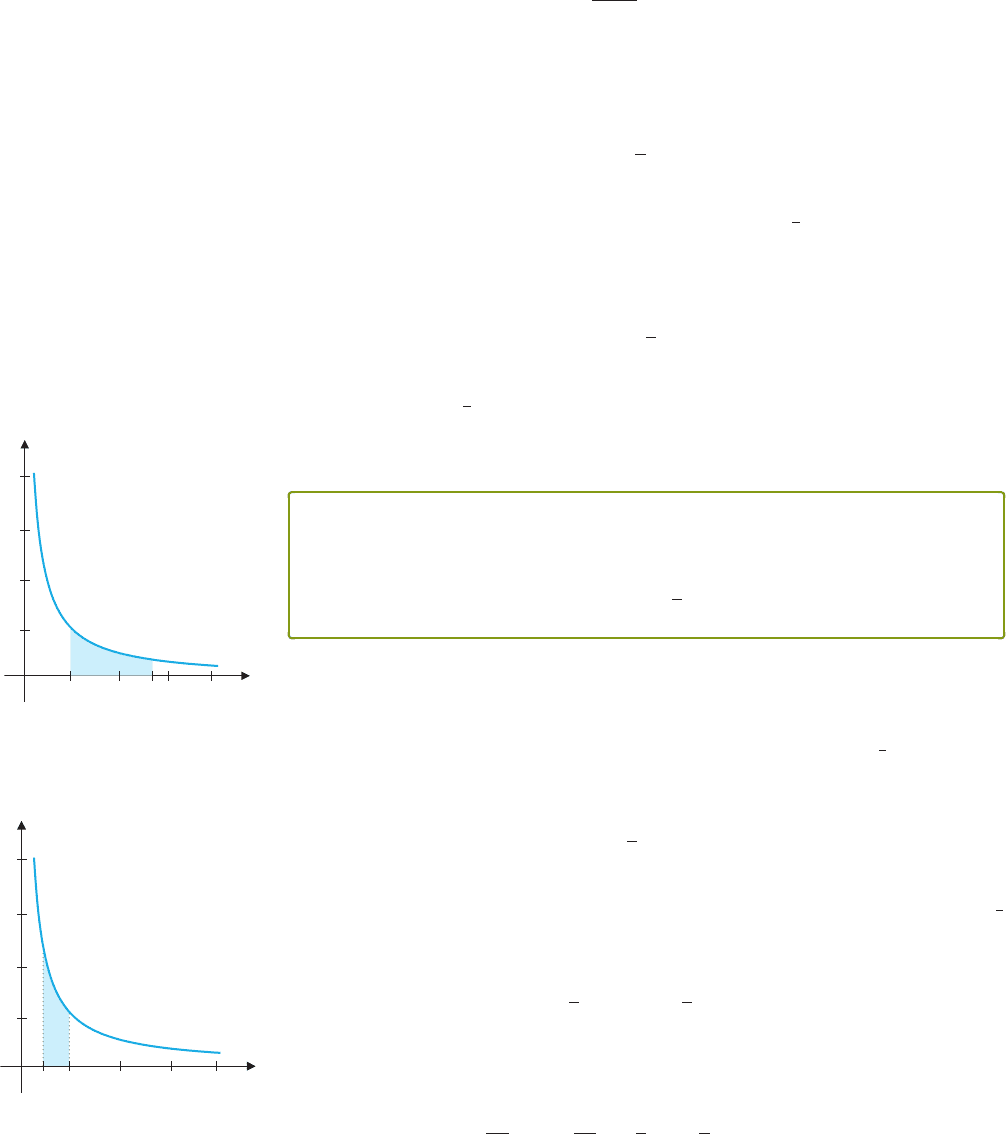
FIGURE 6.1a
ln x (x > 1)
y
y
Q
t
12
x
3 4
2
1
3
4
t
A
FIGURE 6.1b
ln x(0 < x < 1)
We’ll see later in this chapter that this definition is, in fact, consistent with your previous
understanding of ln x. First, let’s interpret this new function graphically. Notice that for
x > 1, this definite integral corresponds to the area A under the curve y =
1
t
from 1 to x,as
indicated in Figure 6.1a. That is,
ln x =
x
1
1
t
dt = A > 0.
Similarly, for 0 < x < 1, notice from Figure 6.1b that for the area A under the curve y =
1
t
from x to 1, we have
ln x =
x
1
1
t
dt =−
1
x
1
t
dt =−A < 0.
Using Definition 1.1, we get by Part II of the Fundamental Theorem of Calculus that
d
dx
ln x =
d
dx
x
1
1
t
dt =
1
x
, for x > 0. (1.1)
We illustrate this new derivative formula in example 1.1.

P1: PIC/OVY P2: OSO/OVY QC: OSO/OVY T1: OSO
MHDQ256-Ch06 MHDQ256-Smith-v1.cls December 15, 2010 19:5
LT (Late Transcendental)
CONFIRMING PAGES
6-3 SECTION 6.1
..
The Natural Logarithm 377
EXAMPLE 1.1 Differentiating a Logarithm
Find the derivative of ln(x
3
+ 7x
2
).
Solution Using the chain rule and (1.1), we have
d
dx
ln(x
3
+ 7x
2
) =
1
x
3
+ 7x
2
d
dx
(x
3
+ 7x
2
)
=
1
x
3
+ 7x
2
(3x
2
+ 14x).
Now, note that ln |x| is defined for x = 0. For x > 0, ln|x|=ln x and hence,
d
dx
ln|x|=
d
dx
ln x =
1
x
.
Similarly, for x < 0, ln|x|=ln(−x), and hence,
d
dx
ln|x|=
d
dx
ln(−x)
=
1
−x
d
dx
(−x)
By the chain rule.
=
1
−x
(−1) =
1
x
.
Notice that we got the same derivative in either case. This proves Theorem 1.1.
THEOREM 1.1
For x = 0,
d
dx
ln|x|=
1
x
.
EXAMPLE 1.2 The Derivative of the Log of an Absolute Value
For any x for which tan x = 0, evaluate
d
dx
ln|tan x|.
Solution From Theorem 1.1 and the chain rule, we have
d
dx
ln|tan x|=
1
tan x
d
dx
tan x
=
1
tan x
sec
2
x.
Of course, with the new differentiation rule in Theorem 1.1, we get a new integration
rule.
COROLLARY 1.1
In any interval not containing 0,
1
x
dx = ln |x|+c.
Corollary 1.1 is a very common integration rule. We illustrate this in example 1.3.

P1: PIC/OVY P2: OSO/OVY QC: OSO/OVY T1: OSO
MHDQ256-Ch06 MHDQ256-Smith-v1.cls December 15, 2010 19:5
LT (Late Transcendental)
CONFIRMING PAGES
378 CHAPTER 6
..
Exponentials, Logarithms and Other Transcendental Functions 6-4
EXAMPLE 1.3 Two Integrals Involving Logarithms
Evaluate the integrals (a)
x
2
x
3
+ 7
dx and (b)
tan xdx.
Solution For (a), notice that the numerator is nearly the derivative of the denominator:
d
dx
(x
3
+ 7) = 3x
2
.
This suggests the substitution u = x
3
+ 7, so that du = 3x
2
dx.Wenowhave
x
2
x
3
+ 7
dx =
1
3
3x
2
x
3
+ 7
dx
=
1
3
1
u
du =
1
3
ln|u|+c
=
1
3
ln|x
3
+ 7|+c.
For (b), we must first rewrite the integrand in terms of sinx and cos x,toreveal
tan xdx=
sin x
cos x
dx.
Here, you should quickly observe that setting u = cos x gives us du =−sin xdx, so that
tan xdx =−
−sin x
cos x
dx =−
1
u
du
=−ln|u|+c =−ln|cos x|+c.
HISTORICAL
NOTE
John Napier (1550–1617)
A Scottish nobleman and inventor
who developed the concept of
the logarithm and constructed the
first table of logarithm values. He
invented a number of useful
techniques for working with large
numbers, including logarithms and
a calculation device sometimes
called “Napier’s bones” that can
be used for multiplication and the
estimation of square roots and
cube roots. Napier also
popularized the use of the decimal
point for representing fractions.
Notice that since ln x is defined by a definite integral, we can use Simpson’s Rule (or
any other convenient numerical integration method) to compute approximate values of the
function. For instance,
ln2 =
2
1
1
t
dt ≈ 0.693147
and ln3 =
3
1
1
t
dt ≈ 1.09861.
We leave these approximations as exercises. (You should also check the values with the ln
key on your calculator.)
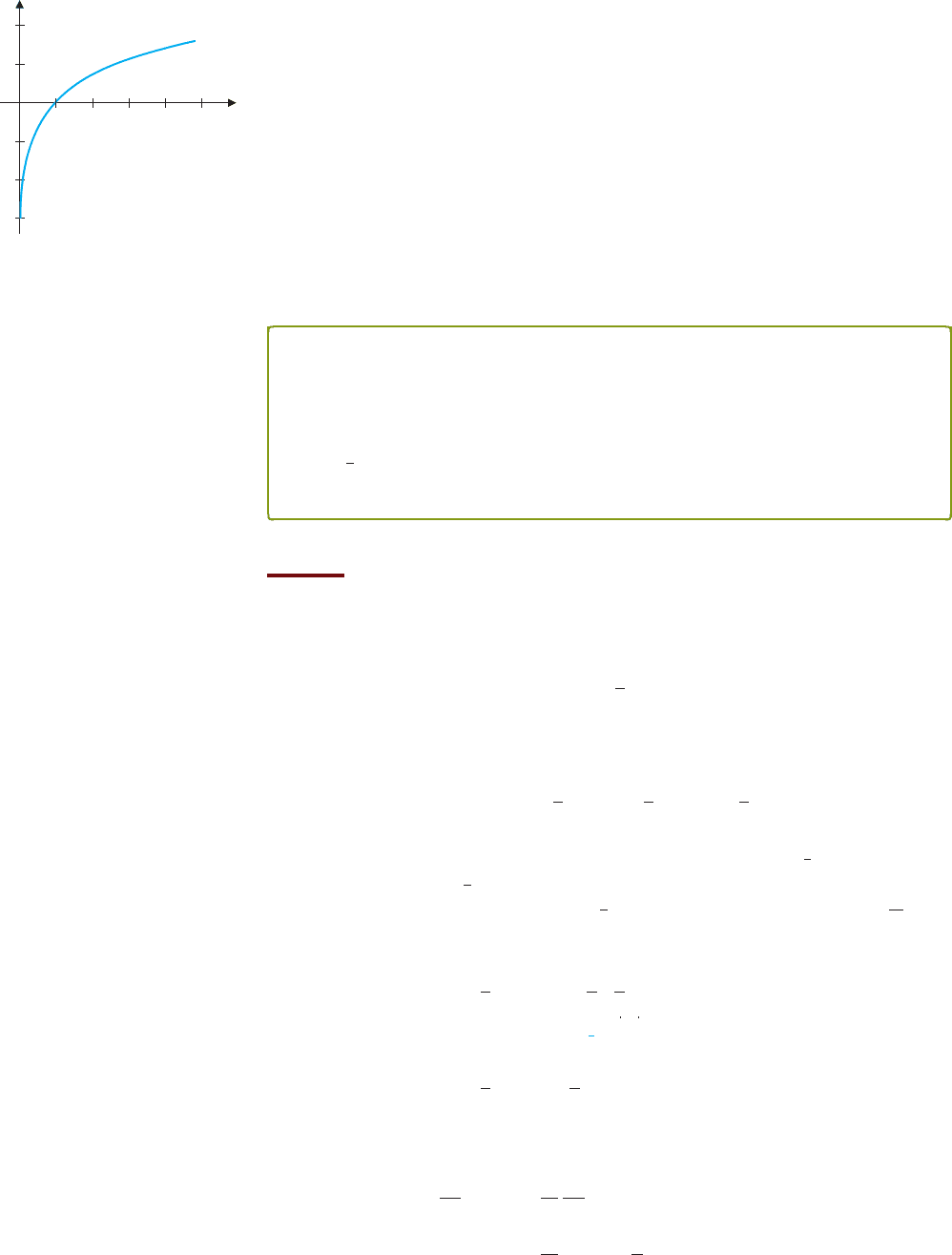
We now briefly sketch a graph of y = ln x. As we’ve already observed, the domain of
f (x) = ln x is (0, ∞). Further, recall that
ln x
⎧
⎨
⎩
< 0 for 0 < x < 1
= 0 for x = 1
> 0 for x > 1
and that f
(x) =
1
x
> 0, for x > 0,
so that f is increasing throughout its domain. Next,
f
(x) =−
1
x
2
< 0, for x > 0,
P1: PIC/OVY P2: OSO/OVY QC: OSO/OVY T1: OSO
MHDQ256-Ch06 MHDQ256-Smith-v1.cls December 15, 2010 19:5
LT (Late Transcendental)
CONFIRMING PAGES
6-5 SECTION 6.1
..
The Natural Logarithm 379
and hence, the graph is concave down everywhere. You can easily use Simpson’s Rule or
the Trapezoidal Rule (this is left as an exercise) to make the conjectures
lim
x→∞
ln x =∞ (1.2)
and lim
x→0
+
ln x =−∞. (1.3)
We postpone the proof of (1.2) until after Theorem 1.2. The proof of (1.3) is left as an
exercise. We now obtain the graph shown in Figure 6.2.
y
x
1234 5
2
1
1
2
3
FIGURE 6.2
y = ln x
Now, it remains for us to explain why this function should be called a logarithm. The
answer is simple: it satisfies all of the properties satisfied by other logarithms. Since ln x
behaves like any other logarithm, we call it (what else?) a logarithm. We summarize these
properties in Theorem 1.2.
THEOREM 1.2
For any real numbers a, b > 0 and any rational number r,
(i) ln 1 = 0
(ii) ln(ab) = lna + lnb
(iii) ln
a
b
= lna − ln b and
(iv) ln(a
r
) = r lna.
PROOF
(i) By definition,
ln1 =
1
1
1
t
dt = 0.
(ii) Also from the definition, we have
ln(ab) =
ab
1
1
t
dt =
a
1
1
t
dt +
ab
a
1
t
dt,
from part (ii) of Theorem 4.2 in section 4.4. Make the substitution u =
t
a
in the last integral
only. This gives us du =
1
a
dt. Finally, the limits of integration must be changed to reflect
the new variable (when t = a,wehaveu =
a
a
= 1 and when t = ab,wehaveu =
ab
a
= b),
to yield
ln(ab) =
a
1
1
t
dt +
ab
a
a
t
1
u
1
a
dt
du
=
a
1
1
t
dt +
b
1
1
u
du = lna + lnb.
From Definition 1.1.
(iv) Note that
d
dx
ln(x
r
) =
1
x
r
d
dx
x
r
From (1.1) and the chain rule.
=
1
x
r
rx
r−1
=
r
x
.
From the power rule.

P1: PIC/OVY P2: OSO/OVY QC: OSO/OVY T1: OSO
MHDQ256-Ch06 MHDQ256-Smith-v1.cls December 15, 2010 19:5
LT (Late Transcendental)
CONFIRMING PAGES
380 CHAPTER 6
..
Exponentials, Logarithms and Other Transcendental Functions 6-6
Likewise,
d
dx
[r ln x] = r
d
dx
(ln x) =
r
x
.
Now, since ln(x
r
) and r ln x have the same derivative, it follows from Corollary 8.1 in
section 2.8 that for all x > 0,
ln(x
r
) = r ln x + k,
for some constant, k. In particular, taking x = 1, we find that
ln(1
r
) = r ln1 +k,
where since 1
r
= 1 and ln1 = 0, we have
0 = r(0) + k.
So, k = 0 and ln(x
r
) = r ln x, for all x > 0.
Part (iii) follows from (ii) and (iv) and is left as an exercise.
EXAMPLE 1.4 Rewriting a Logarithmic Expression
Simplify ln
1
n
√
a
, where n is a positive integer.
Solution For any integer n > 0,
ln
1
n
√
a
= ln(a
−1/n
) =−
1
n
lna.
CAUTION
ln
1
n
√
a
= (lna)
−1/n
(What is wrong with this?)
Using the properties of logarithms will often simplify the calculation of certain deriva-
tives. We illustrate this in example 1.5.
EXAMPLE 1.5 Using Properties of Logarithms to Simplify Differentiation
Find the derivative of ln
(x − 2)
3
x
2
+ 5
.
Solution Rather than directly differentiating this expression by applying the chain
rule and the quotient rule, notice that we can considerably simplify our work by first
using the properties of logarithms. We have
d
dx
ln
(x − 2)
3
x
2
+ 5
=
d
dx
ln
(x − 2)
3
x
2
+ 5
1/2
=
1
2
d
dx
ln
(x − 2)
3
x
2
+ 5
From Theorem 1.2 (iv).
=
1
2
d
dx
[ln(x − 2)
3
− ln(x
2
+ 5)] From Theorem 1.2 (iii).
=
1
2
d
dx
[3ln(x − 2) −ln(x
2
+ 5)] From Theorem 1.2 (iv).
=
1
2
3
1
x −2
d
dx
(x − 2) −
1
x
2
+ 5
d
dx
(x
2
+ 5)
From (1.1)
and the
chain rule.
=
1
2
3
x −2
−
2x
x
2
+ 5
.

P1: PIC/OVY P2: OSO/OVY QC: OSO/OVY T1: OSO
MHDQ256-Ch06 MHDQ256-Smith-v1.cls December 15, 2010 19:5
LT (Late Transcendental)
CONFIRMING PAGES
6-7 SECTION 6.1
..
The Natural Logarithm 381
Of course, you could simply compute the derivative directly using the original
expression. Try this for yourself. It’s not pretty (there are multiple chain rules and a
quotient rule; don’t say we didn’t warn you), but it’s entirely equivalent. The bottom
line is that the rules of logarithms can save you untold complication; so use them where
appropriate.
EXAMPLE 1.6 Examining the Limiting Behavior of ln x
Use the properties of logarithms in Theorem 1.2 to prove that
lim
x→∞
ln x =∞.
Solution We can verify this as follows. First, recall that ln 3 ≈ 1.0986 > 1. Taking
x = 3
n
, we have by the rules of logarithms that for any integer n
ln3
n
= n ln3.
Since x = 3
n
→∞,asn →∞, it now follows that
lim
x→∞
ln x = lim
n→∞
ln3
n
= lim
n→∞
(n ln3) =+∞,
where the first equality depends on the fact that ln x is a strictly increasing function.
Logarithmic Differentiation
A clever technique called logarithmic differentiation uses the rules of logarithms to help
find derivatives of certain functions for which we don’t presently have derivative formulas.
For instance, note that the function f (x) = x
x
is not a power function because the exponent
is not a constant. In example 1.7, we show how to take advantage of the properties of
logarithms to find the derivative of such a function.
EXAMPLE 1.7 Logarithmic Differentiation
Find the derivative of f (x) = x
x
, for x > 0.
Solution As already noted, none of our existing derivative rules apply. We begin by
taking the natural logarithm of both sides of the equation f (x) = x
x
.Wehave
ln[ f (x)] = ln (x
x
)
= x ln x,
from the usual properties of logarithms. We now differentiate both sides of this last
equation. Using the chain rule on the left side and the product rule on the right side,
we get
1
f (x)
f
(x) = (1)ln x + x
1
x
or
f
(x)
f (x)
= ln x + 1.
Solving for f
(x), we get
f
(x) = (ln x +1) f (x) = (ln x + 1)x
x
.

P1: PIC/OVY P2: OSO/OVY QC: OSO/OVY T1: OSO
MHDQ256-Ch06 MHDQ256-Smith-v1.cls December 15, 2010 19:5
LT (Late Transcendental)
CONFIRMING PAGES
382 CHAPTER 6
..
Exponentials, Logarithms and Other Transcendental Functions 6-8
BEYOND FORMULAS
In Definition 1.1, we defined a new function that fills a gap in our previously known
integration rules, namely, what to do with
x
n
dx when n =−1. Surprisingly, we can
then develop properties of this unusually defined function and discover that it is, in
fact, a logarithmic function. Logarithms, in turn, trace their history back to a need
for a practical method of computing by hand with large numbers. Such unexpected
connections are common in mathematics. However, these remarkable connections can
only be fully appreciated with a sound understanding of the underlying mathematical
theory, such as that developed in this section.
EXERCISES 6.1
WRITING EXERCISES
1. Explain why it is (mathematically) legal to define ln x as
x
1
1
t
dt. For some, this type of definition is not very satis-
fying. Even though this is probably the first function you have
seen defined this way, try the following comparison. Clearly,
it is easier to compute function values for x
2
than for ln x, and
therefore x
2
is easier to understand. However, compare how
you would compute (without a calculator) function values for
sin x versus function values for ln x. Describe which is more
“natural” and easy to understand.
2. In this section, we gave two different “definitions” of ln x.
Explain why it is logically invalid to give different definitions
unless you can show that they define the same thing. If they
define the same object, either definition is equally valid and
you should use whichever definition is clearer for the task at
hand. Explain why, in this section, the integral definition is
more convenient than the base e logarithm.
3. Usethe integraldefinitionoflnx (interpretedasarea)toexplain
why it is reasonable that lim
x→0
+
ln x =−∞and lim
x→∞
ln x =∞.
4. The graph of f (x) = ln x appears to get flatter as x gets larger.
Interpret the derivative f
(x) =
1
x
as the slopes of tangent
lines to determine whether this is correct or just an optical
illusion.
In exercises 1–4, express the number as an integral and sketch
the corresponding area.
1. ln4 2. ln5 3. ln 8.2 4. ln 24
............................................................
5. Use Simpson’s Rule with n = 4 to estimate ln 4.
6. Use Simpson’s Rule with n = 4 to estimate ln 5.
............................................................
In exercises 7–12, find the derivative of the function.
7. ln4x
2
8. ln(sec x) 9. ln(cos x)
10.
ln x
x
11. sin(ln(cos x
3
)) 12. ln(sec x +tan x)
............................................................
In exercises 13–20, evaluate the limit or derivative using prop-
erties of logarithms where needed.
13.
d
dx
ln
x
2
+ 1
14.
d
dx
[ln(x
5
sin x cos x)]
15.
d
dx
ln
x
4
x
5
+ 1
16.
d
dx
⎛
⎝
ln
x
3
x
5
+ 1
⎞
⎠
17. lim
x→1
+
ln
1
x − 1
18. lim
x→0
+
ln[(sin x)
1/x
]
19. lim
x→∞
ln[(x + 1)
4/ ln(x+1)
] 20. lim
x→0
ln[(cos x)
x
]
............................................................
In exercises 21–30, evaluate the integral.
21.
2x
x
2
+ 1
dx 22.
3x
3
x
4
+ 5
dx
23.
tan2xdx 24.
x + 1
x
2
+ 2x − 1
dx
25.
1
x ln x
dx 26.
1
√
x(
√
x + 1)
dx
27.
(ln x + 1)
2
x
dx 28.
cos(ln x)
x
dx
29.
2
1
√
ln x
x
dx 30.
1
0
x
2
x
3
+ 1
dx
............................................................
In exercises 31–34, use the properties of logarithms to rewrite
the expression as a single logarithm.
31. ln
√
2 + 3ln2 32. ln8 −2ln2
33. 2ln3− ln9 +ln
√
3 34. 2ln
1
3
− ln3 +ln
1
9
............................................................
35. Use properties (ii) and (iv) of Theorem 1.2 to prove property
(iii) that ln
a
b
= lna − ln b.
36. Prove equation (1.3).
............................................................
In exercises 37–40, use logarithmic differentiation to find the
derivative of the given function.
37. f (x) = x
sin x
38. f (x) = x
4−x
2
39. f (x) = (sinx)
x
40. f (x) = x
ln x
............................................................