
Smith R., Minton R. Calculus
Подождите немного. Документ загружается.

P1: OSO/OVY P2: OSO/OVY QC: OSO/OVY T1: OSO
MHDQ256-Ch07 MHDQ256-Smith-v1.cls December 23, 2010 21:26
LT (Late Transcendental)
CONFIRMING PAGES
7-43 SECTION 7.6
..
Indeterminate Forms and L’H
ˆ
opital’s Rule 463
so that lim
x→c
ln y = lim
x→c
{g(x)ln[f (x)]} will have the indeterminate form 0 ·∞, which we
can deal with as in example 6.7.
EXAMPLE 6.8 The Indeterminate Form 1
∞
Evaluate lim
x→1
+
x
1
x−1
.
y
x
0.5 1.0 1.5 2.0
5
10
15
20
FIGURE 7.9
y = x
1
x−1
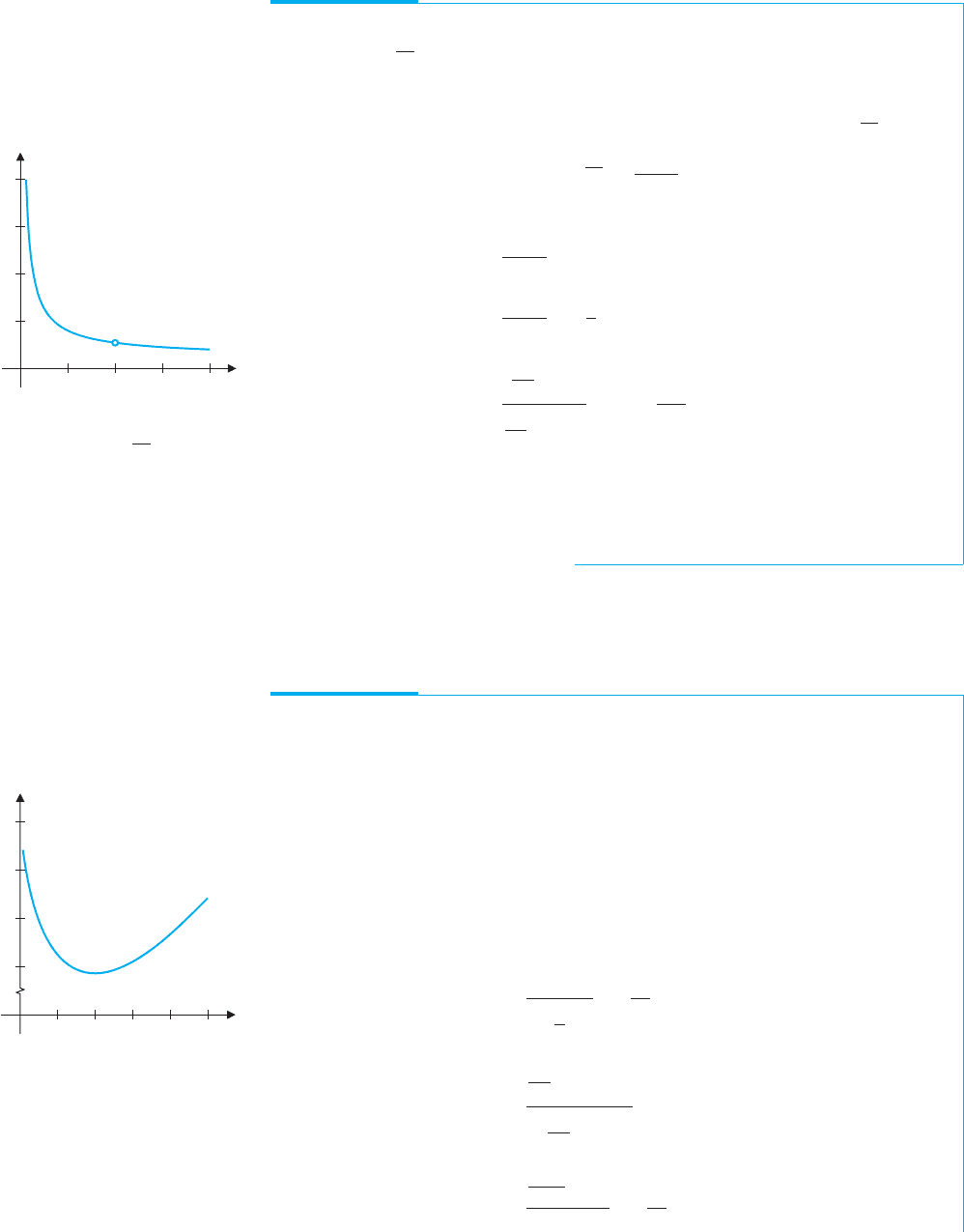
Solution First, note that this limit has the indeterminate form (1
∞
). From the graph in
Figure 7.9, it appears that the limit is somewhere around 3. We define y = x
1
x−1
, so that
ln y = ln x
1
x−1
=
1
x −1
ln x.
We now consider the limit
lim
x→1
+
ln y = lim
x→1
+
1
x −1
ln x (∞·0)
= lim
x→1
+
ln x
x −1
0
0
= lim
x→1
+
d
dx
(ln x)
d
dx
(x − 1)
= lim
x→1
+
x
−1
1
= 1.
By l’Hˆopital’s Rule.
Be careful; we have found that lim
x→1
+
ln y = 1, but this is not the original limit. We want
lim
x→1
+
y = lim
x→1
+
e
ln y
= e
1
,
which is consistent with Figure 7.9.
The computation of limits often requires several applications of l’Hˆopital’s Rule. Just
be careful (in particular, verify the hypotheses at every step) and do not lose sight of the
original problem.
EXAMPLE 6.9 The Indeterminate Form 0
0
Evaluate lim
x→0
+
(sin x)
x
.
x
0.2 0.4 0.6 0.8 1.0
0.7
0.8
0.9
1.0
y
FIGURE 7.10
y = (sin x)
x
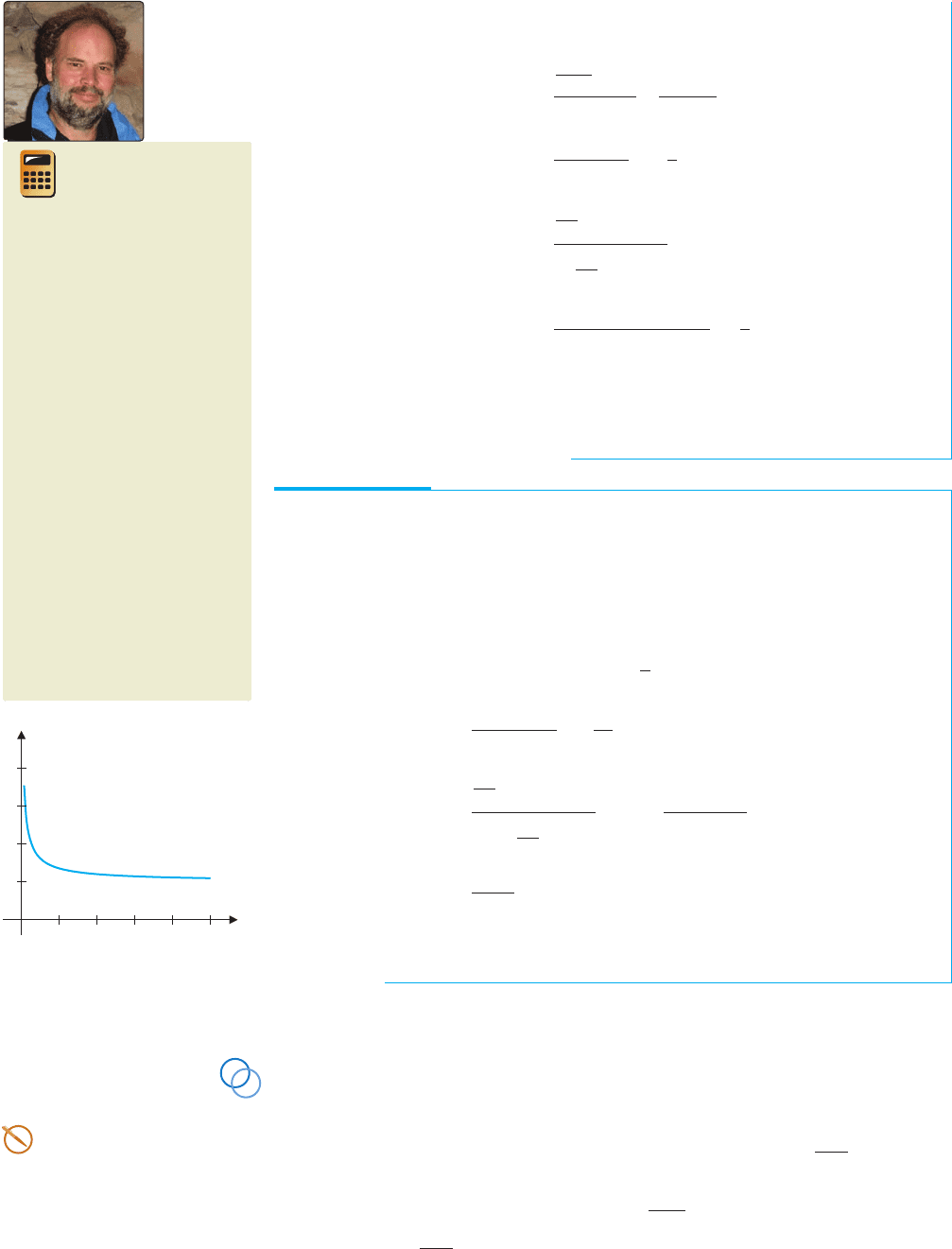
Solution This limit has the indeterminate form (0
0
). In Figure 7.10, it appears that the
limit is somewhere around 1. We let y = (sin x)
x
, so that
ln y = ln (sin x)
x
= x ln(sin x).
Now consider the limit
lim
x→0
+
ln y = lim
x→0
+
ln(sin x)
x
= lim
x→0
+
[x ln(sin x)] (0 ·∞)
= lim
x→0
+
ln(sin x)
1
x
∞
∞
= lim
x→0
+
d
dx
[ln(sin x)]
d
dx
(x
−1
)
By l’Hˆopital’s Rule.
= lim
x→0
+
1
sin x
cos x
−x
−2
∞
∞
.
P1: OSO/OVY P2: OSO/OVY QC: OSO/OVY T1: OSO
MHDQ256-Ch07 MHDQ256-Smith-v1.cls December 23, 2010 21:26
LT (Late Transcendental)
CONFIRMING PAGES
464 CHAPTER 7
..
Integration Techniques 7-44
As we have seen earlier, we should rewrite the expression before proceeding. Here, we
multiply top and bottom by x
2
sin x to get
lim
x→0
+
ln y = lim
x→0
+
1
sin x
cos x
−x
−2
x
2
sin x
x
2
sin x
= lim
x→0
+
−x
2
cos x
sin x
0
0
= lim
x→0
+
d
dx
(−x
2
cos x)
d
dx
(sin x)
By l’Hˆopital’s Rule.
= lim
x→0
+
−2x cos x + x
2
sin x
cos x
=
0
1
= 0.
Again, we have not yet found the original limit. However,
lim
x→0
+
y = lim
x→0
+
e
ln y
= e
0
= 1,
which is consistent with Figure 7.10.
TODAY IN
MATHEMATICS
Vaughan Jones (1952– )
A New Zealand mathematician
whose work has connected
apparently disjoint areas
of mathematics. He was awarded
the Fields Medal in 1990 for
mathematics that was described
by peers as “astonishing.” One
of his major accomplishments
is a discovery in knot theory
that has given biologists insight
into the replication of DNA.
A strong supporter of science and
mathematics education in New
Zealand, Jones’ “style of working
is informal, and one which
encourages the free and open
interchange of ideas ...His open-
ness and generosity in this regard
have been in the best tradition and
spirit of mathematics.” His ideas
have “served as a rich source
of ideas for the work of others.”
y
x
20 40 60 80 100
1
2
3
4
FIGURE 7.11
y = (x + 1)
2/x
EXAMPLE 6.10 The Indeterminate Form ∞
0
Evaluate lim
x→∞
(x + 1)
2/x
.
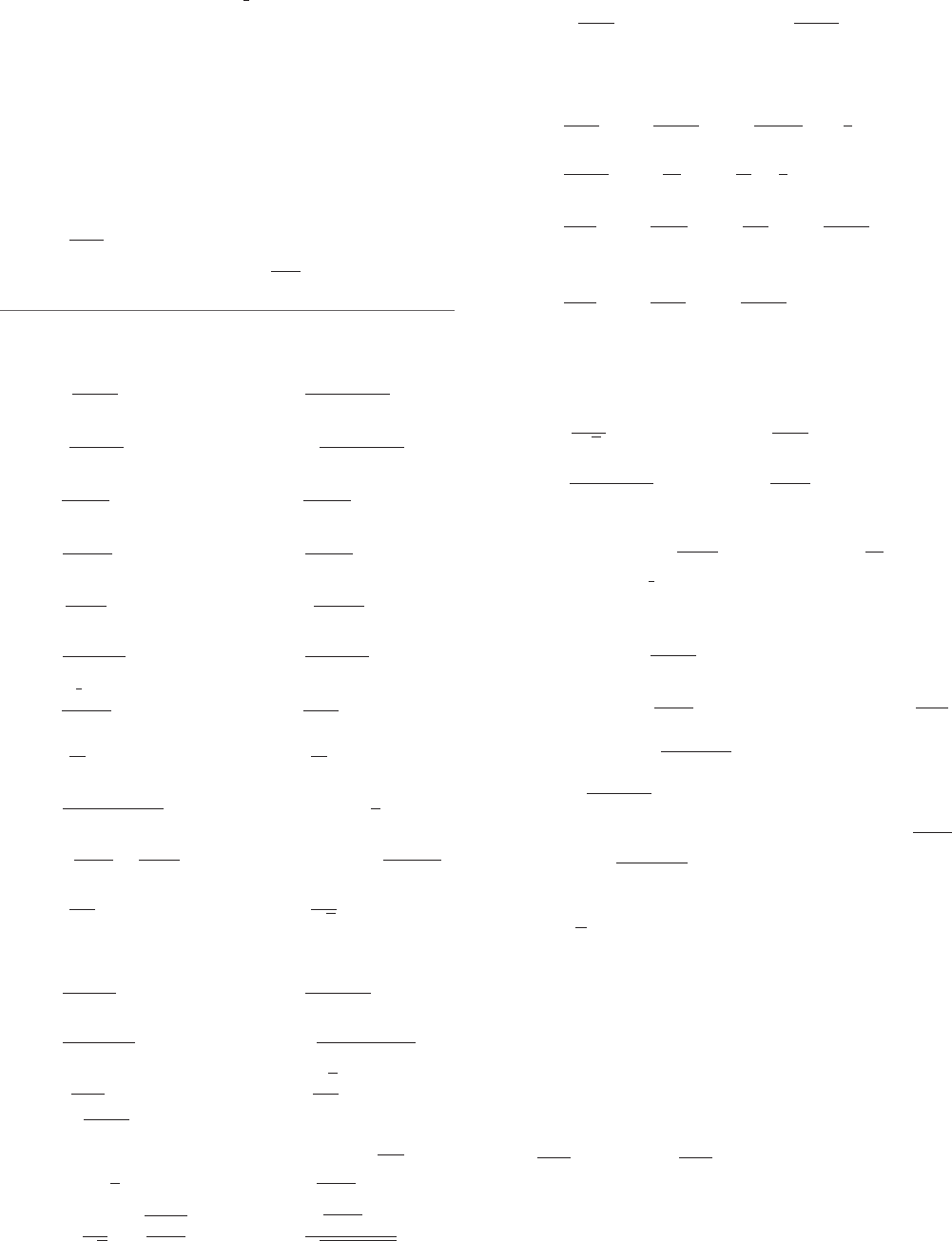
Solution This limit has the indeterminate form (∞
0
). From the graph in Figure 7.11,
it appears that the function tends to a limit around 1 as x →∞.Welety = (x + 1)
2/x
and consider
lim
x→∞
ln y = lim
x→∞
ln(x + 1)
2/x
= lim
x→∞
2
x
ln(x + 1)
(0 ·∞)
= lim
x→∞
2ln(x + 1)
x
∞
∞
= lim
x→∞
d
dx
[2ln (x +1)]
d
dx
x
= lim
x→∞
2(x + 1)
−1
1
By l’Hˆopital’s Rule.
= lim
x→∞
2
x +1
= 0.
We now have that
lim
x→∞
y = lim
x→∞
e
ln y
= e
0
= 1,
as expected.
EXERCISES 7.6
WRITING EXERCISES
1. L’H ˆopital’s Rule states that, in certain situations, the ratios of
function values approach the same limits as the ratios of corre-
sponding derivatives (rates of change). Graphically, this may
be hard to understand. To get a handle on this, consider
f (x)
g(x)
where both f (x) = ax +b and g(x) = cx +d are linear
functions. Explain why the value of lim
x→∞
f (x)
g(x)
should depend
on the relative sizes of the slopes of the lines; that is, it should
be equal to lim
x→∞
f
(x)
g
(x)
.
2. Think of a limit of 0 as actually meaning “getting very small”
and a limit of ∞ as meaning “getting very large.” Discuss
P1: OSO/OVY P2: OSO/OVY QC: OSO/OVY T1: OSO
MHDQ256-Ch07 MHDQ256-Smith-v1.cls December 23, 2010 21:26
LT (Late Transcendental)
CONFIRMING PAGES
7-45 SECTION 7.6
..
Indeterminate Forms and L’H
ˆ
opital’s Rule 465
whether the following limit forms areindeterminate or not and
explainyour answer: ∞−∞,
1
0
, 0·∞, ∞·∞, ∞
0
, 0
∞
and0
0
.
3. A friend is struggling with l’Hˆopital’s Rule. When asked to
work a problem, your friend says, “First, I plug in for x and
get 0 over 0. Then I use the quotient rule to take the derivative.
Then I plug x back in.” Explain to your friend what the mistake
is and how to correct it.
4. Suppose that two runners begin a race from the starting line,
with one runner initially going twice as fast as the other. If
f (t) and g(t) represent the positions of the runners at time
t ≥ 0, explain why we can assume that f (0) = g(0) = 0 and
lim
t→0
+
f
(t)
g
(t)
= 2. Explain in terms of the runners’ positions why
l’Hˆopital’s Rule holds: that is, lim
t→0
f (t)
g(t)
= 2.
In exercises 1–40, find the indicated limits.
1. lim
x→−2
x + 2
x
2
− 4
2. lim
x→2
x
2
− 4
x
2
− 3x + 2
3. lim
x→∞
3x
2
+ 2
x
2
− 4
4. lim
x→−∞
x + 1
x
2
+ 4x + 3
5. lim
t→0
e
2t
− 1
t
6. lim
t→0
sint
e
3t
− 1
7. lim
x→0
tan
−1
x
sin x
8. lim
x→0
sin x
sin
−1
x
9. lim
x→π
sin2x
sin x
10. lim
x→−1
cos
−1
x
x
2
− 1
11. lim
x→0
sin x − x
x
3
12. lim
x→0
tan x − x
x
3
13. lim
t→1
√
t − 1
t − 1
14. lim
t→1
lnt
t − 1
15. lim
x→∞
x
3
e
x
16. lim
x→∞
e
x
x
4
17. lim
x→0
x cos x − sin x
x sin
2
x
18. lim
x→0
cot x −
1
x
19. lim
x→1
x + 1
x
−
2
sin2x
20. lim
x→π/2
tan x +
1
x − π/2
21. lim
x→∞
ln x
x
2
22. lim
x→∞
ln x
√
x
23. lim
t→∞
te
−t
24. lim
t→∞
t sin(1/t)
25. lim
x→1
ln(ln x)
ln x
26. lim
x→0
sin(sin x)
sin x
27. lim
x→0
sin(sinh x)
sinh(sin x)
28. lim
x→0
sin x − sinh x
cos x − cosh x
29. lim
x→0
+
ln x
cot x
30. lim
x→0
+
√
x
ln x
31. lim
x→∞
(
x
2
+ 1 − x) 32. lim
x→∞
(ln x − x)
33. lim
x→∞
1 +
1
x
x
34. lim
x→∞
x + 1
x − 2
√
x
2
−4
35. lim
x→0
+
1
√
x
−
x
x + 1
36. lim
x→1
√
5 − x − 2
√
10 − x − 3
37. lim
x→0
+
(1/x)
x
38. lim
x→0
+
(cos x)
1/x
39. lim
t→∞
t − 3
t + 2
t
40. lim
t→∞
t − 3
2t + 1
t
............................................................
In exercises 41–44, find all error(s).
41. lim
x→0
cos x
x
2
= lim
x→0
−sin x
2x
= lim
x→0
−cos x
2
=−
1
2
42. lim
x→0
e
x
− 1
x
2
= lim
x→0
e
x
2x
= lim
x→0
e
x
2
=
1
2
43. lim
x→0
x
2
ln x
2
= lim
x→0
x
2
2lnx
= lim
x→0
2x
2/x
= lim
x→0
2
−2/x
2
= lim
x→0
(−x
2
) = 0
44. lim
x→0
sin x
x
2
= lim
x→0
cos x
2x
= lim
x→0
−sin x
2
= 0
............................................................
In exercises 45–48, name the method by determining whether
or not l’Hˆopital’s Rule applies.
45. lim
x→0
+
csc x
√
x
46. lim
x→0
+
x
−3/2
ln x
47. lim
x→∞
x
2
− 3x + 1
tan
−1
x
48. lim
x→∞
ln(x
2
)
e
x/3
............................................................
49. (a) Starting with lim
x→0
sin3x
sin2x
,cancelsintoget lim
x→0
3x
2x
,thencan-
cel x’s to get
3
2
. This answer is correct. Is either of the steps
used valid? Use linear approximations to argue that the first
step is likely to give a correct answer.
(b) Evaluate lim
x→0
sinnx
sinmx
for nonzero constants n and m.
50. (a) Compute lim
x→0
sin x
2
x
2
and compare your result to lim
x→0
sin x
x
.
(b) Compute lim
x→0
1 − cos x
2
x
4
and compare your result to
lim
x→0
1 − cos x
x
2
.
(c) Useyourresultsfromparts(a)and(b)toevaluate lim
x→0
sin x
3
x
3
and lim
x→0
1 − cos x
3
x
6
without doing any calculations.
51. Find functions f such that lim
x→∞
f (x) has the indeterminate
form
∞
∞
, but where the limit (a) does not exist; (b) equals 0;
(c) equals 3 and (d) equals −4.
52. Find functions f such that lim
x→∞
f (x) has the indeterminate
form ∞−∞, but where the limit (a) does not exist; (b) equals
0 and (c) equals 2.
............................................................
In exercises 53 and 54, determine which function “dominates,”
where we say that the function f (x) dominates the func-
tion g(x)asx → ∞ if lim
x→∞
f (x) lim
x→∞
g(x) ∞ and either
lim
x→∞
f (x)
g(x)
∞ or lim
x→∞
g(x)
f (x)
0.
53. e
x
or x
n
(n = any positive integer)
54. ln x or x
p
(for any number p > 0)
............................................................
P1: OSO/OVY P2: OSO/OVY QC: OSO/OVY T1: OSO
MHDQ256-Ch07 MHDQ256-Smith-v1.cls December 24, 2010 16:1
LT (Late Transcendental)
CONFIRMING PAGES
466 CHAPTER 7
..
Integration Techniques 7-46
55. Based on exercise 53, conjecture lim
t→∞
(e
t/2
− t
3
). Prove that
your conjecture is correct.
56. Evaluate lim
x→∞
√
x − ln x
√
x
. In the long run, what fraction of
√
x
does
√
x − ln x represent?
57. Evaluate lim
x→∞
ln(x
3
+ 2x + 1)
ln(x
2
+ x + 2)
. Generalize your result to
lim
x→∞
ln(p(x))
ln(q(x))
for polynomials p and q such that p(x) > 0
and q(x) > 0 for x > 0.
58. Evaluate lim
x→∞
ln(e
3x
+ x)
ln(e
2x
+ 4)
. Generalize your result to
lim
x→∞
ln(e
kx
+ p(x))
ln(e
cx
+q(x))
for polynomials p and q and positive
numbers k and c.
59. If lim
x→0
f (x)
g(x)
= L, what can be said about lim
x→0
f (x
2
)
g(x
2
)
? Explain
why knowingthat lim
x→a
f (x)
g(x)
= L for a = 0, 1 does not tell you
anything about lim
x→a
f (x
2
)
g(x
2
)
.
60. Give an example of functions f and g for which lim
x→0
f (x
2
)
g(x
2
)
exists, but lim
x→0
f (x)
g(x)
does not exist.
APPLICATIONS
61. In section 1.2, we briefly discussed the position of a baseball
thrown with the unusual knuckleball pitch. The left/right posi-
tion (in feet) of a ball thrown with spin rate ω and a particular
gripattimet secondsis f (ω) = (2.5/ω)t − (2.5/4ω
2
)sin 4ωt.
Treatingt as a constant and ω as the variable(changeto x ifyou
like), show that lim
ω→0
f (ω) = 0 for any value of t. (Hint: Find
a common denominator and use l’Hˆopital’s Rule.) Conclude
that this pitch does not move left or right at all.
62. In this exercise, we look at a knuckleball thrown with a differ-
ent grip than that of exercise 61. The left or right position (in
feet) of a ball thrown with spin rate ω and this new grip at time
t seconds is f (ω) = (2.5/4ω
2
) − (2.5/4ω
2
)sin(4ωt + π/2).
Treating t as a constant and ω as the variable (change to
x if you like), find lim
ω→0
f (ω). Your answer should depend
on t. By graphing this function of t, you can see the path
of the pitch (use a domain of 0 ≤ t ≤ 0.68). Describe this
pitch.
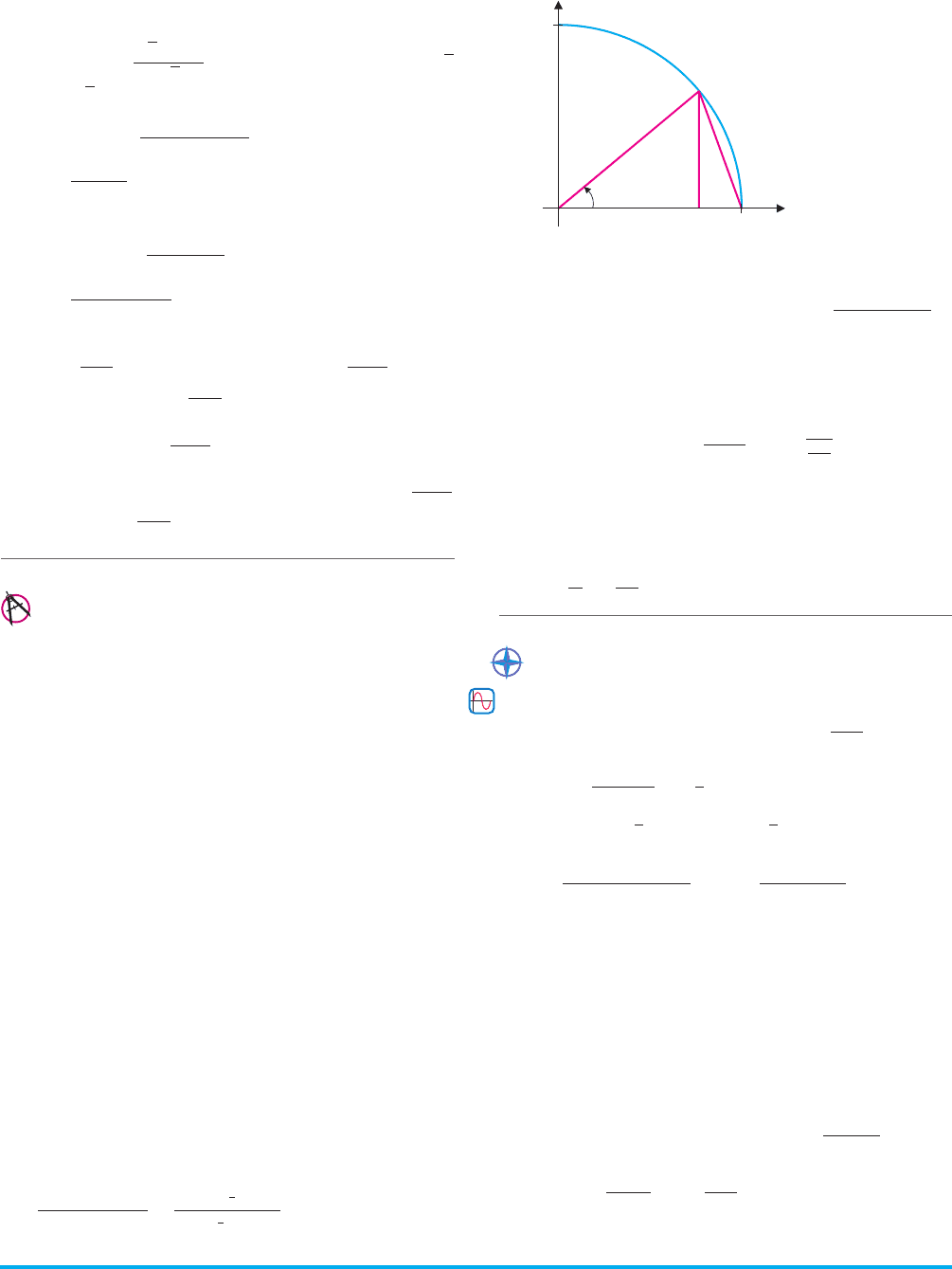
63. In the figure shown here, a section of the unit circle is deter-
mined by an angle θ. Region 1 is the triangle ABC. Region 2
is bounded by the line segments AB and BC and the arc of the
circle. As the angle θ decreases, the difference between the
two regions decreases, also. You might expect that the areas
of the regions become nearly equal, in which case the ratio
of the areas approaches 1. To see what really happens, show
that the area of region 1 divided by the area of region 2 equals
(1 − cos θ) sinθ
θ −cos θ sinθ
=
sinθ −
1
2
sin2θ
θ −
1
2
sin2θ
and find the limit of this
expression as θ → 0. Surprise!
1
1
x
B
A
C
θ
y
Exercise 63
64. The size of an animal’s pupils expand and contract depending
onthe amount of light available. Let f (x) =
160x
−0.4
+ 90
8x
−0.4
+ 10
be
the size in mm of the pupils at light intensity x. Find lim
x→0
+
f (x)
and lim
x→∞
f (x), and argue that these represent the largest and
smallest possible sizes of the pupils, respectively.
65. Thedownwardspeedofaskydiverofmassm actedonbygrav-
ity and air drag is v =
√
40mg tanh (
g
40m
t). Find (a) lim
t→∞
v
(b) lim
m→0
+
v (c) lim
m→∞
v and state what each limit represents in
terms of the sky diver.
66. The power of a reflecting telescope is proportional
to the surface area S of the parabolic reflector, with
S =
8π
3
c
2
d
2
16c
2
+ 1
3/2
− 1
fornumbersc andd.Find lim
c→∞
S.
EXPLORATORY EXERCISES
1. In this exercise, you take a quick look at what we call Taylor
series in Chapter 9. Start with the limit lim
x→0
sin x
x
= 1. Briefly
explain why this means that for x close to 0, sin x ≈ x. Show
that lim
x→0
sin x − x
x
3
=−
1
6
. This says that if x is close to 0, then
sin x − x ≈−
1
6
x
3
or sin x ≈ x −
1
6
x
3
. Graph these two func-
tions to see how well they match up. To continue, compute
lim
x→0
sin x − (x − x
3
/6)
x
4
and lim
x→0
sin x − f (x)
x
5
for the appro-
priate approximation f (x). At this point, look at the pattern of
terms you have (Hint: 6 = 3! and 120 = 5!). Using this pat-
tern, approximate sin x with an 11th-degree polynomial and
graph the two functions.
2. Azeroofafunction f (x)isasolutionoftheequation f (x) = 0.
Clearly, not all zeros are created equal. For example, x = 1
is a zero of f (x) = x − 1, but in some ways it seems that
x = 1 should count as two zeros of f (x) = (x − 1)
2
. To quan-
tify this, we say that x = 1isazero of multiplicity 2 of
f (x) = (x − 1)
2
. The precise definition is: x = c is a zero of
multiplicity n of f (x)if f (c) = 0 and lim
x→c
f (x)
(x − c)
n
existsand
is nonzero. Thus, x = 0 is a zero of multiplicity 2 of x sin x
since lim
x→0
x sin x
x
2
= lim
x→0
sin x
x
= 1. Find the multiplicity of
each zero of the following functions: x
2
sin x, x sin x
2
,
x
4
sin x
3
, (x −1) ln x, ln(x − 1)
2
, e
x
− 1 and cos x − 1.
P1: OSO/OVY P2: OSO/OVY QC: OSO/OVY T1: OSO
MHDQ256-Ch07 MHDQ256-Smith-v1.cls December 23, 2010 21:26
LT (Late Transcendental)
CONFIRMING PAGES
7-47 SECTION 7.7
..
Improper Integrals 467
7.7 IMPROPER INTEGRALS
Improper Integrals with a Discontinuous Integrand
The phrase “familiarity breeds contempt” has particular relevance for us in this section.
You have been using the Fundamental Theorem of Calculus for quite some time now, but
do you always check to see that the hypotheses are met? Try to see what is wrong with the
following erroneous calculation.
2
−1
1
x
2
dx =
x
−1
−1
2
−1
=−
3
2
.
This is incorrect!
There is something fundamentally wrong with this “calculation.” Note that f (x) = 1/x
2
is
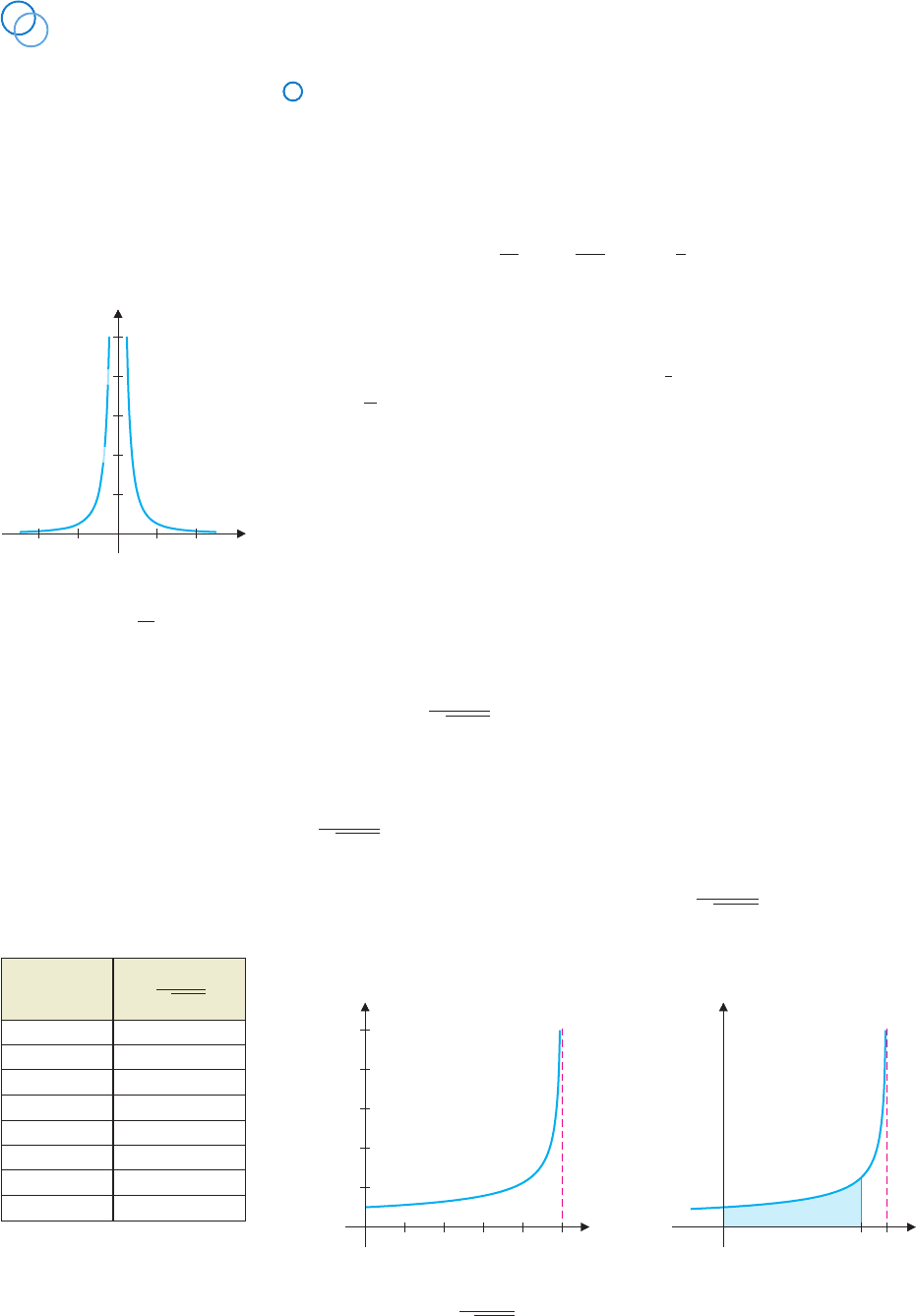
not continuous over the interval of integration. (See Figure 7.12.) Since the Fundamental
Theorem assumes a continuous integrand, our use of the theorem is invalid and our answer
is incorrect. Further, note that an answer of −
3
2
is especially suspicious given that the
integrand
1
x
2
is always positive.
y
x
2 424
2
4
FIGURE 7.12
y =
1
x
2
Recall from Chapter 4, that we define the definite integral by
b
a
f (x) dx = lim
n→∞
n
i=1
f (c
i
)x,
where c
i
is taken to be any point in the subinterval [x
i−1
, x
i
], for i = 1, 2,...,n and where
the limit must be the same for any choice of these c
i
’s. So, if f (x) →∞[or f (x) →−∞]
at some point in [a, b], then the limit defining
b
a
f (x) dx is meaningless. [How would we
add f (c
i
) to the sum, if f (x) →∞as x → c
i
?] In this case, we call such an integral an
improper integral and we will need to carefully define what we mean by this. First, we
examine a somewhat simpler case.
Consider
1
0
1
√
1 − x
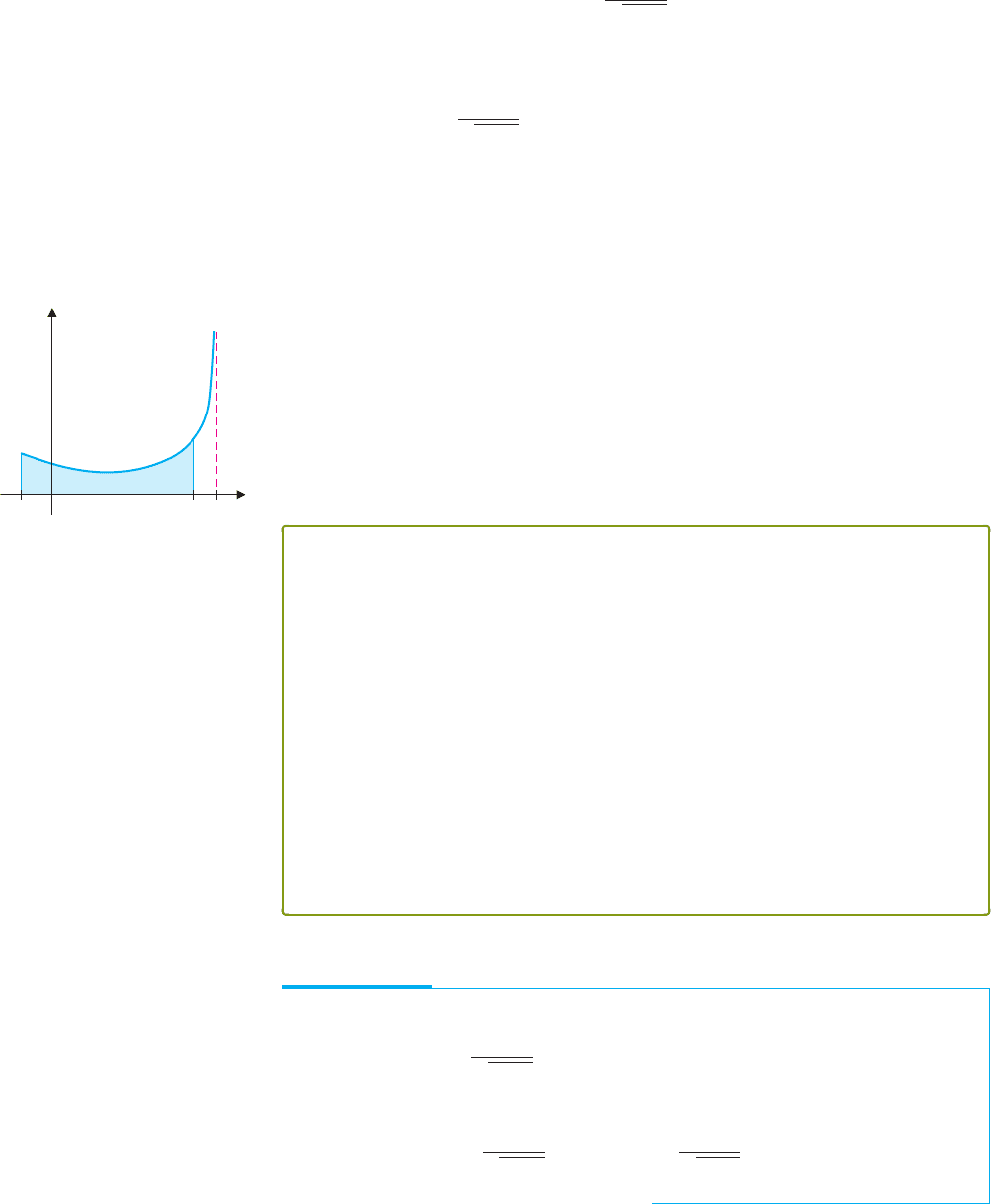
dx. Observe that this is not a proper definite integral, as the
integrand is undefined at x = 1. In Figure 7.13a, note that the integrand blows up to ∞ as
x → 1
−
. Despite this, can we find the area under the curve on the interval [0, 1]? Assuming
the area is finite, notice from Figure 7.13b that for 0 < R < 1, we can approximate it by
R
0
1
√
1 − x
dx.Thisisaproperdefiniteintegral,sincefor0 ≤ x ≤ R < 1, f iscontinuous.
Further, the closer R is to 1, the better the approximation should be. In the accompanying
table, we compute some approximate values of
R
0
1
√
1 − x
dx, for a sequence of values
of R approaching 1.
R
R
0
1
√
1−x
dx
0.9 1.367544
0.99 1.8
0.999 1.936754
0.9999 1.98
0.99999 1.993675
0.999999 1.998
0.9999999 1.999368
0.99999999 1.9998
y
x
0.2 0.4 0.6 0.8 1.0
2
4
6
8
10
y
x
1R
FIGURE 7.13a
y =
1
√
1 − x
FIGURE 7.13b
R
0
f (x) dx
P1: OSO/OVY P2: OSO/OVY QC: OSO/OVY T1: OSO
MHDQ256-Ch07 MHDQ256-Smith-v1.cls December 23, 2010 21:26
LT (Late Transcendental)
CONFIRMING PAGES
468 CHAPTER 7
..
Integration Techniques 7-48
Fromthe table, thesequenceofintegralsseemsto be approaching 2,as R → 1
−
.Notice
that since we know how to compute
R
0
1
√
1 − x
dx, for any 0 < R < 1, we can compute
this limiting value exactly. We have
lim
R→1
−
R
0
1
√
1 − x
dx = lim
R→1
−
−2(1 − x)
1/2
R
0
= lim
R→1
−
−2(1 − R)
1/2
+ 2(1 −0)
1/2
= 2.
From this computation, we can see that the area under the curve is the limiting value, 2.
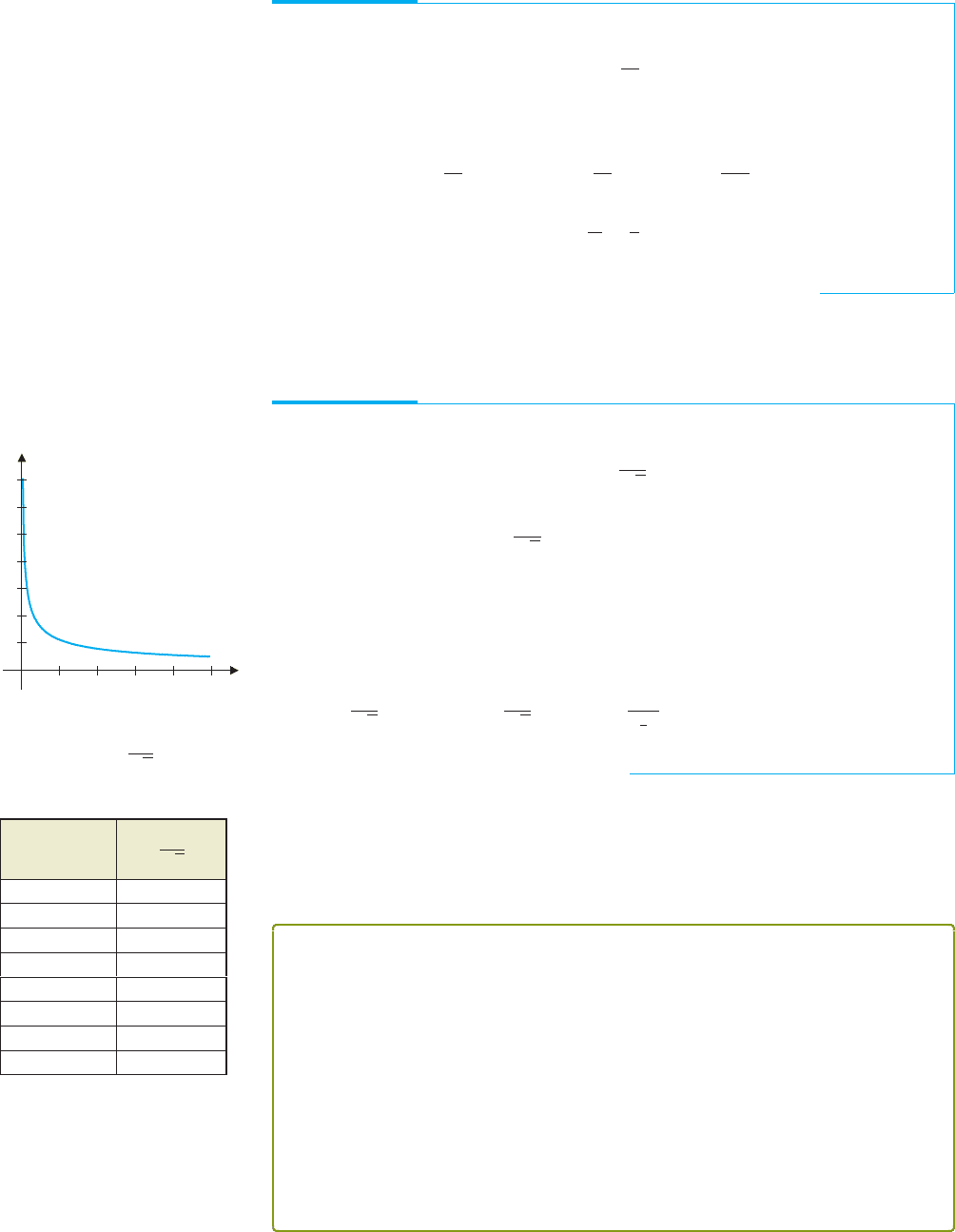
In general, suppose that f is continuous on the interval [a, b) and | f (x)|→∞,as
x → b
−
(i.e., as x approaches b from the left). Then we can approximate
b
a
f (x) dx by
R
a
f (x) dx, for some R < b, but close to b. [Recall that since f is continuous on [a, R],
for any a < R < b,
R
a
f (x) dx is defined.] Further, as in our introductory example, the
closer R is to b, the better the approximation should be. See Figure 7.14 for a graphical
representation of this approximation.
Finally, let R → b
−
;if
R
a
f (x) dx approaches some value, L, then we define
the improper integral
b
a
f (x) dx to be this limiting value. We have the following
definition.
bRa
y
x
FIGURE 7.14
R
a
f (x) dx
DEFINITION 7.1
If f is continuous on the interval [a, b) and | f (x)|→∞as x → b
−
, we define the
improper integral of f on [a, b]by
b
a
f (x) dx = lim
R→b
−
R
a
f (x) dx.
Similarly, if f is continuous on (a, b] and | f (x)|→∞as x → a
+
, we define the
improper integral
b
a
f (x) dx = lim
R→a
+
b
R
f (x) dx.
In either case, if the limit exists (and equals some value L), we say that the improper
integral converges (to L). If the limit does not exist, we say that the improper integral
diverges.
EXAMPLE 7.1 An Integrand That Blows Up at the Right Endpoint
Determine whether
1
0
1
√
1 − x
dx converges or diverges.
Solution Based on the work we just completed,
1
0
1
√
1 − x
dx = lim
R→1
−
R
0
1
√
1 − x
dx = 2
and so, the improper integral converges to 2.
In example 7.2, we illustrate a divergent improper integral closely related to this
section’s introductory example.
P1: OSO/OVY P2: OSO/OVY QC: OSO/OVY T1: OSO
MHDQ256-Ch07 MHDQ256-Smith-v1.cls December 23, 2010 21:26
LT (Late Transcendental)
CONFIRMING PAGES
7-49 SECTION 7.7
..
Improper Integrals 469
EXAMPLE 7.2 A Divergent Improper Integral
Determine whether the improper integral
0
−1
1
x
2
dx converges or diverges.
Solution From Definition 7.1, we have
0
−1
1
x
2
dx = lim
R→0
−
R
−1
1
x
2
dx = lim
R→0
−
x
−1
−1
R
−1
= lim
R→0
−
−
1
R
−
1
1
=∞.
Since the defining limit does not exist, the improper integral diverges.
In example 7.3, the integrand is discontinuous at the lower limit of integration.
y
x
0.2 0.4 0.6 0.8 1.0
2
4
6
8
10
12
14
FIGURE 7.15
y =
1
√
x
EXAMPLE 7.3 A Convergent Improper Integral
Determine whether the improper integral
1
0
1
√
x
dx converges or diverges.
R
1
R
1
√
x
dx
0.1 1.367544
0.01 1.8
0.001 1.936754
0.0001 1.98
0.00001 1.993675
0.000001 1.998
0.0000001 1.999368
0.00000001 1.9998
Solution We show a graph of the integrand on the interval in question in Figure 7.15.
Notice that in this case f (x) =
1
√
x
is continuous on (0, 1] and f (x) →∞as
x → 0
+
.
From the computed values shown in the table, it appears that the integrals
are approaching 2 as R → 0
+
. Since we know an antiderivative for the integrand, we
can compute these integrals exactly, for any fixed 0 < R < 1. We have from Definition
7.1 that
1
0
1
√
x
dx = lim
R→0
+
1
R
1
√
x
dx = lim
R→0
+
x
1/2
1
2
1
R
= lim
R→0
+
2(1
1/2
− R
1/2
) = 2
and so, the improper integral converges to 2.
The introductory example in this section represents a third type of improper integral,
one where the integrand blows up at a point in the interior of the interval (a, b). We can
define such an integral as follows.
DEFINITION 7.2
Suppose that f is continuous on the interval [a, b], except at some c ∈ (a, b), and
| f (x)|→∞as x → c. Again, the integral is improper and we write
b
a
f (x) dx =
c
a
f (x) dx +
b
c
f (x) dx.
If both
c
a
f (x) dx and
b
c
f (x) dx converge (to L
1
and L
2
, respectively), we say that
the improper integral
b
a
f (x) dx converges, also (to L
1
+ L
2
). If either of the
improper integrals
c
a
f (x) dx or
b
c
f (x) dx diverges, then we say that the improper
integral
b
a
f (x) dx diverges, also.
We can now return to our introductory example.
P1: OSO/OVY P2: OSO/OVY QC: OSO/OVY T1: OSO
MHDQ256-Ch07 MHDQ256-Smith-v1.cls January 21, 2011 8:44
LT (Late Transcendental)
CONFIRMING PAGES
470 CHAPTER 7
..
Integration Techniques 7-50
EXAMPLE 7.4 An Integrand That Blows Up in the Middle of an Interval
Determine whether the improper integral
2
−1
1
x
2
dx converges or diverges.
Solution From Definition 7.2, we have
2
−1
1
x
2
dx =
0
−1
1
x
2
dx +
2
0
1
x
2
dx.
In example 7.2, we determined that
0
−1
1
x
2
dx diverges. Thus,
2
−1
1
x
2
dx also diverges.
Note that you do not need to consider
2
0
1
x
2
dx (although it’s an easy exercise to show
that this, too, diverges). Keep in mind that if either of the two improper integrals defining
this type of improper integral diverges, then the original integral diverges, too.
HISTORICAL
NOTES
Pierre Simon Laplace
(1749–1827) A French
mathematician who utilized
improper integrals to develop the
Laplace transform and other
important mathematical
techniques. Laplace made
numerous contributions in
probability, celestial mechanics,
the theory of heat and a variety of
other mathematical topics. Adept
at political intrigue, Laplace
worked on a new calendar for the
French Revolution, served as an
advisor to Napoleon and was
named a marquis by the
Bourbons.
Improper Integrals with an Infinite Limit of Integration
Anothertypeofimproper integralthatisfrequently encounteredinapplicationsisone where
one or both of the limits of integration is infinite. Forinstance,
∞
0
e
−x
2
dx is of fundamental
importance in probability and statistics.
y
x
2 4 6 8 10
0.4
0.2
0.8
0.6
1.2
1.0
FIGURE 7.16
y =
1
x
2
So, given a continuous function f defined on [a, ∞), what could we mean by
∞
a
f (x) dx? Notice that the usual definition of the definite integral:
b
a
f (x) dx = lim
n→∞
n
i=1
f (c
i
)x,
where x =
b −a
n
, makes no sense when b =∞. We should define
∞
a
f (x) dx in some
way consistent with what we already know about integrals.
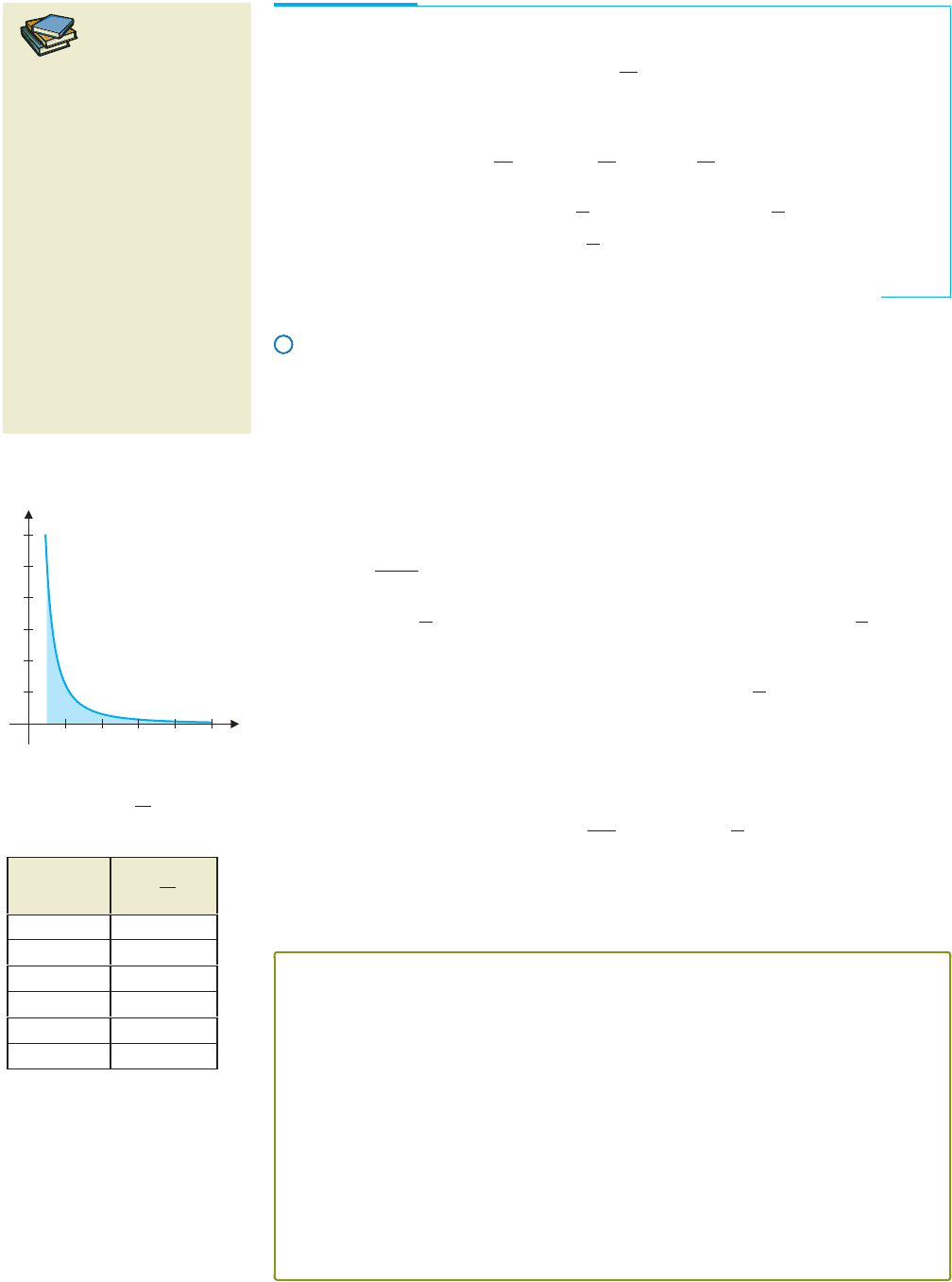
Since f (x) =
1
x
2
is positive and continuous on the interval [1, ∞),
∞
1
1
x
2
dx should
correspond to area under the curve, assuming this area is, in fact, finite (which is at least
plausible, based on the graph in Figure 7.16).
Assuming the area is finite, you could approximate it by
R
1
1
x
2
dx,for some large value
R. (Notice that this is a proper definite integral, as long as R is finite.) A sequence of values
of this integral for increasingly large values of R is displayed in the table.
R
R
1
1
x
2
dx
10 0.9
100 0.99
1000 0.999
10,000 0.9999
100,000 0.99999
1,000,000 0.999999
The sequence of approximating definite integrals seems to be approaching 1, as
R →∞. As it turns out, we can compute this limit exactly. We have
lim
R→∞
R
1
x
−2
dx = lim
R→∞
x
−1
−1
R
1
= lim
R→∞
−
1
R
+ 1
= 1.
Thus, the area under the curveon the interval[1, ∞) is seen to be 1, even though the interval
has infinite length.
More generally, we have Definition 7.3.
DEFINITION 7.3
If f is continuous on the interval [a, ∞), we define the improper integral
∞
a
f (x) dx to be
∞
a
f (x) dx = lim
R→∞
R
a
f (x) dx.
Similarly, if f is continuous on (−∞, a], we define
a
−∞
f (x) dx = lim
R→−∞
a
R
f (x) dx.
In either case, if the limit exists (and equals some value L), we say that the improper
integral converges (to L). If the limit does not exist, we say that the improper integral
diverges.
P1: OSO/OVY P2: OSO/OVY QC: OSO/OVY T1: OSO
MHDQ256-Ch07 MHDQ256-Smith-v1.cls December 23, 2010 21:26
LT (Late Transcendental)
CONFIRMING PAGES
7-51 SECTION 7.7
..
Improper Integrals 471
Youmayhavealreadyobservedthatforadecreasingfunction f,inorderfor
∞
a
f (x) dx
to converge, it must be the case that f (x) → 0asx →∞. (Think about this in terms of
area.) However, the reverse need not be true. That is, even though f (x) → 0asx →∞,
the improper integral may diverge, as we see in example 7.5.
EXAMPLE 7.5 A Divergent Improper Integral
Determine whether
∞
1
1
√
x
dx converges or diverges.
y
x
1 2 3 4 5
1
2
3
4
5
6
FIGURE 7.17
y =
1
√
x
y
x
2468
2
0.2
0.4
0.2
0.4
0.6
FIGURE 7.18
y = xe
x
Solution Note that
1
√
x
→ 0asx →∞. Further, from the graph in Figure 7.17, it
should seem at least plausible that the area under the curve is finite. However, from
Definition 7.3, we have that
∞
1
1
√
x
dx = lim
R→∞
R
1
x
−1/2
dx = lim
R→∞
x
1/2
1
2
R
1
= lim
R→∞
(2R
1/2
− 2) =∞.
This says that the improper integral diverges.
Note that our introductory example and example 7.5 are special cases of
∞
1
1
x
p
dx,
corresponding to p = 2 and p = 1/2, respectively. In the exercises, you will show that this
integral converges whenever p > 1 and diverges for p ≤ 1.
You may need to utilize l’Hˆopital’s Rule to evaluate the defining limit, as in
example 7.6.
EXAMPLE 7.6 A Convergent Improper Integral
Determine whether
0
−∞
xe
x
dx converges or diverges.
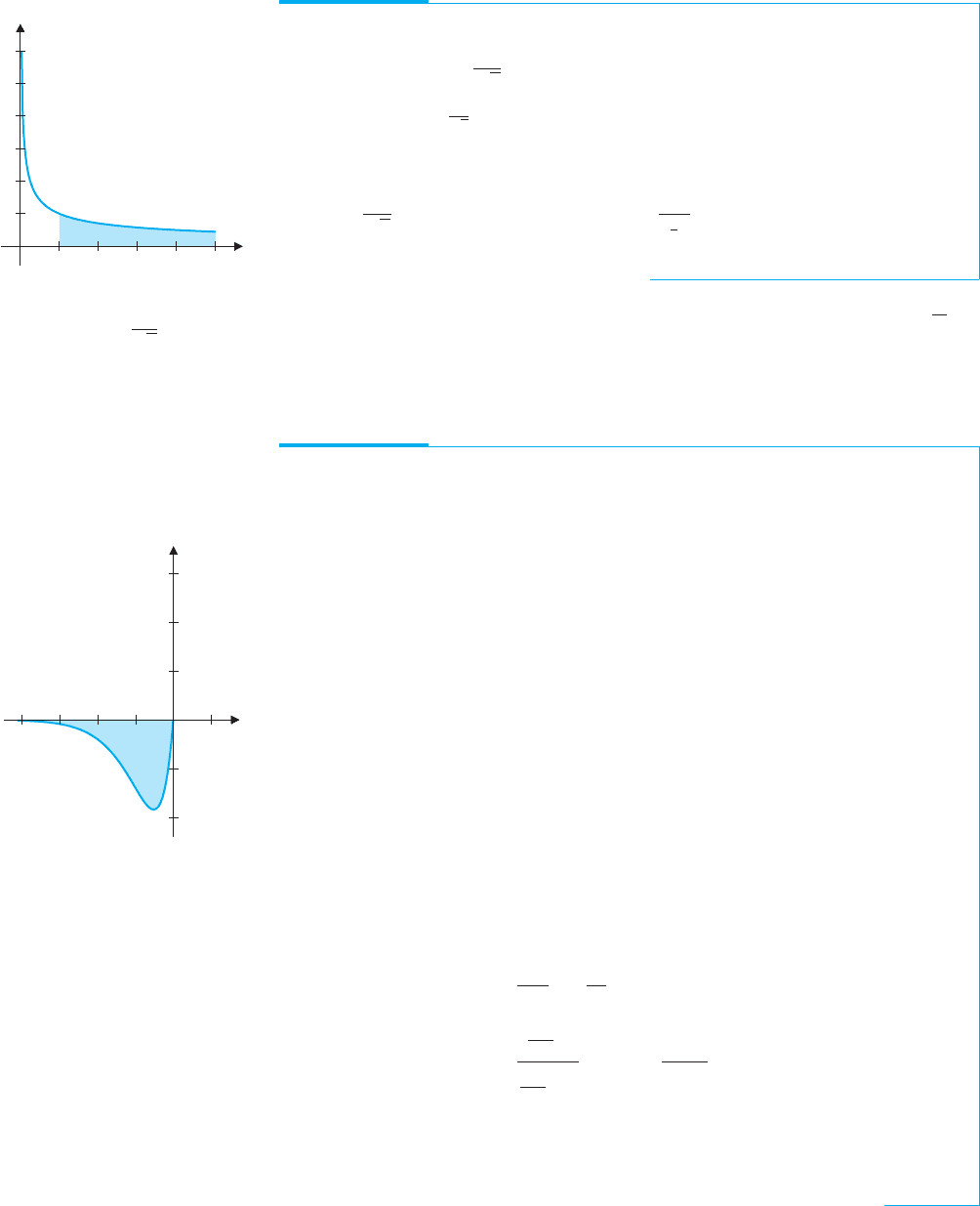
Solution The graph of y = xe
x
in Figure 7.18 makes it appear plausible that there
could be a finite area under the graph. From Definition 7.3, we have
0
−∞
xe
x
dx = lim
R→−∞
0
R
xe
x
dx.
To evaluate the last integral, you will need integration by parts. Let
u = xdv = e
x
dx
du = dx v = e
x
We then have
0
−∞
xe
x
dx = lim
R→−∞
0
R
xe
x
dx = lim
R→−∞
xe
x
0
R
−
0
R
e
x
dx
!
= lim
R→−∞
(0 − Re
R
) − e
x
0
R
= lim
R→−∞
(−Re
R
− e
0
+ e
R
).
Note that the limit lim
R→−∞
Re
R
has the indeterminate form ∞·0. We resolve this with
l’Hˆopital’s Rule, as follows:
lim
R→−∞
Re
R
= lim
R→−∞
R
e
−R
∞
∞
= lim
R→−∞
d
dR
R
d
dR
e
−R
= lim
R→−∞
1
−e
−R
= 0. By l’Hˆopital’s Rule.
Returning to the improper integral, we now have
0
−∞
xe
x
dx = lim
R→−∞
(−Re
R
− e
0
+ e
R
) = 0 − 1 + 0 =−1.
P1: OSO/OVY P2: OSO/OVY QC: OSO/OVY T1: OSO
MHDQ256-Ch07 MHDQ256-Smith-v1.cls December 23, 2010 21:26
LT (Late Transcendental)
CONFIRMING PAGES
472 CHAPTER 7
..
Integration Techniques 7-52
EXAMPLE 7.7 A Divergent Improper Integral
Determine whether
−1
−∞
1
x
dx converges or diverges.
Solution In Figure 7.19, it appears plausible that there might be a finite area bounded
between the graph of y =
1
x
and the x-axis, on the interval (−∞, −1]. However, from
Definition 7.3, we have
−1
−∞
1
x
dx = lim
R→−∞
−1
R
1
x
dx = lim
R→−∞
ln|x|
−1
R
= lim
R→−∞
[ln|−1|−ln |R|] =−∞
and hence, the improper integral diverges.
A final type of improper integral is
∞
−∞
f (x) dx, defined as follows.
DEFINITION 7.4
If f is continuous on (−∞, ∞), we write
∞
−∞
f (x) dx =
a
−∞
f (x) dx +
∞
a
f (x) dx, for any constant a,
where
∞
−∞
f (x) dx converges if and only if both
a
−∞
f (x) dx and
∞
a
f (x) dx
converge. If either one diverges, the original improper integral also diverges.
y
x
10 8 6 4 2
0.2
0.4
0.6
0.8
1.0
FIGURE 7.19
y =
1
x
y
x
4224
0.4
0.2
0.2
0.4
FIGURE 7.20
y = xe
−x
2
In Definition 7.4, note that you can choose a to be any real number. So, choose it to be
something convenient (usually 0).
EXAMPLE 7.8 An Integral with Two Infinite Limits of Integration
Determine whether
∞
−∞
xe
−x
2
dx converges or diverges.
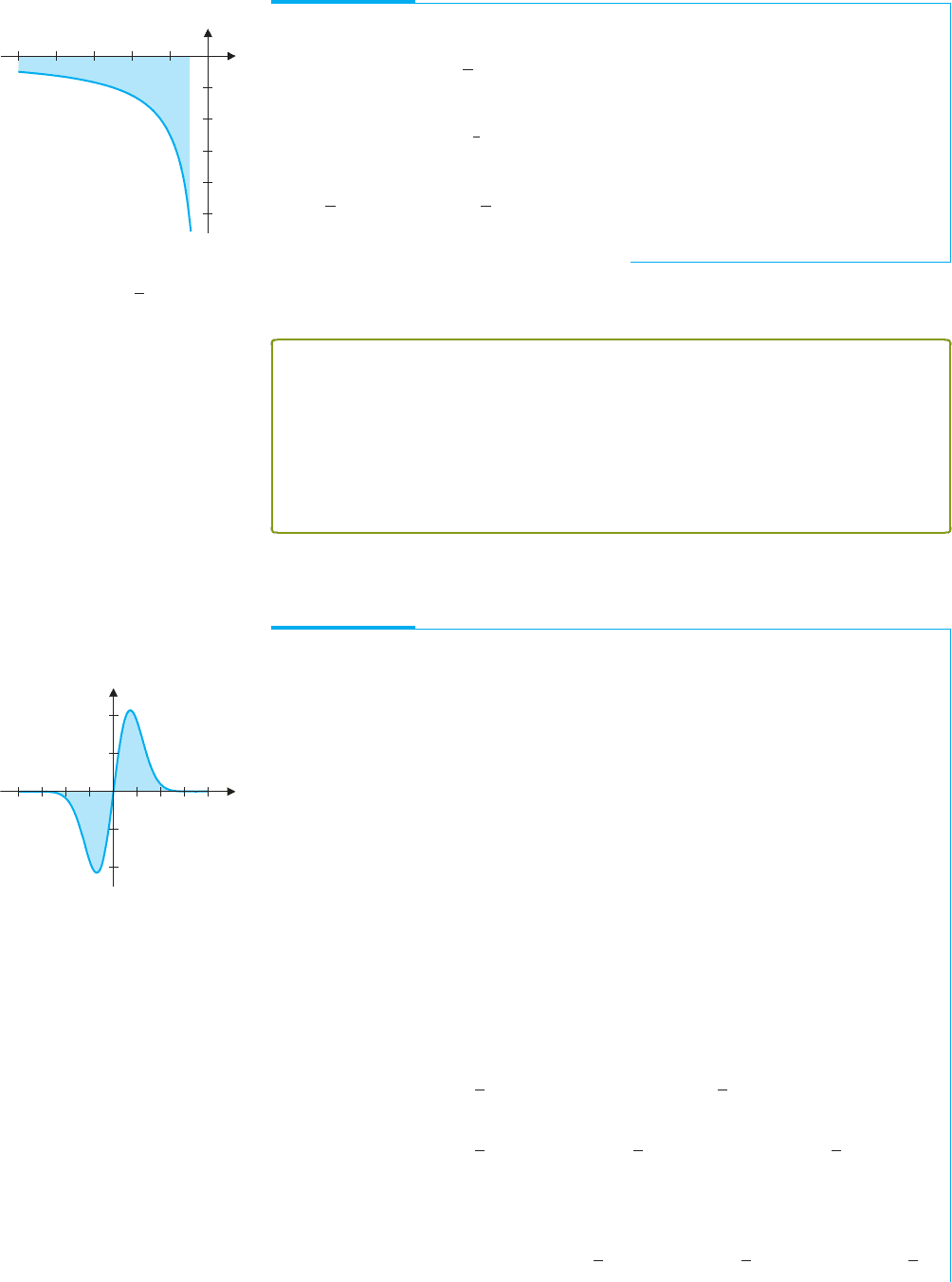
Solution Notice from the graph of the integrand in Figure 7.20 that, since the function
tends to 0 relatively quickly (both as x →∞and as x →−∞), it appears plausible
that there is a finite area bounded by the graph of the function and the x-axis. From
Definition 7.4 we have
∞
−∞
xe
−x
2
dx =
0
−∞
xe
−x
2
dx +
∞
0
xe
−x
2
dx. (7.1)
You must evaluate each of the improper integrals on the right side of (7.1) separately.
First, we have
0
−∞
xe
−x
2
dx = lim
R→−∞
0
R
xe
−x
2
dx.
Letting u =−x
2
,wehavedu =−2xdxand so, being careful to change the limits of
integration to match the new variable, we have
0
−∞
xe
−x
2
dx =−
1
2
lim
R→−∞
0
R
e
−x
2
(−2x)dx =−
1
2
lim
R→−∞
0
−R
2
e
u
du
=−
1
2
lim
R→−∞
e
u
0
−R
2
=−
1
2
lim
R→−∞
e
0
− e
−R
2
=−
1
2
.
Similarly, we get (you should fill in the details)
∞
0
xe
−x
2
dx = lim
R→∞
R
0
xe
−x
2
dx =−
1
2
lim
R→∞
e
u
−R
2
0
=−
1
2
lim
R→∞
(e
−R
2
− e
0
) =
1
2
.