
Smith R., Minton R. Calculus
Подождите немного. Документ загружается.


P1: OSO/OVY P2: OSO/OVY QC: OSO/OVY T1: OSO
MHDQ256-Ch07 MHDQ256-Smith-v1.cls December 23, 2010 21:26
LT (Late Transcendental)
CONFIRMING PAGES
7-33 SECTION 7.5
..
Integration Tables and Computer Algebra Systems 453
Solution You won’t find this integral or anything particularly close to it in our integral
table. However, with a little fiddling, we can rewrite this in a simpler form. First, use the
double-angle formula to rewrite the numerator of the integrand. We get
sin2x
√
4cos x − 1
dx = 2
sin x cos x
√
4cos x − 1
dx.
Remember to always be on the lookout for terms that are derivatives of other terms.
Here, taking u = cos x, we have du =−sin xdxand so,
sin2x
√
4cos x − 1
dx = 2
sin x cos x
√
4cos x − 1
dx =−2
u
√
4u − 1
du.
From our table (see number 18), notice that
u
√
a + bu
du =
2
3b
2
(bu −2a)
√
a + bu +c. (5.4)
Taking a =−1 and b = 4 in (5.4), we have
sin2x
√
4cos x − 1
dx =−2
u
√
4u − 1
du = (−2)
2
3(4
2
)
(4u + 2)
√
4u − 1 + c
=−
1
12
(4cos x + 2)
√
4cos x − 1 +c.
Integration Using a Computer Algebra System
Computer algebra systems are some of the most powerful new tools to arrive on the
mathematical scene in the last 25 years. They run the gamut from handheld calculators (like
the TI-89 and the HP-48) to powerful software systems (like Mathematica and Maple).
The examples that follow focus on some of the rare problems you may encounter us-
ing a CAS. We admit that we intentionally searched for CAS mistakes. The good news
is that the mistakes were very uncommon and the CAS you’re using won’t necessarily
make any of them. Be aware that these are software bugs and the next version of your
CAS may eliminate these completely. As an intelligent user of technology, you need to
be aware of common errors and have the calculus skills to catch mistakes when they
occur.
The first thing you notice when using a CAS to evaluate an indefinite integral is that
it typically supplies an antiderivative, instead of the most general one (the indefinite inte-
gral) by leaving off the constant of integration (a minor shortcoming of this very powerful
software).
EXAMPLE 5.5 A Shortcoming of Some Computer Algebra Systems
Use a computer algebra system to evaluate
1
x
dx.
Solution Many CASs evaluate
1
x
dx = ln x.
(Actually, one CAS reports the integral as log x, where it is using the notation log x to
denote the natural logarithm.) Not only is this missing the constant of integration, but

P1: OSO/OVY P2: OSO/OVY QC: OSO/OVY T1: OSO
MHDQ256-Ch07 MHDQ256-Smith-v1.cls December 23, 2010 21:26
LT (Late Transcendental)
CONFIRMING PAGES
454 CHAPTER 7
..
Integration Techniques 7-34
notice that this antiderivative is valid only for x > 0. A popular calculator returns the
more general antiderivative
1
x
dx = ln |x|,
which, while still missing the constant of integration, at least is valid for all x = 0.
On the other hand, all of the CASs we tested correctly evaluate
−1
−2
1
x
dx =−ln 2,
even though the reported antiderivative ln x is not defined at the limits of integration.
Sometimes the antiderivative reported by a CAS is not valid, as written, for any real
values of x, as in example 5.6. (In some cases, CASs give an antiderivative that is correct
for the more advanced case of a function of a complex variable.)
EXAMPLE 5.6 An Incorrect Antiderivative
Use a computer algebra system to evaluate
cos x
sin x − 2
dx.
Solution One CAS reports the incorrect antiderivative
cos x
sin x − 2
dx = ln(sin x − 2).
At first glance, this may not appear to be wrong, especially since the chain rule seems to
indicate that it’s correct:
d
dx
ln(sin x − 2) =
cos x
sin x − 2
.
This is incorrect!
The error is more fundamental (and subtle) than a misuse of the chain rule. Notice that
the expression ln(sinx −2) is undefined for all real values of x,assinx −2 < 0 for all
x. A general antiderivative rule that applies here is
f
(x)
f (x)
dx = ln | f (x)|+c,
where the absolute value is important. The correct antiderivative is ln|sin x − 2|+c,
which can also be written as ln(2 −sin x) + c since 2 −sin x > 0 for all x.
Probably the most common errors you will run into are actually your own. If you give
your CAS a problem in the wrong form, itmay solve a different problem than you intended.
One simple, but common, mistake is shown in example 5.7.
EXAMPLE 5.7 A Problem Where the CAS Misinterprets
What You Enter
Use a computer algebra system to evaluate
4x 8xdx.
Solution After entering the integrand as 4x8x, one CAS returned the odd answer
4x8xdx= 4x8xx.
You can easily evaluate the integral (first, rewrite the integrand as 32x
2
) to show this is
incorrect, but what was the error? Because of the odd way in which we wrote the
integrand, the CAS interpreted it as four times a variable named x8x, which is unrelated
to the variable of integration, x. Its answer is of the form
4cdx = 4cx.
TheformoftheantiderivativereportedbyaCASwillnotalwaysbethemostconvenient.
EXAMPLE 5.8 An Inconvenient Form of an Antiderivative
Use a computer algebra system to evaluate
x(x
2
+ 3)
5
dx.

P1: OSO/OVY P2: OSO/OVY QC: OSO/OVY T1: OSO
MHDQ256-Ch07 MHDQ256-Smith-v1.cls December 23, 2010 21:26
LT (Late Transcendental)
CONFIRMING PAGES
7-35 SECTION 7.5
..
Integration Tables and Computer Algebra Systems 455
Solution Several CASs evaluate
x(x
2
+ 3)
5
dx =
1
12
x
12
+
3
2
x
10
+
45
4
x
8
+ 45x
6
+
405
4
x
4
+
243
2
x
2
,
while others return the much simpler expression
x(x
2
+ 3)
5
dx =
(x
2
+ 3)
6
12
.
The two answers are equivalent, although they differ by a constant.
Typically, a CAS will perform even lengthy integrations with ease.
TODAY IN
MATHEMATICS
Jean-Christophe Yoccoz
(1957– ) A French
mathematician who earned a
Fields Medal for his contributions
to dynamical systems. His citation
for the Fields Medal stated, “He
combines an extremely acute
geometric intuition, an impressive
command of analysis, and a
penetrating combinatorial sense
to play the chess game at which
he excels. He occasionally spends
half a day on mathematical
‘experiments’ by hand or by
computer. ‘When I make such an
experiment,’ he says, ‘it is not just
the results that interest me, but
the manner in which it unfolds,
which sheds light on what is really
going on.’”
EXAMPLE 5.9 Some Good Integrals for Using a CAS
Use a computer algebra system to evaluate
x
3
sin2xdxand
x
10
sin2xdx.
Solution Using a CAS, you can get in one step
x
3
sin2xdx=−
1
2
x
3
cos2x +
3
4
x
2
sin2x +
3
4
x cos2x −
3
8
sin2x + c.
With the same effort, you can obtain
x
10
sin2xdx =−
1
2
x
10
cos2x +
5
2
x
9
sin2x +
45
4
x
8
cos2x − 45x
7
sin2x
−
315
2
x
6
cos2x +
945
2
x
5
sin2x +
4725
4
x
4
cos2x
−
4725
2
x
3
sin2x −
14,175
4
x
2
cos2x +
14,175
4
x sin2x
+
14,175
8
cos2x + c.
If you wanted to, you could even evaluate
x
100
sin2xdx,
although the large number of terms makes displaying the result prohibitive. Think about
doing this by hand, using a staggering 100 integrations by parts or by applying a
reduction formula 100 times.
You should get the idea by now: a CAS can perform repetitive calculations (numerical
or symbolic) that you could never dream of doing by hand. It is difficult to find a function
that has an elementary antiderivative that your CAS cannot find. Consider the following
example of a hard integral.
EXAMPLE 5.10 A Very Hard Integral
Evaluate
x
7
e
x
sin xdx.
Solution Consider what you would need to do to evaluate this integral by hand and
then use a computer algebra system. For instance, one CAS reports the antiderivative
x
7
e
x
sin xdx =
−
1
2
x
7
+
7
2
x
6
−
21
2
x
5
+ 105x
3
− 315x
2
+ 315x
e
x
cos x
+
1
2
x
7
−
21
2
x
5
+
105
2
x
4
− 105x
3
+ 315x − 315
e
x
sin x.
Don’t try this by hand unless you have plenty of time and patience. However, based on
your experience, observe that the form of the antiderivative is not surprising. (After all,
what kind of function could have x
7
e
x
sin x as its derivative?)
P1: OSO/OVY P2: OSO/OVY QC: OSO/OVY T1: OSO
MHDQ256-Ch07 MHDQ256-Smith-v1.cls December 23, 2010 21:26
LT (Late Transcendental)
CONFIRMING PAGES
456 CHAPTER 7
..
Integration Techniques 7-36
BEYOND FORMULAS
You may ask why we’ve spent so much time on integration techniques when you can
always let a CAS do the work for you. No, it’s not to prepare you in the event that
you are shipwrecked on a desert island without a CAS. Your CAS can solve virtually
all of the computational problems that arise in this text. On rare occasions, however, a
CAS-generated answer may be incorrect or misleading and you need to be prepared for
these. More importantly, many important insights in science and engineering require
an understanding of basic techniques of integration.
EXERCISES 7.5
WRITING EXERCISES
1. Suppose that you are hired by a company to develop a new
CAS. Outline a strategy for symbolic integration. Include pro-
visions for formulas in the Table of Integrals at the back of the
book and the various techniques you have studied.
2. In the text, we discussed the importance of knowing general
rules for integration. Consider the integral in example 5.4,
sin2x
√
4cos x − 1
dx. Can yourCAS evaluate this integral? For
many integrals like this that do show up in applications (there
are harder ones in the exploratory exercises), you have to do
some work before the technology can finish the task. For this
purpose, discuss the importance of recognizing basic forms
and understanding how substitution works.
In exercises 1–28, use the Table of Integrals at the back of the
book to find an antiderivative. Note: When checking the back
of the book or a CAS for answers, beware of functions that look
very different but that are equivalent (through a trig identity,
for instance).
1.
x
(2 + 4x)
2
dx 2.
x
2
(2 + 4x)
2
dx
3.
e
2x
√
1 + e
x
dx 4.
e
3x
1 + e
2x
dx
5.
x
2
√
1 + 4x
2
dx 6.
cos x
sin
2
x(3 +2sin x)
dx
7.
1
0
t
8
4 − t
6
dt 8.
ln4
0
16 − e
2t
dt
9.
ln2
0
e
x
√
e
2x
+ 4
dx 10.
2
√
3
x
√
x
4
− 9
x
2
dx
11.
√
6x − x
2
(x − 3)
2
dx 12.
sec
2
x
tan x
√
8tan x − tan
2
x
dx
13.
tan
6
udu 14.
csc
4
udu
15.
cos x
sin x
√
4 + sin x
dx 16.
x
5
√
4 + x
2
dx
17.
x
3
cos x
2
dx 18.
x sin3x
2
cos4x
2
dx
19.
sin2x
√
1 + cos x
dx 20.
x
√
1 + 4x
2
x
4
dx
21.
sin
2
t cost
sin
2
t + 4
dt 22.
ln
√
t
√
t
dt
23.
e
−2/x
2
x
3
dx 24.
x
3
e
2x
2
dx
25.
x
√
4x − x
2
dx 26.
e
5x
cos3xdx
27.
e
x
tan
−1
(e
x
)dx 28.
(ln4x)
3
dx
............................................................
29. Check your CAS against all examples in this section. Discuss
which errors, if any, your CAS makes.
30. Find out how your CAS evaluates
x sin xdx if you fail to
leave a space between x and sin x.
31. Have your CAS evaluate
(
√
1 − x +
√
x − 1) dx. If you get
an answer, explain why it’s wrong.
32. To find out if your CAS “knows” integration by parts, try
x
3
cos3xdx and
x
3
e
5x
cos3xdx. To see if it “knows”
reduction formulas, try
sec
5
xdx.
33. To find out how many trigonometric techniques your
CAS “knows,” try
sin
6
xdx,
sin
4
x cos
3
xdx and
tan
4
x sec
3
xdx.
34. Find out if your CAS has a special command (e.g., APART in
Mathematica) to do partial fractions decompositions. Also, try
x
2
+ 2x − 1
(x − 1)
2
(x
2
+ 4)
dx and
3x
(x
2
+ x + 2)
2
dx.
35. To find out if your CAS “knows” how to do substitution,
try
1
x
2
(3 + 2x)
dx and
cos x
sin
2
x(3 +2sin x)
dx. Try to
find one that your CAS can’t do: start with a basic for-
mulalike
1
|x|
√
x
2
− 1
dx = sec
−1
x + c andsubstituteyour
favoritefunction. With x = e
u
, the preceding integralbecomes
e
u
e
u
√
e
2u
− 1
du, which you can use to test your CAS.
P1: OSO/OVY P2: OSO/OVY QC: OSO/OVY T1: OSO
MHDQ256-Ch07 MHDQ256-Smith-v1.cls December 23, 2010 21:26
LT (Late Transcendental)
CONFIRMING PAGES
7-37 SECTION 7.6
..
Indeterminate Forms and L’H
ˆ
opital’s Rule 457
36. To compute the area of the ellipse
x
2
a
2
+
y
2
b
2
= 1, note that the
upper-right quarter of the ellipse is given by
y = b
1 −
x
2
a
2
for 0 ≤ x ≤ a. Thus, the area of the ellipse is
4b
a
0
1 −
x
2
a
2
dx. Try this integral on your CAS. The (im-
plicit) assumption we usually make is that a > 0, but your
CAS should not make this assumption for you. Does your
CAS give you πab or π b|a|?
37. Brieflyexplainwhat it means when yourCASreturns
f (x) dx
when asked to evaluate
f (x) dx.
EXPLORATORY EXERCISES
1. This exercise explores two aspects of a famous problem called
the brachistochrone problem. Imagine a bead sliding down
a thin wire that extends in some shape from the point (0, 0)
to the point (π, −2). Assume that gravity pulls the bead down
but that there is no friction or other force acting on the bead.
Thissituationiseasiesttoanalyzeusingparametricequations
where we have functions x(u) and y(u) giving the horizontal
and vertical position of the bead in terms of the variable u.
Examples of paths the bead might follow are
x(u) = πu
y(u) =−2u
and
x(u) = πu
y(u) = 2(u − 1)
2
− 2
and
x(u) = πu − sin π u
y(u) = cosπu − 1
.
In each case, the bead starts at (0, 0) for u = 0 and finishes
at (π, −2) for u = 1. Graph each path on your graphing calcu-
lator. The first path is a line, the second is a parabola and the
third is a special curve called a cycloid. The time it takes the
bead to travel a given path is
T =
1
√
g
1
0
[x
(u)]
2
+ [y
(u)]
2
−2y(u)
du,
where g is the gravitational constant. Compute this quantity
for the line and the parabola. Explain why the parabola would
be a faster path for the bead to slide down, even though the
line is shorter in distance. (Think of which would be a faster
hill to ski down.) It can be shown that the cycloid is the fastest
path possible. Try to get your CAS to compute the optimal
time. Comparing the graphs of the parabola and cycloid, what
important advantage does the cycloid have at the start of the
path?
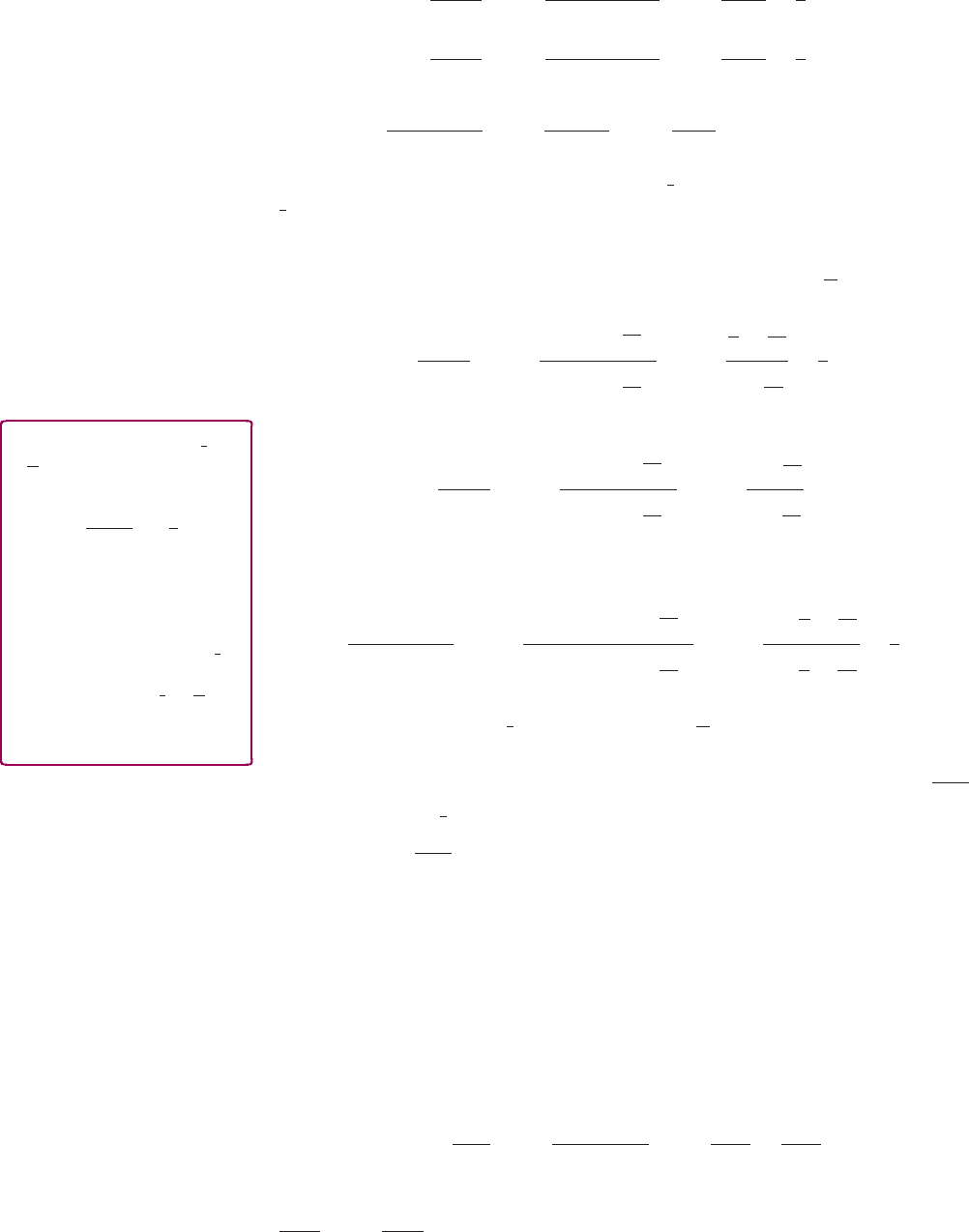
2. It turns out that the cycloid in exploratory exercise 1 has an
amazing property, along with providingthe fastest time (which
is essentially what the term brachistochrone means). The path
is shown in the figure.
y
x
1 2 3
2
1
Suppose that instead of starting the bead at the point (0, 0),
you start the bead partway down the path at x = c. How would
the time to reach the bottom from x = c compare to the total
time from x = 0? Note that the answer is not obvious, since
the farther down you start, the less speed the bead will gain.
If x = c corresponds to u = a, the time to reach the bottom is
given by
π
√
g
1
a
1 − cos πu
cosaπ − cos πu
du.Ifa = 0 (that is, the
bead starts at the top), the time is π/
√
g (the integral equals 1).
If you have a very good CAS, try to evaluate the integral for
various values of a between 0 and 1. If your CAS can’t handle
it, approximate the integral numerically. You should discover
the amazing fact that the integral always equals 1. The cycloid
also solves the tautochrone problem.
7.6 INDETERMINATE FORMS AND L’H
ˆ
OPITAL’S RULE
In this section, we reconsider the problem of computing limits. You have frequently seen
limits of the form
lim
x→a
f (x)
g(x)
,
where lim
x→a
f (x) = lim
x→a
g(x) = 0 or where lim
x→a
f (x) = lim
x→a
g(x) =∞(or −∞). Recall
that from either of these forms
0
0
or
∞
∞
, called indeterminate forms
, we cannot de-
termine the value of the limit, or even whether the limit exists, without additional work.
P1: OSO/OVY P2: OSO/OVY QC: OSO/OVY T1: OSO
MHDQ256-Ch07 MHDQ256-Smith-v1.cls December 23, 2010 21:26
LT (Late Transcendental)
CONFIRMING PAGES
458 CHAPTER 7
..
Integration Techniques 7-38
For instance, note that
lim
x→1
x
2
− 1
x −1
= lim
x→1
(x − 1)(x + 1)
x −1
= lim
x→1
x +1
1
=
2
1
= 2,
lim
x→1
x −1
x
2
− 1
= lim
x→1
x −1
(x − 1)(x + 1)
= lim
x→1
1
x +1
=
1
2
and lim
x→1
x −1
x
2
− 2x + 1
= lim
x→1
x −1
(x − 1)
2
= lim
x→1
1
x −1
, which does not exist,
CAUTION
We will frequently write
0
0
or
∞
∞
next to an expression, for
instance,
lim
x→1
x − 1
x
2
− 1
0
0
.
We use this shorthand to
indicate that the limit has the
indicated indeterminate form.
This notation does not mean
that the value of the limit is
0
0
.
You should take care to avoid
writing lim
x→a
f (x) =
0
0
or
∞
∞
,
as these are meaningless
expressions.
even though all three limits initially have the form
0
0
. The lesson here is that the expression
0
0
is mathematically meaningless. It indicates only that both the numerator and denominator
tend to zero and that we’ll need to dig deeper to find the value of the limit or whether the
limit even exists.
Similarly, each of the following limits has the indeterminate form
∞
∞
:
lim
x→∞
x
2
+ 1
x
3
+ 5
= lim
x→∞
(x
2
+ 1)
1
x
3
(x
3
+ 5)
1
x
3
= lim
x→∞
1
x
+
1
x
3
1 +
5
x
3
=
0
1
= 0,
lim
x→∞
x
3
+ 5
x
2
+ 1
= lim
x→∞
(x
3
+ 5)
1
x
2
(x
2
+ 1)
1
x
2
= lim
x→∞
x +
5
x
2
1 +
1
x
2
=∞
and
lim
x→∞
2x
2
+ 3x − 5
x
2
+ 4x − 11
= lim
x→∞
(2x
2
+ 3x − 5)
1
x
2
(x
2
+ 4x − 11)
1
x
2
= lim
x→∞
2 +
3
x
−
5
x
2
1 +
4
x
−
11
x
2
=
2
1
= 2.
So, as with limits of the form
0
0
, if a limit has the form
∞
∞
, we must dig deeper to determine
its value. Unfortunately, limits with indeterminate forms are frequently more difficult than
those just given. For instance, back in section 2.6, we struggled with the limit lim
x→0
sin x
x
(which has the form
0
0
), ultimately resolving it only with an intricate geometric argument.
In the case of lim
x→c
f (x)
g(x)
, where lim
x→c
f (x) = lim
x→c
g(x) = 0, we can use linear approximations
to suggest a solution, as follows.
Ifboth f and g aredifferentiableat x = c,thentheyarealsocontinuousat x = c, sothat
f (c) = lim
x→c
f (x) = 0 and g(c) = lim
x→c
g(x) = 0. We now have the linear approximations
f (x) ≈ f (c) + f
(c)(x − c) = f
(c)(x − c)
and
g(x) ≈ g(c) + g
(c)(x − c) = g
(c)(x − c),
since f (c) = 0 and g(c) = 0. As we have seen, the approximation should improve as x
approaches c, so we would expect that if the limits exist,
lim
x→c
f (x)
g(x)
= lim
x→c
f
(c)(x − c)
g
(c)(x − c)
= lim
x→c
f
(c)
g
(c)
=
f
(c)
g
(c)
,
assuming that g
(c) = 0. Note that if f
and g
are continuous at x = c and g
(c) = 0, then
f
(c)
g
(c)
= lim
x→c
f
(x)
g
(x)
. This suggests the following result.

P1: OSO/OVY P2: OSO/OVY QC: OSO/OVY T1: OSO
MHDQ256-Ch07 MHDQ256-Smith-v1.cls January 21, 2011 8:44
LT (Late Transcendental)
CONFIRMING PAGES
7-39 SECTION 7.6
..
Indeterminate Forms and L’H
ˆ
opital’s Rule 459
THEOREM 6.1 (l’H
ˆ
opital’s Rule)
Suppose that f and g are differentiable on the interval (a, b), except possibly at the
point c ∈ (a, b) and that g
(x) = 0on(a, b), except possibly at c. Suppose further that
lim
x→c
f (x)
g(x)
has the indeterminate form
0
0
or
∞
∞
and that lim
x→c
f
(x)
g
(x)
= L (or ±∞).
Then,
lim
x→c
f (x)
g(x)
= lim
x→c
f
(x)
g
(x)
.
HISTORICAL
NOTES
Guillaume de l’Hˆopital
(1661–1704) A French
mathematician who first
published the result now known
as l’H
ˆ
opital’s Rule. Born into
nobility, l’H
ˆ
opital was taught
calculus by the brilliant
mathematician Johann Bernoulli,
who is believed to have
discovered the rule that bears his
sponsor’s name. A competent
mathematician, l’H
ˆ
opital is best
known as the author of the first
calculus textbook. l’H
ˆ
opital was a
friend and patron of many of the
top mathematicians of the
seventeenth century.
PROOF
Here, we prove only the
0
0
case where f, f
, g and g
are all continuous on all of (a, b) and
g
(c) = 0, while leaving the more intricate general
0
0
case for Appendix A. First, recall the
alternative form of the definition of derivative (found in section 2.2):
f
(c) = lim
x→c
f (x) − f (c)
x −c
.
Working backward, we have by continuity that
lim
x→c
f
(x)
g
(x)
=
f
(c)
g
(c)
=
lim
x→c
f (x) − f (c)
x −c
lim
x→c
g(x) − g(c)
x −c
= lim
x→c
f (x) − f (c)
x −c
g(x) − g(c)
x −c
= lim
x→c
f (x) − f (c)
g(x) − g(c)
.
Further, since f and g are continuous at x = c, we have that
f (c) = lim
x→c
f (x) = 0 and g(c) = lim
x→c
g(x) = 0.
It now follows that
lim
x→c
f
(x)
g
(x)
= lim
x→c
f (x) − f (c)
g(x) − g(c)
= lim
x→c
f (x)
g(x)
,
which is what we wanted.
We leave the proof for the
∞
∞
case to more advanced texts.
REMARK 6.1
The conclusion of Theorem 6.1 also holds if lim
x→c
f (x)
g(x)
is replaced with any of the
limits lim
x→c
+
f (x)
g(x)
, lim
x→c
−
f (x)
g(x)
, lim
x→∞
f (x)
g(x)
or lim
x→−∞
f (x)
g(x)
. (In each case, we must make
appropriate adjustments to the hypotheses.)
EXAMPLE 6.1 The Indeterminate Form
0
0
Evaluate lim
x→0
1 − cos x
sin x
.
Solution This has the indeterminate form
0
0
, and both (1 − cos x) and sin x are
continuous and differentiable everywhere. Further,
d
dx
sin x = cos x = 0 in some
interval containing x = 0. (Can you determine one such interval?) From the graph of
P1: OSO/OVY P2: OSO/OVY QC: OSO/OVY T1: OSO
MHDQ256-Ch07 MHDQ256-Smith-v1.cls January 21, 2011 8:44
LT (Late Transcendental)
CONFIRMING PAGES
460 CHAPTER 7
..
Integration Techniques 7-40
f (x) =
1 − cos x
sin x
seen in Figure 7.2, it appears that f (x) → 0, as x → 0. We can
confirm this with l’Hˆopital’s Rule, as follows:
lim
x→0
1 − cos x
sin x
= lim
x→0
d
dx
(1 − cos x)
d
dx
(sin x)
= lim
x→0
sin x
cos x
=
0
1
= 0.
y
x
21⫺2
⫺3
⫺2
⫺1
1
2
3
FIGURE 7.2
y =
1 − cos x
sin x
L’H ˆopital’s Rule is equally easy to apply with limits of the form
∞
∞
.
y
1 2 3 4 5
10
20
30
x
FIGURE 7.3
y =
e
x
x
EXAMPLE 6.2 The Indeterminate Form
∞
∞
Evaluate lim
x→∞
e
x
x
.
Solution This has the form
∞
∞
and from the graph in Figure 7.3, it appears that the
function grows larger and larger, without bound, as x →∞. Applying l’Hˆopital’s Rule
confirms our suspicions, as
lim
x→∞
e
x
x
= lim
x→∞
d
dx
(e
x
)
d
dx
(x)
= lim
x→∞
e
x
1
=∞.
For some limits, you may need to apply l’Hˆopital’s Rule repeatedly. Just be careful to
verify the hypotheses at each step.
y
x
2 4 6 8 10
0.2
0.4
0.6
FIGURE 7.4
y =
x
2
e
x
EXAMPLE 6.3 A Limit Requiring Two Applications of l’Hˆopital’s Rule
Evaluate lim
x→∞
x
2
e
x
.
Solution First, note that this limit has the form
∞
∞
. From the graph in Figure 7.4, it
seems that the function tends to 0 as x →∞. Applying l’Hˆopital’s Rule twice, we get
lim
x→∞
x
2
e
x
= lim
x→∞
d
dx
(x
2
)
d
dx
(e
x
)
= lim
x→∞
2x
e
x
∞
∞
= lim
x→∞
d
dx
(2x)
d
dx
(e
x
)
= lim
x→∞
2
e
x
= 0,
as expected.
REMARK 6.2
A very common error is to apply l’Hˆopital’s Rule indiscriminately, without first
checking that the limit has the indeterminate form
0
0
or
∞
∞
. Students also sometimes
incorrectly compute the derivative of the quotient, rather than the quotient of the
derivatives. Be very careful here.
EXAMPLE 6.4 An Erroneous Use of l’Hˆopital’s Rule
Find the mistake in the string of equalities
lim
x→0
x
2
e
x
− 1
= lim
x→0
2x
e
x
= lim
x→0
2
e
x
=
2
1
= 2.
This is incorrect!
P1: OSO/OVY P2: OSO/OVY QC: OSO/OVY T1: OSO
MHDQ256-Ch07 MHDQ256-Smith-v1.cls December 23, 2010 21:26
LT (Late Transcendental)
CONFIRMING PAGES
7-41 SECTION 7.6
..
Indeterminate Forms and L’H
ˆ
opital’s Rule 461
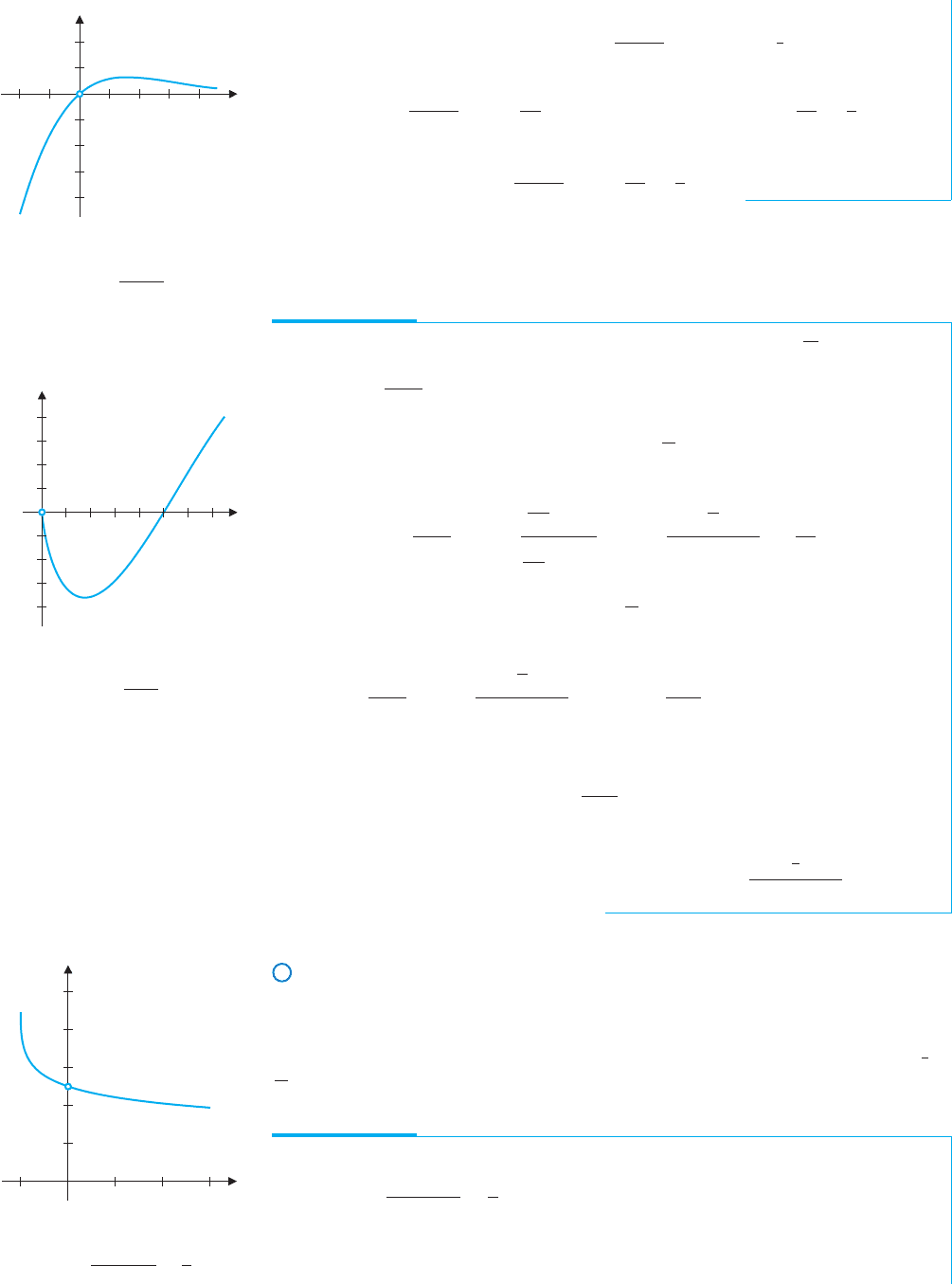
Solution From the graph in Figure 7.5, we can see that the limit is approximately 0, so
2 appears to be incorrect. The first limit, lim
x→0
x
2
e
x
− 1
, has the form
0
0
and the functions
f (x) = x
2
and g(x) = e
x
− 1 satisfy the hypotheses of l’Hˆopital’s Rule. Therefore, the
first equality, lim
x→0
x
2
e
x
− 1
= lim
x→0
2x
e
x
, holds. However, notice that lim
x→0
2x
e
x
=
0
1
= 0 and
l’Hˆopital’s Rule does not apply here. The correct evaluation is then
lim
x→0
x
2
e
x
− 1
= lim
x→0
2x
e
x
=
0
1
= 0.
y
x
3
3
FIGURE 7.5
y =
x
2
e
x
− 1
Sometimesanapplicationof l’Hˆopital’sRule must be followedbysomesimplification,
as we see in example 6.5.
EXAMPLE 6.5 Simplification of the Indeterminate Form
∞
∞
Evaluate lim
x→0
+
ln x
csc x
.
y
x
0.4 0.8 1.2
0.4
0.2
0.2
0.4
FIGURE 7.6
y =
ln x
csc x
Solution First, notice that this limit has the form
∞
∞
. From the graph in Figure 7.6, it
appears that the function tends to 0 as x → 0
+
. Applying l’Hˆopital’s Rule, we have
lim
x→0
+
ln x
csc x
= lim
x→0
+
d
dx
(ln x)
d
dx
(csc x)
= lim
x→0
+
1
x
−csc x cot x
∞
∞
!
.
This last limit still has the indeterminate form
∞
∞
, but rather than apply l’Hˆopital’s Rule
again, observe that we can rewrite the expression. We have
lim
x→0
+
ln x
csc x
= lim
x→0
+
1
x
−csc x cot x
= lim
x→0
+
−
sin x
x
tan x
= (−1)(0) = 0,
as expected, where we have used the fact (established in section 2.6) that
lim
x→0
sin x
x
= 1.
(You can also establish this by using l’Hˆopital’s Rule.) Notice that if we had simply
continued with further applications of l’Hˆopital’s Rule to lim
x→0
+
1
x
−csc x cot x
, we would
never have resolved the limit. (Why not?)
Other Indeterminate Forms
There are five additional indeterminate forms to consider: ∞−∞, 0 ·∞, 0
0
, 1
∞
and ∞
0
.
Look closely at each of these to see why they are indeterminate. When evaluating a limit
of this type, the objective is to somehow reduce it to one of the indeterminate forms
0
0
or
∞
∞
, at which point we can apply l’Hˆopital’s Rule.
EXAMPLE 6.6 The Indeterminate Form ∞−∞
Evaluate lim
x→0
1
ln(x + 1)
−
1
x
.
y
x
1 2 31
0.2
0.4
0.6
0.8
1.0
FIGURE 7.7
y =
1
ln(x +1)
−
1
x
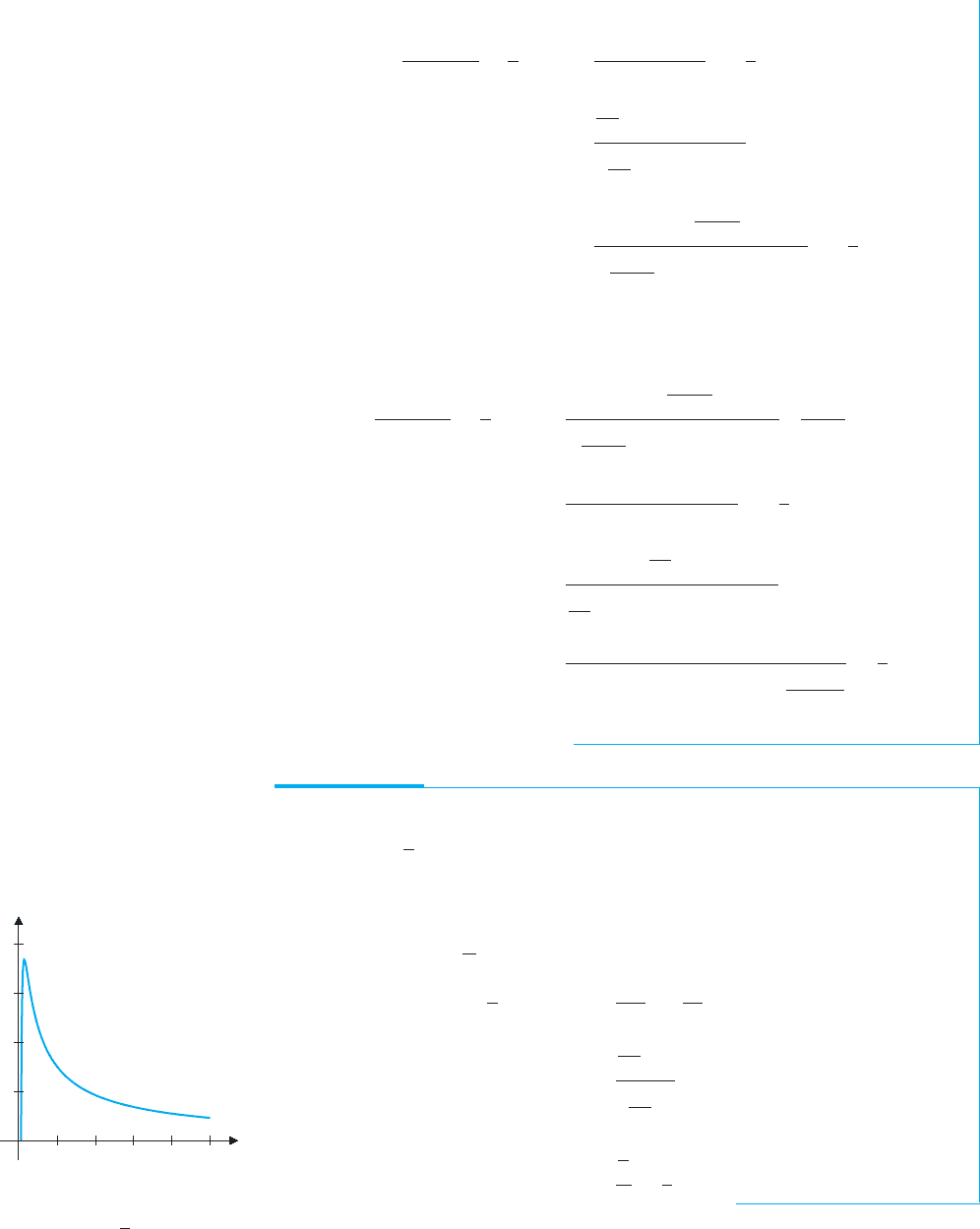
Solution In this case, the limit has the form (∞−∞). From the graph in Figure 7.7,
it appears that the limit is somewhere around 0.5. If we add the fractions, we get a form
P1: OSO/OVY P2: OSO/OVY QC: OSO/OVY T1: OSO
MHDQ256-Ch07 MHDQ256-Smith-v1.cls December 23, 2010 21:26
LT (Late Transcendental)
CONFIRMING PAGES
462 CHAPTER 7
..
Integration Techniques 7-42
to which we can apply l’Hˆopital’s Rule. We have
lim
x→0
1
ln(x + 1)
−
1
x
= lim
x→0
x −ln(x + 1)
ln(x + 1)x
0
0
= lim
x→0
d
dx
[x − ln(x + 1)]
d
dx
[ln(x + 1)x]
By l’Hˆopital’s Rule.
= lim
x→0
1 −
1
x +1
1
x +1
x +ln(x + 1)(1)
0
0
.
Rather than apply l’Hˆopital’s Rule to this last expression, we first simplify the
expression, by multiplying top and bottom by (x + 1). We now have
lim
x→0
1
ln(x + 1)
−
1
x
= lim
x→0
1 −
1
x +1
1
x +1
x +ln(x + 1)(1)
x +1
x +1
= lim
x→0
(x + 1) − 1
x +(x +1)ln(x + 1)
0
0
= lim
x→0
d
dx
(x)
d
dx
[x + (x + 1)ln(x + 1)]
By l’Hˆopital’s Rule.
= lim
x→0
1
1 + (1)ln (x +1) +(x + 1)
1
(x + 1)
=
1
2
,
which is consistent with Figure 7.7.
EXAMPLE 6.7 The Indeterminate Form 0 ·∞
Evaluate lim
x→∞
1
x
ln x
.
Solution This limit has the indeterminate form (0 ·∞). From the graph in Figure 7.8,
it appears that the function is decreasing very slowly toward 0 as x →∞. It’s easy to
rewrite this in the form
∞
∞
and then apply l’Hˆopital’s Rule. Note that
lim
x→∞
1
x
ln x
= lim
x→∞
ln x
x
∞
∞
= lim
x→∞
d
dx
ln x
d
dx
x
By l’Hˆopital’s Rule.
= lim
x→∞
1
x
1
=
0
1
= 0.
y
x
20 40 60 80 100
0.1
0.2
0.3
0.4
FIGURE 7.8
y =
1
x
ln x
Note: If lim
x→c
[ f (x)]
g(x)
has one of the indeterminate forms 0
0
, ∞
0
or 1
∞
, then, letting
y = [ f (x)]
g(x)
,wehavefor f (x) > 0 that
ln y = ln [ f (x)]
g(x)
= g(x)ln[f (x)],