
Smith R., Minton R. Calculus
Подождите немного. Документ загружается.


P1: OSO/OVY P2: OSO/OVY QC: OSO/OVY T1: OSO
MHDQ256-Ch07 MHDQ256-Smith-v1.cls December 23, 2010 21:26
LT (Late Transcendental)
CONFIRMING PAGES
7-63 SECTION 7.8
..
Probability 483
EXAMPLE 8.4 Determining the Coefficient of a pdf
Suppose that the pdf for a random variable has the form f (x) = ce
−3x
for some constant
c, with 0 ≤ x ≤ 1. Find the value of c that makes this a pdf.
Solution To be a pdf, we first need that f (x) = ce
−3x
≥ 0, for all x ∈ [0, 1]. (This will
be the case as long as c ≥ 0.) Also, the integral over the domain must equal 1. So, we set
1 =
1
0
ce
−3x
dx = c
−
1
3
e
−3x
1
0
=
c
3
(1 − e
−3
).
It now follows that c =
3
1 − e
−3
≈ 3.1572.
TODAY IN
MATHEMATICS
Persi Diaconis (1945– )
An American statistician who was
one of the first recipients of a
lucrative MacArthur Foundation
Fellowship, often called a “genius
grant.” Diaconis trained on the
violin at Juilliard until age 14,
when he left home to become a
professional magician for 10 years.
His varied interests find
expression in his work, where he
uses all areas of mathematics and
statistics to solve problems from
throughout science and
engineering. He says, “What
makes somebody a good applied
mathematician is a balance
between finding an interesting
real-world problem and finding an
interesting real-world problem
which relates to beautiful
mathematics.”
Given a pdf, it is possible to compute various statistics to summarize the properties
of the random variable. The most common statistic is the mean, the best-known measure
of average value. If you wanted to average test scores of 85, 89, 93 and 93, you would
probably compute the mean, given by
85+89+93+93
4
= 90.
Notice here that there were three different test scoresrecorded: 85, which has a relative
frequency of
1
4
, 89, also with a relative frequency of
1
4
and 93, with a relative frequency of
2
4
. We can also compute the mean by multiplying each value by its relative frequency and
then summing: (85)
1
4
+ (89)
1
4
+ (93)
2
4
= 90.
Now, suppose we wanted to compute the mean height of the people in the following
table.
Height 63
64
65
66
67
68
69
70
71
72
73
74
Number 23 32 61 94 133 153 155 134 96 62 31 26
It would be silly to write out the heights of all 1000 people, add and divide by 1000. It is
much easier to multiply each height by its relative frequency and add the results. Following
this route, the mean m is given by
m = (63)
23
1000
+ (64)
32
1000
+ (65)
61
1000
+ (66)
94
1000
+ (67)
133
1000
+···+(74)
26
1000
= 68.523.
If we denote the heights by x
1
, x
2
,...,x
n
and let f (x
i
) be the relative frequency or proba-
bility corresponding to x = x
i
, the mean then has the form
m = x
1
f (x
1
) + x
2
f (x
2
) + x
3
f (x
3
) +···+x
12
f (x
12
).
If the heights in our data set were given for every half-inch or tenth-of-an-inch, we would
compute the mean by multiplying each x
i
by the corresponding probability f (x
i
)x,where
x is the fraction of an inch between data points. The mean now has the form
m = [x
1
f (x
1
) + x
2
f (x
2
) + x
3
f (x
3
) +···+x
n
f (x
n
)]x =
n
i=1
x
i
f (x
i
)x,
where n is the number of data points. Notice that, as n increases and x approaches 0, the
Riemann sum approaches the integral
b
a
xf(x)dx. This gives us the following definition.
DEFINITION 8.2
The mean μ of a random variable with pdf f on the interval [a, b]isgivenby
μ =
b
a
xf(x)dx. (8.2)
P1: OSO/OVY P2: OSO/OVY QC: OSO/OVY T1: OSO
MHDQ256-Ch07 MHDQ256-Smith-v1.cls December 23, 2010 21:26
LT (Late Transcendental)
CONFIRMING PAGES
484 CHAPTER 7
..
Integration Techniques 7-64
Although the mean is commonly used to reportthe averagevalue of a random variable,
it is important to realize that it is not the only measure of average used by statisticians. An
alternative measurement of average is the median, the x-value that divides the probability
in half. (That is, half of all values of the random variable lie at or below the median and
half lie at or above the median.) In example 8.5 and in the exercises, you will explore situa-
tions in which each measure provides a different indication about the average of a random
variable.
EXAMPLE 8.5 Finding the Mean Age and Median Age
of a Group of Cells
Suppose that the age in days of a type of single-celled organism has pdf
f (x) = (ln2)e
−kx
, where k =
1
2
ln2. The domain is 0 ≤ x ≤ 2. (The assumption here is
that upon reaching an age of 2 days, each cell divides into two daughter cells.) Find (a)
the mean age of the cells, (b) the proportion of cells that are younger than the mean and
(c) the median age of the cells.
Solution For part (a), we have from (8.2) that the mean is given by
μ ≈
2
0
x(ln 2)e
−(ln2)x/2
dx ≈ 0.88539 day,
where we have approximated the value of the integral numerically. Notice that even
though the cells range in age from 0 to 2 days, the mean is not 1. The graph of the pdf in
Figure 7.32 shows that younger ages are more likely than older ages and this causes the
mean to be less than 1.
y
x
0.5 1 1.5 2
0.1
0.2
0.3
0.4
0.5
0.6
0.7
FIGURE 7.32
y = (ln 2)e
−(ln2)x/2
For part (b), notice that the proportion of cells younger than the mean is the same as
the probability that a randomly selected cell is younger than the mean. This probability
is given by
P(0 ≤ X ≤ μ) ≈
0.88539
0
(ln2)e
−(ln2)x/2
dx ≈ 0.52848,
where we have again approximated the value of the integral numerically. Therefore, the
proportion of cells younger than the mean is about 53%. Notice that in this case the
mean does not represent the 50% mark for probabilities. In other words, the mean is not
the same as the median.
To find the median in part (c), we must solve for the constant c such that
0.5 =
c
0
(ln2)e
−(ln2)x/2
dx.
Since an antiderivative of e
−(ln2)x/2
is −
2
ln2
e
−(ln2)x/2
,wehave
0.5 =
c
0
(ln2)e
−(ln2)x/2
dx
= ln 2
−
2
ln2
e
−(ln2)x/2
c
0
=−2e
−(ln2)c/2
+ 2.
Subtracting 2 from both sides, we have
−1.5 =−2e
−(ln2)c/2
,
so that dividing by −2 yields
0.75 = e
−(ln2)c/2
.
Taking the natural log of both sides gives us
ln0.75 =−(ln 2)c/2.

P1: OSO/OVY P2: OSO/OVY QC: OSO/OVY T1: OSO
MHDQ256-Ch07 MHDQ256-Smith-v1.cls December 23, 2010 21:26
LT (Late Transcendental)
CONFIRMING PAGES
7-65 SECTION 7.8
..
Probability 485
Finally, solving for c gives us
c =
−2ln0.75
ln2
,
so that the median is −2ln0.75/ ln 2 ≈ 0.83. We can now conclude that half of the cells
are younger than 0.83 day and half the cells are older than 0.83 day.
EXERCISES 7.8
WRITING EXERCISES
1. In the text, we stated that the probability of tossing two fair
coins and getting two heads is
1
4
. If you try this experiment
four times, explain why you will not always get two heads ex-
actly one out of four times. If probability doesn’t give precise
predictions, what is its usefulness? To answer this question,
discuss the information conveyed by knowing that in the above
experiment the probability of getting one head and one tail is
1
2
(twice as big as
1
4
).
2. Suppose you toss two coins numerous times (or simulate this
on your calculator or computer). Theoretically, the probability
ofgettingtwoheadsis
1
4
.Inthelong run (as the coinsaretossed
more and more often), what proportion of the time should two
heads occur? Try this and discuss how your results compare to
the theoretical calculation.
3. Based on Figures 7.25 and 7.26, describe what you expect the
histogram to look like for larger numbers of coins. Compare
to Figure 7.31.
4. The height of a person is determined by numerous factors,
both hereditary and environmental (e.g., diet). Explain why
this might produce a histogram similar to that produced by
tossing a large number of coins.
In exercises 1–6, show that the given function is a pdf on the
indicated interval.
1. f (x) = 4x
3
, [0, 1] 2. f (x) =
3
8
x
2
, [0, 2]
3. f (x) = x + 2x
3
, [0, 1] 4. f (x) = cosx, [0,π/2]
5. f (x) =
1
2
sin x, [0,π] 6. f (x) = e
−x/2
, [0, ln4]
............................................................
In exercises 7–12, find a value of c for which f (x) is a pdf on the
indicated interval.
7. f (x) = cx
3
, [0, 1] 8. f (x) = cx + x
2
, [0, 1]
9. f (x) = ce
−4x
, [0, 1] 10. f (x) = 2ce
−cx
, [0, 2]
11. f (x) =
c
1 + x
2
, [0, 1] 12. f (x) =
c
√
1 − x
2
, [0, 1]
............................................................
In exercises 13–16, use the pdf in example 8.2 to find the proba-
bility that a randomly selected American male has height in the
indicated range.
13. Between 5
10
and 6
.
14. Between 6
6
and 6
10
.
15. Between 7
and 10
.
16. Between 2
and 5
.
............................................................
In exercises 17–20, find the indicated probabilities, given that
the lifetime of a lightbulb is exponentially distributed with pdf
f (x) 6e
−6x
(with x measured in years).
17. The lightbulb lasts less than 3 months.
18. The lightbulb lasts less than 6 months.
19. The lightbulb lasts between 1 and 2 years.
20. The lightbulb lasts between 3 and 10 years.
............................................................
In exercises 21–24, suppose the lifetime of an organism has pdf
f (x) 4xe
−2x
(with x measured in years).
21. Find the probability that the organism lives less than 1 year.
22. Find the probability that the organism lives between 1 and
2 years.
23. Find the mean lifetime (0 ≤ x ≤ 10).
24. Graph the pdf and compare the maximum value of the pdf to
the mean.
............................................................
In exercises 25–30, find (a) the mean and (b) the median of the
random variable with the given pdf.
25. f (x) = 3x
2
, [0, 1] 26. f (x) = 4x
3
, 0 ≤ x ≤ 1
27. f (x) =
4/π
1 + x
2
, [0, 1] 28. f (x) =
2/π
√
1 − x
2
, [0, 1]
29.
f (x) =
1
2
sin x, [0,π] 30. f (x) = cos x, [0,π/2]
............................................................
31. For f (x) = ce
−4x
, find c so that f (x) is a pdf on the interval
[0, b] for b > 0. What happens to c as b →∞?
32. For the pdf of exercise 31, find the mean exactly (use a
CAS for the antiderivative). As b increases, what happens to
the mean?
33. Repeat exercises 31 and 32 for f (x) = ce
−6x
.
34. Based on the results of exercises 31–33, conjecture the values
for c and the mean as a →∞, for f (x) = ce
−ax
, a > 0.
P1: OSO/OVY P2: OSO/OVY QC: OSO/OVY T1: OSO
MHDQ256-Ch07 MHDQ256-Smith-v1.cls December 23, 2010 21:26
LT (Late Transcendental)
CONFIRMING PAGES
486 CHAPTER 7
..
Integration Techniques 7-66
APPLICATIONS
35. In one version of the game of keno, you choose 10 numbers
between 1 and 80. A random drawing selects 20 numbers be-
tween 1 and 80. Your payoff depends on how many of your
numbers are selected. Use the given probabilities (rounded to
4 digits) to find the probability of each event indicated below.
(To win, at least 5 of your numbers must be selected. On a
$2 bet, you win $40 or more if 6 or more of your numbers are
selected.)
Number selected 0 1 2 3 4
Probability 0.0458 0.1796 0.2953 0.2674 0.1473
Number selected 5 6 7 8 9 10
Probability 0.0514 0.0115 0.0016 0.0001 0.0 0.0
(a) winning (at least 5 selected)
(b) losing (4 or fewer selected)
(c) winning big (6 or more)
(d) 3 or 4 numbers selected
36. Suppose a basketball player makes 70% of her free throws.
If she shoots three free throws and the probability of making
each one is 0.7, the probabilities for the total number made
are as shown. Find the probability of each event indicated
below.
Number made 0 1 2 3
Probability 0.027 0.189 0.441 0.343
(a) She makes 2 or 3 (b) She makes at least 1
37. (a) Suppose that a game player has won m games out of n,
with a winning percentage of 100
m
n
< 75. The player then
wins severalgames in a row, so that the winning percentage
exceeds 75%. Show that at some point in this process the
player’s winning percentage is exactly 75%.
(b) Generalize to any winning percentage that can be written
as 100
k
k + 1
, for some integer k.
38. In example 8.5, we found the median (also called the sec-
ond quartile). Now find the first and third quartiles, the ages
such that the probability of being younger are 0.25 and 0.75,
respectively.
39. Thepdfinexample8.2is the pdf foranormally distributedran-
dom variable. The mean is easily read off from f (x); in exam-
ple 8.2, the mean is 68. The mean and a number called
the standard deviation characterize normal distributions. As
Figure7.31indicates,thegraphofthepdfhasamaximumatthe
mean and has two inflection points located on opposite sides
of the mean. The standard deviation equals the distance from
the mean to an inflection point. Find the standard deviation in
example 8.2.
40. In exercise 39, you found the standard deviation for the pdf
in example 8.2. Denoting the mean as μ and the standard
deviation as σ , find the probability that a given height is
between μ − σ and μ + σ (that is, within one standard de-
viation of the mean). Find the probability that a given height
is within two standard deviations of the mean (μ − 2σ to
μ + 2σ ) and within three standard deviations of the mean.
These probabilities are the same for any normal distribution.
So, if you know the mean andstandard deviation of a normally
distributed random variable, you automatically know these
probabilities.
41. Iftheprobabilityofaneventis p, theprobabilitythatitwillhap-
pen m times in n tries is f (p) =
n!
m!(n − m)!
p
m
(1 − p)
n−m
.
Find the value of p that maximizes f (p). This is called the
maximum likelihood estimator of p. Briefly explain why your
answer makes sense.
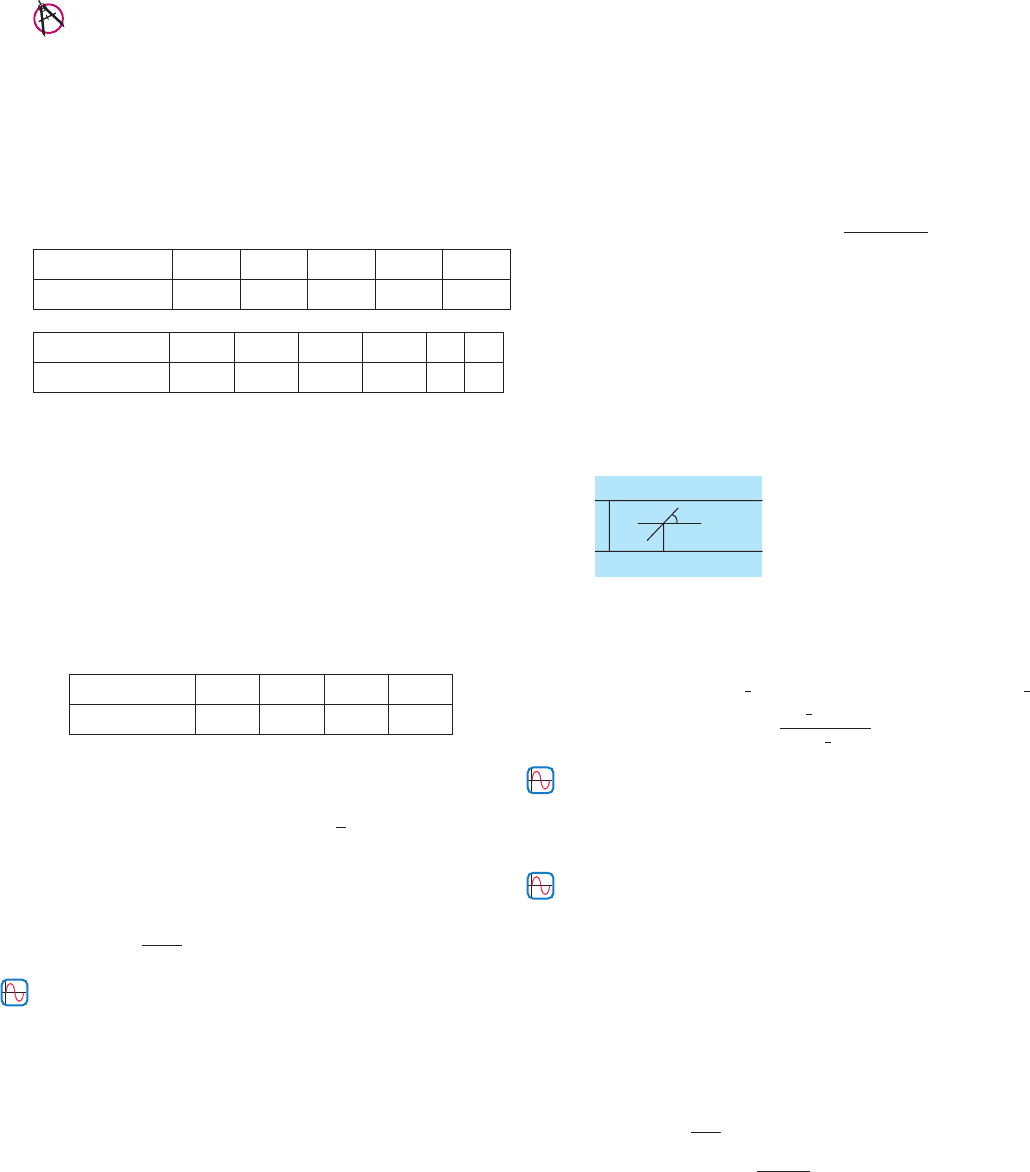
42. The Buffon needle problem is one of the oldest and most
famous of probability problems. Suppose that a series of hor-
izontal lines are spaced one unit apart and a needle of length
one is placed randomly. What is the probability that the needle
intersects one of the horizontal lines?
1
y
θ
In the figure, y is the distance from the center of the needle to
thenearestline and θ is thepositiveangle that theneedlemakes
with the horizontal. Show that the needle intersects the line if
and only if 0 ≤ y ≤
1
2
sinθ. Since 0 ≤ θ ≤ π and 0 ≤ y ≤
1
2
,
the desired probability is
π
0
1
2
sinθdθ
π
0
1
2
dθ
. Compute this.
43. The Maxwell-Boltzmann pdf for molecular speeds in a gas
at equilibrium is f (x) = ax
2
e
−b
2
x
2
, for positive parame-
ters a and b. Find the most common speed [i.e., find x to
maximize f (x)].
44. The pdf for inter-spike intervals of neurons firing in the
cochlear nucleus of a cat is f (t) = kt
−3/2
e
bt−a/t
, where a =
100, b = 0.38andt ismeasuredinmicroseconds.(See Mackey
and Glass, From Clocks to Chaos.) Use your CAS to find the
value of k that makes f a pdf on the interval [0, 40]. Then find
the probability that neurons fire between 20 and 30 microsec-
onds apart.
45. Suppose that a soccer team has a probability p of scoring the
nextgoalin agame. The probability of a 2-goal game ending in
a 1-1 tie is 2p(1 − p), the probability of a 4-goal game ending
in a 2-2 tie is
4 · 3
2 · 1
p
2
(1 − p)
2
, the probability of a 6-goal game
ending in a 3-3 tie is
6 · 5 · 4
3 · 2 · 1
p
3
(1 − p)
3
and so on. Assume
that an even number of goals is scored. Show that the proba-
bility of a tie is a decreasing function of the number of goals
scored.
46. Two players toss a fair coin until either the sequence HTT or
HHT occurs. Player A wins if HTT occurs first, and player B
wins if HHT occurs first. Show that player B is twice as likely
to win.

P1: OSO/OVY P2: OSO/OVY QC: OSO/OVY T1: OSO
MHDQ256-Ch07 MHDQ256-Smith-v1.cls December 23, 2010 21:26
LT (Late Transcendental)
CONFIRMING PAGES
7-67 CHAPTER 7
..
Review Exercises 487
47. Let f be a function such that both f and g are pdf’s on [0, 1],
where g(x) = f (x
2
).
(a) Find such a function of the form f (x) = a + bx +cx
2
.
(b) Find the mean of any random variable with pdf g.
EXPLORATORY EXERCISES
1. The mathematical theory of chaos indicates that numbers gen-
erated by very simple algorithms can look random. Chaos
researchers look at a variety of graphs to try to distinguish
randomness from deterministicchaos. For example, iterate the
function f (x) = 4x(1 − x) starting at x = 0.1. That is, com-
pute f (0.1) = 0.36, f (0.36) = 0.9216, f (0.9216) ≈ 0.289
and so on. Iterate 50 times and record how many times each
first digit occurs. (So far, we’ve got a 1, a 3, a 9 and a 2.) If
the process were truly random, the digits would occur about
the same number of times. Does this seem to be happening?
To unmask this process as nonrandom, you can draw a phase
portrait. To do this, take consecutive iterates as coordinates
of a point (x, y) and plot the points. The first three points are
(0.1, 0.36), (0.36, 0.9216) and (0.9216, 0.289). Describe the
(nonrandom) pattern that appears,identifying it asprecisely as
possible.
2. Suppose that a spring is oscillating up and down with verti-
cal position given by u(t) = sint. If you pick a random time
and look at the position of the spring, would you be more
likely to find the spring near an extreme (u = 1oru =−1) or
near the middle (u = 0)? The pdf is inversely proportional to
speed. (Why is this reasonable?) Show that speed is given by
|cost|=
√
1 − u
2
, so the pdf is f (u) = c/
√
1 − u
2
,
−1 ≤ u ≤ 1, for some constant c. Show that c = 1/π, then
graph f (x) and describe the positions in which the spring is
likely to be found. Use this result to explain the following. If
you are driving in a residential neighborhood, you are more
likely to meet a car coming the other way at an intersection
than in the middle of a block.
Review Exercises
WRITING EXERCISES
The following list includes terms that are defined and theorems that
arestatedin this chapter.Foreach termor theorem, (1) give a precise
definition or statement, (2) state in general terms what it means and
(3) describe the types of problems with which it is associated.
Integration by parts Reduction formula
Partial fractions decomposition CAS
Improper integral Integral converges
Integral diverges Comparison Test
Probability density function
TRUE OR FALSE
State whether each statement is true or false, and briefly explain
why. If the statement is false, try to “fix it” by modifying the given
statement to a new statement that is true.
1. Integration by parts works only for integrals of the form
f (x)g(x)dx.
2. For an integral of the form
xf(x) dx, always use integration
by parts with u = x.
3. The trigonometric techniques in section 7.3 are all versions of
substitution.
4. If an integrand contains a factor of
√
1 − x
2
, you should sub-
stitute x = sinθ.
5. If p and q are polynomials, then any integral of the form
p(x)
q(x)
dx can be evaluated.
6. With an extensive integral table, you don’t need to know any
integration techniques.
7. If f (x) has a vertical asymptote at x = a, then
b
a
f (x) dx
diverges for any b.
8. If lim
x→∞
f (x) = L = 0, then
∞
1
f (x) dx diverges.
9. The mean of a random variable is always larger than the
median.
10. L’H ˆopital’s Rule states that the limit of the derivative equals
the limit of the function.
In exercises 1–44, evaluate the integral.
1.
e
√
x
√
x
dx 2.
sin(1/x)
x
2
dx
3.
x
2
√
1 − x
2
dx 4.
2
√
9 − x
2
dx
5.
x
2
e
−3x
dx 6.
x
2
e
−x
3
dx
7.
x
1 + x
4
dx 8.
x
3
1 + x
4
dx
9.
x
3
4 + x
4
dx 10.
x
4 + x
4
dx
11.
e
2lnx
dx 12.
cos4xdx
13.
1
0
x sin3xdx 14.
1
0
x sin4x
2
dx

P1: OSO/OVY P2: OSO/OVY QC: OSO/OVY T1: OSO
MHDQ256-Ch07 MHDQ256-Smith-v1.cls December 23, 2010 21:26
LT (Late Transcendental)
CONFIRMING PAGES
488 CHAPTER 7
..
Integration Techniques 7-68
Review Exercises
15.
π/2
0
sin
4
xdx 16.
π/2
0
cos
3
xdx
17.
1
−1
x sinπ xdx 18.
1
0
x
2
cosπ xdx
19.
2
1
x
3
ln xdx 20.
π/4
0
sin x cos xdx
21.
cos x sin
2
xdx 22.
cos x sin
3
xdx
23.
cos
3
x sin
3
xdx 24.
cos
4
x sin
3
xdx
25.
tan
2
x sec
4
xdx 26.
tan
3
x sec
2
xdx
27.
√
sin x cos
3
xdx 28.
tan
3
x sec
3
xdx
29.
2
8 + 4x + x
2
dx 30.
3
√
−2x − x
2
dx
31.
2
x
2
√
4 − x
2
dx 32.
x
√
9 − x
2
dx
33.
x
3
√
9 − x
2
dx 34.
x
3
√
x
2
− 9
dx
35.
x
3
√
x
2
+ 9
dx 36.
4
√
x + 9
dx
37.
x + 4
x
2
+ 3x + 2
dx 38.
5x + 6
x
2
+ x − 12
dx
39.
4x
2
+ 6x − 12
x
3
− 4x
dx 40.
5x
2
+ 2
x
3
+ x
dx
41.
e
x
cos2xdx 42.
x
3
sin x
2
dx
43.
x
x
2
+ 1dx 44.
1 − x
2
dx
............................................................
In exercises 45–50, find the partial fractions decomposition.
45.
4
x
2
− 3x − 4
46.
2x
x
2
+ x − 6
47.
−6
x
3
+ x
2
− 2x
48.
x
2
− 2x − 2
x
3
+ x
49.
x − 2
x
2
+ 4x + 4
50.
x
2
− 2
(x
2
+ 1)
2
............................................................
In exercises 51–60, use the Table of Integrals to find the integral.
51.
e
3x
4 + e
2x
dx 52.
x
x
4
− 4dx
53.
sec
4
xdx 54.
tan
5
xdx
55.
4
x(3 − x)
2
dx 56.
cos x
sin
2
x(3 +4sin x)
dx
57.
√
9 + 4x
2
x
2
dx 58.
x
2
√
4 − 9x
2
dx
59.
√
4 − x
2
x
dx 60.
x
2
(x
6
− 4)
3/2
dx
............................................................
In exercises 61–68, determine whether the integral converges or
diverges. If it converges, find the limit.
61.
1
0
x
x
2
− 1
dx 62.
10
4
2
√
x − 4
dx
63.
∞
1
3
x
2
dx 64.
∞
1
xe
−3x
dx
65.
∞
0
4
4 + x
2
dx 66.
∞
−∞
xe
−x
2
dx
67.
2
−2
3
x
2
dx 68.
2
−2
x
1 − x
2
dx
............................................................
In exercises 69–76, find the limit.
69. lim
x→1
x
3
− 1
x
2
− 1
70. lim
x→0
sin x
x
2
+ 3x
71. lim
x→∞
e
2x
x
4
+ 2
72. lim
x→∞
(x
2
e
−3x
)
73. lim
x→2
+
x + 1
x − 2
√
x
2
−4
74. lim
x→∞
x ln(1 +1/x)
75. lim
x→0
+
(tan x ln x) 76. lim
x→0
tan
−1
x
sin
−1
x
............................................................
77. Show that f (x) = x +2x
3
is a pdf on the interval [0, 1].
78. Show that f (x) =
8
3
e
−2x
is a pdf on the interval [0, ln 2].
79. Find the value of c such that f (x) =
c
x
2
is a pdf onthe interval
[1, 2].
80. Find the value of c such that f (x) = ce
−2x
is a pdf on the
interval [0, 4].
81. The lifetime of a lightbulb has pdf f (x) = 4e
−4x
(x in years).
Find the probability that the lightbulb lasts (a) less than
6 months; (b) between 6 months and 1 year.
82. The lifetime of an organism has pdf f (x) = 9xe
−3x
(x in
years). Find the probability that the organism lasts (a) less
than 2 months; (b) between 3 months and 1 year.
83. Find the (a) mean and (b) median of a random variable with
pdf f (x) = x + 2x
3
on the interval [0, 1].
84. Find the (a) mean and (b) median of a random variable with
pdf f (x) =
8
3
e
−2x
on the interval [0, ln 2].

P1: OSO/OVY P2: OSO/OVY QC: OSO/OVY T1: OSO
MHDQ256-Ch07 MHDQ256-Smith-v1.cls December 23, 2010 21:26
LT (Late Transcendental)
CONFIRMING PAGES
7-69 CHAPTER 7
..
Review Exercises 489
Review Exercises
85. Cardiologists test heart efficiency by injecting a dye at a con-
stant rate R into a vein near the heart and measuring the con-
centration of the dye in the bloodstream over a period of T
seconds. If all of the dye is pumped through, the concentra-
tion is c(t) = R. Compute the total amount of dye
T
0
c(t)dt.
For a general concentration, the cardiac output is defined by
RT
T
0
c(t)dt
. Interpret this quantity. Compute the cardiac output
if c(t) = 3te
2Tt
.
86. For
ln(x + 1) dx, you can use integration by parts with
u = ln(x + 1) and dv = 1. Compare your answers using v = x
versus using v = x + 1.
87. Showthattheaveragevalueofln x ontheinterval(0, e
n
)equals
n − 1 for any positive integer n.
88. Manyprobability questions involveconditional probabilities.
Forexample,ifyouknowthatalightbulbhasalreadyburnedfor
30 hours, what is the probability that it will last at least 5 more
hours? This is the “probability that x > 35 given that x > 30”
and is written as P(x > 35|x > 30). In general, for events A
and B, P(A|B) =
P(A and B)
P(B)
. The failure rate function is
given as the limit of
P(x < t + t|x > t)
t
as t → 0. For the
pdf f (x) of the lifetime of a lightbulb, the numerator is the
probability that the bulb burns out between times t and t + t.
Use R(t) = P(x > t) to show that the failure rate function can
be written as
f (t)
R(t)
.
89. Show that the failure rate function (see exercise 88) of an ex-
ponential pdf f (x) = ce
−cx
is constant.
90. For the gamma distribution f (x) = xe
−x
, (a) use a CAS to
show that P(x > s + t|x > s) = e
−t
+
t
1 + s
e
−t
. (b) Show
that this is a decreasing function of s (for a fixed t). (c) If this
is the pdf for annual rainfall amounts in a certain city, interpret
the result of part (b).
91. Scores on IQ tests are intended to follow the distribution
f (x) =
1
√
450π
e
−(x−100)
2
/450
. Based on this distribution, what
percentage of people are supposedto have IQs between 90 and
100?If the top1% of scoresare to be giventhe titleof “genius,”
how high do you have to score to get this title?
92. Define I(n) =
∞
0
1
(1+x
2
)
n
dx for positive integers n. Show
that I (1) =
π
2
. Using integration by parts with u =
1
(1+x
2
)
n
, show that I (n + 1) =
2n−1
2n
I(n). Conclude that
I(n) =
π
2
1 · 3 · 5 ···(2n − 3)
2 · 4 · 6 ···(2n − 2)
.
EXPLORATORY EXERCISES
1. In this exercise, you will try to determine whether or
not
1
0
sin(1/x)dx converges. Since |sin(1/x)|≤1, the
integral does not diverge to ∞, but that does not necessar-
ily mean it converges. Explain why the integral
∞
0
sin xdx
diverges (not to ∞, but by oscillating indefinitely). You
need to determine whether a similar oscillation occurs for
1
0
sin(1/x)dx. First, estimate
1
R
sin(1/x)dx numerically
for R = 1/π, 1/(2π), 1/(3π ) and so on. Note that once you
have
1
1/π
sin(1/x)dx, you can get
1
1/(2π)
sin(1/x)dx by
“adding”
1/π
1/(2π)
sin(1/x)dx. We put this in quotes because
this new integral is negative. Verify that the integrals
1/π
1/(2π)
sin(1/x)dx,
1/(2π)
1/(3π)
sin(1/x)dx and so on, are
alternately negative and positive, so that the sum
1
R
sin(1/x)dx does seem to converge as R → 0
+
. It turns
out that the limit does converge if the additional integrals
1/(nπ)
1/((n+1)π)
sin(1/x)dx tend to 0 as n →∞. Show that this is
true.
2. Supposethat f (x) is a function such that both
∞
−∞
f (x) dx and
∞
−∞
f (x − 1/x)dx converge. Start with
∞
−∞
f (x − 1/x)dx
and make the substitution u =−
1
x
. Show that
2
∞
−∞
f (x − 1/x)dx =
∞
−∞
1
u
2
f (u − 1/u)du. Then let
y = u − 1/u. Show that
∞
−∞
f (x) dx =
∞
−∞
f (x − 1/x)dx.
Use this result to evaluate
∞
−∞
x
2
x
2
+ (x
2
− 1)
2
dx and
∞
−∞
e
−x
2
+2−1/x
2
dx.
3. Evaluate
π/2
0
ab
(a cos x + b sin x)
2
dx, by dividing all terms
by cos
2
x, using the substitution u = ab tan x and evaluating
the improper integral
∞
0
a
2
(u + a
2
)
2
dx.
This page intentionally left blank

P1: OSO/OVY P2: OSO/OVY QC: OSO/OVY T1: OSO
MHDQ256-Ch08 MHDQ256-Smith-v1.cls December 16, 2010 21:19
LT (Late Transcendental)
CONFIRMING PAGES
CHAPTER
8
First-Order
Differential Equations
Well-preserved fossils can provide paleontologists with priceless clues
about the early history of life on Earth. In 1993, an amateur fossil hunter
found the bones of a massive dinosaur in southern Argentina. The new
species of dinosaur, named Giganotosaurus, replaced Tyrannosaurus Rex
as the largest known carnivore. Measuring up to 45 feet in length and
standing 12 feet high at the hip bone, Giganotosaurus is estimated to
have weighed roughly 8 tons.
Paleontologists employ several techniques for dating fossils, in order
to place them in their correct historical perspective. The most well known
of these is radiocarbon dating using carbon-14, an unstable isotope of
carbon. In living plants and animals, the ratio of the amount of carbon-14 to the
total amount of carbon is constant. When a plant or animal dies, it stops taking in
carbon-14 and the existing carbon-14 begins to decay, at a constant (though nearly
imperceptible) rate. An accurate measurement of the proportion of carbon-14
remaining can then be converted into an estimate of the time of death. Estimates
from carbon-14 dating are considered to be reliable for fossils dating back tens of
thousands of years, due to its very slow rate of decay.
Dating using other radioisotopes with slower decay rates than that of
carbon-14 works on the same basic principle, but can be used to accurately date
very old rock or sediment that surrounds the fossils. Using such techniques, pale-
ontologists estimate that Giganotosaurus lived about 100 million years ago. This
is critical information to scientists studying life near the end of the Mesozoic era.
For example, based on this method of dating, it is apparent that Giganotosaurus
did not live at the same time and therefore did not compete with the smaller but
stronger Tyrannosaurus Rex.
The mathematics underlying carbon-14 and other radioisotope dating
techniques is developed in this chapter. The study of differential equations pro-
vides you with essential tools to analyze many important phenomena such as
radiocarbon dating and the population of a bacterial colony. In this chapter, we
introduce the basic theory and a few common applications of some elementary
differential equations. In Chapter 16, we return to the topic of differential equa-
tions and present additional examples. However, a more thorough examination of
this vast field will need to wait for a course focused on this topic.
8.1 MODELING WITH DIFFERENTIAL EQUATIONS
Growth and Decay Problems
In this age, we are all keenly aware of how infection by microorganisms such as
Escherichia coli (E. coli) causes disease. Many organisms (such as E. coli) can
491
P1: OSO/OVY P2: OSO/OVY QC: OSO/OVY T1: OSO
MHDQ256-Ch08 MHDQ256-Smith-v1.cls December 16, 2010 21:19
LT (Late Transcendental)
CONFIRMING PAGES
492 CHAPTER 8
..
First-Order Differential Equations 8-2
reproduceinourbodiesatasurprisinglyfastrate,overwhelmingourbodies’naturaldefenses
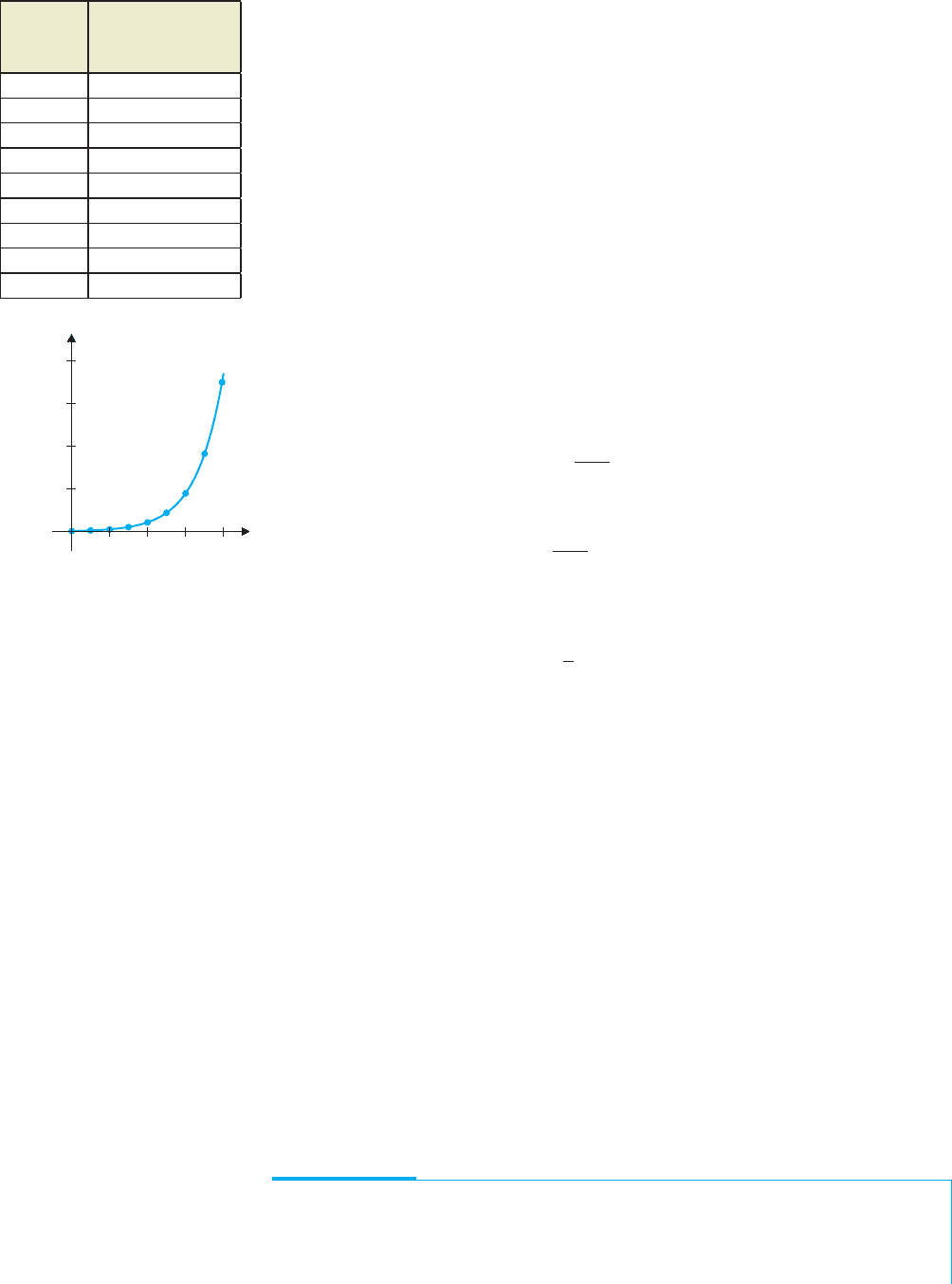
with the sheer volume of toxin they are producing. The table shown in the margin indicates
thenumberofE. coli bacteria(inmillionsofbacteriaperml)inalaboratoryculturemeasured
at half-hour intervals during the course of an experiment. We have plotted the number
of bacteria per milliliter versus time in Figure 8.1. What would you say the graph most
resembles?Ifyousaid,“anexponential,”youguessedright.Carefulanalysisofexperimental
data has shownthat many populations grow at a rateproportional to their current level. This
is quite easily observed in bacterial cultures, where the bacteria reproduce by binary fission
(i.e., each cell reproduces by dividing into two cells). In this case, the rate at which the
bacterial culture grows is directly proportional to the current population (until such time as
resourcesbecome scarceorovercrowdingbecomesa limiting factor).If welet y(t)represent
the number of bacteria in a culture at time t, then the rate of change of the population with
respect to time is y
(t). Thus, since y
(t) is proportional to y(t), we have
y
(t) = ky(t), (1.1)
100
200
300
400
4321
Number of bacteria
(millions per ml)
Time (hours)
FIGURE 8.1
Growth of bacteria
Number of
Time Bacteria
(hours) (millions per ml)
0 1.2
0.5 2.5
1 5.1
1.5 11.0
2 23.0
2.5 45.0
3 91.0
3.5 180.0
4 350.0
for some constant of proportionality k (the growth constant). Since equation (1.1) involves
the derivative of an unknown function, we call it a differential equation. Our aim is to
solve the differential equation, that is, find the function y(t). Assuming that y(t) > 0 (this
is a reasonable assumption, since y(t) represents a population), we have
y
(t)
y(t)
= k. (1.2)
Integrating both sides of equation (1.2) with respect to t, we obtain
y
(t)
y(t)
dt =
kdt. (1.3)
Substituting y = y(t) in the integral on the left-hand side, we have dy = y
(t) dt and so,
(1.3) becomes
1
y
dy =
kdt.
Evaluating these integrals, we obtain
ln|y|+c
1
= kt + c
2
,
where c
1
and c
2
are constants of integration. Subtracting c
1
from both sides yields
ln|y|=kt + (c
2
− c
1
) = kt + c,
for some constant c. Since y(t) > 0, we have
ln y(t) = kt + c
and taking exponentials of both sides, we get
y(t) = e
ln y(t)
= e
kt+c
= e
kt
e
c
.
Since c is an arbitrary constant, we write A = e
c
and get
y(t) = Ae
kt
. (1.4)
We refer to (1.4) as the general solution of the differential equation (1.1). For k > 0,
equation (1.4) is called an exponential growth law and for k < 0, it is an exponential
decay law. (Think about the distinction.)
In example 1.1, we examine how an exponential growth law predicts the number of
cells in a bacterial culture.
EXAMPLE 1.1 Exponential Growth of a Bacterial Colony
A freshly inoculated bacterial culture of Streptococcus A (a common group of
microorganisms that cause strep throat) contains 100 cells. When the culture is checked
60 minutes later, it is determined that there are 450 cells present. Assuming exponential