
Smith R., Minton R. Calculus
Подождите немного. Документ загружается.

P1: OSO/OVY P2: OSO/OVY QC: OSO/OVY T1: OSO
MHDQ256-Ch09 MHDQ256-Smith-v1.cls December 17, 2010 19:47
LT (Late Transcendental)
CONFIRMING PAGES
9-93 CHAPTER 9
..
Review Exercises 623
Review Exercises
63.
∞
k=0
4
k!
(x − 2)
k
64.
∞
k=0
k
2
(x + 3)
k
65.
∞
k=0
3
k
(x − 2)
k
66.
∞
k=0
k
4
k
(x + 1)
k
............................................................
In exercises 67 and 68, derive the Taylor series of f (x) about the
center x c.
67. f (x) = sinx, c = 0 68. f (x) =
1
x
, c = 1
............................................................
In exercises 69 and 70, find the Taylor polynomial P
4
(x). Graph
f (x) and P
4
(x).
69. f (x) = lnx, c = 1 70. f (x) =
1
√
x
, c = 1
............................................................
In exercises 71 and 72, use the Taylor polynomials from exer-
cises 69 and 70 to estimate the given values. Determine the order
of the Taylor polynomial needed to estimate the value to within
10
−8
.
71. ln1.2 72.
1
√
1.1
............................................................
In exercises 73 and 74, use a known Taylor series to find a Taylor
series of the function and find its radius of convergence.
73. e
−3x
2
74. sin4x
............................................................
In exercises75 and 76, use the first five nonzero terms of a known
Taylor series to estimate the value of the integral.
75.
1
0
tan
−1
xdx 76.
2
0
e
−3x
2
dx
............................................................
In exercises 77 and 78, derive the Fourier series of the function.
77. f (x) = x, −2 ≤ x ≤ 2
78. f (x) =
0, if −π<x ≤ 0
1, if 0 < x ≤ π
............................................................
In exercises 79–82, graph at least three periods of the function
to which the Fourier series converges.
79. f (x) = x
2
, −1 ≤ x ≤ 1
80. f (x) = 2x, −2 ≤ x ≤ 2
81. f (x) =
−1, if −1 < x ≤ 0
1, if 0 < x ≤ 1
82. f (x) =
0, if −2 < x ≤ 0
x, if 0 < x ≤ 2
............................................................
83. Suppose you and your friend take turns tossing a coin. The
first one to get a head wins. Obviously, the person who goes
first has an advantage, but how much of an advantage is it?
If you go first, the probability that you win on your first toss
is
1
2
, the probability that you win on your second toss is
1
8
,
the probability that you win on your third toss is
1
32
and so
on. Sum a geometric series to find the probability that you
win.
84. In a game similar to that of exercise 83, the first one to roll a
4 on a six-sided die wins. Is this game more fair than the pre-
vious game? The probabilities of winning on the first, second
andthird rollare
1
6
,
25
216
and
625
7776
,respectively.Sum a geometric
series to find the probability that you win.
85. Recall the Fibonacci sequence defined by a
0
= 1,
a
1
= 1, a
2
= 2 and a
n+1
= a
n
+ a
n−1
. Prove the following
fact: lim
n→∞
a
n+1
a
n
=
1 +
√
5
2
. (This number, known to the
ancient Greeks, is called the golden ratio.) (Hint: Start with
a
n+1
= a
n
+ a
n−1
and divide by a
n
.Ifr = lim
n→∞
a
n+1
a
n
, argue
that lim
n→∞
a
n−1
a
n
=
1
r
and then solve the equation r = 1 +
1
r
.)
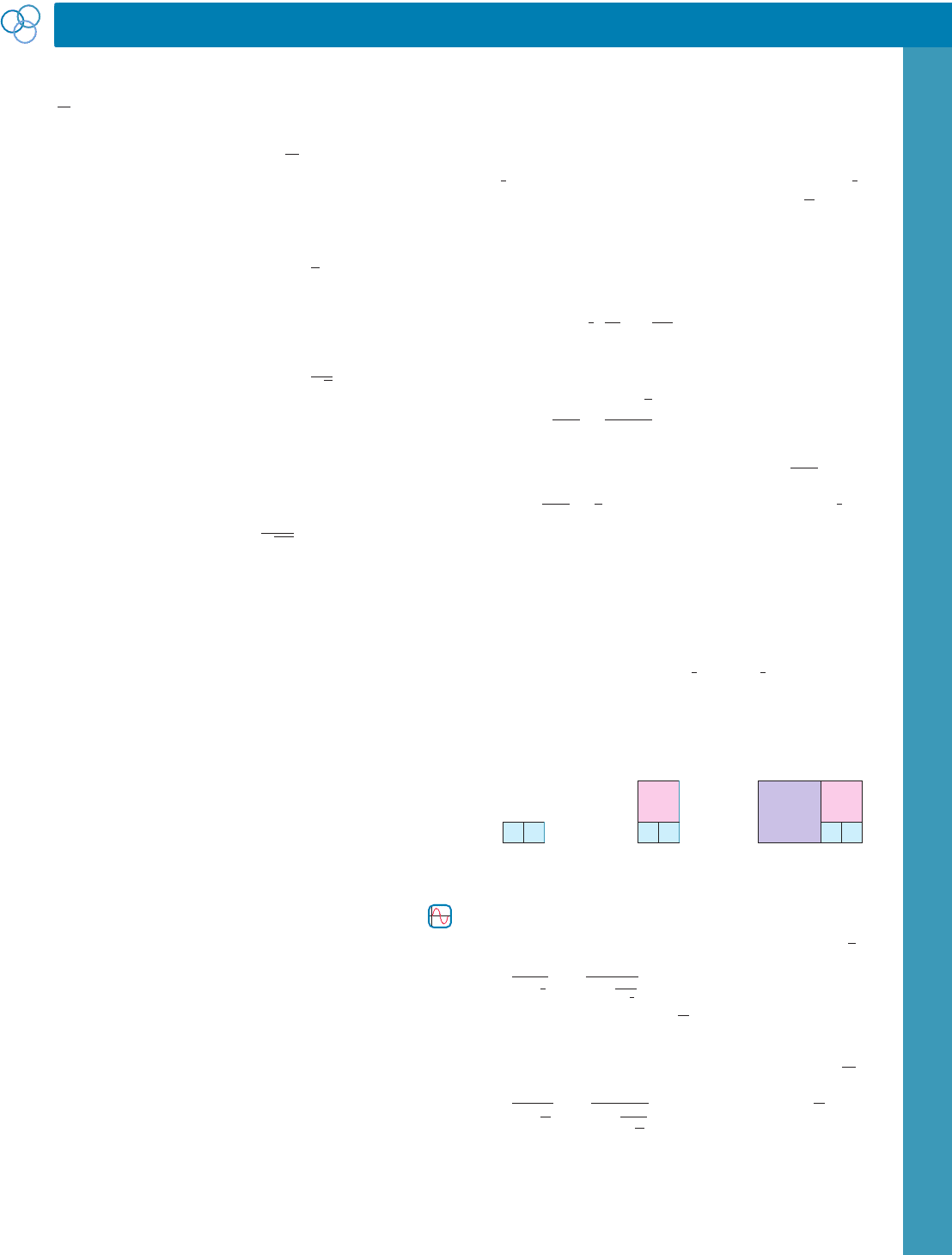
86. The Fibonacci sequence can be visualized with the follow-
ing construction. Start with two side-by-side squares of side 1
(Figure A). Above them, draw a square (Figure B), which will
have side 2. To the leftof that, draw a square (Figure C),which
willhaveside3.Continuetospiralaround,drawingsquaresthat
have sides given by the Fibonacci sequence. For each bound-
ing rectangle in Figures A–C, compute the ratio of the sides
of the rectangle. (Hint: Start with
2
1
and then
3
2
.) Find the limit
of the ratios as the construction process continues. The Greeks
proclaimed this to be the most “pleasing” of all rectangles,
buildingtheParthenonandotherimportantbuildingswiththese
proportions. (See The Divine Proportion by H. E. Huntley.)
FIGURE A FIGURE B FIGURE C
87. Another type of sequence studied by mathematicians is the
continued fraction. Numerically explore the sequence 1 +
1
1
,
1 +
1
1 +
1
1
, 1 +
1
1 +
1
1+
1
1
and so on. Show that the limit L
satisfies the equation L = 1 +
1
L
. Show that the limit equals
the golden ratio! Viscount Brouncker, a seventeenth-century
English mathematician, showed that the sequence 1 +
1
2
2
,
1 +
1
2
2 +
3
2
2
, 1 +
1
2
2 +
3
2
2+
5
2
2
and so on, converges to
4
π
. (See
A History of Pi by Petr Beckmann.) Explore this sequence
numerically.

P1: OSO/OVY P2: OSO/OVY QC: OSO/OVY T1: OSO
MHDQ256-Ch09 MHDQ256-Smith-v1.cls December 17, 2010 19:47
LT (Late Transcendental)
CONFIRMING PAGES
624 CHAPTER 9
..
Infinite Series 9-94
Review Exercises
88. For the power series
1
1 − x − x
2
= c
1
+ c
2
x + c
3
x
2
+···,
show that the constants c
i
are the Fibonacci numbers. Sub-
stitute x =
1
1000
to find the interestingdecimal representation
for
1,000,000
998,999
.
89. If 0 < r <
1
2
, show that
1 + 2r + 4r
2
+···+(2r)
n
+···=
1
1 − 2r
. Replace r with
1
1000
and discuss what’s interesting about the decimal repre-
sentation of
500
499
.
EXPLORATORY EXERCISES
1. The challenge here is to determine
∞
k=1
x
k
k(k +1)
as completely
as possible. Start by finding the interval of convergence. Find
the sum for the special cases (a) x = 0 and (b) x = 1. For
0 < x < 1, do the following: (c) Rewrite the series using the
partial fractions expansion of
1
k(k +1)
. (d) Because the series
converges absolutely, it is legal to rearrange terms. Do so and
rewrite the series as x +
x − 1
x
1
2
x
2
+
1
3
x
3
+
1
4
x
4
+···
. (e)
Identify the series in brackets as
∞
k=1
x
k
dx, evaluate the
series and then integrate term-by-term. (f) Replace the term in
brackets in part (d) with its value obtained in part (e). (g) The
next case is for −1 < x < 0. Use the technique in parts (c)–(f)
to find the sum. (h) Evaluate the sum at x =−1 using the fact
that the alternatingharmonic series sums to ln 2. (Used by per-
mission of the Virginia Tech Mathematics Contest. Solution
suggested by Gregory Minton.)
2. You have used Fourier series to show that
∞
k=1
1
k
2
=
π
2
6
. Here,
you will use a versionof Vi`eta’s formula to give an alternative
derivation.Startbyusinga Maclaurin series forsinx to derivea
series for f (x) =
sin
√
x
√
x
. Then find the zeros of f (x). Vi`eta’s
formula states that the sum of the reciprocals of the zeros of
f (x) equals the negative of the coefficient of the linear term in
theMaclaurin series of f (x) dividedbytheconstant term. Take
this equation and multiply by π
2
to get the desired formula.
Use the same method with a different function to show that
∞
k=1
1
(2k − 1)
2
=
π
2
8
.
P1: OSO/OVY P2: OSO/OVY QC: OSO/OVY T1: OSO
MHDQ256-Ch10 MHDQ256-Smith-v1.cls December 21, 2010 21:17
LT (Late Transcendental)
CONFIRMING PAGES
CHAPTER
10
Parametric Equations
and Polar Coordinates
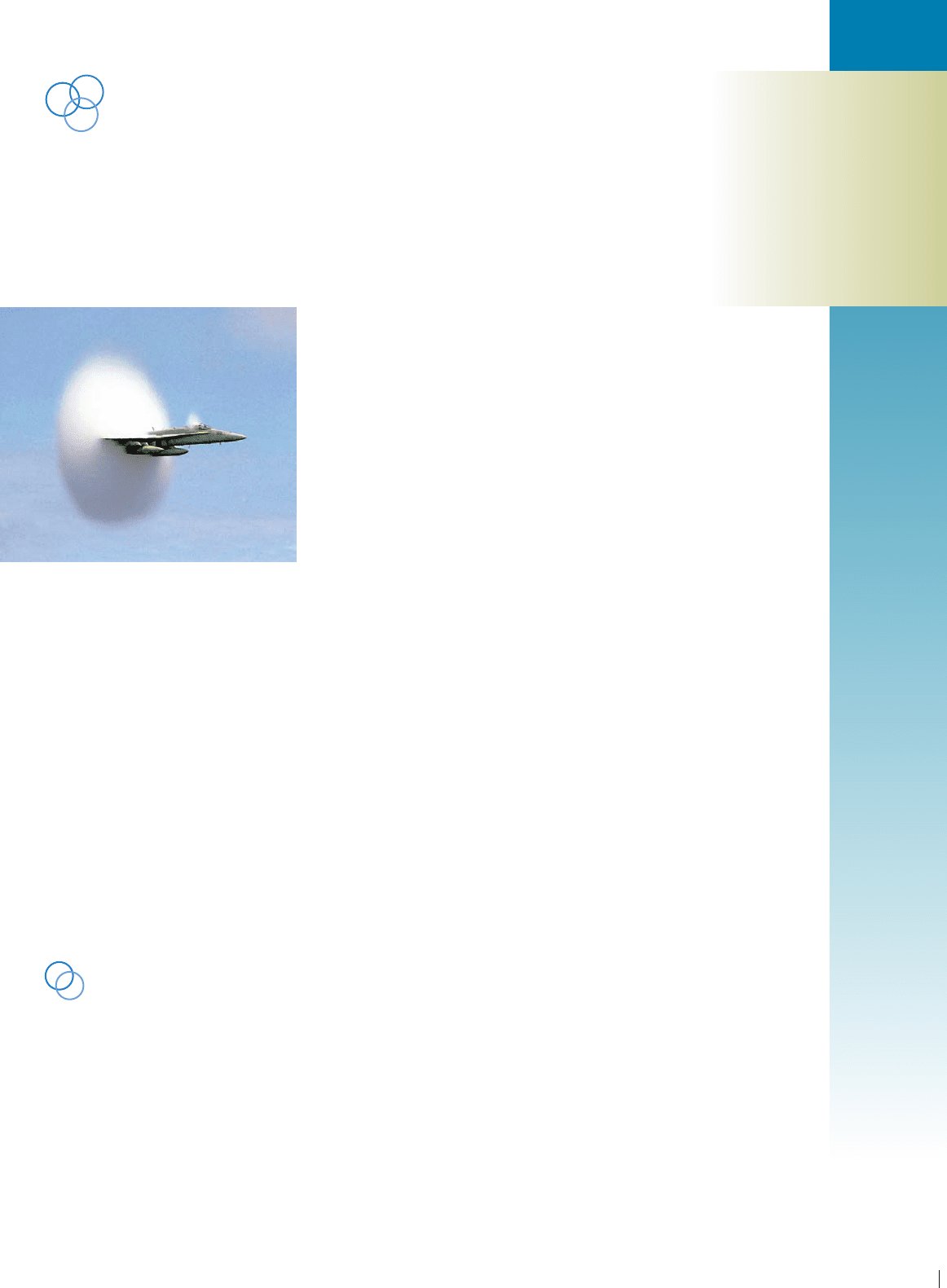
You are all familiar with sonic booms, those loud crashes of noise caused by
aircraftflyingfasterthanthespeedofsound.Youmayhaveevenheardasonic
boom, but you have probably never seen one. The remarkable photograph
here shows water vapor outlining the surface of a shock wave created by an
F-18 jet flying supersonically. (Note that there is also a small cone of water
vapor trailing the back of the cockpit.)
Youmaybesurprisedattheapparentlyconicalshape,butamathematical
analysis verifies that the shape of the shock waves is indeed conical. (You
will have an opportunity to explore this in the exercises in section 10.1.) To
visualize how sound waves propagate, imagine an exploding firecracker. If
you think of this in two dimensions, you’ll recognize that the sound waves
propagateinaseriesofever-expandingconcentriccirclesthatreacheveryone
standing a given distance away from the firecracker at the same time.
In this chapter, we extend the concepts of calculus to curves described by
parametric equations and polar coordinates. For instance, to describe the motion
of an object such as an airplane in two dimensions, we would need to describe the
object’s position (x, y) as a function of the parameter t (time). That is, we write
the position in the form (x, y) = (x(t), y(t)), where x(t) and y(t) are functions to
which our existing techniques of calculus can be applied. The equations x = x(t)
and y = y(t) are called parametric equations. Additionally, we’ll explore how to
use polar coordinates to represent curves, not as a set of points (x, y), but rather,
by specifying the points by the distance from the origin to the point, together
with an angle corresponding to the direction from the origin to the point. Polar
coordinates are especially convenient for describing circles, such as those that
occur in propagating sound waves.
These alternative descriptions of curves bring us needed flexibility for attack-
ing many problems. Often, even very complicated looking curves have a simple
description in terms of parametric equations or polar coordinates.
10.1 PLANE CURVES AND PARAMETRIC EQUATIONS
We often find it convenient to describe the location of a point (x, y) in the plane in
terms of a parameter. For instance, for a moving object, we would naturally give
its location in terms of time. In this way, we not only specify the path the object
follows, but we also know when it passes through each point.
Given any pair of functions x(t) and y(t) defined on the same domain D, the
equations
x = x(t), y = y(t)
625
P1: OSO/OVY P2: OSO/OVY QC: OSO/OVY T1: OSO
MHDQ256-Ch10 MHDQ256-Smith-v1.cls December 21, 2010 21:17
LT (Late Transcendental)
CONFIRMING PAGES
626 CHAPTER 10
..
Parametric Equations and Polar Coordinates 10-2
are called parametric equations. Notice that for each choice of t, the parametric equations
specify a point (x, y) = (x(t), y(t)) in the xy-plane. The collection of all such points is
called the graph of the parametric equations. In the case where x(t)and y(t) are continuous
functions and D is an interval of the real line, the graph is a curve in the xy-plane, referred
to as a plane curve.
The choice of the letter t to denote the independent variable (called the parameter)
should make you think of time, which is often what the parameter represents. In fact, you
might recall that in section 5.5, we used a pair of equations of this type to describe two-
dimensionalprojectile motion. In general, a parametercanbeany quantitythatis convenient
for describing the relationship between x and y. In example 1.1, we simplify our discussion
by eliminating the parameter.
EXAMPLE 1.1 Graphing a Plane Curve
Sketch the plane curve defined by the parametric equations x = 6 −t
2
, y = t/2, for
−2 ≤ t ≤ 4.
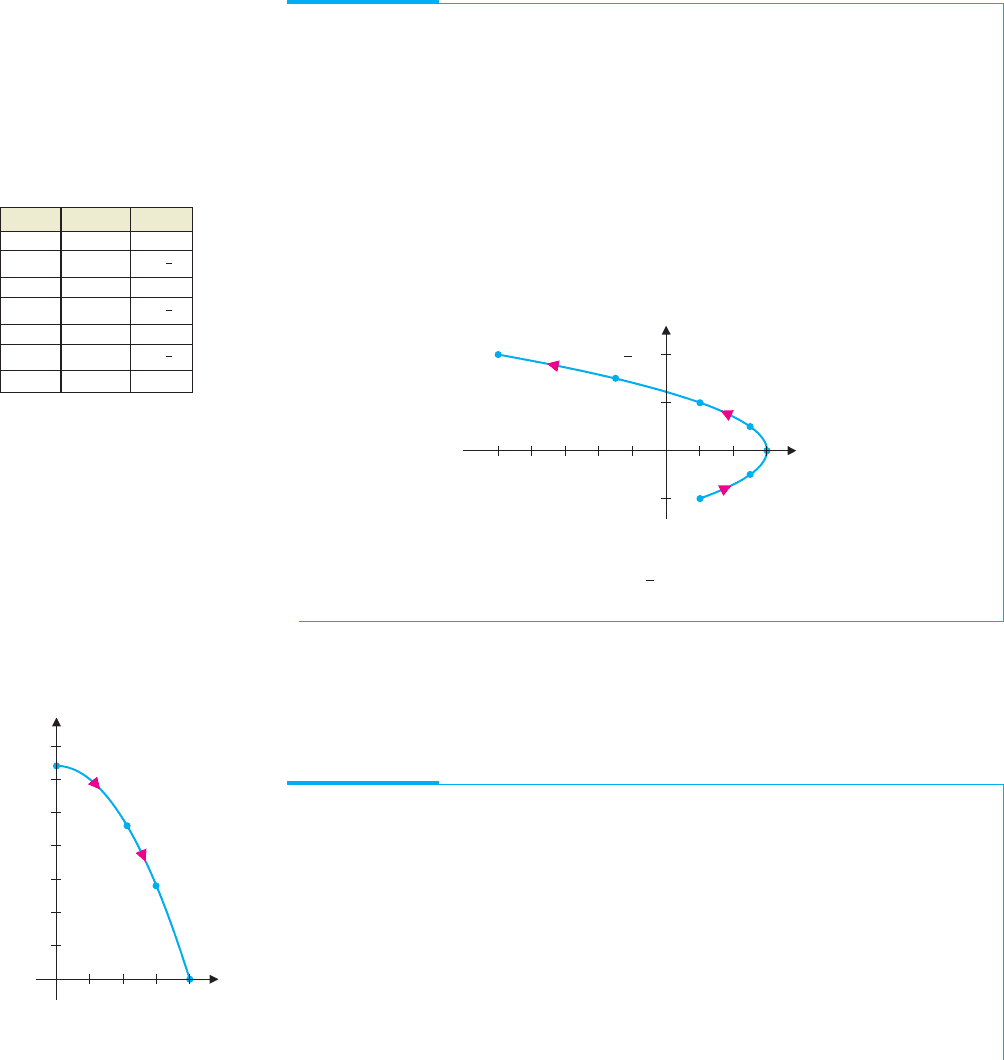
Solution In the accompanying table, we list a number of values of the parameter t and
the corresponding values of x and y. We have plotted these points and connected them
with a smooth curve in Figure 10.1. You might also notice that we can easily eliminate
the parameter here, by solving for t in terms of y.Wehavet = 2y, so that x = 6 − 4y
2
.
t x y
−2 2 −1
−1 5
−
1
2
0 6 0
1 5
1
2
2 2 1
3 −3
3
2
4 −10 2
The graph of this last equation is a parabola opening to the left. However, the plane
curve we’re looking for is the portion of this parabola corresponding to −2 ≤ t ≤ 4.
From the table, notice that this corresponds to −1 ≤ y ≤ 2, so that the plane curve is
the portion of the parabola indicated in Figure 10.1.
y
42246810
1
1
2
3
2
(10, 2)
(
3,
)
(
5, Q
)
(6, 0)
(2, 1)
(2, 1)
(
5, Q
)
x
FIGURE 10.1
x = 6 −t
2
, y =
t
2
, −2 ≤ t ≤ 4
You probably noticed the small arrows drawn on top of the plane curve in Figure 10.1.
These indicate the orientation of the curve(i.e., the direction of increasing t). If t represents
time and the curve represents the path of an object, the orientation indicates the direction
followed by the object as it traverses the path, as in example 1.2.
y
x
20 40
t 0
t 1
t 1.5
t 2
20
40
60
FIGURE 10.2
Path of projectile
EXAMPLE 1.2 The Path of a Projectile
Find the path of a projectile thrown horizontally with initial speed of 20 ft/s from a
height of 64 feet.
Solution Following our discussion in section 5.5, the path is defined by the
parametric equations
x = 20t, y = 64 − 16t
2
, for 0 ≤ t ≤ 2,
where t represents time (in seconds). This describes the plane curve shown in Figure 10.2.
Note that in this case, the orientation indicated in the graph gives the direction of motion.
If we eliminate the parameter, as in example 1.1, the corresponding x-y equation
P1: OSO/OVY P2: OSO/OVY QC: OSO/OVY T1: OSO
MHDQ256-Ch10 MHDQ256-Smith-v1.cls December 21, 2010 21:17
LT (Late Transcendental)
CONFIRMING PAGES
10-3 SECTION 10.1
..
Plane Curves and Parametric Equations 627
y = 64 −16
x
2
20
2
describes the path followed by the projectile. However, the
parametric equations provide us with additional information, as they also tell us when
the object is located at a given point and indicate the direction of motion.
Graphing calculators and computer algebra systems sketch a plane curve by plotting
points corresponding to a large number of values of the parameter t and then connecting
the plotted points with a curve. The appearance of the resulting graph depends greatly on
the graphing window used and also on the particular choice of t-values. This can be seen
in example 1.3.
EXAMPLE 1.3 Parametric Equations Involving Sines and Cosines
Sketch the plane curve defined by the parametric equations
x = 2cost, y = 2sin t, for (a) 0 ≤ t ≤ 2π and (b) 0 ≤ t ≤ π. (1.1)
y
x
44
4
4
FIGURE 10.3a
x = 2cos t, y = 2sint
y
x
22
2
2
FIGURE 10.3b
x = 2cos t, y = 2sint
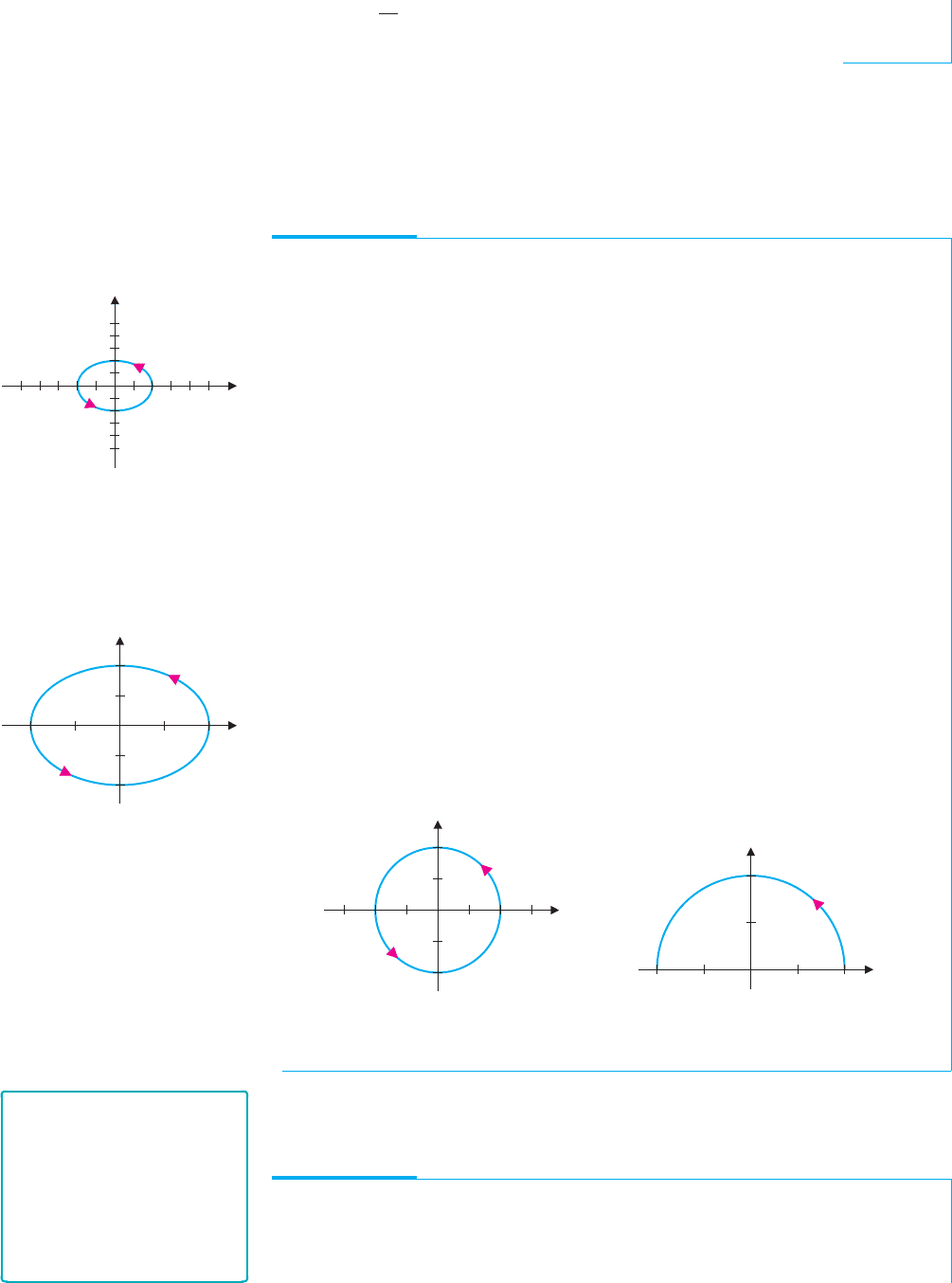
Solution (a) The default graph produced by most graphing calculators looks
something like the curve shown in Figure 10.3a (where we have added arrows indicating
the orientation). We can improve this sketch by noticing that since x = 2cos t, x ranges
between −2 and 2. Similarly, y ranges between −2 and 2. Changing the graphing
window to −2.1 ≤ x ≤ 2.1 and −2.1 ≤ y ≤ 2.1 produces the curve shown in
Figure 10.3b. The curve looks like an ellipse, but with some thought we can identify it
as a circle. Rather than eliminate the parameter by solving for t in terms of either x or y,
instead notice from (1.1) that
x
2
+ y
2
= 4cos
2
t +4sin
2
t = 4(cos
2
t +sin
2
t) = 4.
So, the plane curve lies on the circle of radius 2 centered at the origin. It’s not hard to
see that this is the entire circle, traversed counterclockwise. [Simply plot some points,
or better yet, recognize that t corresponds to the angle measured from the positive
x-axis to the line segment joining (x, y) to the origin, noting that t ranges from 0 to 2π.]
A “square” graphing window (one with the same scale on the x- and y-axes, though not
necessarily the same x and y ranges) gives us the circle seen in Figure 10.3c.
(b) Since we’ve identified t as the angle as measured from the positive x-axis,
limiting the domain to 0 ≤ t ≤ π will give the top half of the circle, as shown in
Figure 10.3d.
y
x
22
2
2
y
x
22
2
FIGURE 10.3c
A circle
FIGURE 10.3d
Top semicircle
REMARK 1.1
To sketch a parametric graph on
a CAS, you may need to write
the equations in vector format.
For instance, in the case of
example 1.3, instead of entering
x = 2cos t and y = 2 sin t, you
would enter the ordered pair of
functions (2cost, 2sint).
Simple modifications to the parametric equations in example 1.3 will produce a variety
of circles and ellipses. We explore this in example 1.4 and the exercises.
EXAMPLE 1.4 More Circles and Ellipses Defined
by Parametric Equations
Identify the plane curves (a) x = 2sint, y = 3cost, (b) x = 2 +4cos t,
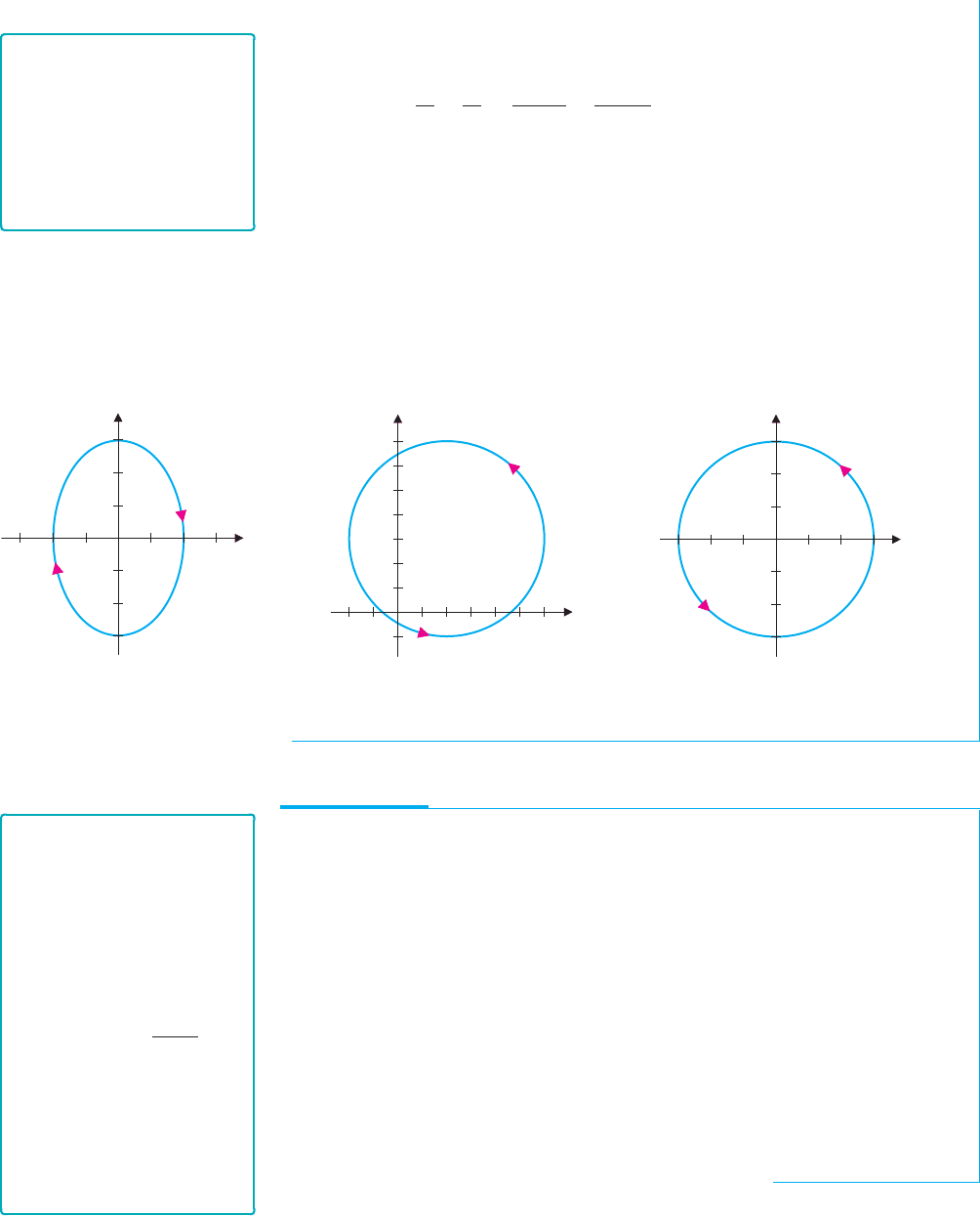
y = 3 +4 sin t and (c) x = 3cos2t, y = 3sin 2t, all for 0 ≤ t ≤ 2π .
P1: OSO/OVY P2: OSO/OVY QC: OSO/OVY T1: OSO
MHDQ256-Ch10 MHDQ256-Smith-v1.cls December 21, 2010 21:17
LT (Late Transcendental)
CONFIRMING PAGES
628 CHAPTER 10
..
Parametric Equations and Polar Coordinates 10-4
Solution A computer-generated sketch of (a) is shown in Figure 10.4a. Observe that
this is not a circle, since the parametric equations produce x-values between −2 and 2
and y-values between −3 and 3. To verify that this is an ellipse, observe that
x
2
4
+
y
2
9
=
4sin
2
t
4
+
9cos
2
t
9
= sin
2
t +cos
2
t = 1.
A computer-generated sketch of (b) is shown in Figure 10.4b. You should verify
that this is the circle (x − 2)
2
+ (y − 3)
2
= 16, by eliminating the parameter. Finally, a
computer sketch of (c) is shown in Figure 10.4c. You should verify that this is the circle
x
2
+ y
2
= 9, but what is the role of the 2 in the argument of cosine and sine? If you
sketched this on a calculator, you may have noticed that the circle was completed long
before the calculator finished graphing. Because of the 2, a complete circle corresponds
to 0 ≤ 2t ≤ 2π or 0 ≤ t ≤ π. With the domain 0 ≤ t ≤ 2π, the circle is traced out
twice. You might say that the factor of 2 in the argument doubles the speed with which
the curve is traced.
y
x
2 62
2
4
y
x
33
3
3
FIGURE 10.4b
x = 2 +4 cos t, y = 3 +4sint
FIGURE 10.4c
x = 3cos 2t, y = 3sin2t
REMARK 1.2
Look carefully at the plane
curves in examples 1.3 and 1.4
until you can identify the roles
of each of the constants in the
equations x = a + b cos ct,
y(t) = d + e sinct. These
interpretations are important in
applications.
y
x
22
3
3
FIGURE 10.4a
x = 2sin t, y = 3cost
In example 1.5, we see how to find parametric equations for a line segment.
EXAMPLE 1.5 Parametric Equations for a Line Segment
Find parametric equations for the line segment joining the points (1, 2) and (4, 7).
Solution For a line segment, notice that the parametric equations can be chosen to be
linear functions. That is,
x = a + bt, y = c +dt,
for some constants a, b, c and d. (Eliminate the parameter t to see why this generates a
line.) The simplest way to choose these constants is to have t = 0 correspond to the
starting point (1, 2). Note that if t = 0, the equations reduce to x = a and y = c.To
start our segment at x = 1 and y = 2, we set a = 1 and c = 2. Taking t = 1to
correspond to the endpoint (4, 7), we have a + b = 4 and c + d = 7. Since a = 1 and
c = 2, we get b = 3 and d = 5, so that
x = 1 +3t, y = 2 +5t, for 0 ≤ t ≤ 1
is a pair of parametric equations describing the line segment.
Ingeneral,forparametricequationsoftheformx = a + bt, y = c +dt,noticethatyou
can always choose a and c to be the x- and y-coordinates, respectively, of the starting point
(since x = a, y = c corresponds to t = 0). In this case, b is the difference in x-coordinates
(endpoint minus starting point) and d is the difference in y-coordinates. With these choices,
the line segment is always sketched out for 0 ≤ t ≤ 1.
REMARK 1.3
There are infinitely many
choices of parameters that
produce a given curve. For
instance, you can verify that
x =−2 +3t, y =−3 +5t,
for 1 ≤ t ≤ 2
and
x = t, y =
1 + 5t
3
,
for 1 ≤ t ≤ 4
both produce the line segment
from example 1.5. We say that
each of these pairs of parametric
equations is a different
parameterization of the curve.
P1: OSO/OVY P2: OSO/OVY QC: OSO/OVY T1: OSO
MHDQ256-Ch10 MHDQ256-Smith-v1.cls December 21, 2010 21:17
LT (Late Transcendental)
CONFIRMING PAGES
10-5 SECTION 10.1
..
Plane Curves and Parametric Equations 629
As we illustrate in example 1.6, every equation of the form y = f (x) can be simply
expressed using parametric equations.
EXAMPLE 1.6 Parametric Equations from an x-y Equation
Find parametric equations for the portion of the parabola y = x
2
from (−1, 1)
to (3, 9).
Solution Any equation of the form y = f (x) can be converted to parametric form
simply by defining t = x. Here, this gives us y = x
2
= t
2
, so that
x = t, y = t
2
, for −1 ≤ t ≤ 3,
is a parametric representation of the curve.
Besides indicating an orientation, parametric representations of curves often also
carry with them a built-in restriction on the portion of the curve included, as we see in
example 1.7.
y
x
2 4246
5
5
10
15
20
FIGURE 10.5a
y = (x + 1)
2
− 2
y
x
2 4246
5
5
10
15
20
FIGURE 10.5b
x = t
2
− 1, y = t
4
− 2
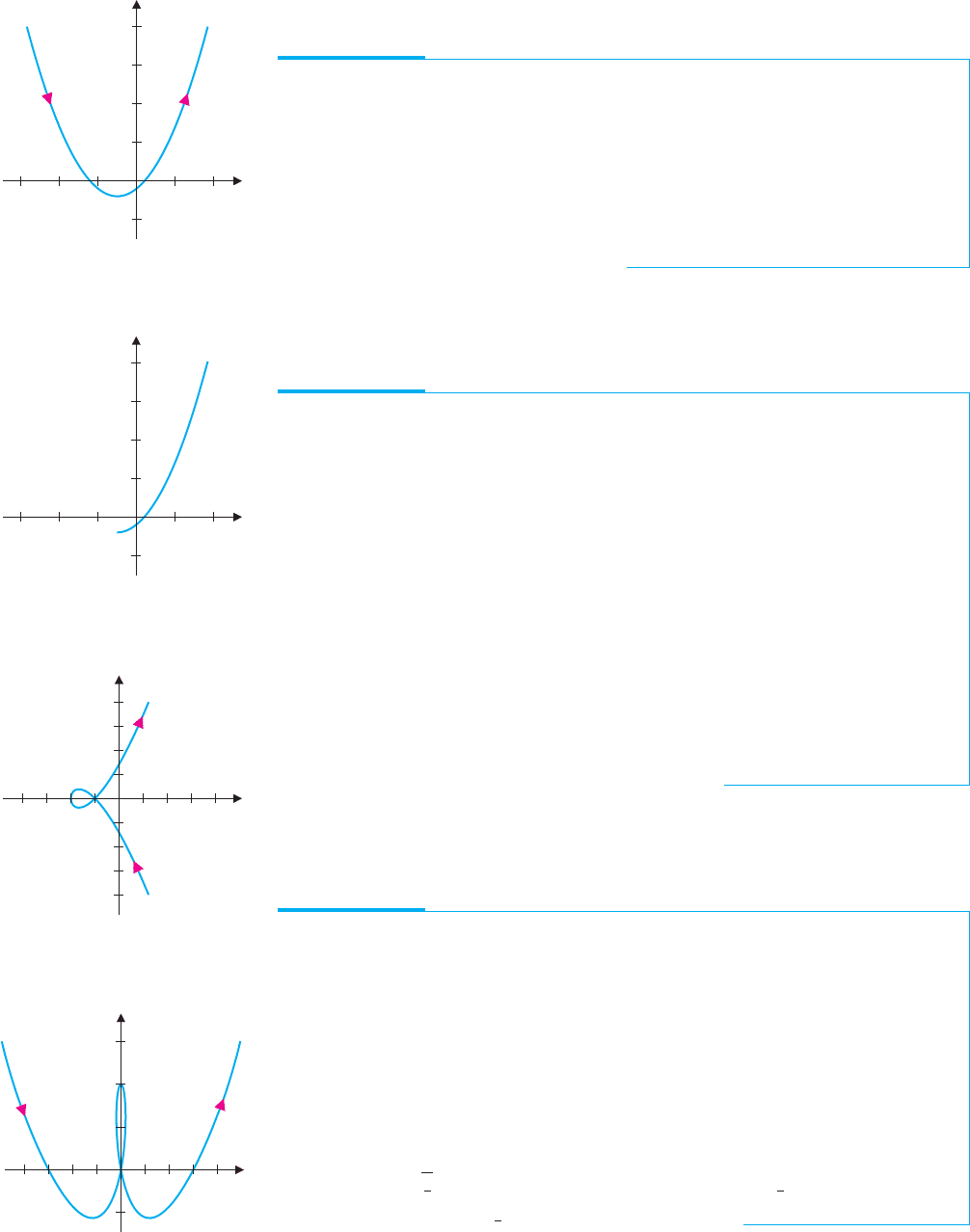
EXAMPLE 1.7 Parametric Representations of a Curve
with a Subtle Difference
Sketch the plane curves (a) x = t − 1, y = t
2
− 2 and (b) x = t
2
− 1, y = t
4
− 2.
Solution Since there is no restriction placed on t, we can assume that t can be any
real number. Eliminating the parameter in (a), we get t = x + 1, so that the parametric
equations in (a) correspond to the parabola y = (x + 1)
2
− 2, shown in Figure 10.5a.
Notice that the graph includes the entire parabola, since t and hence, x = t − 1 can be
any real number. (If your calculator sketch doesn’t show both sides of the parabola,
adjust the range of t-values in the plot.) The importance of this check is shown by (b).
When we eliminate the parameter, we get t
2
= x + 1 and so, y = (x + 1)
2
− 2. This
gives the same parabola as in (a). However, the initial computer sketch of the parametric
equations shown in Figure 10.5b shows only the right half of the parabola. To verify that
this is correct, note that since x = t
2
− 1, we have that x ≥−1 for every real number t.
Therefore, the curve is only the right half of the parabola y = (x + 1)
2
− 2, as shown.
Note that we do not indicate an orientation here, since the curve is traversed in one
direction for t > 0 and the opposite direction for t < 0.
Many plane curves described parametrically are unlike anything you’ve seen so far in
your study of calculus. Many of these are difficult to draw by hand,but can be easily plotted
with a graphing calculator or CAS.
y
x
2 424
4
2
2
4
FIGURE 10.6a
x = t
2
− 2, y = t
3
− t
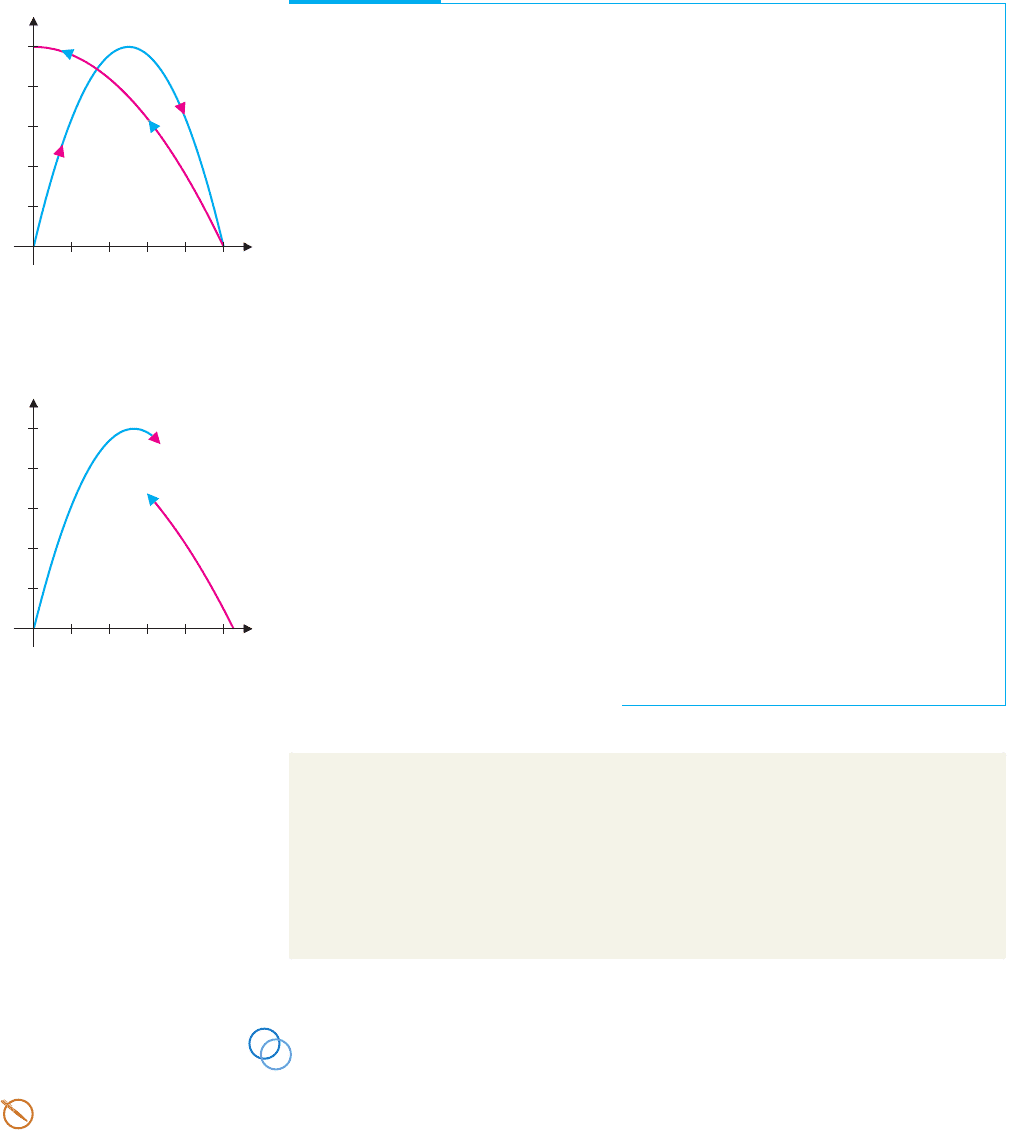
EXAMPLE 1.8 Some Unusual Plane Curves
Sketch the plane curves (a) x = t
2
− 2, y = t
3
− t and (b) x = t
3
− t,
y = t
4
− 5t
2
+ 4.
Solution A sketch of (a) is shown in Figure 10.6a. From the vertical line test, this is
not the graph of any function. Further, converting to an x-y equation here is messy and
not particularly helpful. (Try this to see why.) However, note that x = t
2
− 2 ≥−2 for
all t and y = t
3
− t has no maximum or minimum. (Think about why.)
A computer sketch of (b) is shown in Figure 10.6b. Again, this is not a familiar
graph. To get an idea of the scope of the graph, note that x = t
3
− t has no maximum or
minimum. To find the minimum of y = t
4
− 5t
2
+ 4, note that critical numbers are at
t = 0 and t =±
5
2
with corresponding function values 4 and −
9
4
, respectively. You
should conclude that y ≥−
9
4
, as indicated in Figure 10.6b.
y
x
4 848
6
4
2
FIGURE 10.6b
x = t
3
− t, y = t
4
− 5t
2
+ 4
You should now have some idea of the flexibility of parametric equations. Quite
significantly, a large number of applications translate simply into parametric equations.
P1: OSO/OVY P2: OSO/OVY QC: OSO/OVY T1: OSO
MHDQ256-Ch10 MHDQ256-Smith-v1.cls December 21, 2010 21:17
LT (Late Transcendental)
CONFIRMING PAGES
630 CHAPTER 10
..
Parametric Equations and Polar Coordinates 10-6
Bear in mind that parametric equations communicate more information than do the
corresponding x-y equations. We illustrate this with example 1.9.
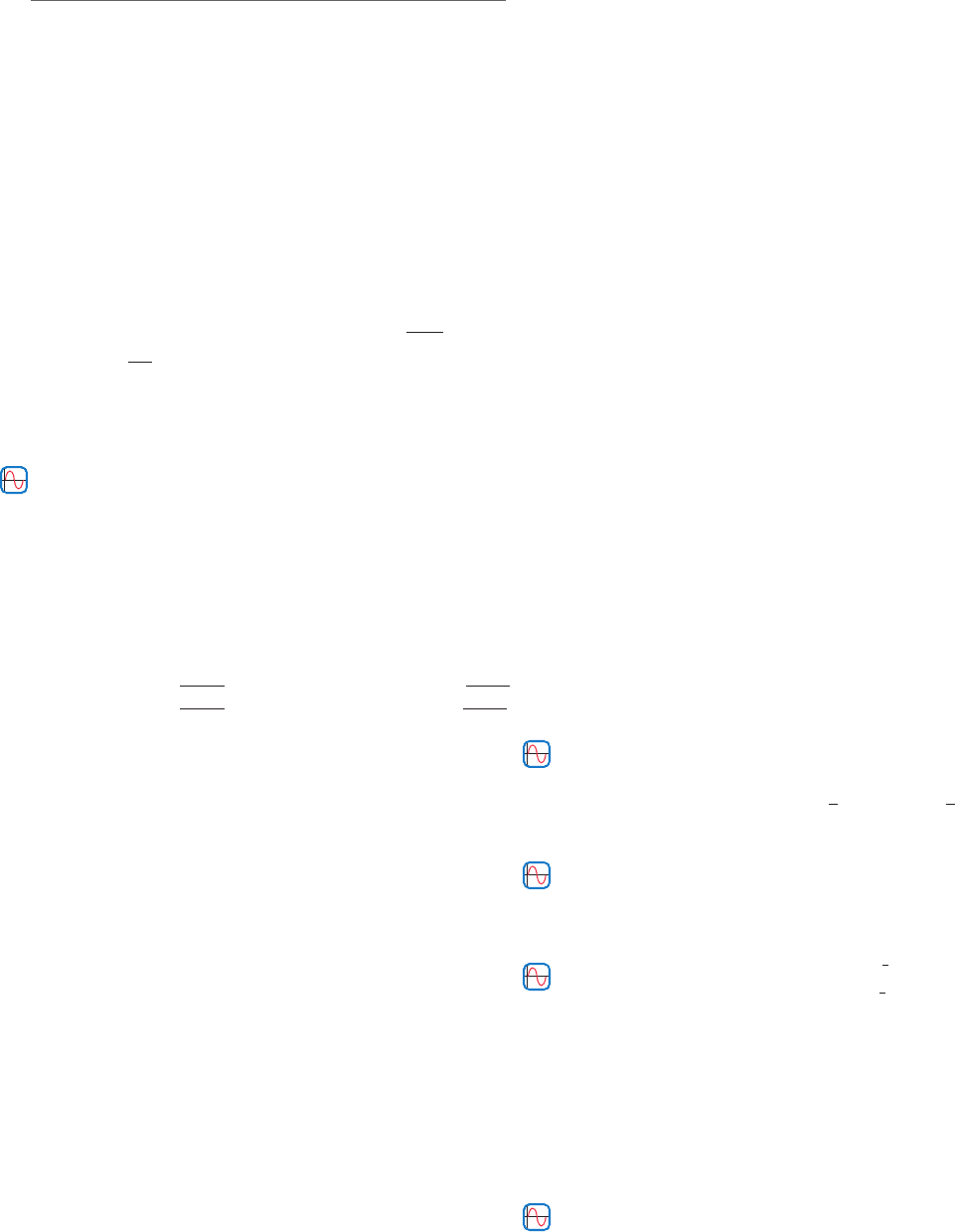
EXAMPLE 1.9 Intercepting a Missile in Flight
Suppose that a missile is fired toward your location from 500 miles away and follows a
flight path given by the parametric equations
x = 100t, y = 80t −16t
2
, for 0 ≤ t ≤ 5.
Two minutes later, you fire an interceptor missile from your location following the flight
path
x = 500 −200(t − 2), y = 80(t −2) −16(t −2)
2
, for 2 ≤ t ≤ 7.
Determine whether the interceptor missile hits its target.
y
x
100 200 300 400 500
20
40
60
80
100
FIGURE 10.7a
Missile flight paths
Solution In Figure 10.7a, we have plotted the flight paths for both missiles
simultaneously. The two paths clearly intersect, but this does not necessarily mean that
the two missiles collide. For that to happen, they need to be at the same point at the
same time. To determine whether there are any values of t for which both paths are
simultaneously passing through the same point, we set the two x-values equal:
100t = 500 −200(t − 2)
and obtain one solution: t = 3. Note that this simply says that the two missiles have the
same x-coordinate when t = 3. Unfortunately, the y-coordinates are not the same here,
since when t = 3, we have
80t −16t
2
= 96 but 80(t − 2) − 16(t − 2)
2
= 64.
You can see this graphically by plotting the two paths simultaneously for 0 ≤ t ≤ 3
only, as we have done in Figure 10.7b. From the graph, you can clearly see that the two
missiles pass one another without colliding. So, by the time the interceptor missile
intersects the flight path of the incoming missile, it is long gone! Another very nice way
to observe this behavior is to plot the two sets of parametric equations on your graphing
calculator in “simultaneous plot” mode. With this, you can animate the flight paths and
watch the missiles pass by one another.
y
x
100 200 300 400 500
20
40
60
80
100
FIGURE 10.7b
Missile flight paths
BEYOND FORMULAS
When thinking of parametric equations, it is often helpful to think of t as representing
timeandthegraphasrepresentingthepathofamovingparticle.However,itisimportant
to realize that the parameter can be anything. For example, in equations of circles and
ellipses, the parameter may represent the angle asyou rotate around the oval. Allowing
the parameter to change from problem to problem gives us incredible flexibility to
describe the relationship between x and y in the most convenient way possible.
EXERCISES 10.1
WRITING EXERCISES
1. Interpret in words the roles of each of the constants in the
parametric equations
x = a
1
+ b
1
cos(ct)
y = a
2
+ b
2
sin(ct)
.
2. An algorithm was given in example 1.5 for finding parametric
equations of a line segment. Discuss the advantages that this
method has over the other methods presented in remark 1.3.
3. As indicated in remark 1.3, a given curve can be described by
numerous sets of parametric equations. Explain why several
different equations can all be correct. (Hint: Emphasize the
fact that t is a dummy variable.)
4. In example 1.9, you saw that missiles don’t collide even
though their paths intersect. If you wanted to determine the
intersection point of the graphs, explain why you would
need to solve for values s and t (possibly different) such
P1: OSO/OVY P2: OSO/OVY QC: OSO/OVY T1: OSO
MHDQ256-Ch10 MHDQ256-Smith-v1.cls December 21, 2010 21:17
LT (Late Transcendental)
CONFIRMING PAGES
10-7 SECTION 10.1
..
Plane Curves and Parametric Equations 631
that 100t = 500 −200(s − 2) and 80t −16t
2
= 80(s − 2) −
16(s − 2)
2
.
In exercises 1–12, sketch the plane curve defined by the given
parametric equations and find an x-y equation for the curve.
1.
x = 2cos t
y = 3 sin t
2.
x = 1 +2 cos t
y =−2 +2 sin t
3.
x =−1 +2t
y = 3t
4.
x = 4 +3t
y = 2 −4t
5.
x = 1 +t
y = t
2
+ 2
6.
x = 2 −t
y = t
2
+ 1
7.
x = t
2
− 1
y = 2t
8.
x = t
2
− 1
y = t
2
+ 1
9.
x = sin
−1
t
y = sin t
10.
x = tan
−1
t
y = 4/
√
t + 1
11.
x =
√
lnt
y = 1/t
12.
x = e
t
y = e
−2t
............................................................
In exercises 13–20, use a graphing calculator to sketch the plane
curves defined by the parametric equations.
13.
x = t
3
− 2t
y = t
2
− 3
14.
x = t
3
− 2t
y = t
2
− 3t
15.
x = cos2t
y = sin 7t
16.
x = cos2t
y = sin π t
17.
x = 3cos 2t + sin 5t
y = 3 sin 2t + cos 5t
18.
x = 3cos 2t + sin 6t
y = 3 sin 2t + cos 6t
19.
x = (2 −t/
√
t
2
+ 1)cos32t
y = (1 +t/
√
t
2
+ 1)sin32t
20.
x = 8t cos 4t/
√
t
2
+ 1
y = 8t sin4t/
√
t
2
+ 1
............................................................
In exercises 21–28, find parametric equations describing the
given curve.
21. The line segment from (0, 1) to (3, 4)
22. The line segment from (3, 1) to (1, 3)
23. The line segment from (−2, 4) to (6, 1)
24. The line segment from (4, −2) to (2, −1)
25. The portion of the parabola y = x
2
+ 1 from (1, 2) to (2, 5)
26. The portion of the parabola y = 2 − x
2
from (2, −2) to (0, 2)
27. The circle of radius 3 centered at (2, 1), counterclockwise
28. The circle of radius 5 centered at (−1, 3), counterclockwise
............................................................
In exercises 29–32, find parametric equations for the path of a
projectile launched from height h with initial speed v at angle
θ from the horizontal.
29. h = 16
, v = 12 ft/s, (a) θ = 0
◦
(b) θ = 6
◦
up
30. h = 100
, v = 24 ft/s, (a) θ = 0
◦
(b) θ = 4
◦
down
31. h = 10 m, v = 2 m/s, (a) θ = 0
◦
(b) θ = 8
◦
down
32. h = 40 m, v = 8 m/s, (a) θ = 0
◦
(b) θ = 6
◦
up
............................................................
33. Rework example 1.9 with the interceptor missile following
the flight path x = 500 −500(t − 2) and y = 208(t − 2) −
16(t − 2)
2
.
34. Rework example 1.9 withthe interceptor missile following the
flight path x = 500 −100t and y = 80t − 16t
2
.
35. In example 1.9 and exercise 33, explain why the 2 in the term
t − 2 represents the time delay between the launches of the
two missiles. For the equations in example 1.9, find a value of
the time delay such that the two missiles do collide.
36. Explain why the missile path in exercise 34 must produce a
collision (compare the y-equations) but is unrealistic.
In exercises 37–40, find all points of intersection of the two
curves.
37.
x = t
y = t
2
− 1
and
x = 1 +s
y = 4 −s
38.
x = t
2
y = t + 1
and
x = 2 +s
y = 1 −s
39.
x = t + 3
y = t
2
and
x = 1 +s
y = 2 −s
40.
x = t
2
+ 3
y = t
3
+ t
and
x = 2 +s
y = 1 −s
............................................................
41. Conjecture the differencebetween the graphs of
x = cos2t
,
y = sin kt
where k is an integer compared to when k is an irrational
number. (Hint: Try k = 3, k =
√
3, k = 5, k =
√
5 and other
values.)
42. Compare the graphs of
x = cos3t
y = sin kt
for k = 1, k = 2,
k = 3, k = 4 and k = 5, and describe the role that k plays in
the graph.
43. Compare the graphs of
x = cost −
1
2
coskt
y = sin t −
1
2
sinkt
for k = 2,
k = 3, k = 4 and k = 5, and describe the role that k plays in
the graph.
44. Describe the role that r plays in the graph of
x = r cost
y = r sin t
and then describe how to sketch the graph of
x = t cos t
y = t sint
.
45. Compare the graphs of
x = cos2t
y = sin t
and
x = cost
y = sin 2t
. Use
the identities cos 2t = cos
2
t − sin
2
t and sin2t = 2 cos t sint
to find x-y equations for each graph.
P1: OSO/OVY P2: OSO/OVY QC: OSO/OVY T1: OSO
MHDQ256-Ch10 MHDQ256-Smith-v1.cls December 21, 2010 21:17
LT (Late Transcendental)
CONFIRMING PAGES
632 CHAPTER 10
..
Parametric Equations and Polar Coordinates 10-8
46. Determine parametric equations for the curves defined
by x
2n
+ y
2n
= r
2n
for integers n. [Hint: Start with n = 1,
x
2
+ y
2
= r
2
, then think of the general equation as (x
n
)
2
+
(y
n
)
2
= r
2n
.] Sketch the graphs for n = 1, n = 2 and n = 3,
and predict what the curve will look like for large values of n.
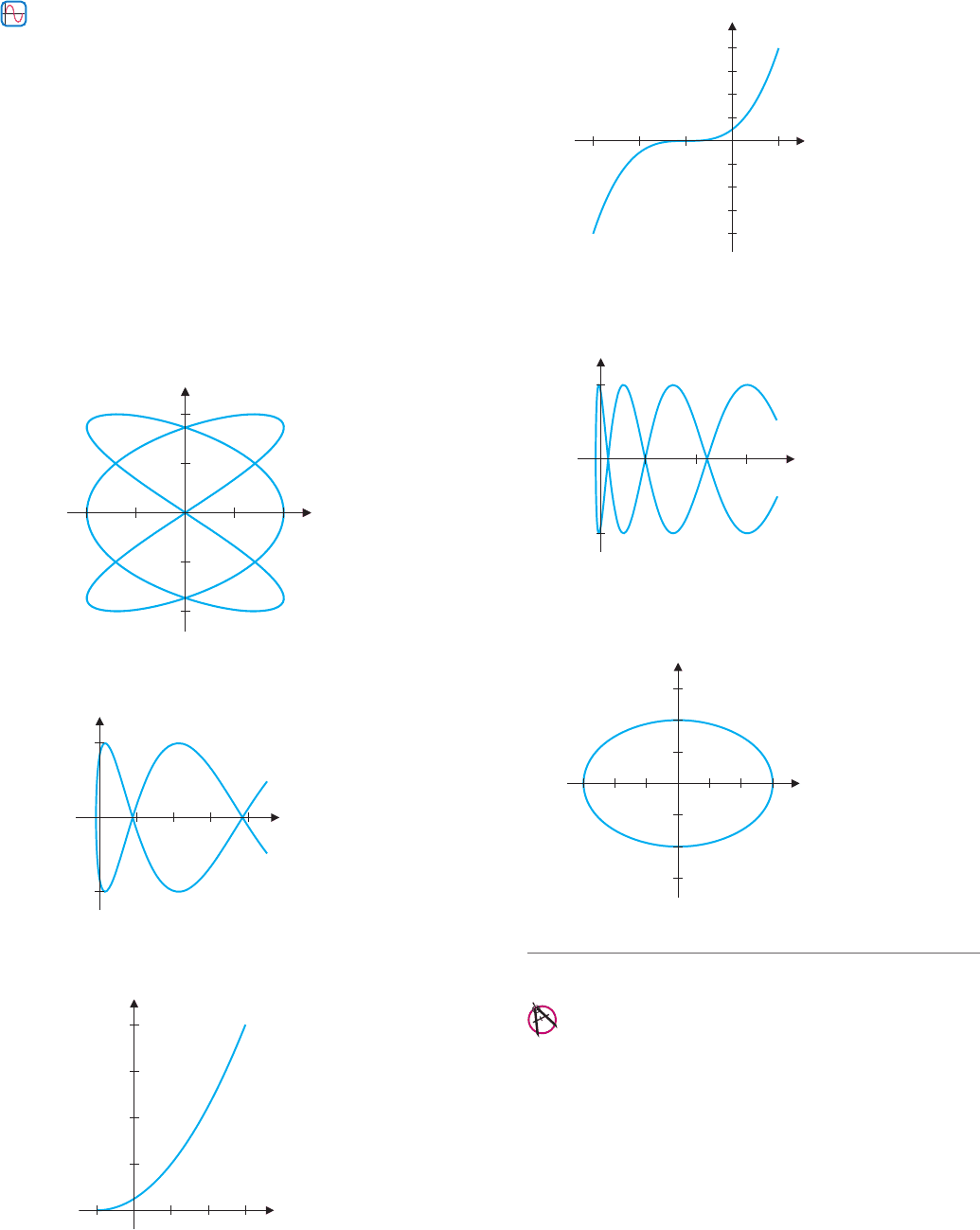
In exercises 47–52,match the parametric equations with the cor-
responding plane curve displayed in Figures A–F. Give reasons
for your choices.
47.
x = t
2
− 1
y = t
4
48.
x = t − 1
y = t
3
49.
x = t
2
− 1
y = sin t
50.
x = t
2
− 1
y = sin 2t
51.
x = cos3t
y = sin 2t
52.
x = 3cos t
y = 2 sin t
y
x
0.5 10.51
0.5
1
0.5
1
FIGURE A
y
x
20 40
1
1
FIGURE B
y
x
1 2 31
4
8
12
16
FIGURE C
y
x
113
8
4
4
8
FIGURE D
y
x
3020
1
1
FIGURE E
y
x
1 2 3123
1
3
1
3
FIGURE F
APPLICATIONS
Exercises53and 54 explorethesound barrierproblemdiscussed
in the chapter introduction. Define 1 unit to be the distance trav-
eled by sound in 1 second.
53. (a) Suppose a sound wave is emitted from the origin at time 0.
After t seconds (t > 0), explainwhy the position in units of
the sound wave is modeled by x = t cos θ and y = t sinθ,
where the dummy parameter θ has range 0 ≤ θ ≤ 2π .
(b) Find parametric equations for the position at time t seconds
(t > 0) of a sound wave emitted at time c seconds from the
point (a, b).