
Smith R., Minton R. Calculus
Подождите немного. Документ загружается.

P1: OSO/OVY P2: OSO/OVY QC: OSO/OVY T1: OSO
MHDQ256-Ch12 MHDQ256-Smith-v1.cls December 30, 2010 19:29
LT (Late Transcendental)
CONFIRMING PAGES
12-15 SECTION 12.2
..
The Calculus of Vector-Valued Functions 763
(iv) From the definition of dot product and the usual product rule for the product of
two scalar functions, we have
d
dt
[r(t) ·s(t)] =
d
dt
[ f
1
(t), g
1
(t), h
1
(t)·f
2
(t), g
2
(t), h
2
(t)]
=
d
dt
[ f
1
(t) f
2
(t) + g
1
(t)g
2
(t) + h
1
(t)h
2
(t)]
= f
1
(t) f
2
(t) + f
1
(t) f
2
(t) + g
1
(t)g
2
(t) + g
1
(t)g
2
(t)
+ h
1
(t)h
2
(t) + h
1
(t)h
2
(t)
= [ f
1
(t) f
2
(t) + g
1
(t)g
2
(t) + h
1
(t)h
2
(t)]
+[ f
1
(t) f
2
(t) + g
1
(t)g
2
(t) + h
1
(t)h
2
(t)]
= r
(t) ·s(t) + r(t) ·s
(t).
We leave the proofs of (ii), (iii) and (v) as exercises.
y
x
07.5 5 2.5
3
1
4
2
2.5 5 7.5
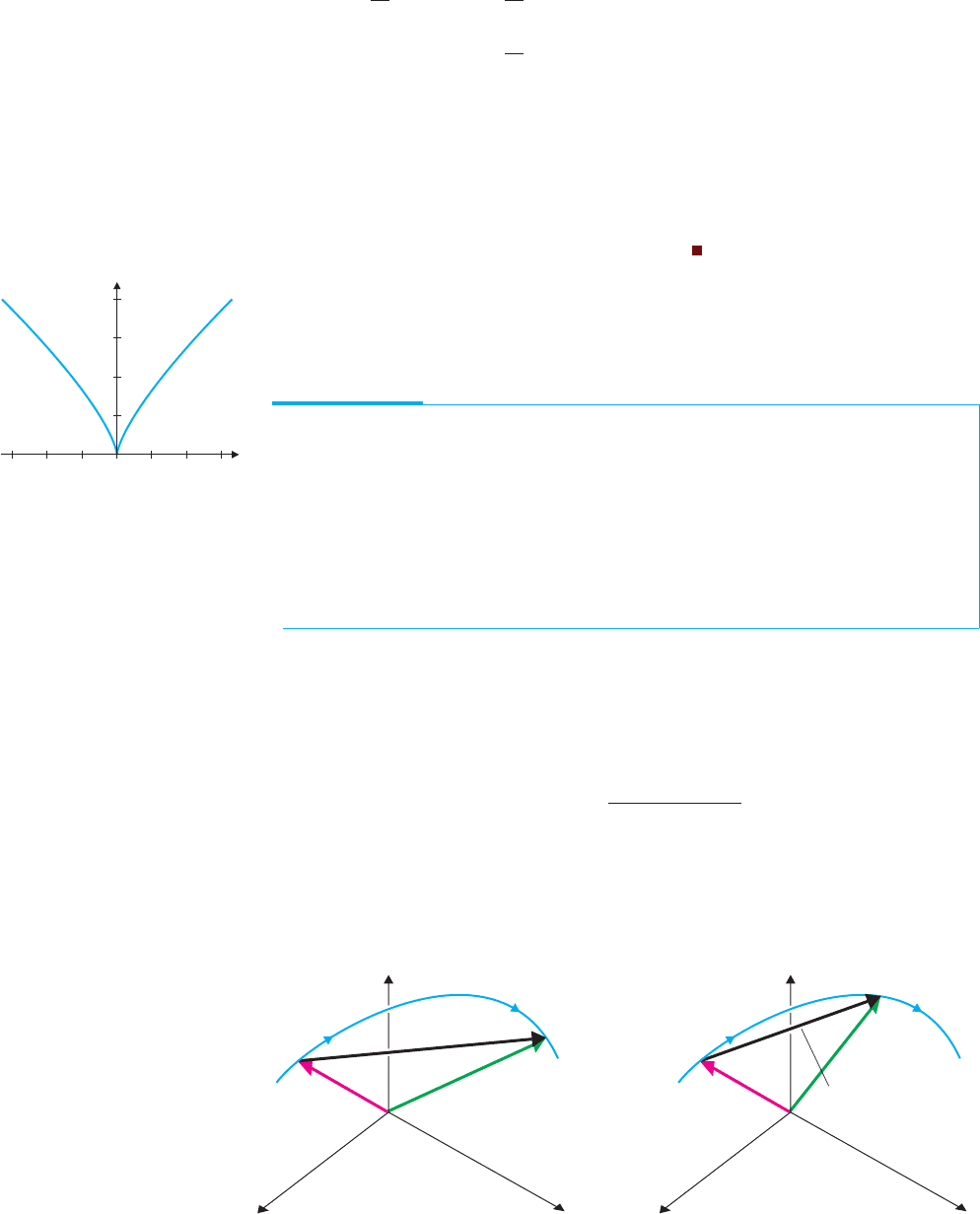
FIGURE 12.10
The curve traced out by
r(t) =t
3
, t
2
We say that the curve traced out by the vector-valued function r(t) =f (t), g(t), h(t)
on an interval I is smooth if r
is continuous on I and r
(t) = 0, except possibly at any
endpoints of I. Notice that this says that the curve is smooth provided f
, g
and h
are all
continuous on I and f
(t), g
(t) and h
(t) are not all zero at the same point in I.
EXAMPLE 2.6 Determining Where a Curve Is Smooth
Determine where the plane curve traced out by the vector-valued function r(t) =t
3
, t
2
is smooth.
Solution We show a graph of the curve in Figure 12.10.
Here, r
(t) =3t
2
, 2t is continuous everywhere and r
(t) = 0 if and only if t = 0. This
says that the curve is smooth in any interval not including t = 0. Referring to Figure
12.10, observe that the curve is smooth except at the cusp located at the origin.
We next explore an important graphical interpretation of the derivative of a vector-
valuedfunction. First, recall that the derivative of a scalar function at apoint gives the slope
of the tangent line to the curve at that point. For the case of the vector-valued function r(t),
notice that from (2.2), the derivative of r(t)att = a is given by
r
(a) = lim
t→0
r(a + t) −r(a)
t
.
Again, recall that the endpoint of the vector-valued function r(t) traces out a curve C in R
3
.
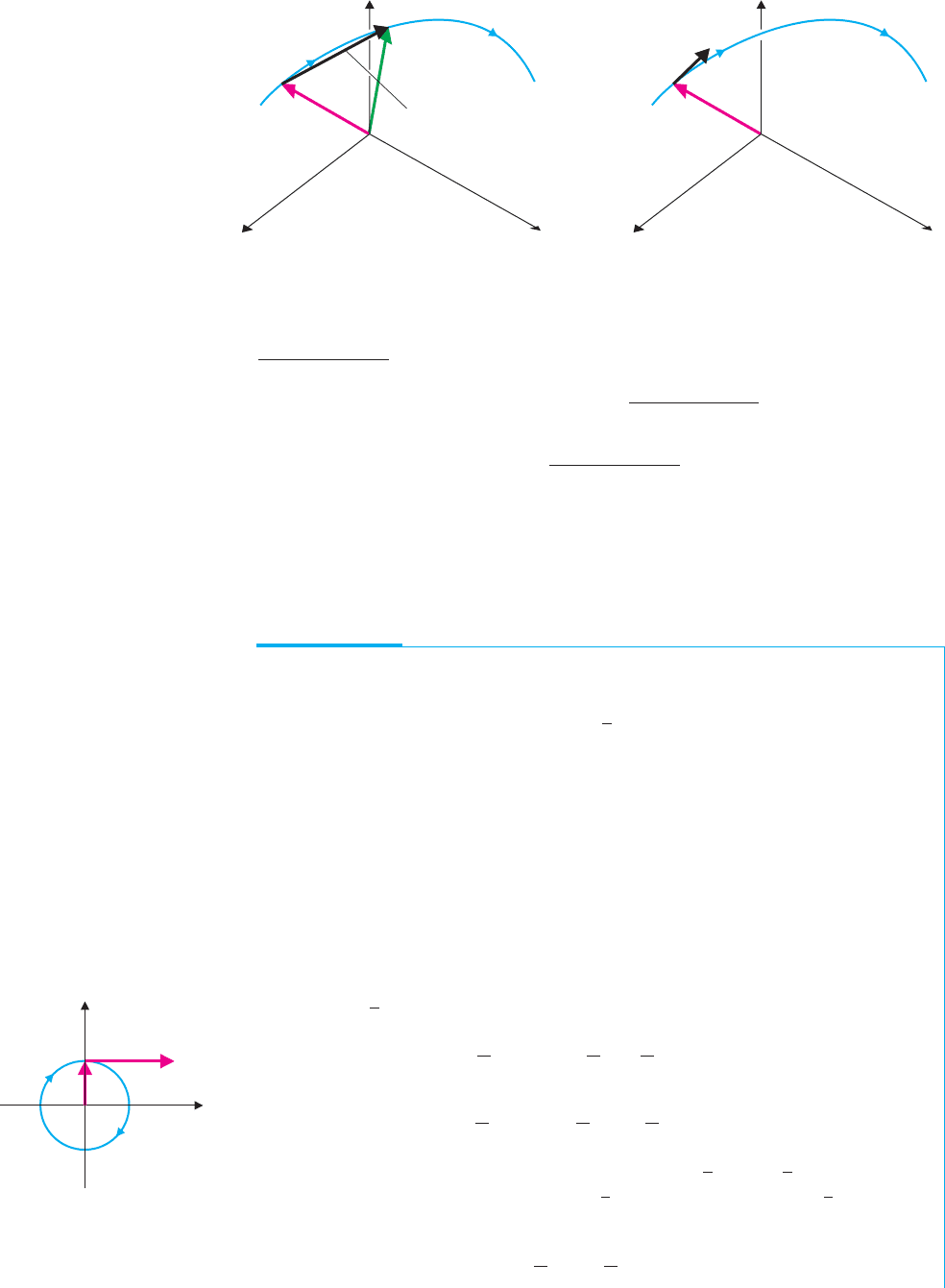
In Figure 12.11a, we show the position vectors r(a), r(a + t) and r(a + t) − r(a), for
some fixed t > 0, using our graphical interpretation of vector subtraction, developed in
y
x
z
O
r(a)
r(a t)
r(a t) r(a)
C
y
x
z
O
r(a)
r(a t)
r(a t) r(a)
C
FIGURE 12.11a FIGURE 12.11b
P1: OSO/OVY P2: OSO/OVY QC: OSO/OVY T1: OSO
MHDQ256-Ch12 MHDQ256-Smith-v1.cls December 27, 2010 20:38
LT (Late Transcendental)
CONFIRMING PAGES
764 CHAPTER 12
..
Vector-Valued Functions 12-16
y
x
z
O
r(a)
r(a t)
r(a t) r(a)
C
y
x
z
O
r(a)
r(a)
C
FIGURE 12.11c FIGURE 12.11d
The tangent vector r
(a)
Chapter 11. (How does the picture differ if t < 0?) Notice that for t > 0, the vector
r(a + t) −r(a)
t
points in the same direction as r(a + t) −r(a).
If we take smaller and smaller values of t,
r(a + t) −r(a)
t
will approach r
(a). We
illustrate this graphically in Figures 12.11b (on the preceding page) and 12.11c.
As t → 0, notice that the vector
r(a + t) −r(a)
t
approaches a vector that is tangent
to the curve C at the terminal point of r(a), as seen in Figure 12.11d. We refer to r
(a)as
a tangent vector to the curve C at the point corresponding to t = a. Be sure to observe
that r
(a) lies along the tangent line to the curve at t = a and points in the direction of the
orientation of C. (Recognize that Figures 12.11a, 12.11b and 12.11c are all drawn so that
t > 0. What changes in each of the figures if t < 0?)
We illustrate this notion for a simple curve in R
2
in example 2.7.
EXAMPLE 2.7 Drawing Position and Tangent Vectors
For r(t) =−cos 2t, sin 2t, plot the curve traced out by the endpoint of r(t) and draw
the position vector and tangent vector at t =
π
4
.
Solution First, notice that
r
(t) =2 sin 2t, 2cos2t.
Also, the curve traced out by r(t) is given parametrically by
C: x =−cos2t, y = sin2t, t ∈ R.
Observe that here,
x
2
+ y
2
= cos
2
2t +sin
2
2t = 1,
x
y
r
(
d
)
r
(
d
)
FIGURE 12.12
Position and tangent vectors
so that the curve is the circle of radius 1, centered at the origin. Further, from the
parameterization, you can see that the orientation is clockwise. The position and tangent
vectors at t =
π
4
are given by
r
π
4
=
−cos
π
2
, sin
π
2
=0, 1
and r
π
4
=
2sin
π
2
, 2 cos
π
2
=2, 0,
respectively. We show the curve, along with the vectors r
π
4
and r
π
4
in Figure 12.12
where we have drawn the initial point of r
π
4
at the terminal point of r
π
4
.In
particular, you might note that
r
π
4
· r
π
4
= 0,

P1: OSO/OVY P2: OSO/OVY QC: OSO/OVY T1: OSO
MHDQ256-Ch12 MHDQ256-Smith-v1.cls December 27, 2010 20:38
LT (Late Transcendental)
CONFIRMING PAGES
12-17 SECTION 12.2
..
The Calculus of Vector-Valued Functions 765
so that r
π
4
and r
π
4
are orthogonal. In fact, r(t) and r
(t) are orthogonal for every t,
as follows:
r(t) ·r
(t) =−cos 2t, sin2t·2 sin2t, 2cos2t
=−2cos2t sin2t + 2sin2t cos2t = 0.
Were you surprised to find in example 2.7 that the position vector and the tangent vector
were orthogonal at every point? As it turns out, this is a special case of a more general
result, which we state in Theorem 2.4.
THEOREM 2.4
r(t)=constant if and only if r(t) and r
(t) are orthogonal, for all t.
PROOF
(i) Suppose that r(t)=c, for some constant c. Recall that
r(t) ·r(t) =r(t)
2
= c
2
. (2.4)
Differentiating both sides of (2.4), we get
d
dt
[r(t) ·r(t)] =
d
dt
c
2
= 0.
From Theorem 2.3 (iv), we now have
0 =
d
dt
[r(t) ·r(t)] = r
(t) ·r(t) + r(t) ·r
(t) = 2r(t) · r
(t),
so that r(t) ·r
(t) = 0, as desired.
(ii) We leave the proof of the converse as an exercise.
Notethatintwodimensions, if r(t)=c for all t (where c is a constant), then the curve
traced out by the position vector r(t) must lie on the circle of radius c, centered at the origin.
Theorem 2.4 then says that the path traced out by r(t) lies on a circle centered at the origin if
and only if the tangent vector is orthogonal to the position vector at every point on the curve.
Likewise, in three dimensions, if r(t)=c for all t (where c is a constant), the curve traced
out by r(t) lies on the sphere of radius c centered at the origin. In this case, Theorem 2.4
says that the curve traced out by r(t) lies on a sphere centered at the origin if and only if
the tangent vector is orthogonal to the position vector at every point on the curve.
BEYOND FORMULAS
Theorem 2.4 illustrates the
importance of good notation.
While we could have derived
the same result using parametric
equations, the vector notation
greatly simplifies both the
statement and proof of the
theorem. The simplicity of the
notation allows us to make
connections and use our
geometric intuition, instead of
floundering in a mess of
equations. We can visualize the
graph of a vector-valued
function r(t) more easily than
we can try to keep track of
separate expressions for
x(t), y(t) and z(t).
Weconclude this section by making a few straightforward definitions. Recall that when
we say that the scalar function F(t) is anantiderivative of thescalar function f (t), we mean
that F is any function such that F
(t) = f (t). We now extend this notion to vector-valued
functions.
DEFINITION 2.4
The vector-valued function R(t)isanantiderivative of the vector-valued function
r(t) whenever R
(t) = r(t).
Notice that if r(t) =f (t), g(t), h(t) and f, g and h have antiderivatives F, G and H,
respectively, then
d
dt
F(t), G(t), H(t)=F
(t), G
(t), H
(t)=f (t), g(t), h(t).
That is, F(t), G(t), H(t) is an antiderivative of r(t). In fact, F(t) +c
1
, G(t) + c
2
,
H(t) +c
3
is also an antiderivative of r(t), for any choice of constants c
1
, c
2
and c
3
. This
leads us to Definition 2.5.

P1: OSO/OVY P2: OSO/OVY QC: OSO/OVY T1: OSO
MHDQ256-Ch12 MHDQ256-Smith-v1.cls December 27, 2010 20:38
LT (Late Transcendental)
CONFIRMING PAGES
766 CHAPTER 12
..
Vector-Valued Functions 12-18
DEFINITION 2.5
If R(t) is any antiderivative of r(t), the indefinite integral of r(t) is defined to be
r(t) dt = R(t) + c,
where c is an arbitrary constant vector.
As in the scalar case, R(t) + c is the most general antiderivative of r(t). (Why is that?)
Notice that this says that
Indefinite integral of a
vector-valued function
r(t) dt =
f (t), g(t), h(t)
dt =
f (t)dt,
g(t) dt,
h(t)dt
. (2.5)
That is, you integrate a vector-valued function by integrating each of the individual
components.
EXAMPLE 2.8 Evaluating the Indefinite Integral
of a Vector-Valued Function
Evaluate the indefinite integral
t
2
+ 2, sin2t, 4te
t
2
dt.
Solution From (2.5), we have
t
2
+ 2, sin2t, 4te
t
2
dt =
(t
2
+ 2) dt,
sin2tdt,
4te
t
2
dt
=
1
3
t
3
+ 2t + c
1
, −
1
2
cos2t + c
2
, 2e
t
2
+ c
3
=
1
3
t
3
+ 2t, −
1
2
cos2t, 2e
t
2
+ c,
where c =c
1
, c
2
, c
3
is an arbitrary constant vector.
We define the definite integral of a vector-valued function in the obvious way.
DEFINITION 2.6
For the vector-valued function r(t) =f (t), g(t), h(t), we define the definite
integral of r(t) on the interval [a, b]by
b
a
r(t) dt =
b
a
f (t), g(t), h(t)dt =
b
a
f (t)dt,
b
a
g(t) dt,
b
a
h(t)dt
. (2.6)
This says simply that the definite integral of a vector-valued function r(t) is the vector
whose components are the definite integrals of the corresponding components of r(t).
With this in mind, we now extend the Fundamental Theorem of Calculus to vector-valued
functions.
THEOREM 2.5
Suppose that R(t) is an antiderivative of r(t) on the interval [a, b]. Then,
b
a
r(t) dt = R(b) − R(a).
PROOF
The proof is straightforward and we leave this as an exercise.

P1: OSO/OVY P2: OSO/OVY QC: OSO/OVY T1: OSO
MHDQ256-Ch12 MHDQ256-Smith-v1.cls December 27, 2010 20:38
LT (Late Transcendental)
CONFIRMING PAGES
12-19 SECTION 12.2
..
The Calculus of Vector-Valued Functions 767
EXAMPLE 2.9 Evaluating the Definite Integral
of a Vector-Valued Function
Evaluate
1
0
sinπ t, 6t
2
+ 4tdt.
Solution Notice that an antiderivative for the integrand is
−
1
π
cosπ t,
6t
3
3
+ 4
t
2
2
=
−
1
π
cosπ t, 2t
3
+ 2t
2
.
From Theorem 2.5, we have that
1
0
sinπ t, 6t
2
+ 4tdt =
−
1
π
cosπ t, 2t
3
+ 2t
2
1
0
=
−
1
π
cosπ, 2 +2
−
−
1
π
cos0, 0
=
1
π
+
1
π
, 4 −0
=
2
π
, 4
.
EXERCISES 12.2
WRITING EXERCISES
1. If lim
t→0
f (t) = lim
t→0
g(t) = 0 and lim
t→0
h(t) =∞, describe what
happens graphically as t → 0 to the curve traced out by
r(t) =f (t), g(t), h(t). Explain why the limit of r(t)ast → 0
does not exist.
2. In example 2.3, describe what is happening graphically for
t ≤−1. Explain why we don’t say that r(t) is continuous for
t ≤−1.
3. Suppose that r(t) is a vector-valued function such that
r(0) =a, b, c and r
(0) exists. Imagine zooming in on the
curve traced out by r(t) near the point (a, b, c). Describe what
the curve will look like and how it relates to the tangent vector
r
(0).
4. There is a quotient rule corresponding to the product rule in
Theorem 2.3, part (iii). State this rule and describe in words
how you would prove it. Explain why there isn’t a quotient
rule corresponding to the product rules in parts (iv) and (v) of
Theorem 2.3.
In exercises 1–6, find the limit if it exists.
1. lim
t→0
t
2
− 1, e
2t
, sint 2. lim
t→1
t
2
, e
2t
,
t
2
+ 2t
3. lim
t→0
sint
t
, cost,
t + 1
t − 1
4. lim
t→1
√
t − 1, t
2
+ 3,
t + 1
t − 1
5. lim
t→0
lnt,
t
2
+ 1, t − 3
6. lim
t→π/2
cost, t
2
+ 3, tant
............................................................
In exercises 7–14, determine all values of t at which the given
vector-valued function is continuous.
7. r(t) =
t + 1
t − 2
,
t
2
− 1, 2t
8. r(t) =
sint, cost,
3
t
9. r(t) =tan t, sint
2
, cost 10. r(t) =cos 5t, tant, ln t
11. r(t) =
e
2/t
,
t
2
+ t,
2
t + 3
12. r(t) =sin t, −csct, cot t
13. r(t) =
√
t,
√
4 − t, tan t 14. r(t) =lnt, sect,
√
−t
............................................................
In exercises 15–20, find the derivative of the given vector-valued
function.
15. r(t) =
t
4
,
√
t + 1,
3
t
2
16. r(t) =
t − 3
t + 1
, te
2t
, t
3
17. r(t) =sin t, sint
2
, cost
18. r(t) =cos 5t, tant, 6sint
19. r(t) =e
t
2
, t
2
e
2t
, sec2t
20. r(t) =
t
2
+ 1, cost, e
−3t
............................................................
In exercises 21–26, determine where the curve traced out by r(t)
is smooth.
21. r(t) =t
4
− 2t
2
, t
2
− 2t 22. r(t) =t
2
+ t, t
3
23. r(t) =sin t, cos2t 24. r(t) =cos
2
t, sin
2
t
25. r(t) =e
√
t
, t
3
− t 26. r(t) =
t
t
2
+ 4
, ln(t
2
− 4t)
............................................................

P1: OSO/OVY P2: OSO/OVY QC: OSO/OVY T1: OSO
MHDQ256-Ch12 MHDQ256-Smith-v1.cls December 27, 2010 20:38
LT (Late Transcendental)
CONFIRMING PAGES
768 CHAPTER 12
..
Vector-Valued Functions 12-20
In exercises 27–30, sketch the curve traced out by the endpoint
of the givenvector-valued function and plot position and tangent
vectors at the indicated points.
27. r(t) =cos t, sint, t = 0, t =
π
2
, t = π
28. r(t) =t, t
2
− 1, t = 0, t = 1, t = 2
29. r(t) =cos t, t, sint, t = 0, t =
π
2
, t = π
30. r(t) =t, t, t
2
− 1, t = 0, t = 1, t = 2
............................................................
In exercises 31–40, evaluate the given indefinite or definite
integral.
31.
3t − 1,
√
t
dt 32.
3
t
2
,
4
t
dt
33.
t cos3t, t sin t
2
, e
2t
dt
34.
t
2
e
−t
, sin
2
t cost, sec
2
t
dt
35.
4
t
2
− t
,
2t
t
2
+ 1
,
4
t
2
+ 1
dt
36.
2
√
1 − t
2
,
t
2
− 1, t
t
2
− 1
dt
37.
1
0
t
2
− 1, 3t
dt
38.
4
1
√
t + 3, 5(t + 1)
−1
dt
39.
2
0
4
t + 1
, e
t−2
, te
t
dt
40.
4
0
2te
4t
,
4
t
2
+ 5t + 6
,
4t
t
2
+ 1
dt
............................................................
In exercises 41–44, find all values of t such that r(t) and r
(t)are
perpendicular.
41. r(t) =
cost, sint
42. r(t) =
2cost, sint
43. r(t) =
t, t, t
2
− 1
44. r(t) =
t
2
, t, t
2
− 5
............................................................
45. In each of exercises 41 and 42, show that there are no values
of t such that r(t) and r
(t) are parallel.
46. In each of exercises 43 and 44, show that there are no values
of t such that r(t) and r
(t) are parallel.
In exercises 47–50, find all values of t such that r
(t) is parallel
to the (a) xy-plane; (b) yz-plane; (c) plane x y.
47. r(t) =t, t, t
3
− 3 48. r(t) =
t
2
, t, sint
2
49. r(t) =cos t, sint, sin2t
50. r(t) =
√
t + 1, cost, t
4
− 8t
2
............................................................
In exercises 51–54, graph the curve traced out by r(t).
51. r(t) =
(2 + cos 8t) cos t, (2 + cos8t)sin t, sin 8t
52. r(t) =
(2 + t cos8t)cost, (2 +t cos 8t)sin t, t sin8t
53. r(t) =
2cost cos8t, 2 cos t sin8t, 2 sin t
54. r(t) =(−2 +8 cos t)cos (8
√
2t), (−2 +8 cos t)sin (8
√
2t),
8sint
............................................................
55. Find all values of a and b for which
r(t) =sin t, sin(at), sin(bt) is periodic.
56. Find all values of a and b for which
r(t) =sin(π t), sin(at), sin(bt) is periodic.
In exercises 57–60, label as true or false and explain why.
57. If u(t) =
1
r(t)
r(t) and u(t) · u
(t) = 0 then r(t) · r
(t) = 0.
58. If r(t
0
) · r
(t
0
) = 0 for some t
0
, then r(t) is constant.
59. If
b
a
f(t) ·g(t)dt =
b
a
f(t)dt ·
b
a
g(t)dt.
60. If F
(t) = f(t), then
f(t)dt = F(t).
............................................................
61. Define the ellipse C with parametric equations x = a cost and
y = b sin t,for positive constants a and b. Forafixedvalueof t,
define the points P = (a cost, b sint),
Q = (a cos(t + π/2), b sin(t + π/2)) and
Q
= (a cos(t − π/2), b sin(t − π/2)). Show that the vector
QQ
(called the conjugate diameter) is parallel to the tan-
gent vector to C at the point P. Sketch a graph and show the
relationship between P, Q and Q
.
62. Repeat exercise 61 for the general angle θ , so that the points
are P = (a cost, b sin t), Q = (a cos(t + θ ), b sin(t + θ )) and
Q
= (a cos(t − θ ), b sin(t − θ )).
63. Find
d
dt
[f(t) ·(g(t) × h(t))].
64. Find
d
dt
[f(t) ×(g(t) × h(t))].
65. Prove Theorem 2.3, part (ii).
66. In Theorem 2.3, part (ii), replace the scalar product cr(t) with
the dot product c · r(t), for a constant vector c and prove the
results.
67. Prove Theorem 2.3, parts (ii) and (iii).
68. Prove Theorem 2.3, part (v).
69. Prove that if r(t) and r
(t) are orthogonal for all t, then
r(t)=constant [Theorem 2.4, part (ii)].
70. Prove Theorem 2.5.
APPLICATION
71. If the curves traced out by f(t) =
t
2
− 4t,
√
t + 5, 4t
and
g(t) =
sin(πt),
t
2
t + 1
, 4 +3t
represent the paths of two air-
planes, determine if they collide.

P1: OSO/OVY P2: OSO/OVY QC: OSO/OVY T1: OSO
MHDQ256-Ch12 MHDQ256-Smith-v1.cls December 27, 2010 20:38
LT (Late Transcendental)
CONFIRMING PAGES
12-21 SECTION 12.3
..
Motion in Space 769
EXPLORATORY EXERCISES
1. Find all values of t such that r
(t) = 0 for each function:
(a)r(t) =t, t
2
−1,(b)r(t)=2cost +sin 2t, 2sint +cos2t,
(c) r(t) =2 cos3t + sin5t, 2sin3t + cos5t, (d) r(t) =
t
2
, t
4
− 1 and (e) r(t) =t
3
, t
6
− 1. Based on your results,
conjecture the graphical significance of having the deriva-
tive of a vector-valued function equal the zero vector. If r(t)
is the position function of some object in motion, explain
the physical significance of having a zero derivative. Ex-
plain your geometric interpretation in light of your physical
interpretation.
2. A curve C is smooth if it is traced out by a vector-valued
function r(t), where r
(t) is continuous and r
(t) = 0 for all
values of t. Sketch the graph of r(t) =
t,
3
√
t
2
and explain
why r
(t) must be continuous. Sketch the graph of r(t) =
2cost + sin2t, 2sint + cos2t and show that r
(0) = 0.
Explain why r
(t) must be nonzero. Sketch the graph of
r(t) =2 cos 3t + sin 5t, 2sin3t + cos5tand show that r
(t)
never equals the zero vector. By zooming in on the edges of the
graph, show that this curve is accurately described as smooth.
Sketch the graphs of r(t) =
t, t
2
− 1and g(t) = t
2
, t
4
− 1
for t ≥ 0 and observe that they trace out the same curve.
Show that g
(0) = 0, but that the curve is smooth at t = 0.
Explain why this says that the requirement that r
(t) = 0
need not hold for every r(t) tracing out the curve. [This
requirement needs to hold for only one such r(t).] Deter-
mine which of the following curves are smooth. If the curve
is not smooth, identify the graphical characteristic that is
“unsmooth”: r(t) =cos t, sint, t, r(t) =
cost, sint,
3
√
t
2
,
r(t) =
tant, sint
2
, cost, r(t) =
5sin
3
t, 5cos
3
t, t and
r(t) =
cos t, t
2
e
−t
, cos
2
t
.
12.3 MOTION IN SPACE
We are finally at a point where we have sufficient mathematical machinery to describe
the motion of an object in a three-dimensional setting. Problems such as this were one of
the primary focuses of Newton and many of his contemporaries. Newton used his newly
invented calculus to explain all kinds of motion, from the motion of a projectile (such as a
ball) hurled through the air, to the motion of the planets. His stunning achievements in this
field unlocked mysteries that had eluded the greatest minds for centuries and form the basis
of our understanding of mechanics today.
Suppose that an object moves along a curve traced out by the endpoint of the vector-
valued function
r(t) =f (t), g(t), h(t),
where t represents time and where t ∈ [a, b]. We observed in section 12.2 that for any given
value of t, r
(t) is a tangent vector pointing in the direction of the orientation of the curve.
We can now give another interpretation of this. From (2.3), we have
r
(t) =f
(t), g
(t), h
(t)
and the magnitude of this vector-valued function is
r
(t)=
[ f
(t)]
2
+ [g
(t)]
2
+ [h
(t)]
2
.
(Where have you seen this expression before?) Notice that from (1.4), given any number
t
0
∈ [a, b], the arc length of the portion of the curve from u = t
0
up to u = t is given by
s(t) =
t
t
0
[ f
(u)]
2
+ [g
(u)]
2
+ [h
(u)]
2
du. (3.1)
Part II of the Fundamental Theorem of Calculus says that if we differentiate both sides of
(3.1), we get
s
(t) =
[ f
(t)]
2
+ [g
(t)]
2
+ [h
(t)]
2
=r
(t).
Since s(t) represents arc length, s
(t) gives the instantaneous rate of change of arc length
with respect to time, that is, the speed of the object as it moves along the curve. So, for
any given value of t, r
(t) is a tangent vector pointing in the direction of the orientation of
C (i.e., the direction followed by the object) and whose magnitude gives the speed of the
object. So, we call r
(t) the velocity vector, denoted v(t). Finally, we refer to the derivative
P1: OSO/OVY P2: OSO/OVY QC: OSO/OVY T1: OSO
MHDQ256-Ch12 MHDQ256-Smith-v1.cls December 27, 2010 20:38
LT (Late Transcendental)
CONFIRMING PAGES
770 CHAPTER 12
..
Vector-Valued Functions 12-22
of the velocity vector v
(t) = r
(t)astheacceleration vector, denoted a(t). When drawing
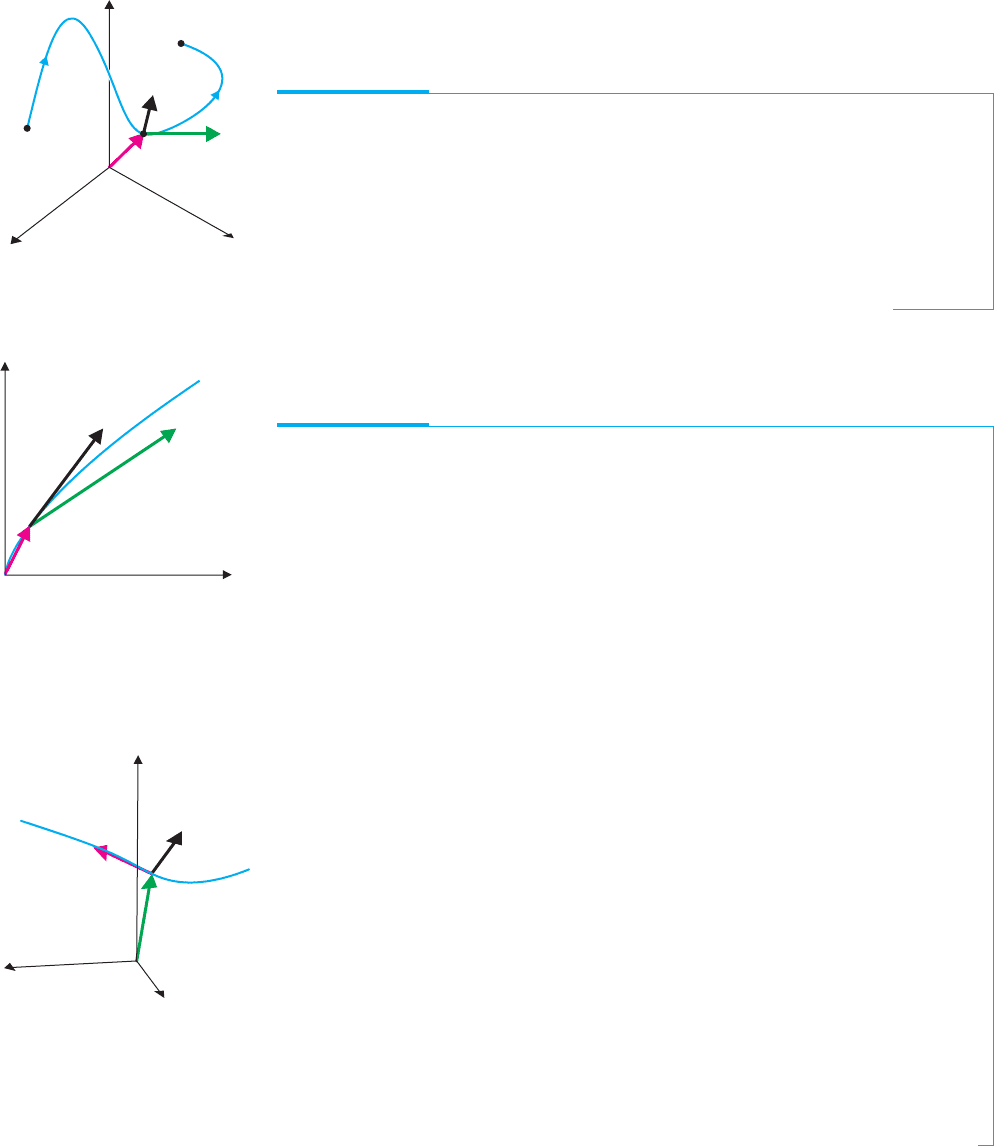
the velocity and acceleration vectors, we locate both of their initial points at the terminal
point of r(t) (i.e., at the point on the curve), as shown in Figure 12.13.
y
x
z
O
r(t)
r (t)
r(t)
C
FIGURE 12.13
Position, velocity and
acceleration vectors
y
x
r(1)
v(1)
a(1)
FIGURE 12.14
Position, velocity and acceleration
vectors
EXAMPLE 3.1 Finding Velocity and Acceleration Vectors
Find the velocity and acceleration vectors if the position of an object moving in the
xy-plane is given by r(t) =t
3
, 2t
2
.
Solution We have
v(t) = r
(t) =3t
2
, 4t and a(t) = r
(t) =6t, 4.
In particular, this says that at t = 1, we have r(1) =1, 2, v(1) = r
(1) =3, 4 and
a(1) = r
(1) =6, 4. We plot the curve and these vectors in Figure 12.14.
Just as in the case of one-dimensional motion, given the acceleration vector, we can
determine the velocity and position vectors, provided we havesome additional information.
EXAMPLE 3.2 Finding Velocity and Position from Acceleration
Find the velocity and position of an object at any time t, given that its acceleration is
a(t) =6t, 12t +2, e
t
, its initial velocity is v(0) =2, 0, 1 and its initial position is
r(0) =0, 3, 5.
Solution Since a(t) = v
(t), we integrate once to obtain
v(t) =
a(t) dt =
[6ti +(12t + 2)j + e
t
k]dt
= 3t
2
i + (6t
2
+ 2t)j + e
t
k + c
1
,
where c
1
is an arbitrary constant vector. To determine the value of c
1
, we use the given
initial velocity:
2, 0, 1=v(0) = (0)i +(0)j +(1)k +c
1
,
so that c
1
=2, 0, 0. This gives us the velocity
v(t) = (3t
2
+ 2)i +(6t
2
+ 2t)j + e
t
k.
Since v(t) = r
(t), we integrate again, to obtain
r(t) =
v(t) dt =
[(3t
2
+ 2)i +(6t
2
+ 2t)j + e
t
k]dt
= (t
3
+ 2t)i + (2t
3
+ t
2
)j + e
t
k + c
2
,
where c
2
is an arbitrary constant vector. We can use the given initial position to determine
the value of c
2
, as follows:
0, 3, 5=r(0) = (0)i +(0)j +(1)k +c
2
,
so that c
2
=0, 3, 4. This gives us the position vector
r(t) = (t
3
+ 2t)i + (2t
3
+ t
2
+ 3)j +(e
t
+ 4)k.
We show the curve and indicate sample vectors for r(t), v(t) and a(t) in Figure 12.15.
x
y
z
a(t)
v(t)
r(t)
FIGURE 12.15
Position, velocity and acceleration
vectors
We have already seen Newton’s second law of motion several times now. In the case
of motion in two or more dimensions, we have the vector form of Newton’s second law:
F = ma.
Here, m is the mass, a is the acceleration vector and F is the vector representing the net
force acting on the object.
P1: OSO/OVY P2: OSO/OVY QC: OSO/OVY T1: OSO
MHDQ256-Ch12 MHDQ256-Smith-v1.cls December 27, 2010 20:38
LT (Late Transcendental)
CONFIRMING PAGES
12-23 SECTION 12.3
..
Motion in Space 771
EXAMPLE 3.3 Finding the Force Acting on an Object
Find the force acting on an object moving along a circular path of radius b, with
constant angular speed.
Solution For simplicity, we will take the circular path to lie in the xy-plane with its
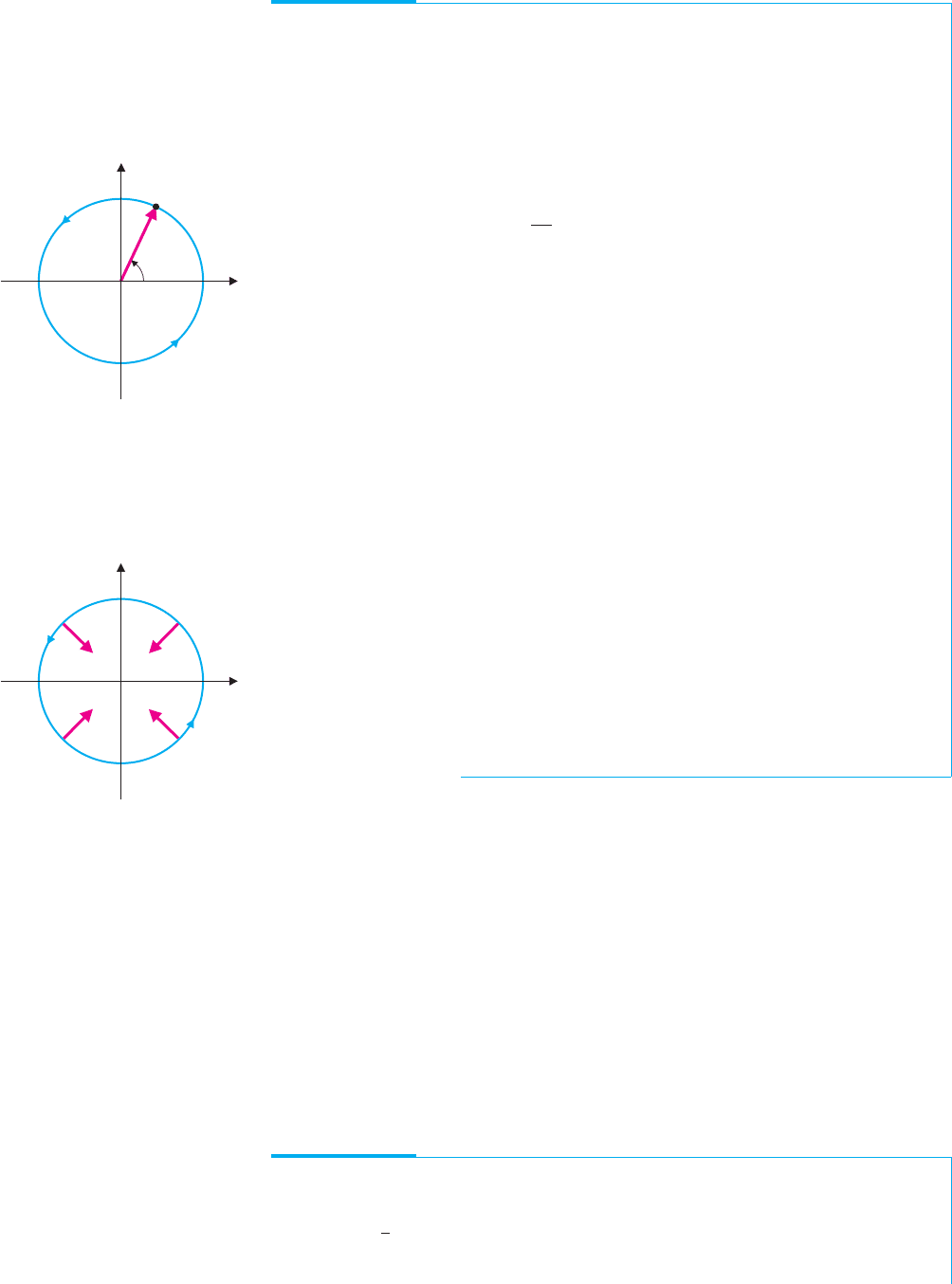
center at the origin. Here, by constant angular speed, we mean that if θ is the angle
made by the position vector and the positive x-axis and t is time (see Figure 12.16a,
where the indicated orientation is for the case where ω>0), then we have that
dθ
dt
= ω (constant).
Notice that this says that θ = ωt + c, for some constant c. Further, we can think of the
circular path as the curve traced out by the endpoint of the vector-valued function
r(t) =b cosθ,b sinθ =b cos(ωt +c), b sin(ωt + c).
Notice that the path is the same for every value of c. (Think about what the value of c
affects.) For simplicity, we take θ = 0 when t = 0, so that θ = ωt and
r(t) =b cosωt, b sin ωt.
Now that we know the position at any time t, we can differentiate to find the velocity
and acceleration. We have
v(t) = r
(t) =−bω sinωt, bω cosωt,
so that the speed is v(t)=ωb and
a(t) = v
(t) = r
(t) =−bω
2
cosωt, −bω
2
sinωt
=−ω
2
b cosωt, b sinωt=−ω
2
r(t).
From Newton’s second law of motion, we now have
F(t) = ma(t) =−mω
2
r(t).
Notice that since mω
2
> 0, this says that the force acting on the object points in the
direction opposite the position vector. That is, at any point on the path, it points in
toward the origin. (See Figure 12.16b.) We call such a force a centripetal
(center-seeking) force.
Observe that on the circular path of example 3.3, r(t)=b, so that at every point on
the path, the force vector has constant magnitude:
F(t)=−mω
2
r(t)=mω
2
r(t)=mω
2
b.
x
y
r(t)
u
FIGURE 12.16a
Motion along a circle
x
y
FIGURE 12.16b
Centripetal force
Notice that one consequence of the result F(t) =−mω
2
r(t) from example 3.3 is that
the magnitude of the force increases as the rotation rate ω increases. You have experienced
thisif youhavebeenon arollercoaster withtightturns or loops.Thefasteryouare going,the
strongerthe force that your seat exerts on you. Alternatively,since thespeedis v(t)=ωb,
the tighter the turn (i.e., the smaller b is), the larger ω must be to obtain a given speed. So,
on a roller coaster, a tighter turn requires a larger value of ω, which in turn increases the
centripetal force.
Just as we did in the one-dimensional case, we can use Newton’s second law of motion
to determine the position of an object given only a knowledge of the forces acting on it. We
present a simple case in example 3.4.
EXAMPLE 3.4 Analyzing the Motion of a Projectile
A projectile is launched from ground level with an initial speed of 50 meters per second
at an angle of
π
4
to the horizontal. Assuming that the only force acting on the object is
gravity (i.e., there is no air resistance, etc.), find the maximum altitude, the horizontal
range and the speed at impact of the projectile.
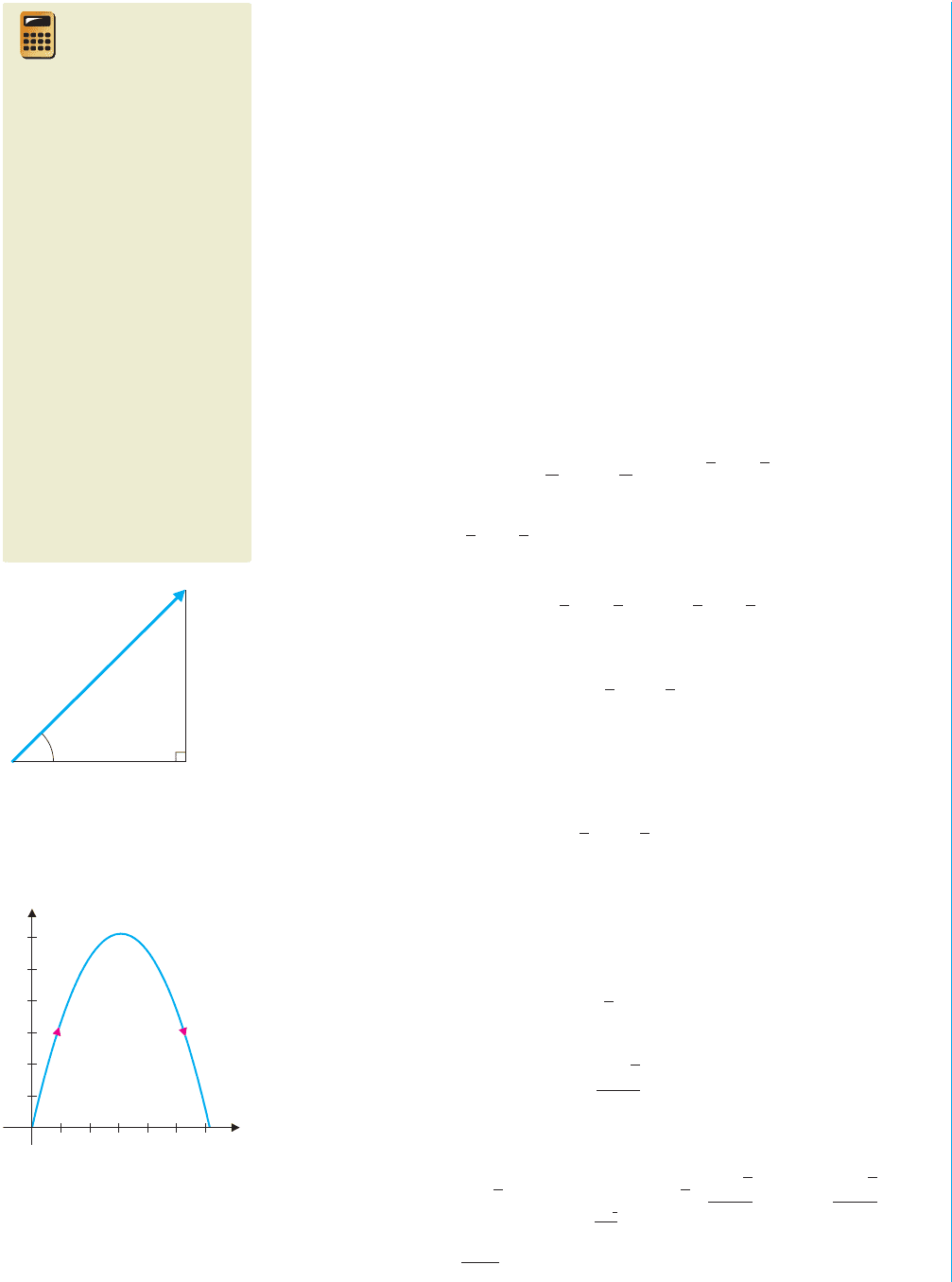
P1: OSO/OVY P2: OSO/OVY QC: OSO/OVY T1: OSO
MHDQ256-Ch12 MHDQ256-Smith-v1.cls December 27, 2010 20:38
LT (Late Transcendental)
CONFIRMING PAGES
772 CHAPTER 12
..
Vector-Valued Functions 12-24
Solution Notice that here, the motion is in a single plane (so that we need only
consider two dimensions) and the only force acting on the object is the force of gravity,
which acts straight downward. Although this is not constant, it is nearly so at altitudes
reasonably close to sea level. We will assume that
F(t) =−mgj,
where g is the constant acceleration due to gravity, g ≈ 9.8 m/s
2
(using the metric value
since the initial speed is given in m/s). From Newton’s second law of motion, we have
−mgj = F(t) = ma(t).
We now have v
(t) = a(t) =−9.8j.
Integrating this once gives us
TODAY IN
MATHEMATICS
Evelyn Granville (1924– )
An American mathematician who
has made important contributions
to the space program and the
teaching of mathematics. Growing
up poor, she and her sister
“accepted education as the means
to rise above the limitations that a
prejudiced society endeavored to
place upon us.’’ She was the first
black American woman to be
awarded a Ph.D. in mathematics.
Upon graduation, she was
employed as a computer
programmer and in the early
1960s helped NASA write
programs to track the paths of
vehicles in space for Project
Mercury. She then turned to
education, her first love. Granville
has coauthored an influential
textbook on the teaching of
mathematics.
50 sin
u
50 cos u
u
50
v(0)
FIGURE 12.17a
Initial velocity vector
v(t) =
a(t) dt =−9.8t j +c
1
, (3.2)
where c
1
is an arbitrary constant vector. If we knew the initial velocity vector v(0), we
could use this to solve for c
1
, but we know only the initial speed (i.e., the magnitude of
the velocity vector). Referring to Figure 12.17a, notice that you can read off the
components of v(0), using the definitions of the sine and cosine functions:
v(0) =
50cos
π
4
, 50 sin
π
4
=
25
√
2, 25
√
2
.
From (3.2), we now have
25
√
2, 25
√
2
= v(0) = (−9.8)(0) j +c
1
= c
1
.
Substituting this back into (3.2), we have
v(t) =−9.8t j +
25
√
2, 25
√
2
=
25
√
2, 25
√
2 − 9.8t
. (3.3)
Integrating (3.3) will give us the position vector
r(t) =
v(t) dt =
25
√
2t, 25
√
2t −4.9t
2
+ c
2
,
where c
2
is an arbitrary constant vector. Since the initial location was not specified, we
choose it to be the origin (for simplicity). This gives us
0 = r(0) = c
2
,
so that r(t) =
25
√
2t, 25
√
2t −4.9t
2
. (3.4)
We show a graph of the path of the projectile in Figure 12.17b. Now that we have found
expressions for the position and velocity vectors for any time, we can answer the
physical questions. Notice that the maximum altitude occurs at the instant when the
object stops moving up (just before it starts to fall). This says that the vertical (j)
component of velocity must be zero. From (3.3), we get
0 = 25
√
2 − 9.8t,
so that the time at the maximum altitude is
t =
25
√
2
9.8
.
The maximum altitude is then found from the vertical component of the position vector
at this time:
Maximum altitude = 25
√
2t −4.9t
2
t=
25
√
2
9.8
= 25
√
2
25
√
2
9.8
− 4.9
25
√
2
9.8
2
m
=
1250
19.6
m = 63.8m.
y
x
64
32
125 250
FIGURE 12.17b
Path of a projectile