
Smith R., Minton R. Calculus
Подождите немного. Документ загружается.

P1: OSO/OVY P2: OSO/OVY QC: OSO/OVY T1: OSO
MHDQ256-Ch13 MHDQ256-Smith-v1.cls December 31, 2010 16:55
LT (Late Transcendental)
CONFIRMING PAGES
13-45 SECTION 13.4
..
Tangent Planes and Linear Approximations 853
19. Use a linear approximation to estimate the gauge of the metal
in example 4.6 at 9.9 m/s and 930
◦
.
20. Use a linear approximation to estimate the gauge of the metal
in example 4.6 at 10.2 m/s and 910
◦
.
21. Suppose that for a metal similar to that of example 4.6, an
increase in speed of 0.3 m/s increases the gauge by 0.03 mm
and an increase in temperature of 20
◦
decreases the gauge by
0.02 mm. Use a linear approximation to estimate the gauge at
10.2 m/s and 890
◦
.
22. Suppose that for the metal in example 4.6, a decrease of 0.05
mm in the gap between the working rolls decreases the gauge
by 0.04 mm. Use a linear approximation in three variables to
estimate the gauge at 10.15 m/s, 905
◦
and a gap of 3.98 mm.
............................................................
In exercises 23–30, find the increment z and write it in the
form given in (4.5). Determine whether f is differentiable at all
points (a, b). (Hint: Use a Taylor series for e
x
, cos x,orsinx.)
23. f (x, y) = 2xy + y
2
24. f (x, y) = (x + y)
2
25. f (x, y) = x
2
+ y
2
26. f (x, y) = x
3
− 3xy
27. f (x, y) = e
x+2y
28. f (x, y) = x
2
sin y
29. f (x, y) =
x
2
y
30. f (x, y) =
2
x + y
............................................................
In exercises 31–34, find the total differential of f (x, y).
31. f (x, y) = ye
x
+ sin x 32. f (x, y) =
√
x + y
33. f (x, y, z) = ln(xyz) − tan
−1
(x − y − z)
34. f (x, y, z) = xe
x
2
y/z
− z
ln(x + y)
............................................................
In exercises 35 and 36, show that the partial derivatives f
x
(0, 0)
and f
y
(0, 0) both exist, but the function f (x, y) is not differen-
tiable at (0, 0).
35. f (x, y) =
⎧
⎨
⎩
2xy
x
2
+ y
2
, if(x, y) = (0, 0)
0, if(x, y) = (0, 0)
36. f (x, y) =
⎧
⎨
⎩
xy
2
x
2
+ y
2
, if(x, y) = (0, 0)
0, if(x, y) = (0, 0)
............................................................
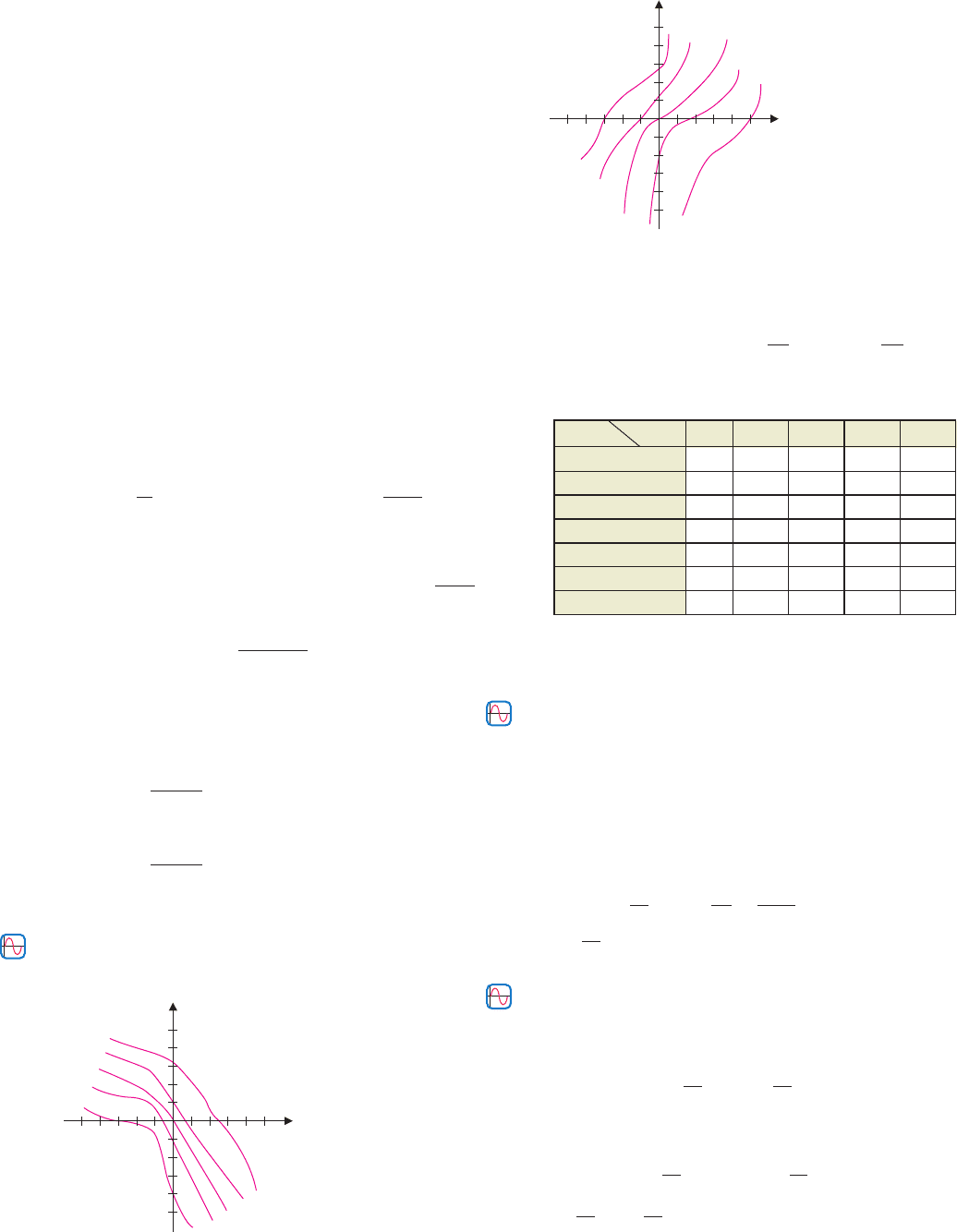
In exercises 37 and 38, use the given contour plot to estimate the
linear approximation of f (x, y) at (a) (0, 0); (b) (1, 0); (c) (0, 2).
37.
y
x
55
5
5
2
4
6
8
10
38.
y
x
55
5
5
0
2
2
4
4
............................................................
39. The table here gives wind chill (how cold it “feels” out-
side) as a function of temperature (degrees Fahrenheit) and
wind speed (mph). We can think of this as a function w(t, s).
Estimate the partial derivatives
∂w
∂t
(10, 10) and
∂w
∂s
(10, 10)
and the linear approximation of w(t, s) at (10, 10). Use the
linear approximation to estimate the wind chill at (12, 13).
Speed Temp 30 20 10 0 −10
0 30 20 10 0 −10
5 27 16 6 −5 −15
10 16 4 −9 −24 −33
15 9 −5 −18 −32 −45
20 4 −10 −25 −39 −53
25 0 −15 −29 −44 −59
30 −2 −18 −33 −48 −63
40. Estimate the linear approximation of wind chill at (10, 15)
and use it to estimate the wind chill at (12, 13). Explain any
differences between this answer and that of exercise 39.
41. In this exercise, we visualize the linear approximation of ex-
ample 4.3. Start with a contour plot of f (x, y) = 2x + e
x
2
−y
with −1 ≤ x ≤ 1 and −1 ≤ y ≤ 1. Then zoom in on the
point (0, 0) of the contour plot until the level curves appear
straight and equally spaced. (Level curves for z-values be-
tween 0.9 and 1.1 with a graphing window of −0.1 ≤ x ≤ 0.1
and −0.1 ≤ y ≤ 0.1 should work.) You will need the z-values
for the level curves. Notice that to move from the z = 1level
curve to the z = 1.05 level curve you move 0.025 unit to the
right. Then
∂ f
∂x
(0, 0) ≈
z
x
=
0.05
0.025
= 2. Verify graphically
that
∂ f
∂y
(0, 0) ≈−1. Explain how to use the contour plot to
reproduce the linear approximation 1 + 2x − y.
42. In exercise 41, we specified that you zoom in on the contour
plot until the level curves appear linear and equally spaced.
To see why the second condition is necessary, sketch a contour
plotof f (x, y) = e
x−y
with−1 ≤ x ≤ 1and−1 ≤ y ≤ 1.Use
this plot to estimate
∂ f
∂x
(0, 0) and
∂ f
∂y
(0, 0) and compare to the
exact values. Zoom in until the level curves are equally spaced
and estimate again. Explain why this estimate is much better.
43. Show that
0, 1,
∂ f
∂y
(a, b)
×
1, 0,
∂ f
∂x
(a, b)
=
∂ f
∂x
(a, b),
∂ f
∂y
(a, b), −1
.

P1: OSO/OVY P2: OSO/OVY QC: OSO/OVY T1: OSO
MHDQ256-Ch13 MHDQ256-Smith-v1.cls December 31, 2010 16:55
LT (Late Transcendental)
CONFIRMING PAGES
854 CHAPTER 13
..
Functions of Several Variables and Partial Differentiation 13-46
44. Let S be a surface defined parametrically
by r(u,v) =x(u,v), y(u,v), z(u,v). Define
r
u
(u,v) =
∂x
∂u
(u,v),
∂y
∂u
(u,v),
∂z
∂u
(u,v)
and
r
v
(u,v) =
∂x
∂v
(u,v),
∂y
∂v
(u,v),
∂z
∂v
(u,v)
. Show that
r
u
× r
v
is a normal vector to the tangent plane at the point
(x(u,v), y(u,v), z(u,v)).
............................................................
In exercises 45–48, use the result of exercise 44 to find an
equation of the tangent plane to the parametric surface at the
indicated point.
45. S isdefinedbyx = 2u, y = v andz = 4uv;atu = 1andv = 2.
46. S is defined by x = 2u
2
, y = uv and z = 4uv
2
;atu =−1 and
v = 1.
47. S is the cylinder x
2
+ y
2
= 1 with 0 ≤ z ≤ 2; at (1, 0, 1).
48. S is the cylinder y
2
= 2x with 0 ≤ z ≤ 2; at (2, 2, 1).
............................................................
49. If f (x) is differentiable at x = a, show that
y = f
(a)x +εx, where lim
x→0
ε(x) = 0. Compare to
Definition 4.1.
50. If f has a Taylor series that converges to f (x) for all x, find a
formula for ε(x).
EXPLORATORY EXERCISES
For these exercises, we need the notation of matrix algebra.
Define the 2 × 2 matrix A of real numbers, A
ab
cd
, and
the column vector x of real numbers, x
x
1
x
2
. The prod-
uct of a matrix and column vector is the (column) vector
ab
cd
x
1
x
2
ax
1
bx
2
cx
1
dx
2
.
1. We can extend the linear approximation of this section
to quadratic approximations. Define the Hessian matrix
H =
f
xx
f
xy
f
yx
f
yy
, the gradient vector
∇ f (x
0
, y
0
) =f
x
(x
0
, y
0
), f
y
(x
0
, y
0
), the column vector
x =
x
y
, the vector x
0
=
x
0
y
0
and the transpose vector
x
T
= [xy]. The quadratic approximation of f (x, y) at the
point (x
0
, y
0
) is defined by
Q(x, y) = f (x
0
, y
0
) +∇f (x
0
, y
0
) · (x − x
0
)
+
1
2
(x − x
0
)
T
H(x
0
, y
0
)(x − x
0
).
Findthequadratic approximation of f (x, y) = 2x + e
x
2
−y
and
compute Q(x, y) for the points in the table of example 4.3.
2. In this exercise, we extend Newton’s method to functions of
several variables. Suppose that f
1
and f
2
are functions of
two variables with continuous partial derivatives. To solve the
equations f
1
(x, y) = 0 and f
2
(x, y) = 0 simultaneously, start
with a guess x = x
0
and y = y
0
. The idea is to replace f
1
(x, y)
and f
2
(x, y) with their linear approximations L
1
(x, y) and
L
2
(x, y) and solve the (simpler) equations L
1
(x, y) = 0 and
L
2
(x, y) = 0 simultaneously. Write out the linear approxima-
tions and show that we want
∂ f
1
∂x
(x
0
, y
0
)(x − x
0
) +
∂ f
1
∂y
(x
0
, y
0
)(y − y
0
) =−f
1
(x
0
, y
0
)
∂ f
2
∂x
(x
0
, y
0
)(x − x
0
) +
∂ f
2
∂y
(x
0
, y
0
)(y − y
0
) =−f
2
(x
0
, y
0
).
If we define the Jacobian matrix
J(x
0
) =
⎡
⎢
⎢
⎣
∂ f
1
∂x
(x
0
)
∂ f
1
∂y
(x
0
)
∂ f
2
∂x
(x
0
)
∂ f
2
∂y
(x
0
)
⎤
⎥
⎥
⎦
where x
0
represents the point (x
0
, y
0
), the preceding equations
can be written as J (x
0
)(x − x
0
) =−f(x
0
), which has solution
x − x
0
=−J
−1
(x
0
)f(x
0
)orx = x
0
− J
−1
(x
0
)f(x
0
). Here, the
matrix J
−1
(x
0
) is called the inverse of the matrix J (x
0
) and
f(x
0
) =
f
1
(x
0
)
f
2
(x
0
)
.The inverse A
−1
ofa matrixA (whenitisde-
fined) is the matrix for which a = Ab if and only if b = A
−1
a,
for all column vectors a and b. In general, Newton’s method
is defined by the iteration
x
n+1
= x
n
− J
−1
(x
n
)f(x
n
).
Use Newton’s method with an initial guess of x
0
= (−1, 0.5)
to approximate a solution of the equations x
2
− 2y = 0 and
x
2
y − sin y = 0.
13.5 THE CHAIN RULE
You already are quite familiar with the chain rule for functions of a single variable. For
instance, to differentiate the function e
sin(x
2
)
,wehave
d
dx
[e
sin(x
2
)
] = e
sin(x
2
)
d
dx
[sin(x
2
)]
the derivative of the inside
= e
sin(x
2
)
cos(x
2
)
d
dx
(x
2
)
the derivative of the inside
= e
sin(x
2
)
cos(x
2
)(2x).

P1: OSO/OVY P2: OSO/OVY QC: OSO/OVY T1: OSO
MHDQ256-Ch13 MHDQ256-Smith-v1.cls December 31, 2010 16:55
LT (Late Transcendental)
CONFIRMING PAGES
13-47 SECTION 13.5
..
The Chain Rule 855
The general form of the chain rule says that for differentiable functions f and g,
d
dx
[ f (g(x))] = f
(g(x)) g
(x)
the derivative of the inside
.
We now extend the chain rule to functions of several variables. This takes several slightly
different forms, depending on the number of independent variables, but each is a variation
of the already familiar chain rule for functions of a single variable.
For a differentiable function f (x, y), where x and y are both in turn, differentiable
functions of a single variable t, to find the derivative of f (x, y) with respect to t, we first
write g(t) = f (x(t), y(t)). Then, from the definition of (an ordinary) derivative, we have
d
dt
[ f (x(t), y(t))] = g
(t) = lim
t→0
g(t +t) − g(t)
t
= lim
t→0
f (x(t + t), y(t + t)) − f (x(t), y(t))
t
.
For simplicity, we write x = x(t + t) − x(t), y = y(t +t) − y(t) and
z = f (x(t + t), y(t + t)) − f (x(t), y(t)). This gives us
d
dt
[ f (x(t), y(t))] = lim
t→0
z
t
.
Since f is a differentiable function of x and y, we have (from the definition of differentia-
bility) that
z =
∂ f
∂x
x +
∂ f
∂y
y + ε
1
x + ε
2
y,
where ε
1
and ε
2
both tend to 0, as (x, y) → (0, 0). Dividing through by t gives us
z
t
=
∂ f
∂x
x
t
+
∂ f
∂y
y
t
+ ε
1
x
t
+ ε
2
y
t
.
Taking the limit as t → 0nowgivesus
d
dt
[ f (x(t), y(t))] = lim
t→0
z
t
=
∂ f
∂x
lim
t→0
x
t
+
∂ f
∂y
lim
t→0
y
t
+ lim
t→0
ε
1
lim
t→0
x
t
+ lim
t→0
ε
2
lim
t→0
y
t
. (5.1)
Notice that lim
t→0
x
t
= lim
t→0
x(t + t) − x(t)
t
=
dx
dt
and lim
t→0
y
t
= lim
t→0
y(t + t) − y(t)
t
=
dy
dt
.
Further, notice that since x(t) and y(t) are differentiable, they are also continuous and so,
lim
t→0
x = lim
t→0
[x(t + t) − x(t)] = 0.
Likewise, lim
t→0
y = 0, also. Consequently, since (x, y) → (0, 0), as t → 0, we have
lim
t→0
ε
1
= lim
t→0
ε
2
= 0.

P1: OSO/OVY P2: OSO/OVY QC: OSO/OVY T1: OSO
MHDQ256-Ch13 MHDQ256-Smith-v1.cls December 31, 2010 16:55
LT (Late Transcendental)
CONFIRMING PAGES
856 CHAPTER 13
..
Functions of Several Variables and Partial Differentiation 13-48
From (5.1), we now have
d
dt
[ f (x(t), y(t))] =
∂ f
∂x
lim
t→0
x
t
+
∂ f
∂y
lim
t→0
y
t
+ lim
t→0
ε
1
lim
t→0
x
t
+ lim
t→0
ε
2
lim
t→0
y
t
=
∂ f
∂x
dx
dt
+
∂ f
∂y
dy
dt
.
We summarize the chain rule for the derivative of f (x(t), y(t)) in Theorem 5.1.
THEOREM 5.1 (Chain Rule)
If z = f (x(t), y(t)), where x(t) and y(t) are differentiable and f (x, y)isa
differentiable function of x and y, then
dz
dt
=
d
dt
[ f (x(t), y(t))] =
∂ f
∂x
(x(t), y(t))
dx
dt
+
∂ f
∂y
(x(t), y(t))
dy
dt
.
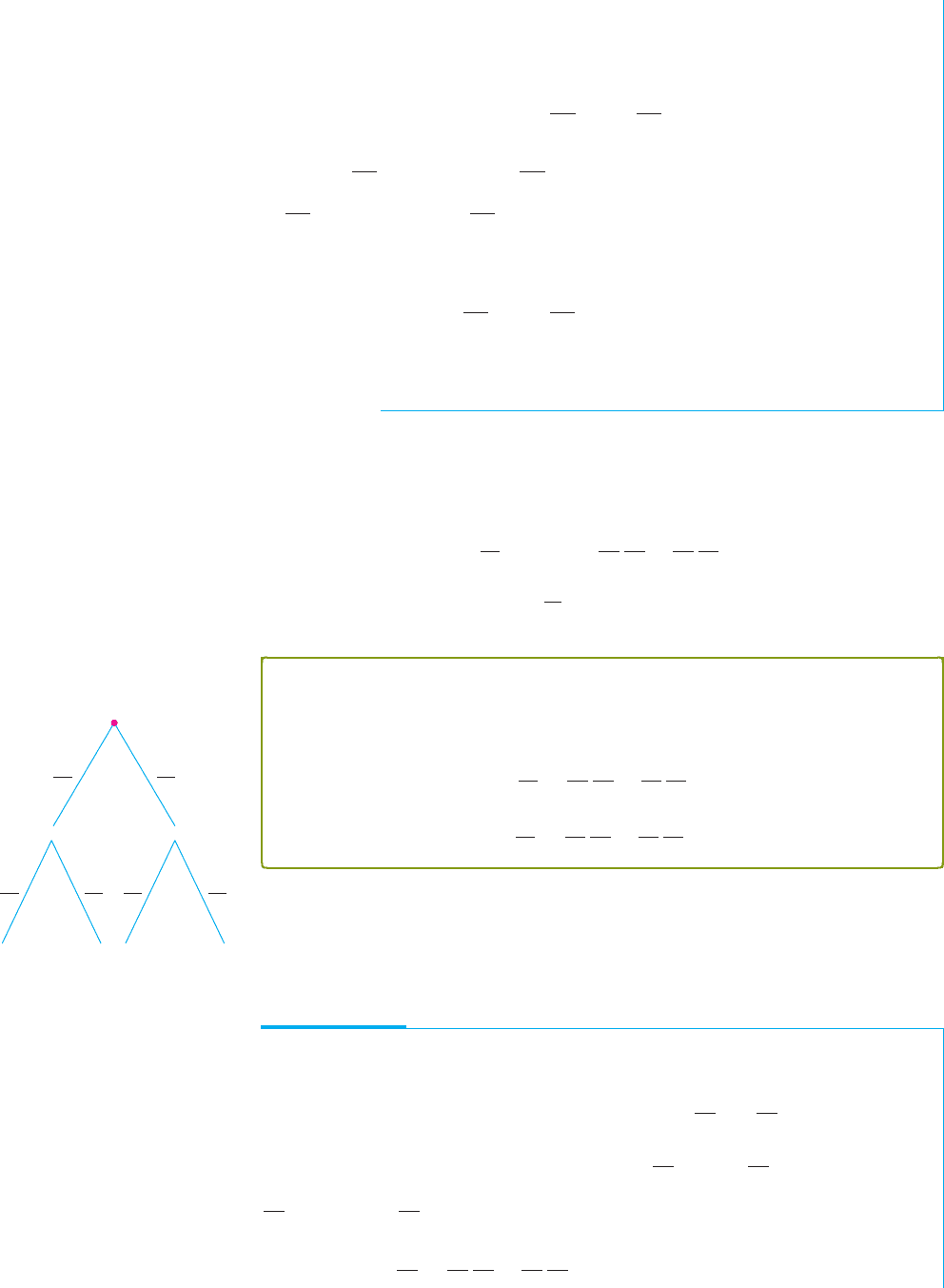
As a convenient device for remembering the chain rule, we sometimes use a tree
diagram like the one shown in the margin. Notice that if z = f (x, y) and x and y are
both functions of the variable t, then t is the independent variable. We consider x and y to
be intermediate variables, since they both depend on t. In the tree diagram, we list the
dependent variable z at the top, followed by each of the intermediate variables x and y, with
the independent variable t at the bottom level, with each of the variables connected by a
path. Next to each of the paths, we indicate the corresponding derivative
i.e., between z
and x, we indicate
∂z
∂x
. The chain rule then gives
dz
dt
as the sum of all of the products of
the derivatives along each path to t. That is,
dz
dt
=
∂z
∂x
dx
dt
+
∂z
∂y
dy
dt
.
This device is especially useful for functions of several variables that are in turn functions
of several other variables, as we will see shortly.
We illustrate the use of this new chain rule in example 5.1.
z f(x, y)
xy
tt
∂ z
∂x
∂ z
∂y
dx
dt
dy
dt
EXAMPLE 5.1 Using the Chain Rule
For z = f (x, y) = x
2
e
y
, x(t) = t
2
− 1 and y(t) = sint, find the derivative of
g(t) = f (x(t), y(t)).
Solution We first compute the derivatives
∂z
∂x
= 2xe
y
,
∂z
∂y
= x
2
e
y
, x
(t) = 2t and
y
(t) = cost. The chain rule (Theorem 5.1) then gives us
g
(t) =
∂z
∂x
dx
dt
+
∂z
∂y
dy
dt
= 2xe
y
(2t) + x
2
e
y
cost
= 2(t
2
− 1)e
sint
(2t) +(t
2
− 1)
2
e
sint
cost.
In example 5.1, notice that you could have first substituted for x and y and then com-
puted the derivative of g(t) = (t
2
− 1)
2
e
sint
, using the usual rules of differentiation. In
example 5.2, you don’t have any alternative but to use the chain rule.
EXAMPLE 5.2 A Case Where the Chain Rule Is Needed
Suppose the production of a firm is modeled by the Cobb-Douglas production
function P(k, l) = 20k
1/4
l
3/4
, where k measures capital (in millions of dollars) and l
measures the labor force (in thousands of workers). Suppose that when l = 2 and k = 6,
P1: OSO/OVY P2: OSO/OVY QC: OSO/OVY T1: OSO
MHDQ256-Ch13 MHDQ256-Smith-v1.cls December 31, 2010 16:55
LT (Late Transcendental)
CONFIRMING PAGES
13-49 SECTION 13.5
..
The Chain Rule 857
the labor force is decreasing at the rate of 20 workers per year and capital is growing at
the rate of $400,000 per year. Determine the rate of change of production.
Solution Suppose that g(t) = P(k(t), l(t)). From the chain rule, we have
g
(t) =
∂ P
∂k
k
(t) +
∂ P
∂l
l
(t).
Notice that
∂ P
∂k
= 5k
−3/4
l
3/4
and
∂ P
∂l
= 15k
1/4
l
−1/4
. With l = 2 and k = 6, this gives
us
∂ P
∂k
(6, 2) ≈ 2.1935 and
∂ P
∂l
(6, 2) ≈ 19.7411. Since k is measured in millions of
dollars and l is measured in thousands of workers, we have k
(t) = 0.4 and
l
(t) =−0.02. From the chain rule, we now have
g
(t) =
∂ P
∂k
k
(t) +
∂ P
∂l
l
(t)
≈ 2.1935(0.4) +19.7411(−0.02) = 0.48258.
This indicates that the production is increasing at the rate of approximately one-half
unit per year.
We can easily extend Theorem 5.1 to the case of a function f (x, y), where x and y are
both functions of the two independent variables s and t, x = x(s, t) and y = y(s, t). Notice
that if we differentiate with respect to s, we treat t as a constant. Applying Theorem 5.1
(while holding t fixed), we have
∂
∂s
[ f (x, y)] =
∂ f
∂x
∂x
∂s
+
∂ f
∂y
∂y
∂s
.
Similarly, we can find a chain rule for
∂
∂t
[ f (x, y)].This givesus the followingmore general
form of the chain rule.
z
xy
sst
∂ z
∂x
∂ x
∂s
∂ x
∂t
∂ z
∂y
t
∂ y
∂s
∂ y
∂t
THEOREM 5.2 (Chain Rule)
Suppose that z = f (x, y), where f is a differentiable function of x and y and where
x = x(s, t) and y = y(s, t) both have first-order partial derivatives. Then we have the
chain rules:
∂z
∂s
=
∂z
∂x
∂x
∂s
+
∂z
∂y
∂y
∂s
and
∂z
∂t
=
∂z
∂x
∂x
∂t
+
∂z
∂y
∂y
∂t
.
The tree diagram shown in the margin serves as a convenient reminder of the chain
rules indicated in Theorem 5.2, again by summing the products of the indicated partial
derivatives along each path from z to s or t, respectively.
The chain rule is easily extended to functions of three or more variables. You will
explore this in the exercises.
EXAMPLE 5.3 Using the Chain Rule
Suppose that f (x, y) = e
xy
, x(u,v) = 3u sinv and y(u,v) = 4v
2
u.For
g(u,v) = f (x(u,v), y(u,v)), find the partial derivatives
∂g
∂u
and
∂g
∂v
.
Solution We first compute the partial derivatives
∂ f
∂x
= ye
xy
,
∂ f
∂y
= xe
xy
,
∂x
∂u
= 3sinv and
∂y
∂u
= 4v
2
. The chain rule (Theorem 5.2) gives us
∂g
∂u
=
∂ f
∂x
∂x
∂u
+
∂ f
∂y
∂y
∂u
= ye
xy
(3sin v) + xe
xy
(4v
2
).

P1: OSO/OVY P2: OSO/OVY QC: OSO/OVY T1: OSO
MHDQ256-Ch13 MHDQ256-Smith-v1.cls December 31, 2010 16:55
LT (Late Transcendental)
CONFIRMING PAGES
858 CHAPTER 13
..
Functions of Several Variables and Partial Differentiation 13-50
Substituting for x and y,weget
∂g
∂u
= 4v
2
ue
12u
2
v
2
sinv
(3sin v) +3u sinve
12u
2
v
2
sinv
(4v
2
).
For the partial derivative of g with respect to v, we compute
∂x
∂v
= 3u cosv and
∂y
∂v
= 8vu. Here, the chain rule gives us
∂g
∂v
= ye
xy
(3u cos v) + xe
xy
(8vu).
Substituting for x and y,wehave
∂g
∂v
= 4v
2
ue
12u
2
v
2
sinv
(3u cos v) +3u sinve
12u
2
v
2
sinv
(8vu).
Once again, it is often simpler to first substitute in the expressions for x and y. We leave
it as an exercise to show that you get the same derivatives either way. On the other hand,
there are plenty of times where the general forms of the chain rule seen in Theorems 5.1
and 5.2 are indispensable. You will see some of these in the exercises, while we present
several important uses next.
EXAMPLE 5.4 Converting from Rectangular to Polar Coordinates
For a differentiable function f (x, y) with continuous second partial derivatives,
x = r cosθ and y = r sin θ, show that f
r
= f
x
cosθ + f
y
sinθ and
f
rr
= f
xx
cos
2
θ +2 f
xy
cosθ sinθ + f
yy
sin
2
θ.
Solution First, notice that
∂x
∂r
= cosθ and
∂y
∂r
= sinθ. From Theorem 5.2, we
now have
f
r
=
∂ f
∂r
=
∂ f
∂x
∂x
∂r
+
∂ f
∂y
∂y
∂r
= f
x
cosθ + f
y
sinθ.
Be very careful when computing the second partial derivative. Using the expression we
have already found for f
r
and Theorem 5.2, we have
f
rr
=
∂( f
r
)
∂r
=
∂
∂r
( f
x
cosθ + f
y
sinθ ) =
∂
∂r
( f
x
)cos θ +
∂
∂r
( f
y
)sin θ
=
∂
∂x
( f
x
)
∂x
∂r
+
∂
∂y
( f
x
)
∂y
∂r
cosθ +
∂
∂x
( f
y
)
∂x
∂r
+
∂
∂y
( f
y
)
∂y
∂r
sinθ
= ( f
xx
cosθ + f
xy
sinθ )cos θ + ( f
yx
cosθ + f
yy
sinθ )sin θ
= f
xx
cos
2
θ +2 f
xy
cosθ sinθ + f
yy
sin
2
θ,
as desired, where we used the fact that f
xy
= f
yx
(due to the continuity of the second
partial derivatives).
In the exercises, you will use the chain rule to compute other partial derivatives in polar
coordinates. One important exercise is to show that we can write (for r = 0)
f
xx
+ f
yy
= f
rr
+
1
r
f
r
+
1
r
2
f
θθ
.
Thisparticularcombinationof second partial derivatives, f
xx
+ f
yy
,iscalledthe Laplacian
of f and appears frequently in equations describing heat conduction and wave propagation,
among others.
A slightly different use of a change of variables is demonstrated in example 5.5. An
important strategy in solving some equations is to first rewrite and solve them in the most
general form possible. One convenient approach to this is to convert to dimensionless
variables. As the name implies, these are typically combinations of variables such that all

P1: OSO/OVY P2: OSO/OVY QC: OSO/OVY T1: OSO
MHDQ256-Ch13 MHDQ256-Smith-v1.cls December 31, 2010 16:55
LT (Late Transcendental)
CONFIRMING PAGES
13-51 SECTION 13.5
..
The Chain Rule 859
the units cancel. One example would be for an object with (one-dimensional) velocity v ft/s
and initial velocity v(0) = v
0
ft/s. The variable V =
v
v
0
is dimensionless because the units
of V are ft/s divided by ft/s, leaving no units. Often, a change to dimensionless variables
will simplify an equation.
EXAMPLE 5.5 Dimensionless Variables
An object moves in two dimensions according to the equations of motion: x
(t) = 0,
y
(t) =−g, with initial velocity x
(0) = v
0
cosθ and y
(0) = v
0
sinθ and initial
position x(0) = y(0) = 0. Rewrite the equations and initial conditions in terms of the
variables X =
g
v
2
0
x, Y =
g
v
2
0
y and T =
g
v
0
t. Show that the variables X, Y and T are
dimensionless, assuming that x and y are given in feet and t in seconds.
Solution To transform the equations, we first need to rewrite the derivatives
x
=
d
2
x
dt
2
and y
=
d
2
y
dt
2
in terms of X, Y and T. From the chain rule, we have
dx
dt
=
dx
dT
dT
dt
=
d
v
2
0
X/g
dT
d(gt/v
0
)
dt
=
v
2
0
g
dX
dT
g
v
0
= v
0
dX
dT
.
Again, we must be careful computing the second derivative. We have
d
2
x
dt
2
=
d
dt
dx
dt
=
d
dt
v
0
dX
dT
=
d
dT
v
0
dX
dT
dT
dt
= v
0
d
2
X
dT
2
g
v
0
= g
d
2
X
dT
2
.
You should verify that similar calculations give
dy
dt
= v
0
dY
dT
and
d
2
y
dt
2
= g
d
2
Y
dT
2
. The
differential equation x
(t) = 0 then becomes g
d
2
X
dT
2
= 0 or simply,
d
2
X
dT
2
= 0.
Similarly, the differential equation y
(t) =−g becomes g
d
2
Y
dT
2
=−g or
d
2
Y
dT
2
=−1.
Further, the initial condition x
(0) = v
0
cosθ becomes v
0
dX
dT
(0) = v
0
cosθ or
dX
dT
(0) = cosθ and the initial condition y
(0) = v
0
sinθ becomes v
0
dY
dT
(0) = v
0
sinθ
or
dY
dT
(0) = sinθ. The initial value problem is now
d
2
X
dT
2
= 0,
d
2
Y
dT
2
=−1,
dX
dT
(0) = cosθ,
dY
dT
(0) = sinθ, X(0) = 0, Y (0) = 0.
Notice that the only parameter left in the entire set of equations is θ, which is measured
in radians (which is considered unitless). So, we would not need to know which unit
system is being used to solve this initial value problem. Finally, to show that the
variables are indeed dimensionless, we look at the units. In the English system, the
initial speed v
0
has units ft/s and g has units ft/s
2
(the same as acceleration). Then
X =
g
v
2
0
x has units
ft/s
2
(ft/s)
2
(ft) =
ft
2
/s
2
ft
2
/s
2
= 1.
Similarly, Y has no units. Finally T =
g
v
0
t has units
ft/s
2
ft/s
(s) =
ft/s
ft/s
= 1.
P1: OSO/OVY P2: OSO/OVY QC: OSO/OVY T1: OSO
MHDQ256-Ch13 MHDQ256-Smith-v1.cls December 31, 2010 16:55
LT (Late Transcendental)
CONFIRMING PAGES
860 CHAPTER 13
..
Functions of Several Variables and Partial Differentiation 13-52
Implicit Differentiation
Suppose that the equation F(x, y) = 0 defines y implicitly as a function of x, say
y = f (x). In section 2.7, we saw how to calculate
dy
dx
in such a case. We can use the
chain rule for functions of several variables to obtain an alternative method for calculating
this. Moreover, this will provide us with new insights into when this can be done and, more
important yet, this will generalize to functions of several variables defined implicitly by an
equation.
We let z = F(x, y), where x = t and y = f (t). From Theorem 5.1, we have
dz
dt
= F
x
dx
dt
+ F
y
dy
dt
.
But, since z = F(x, y) = 0, we have
dz
dt
= 0, too. Further, since x = t,wehave
dx
dt
= 1
and
dy
dt
=
dy
dx
. This leaves us with
0 = F
x
+ F
y
dy
dx
.
Provided F
y
= 0, we have
dy
dx
=−
F
x
F
y
.
Since we already knew how to calculate
dy
dx
implicitly, this doesn’t appear to give us any-
thing new. However, it turns out that the Implicit Function Theorem (proved in a course
in advanced calculus) says that if F
x
and F
y
are continuous on an open disk contain-
ing the point (a, b), where F(a, b) = 0 and F
y
(a, b) = 0, then the equation F(x, y) = 0
implicitly defines y as a differentiable function of x nearby the point (a, b).
More significantly, we can extend this notion to functions of several variables defined
implicitly, as follows. Suppose that the equation F(x, y, z) = 0 implicitly defines a func-
tion z = f (x, y), where f is differentiable. Then, we can find the partial derivatives f
x
and f
y
using the chain rule, as follows. We first let w = F(x, y, z). From the chain rule,
we have
∂w
∂x
= F
x
∂x
∂x
+ F
y
∂y
∂x
+ F
z
∂z
∂x
.
Notice that since w = F(x, y, z) = 0,
∂w
∂x
= 0. Also,
∂x
∂x
= 1 and
∂y
∂x
= 0, since x and y
are independent variables. This gives us
0 = F
x
+ F
z
∂z
∂x
.
As long as F
z
= 0, we have
∂z
∂x
=−
F
x
F
z
. (5.2)
Likewise, differentiating w with respect to y leads us to
∂z
∂y
=−
F
y
F
z
, (5.3)
again, as long as F
z
= 0. Much as in the two-variable case, the Implicit Function The-
orem for functions of three variables says that if F
x
, F
y
and F
z
are continuous inside
a sphere containing the point (a, b, c), where F(a, b, c) = 0 and F
z
(a, b, c) = 0, then
the equation F(x, y, z) = 0 implicitly defines z as a function of x and y nearby the
point (a, b, c).

P1: OSO/OVY P2: OSO/OVY QC: OSO/OVY T1: OSO
MHDQ256-Ch13 MHDQ256-Smith-v1.cls December 31, 2010 16:55
LT (Late Transcendental)
CONFIRMING PAGES
13-53 SECTION 13.5
..
The Chain Rule 861
EXAMPLE 5.6 Finding Partial Derivatives Implicitly
Find
∂z
∂x
and
∂z
∂y
, given that F(x, y, z) = xy
2
+ z
3
+ sin(xyz) = 0.
Solution First, note that using the usual chain rule, we have
F
x
= y
2
+ yz cos(xyz),
F
y
= 2xy + xzcos(xyz)
and
F
z
= 3z
2
+ xycos(xyz).
From (5.2) and (5.3), we now have
∂z
∂x
=−
F
x
F
z
=−
y
2
+ yz cos(xyz)
3z
2
+ xycos(xyz)
and
∂z
∂y
=−
F
y
F
z
=−
2xy + xzcos(xyz)
3z
2
+ xycos(xyz)
.
Notice that, much like implicit differentiation with two variables, implicit differenti-
ation with three variables yields expressions for the derivatives that depend on all three
variables.
BEYOND FORMULAS
There are many more examples
of the chain rule beyond the two
written out in Theorems 5.1 and
5.2. We ask you to write out
other forms of the chain rule in
the exercises. All of these
variations would be impossible
to memorize, but all you need to
do to reproduce whichever rule
you need is construct the
appropriate tree diagram and
remember the general format,
“derivative of the outside times
derivative of the inside.”
EXERCISES 13.5
WRITING EXERCISES
1. In example 5.1, we mentionedthat direct substitution followed
bydifferentiationis anoption (see exercises1and 2 below)and
can be preferable. Discuss the advantages and disadvantages
of direct substitution versus the method of example 5.1.
2. In example 5.6, we treated z as a function of x and y. Explain
howto modify our results fromthe Implicit FunctionTheorem
for treating x as a function of y and z.
1. Repeat example 5.1 by first substituting x = t
2
− 1 and
y = sin t and then computing g
(t).
2. Repeat example 5.3 by first substituting x = 3u sinv and
y = 4v
2
u and then computing
∂g
∂u
and
∂g
∂v
.
............................................................
In exercises 3–6, use the chain rule to find the indicated
derivative(s).
3. g
(t), where g(t) = f (x(t), y(t)), f (x, y) = x
2
y − sin y,
x(t) =
√
t
2
+ 1, y(t) = e
t
4. g
(t), where g(t) = f (x(t), y(t)), f (x, y) =
x
2
+ y
2
,
x(t) = sint, y(t) = t
2
+ 2
5.
∂g
∂u
and
∂g
∂v
, where g(u,v) = f (x(u,v), y(u,v)),
f (x, y) = 4x
2
y
3
, x(u,v) = u
3
− v sinu, y(u,v) = 4u
2
6.
∂g
∂u
and
∂g
∂v
, where g(u,v) = f (x(u,v), y(u,v)),
f (x, y) = xy
3
− 4x
2
, x(u,v) = e
u
2
, y(u,v) =
√
v
2
+ 1sinu
............................................................
In exercises 7–14, state the chain rule for the general composite
function.
7. g(t) = f (x(t), y(t), z(t))
8. g(u,v) = f (x(u,v), y(u,v), z(u,v))
9. g(u,v,w) = f (x(u,v,w), y(u,v,w))
10. g(u,v,w) = f (x(u,v,w), y(u,v,w), z(u,v,w))
11. g(u,v) = f (u + v, u − v, u
2
+ v
2
)
12. g(u,v) = f (u
2
v, v, v cos u)
13. g(u,v,w) = f (uv, u/v, w
2
)
14. g(u,v,w) = f (u
2
+ w
2
, u + v + w, u cos v)
............................................................
15. In example 5.2, suppose that l = 4 and k = 6, the labor force
is decreasing at the rate of 60 workers per year and capital is
growing at the rate of $100,000 per year. Determine the rate of
change of production.
16. In example 5.2, suppose that l = 3 and k = 4, the labor force
is increasing at the rate of 80 workers per year and capital is
decreasing at the rate of $200,000 per year. Determine the rate
of change of production.
17. Suppose the production of a firm is modeled by
P(k, l) = 16k
1/3
l
2/3
, with k and l defined as in example 5.2.
Suppose that l = 3 and k = 4, the labor force is increasing at
the rate of 80 workers per year and capital is decreasing at
the rate of $200,000 per year. Determine the rate of change of
production.

P1: OSO/OVY P2: OSO/OVY QC: OSO/OVY T1: OSO
MHDQ256-Ch13 MHDQ256-Smith-v1.cls December 31, 2010 16:55
LT (Late Transcendental)
CONFIRMING PAGES
862 CHAPTER 13
..
Functions of Several Variables and Partial Differentiation 13-54
18. Suppose the production of a firm is modeled by
P(k, l) = 16k
1/3
l
2/3
, with k and l defined as in example 5.2.
Suppose that l = 2 and k = 5, the labor force is increasing at
the rate of 40 workers per year and capital is decreasing at
the rate of $100,000 per year. Determine the rate of change of
production.
19. For a business product, income is the product of the quantity
sold and the price, which we can write as I = qp. If the quan-
tity sold increases at a rate of 5% and the price increases at a
rate of 3%, show that income increases at a rate of 8%.
20. Assume that I = qp as in exercise 15. If the quantity sold de-
creases at a rate of 3% and price increases at a rate of 5%,
determine the rate of increase or decrease in income.
............................................................
In exercises 21–26, use implicit differentiation to find
∂z
∂x
and
∂z
∂y
. Assume that the equation defines z as a differentiable
function near each (x, y).
21. 3x
2
z + 2z
3
− 3yz = 0
22. xyz − 4y
2
z
2
+ cos xy = 0
23. 3e
xyz
− 4xz
2
+ x cos y = 2
24. 3yz
2
− e
4x
cos4z − 3y
2
= 4
25. xyz = cos(x + y + z)
26. ln(x
2
+ y
2
) − z = tan
−1
(x + z)
............................................................
27. For a differentiable function f (x, y) with continuous par-
tial derivatives, x = r cosθ and y = r sinθ, show that
f
θ
=−f
x
r sin θ + f
y
r cos θ .
28. For a differentiable function f (x, y) with continuous par-
tial derivatives, x = r cosθ and y = r sin θ , show that
f
θθ
= f
xx
r
2
sin
2
θ −2 f
xy
r
2
cosθ sinθ + f
yy
r
2
cos
2
θ −
f
x
r cos θ − f
y
r sin θ .
29. For a differentiable function f (x, y) with continuous par-
tial derivatives, x = r cos θ and y = r sin θ , use the re-
sults of exercises 25 and 26 and example 5.4 to show that
f
xx
+ f
yy
= f
rr
+
1
r
f
r
+
1
r
2
f
θθ
. This expression is called the
Laplacian of f.
30. Given that r =
x
2
+ y
2
, show that
∂r
∂x
=
x
x
2
+ y
2
=
x
r
= cosθ. Starting from r =
x
cos θ
,
does it follow that
∂r
∂x
=
1
cos θ
? Explain why it’s not possible
for both calculations to be correct. Find all mistakes.
31. The heat equation for the temperature u(x, t) of a thin rod
of length L is α
2
u
xx
= u
t
, 0 < x < L, for some constant α
2
,
called the thermal diffusivity. Make the change of variables
X =
x
L
and T =
α
2
L
2
t to simplify the equation. Show that X
and T are dimensionless, given that the units of α
2
are ft
2
/s.
32. The wave equation for the displacement u(x, t) of a vibrating
stringoflengthL isa
2
u
xx
= u
tt
, 0 < x < L,for some constant
a
2
. Make the change of variables X =
x
L
and T =
a
L
t to sim-
plify the equation. Assuming that X and T are dimensionless,
find the dimensions of a
2
.
33. A simple model for the horizontalvelocity of an object subject
todragisv
(t) =−c[v(t)]
2
,v(0) = v
0
> 0.Showthat V =
v
v
0
is a dimensionless variable. Find a dimensionless variable of
the form T =
t
k
for some parameter k such that the simplified
initial value problem is
dV
dT
=−V
2
, V (0) = 1.
34. A simple model for the vertical velocity of an object sub-
jecttodrag is v
(t) =−g + c[v(t)]
2
,v(0) = v
0
< 0.Showthat
V =
v
v
0
isadimensionlessvariable.Find a dimensionlessvari-
able of the form T =
t
k
such that the simplified initial value
problem is
dV
dT
=−a + V
2
, V (0) = 1, for some parameter a.
............................................................
In exercises 35–40, use the chain rule twice to find the indicated
derivative.
35. g(t) = f (x(t), y(t)), find g
(t)
36. g(t) = f (x(t), y(t), z(t)), find g
(t)
37. g(u,v) = f (x(u,v), y(u,v)), find
∂
2
g
∂u
2
38. g(u,v) = f (x(u,v), y(u,v)), find
∂
2
g
∂u∂v
39. g(u,v) = f (u + v, u − v, u
2
+ v
2
), find
∂
2
g
∂u∂v
40. g(u,v) = f (u
2
v, v, v cos u), find
∂
2
g
∂v
2
............................................................
41. Find the general form for the derivative of g(t) = u(t)
v(t)
for differentiable functions u and v. (Hint: Start with
f (u,v) = u
v
.) Apply the result to find the derivative of
(2t + 1)
3t
2
.
42. Find the general form for the derivative of g(t) = u(t)
v(t)
w(t)
for
differentiablefunctions u, v and w. Apply the result to find the
derivative of (sint)
(t
2
+4)
3−t
3
............................................................
Exercises 43–48 relate to Taylor series for functions of two or
more variables.
43. Suppose that f (x, y) is a function with all partial
derivatives continuous. For constants u
1
and u
2
, define
g(h) = f (x + hu
1
, y + hu
2
). We will construct the Taylor
series for g(h) about h = 0. First, show that g(0) = f (x, y).
Then show that g
(0) = f
x
(x, y)u
1
+ f
y
(x, y)u
2
. Next, show
that g
(0) = f
xx
u
2
1
+ 2 f
xy
u
1
u
2
+ f
yy
u
2
2
, where the functions
f
xx
, f
xy
and f
yy
are all evaluated at (x, y). Evaluate g
(0) and
g
(4)
(0), and briefly describe the pattern of terms that emerges.
44. Use the result of exercise 43 with hu
1
= x and hu
2
= y to
show that
f (x + x, y + y) = f (x, y) + f
x
(x, y)x + f
y
(x, y)y
+
1
2
[ f
xx
(x, y)x
2
+ 2 f
xy
(x, y)xy + f
yy
(x, y)y
2
]
+
1
3!
[ f
xxx
(x, y)x
3
+ 3 f
xxy
(x, y)x
2
y + 3 f
xyy
(x, y)
xy
2
+ f
yyy
(x, y)y
3
] +··· ,
whichistheform of Taylorseriesforfunctionsof twovariables
about the center (x, y).
45. (a) Use the result of exercise 44 to write out the third-order
Taylor polynomial for f (x, y) = sin x cos y about (0, 0).