
Smith R., Minton R. Calculus
Подождите немного. Документ загружается.

P1: OSO/OVY P2: OSO/OVY QC: OSO/OVY T1: OSO
MHDQ256-Ch13 MHDQ256-Smith-v1.cls December 31, 2010 16:55
LT (Late Transcendental)
CONFIRMING PAGES
13-15 SECTION 13.2
..
Limits and Continuity 823
represent this distance by ε), you can make it that close, just by making x sufficiently close
to a (i.e., within a distance δ of a).
The definition of the limit of a function of two variables is completely analogous to the
definition for a function of a single variable. We say that lim
(x,y)→(a,b)
f (x, y) = L,ifwecan
make f (x, y) as close as desired to L by making the point (x, y) sufficiently close to (a, b).
We make this more precise in Definition 2.1.
DEFINITION 2.1 (Formal Definition of Limit)
Let f be defined on the interior of a circle centered at the point (a, b), except possibly
at (a, b) itself. We say that lim
(x,y)→(a,b)
f (x, y) = L if for every ε>0 there exists a
δ>0 such that | f (x, y) − L| <εwhenever 0 <
(x − a)
2
+ (y − b)
2
<δ.
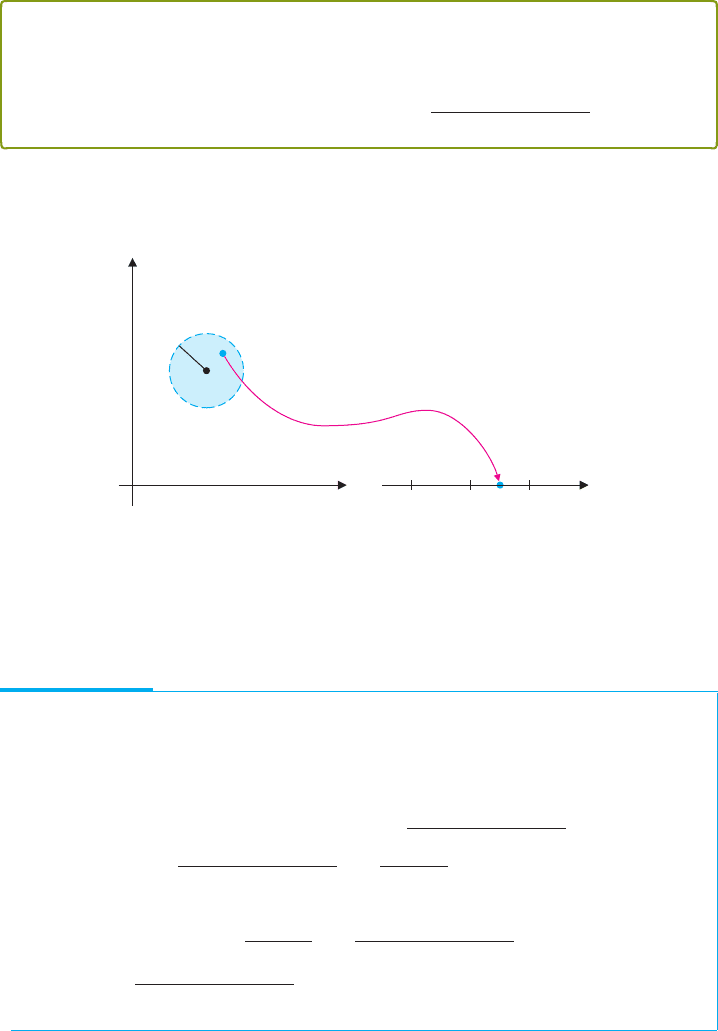
We illustrate the definition in Figure 13.14.
y
x z
L ´ L L ´
f
(a, b)
(x, y)
f(x, y)
d
FIGURE 13.14
The definition of limit
Notice that the definition says that given any desired degree of closeness ε>0, you must
be able to find another number δ>0, so that all points lying within a distance δ of (a, b)
are mapped by f to points within distance ε of L on the real line.
EXAMPLE 2.1 Using the Definition of Limit
Verify that lim
(x,y)→(a,b)
x = a and lim
(x,y)→(a,b)
y = b.
Solution Certainly, both of these limits are intuitively quite clear. We can use
Definition 2.1 to verify them, however. Given any number ε>0, we must find another
number δ>0 so that |x − a| <εwhenever 0 <
(x − a)
2
+ (y − b)
2
<δ. Notice that
(x − a)
2
+ (y − b)
2
≥
(x − a)
2
=|x −a|,
and so, taking δ = ε, we have that
|x − a|=
(x − a)
2
≤
(x − a)
2
+ (y − b)
2
<ε,
whenever 0 <
(x − a)
2
+ (y − b)
2
<δ. Likewise, we can show that lim
(x,y)→(a,b)
y = b.
With this definition of limit, we can prove the usual results for limits of sums, products
and quotients. That is, if f (x, y) and g(x, y) both have limits as (x, y) approaches (a, b),
we have
lim
(x,y)→(a,b)
[ f (x, y) ± g(x, y)] = lim
(x,y)→(a,b)
f (x, y) ± lim
(x,y)→(a,b)
g(x, y)
P1: OSO/OVY P2: OSO/OVY QC: OSO/OVY T1: OSO
MHDQ256-Ch13 MHDQ256-Smith-v1.cls December 31, 2010 16:55
LT (Late Transcendental)
CONFIRMING PAGES
824 CHAPTER 13
..
Functions of Several Variables and Partial Differentiation 13-16
(i.e., the limit of a sum or difference is the sum or difference of the limits),
lim
(x,y)→(a,b)
[ f (x, y)g(x, y)] =
lim
(x,y)→(a,b)
f (x, y)
lim
(x,y)→(a,b)
g(x, y)
(i.e., the limit of a product is the product of the limits) and
lim
(x,y)→(a,b)
f (x, y)
g(x, y)
=
lim
(x,y)→(a,b)
f (x, y)
lim
(x,y)→(a,b)
g(x, y)
(i.e., the limit of a quotient is the quotient of the limits), provided lim
(x,y)→(a,b)
g(x, y) = 0.
A polynomial in the two variables x and y is any sum of terms of the form cx
n
y
m
,
where c is a constant and n and m are nonnegative integers. Using the preceding results
and example 2.1, we can show that the limit of any polynomial always exists and is found
simply by substitution.
EXAMPLE 2.2 Finding a Simple Limit
Evaluate lim
(x,y)→(2,1)
2x
2
y + 3xy
5xy
2
+ 3y
.
Solution First, note that this is the limit of a rational function (i.e., the quotient of two
polynomials). Since the limit in the denominator is
lim
(x,y)→(2,1)
(5xy
2
+ 3y) = 10 + 3 = 13 = 0,
we have
lim
(x,y)→(2,1)
2x
2
y + 3xy
5xy
2
+ 3y
=
lim
(x,y)→(2,1)
(2x
2
y + 3xy)
lim
(x,y)→(2,1)
(5xy
2
+ 3y)
=
14
13
.
Think about the implications of Definition 2.1 (even if you are a little unsure of the
role of ε and δ). If there is any way to approach the point (a, b) without the function values
approaching the value L (e.g., by virtue of the function values blowing up, oscillating or by
approaching some other value), then the limit will not equal L. For the limit to equal L, the
function has to approach L along every possible path. This gives us a simple method for
determining that a limit does not exist.
REMARK 2.1
If f (x, y) approaches L
1
as (x, y) approaches (a, b) along a path P
1
and f (x, y)
approaches L
2
= L
1
as (x, y) approaches (a, b) along a path P
2
, then
lim
(x,y)→(a,b)
f (x, y) does not exist.
Unlike the case for functions of a single variable where there are just two paths ap-
proaching a given point (corresponding to left- and right-hand limits), in two dimensions
there are infinitely many paths (and you obviously can’t check each one individually). In
practice, when you suspect that a limit does not exist, you should check the limit along the
simplest paths first. We will use the following guidelines.
REMARK 2.2
The simplest paths to try are (1) x = a, y → b (vertical lines); (2) y = b, x → a
(horizontal lines); (3) y = g(x), x → a [where b = g(a)] and (4) x = g(y),
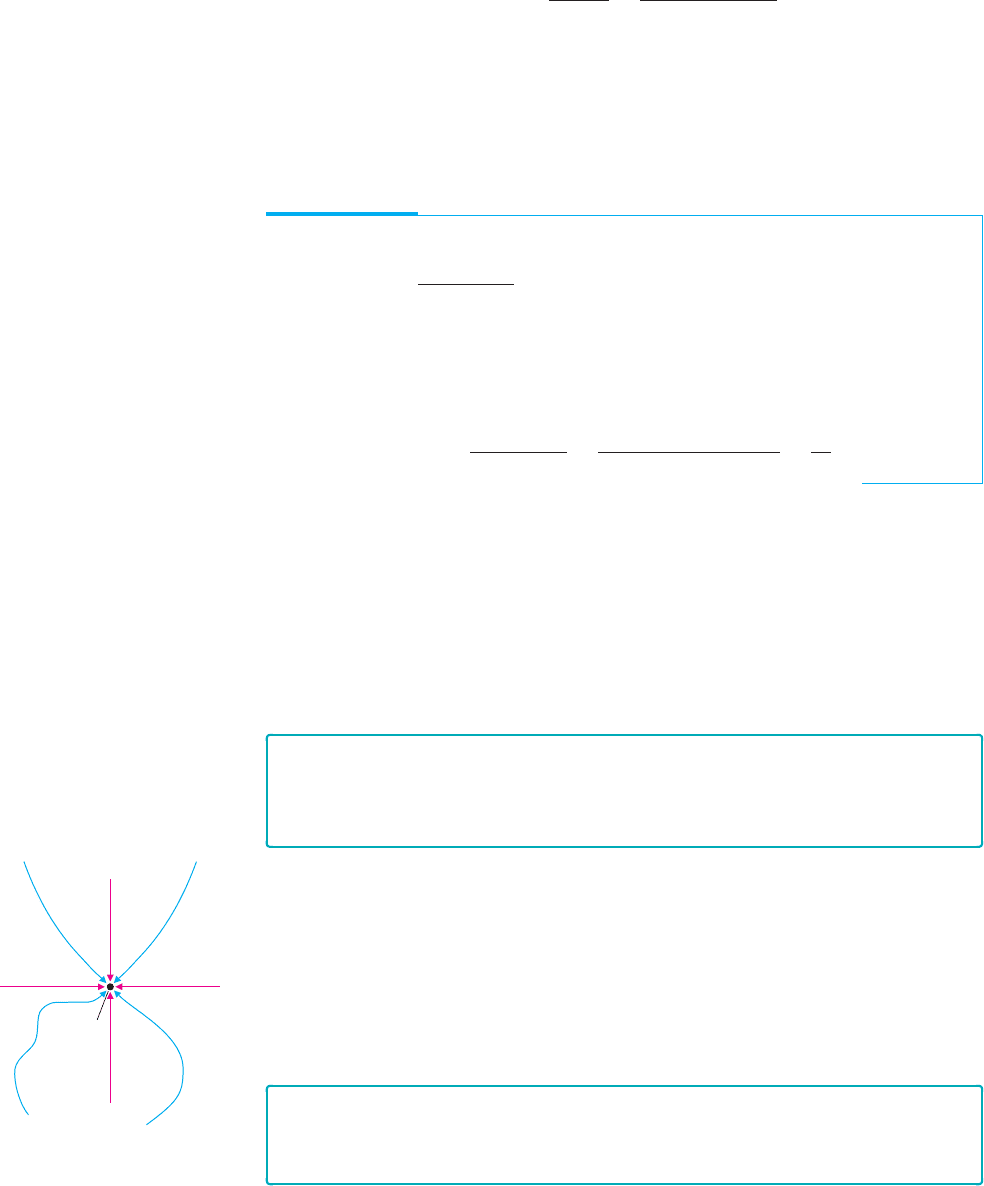
y → b [where a = g(b)]. Several of these paths are illustrated in Figure 13.15.
(1) (3)
(4)(4)
(3)
(1)
(2) (2)
(a, b)
FIGURE 13.15
Various paths to (a, b)

P1: OSO/OVY P2: OSO/OVY QC: OSO/OVY T1: OSO
MHDQ256-Ch13 MHDQ256-Smith-v1.cls December 31, 2010 16:55
LT (Late Transcendental)
CONFIRMING PAGES
13-17 SECTION 13.2
..
Limits and Continuity 825
EXAMPLE 2.3 A Limit That Does Not Exist
Evaluate lim
(x,y)→(1,0)
y
x + y − 1
.
Solution First, we consider the vertical line path along the line x = 1 and compute
the limit as y approaches 0. If (x, y) → (1, 0) along the line x = 1, we have
lim
(1,y)→(1,0)
y
1 + y − 1
= lim
y→0
1 = 1.
We next consider the path along the horizontal line y = 0 and compute the limit as x
approaches 1. Here, we have
lim
(x,0)→(1,0)
0
x +0 −1
= lim
x→1
0 = 0.
Since the function approaches two different values along two different paths to the point
(1, 0), the limit does not exist.
Many of our examples and exercises have (x, y) approaching (0, 0). In this case, notice
that another simple path passing through (0, 0) is the line y = x.
EXAMPLE 2.4 A Limit That Is the Same Along Two Paths
but Does Not Exist
Evaluate lim
(x,y)→(0,0)
xy
x
2
+ y
2
.
Solution First, we consider the limit along the path x = 0. We have
lim
(0,y)→(0,0)
0
0 + y
2
= lim
y→0
0 = 0.
Similarly, for the path y = 0, we have
lim
(x,0)→(0,0)
0
x
2
+ 0
= lim
x→0
0 = 0.
Be careful; just because the limits along the first two paths you try are the same does not
mean that the limit exists. For a limit to exist, the limit must be the same along all paths
through (0, 0) (not just along two). Here, we may simply need to look at more paths.
Notice that for the path y = x,wehave
lim
(x,x)→(0,0)
x(x)
x
2
+ x
2
= lim
x→0
x
2
2x
2
=
1
2
.
Since the limit along this path doesn’t match the limit along the first two paths, the limit
does not exist.
As we’ve done in examples 2.3 and 2.4, when choosing paths, you should look for
substitutions that will simplify the function dramatically.
EXAMPLE 2.5 A Limit Problem Requiring a More
Complicated Choice of Path
Evaluate lim
(x,y)→(0,0)
xy
2
x
2
+ y
4
.
Solution First, we consider the path x = 0 and get
lim
(0,y)→(0,0)
0
0 + y
4
= lim
y→0
0 = 0.
P1: OSO/OVY P2: OSO/OVY QC: OSO/OVY T1: OSO
MHDQ256-Ch13 MHDQ256-Smith-v1.cls December 31, 2010 16:55
LT (Late Transcendental)
CONFIRMING PAGES
826 CHAPTER 13
..
Functions of Several Variables and Partial Differentiation 13-18
Similarly, following the path y = 0, we get
lim
(x,0)→(0,0)
0
x
2
+ 0
= lim
x→0
0 = 0.
Since the limits along the first two paths are the same, we try another path. As in
example 2.4, we next try the line y = x. As it turns out, this limit is
lim
(x,x)→(0,0)
x
3
x
2
+ x
4
= lim
x→0
x
1 + x
2
= 0,
also. In exercise 59, you will show that the limit along every straight line through the
origin is 0. However, we still cannot conclude that the limit is 0. For this to happen,
the limit along all paths (not just along all straight-line paths) must be 0. At this point,
we know that either the limit exists (and equals 0) or the limit does not exist, in which
case, we must discover a path through (0, 0) along which the limit is not 0. Notice that
along the path x = y
2
, the terms x
2
and y
4
will be equal. We then have
lim
(y
2
,y)→(0,0)
y
2
(y
2
)
(y
2
)
2
+ y
4
= lim
y→0
y
4
2y
4
=
1
2
.
Since this limit does not agree with the limits along the earlier paths, the original limit
does not exist.
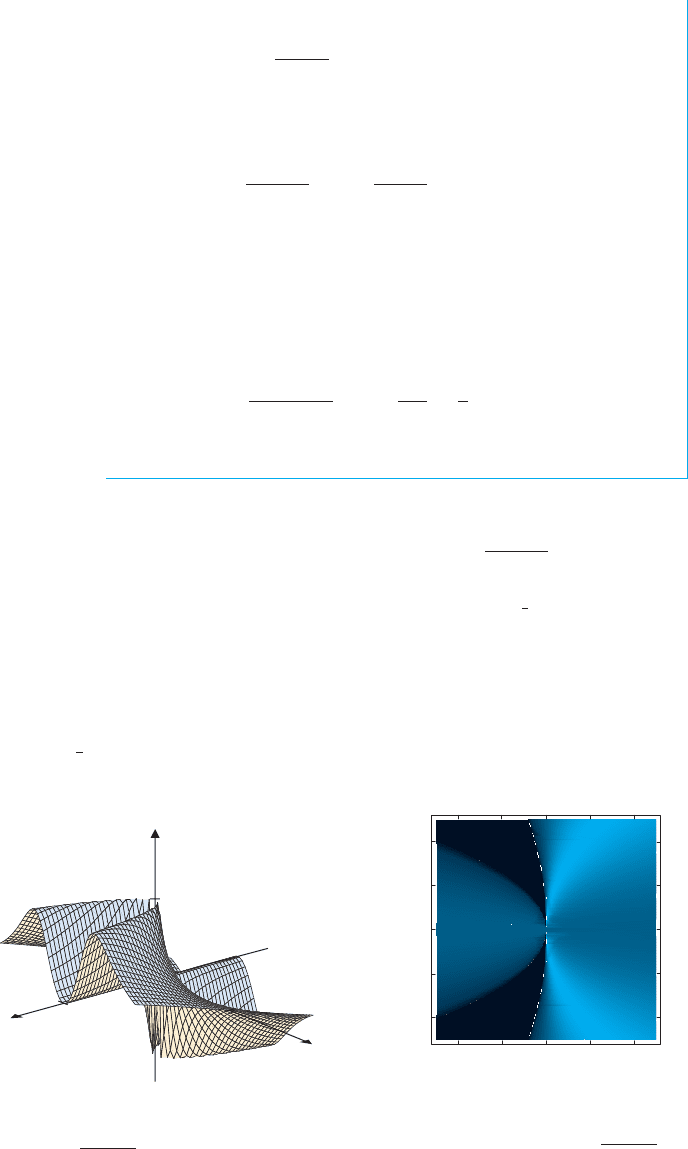
Before discussing how to show that a limit does exist, we pause to explore example 2.5
graphically. First, try to imagine what the graph of f (x, y) =
xy
2
x
2
+ y
4
might look like.
The function is defined except at the origin, it approaches 0 along the x-axis, y-axis and
along any line y = kx through the origin. Yet, f (x, y) approaches
1
2
along the parabola
x = y
2
. A standard sketch of the surface z = f (x, y) with −5 ≤ x ≤ 5 and −5 ≤ y ≤ 5is
helpful, but you need to know what to look for. You can see part of the ridge at z = 0.5, as
well as a trough at z =−0.5 corresponding to x =−y
2
, in Figure 13.16a. A density plot
clearly shows the parabola of large function values in light blue and a parabola of small
function values in black. (See Figure 13.16b.) Near the origin, the surface has a ridge at
x = y
2
, z =
1
2
, dropping off quickly to a smooth surface that approaches the origin. The
ridge is in two pieces (y > 0 and y < 0) separated by the origin.
z
y
x
5
5
0.5
0.4
0.4
0.2
0
0.2
0.4
0.2 0 0.2 0.4
x
y
FIGURE 13.16a
z =
xy
2
x
2
+ y
4
, for −5 ≤ x ≤ 5,
−5 ≤ y ≤ 5
FIGURE 13.16b
Density plot of f (x, y) =
xy
2
x
2
+ y
4
In examples 2.3, 2.4 and 2.5,we showed that a limit does not exist. If a limit does exist,
you’ll never be able to establish this by computing limits along specific paths. There are
infinitely many paths through any given point and you’ll never be able to exhaust all of the
possibilities. However, after following a number of paths and getting the same limit along
each of them, you should begin to suspect that the limit just might exist. One tool you can
use is the following generalization of the Squeeze Theorem presented in section 1.3.

P1: OSO/OVY P2: OSO/OVY QC: OSO/OVY T1: OSO
MHDQ256-Ch13 MHDQ256-Smith-v1.cls December 31, 2010 16:55
LT (Late Transcendental)
CONFIRMING PAGES
13-19 SECTION 13.2
..
Limits and Continuity 827
THEOREM 2.1
Suppose that | f (x, y) − L|≤g(x, y) for all (x, y) in the interior of some circle
centered at (a, b), except possibly at (a, b). If lim
(x,y)→(a,b)
g(x, y) = 0, then
lim
(x,y)→(a,b)
f (x, y) = L.
PROOF
For any given ε>0, we know from the definition of lim
(x,y)→(a,b)
g(x, y) = 0, that there is a
number δ>0 such that 0 <
(x − a)
2
+ (y − b)
2
<δguarantees that |g(x, y) − 0| <ε.
For any such points (x, y), we have
| f (x, y) − L|≤g(x, y) <ε.
It now follows from the definition of limit that lim
(x,y)→(a,b)
f (x, y) = L.
Inother words, the theorem simply states that if| f (x, y) − L|is trapped between 0 (the
absolute value is never negative) and a function (g) that approaches 0, then | f (x, y) − L|
must also have a limit of 0.
To use Theorem 2.1, start with a conjecture for the limit L (obtained for instance, by
calculating the limit along several simple paths). Then, look for a simpler function that is
larger than |f (x, y) − L| and that tends to zero as (x, y) approaches (a, b).
EXAMPLE 2.6 Proving That a Limit Exists
Evaluate lim
(x,y)→(0,0)
x
2
y
x
2
+ y
2
.
Solution As we did in earlier examples, we start by looking at the limit along several
paths through (0, 0). Along the path x = 0, we have
lim
(0,y)→(0,0)
0
0 + y
2
= 0.
Similarly, along the path y = 0, we have
lim
(x,0)→(0,0)
0
x
2
+ 0
= 0.
Further, along the path y = x,wehave
lim
(x,x)→(0,0)
x
3
x
2
+ x
2
= lim
x→0
x
2
= 0.
We know that if the limit exists, it must equal 0. Our last calculation gives an important
clue that the limit does exist. After simplifying the expression, there remained an extra
power of x in the numerator forcing the limit to 0. To show that the limit equals 0,
consider
| f (x, y) − L|=|f (x, y) − 0|=
x
2
y
x
2
+ y
2
.
Notice that without the y
2
term in the denominator, we could cancel the x
2
terms. Since
x
2
+ y
2
≥ x
2
, we have that for x = 0
| f (x, y) − L|=
x
2
y
x
2
+ y
2
≤
x
2
y
x
2
=|y|.
Since lim
(x,y)→(0,0)
|y|=0, Theorem 2.1 gives us lim
(x,y)→(0,0)
x
2
y
x
2
+ y
2
= 0, also.
When (x, y) approaches a point other than (0, 0), the idea is the same as in example
2.6, but the algebra may get messier, as we see in example 2.7.

P1: OSO/OVY P2: OSO/OVY QC: OSO/OVY T1: OSO
MHDQ256-Ch13 MHDQ256-Smith-v1.cls December 31, 2010 16:55
LT (Late Transcendental)
CONFIRMING PAGES
828 CHAPTER 13
..
Functions of Several Variables and Partial Differentiation 13-20
EXAMPLE 2.7 Finding a Limit of a Function of Two Variables
Evaluate lim
(x,y)→(1,0)
(x − 1)
2
ln x
(x − 1)
2
+ y
2
.
Solution Along the path x = 1, we have
lim
(1,y)→(1,0)
0
y
2
= 0.
Along the path y = 0, we have
lim
(x,0)→(1,0)
(x − 1)
2
ln x
(x − 1)
2
= lim
x→1
ln x = 0.
A third path through (1, 0) is the line y = x − 1. (Note that in this case, we must have
y → 0asx → 1.) We have
lim
(x,x−1)→(1,0)
(x − 1)
2
ln x
(x − 1)
2
+ (x − 1)
2
= lim
x→1
(x − 1)
2
ln x
2(x − 1)
2
= lim
x→1
ln x
2
= 0.
At this point, you should begin to suspect that the limit just might be 0. You never know,
though, until you find another path along which the limit is different or until you prove
that the limit actually is 0. To show this, we consider
| f (x, y) − L|=
(x − 1)
2
ln x
(x − 1)
2
+ y
2
.
Notice that if the y
2
term were not present in the denominator, then we could cancel the
(x − 1)
2
terms. We have
| f (x, y) − L|=
(x − 1)
2
ln x
(x − 1)
2
+ y
2
≤
(x − 1)
2
ln x
(x − 1)
2
=|ln x|
Since lim
(x,y)→(1,0)
|ln x|=0, it follows from Theorem 2.1 that
lim
(x,y)→(1,0)
(x − 1)
2
ln x
(x − 1)
2
+ y
2
= 0, also.
As with functions of one variable and (more recently) vector-valued functions, the
concept of continuity is closely connected to limits. Recall that in these cases, a function
is continuous at a point whenever the limit and the value of the function are the same. This
same characterization applies to continuous functions of several variables, as we see in
Definition 2.2.
DEFINITION 2.2
Suppose that f (x, y) is defined in the interior of a circle centered at the point (a, b).
We say that f is continuous at (a, b) if lim
(x,y)→(a,b)
f (x, y) = f (a, b).
If f is not continuous at (a, b), then we call (a, b)adiscontinuity of f.
Before we define the concept of continuity on a region R ⊂ R
2
, we first need to
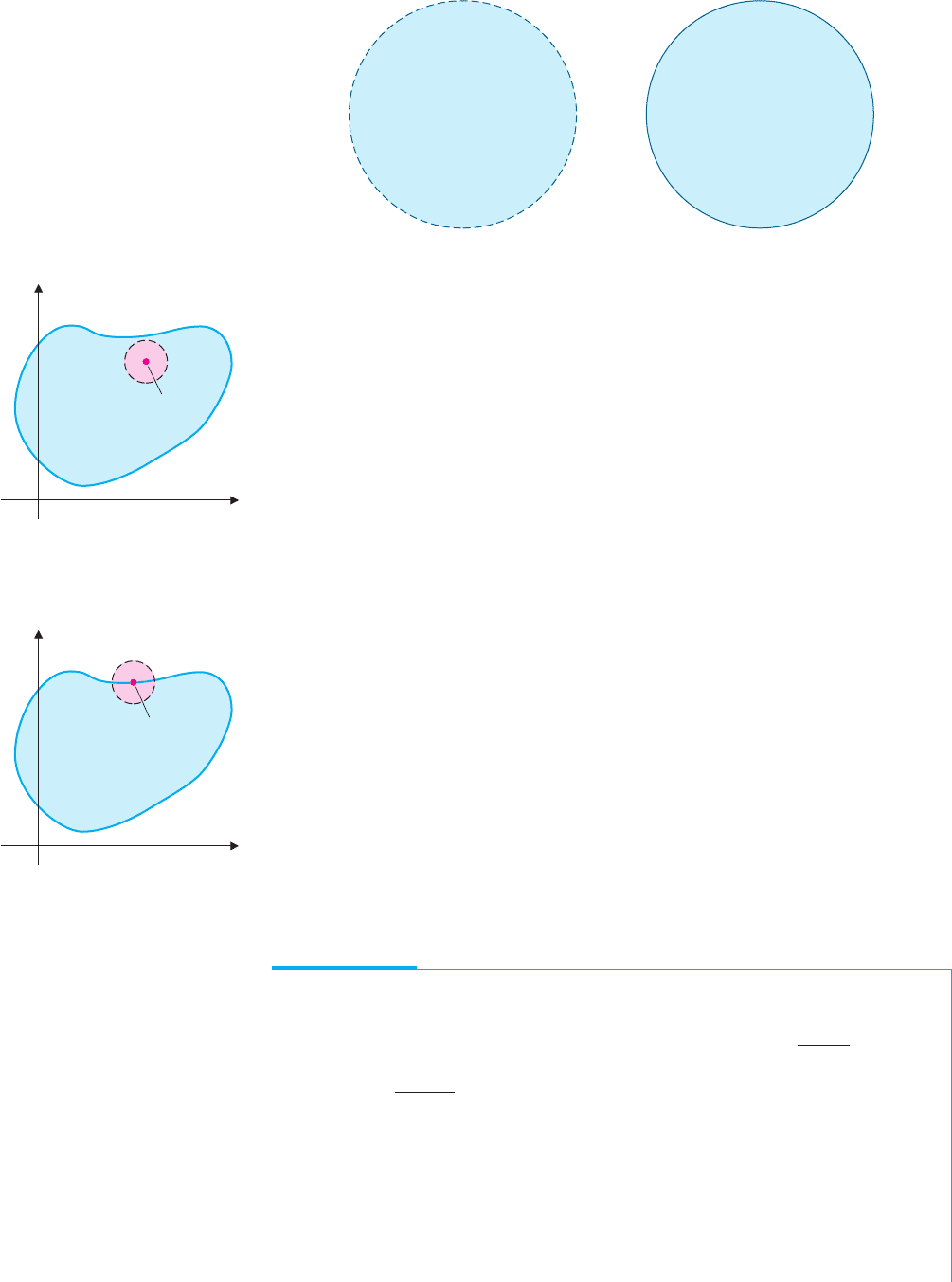
define open and closed regions in two dimensions. We refer to the interior of a circle (i.e.,
the set of all points inside but not on the circle) as an open disk. (See Figure 13.17a.)
A closed disk consists of the circle and its interior. (See Figure 13.17b.) These are the
two-dimensional analogs of open and closed intervals, respectively, of the real line. For a
given two-dimensional region R, a point (a, b)inR is called an interior point of R if there is
an open disk centered at (a, b) that lies completely inside of R. (See Figure 13.18a.) A point
(a, b)inR is called a boundary point of R if every open disk centered at (a, b) contains
points in R and points outside R. (See Figure 13.18b.) A set R is closed if it contains all
of its boundary points. Alternatively, R is open if it contains none of its boundary points.
Note that these are analogous to closed and open intervals of the real line: closed intervals
P1: OSO/OVY P2: OSO/OVY QC: OSO/OVY T1: OSO
MHDQ256-Ch13 MHDQ256-Smith-v1.cls December 31, 2010 16:55
LT (Late Transcendental)
CONFIRMING PAGES
13-21 SECTION 13.2
..
Limits and Continuity 829
FIGURE 13.17a
Open disk
FIGURE 13.17b
Closed disk
include both of their boundary points (endpoints), while open intervals include neither of
their boundary points.
y
x
R
(a, b)
FIGURE 13.18a
Interior point
Ifthedomainof afunctioncontains anyofitsboundary points,wemodify ourdefinition
ofcontinuity slightly,sothatthelimit is calculated onlyoverpathsthat lie insidethedomain.
(Compare this to what we did to define continuity of a function of a single variable on a
closed interval.) If (a, b) is a boundary point of the domain D of a function f, we say that f
is continuous at (a, b)if
lim
(x,y)→(a,b)
(x,y)∈D
f (x, y) = f (a, b).
This notation indicates that the limit is taken only along paths lying completely inside D.
Note that this limit requires a slight modification of Definition 2.1, as follows.
y
x
R
(a, b)
FIGURE 13.18b
Boundary point
We say that
lim
(x,y)→(a,b)
(x,y)∈D
f (x, y) = L
if for every ε>0 there exists a δ>0 such that |f (x) − L| <εwhenever (x, y) ∈ D and
0 <
(x − a)
2
+ (y − b)
2
<δ.
We say that a function f is continuous on a region R if it is continuous at each point
in R.
Since we define continuity in terms of limits, we immediately have the following
results, which follow directly from the corresponding results for limits. If f and g are
continuous at (a, b), then f + g, f − g and f · g are all continuous at (a, b). Further, f/g
is continuous at (a, b), if, in addition, g(a, b) = 0. We leave the proofs of these statements
as exercises.
In many cases, determining where a function is continuous involves identifying where
the function isn’t defined and using our continuity results for functions of a single variable.
EXAMPLE 2.8 Determining Where a Function of Two Variables
Is Continuous
Find all points where the given function is continuous: (a) f (x, y) =
x
x
2
− y
and
(b) g(x, y) =
⎧
⎨
⎩
x
4
x
2
+ y
2
, if (x, y) = (0, 0)
0, if (x, y) = (0, 0)
.
Solution For (a), notice that f (x, y) is a quotient of two polynomials (i.e., a rational
function) and so, it is continuous at any point where we don’t divide by 0. Since
division by zero occurs only when y = x
2
, we have that f is continuous at all points
(x, y) with y = x
2
. For (b), the function g is also a quotient of polynomials, except
at the origin. Since the denominator is never zero, g must be continuous at every point
(x, y) = (0, 0). We must consider the point (0, 0) separately, however, since the function

P1: OSO/OVY P2: OSO/OVY QC: OSO/OVY T1: OSO
MHDQ256-Ch13 MHDQ256-Smith-v1.cls December 31, 2010 16:55
LT (Late Transcendental)
CONFIRMING PAGES
830 CHAPTER 13
..
Functions of Several Variables and Partial Differentiation 13-22
is not defined by the rational expression there. We can verify that lim
(x,y)→(0,0)
g(x, y) = 0
using the following string of inequalities. Notice that for (x, y) = (0, 0),
|g(x, y)|=
x
4
x
2
+ y
2
≤
x
4
x
2
= x
2
and x
2
→ 0as(x, y) → (0, 0). By Theorem 2.1, we have that
lim
(x,y)→(0,0)
g(x, y) = 0 = g(0, 0),
so that g is continuous at (0, 0). Putting this all together, we get that g is continuous
everywhere.
Theorem2.2showsthatwe canuseall ofourestablishedcontinuityresultsforfunctions
of a single variable when considering functions of several variables.
THEOREM 2.2
Suppose that f (x, y) is continuous at (a, b) and g(x) is continuous at the point
f (a, b). Then
h(x, y) = (g ◦ f )(x, y) = g( f (x, y))
is continuous at (a, b).
SKETCH OF THE PROOF
We leave the proof as an exercise, but it goes something like this. Notice that if (x, y)is
close to (a, b), then by the continuity of f at (a, b), f (x, y) will be close to f (a, b). By the
continuity of g at the point f (a, b), it follows that g( f (x, y)) will be close to g( f (a, b)), so
that g ◦ f is also continuous at (a, b).
EXAMPLE 2.9 Determining Where a Composition of Functions
Is Continuous
Determine where f (x, y) = e
x
2
y
is continuous.
Solution Notice that f (x, y) = g(h(x, y)), where g(t) = e
t
and h(x, y) = x
2
y. Since
g is continuous for all values of t and h is a polynomial in x and y (and hence continuous
for all x and y), it follows from Theorem 2.2 that f is continuous for all x and y.
REMARK 2.3
All of the foregoing analysis is extended to functions of three (or more) variables in
the obvious fashion.
DEFINITION 2.3
Let the function f (x, y, z) be defined on the interior of a sphere, centered at the point
(a, b, c), except possibly at (a, b, c) itself. We say that lim
(x,y,z)→(a,b,c)
f (x, y, z) = L if
for every ε>0 there exists a δ>0 such that |f (x, y, z) − L| <εwhenever
0 <
(x − a)
2
+ (y − b)
2
+ (z − c)
2
<δ.
Observe that, as with limits of functions of two variables, Definition 2.3 says that in
order to have lim
(x,y,z)→(a,b,c)
f (x, y, z) = L, we must have that f (x, y, z) approaches L along
everypossible path through the point (a, b, c).Just as with functions oftwovariables,notice
P1: OSO/OVY P2: OSO/OVY QC: OSO/OVY T1: OSO
MHDQ256-Ch13 MHDQ256-Smith-v1.cls December 31, 2010 16:55
LT (Late Transcendental)
CONFIRMING PAGES
13-23 SECTION 13.2
..
Limits and Continuity 831
that if a function of three variables approaches different limits along two particular paths,
then the limit does not exist.
BEYOND FORMULAS
The examples in this section
illustrate an important principle
of logic. In this case, a limit
exists if you get the same limit
along all possible paths through
the point. To disprove such a
“for all” statement, you need
only to find one specific
counterexample: two paths with
different limits. However, to
prove a “for all” statement, you
must demonstrate that a general
statement is true. This is
typically a more elaborate task
than finding a counterexample.
To see what we mean, compare
examples 2.3 and 2.6.
EXAMPLE 2.10 A Limit in Three Dimensions That Does Not Exist
Evaluate lim
(x,y,z)→(0,0,0)
x
2
+ y
2
− z
2
x
2
+ y
2
+ z
2
.
Solution First, we consider the path x = y = 0 (the z-axis). There, we have
lim
(0,0,z)→(0,0,0)
0
2
+ 0
2
− z
2
0
2
+ 0
2
+ z
2
= lim
z→0
−z
2
z
2
=−1.
Along the path x = z = 0 (the y-axis), we have
lim
(0,y,0)→(0,0,0)
0
2
+ y
2
− 0
2
0
2
+ y
2
+ 0
2
= lim
y→0
y
2
y
2
= 1.
Since the limits along these two specific paths do not agree, the limit does not exist.
We extend the definition of continuity to functions of three variables in the obvious
way, as follows.
DEFINITION 2.4
Suppose that f (x, y, z) is defined in the interior of a sphere centered at (a, b, c). We
say that f is continuous at (a, b, c) if lim
(x,y,z)→(a,b,c)
f (x, y, z) = f (a, b, c).
If f is not continuous at (a, b, c), then we call (a, b, c)adiscontinuity of f.
As you can see, limits and continuity for functions of three variables work essentially
the same as they do for functions of two variables. You will examine these in more detail
in the exercises.
EXAMPLE 2.11 Continuity for a Function of Three Variables
Find all points where f (x, y, z) = ln(9 − x
2
− y
2
− z
2
) is continuous.
Solution Notice that f (x, y, z) is defined only for 9 − x
2
− y
2
− z
2
> 0. On this
domain, f is a composition of continuous functions, which is also continuous. So, f is
continuous for 9 > x
2
+ y
2
+ z
2
, which you should recognize as the interior of the
sphere of radius 3 centered at (0, 0, 0).
EXERCISES 13.2
WRITING EXERCISES
1. Choosing between the paths y = x and x = y
2
, explain why
y = x is a better choice in example 2.4 but x = y
2
is a better
choice in example 2.5.
2. In terms of Definition 2.1, explain why the limit in example
2.5 does not exist. That is, explain why making (x, y) close to
(0, 0) doesn’t guarantee that f (x, y) is close to 0.
3. A friend claims that a limit equals 0, but you found that it does
not exist. Looking over your friend’s work, you see that the
path with x = 0 and the path with y = 0 both produce a limit
of 0. No other work is shown. Explain to your friend why no
conclusioncanbemadefromthiswork,andsuggestanextstep.
4. Explain why the path y = x is not a valid path for the limit in
example 2.7.
In exercises 1–4, use Definition 2.1 to verify the limit. Assume
that lim
(x,y)→(a,b)
f (x, y) L and lim
(x,y)→(a,b)
g(x, y) M.
1. lim
(x,y)→(a,b)
(x + y) = a + b 2. lim
(x,y)→(1,2)
(2x + 3y) = 8
3. lim
(x,y)→(a,b)
[ f (x, y) + g(x, y)] = L + M
4. lim
(x,y)→(a,b)
[cf(x, y)] = cL
............................................................

P1: OSO/OVY P2: OSO/OVY QC: OSO/OVY T1: OSO
MHDQ256-Ch13 MHDQ256-Smith-v1.cls December 31, 2010 16:55
LT (Late Transcendental)
CONFIRMING PAGES
832 CHAPTER 13
..
Functions of Several Variables and Partial Differentiation 13-24
In exercises 5–8, compute the indicated limit.
5. lim
(x,y)→(1,3)
x
2
y
4x
2
− y
6. lim
(x,y)→(2,−1)
x + y
x
2
− 2xy
7. lim
(x,y)→(π,1)
cos xy
y
2
+ 1
8. lim
(x,y)→(−3,0)
e
xy
x
2
+ y
2
............................................................
In exercises 9–24, show that the indicated limit does not exist.
9. lim
(x,y)→(0,0)
3x
2
x
2
+ y
2
10. lim
(x,y)→(0,0)
2y
2
2x
2
− y
2
11. lim
(x,y)→(0,0)
4xy
3y
2
− x
2
12. lim
(x,y)→(0,0)
2xy
x
2
+ 2y
2
13. lim
(x,y)→(0,0)
2x
2
y
x
4
+ y
2
14. lim
(x,y)→(0,0)
3x
3
√
y
x
4
+ y
2
15. lim
(x,y)→(0,0)
3
√
xy
2
x + y
3
16. lim
(x,y)→(0,0)
2xy
3
x
2
+ 8y
6
17. lim
(x,y)→(0,0)
y sin x
x
2
+ y
2
18. lim
(x,y)→(0,0)
x(cos y − 1)
x
3
+ y
3
19. lim
(x,y)→(1,2)
xy −2x − y + 2
x
2
− 2x + y
2
− 4y + 5
20. lim
(x,y)→(2,0)
2y
2
(x − 2)
2
+ y
2
21. lim
(x,y,z)→(0,0,0)
3x
2
x
2
+ y
2
+ z
2
22. lim
(x,y,z)→(0,0,0)
x
2
+ y
2
+ z
2
x
2
− y
2
+ z
2
23. lim
(x,y,z)→(0,0,0)
xyz
x
3
+ y
3
+ z
3
24. lim
(x,y,z)→(0,0,0)
x
2
yz
x
4
+ y
4
+ z
4
............................................................
In exercises 25–34, show that the indicated limit exists.
25. lim
(x,y)→(0,0)
xy
2
x
2
+ y
2
26. lim
(x,y)→(0,0)
x
2
y
x
2
+ y
2
27. lim
(x,y)→(0,0)
2x
2
sin y
2x
2
+ y
2
28. lim
(x,y)→(0,0)
x
3
y + x
2
y
3
x
2
+ y
2
29. lim
(x,y)→(0,0)
x
3
+ 4x
2
+ 2y
2
2x
2
+ y
2
30. lim
(x,y)→(0,0)
x
2
y − x
2
− y
2
x
2
+ y
2
31. lim
(x,y)→(0,1)
x
2
y − x
2
x
2
+ y
2
− 2y + 1
32. lim
(x,y)→(−1,2)
xy
2
− 4xy + 4x + (y − 2)
2
2x
2
+ 4x + y
2
− 4y + 6
33. lim
(x,y,z)→(0,0,0)
3x
3
x
2
+ y
2
+ z
2
34. lim
(x,y,z)→(0,0,0)
x
2
y
2
z
2
x
2
+ y
2
+ z
2
............................................................
In exercises 35–44, determine all points at which the given
function is continuous.
35. f (x, y) =
9 − x
2
− y
2
36. f (x, y, z) =
x
3
y
+ sin z
37. f (x, y) = ln(3 − x
2
+ y) 38. f (x, y) = tan(x + y)
39. f (x, y, z) =
x
2
+ y
2
+ z
2
− 4
40. f (x, y, z) =
z − x
2
− y
2
41. f (x, y) =
(y − 2) cos
1
x
2
, if x = 0
0, if x = 0
42. f (x, y) =
⎧
⎪
⎨
⎪
⎩
sin
1 − x
2
− y
2
1 − x
2
− y
2
, if x
2
+ y
2
< 1
1, if x
2
+ y
2
= 1
43. f (x, y) =
⎧
⎨
⎩
x
2
− y
2
x − y
, if x = y
2x, if x = y
44. f (x, y) =
⎧
⎪
⎨
⎪
⎩
cos
1
x
2
+ y
2
, if (x, y) = (0, 0)
1, if (x, y) = (0, 0)
............................................................
In exercises 45–48, determine whether the limit exists.
45. lim
(x,y)→(0,0)
x + y
x
2
+ y
2
+ 4 − 2
46. lim
(x,y)→(0,0)
x
2
− xy
3
√
x −
3
√
y
47. lim
(x,y)→(0,0)
x(e
y/x
− 1)
x + y
48. lim
(x,y)→(0,0)
3sin xy
xy
2
+ x
2
y
............................................................
In exercises 49 and 50, estimate the indicated limit numerically.
Use a Maclaurin series to verify your estimate.
49. lim
(x,y)→(0,0)
1 − cos xy
x
2
y
2
+ x
2
y
3
50. lim
(x,y)→(0,0)
3sin xy
2
x
2
y
2
+ xy
2
............................................................
In exercises 51–54, label the statement as true or false and
explain. Assume that f (x, y) is defined for all (x, y).
51. If lim
(x,y)→(a,b)
f (x, y) = L, then lim
x→a
f (x, b) = L.
52. If lim
x→a
f (x, b) = L, then lim
(x,y)→(a,b)
f (x, y) = L.
53. If lim
x→a
f (x, b) = lim
y→b
f (a, y) = L, then lim
(x,y)→(a,b)
f (x, y) = L.
54. If lim
(x,y)→(0,0)
f (x, y) = 0, then lim
(x,y)→(0,0)
f (cx, y) = 0 for any
constant c.
............................................................
In exercises 55–58, use graphs and density plots to explain why
the limit in the indicated exercise does not exist.
55. Exercise 9 56. Exercise 10
57. Exercise 11 58. Exercise 12
............................................................
59. (a) In example 2.5, show that for any k, if the limit is evaluated
along the line y = kx, lim
(x,y)→(0,0)
y=kx
xy
2
x
2
+ y
4
= 0.
(b) Repeat for the limit in exercise 16.