
Smith R., Minton R. Calculus
Подождите немного. Документ загружается.


P1: OSO/OVY P2: OSO/OVY QC: OSO/OVY T1: OSO
MHDQ256-Ch13 MHDQ256-Smith-v1.cls December 31, 2010 16:55
LT (Late Transcendental)
CONFIRMING PAGES
13-75 SECTION 13.7
..
Extrema of Functions of Several Variables 883
To find the maximum and minimum values of f on this portion of the boundary, we need
only find the maximum and minimum values of g on the interval [−2, 2]. We have
g
(x) = 4 −4x = 0 only for x = 1. Comparing the value of g at the endpoints and at the
only critical number in the interval, we have: g(−2) =−9, g(2) = 7 and g(1) = 9. So,
the maximum value of f on this portion of the boundary is 9 and the minimum value
is −9.
On the portion of the line y = x for 0 ≤ x ≤ 2, we have
f (x, y) = f (x, x) = 5 +7x −3x
2
= h(x).
We have h
(x) = 7 −6x = 0, only for x =
7
6
, which is in the interval. Comparing the
values of h at the endpoints and the critical number, we have: h(0) = 5, h(2) = 7 and
h
7
6
≈ 9.08. So, the maximum value of f on this portion of the boundary is
approximately 9.08 and its minimum value is 5.
On the portion of the line y =−x for −2 ≤ x ≤ 0, we have
f (x, y) = f (x, −x) = 5 + x − 3x
2
= k(x).
We have k
(x) = 1 −6x = 0, only for x =
1
6
, which is not in the interval [−2, 0] under
consideration. Comparing the values of k at the endpoints, we have k(−2) =−9 and
k(0) = 5, so that the maximum value of f on this portion of the boundary is 5 and its
minimum value is −9.
Finally, we compute the value of f at the lone critical point in the interior of
R: f
1,
3
2
=
37
4
= 9.25. The largest of all these values we have computed is the
absolute maximum in R and the smallest is the absolute minimum. So, the absolute
maximum is f
1,
3
2
= 9.25 and the absolute minimum is f (−2, 2) =−9. Note that
these are also consistent with what we observed in Figure 13.49a.
We close this section with a proof of the Second Derivatives Test (Theorem 7.2). To
keep the notation to a minimum, we will assume that the critical point to be tested is (0, 0).
The proof can be extended to any critical point by a change of variables.
Proof of the Second Derivatives Test
Suppose that (0, 0) is a critical point of f (x, y) with f
x
(0, 0) = f
y
(0, 0) = 0. We will look
at the change in f (x, y) from (0, 0) in the direction of the unit vector u =
k, 1
√
k
2
+ 1
, for
some constant k. (Note that u can point in any direction except the direction of i.) In this
direction, notice that x = ky. If we define g(x) = f (kx, x), then by the chain rule, we have
g
(x) = kf
x
(kx, x) + f
y
(kx, x) (7.1)
and g
(x) = k
2
f
xx
(kx, x) + kf
xy
(kx, x) + kf
yx
(kx, x) + f
yy
(kx, x).
At x = 0, this gives us
g
(0) = k
2
f
xx
(0, 0) +2kf
xy
(0, 0) + f
yy
(0, 0), (7.2)
where we have f
xy
= f
yx
, since f was assumed to have continuous second partial deri-
vatives. Since f
x
(0, 0) = f
y
(0, 0) = 0, we have from (7.1) that
g
(0) = kf
x
(0, 0) + f
y
(0, 0) = 0.
Using the second derivative test for functions of a single variable, the sign of g
(0) can tell
us whether there is a local maximum or a local minimum of g at x = 0. Observe that using
(7.2), we can write g
(0) as
g
(0) = ak
2
+ 2bk + c = p(k),
wherea, b and c are the constants a = f
xx
(0, 0), b = f
xy
(0, 0) and c = f
yy
(0, 0). Of course,
the graph of p(k) is a parabola. Recall that for any parabola, if a > 0, then p(k) has a
minimum at k =−
b
a
, given by p
−
b
a
=−
b
2
a
+ c. (Hint: Complete the square.) In case (i)
of the theorem, we assume that the discriminant satisfies
0 < D(0, 0) = f
xx
(0, 0) f
yy
(0, 0) −[ f
xy
(0, 0)]
2
= ac − b
2
,

P1: OSO/OVY P2: OSO/OVY QC: OSO/OVY T1: OSO
MHDQ256-Ch13 MHDQ256-Smith-v1.cls December 31, 2010 16:55
LT (Late Transcendental)
CONFIRMING PAGES
884 CHAPTER 13
..
Functions of Several Variables and Partial Differentiation 13-76
so that −
b
2
a
+ c > 0. In this case,
p(k) ≥ p
−
b
a
=−
b
2
a
+ c > 0.
We have shown that, in case (i), when D(0, 0) > 0 and f
xx
(0, 0) > 0, g
(0) = p(k) > 0 for
all k. So, g has a local minimum at 0 and consequently, in all directions, the point at (0, 0) is
a local minimum of f. For case (ii),where D(0, 0) > 0 and f
xx
(0, 0) < 0, we consider p(k)
with a < 0. In a similar fashion, we can show that here, p(k) ≤−
b
2
a
+ c < 0. Given that
we have g
(0) = p(k) < 0 for all k, we conclude that the point at (0, 0) is a local maximum
of f. For case (iii), where the discriminant D(0, 0) < 0, the parabola p(k) will assume both
positive and negative values. For some values of k,wehaveg
(0) > 0 and the point (0, 0)
is a local minimum along the path x = ky, while for other values of k,wehaveg
(0) < 0
and the point (0, 0) is a local maximum along the path x = ky. Taken together, this says
that the point at (0, 0) must be a saddle point of f. To complete the proof, we must only
consider the case where u = i. In this case, the preceding proof is easily revised to show
the same results and we leave the details as an exercise.
BEYOND FORMULAS
You can think about local
extrema for functions of n
variables in the same way for
any value of n ≥ 2. Critical
points are points where either
all of the first partial derivatives
are zero or where one or more is
undefined. These provide the
candidates for local extrema, in
the sense that a local extremum
may occur only at a critical
point. However, further testing
is needed to determine whether
a function has a local maximum,
a local minimum or neither at a
given critical point.
EXERCISES 13.7
WRITING EXERCISES
1. If f (x, y) has a local minimum at (a, b), explain why the
point (a, b, f (a, b)) is a local minimum in the intersection of
z = f (x, y) with any vertical plane passing through the point.
Explain why the condition f
x
(a, b) = f
y
(a, b) = 0 guarantees
that (a, b) is a critical point in any such plane.
2. Suppose that f
x
(a, b) = 0. Explain why the tangent plane to
z = f (x, y)at(a, b)must be “tilted,”so that there is not a local
extremum at (a, b).
3. Suppose that f
x
(a, b) = f
y
(a, b) = 0 and f
xx
(a, b) f
yy
(a, b)< 0.
Explain why there must be a saddle point at (a, b).
4. Explainwhy thecenterofasetofconcentriccirclesinacontour
plot will often represent a local extremum.
In exercises 1–12, locate all critical points and classify them us-
ing Theorem 7.2.
1. f (x, y) = e
−x
2
(y
2
+ 1)
2. f (x, y) = cos
2
x + y
2
3. f (x, y) = x
3
− 3xy + y
3
4. f (x, y) = 4xy − x
4
− y
4
+ 4
5. f (x, y) = y
2
+ x
2
y + x
2
− 2y
6. f (x, y) = 2x
2
+ y
3
− x
2
y − 3y
7. f (x, y) = e
−x
2
−y
2
8. f (x, y) = x sin y
9. f (x, y) = xy +
1
x
+
1
y
10. f (x, y) = e
y
(x
2
− y
2
)
11. f (x, y) = xe
−x
2
−y
2
12. f (x, y) = x
2
e
−x
2
−y
2
............................................................
In exercises 13–16, locate all critical points and analyze each
graphically. If you have a CAS, use Theorem 7.2 to classify each
point.
13. f (x, y) = x
2
−
4xy
y
2
+ 1
14. f (x, y) =
x + y
x
2
+ y
2
+ 1
15. f (x, y) = xye
−x
2
−y
2
16. f (x, y) = xye
−x
2
−y
4
............................................................
In exercises 17–20, numerically approximate all critical points.
Classify each point graphically or with Theorem 7.2.
17. f (x, y) = xy
2
− x
2
− y +
1
16
x
4
18. f (x, y) = 2y(x + 2) − x
2
+ y
4
− 9y
2
19. f (x, y) = (x
2
− y
3
)e
−x
2
−y
2
20. f (x, y) = (x
2
− 3x)e
−x
2
−y
2
............................................................
21. (a) Show that for data (x
1
, y
1
), (x
2
, y
2
),...,(x
n
, y
n
), the
least-squares equations become
)
n
*
k=1
x
k
+
a +
)
n
*
k=1
1
+
b =
n
*
k=1
y
k
)
n
*
k=1
x
2
k
+
a +
)
n
*
k=1
x
k
+
b =
n
*
k=1
x
k
y
k
(b) Solve the equations for a and b.
............................................................
In exercises 22–24, use least squares as in example 7.4 to find a
linear model of the data.
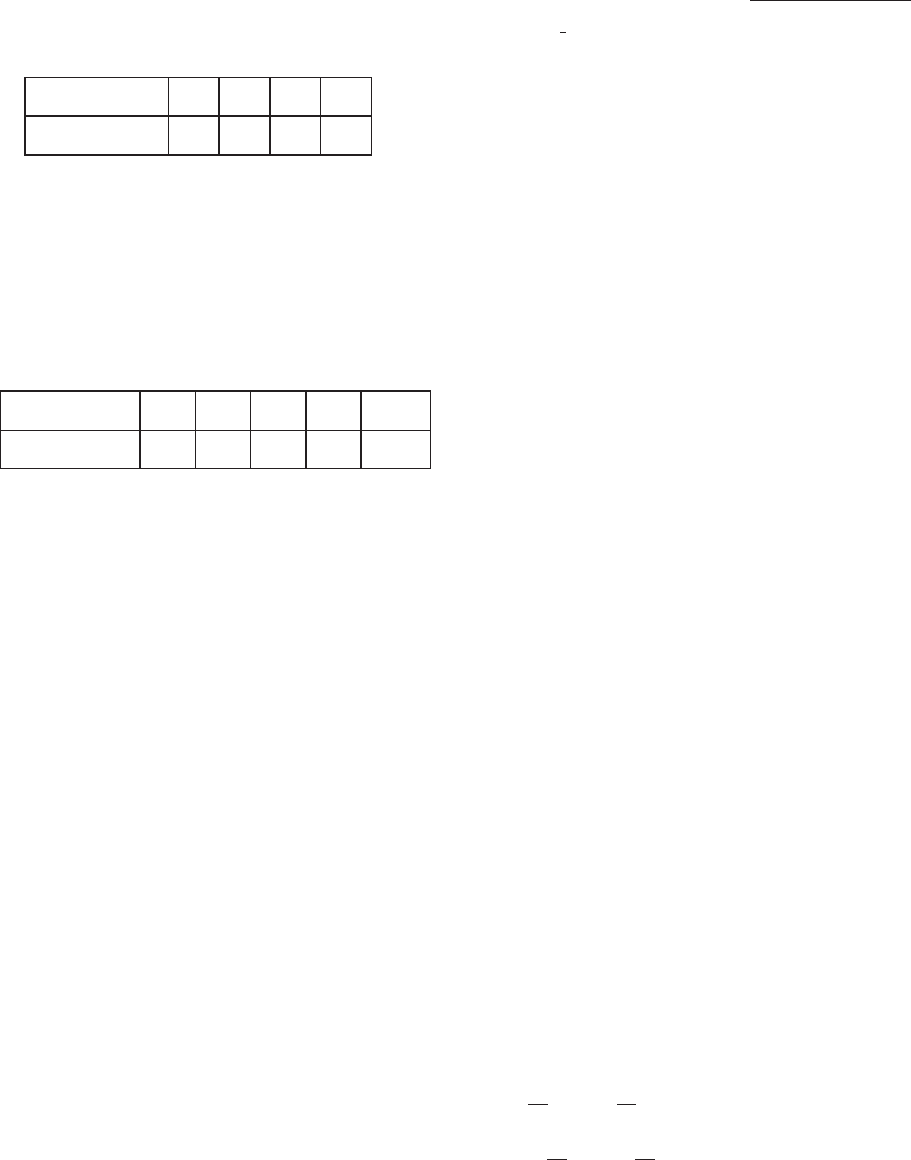
22. The following data show the average price of a gallon of
regular gasoline in California. Use the linear model to pre-
dict the price in 1990 and 1995. The actual prices were $1.09
and $1.23. Explain why your forecasts were not accurate.
Year 1970 1975 1980 1985
Price $0.34 $0.59 $1.23 $1.11
P1: OSO/OVY P2: OSO/OVY QC: OSO/OVY T1: OSO
MHDQ256-Ch13 MHDQ256-Smith-v1.cls December 31, 2010 16:55
LT (Late Transcendental)
CONFIRMING PAGES
13-77 SECTION 13.7
..
Extrema of Functions of Several Variables 885
23. (a) The following data show the height and weight of a small
numberofpeople.Usethelinearmodeltopredicttheweight
of a 6
8
person and a 5
0
person. Comment on how accu-
rate you think the model is.
Height (inches) 68 70 70 71
Weight (pounds) 160 172 184 180
(b) Add thedata point (70, 221) andrepeat part(a). How much
influence can one point have?
24. The accompanying data show the average number of points
professional football teams score when starting different
distances from the opponents’ goal line. The number of points
is determined by the next score, so that if the opponent scores
next, the number of points is negative. Use the linear model to
predict the average number ofpoints starting (a) 60 yards from
the goal line and (b) 40 yards from the goal line.
Yards from goal 15 35 55 75 95
Average points 4.57 3.17 1.54 0.24 −1.25
In The Hidden Game of Pro Football, authors Carroll, Palmer
and Thorn claim that when a team loses a fumble they lose an
average of 4 points regardless of where they are on the field.
That is, a fumble at the 50-yard line costs the same number
of points as a fumble at the opponents’ 10-yard line. Use your
result to verify this claim.
............................................................
In exercises 25–28, calculate the first two steps of the steepest
ascent algorithm from the given starting point.
25. f (x, y) = 2xy − 2x
2
+ y
3
, (0, −1)
26. f (x, y) = 3xy − x
3
− y
2
, (1, 1)
27. f (x, y) = x − x
2
y
4
+ y
2
, (1, 1)
28. f (x, y) = xy
2
− x
2
− y, (1, 0)
............................................................
29. Calculate one step of the steepest ascent algorithm for
f (x, y) = 2xy −2x
2
+ y
3
,starting at(0, 0).Explain ingraph-
ical terms what goes wrong.
30. Define a steepest descent algorithm for finding local minima.
............................................................
In exercises 31–36, find the absolute extrema of the function on
the region.
31. f (x, y) = x
2
+ 3y − 3xy, region bounded by y = x, y = 0
and x = 2
32. f (x, y) = x
2
+ y
2
− 4xy, region bounded by y = x, y =−3
and x = 3
33. f (x, y) = x
2
+ y
2
, region bounded by (x − 1)
2
+ y
2
= 4
34. f (x, y) = x
2
+ y
2
− 2x − 4y, region bounded by y = x,
y = 3 and x = 0
35. f (x, y) = xye
−x
2
/2−y
2
/2
with 0 ≤ x ≤ 2, 0 ≤ y ≤ 2
36. f (x, y) = ln(x
2
+ y
2
+ 1) − y
2
/2 with 0 ≤ x
2
+ y
2
≤ 4
............................................................
37. Heron’s formula gives the area of a triangle with sides of
lengths a, b and c as A =
√
s(s −a)(s −b)(s − c), where
s =
1
2
(a + b + c). For a given perimeter, find the triangle of
maximum area.
38. Find the maximum of x
2
+ y
2
on the square with −1 ≤ x ≤ 1
and −1 ≤ y ≤ 1. Use your result to explain why a computer
graph of z = x
2
+ y
2
with the graphing window −1 ≤ x ≤ 1
and −1 ≤ y ≤ 1 does not show a circular cross section at the
top.
39. Find all critical points of f (x, y) = x
2
y
2
and show that
Theorem 7.2 fails to identify any of them. Use the form of
the function to determine what each critical point represents.
Repeat for f (x, y) = x
2/3
y
2
.
40. Complete the square to identify all local extrema of
(a) f (x, y) = x
2
+ 2x + y
2
− 4y + 1,
(b) f (x, y) = x
4
− 6x
2
+ y
4
+ 2y
2
− 1.
41. In exercise 3, there is a saddle point at (0, 0). One possibil-
ity is that there is (at least) one trace of z = x
3
− 3xy + y
3
with a local minimum at (0, 0) and (at least) one trace with
a local maximum at (0, 0). To analyze traces in the planes
y = kx (for some constant k), substitute y = kx and show that
z = (1 +k
3
)x
3
− 3kx
2
. Show that f (x) = (1 +k
3
)x
3
− 3kx
2
has a local minimum at x = 0ifk < 0 and a local maximum
at x = 0ifk > 0. (Hint: Use the Second Derivative Test from
section 3.4.)
42. In exercise 4, there is a saddle point at (0, 0). As in
exercise 41, find traces such that there is a local maximum
at (0, 0) and traces such that there is a local minimum
at (0, 0).
43. (a) In example 7.3, (0, 0) is a critical point but is not classi-
fied by Theorem 7.2. Use the technique of exercise 41 to
analyze this critical point.
(b) Repeat for f (x, y) = x
2
− 3xy
2
+ 4x
3
y.
44. (a) For f (x, y, z) = xz − x + y
3
− 3y, show that (0, 1, 1)
is a critical point. To classify this critical point,
show that f (0 +x, 1 + y, 1 + z) = xz + 3y
2
+
y
3
+ f (0, 1, 1). Setting y = 0 and xz > 0, conclude
that f (0, 1, 1) is not a local maximum. Setting y = 0 and
xz < 0, concludethat f (0, 1, 1) isnot a localminimum.
(b) Repeat for the point (0, −1, 1).
............................................................
In exercises 45–48, label the statement as true or false and
explain why.
45. If f (x, y) has a local maximum at (a, b), then
∂ f
∂x
(a, b) =
∂ f
∂y
(a, b) = 0.
46. If
∂ f
∂x
(a, b) =
∂ f
∂y
(a, b) = 0, then f (x, y) has a local maxi-
mum at (a, b).
47. In between any two local maxima of f (x, y) there must be at
least one local minimum of f (x, y).
48. If f (x, y) has exactly two critical points, they can’t both be
local maxima.
............................................................

P1: OSO/OVY P2: OSO/OVY QC: OSO/OVY T1: OSO
MHDQ256-Ch13 MHDQ256-Smith-v1.cls December 31, 2010 16:55
LT (Late Transcendental)
CONFIRMING PAGES
886 CHAPTER 13
..
Functions of Several Variables and Partial Differentiation 13-78
49. In the contour plot, the locations of four local extrema and nine
saddle points are visible. Identify these critical points.
4
2
4
0
2
4
20 2 4
x
y
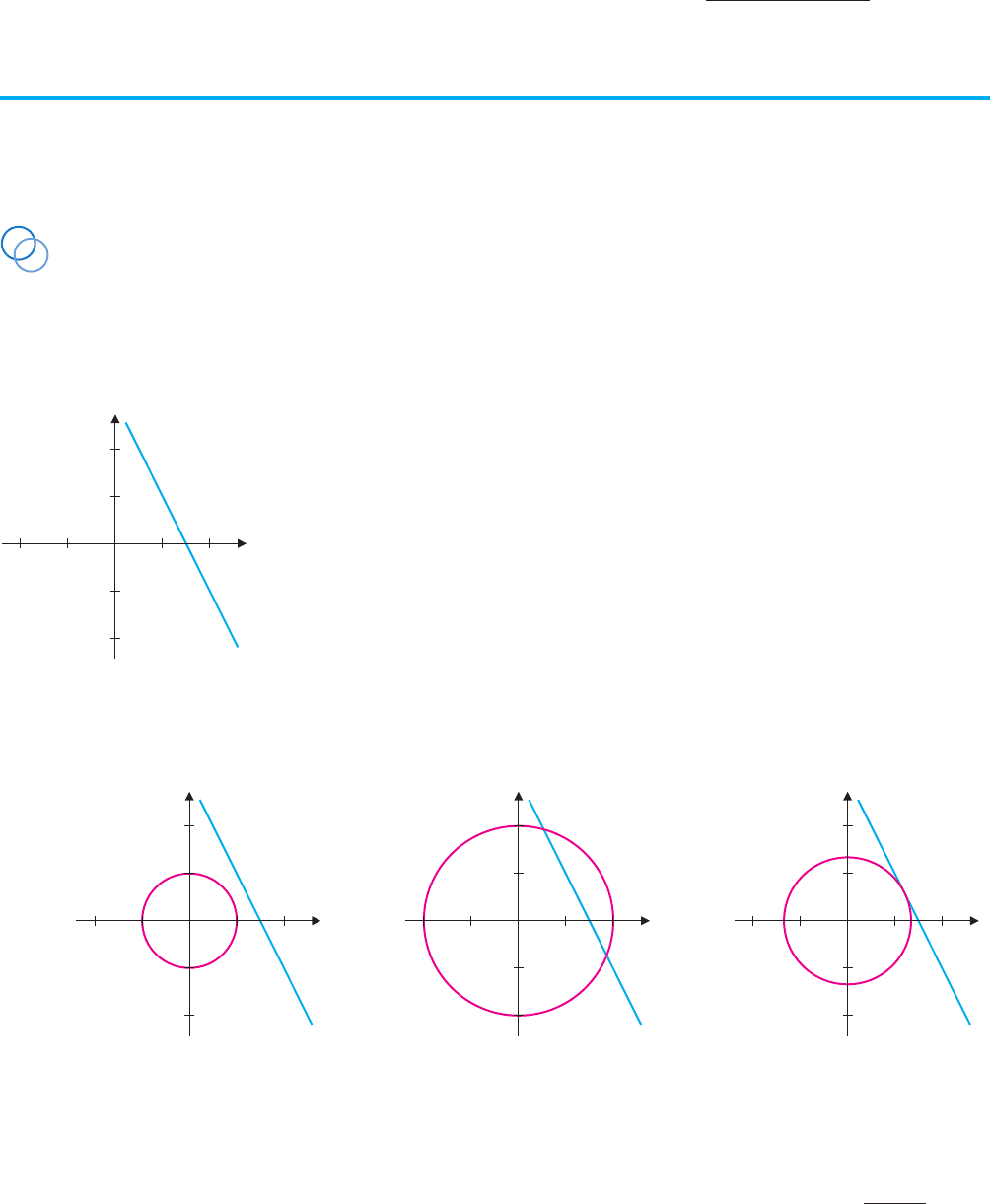
50. In the contour plot, the locations of two local extrema and one
saddle point are visible. Identify each critical point.
2
1
0
1
2
12210
x
y
51. Showthat the function f (x, y) = 5xe
y
− x
5
− e
5y
has exactly
onecriticalpoint,whichisalocalmaximumbutnotan absolute
maximum.
52. Show that the function f (x, y) = 2x
4
+ e
4y
− 4x
2
e
y
has ex-
actly two critical points, both of which are local minima.
53. (a) Construct the function d(x, y) giving the distance from a
point (x, y, z) on the paraboloid z = 4 − x
2
− y
2
to the point
(3, −2, 1). Then determine the point that minimizes d(x, y).
(b) Find the closest point on the cone z =
x
2
+ y
2
to the
point (2, −3, 0).
54. (a) Use the method of exercise 53 to find the closest point
on the sphere x
2
+ y
2
+ z
2
= 9 to the point (2, 1, −3).
(b) Find the closest point on the plane 3x − 4y + 3z = 12 to
the origin.
APPLICATIONS
55. (a) A box is to be constructed out of 96 square feet of material.
Find the dimensions x, y and z that maximize the volume of
the box. (b) If the bottom of the box must be reinforced by
doubling up the material (essentially, there are two bottoms
of the box), find the dimensions that maximize the volume of
the box.
56. The Hardy-Weinberg law of genetics describes the relation-
ship between the proportions of different genes inpopulations.
Suppose that a certain gene has three types (e.g., blood types
of A, B and O). If the three types have proportions p, q and r,
respectively, in the population, then the Hardy-Weinberg law
states that the proportion of people who carry two different
typesofgenes equals f (p, q, r) = 2pq + 2pr + 2qr.Explain
why p + q +r = 1 and then show that the maximum value of
f (p, q, r)is
2
3
.
57. Elvis the dog starts 10 m from shore in the water and wants
to reach a ball 16 m downshore (also 10 m from shore). He
swims to shore to a point x m downshore, runs along the shore
16 − x − y m and swims out to the ball. If Elvis swims 0.9
m/s and runs 6.4 m/s, find x and y to minimize the total time
to the ball. Compare this minimum time to the time to swim
directly to the ball.
58. If the ball in exercise 57 is thrown z m downshore, find all
values of z such that Elvis is better off swimming directly to
the ball than going to shore. (See “Do Dogs Know Bifurca-
tions?” the November 2007 issue of The College Mathematics
Journal.)
EXPLORATORY EXERCISES
1. Use the least-squares criterion to find (a) the best quadratic fit
(y = ax
2
+ bx +c) and (b) the best exponential fit (y = ae
bx
)
to the data of example 7.4. Compare the actual residuals of this
model to the actual residuals of the linear model. Explain why
there is some theoretical justification for using an exponential
model, and then discuss the advantages and disadvantages of
the exponential and linear models.
2. A practical flaw with the method of steepest ascent pre-
sented in example 7.5 is that the equation g
(h) = 0 may be
difficult to solve. An alternative is to use Newton’s method
to approximate a solution. A method commonly used
in practice is to approximate h using one iteration of
Newton’s method with initial guess h = 0. We derive the re-
sulting formula here. Recall that g(h) = f (x
k
+ ah, y
k
+ bh),
where (x
k
, y
k
) is the current point and a, b=∇f (x
k
, y
k
).
Newton’s method applied to g
(h) = 0 with h
0
= 0isgivenby
h
1
=−
g
(0)
g
(0)
. Show that g
(0) = af
x
(x
k
, y
k
) + bf
y
(x
k
, y
k
) =
a
2
+ b
2
=∇f (x
k
, y
k
) ·∇f (x
k
, y
k
). Also, show that
P1: OSO/OVY P2: OSO/OVY QC: OSO/OVY T1: OSO
MHDQ256-Ch13 MHDQ256-Smith-v1.cls December 31, 2010 16:55
LT (Late Transcendental)
CONFIRMING PAGES
13-79 SECTION 13.8
..
Constrained Optimization and Lagrange Multipliers 887
g
(0) = a
2
f
xx
(x
k
, y
k
) + 2abf
xy
(x
k
, y
k
) + b
2
f
yy
(x
k
, y
k
) =
∇ f (x
k
, y
k
) · H(x
k
, y
k
)∇ f (x
k
, y
k
), where the Hessian matrix
is defined by H =
f
xx
f
xy
f
yx
f
yy
. Putting this together with
the work in example 7.5, the method of steepest ascent be-
comes v
k+1
= v
k
−
∇ f (v
k
) ·∇f (v
k
)
∇ f (v
k
) · H(v
k
)∇ f (v
k
)
∇ f (v
k
), where
v
k
=
x
k
y
k
.
13.8 CONSTRAINED OPTIMIZATION
AND LAGRANGE MULTIPLIERS
The method presented in section 13.7 forms only one piece of the optimization puzzle. In
many applications, the goal is to achieve the absolute best possible product given a set of
constraints such as limited resources or technology. In this section, we develop a technique
for finding the maximum or minimum of a function, given one or more constraints on the
function’s domain.
y
x
1 22 1
1
2
1
2
FIGURE 13.50a
y = 3 −2x
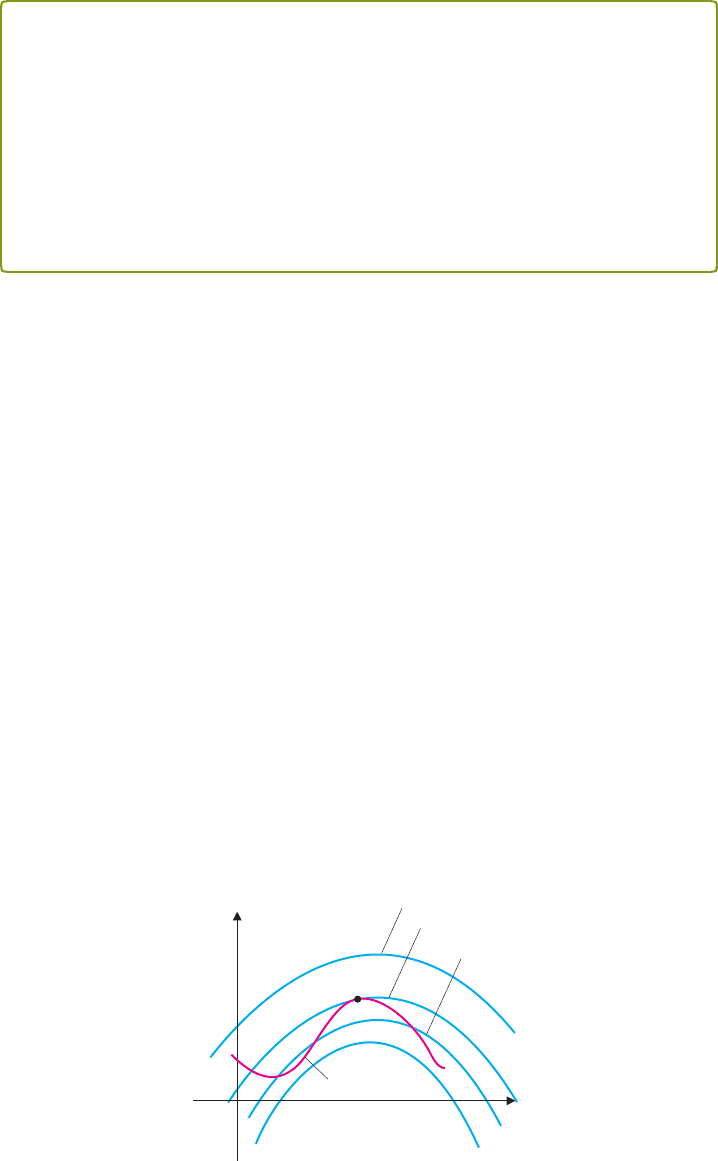
We first consider the two-dimensional geometric problem of finding the point on the
line y = 3 − 2x that is closest to the origin. A graph of the line is shown in Figure 13.50a.
Notice that the set of points that are 1 unit from the origin form the circle x
2
+ y
2
= 1. In
Figure 13.50b, you can see that the line y = 3 −2x lies entirely outside this circle, which
meansthat every point on the line y = 3 −2x lies more than 1 unit fromthe origin. Looking
at the circle x
2
+ y
2
= 4 in Figure 13.50c, you can clearlysee that there are infinitely many
points on the line that are less than 2 units from the origin. If we shrink the circle in Figure
13.50c (or enlarge the circle in Figure 13.50b), it will eventually reach a size at which the
line is tangent to the circle. (See Figure 13.50d.) The point of tangency is the closest point
on the line to the origin, since all other points on the line are outside the circle and hence,
are farther away from the origin.
y
x
1 22 1
1
2
1
2
y
x
1 22 1
1
2
1
2
y
x
1 22 1
1
2
1
2
FIGURE 13.50b FIGURE 13.50c FIGURE 13.50d
y = 3 −2x and the circle of y = 3 −2x and the circle of y = 3 −2x and a circle
radius 1 centered at (0, 0) radius 2 centered at (0, 0) tangent to the line
Translating the preceding geometric argument into the language of calculus, we want
to minimize the distance from the point (x, y) to the origin, given by
x
2
+ y
2
. Before
we continue, observe that the distance is minimized at exactly the same point at which
the square of the distance is minimized. Minimizing the square of the distance, given by
x
2
+ y
2
, avoids the mess created by the square root in the distance formula. So, instead,
we minimize f (x, y) = x
2
+ y
2
, subject to the constraint that the point lie on the line (i.e.,

P1: OSO/OVY P2: OSO/OVY QC: OSO/OVY T1: OSO
MHDQ256-Ch13 MHDQ256-Smith-v1.cls December 31, 2010 16:55
LT (Late Transcendental)
CONFIRMING PAGES
888 CHAPTER 13
..
Functions of Several Variables and Partial Differentiation 13-80
that y = 3 −2x)org(x, y) = 2x + y − 3 = 0. We have already argued that at the closest
point,thelineandcirclearetangent.Moreover, since the gradient vectorforagivenfunction
is orthogonal to its level curves at any given point, for a level curve of f to be tangent to
the constraint curve g(x, y) = 0, the gradients of f and g must be parallel. That is, at the
closest point (x, y) on the line to the origin, we must have ∇ f (x, y) = λ∇g(x, y), for some
constant λ. We illustrate this in example 8.1.
EXAMPLE 8.1 Finding a Minimum Distance
Use the relationship ∇ f (x, y) = λ∇g(x, y) and the constraint y = 3 − 2x to find the
point on the line y = 3 − 2x that is closest to the origin.
Solution For f (x, y) = x
2
+ y
2
,wehave∇ f (x, y) =2x, 2y and for
g(x, y) = 2x + y − 3, we have ∇g(x, y) =2, 1. The vector equation
∇ f (x, y) = λ∇g(x, y) becomes
2x, 2y=λ2, 1,
from which it follows that
2x = 2λ and 2y = λ.
HISTORICAL
NOTES
Joseph-Louis Lagrange
(1736–1813) Mathematician
who developed many
fundamental techniques in the
calculus of variations, including
the method that bears his name.
Lagrange was largely self-taught,
but quickly attracted the attention
of the great mathematician
Leonhard Euler. At age 19,
Lagrange was appointed
Professor of Mathematics at the
Royal Artillery School in his
native Turin. Over a long and
outstanding career, Lagrange
made contributions to probability,
differential equations and fluid
mechanics, for which he
introduced what is now known as
the Lagrangian function.
The second equation gives us λ = 2y. The first equation then gives us x = λ = 2y.
Substituting x = 2y into the constraint equation y = 3 − 2x,wehavey = 3 −2(2y),
or 5y = 3. The solution is y =
3
5
, giving us x = 2y =
6
5
. The closest point is then
6
5
,
3
5
. Look carefully at Figure 13.50d and recognize that this is consistent with our
graphical solution. Also, note that the line described parametrically by x = λ, y =
λ
2
is
the line through the origin and perpendicular to y = 3 − 2x.
The technique illustrated in example8.1 can be applied to a wide varietyof constrained
optimization problems. We will now develop this method, referred to as the method of
Lagrange multipliers.
Suppose that we want to find maximum or minimum values of the function f (x, y, z),
subject to the constraint that g(x, y, z) = 0. We assume that both f and g have continuous
first partial derivatives. Now, suppose that f has an extremum at (x
0
, y
0
, z
0
) lying on the
level surface S defined by g(x, y, z) = 0. Let C be any curve lying on the level surface and
passing through the point (x
0
, y
0
, z
0
). Assume that C is traced out by the terminal point
of the vector-valued function r(t) =x(t), y(t), z(t) and that r(t
0
) =x
0
, y
0
, z
0
. Define a
function of the single variable t by
h(t) = f (x(t), y(t), z(t)).
Notice that if f (x, y, z) has an extremum at (x
0
, y
0
, z
0
), then h(t) must have an extremum
at t
0
and so, h
(t
0
) = 0. From the chain rule, we get that
0 = h
(t
0
) = f
x
(x
0
, y
0
, z
0
)x
(t
0
) + f
y
(x
0
, y
0
, z
0
)y
(t
0
) + f
z
(x
0
, y
0
, z
0
)z
(t
0
)
=f
x
(x
0
, y
0
, z
0
), f
y
(x
0
, y
0
, z
0
), f
z
(x
0
, y
0
, z
0
)·x
(t
0
), y
(t
0
), z
(t
0
)
=∇f (x
0
, y
0
, z
0
) · r
(t
0
).
That is, if f (x
0
, y
0
, z
0
) is an extremum, the gradient of f at (x
0
, y
0
, z
0
) is orthogonal to the
tangent vector r
(t
0
). Since C was an arbitrary curve lying on the level surface S, it follows
that∇ f (x
0
, y
0
, z
0
)must be orthogonal to every curve lying on the level surface S andso, too
is orthogonal to S. Recall from Theorem 6.5 that ∇g is also orthogonal to the level surface
g(x, y, z) = 0, so that ∇ f (x
0
, y
0
, z
0
) and ∇g(x
0
, y
0
, z
0
) must be parallel. This proves the
following result.
P1: OSO/OVY P2: OSO/OVY QC: OSO/OVY T1: OSO
MHDQ256-Ch13 MHDQ256-Smith-v1.cls December 31, 2010 16:55
LT (Late Transcendental)
CONFIRMING PAGES
13-81 SECTION 13.8
..
Constrained Optimization and Lagrange Multipliers 889
THEOREM 8.1
Suppose that f (x, y, z) and g(x, y, z) are functions with continuous first partial
derivatives and ∇g(x, y, z) = 0 on the surface g(x, y, z) = 0. Suppose that either
(i) the minimum value of f (x, y, z) subject to the constraint g(x, y, z) = 0 occurs at
(x
0
, y
0
, z
0
); or
(ii) the maximum value of f (x, y, z) subject to the constraint g(x, y, z) = 0 occurs
at (x
0
, y
0
, z
0
).
Then ∇ f (x
0
, y
0
, z
0
) = λ∇g(x
0
, y
0
, z
0
), for some constant λ (called a Lagrange
multiplier).
Note that Theorem 8.1 says that if f (x, y, z) has an extremum at a point (x
0
, y
0
, z
0
)on
the surface g(x, y, z) = 0, we will have for (x, y, z) = (x
0
, y
0
, z
0
),
f
x
(x, y, z) = λg
x
(x, y, z),
f
y
(x, y, z) = λg
y
(x, y, z),
f
z
(x, y, z) = λg
z
(x, y, z)
and g(x, y, z) = 0.
Finding such extrema then boils downto solving these four equations for the four unknowns
x, y, z and λ. (Actually, we need only find the values of x, y and z.)
It’s important to recognize that this method only produces candidates for extrema.
Along with finding a solution(s) to the abovefour equations, you need to verify (graphically
as we did in example 8.1 or by some other means) that the solution you found in fact
represents the desired optimal point.
Notice that the Lagrange multiplier method we have just developedcan also be applied
to functions of two variables, by ignoring the third variable in Theorem 8.1. That is, if
f (x, y) and g(x, y) have continuous first partial derivatives and f (x
0
, y
0
) is an extremum
of f, subject to the constraint g(x, y) = 0, then we must have
∇ f (x
0
, y
0
) = λ∇g(x
0
, y
0
),
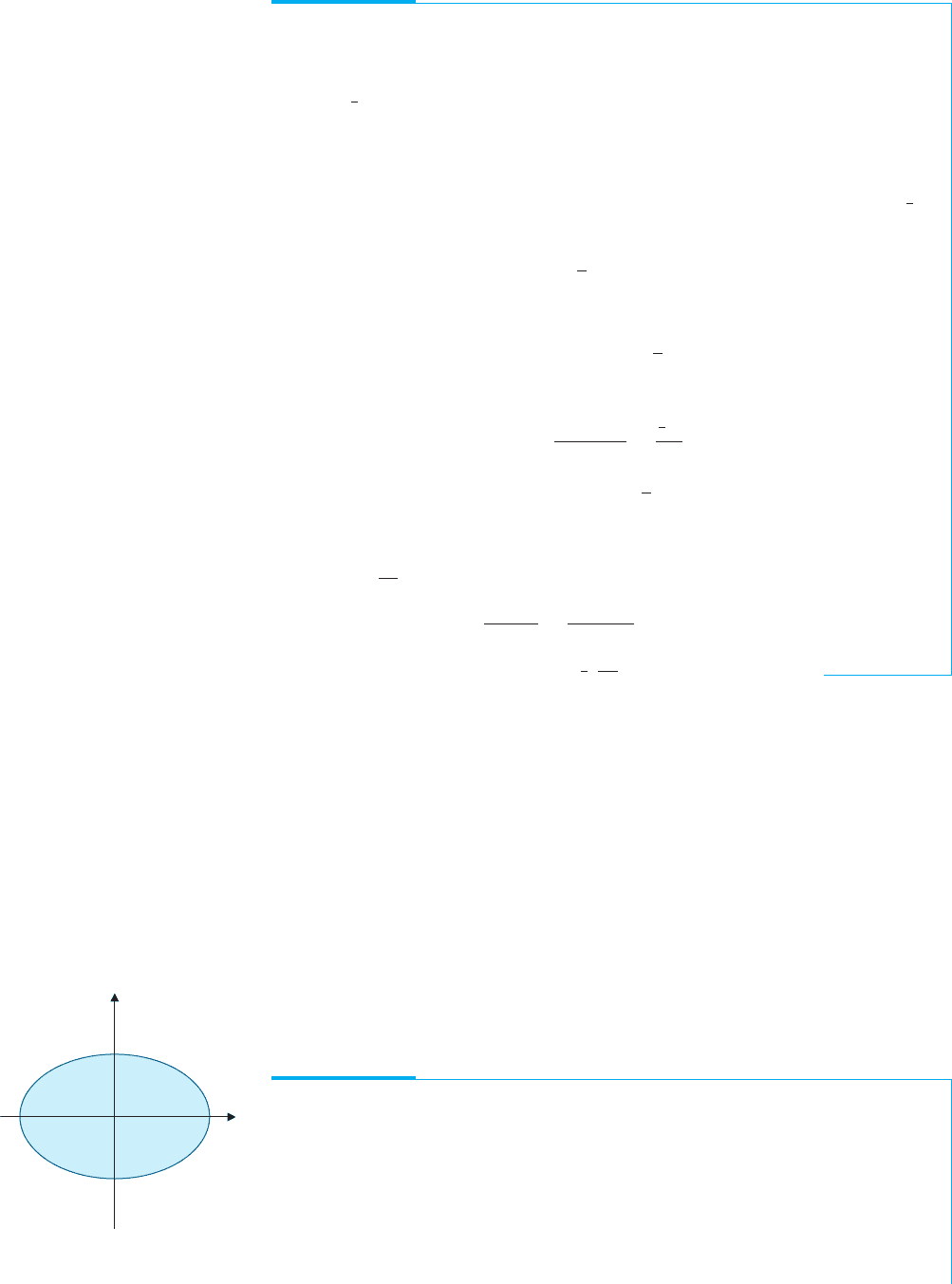
for some constant λ. Graphically, this says that if f (x
0
, y
0
) is an extremum, the level curve
of f passing through (x
0
, y
0
) is tangent to the constraint curve g(x, y) = 0at(x
0
, y
0
). We
illustrate this in Figure 13.51.
y
x
f (x, y) 6
f (x, y) 4
g(x, y) 0
(x
0
, y
0
)
f (x, y) 2
f (x, y) 8
FIGURE 13.51
Level curve tangent to constraint
curve at an extremum
In this case, we end up with the three equations
f
x
(x, y) = λg
x
(x, y), f
y
(x, y) = λg
y
(x, y) and g(x, y) = 0,
for the three unknowns x, y and λ. We illustrate this in example 8.2.
P1: OSO/OVY P2: OSO/OVY QC: OSO/OVY T1: OSO
MHDQ256-Ch13 MHDQ256-Smith-v1.cls December 31, 2010 16:55
LT (Late Transcendental)
CONFIRMING PAGES
890 CHAPTER 13
..
Functions of Several Variables and Partial Differentiation 13-82
EXAMPLE 8.2 Finding the Optimal Thrust of a Rocket
A rocket is launched with a constant thrust corresponding to an acceleration of
u ft/s
2
. Ignoring air resistance, the rocket’s height after t seconds is given by
f (t, u) =
1
2
(u − 32)t
2
feet. Fuel usage for t seconds is proportional to u
2
t and the
limited fuel capacity of the rocket satisfies the equation u
2
t = 10,000. Find the value
of u that maximizes the height that the rocket reaches when the fuel runs out.
Solution From Theorem 8.1, we look for solutions of ∇ f (t, u) = λ∇g(t, u), where
g(t, u)=u
2
t −10,000=0 is the constraint equation.We have ∇f (t, u)=
%
(u −32)t,
1
2
t
2
&
and ∇g(t, u) =u
2
, 2ut. From Theorem 8.1, we must have
(u − 32)t,
1
2
t
2
= λu
2
, 2ut,
for some constant λ. It follows that
(u − 32)t = λu
2
and
1
2
t
2
= λ2ut.
Solving both equations for λ,wehave
λ =
(u − 32)t
u
2
=
1
2
t
2
2ut
.
This gives us
2u(u − 32)t
2
=
1
2
t
2
u
2
.
Solutions include t = 0 and u = 0, but neither of these satisfies the constraint
u
2
t = 10,000. Canceling the factors of t
2
and u,wehave4(u − 32) = u. The solution
to this is u =
128
3
. With this value of u, the engines can burn for
t =
10,000
u
2
=
10,000
(128/3)
2
≈ 5.5 seconds,
with the rocket reaching a height of z =
1
2
(
128
3
− 32)(5.5)
2
≈ 161 feet.
We left example 8.2 unfinished. (Can you tell what’s missing?) It is very difficult to
argue that our solution actually represents a maximum height. (Could it be a saddle point?)
What we do know is that by Theorem 8.1, if there is a maximum, we found it. Returning
to a discussion of the physical problem, it should be completely reasonable that with a
limited amount of fuel, there is a maximum attainable altitude and so, we did indeed find
the maximum altitude.
We next optimize a function subject to an inequality constraint of the form g(x, y) ≤ c.
To understand our technique, recall how we solved for absolute extrema of functions of
several variables on a closed and bounded region in section 13.7. We found critical points
in the interior of the region and compared the values of the function at the critical points
with the maximum and minimum function values on the boundary of the region. To find the
extrema of f (x, y) subject to a constraint of the form g(x, y) ≤ c, we first find the critical
points of f (x, y) that satisfy the constraint, then find the extrema of the function on the
boundary g(x, y) = c (the constraint curve) and finally, compare the function values. We
illustrate this in example 8.3.
R
y
x
FIGURE 13.52
A metal plate
EXAMPLE 8.3 Optimization with an Inequality Constraint
Suppose that the temperature of a metal plate is given by T (x, y) = x
2
+ 2x + y
2
, for
points (x, y) on the elliptical plate defined by x
2
+ 4y
2
≤ 24. Find the maximum and
minimum temperatures on the plate.
Solution The plate corresponds to the shaded region R shown in Figure 13.52.
We first look for critical points of T (x, y) inside the region R.Wehave
∇T(x, y) =2x + 2, 2y=0, 0 if (x, y) = (−1, 0), which is in R. At this point,
T (−1, 0) =−1. We next look for the extrema of T (x, y) on the ellipse x
2
+ 4y
2
= 24.

P1: OSO/OVY P2: OSO/OVY QC: OSO/OVY T1: OSO
MHDQ256-Ch13 MHDQ256-Smith-v1.cls December 31, 2010 16:55
LT (Late Transcendental)
CONFIRMING PAGES
13-83 SECTION 13.8
..
Constrained Optimization and Lagrange Multipliers 891
We first rewrite the constraint equation as g(x, y) = x
2
+ 4y
2
− 24 = 0. From
Theorem 8.1, any extrema on the ellipse will satisfy the Lagrange multiplier equation:
∇T(x, y) = λ∇g(x, y)or
2x + 2, 2y=λ2x, 8y=2λx, 8λy.
This occurs when
2x + 2 = 2λx and 2y = 8λy.
Notice that the second equation holds when y = 0orλ =
1
4
.Ify = 0, the constraint
x
2
+ 4y
2
= 24 gives x =±
√
24. If λ =
1
4
, the first equation becomes 2x + 2 =
1
2
x,so
that x =−
4
3
. The constraint x
2
+ 4y
2
= 24 now gives y =±
√
50
3
. Finally, we compare
the function values at all of these points (the one interior critical point and the
candidates for boundary extrema):
T (−1, 0) =−1,
T (
√
24, 0) = 24 +2
√
24 ≈ 33.8,
T (−
√
24, 0) = 24 −2
√
24 ≈ 14.2,
T
)
−
4
3
,
√
50
3
+
=
14
3
≈ 4.7
and
T
)
−
4
3
, −
√
50
3
+
=
14
3
≈ 4.7.
From this list, it’s easy to identify the minimum value of −1 at the point (−1, 0) and the
maximum value of 24 + 2
√
24 at the point (
√
24, 0).
In example 8.4, we illustrate the use of Lagrange multipliers for functions of three
variables. In the course of doing so, we develop an interpretation of the Lagrange multi-
plier λ.
EXAMPLE 8.4 Finding an Optimal Level of Production
For a business that produces three products, suppose that when producing x, y and z
thousand units of the products, the profit of the company (in thousands of dollars)
can be modeled by P(x, y, z) = 4x +8y + 6z. Manufacturing constraints force
x
2
+ 4y
2
+ 2z
2
≤ 800. Find the maximum profit for the company. Rework the
problem with the constraint x
2
+ 4y
2
+ 2z
2
≤ 801 and use the result to interpret the
meaning of λ.
Solution We start with ∇P(x, y, z) =4, 8, 6 and note that there are no critical
points. This says that the extrema must lie on the boundary of the constraint region. That
is, they must satisfy the constraint equation g(x, y, z) = x
2
+ 4y
2
+ 2z
2
− 800 = 0.
From Theorem 8.1, the Lagrange multiplier equation is ∇P(x, y, z) = λ∇g(x, y, z)or
4, 8, 6=λ2x, 8y, 4z=2λx, 8λy, 4λz.
This occurs when
4 = 2λx, 8 = 8λy and 6 = 4λz.
From the first equation, we get x =
2
λ
. The second equation gives us y =
1
λ
and
the third equation gives us z =
3
2λ
. From the constraint equation
x
2
+ 4y
2
+ 2z
2
= 800, we now have
800 =
2
λ
2
+ 4
1
λ
2
+ 2
3
2λ
2
=
25
2λ
2
,
so that λ
2
=
25
1600
and λ =
1
8
.
P1: OSO/OVY P2: OSO/OVY QC: OSO/OVY T1: OSO
MHDQ256-Ch13 MHDQ256-Smith-v1.cls December 31, 2010 16:55
LT (Late Transcendental)
CONFIRMING PAGES
892 CHAPTER 13
..
Functions of Several Variables and Partial Differentiation 13-84
(Why did we choose the positive sign for λ? Hint: Think about what x, y and z represent.
Since x > 0, we must have λ =
2
x
> 0.) The only candidate for an extremum is then
x =
2
λ
= 16, y =
1
λ
= 8 and z =
3
2λ
= 12,
and the corresponding profit is
P(16, 8, 12) = 4(16) + 8(8) + 6(12) = 200.
Observe that this is the maximum profit. Notice that if the constant on the right-hand
side of the constraint equation is changed to 801, the first difference occurs in solving
for λ, where we now get
801 =
25
2λ
2
,
so that λ ≈ 0.12492, x =
2
λ
≈ 16.009997, y =
1
λ
≈ 8.004998 and
z =
3
2λ
≈ 12.007498. In this case, the maximum profit is
P
2
λ
,
1
λ
,
3
2λ
≈ 200.12496.
It is interesting to observe that the increase in profit is
P
2
λ
,
1
λ
,
3
2λ
− P(16, 8, 12) ≈ 200.12496 −200 = 0.12496 ≈ λ.
As you might suspect from this observation, the Lagrange multiplier λ actually gives
you the instantaneous rate of change of the profit with respect to a change in the
production constraint.
We close this section by considering the case of finding the minimum or maximum
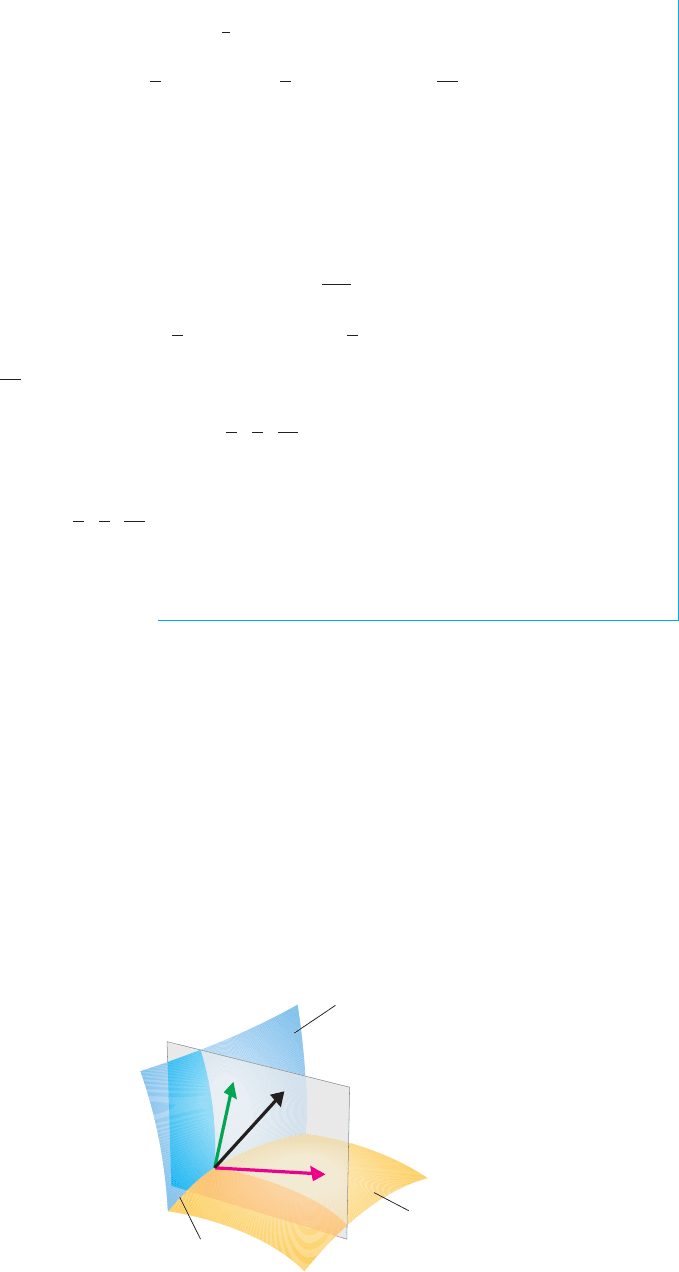
value of a differentiable function f (x, y, z) subject to two constraints g(x, y, z) = 0 and
h(x, y, z) = 0, where g and h are also differentiable. Notice that for both constraints to be
satisfied at a point (x, y, z), the point must lie on both surfaces defined by the constraints.
Consequently, in order for there to be a solution, we must assume that the two surfaces
intersect. We further assume that ∇g and ∇h are nonzero and are not parallel, so that the
two surfaces intersect in a curve C and are not tangent to one another. As we have already
seen, if f has an extremum at a point (x
0
, y
0
, z
0
) on a curve C, then ∇ f (x
0
, y
0
, z
0
) must be
normal to the curve. Notice that since C lies on both constraint surfaces, ∇g(x
0
, y
0
, z
0
) and
∇h(x
0
, y
0
, z
0
) are both orthogonal to C at (x
0
, y
0
, z
0
). This says that ∇ f (x
0
, y
0
, z
0
) must
lie in the plane determined by ∇g(x
0
, y
0
, z
0
) and ∇h(x
0
, y
0
, z
0
). (See Figure 13.53.) That
is, for (x, y, z) = (x
0
, y
0
, z
0
) and some constants λ and μ (Lagrange multipliers),
∇ f (x, y, z) = λ∇g(x, y, z) + μ∇h(x, y, z).
f
h
h(x, y, z) 0
g(x, y, z) 0
C
g
FIGURE 13.53
Constraint surfaces and the plane
determined by the normal vectors ∇g and ∇h