
Smith R., Minton R. Calculus
Подождите немного. Документ загружается.

P1: OSO/OVY P2: OSO/OVY QC: OSO/OVY T1: OSO
MHDQ256-Ch13 MHDQ256-Smith-v1.cls December 31, 2010 16:55
LT (Late Transcendental)
CONFIRMING PAGES
13-85 SECTION 13.8
..
Constrained Optimization and Lagrange Multipliers 893
The method of Lagrange multipliers for the case of two constraints then consists of finding
the point (x, y, z) and the Lagrange multipliers λ and μ (for a total of five unknowns)
satisfying the five equations defined by:
f
x
(x, y, z) = λg
x
(x, y, z) +μh
x
(x, y, z),
f
y
(x, y, z) = λg
y
(x, y, z) +μh
y
(x, y, z),
f
z
(x, y, z) = λg
z
(x, y, z) +μh
z
(x, y, z),
g(x, y, z) = 0
and h(x, y, z) = 0.
We illustrate the use of Lagrange multipliers for the case of two constraints in
example 8.5.
EXAMPLE 8.5 Optimization with Two Constraints
The plane x + y + z = 12 intersects the paraboloid z = x
2
+ y
2
in an ellipse. Find the
point on the ellipse that is closest to the origin.
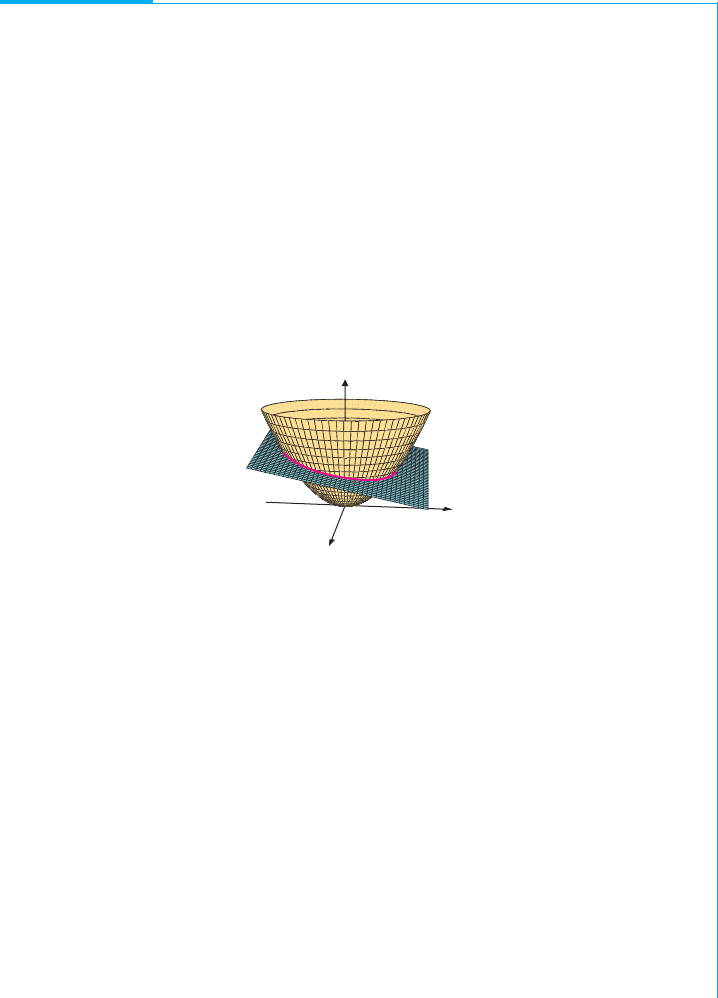
Solution We illustrate the intersection of the plane with the paraboloid in Figure
13.54. Observe that minimizing the distance to the origin is equivalent to minimizing
f (x, y, z) = x
2
+ y
2
+ z
2
[the square of the distance from the point (x, y, z)tothe
origin]. Further, the constraints may be written as g(x, y, z) = x + y + z − 12 = 0 and
h(x, y, z) = x
2
+ y
2
− z = 0. At any extremum, we must have that
∇ f (x, y, z) = λ∇g(x, y, z) + μ∇h(x, y, z)
or
2x, 2y, 2z=λ1, 1, 1+μ2x, 2y, −1.
x
z
y
FIGURE 13.54
Intersection of a paraboloid and a plane
Together with the constraint equations, we now have the system of equations
2x = λ +2μx, (8.1)
2y = λ +2μy, (8.2)
2z = λ − μ, (8.3)
x + y + z − 12 = 0 (8.4)
and x
2
+ y
2
− z = 0. (8.5)
From (8.1), we have
λ = 2x(1 − μ),
while from (8.2), we have
λ = 2y(1 −μ).
Setting these two expressions for λ equal gives us
2x(1 −μ) = 2y(1 −μ),

P1: OSO/OVY P2: OSO/OVY QC: OSO/OVY T1: OSO
MHDQ256-Ch13 MHDQ256-Smith-v1.cls December 31, 2010 16:55
LT (Late Transcendental)
CONFIRMING PAGES
894 CHAPTER 13
..
Functions of Several Variables and Partial Differentiation 13-86
from which it follows that either μ = 1 (in which case λ = 0) or x = y. However, if
μ = 1 and λ = 0, we have from (8.3) that z =−
1
2
, which contradicts (8.5).
Consequently, the only possibility is to have x = y, from which it follows from (8.5)
that z = 2x
2
. Substituting this into (8.4) gives us
0 = x + y + z − 12 = x + x + 2x
2
− 12
= 2x
2
+ 2x − 12 = 2(x
2
+ x −6) = 2(x +3)(x −2),
so that x =−3orx = 2. Since y = x and z = 2x
2
, we have that (2, 2, 8) and
(−3, −3, 18) are the only candidates for extrema. Finally, since
f (2, 2, 8) = 72 and f (−3, −3, 18) = 342,
the closest point on the intersection of the two surfaces to the origin is (2, 2, 8). By the
same reasoning, observe that the point on the intersection of the two surfaces that is
farthest from the origin is (−3, −3, 18). Notice that these are also consistent with what
you can see in Figure 13.54.
The method of Lagrange multipliers can be extended in a straightforward fashion to
the case of minimizing or maximizing a function of any number of variables subject to any
number of constraints.
EXERCISES 13.8
WRITING EXERCISES
1. Explain why the point of tangency in Figure 13.50d must be
the closest point to the origin.
2. Explain why in example 8.1 you know that the critical point
found corresponds to the minimum distance and not the
maximum distance or a saddle point.
3. In example 8.2, explain in physical terms why there would
be a value of u that would maximize the rocket’s height. In
particular, explain why a larger value of u wouldn’t always
produce a larger height.
4. In example 8.4, we showed that the Lagrange multiplier λ
corresponds to the rate of change of profit with respect to a
change in production level. Explain how knowledge of this
value (positive, negative, small, large) would be useful to a
plant manager.
In exercises 1–8, use Lagrange multipliers to find the closest
point on the given curve to the indicated point.
1. y = 3x − 4, origin 2. y = 2x + 1, origin
3. y = 3 − 2x, (4, 0) 4. y = x − 2, (0, 2)
5. y = x
2
, (3, 0) 6. y = x
2
, (0, 2)
7. y = x
2
,
2,
1
2
8. y = x
2
− 1, (1, 2)
............................................................
Inexercises 9–24, use Lagrangemultipliers tofind the maximum
and minimum of the function f subject to the given constraint.
9. f (x, y) = 4xy subject to x
2
+ y
2
= 8
10. f (x, y) = 4xy subject to 4x
2
+ y
2
= 8
11. f (x, y) = 4x
2
y subject to (x, y) on the triangle with vertices
(0, 0), (2, 0) and (0, 4)
12. f (x, y) = 2x
3
y subject to (x, y) on the rectangle with vertices
(−2, 1), (1, 1), (1, 3) and (−2, 3)
13. f (x, y) = xe
y
subject to 4x
2
+ y
2
= 4
14. f (x, y) = e
2x+y
subject to x
2
+ y
2
= 5
15. f (x, y) = x
2
e
y
subject to x
2
+ y
2
= 3
16. f (x, y) = x
2
y
2
subject to x
2
+ 4y
2
= 24
17. f (x, y, z) = 4x
2
+ y
2
+ z
2
subject to x
4
+ y
4
+ z
4
= 1
18. f (x, y, z) = x − y − z subject to x
2
− y
2
+ z
2
= 1
19. f (x, y, z) = y
2
+ 3xz + 2yz subject to x + 2y + z = 1
20. f (x, y, z) = x + y + z subject to
x
2
4
+
y
2
9
+ z
2
= 1
21. f (x, y) = x + y subject to
x
2
a
2
+ y
2
= 1(a > 0)
22. f (x, y) = sin(ax + y) subject to
x
2
b
2
+ y
2
= 1(a, b > 0)
23. f (x, y) = x
a
y
b
subject to x
2
+ y
2
= 1(a, b > 0)
24. f (x, y) = x + y subject to x
n
+ y
n
= 1(n ≥ 2)
............................................................
In exercises 25–32, find the maximum and minimum of the func-
tion f (x, y) subject to the constraint g(x, y) ≤ c.
25. f (x, y) = 4x
2
y subject to x
2
+ y
2
≤ 3
26. f (x, y) = 2x
3
y subject to x
2
+ y
2
≤ 4
27. f (x, y) = x
3
+ y
3
subject to x
4
+ y
4
≤ 1
P1: OSO/OVY P2: OSO/OVY QC: OSO/OVY T1: OSO
MHDQ256-Ch13 MHDQ256-Smith-v1.cls December 31, 2010 16:55
LT (Late Transcendental)
CONFIRMING PAGES
13-87 SECTION 13.8
..
Constrained Optimization and Lagrange Multipliers 895
28. f (x, y) = 4xy subject to 4x
2
+ y
2
≤ 8
29. f (x, y) = 3 − x + xy − 2y inside and on the triangle with
vertices (1, 0), (5, 0) and (1, 4)
30. f (x, y) = xy
2
subject to x
2
+ y
2
≤ 3(x, y ≥ 0)
31. f (x, y, z) = x
2
+ y
2
+ z
2
subject to x
4
+ y
4
+ z
4
≤ 1
32. f (x, y, z) = x
2
y
2
+ z
2
subject to x
2
+ y
2
+ z
2
≤ 1
............................................................
33. Rework example 8.2 with extra fuel, so that u
2
t = 11,000.
34. In exercise 33, compute λ. Comparing solutions to example
8.2 and exercise 33, compute the change in z divided by the
change in u
2
t.
35. Solve example 8.2 by substituting t = 10,000/u
2
into the
height equation. Be sure to show that your solution represents
a maximum height.
36. In example 8.2, the general constraint is u
2
t = k and the re-
sulting maximum height is h(k). Use the technique of exercise
35 and the results of example 8.2 to show that λ = h
(k).
37. Suppose that the business in example 8.4 has profit func-
tion P(x, y, z) = 3x + 6y + 6z and manufacturing constraint
2x
2
+ y
2
+ 4z
2
≤ 8800. Maximize the profits.
38. Suppose that the business in example 8.4 has profit func-
tion P(x, y, z) = 3xz + 6y and manufacturing constraint
x
2
+ 2y
2
+ z
2
≤ 6. Maximize the profits.
39. In exercise 37, show that theLagrange multiplier givesthe rate
of change of the profit relative to a change in the production
constraint.
40. Use the value of λ (do not solve any equations) to determine
the amount of profit if the constraint in exercise 38 is changed
to x
2
+ 2y
2
+ z
2
≤ 7.
41. Minimize 2x +2y subject to the constraint xy = c for some
constant c > 0 and conclude that for a givenarea, the rectangle
with smallest perimeter is the square.
42. As in exercise 41, find the rectangular box of a given volume
that has the minimum surface area.
43. Maximize y − x subject to the constraint x
2
+ y
2
= 1.
44. Maximize e
x+y
subject to the constraint x
2
+ y
2
= 2.
45. Consider the problem of finding extreme values of xy
2
subject
to x + y = 0. Show that the Lagrange multiplier method iden-
tifies (0, 0) as a critical point. Show that this point is neither a
local minimum nor a local maximum.
46. Make the substitution y =−x in the function f (x, y) = xy
2
.
Show that x = 0 is a critical point and determine what type
point is at x = 0. Explain why the Lagrange multiplier method
fails in exercise 45.
............................................................
Exercises 47–50 involve optimization with two constraints.
47. Minimize f (x, y, z) = x
2
+ y
2
+ z
2
,subject to theconstraints
x + 2y + 3z = 6 and y + z = 0.
48. Interpret the function f (x, y, z) of exercise 47 in terms of the
distance from a point (x, y, z) to the origin. Sketch the two
planes given in exercise 47. Interpretexercise 47 as finding the
closest point on a line to the origin.
49. Maximize f (x, y, z) = xyz, subject to the constraints
x + y + z = 4 and x + y − z = 0.
50. Maximize f (x, y, z) = 3x + y + 2z, subject tothe constraints
y
2
+ z
2
= 1 and x + y − z = 1.
............................................................
51. Find the points on the intersection of x
2
+ y
2
= 1 and
x
2
+ z
2
= 1 that are (a) closest to and (b) farthest from the
origin.
52. Find the pointonthe intersection of x + 2y + z = 2and y = x
that is closest to the origin.
53. Use Lagrange multipliers to explore the problem of finding
the closest point on y = x
n
to the point (0, 1), for some pos-
itive integer n. Show that (0, 0) is always a solution to the
Lagrange multiplier equation. Show that (0, 0) is the location
of a local maximumfor n = 2, but a localminimum for n > 2.
As n →∞, show that the difference between the absolute
minimum and the local minimum at (0, 0) goes to 0.
54. Repeat example 8.4 with constraints x ≥ 0, y ≥ 0 and z ≥ 0.
Note that you can find the maximum on the boundary x = 0
by maximizing 8y + 6z subject to 4y
2
+ 2z
2
≤ 800.
55. Estimate the closest point on the paraboloid z = x
2
+ y
2
to
the point (1, 0, 0).
56. Estimatetheclosestpointonthehyperboloid x
2
+ y
2
− z
2
= 1
to the point (0, 2, 0).
APPLICATIONS
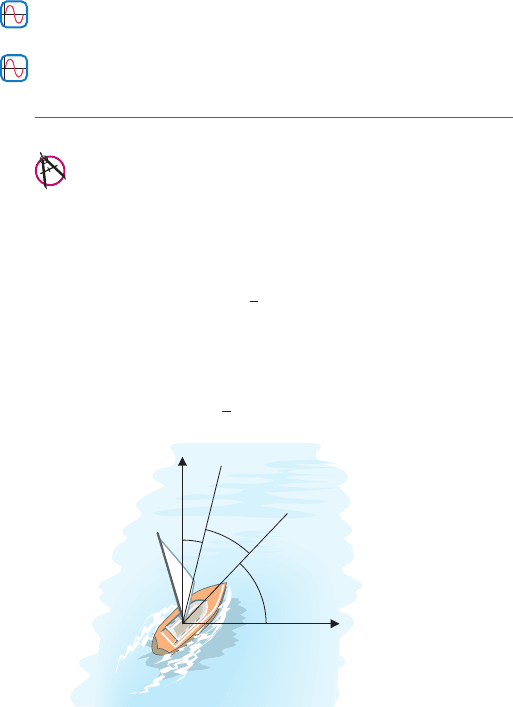
57. In the picture, a sailboat is sailing into a crosswind. The wind
is blowing out of the north; the sail is at an angle α to the east
of due north and at an angle β north of the hull of the boat.
The hull, in turn, is at an angle θ to the north of due east. Ex-
plain why α + β + θ =
π
2
. If the wind is blowing with speed
w, then the northward component of the wind’s force on the
boat is given by w sinα sin β sinθ . If this component is posi-
tive, the boat can travel “against the wind.” Taking w = 1 for
convenience, maximize sinα sinβ sin θ subject to the con-
straint α +β +θ =
π
2
.
u
b
a
58. Suppose a music company sells two types of speakers. The
profit for selling x speakers of style A and y speakers of styleB
is modeled by f (x, y) = x
3
+ y
3
− 5xy. The company can’t
manufacture more than k speakers total in a given month

P1: OSO/OVY P2: OSO/OVY QC: OSO/OVY T1: OSO
MHDQ256-Ch13 MHDQ256-Smith-v1.cls December 31, 2010 16:55
LT (Late Transcendental)
CONFIRMING PAGES
896 CHAPTER 13
..
Functions of Several Variables and Partial Differentiation 13-88
for some constant k > 5. Show that the maximum profit is
k
2
(k − 5)
4
and show that λ =
df
dk
.
............................................................
In exercises 59 and 60, you will illustrate the least-cost rule.
59. Minimize the cost function C = 25L + 100K , given the pro-
duction constraint P = 60L
2/3
K
1/3
= 1920.
60. In exercise 59, show that the minimum cost occurs when the
ratio of marginal productivity of labor,
∂ P
∂ L
, to the marginal
productivity of capital,
∂ P
∂ K
, equals the ratio of the price of
labor,
∂C
∂ L
, to the price of capital,
∂C
∂ K
.
............................................................
61. A person has $300 to spend on entertainment. Assume that
CDs cost $10 apiece, DVDs cost $15 apiece and the person’s
utility function is 10c
0.4
d
0.6
for buying c CDs and d DVDs.
Find c and d to maximize the utility function.
62. To generalize exercise 61, suppose that on a fixed budget of
$k you buy x units of product A purchased at $a apiece and
y units of product B purchased at $b apiece. For the utility
function x
p
y
q
with p +q = 1 and 0 < p < 1, show that the
utility function is maximized with x =
kp
a
and y =
kq
b
.
EXPLORATORY EXERCISES
1. (This exercisewas suggested by Adel Faridani of OregonState
University.) The maximum height found in example 8.2 is
actually the height at the time the fuel runs out. A different
problem is to find the maximum total height, including the
extra height gained after the fuel runs out. In this exercise,
we find the value of u that maximizes the total height. First,
find the velocity and height when the fuel runs out. (Hint:
This should be a function of u only.) Then find the total height
of a rocket with that initial height and initial velocity, again
assuming that gravity is the only force. Find u to maximize
this function. Compare this u-value with that found in example
8.2. Explain in physical terms why this one is larger.
2. Find the maximum value of f (x, y, z) = xyz subject to
x + y + z = 1 with x > 0, y > 0 and z > 0. Conclude that
3
√
xyz ≤
x + y + z
3
. The expression on the left is called the
geometric mean of x, y and z while the expression on the
right is the more familiar arithmetic mean. Generalize this
result in two ways. First, show that the geometric mean of any
three positive numbers does not exceed the arithmetic mean.
Then, show that the geometric mean of any number of positive
numbers does not exceed the arithmetic mean.
Review Exercises
WRITING EXERCISES
The following list includes terms that are defined and theorems that
arestatedin this chapter. Foreach term or theorem,(1) givea precise
definition or statement, (2) state in general terms what it means and
(3) describe the types of problems with which it is associated.
Level curve Limit of f (x, y) Continuous
Level surface Tangent plane Normal line
Partial derivative Differential Differentiable
Linear approximation Laplacian Implicit
Chain rule Gradient differentiation
Directional derivative Saddle point Local extremum
Critical point Extreme Value Second Derivatives
Linear regression Theorem Test
Contour plot Density plot Lagrange multiplier
TRUE OR FALSE
State whether each statement is true or false and briefly explain
why. If the statement is false, try to “fix it” by modifying the given
statement to a new statement that is true.
1. Quadric surfaces are examples of graphs of functions of two
variables.
2. Level curves are traces in planes z = c of the surface
z = f (x, y).
3. If a function is continuous on every line through (a, b), then it
is continuous at (a, b).
4.
∂ f
∂x
(a, b) equals the slope of the tangent line to z = f (x, y)at
(a, b).
5. For the partial derivative
∂
2
f
∂x∂ y
, the order of partial derivatives
does not matter.
6. The normal vector to the tangent plane is given by the partial
derivatives.
7. A linear approximation is an equation for a tangent plane.
8. The gradient vector is perpendicular to all level curves.
9. If D
u
f (a, b) < 0, then f (a + u
1
, b +u
2
) < f (a, b).
10. A normal vector to the tangent plane to z = f (x, y)is
∇ f (x, y).
11. If
∂ f
∂x
(a, b) > 0 and
∂ f
∂y
(a, b) < 0, then there is a saddle point
at (a, b).
12. The maximum of f on a region R occurs either at a critical
point or on the boundary of R.
13. Solving the equation ∇ f = λ∇g gives the maximum of f sub-
ject to g = 0.
P1: OSO/OVY P2: OSO/OVY QC: OSO/OVY T1: OSO
MHDQ256-Ch13 MHDQ256-Smith-v1.cls December 31, 2010 16:55
LT (Late Transcendental)
CONFIRMING PAGES
13-89 CHAPTER 13
..
Review Exercises 897
Review Exercises
In exercises 1–10, sketch the graph of z f (x, y).
1. f (x, y) = x
2
− y
2
2. f (x, y) =
x
2
+ y
2
3. f (x, y) = 2 − x
2
− y
2
4. f (x, y) =
2 − x
2
− y
2
5. f (x, y) =
4x
2
+ y
2
6. f (x, y) =
4 − y
2
− x
7. f (x, y) = sin(x
2
y)
8. f (x, y) = sin(y − x
2
)
9. f (x, y) = 3xe
y
− x
3
− e
3y
10. f (x, y) = 4x
2
e
y
− 2x
4
− e
4y
............................................................
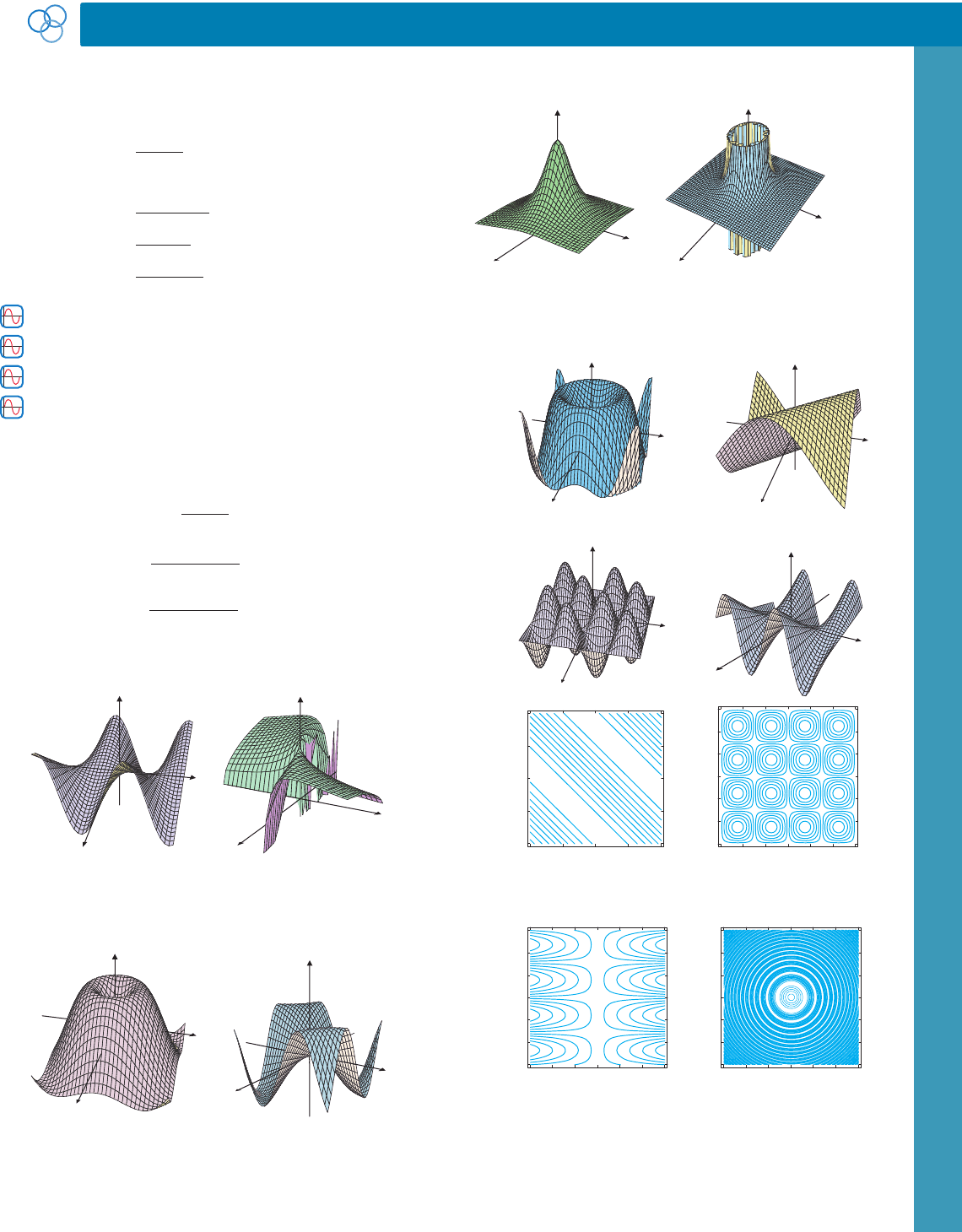
11. In parts a–f, match the functions to the surfaces.
(a) f (x, y) = sin xy (b) f (x, y) = sin(x/y)
(c) f (x, y) = sin
x
2
+ y
2
(d) f (x, y) = x sin y
(e) f (x, y) =
4
2x
2
+ 3y
2
− 1
(f) f (x, y) =
4
2x
2
+ 3y
2
+ 1
y
x
z
y
x
z
SURFACE 1 SURFACE 2
y
x
z
y
x
z
SURFACE 3 SURFACE 4
y
x
z
y
x
z
SURFACE 5 SURFACE 6
12. In parts a–d, match the surfaces to the contour plots.
(a) (b)
y
x
z
y
x
z
(c) (d)
y
x
z
y
x
z
2
1
0
1
2
12210
x
y
6
2
4
0
4
2
6
26 46420
x
y
CONTOUR A CONTOUR B
6
2
4
0
4
2
6
26 46420
x
y
6
2
4
0
4
2
6
26 46420
x
y
CONTOUR C CONTOUR D
............................................................
P1: OSO/OVY P2: OSO/OVY QC: OSO/OVY T1: OSO
MHDQ256-Ch13 MHDQ256-Smith-v1.cls December 31, 2010 16:55
LT (Late Transcendental)
CONFIRMING PAGES
898 CHAPTER 13
..
Functions of Several Variables and Partial Differentiation 13-90
Review Exercises
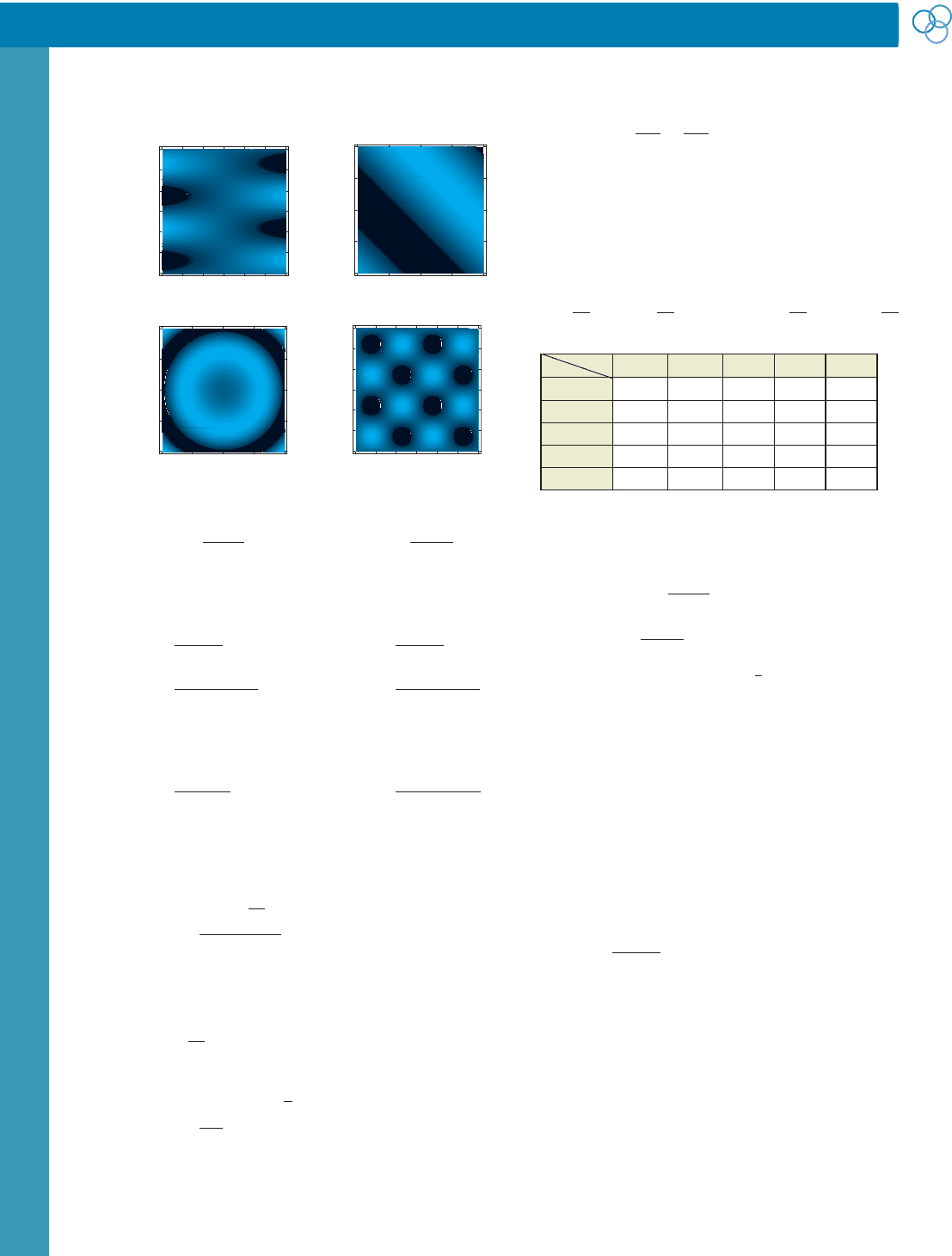
13. In parts a–d, match the density plots to the contour plots of
exercise 12.
(a) (b)
6
2
4
0
4
2
6
26 46420
x
y
2
2
1
1
2
10 1 2
x
0
y
(c) (d)
2
2
1
0
1
2
10 1 2
x
y
6
2
4
0
4
2
6
26 46420
x
y
14. Compute the indicated limit.
(a) lim
(x,y)→(0,2)
3x
y
2
+ 1
(b) lim
(x,y)→(1,π)
xy −1
cos xy
............................................................
In exercises 15–18, show that the indicated limit does not exist.
15. lim
(x,y)→(0,0)
3x
2
y
x
4
+ y
2
16. lim
(x,y)→(0,0)
2xy
3/2
x
2
+ y
3
17. lim
(x,y)→(0,0)
x
2
+ y
2
x
2
+ xy + y
2
18. lim
(x,y)→(0,0)
x
2
x
2
+ xy + y
2
............................................................
In exercises 19 and 20, show that the indicated limit exists.
19. lim
(x,y)→(0,0)
x
3
+ xy
2
x
2
+ y
2
20. lim
(x,y)→(0,0)
3y
2
ln(x +1)
x
2
+ 3y
2
............................................................
In exercises 21 and 22, find the region on which the function is
continuous.
21. f (x, y) = 3x
2
e
4y
−
3y
x
22. f (x, y) =
4 − 4x
2
− y
2
............................................................
In exercises 23–26, find both first-order partial derivatives.
23. f (x, y) =
4x
y
+ xe
xy
24. f (x, y) = xe
xy
+ 3y
2
25. f (x, y) = 3x
2
y cos y −
√
x
26. f (x, y) =
x
3
y + 3x − 5
............................................................
27. Show that the function f (x, y) = e
x
sin y satisfies Laplace’s
equation
∂
2
f
∂x
2
+
∂
2
f
∂y
2
= 0.
28. Show that the function f (x, y) = e
x
cos y satisfies Laplace’s
equation. (See exercise 27.)
............................................................
In exercises 29 and 30, use the chart to estimate the partial
derivatives.
29.
∂ f
∂x
(0, 0) and
∂ f
∂y
(0, 0) 30.
∂ f
∂x
(10, 0) and
∂ f
∂y
(10, 0)
y
x
–20 –10 0 10 20
–20 2.4 2.1 0.8 0.5 1.0
–10 2.6 2.2 1.4 1.0 1.2
0 2.7 2.4 2.0 1.6 1.2
10 2.9 2.5 2.6 2.2 1.8
20 3.1 2.7 3.0 2.9 2.7
............................................................
In exercises 31–34, compute the linear approximation of the
function at the given point.
31. f (x, y) = 3y
√
x
2
+ 5at(−2, 5)
32. f (x, y) =
x + 2
4y − 2
at (2, 3)
33. f (x, y) = tan(x + 2y)at(π,
π
2
)
34. f (x, y) = ln(x
2
+ 3y)at(4, 2)
............................................................
In exercises 35 and 36, find the indicated derivatives.
35. f (x, y) = 2x
4
y + 3x
2
y
2
; f
xx
, f
yy
, f
xy
36. f (x, y) = x
2
e
3y
− sin y; f
xx
, f
yy
, f
yyx
............................................................
In exercises 37–40, find an equation of the tangent plane.
37. z = x
2
y + 2x − y
2
at (1, −1, 0)
38. z =
x
2
+ y
2
at (3, −4, 5)
39. x
2
+ 2xy + y
2
+ z
2
= 5at(0, 2, 1)
40. x
2
z − y
2
x + 3y − z =−4at(1, −1, 2)
............................................................
In exercises 41 and 42, use the chain rule to find the indicated
derivative(s).
41. g
(t) where g(t) = f (x(t), y(t)), f (x, y) = x
2
y + y
2
,
x(t) = e
4t
and y(t) = sint
P1: OSO/OVY P2: OSO/OVY QC: OSO/OVY T1: OSO
MHDQ256-Ch13 MHDQ256-Smith-v1.cls December 31, 2010 16:55
LT (Late Transcendental)
CONFIRMING PAGES
13-91 CHAPTER 13
..
Review Exercises 899
Review Exercises
42.
∂g
∂u
and
∂g
∂v
where g(u,v) = f (x(u,v), y(u,v)),
f (x, y) = 4x
2
− y, x(u,v) = u
3
v +sin u and y(u,v) = 4v
2
............................................................
In exercises 43 and 44, state the chain rule for the general
composite function.
43. g(t) = f (x(t), y(t), z(t),w(t))
44. g(u,v) = f (x(u,v), y(u,v))
............................................................
In exercises 45 and 46, use implicit differentiation to find
∂z
∂x
and
∂z
∂y
.
45. x
2
+ 2xy + y
2
+ z
2
= 1
46. x
2
z − y
2
x + 3y − z =−4
............................................................
In exercises 47 and 48, find the gradient of the given function at
the indicated point.
47. f (x, y) = 3x sin 4y −
√
xy, (π, π)
48. f (x, y, z) = 4xz
2
− 3cos x + 4y
2
, (0, 1, −1)
............................................................
In exercises 49–52, compute the directional derivative of f at the
given point in the direction of the indicated vector.
49. f (x, y) = x
3
y − 4y
2
, (−2, 3), u =
%
3
5
,
4
5
&
50. f (x, y) = x
2
+ xy
2
, (2, 1), u in the direction of 3, −2
51. f (x, y) = e
3xy
− y
2
, (0, −1), u in the direction from (2, 3) to
(3, 1)
52. f (x, y) =
x
2
+ xy
2
, (2, 1), u in the direction of 1, −2
............................................................
In exercises 53–56, find the directions of maximum and
minimum change of f at the given point, and the values of the
maximum and minimum rates of change.
53. f (x, y) = x
3
y − 4y
2
, (−2, 3)
54. f (x, y) = x
2
+ xy
2
, (2, 1)
55. f (x, y) =
x
4
+ y
4
, (2, 0)
56. f (x, y) = x
2
+ xy
2
, (1, 2)
............................................................
57. Suppose that the elevation on a hill is given by
f (x, y) = 100 −4x
2
− 2y. From the site at (2, 1), in which
direction will the rain run off?
58. If the temperature at the point (x, y, z)isgivenby
T (x, y, z) = 70 + 5e
−z
2
(4x + 3y
−1
), find the direction from
the point (1, 2, 1) in which the temperature decreases most
rapidly.
............................................................
In exercises 59–62, find all critical points and use Theorem 7.2
(if applicable) to classify them.
59. f (x, y) = 2x
4
− xy
2
+ 2y
2
60. f (x, y) = 2x
4
+ y
3
− x
2
y
61. f (x, y) = 4xy − x
3
− 2y
2
62. f (x, y) = 3xy − x
3
y + y
2
− y
............................................................
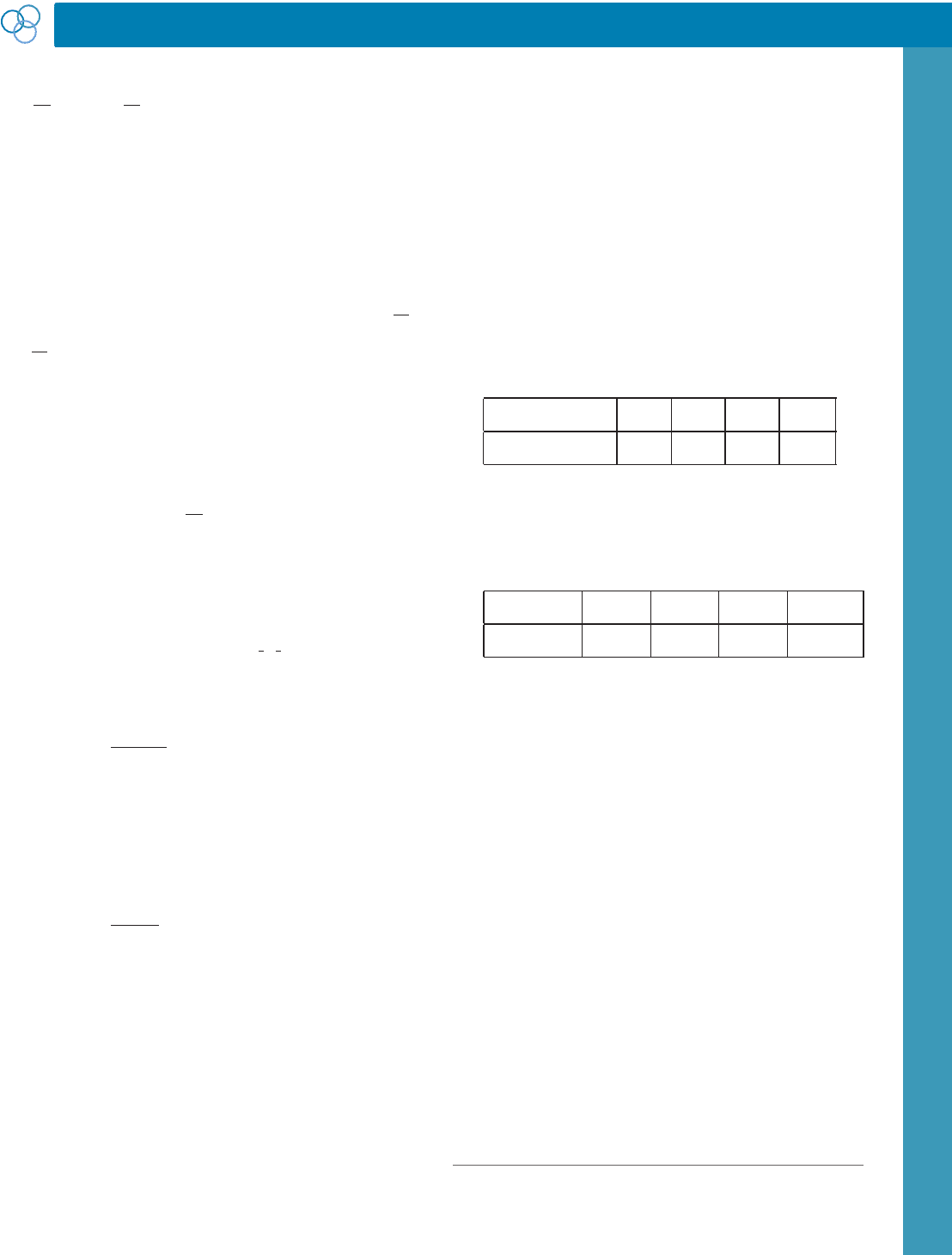
63. The following data show the height and weight of a small
number of people. Use the linear model to predict the weight
of a 6
2
person and a 5
0
person. Comment on how accurate
you think the model is.
Height (inches) 64 66 70 71
Weight (pounds) 140 156 184 190
64. The following data show the age and income for a small
numberof people.Usethelinearmodeltopredicttheincome of
a 20-year-old and of a 60-year-old. Comment on how accurate
you think the model is.
Age (years) 28 32 40 56
Income ($) 36,000 34,000 88,000 104,000
............................................................
In exercises 65 and 66, find the absolute extrema of the function
on the given region.
65. f (x, y) = 2x
4
− xy
2
+ 2y
2
, 0 ≤ x ≤ 4, 0 ≤ y ≤ 2
66. f (x, y) = 2x
4
+ y
3
− x
2
y, region bounded by y = 0, y = x
and x = 2
............................................................
In exercises 67–70, use Lagrange multipliers to find the
maximum and minimum of the function f (x, y), subject to the
constraint g(x, y) c.
67. f (x, y) = x +2y, subject to x
2
+ y
2
= 5
68. f (x, y) = 2x
2
y, subject to x
2
+ y
2
= 4
69. f (x, y) = xy, subject to x
2
+ y
2
= 1
70. f (x, y) = x
2
+ 2y
2
− 2x, subject to x
2
+ y
2
= 1
............................................................
In exercises 71 and 72, use Lagrange multipliers to find the
closest point on the given curve to the indicated point.
71. y = x
3
, (4, 0) 72. y = x
3
, (2, 1)
P1: OSO/OVY P2: OSO/OVY QC: OSO/OVY T1: OSO
MHDQ256-Ch13 MHDQ256-Smith-v1.cls December 31, 2010 16:55
LT (Late Transcendental)
CONFIRMING PAGES
900 CHAPTER 13
..
Functions of Several Variables and Partial Differentiation 13-92
Review Exercises
EXPLORATORY EXERCISES
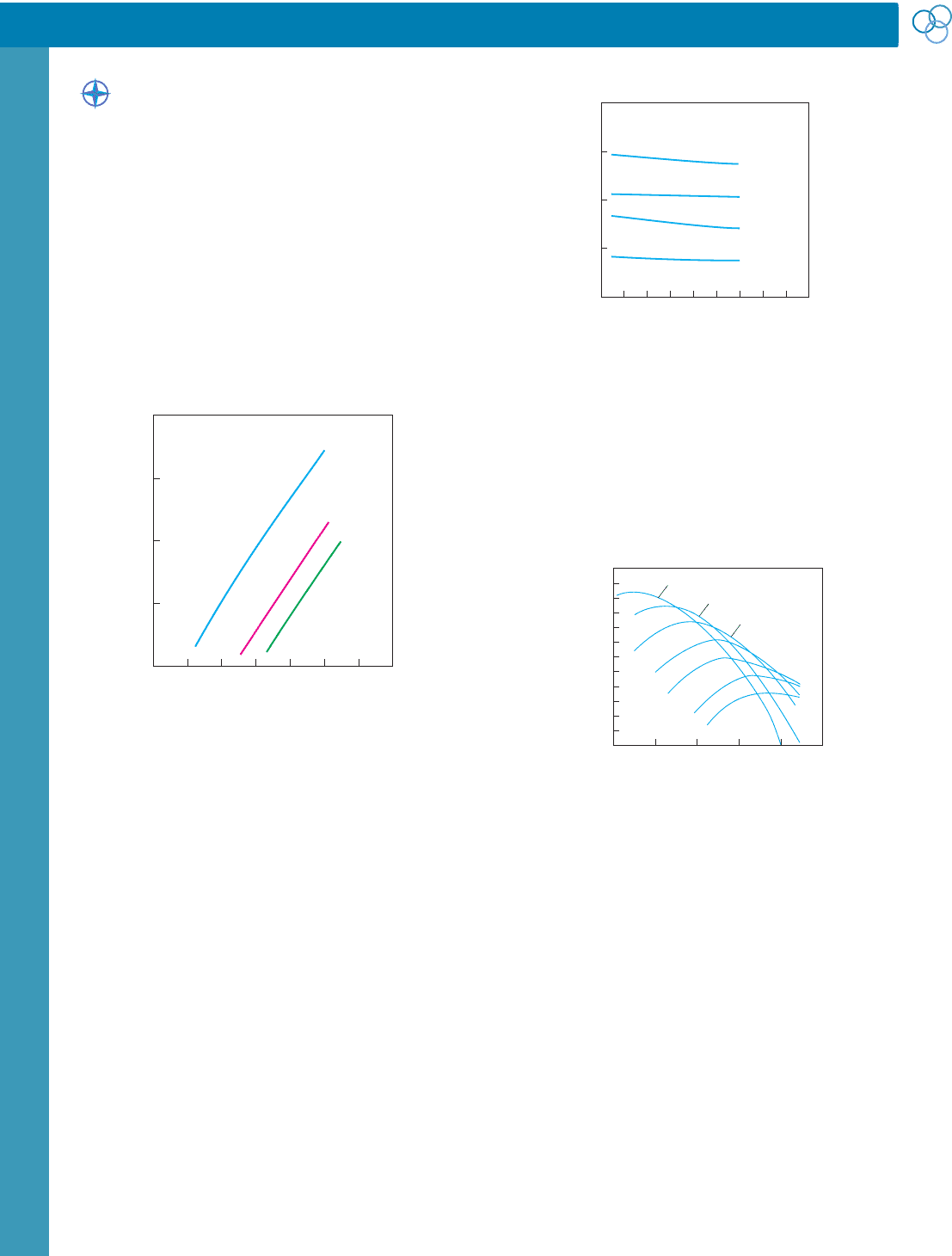
1. The graph (from the excellent book Tennis Science for
Tennis Players by Howard Brody) shows the vertical
angular acceptance of a tennis serve as a function of veloc-
ity and the height at which the ball is hit. With vertical angular
acceptance, Brody is measuring a margin of error. For exam-
ple, if serves with angles ranging from 5
◦
to 8
◦
will land in
the service box (for a given height and velocity), the vertical
angular acceptance is 3
◦
. For a given height, does the angular
acceptance increase or decrease as velocity increases? Explain
why this is reasonable. For a given velocity, does the angular
acceptance increase or decrease as height increases? Explain
why this is reasonable.
40 60 80 100 120 140
4
Vertical angular acceptance (degrees)
0
1
2
3
v 67 mi/hr
v 112 mi/hr
Height
v 90 mi/hr
2. The graphic in exercise 1 is somewhat like a contour plot.
Assuming that angular acceptance is the dependent variable,
explain what is different about this plot from the contour plots
drawn in this chapter. Which type of plot do youthink is easier
to read? The accompanying plot shows angular acceptance in
terms of a number of variables. Identify the independent vari-
ables and compare this plot to the level surfaces drawn in this
chapter.
Vertical angular acceptance (degrees)
3
2
1
h 105 in., v
0
67 mi/hr
h 85 in., v
0
67 mi/hr
h 85 in., v
0
90 mi/hr
h 105 in., v
0
90 mi/hr
Distance behind baseline (feet)
0 1 2 3 4 5 6 7
0
3. The horizontal range of a golf ball or baseball depends on the
launch angle and the rate of backspin on the ball. The accom-
panying figure, reprinted from Keep Your Eye on the Ball by
Watts and Bahill, shows level curves for this relationship for
an initial velocity of 110mph, although thedependent variable
(range)isgraphedverticallyandthelevelcurvesrepresentcon-
stant values of one of the independent variables. Estimate the
partial derivatives of range at 30
◦
and 1910rpm and use them
to find a linear approximation of range. Predict the range at
25
◦
and 2500rpm, and also at 40
◦
and 4000rpm. Discuss the
accuracy of each prediction.
v 5700 rpm
4780
3820
2870
1910
955
0
280
320
360
400
440
480
Range of ball (feet)
0
10 20 30 40
Launch angle (degrees)
4. Following up on exercises 57 and 58 in section 13.7, suppose
that Elvis starts w
1
m from shore (in the water) and the ball
is thrown z m downshore and w
2
m from shore. If Elvis runs
r m/s and swims s m/s, find x and y to minimize the total
time to the ball. Compare to the time to swim straight to the
ball. Find all values of z such that Elvis is better off swimming
directly to the ball than going to shore.
P1: OSO/OVY P2: OSO/OVY QC: OSO/OVY T1: OSO
MHDQ256-Ch14 MHDQ256-Smith-v1.cls January 5, 2011 10:17
LT (Late Transcendental)
CONFIRMING PAGES
CHAPTER
14
Multiple Integrals
A M.F. Wood Standard
Racket
Greater Than 3
THROAT
THROAT
Prince Racket
FIRST STRING
FIRST STRING
Greater Than 4
Greater Than 5
Greater Than 6
COEFFICIENT OF RESTITUTION
RACKETS HELD BY VISE
BALL VELOCITY OF 385 M PA
FRAME
BALL HITS FRAME
IN THIS AREA
25
25
17
26
27
32
45
40
44
32
74
77
43
45
50
42
42
47
44
55
55
55
52
52
52
53
53
52
41
34
27
42
30
20
26
34
25
35
35
35
32
45
27
28
30
40
45
45
47
66
65
22
45
24
27
The design of modern sports equipment has become a sophisticated en-
gineering enterprise. Many innovations can be traced back to a brilliant
aeronautical engineer but mediocre athlete named Howard Head, who in
the 1940s became frustrated learning to ski onthe wooden skis of the day.
Following years of experimentation, Head revolutionized the ski indus-
try by introducing metal skis designed using principles borrowed from
aircraft design.
After retiring from the Head Ski Company as a wealthy ski mogul,
in 1970, Head quickly became frustrated by his slow progress learning to
play tennis, a sport then played exclusively with wooden rackets. Head
again focused on his equipment, reasoning that a larger racket would twist
less and therefore be easier to control. However, years of experimentation
showed that large wooden rackets either broke easily or were too heavy
to swing.
Given that Head’s metal skis were successful largely because they
reduced the twisting of the skis in turns, it is not surprising that his ex-
perimentation turned to oversized metal tennis rackets. The rackets that
Head eventually marketed as Prince rackets revolutionized tennis racket
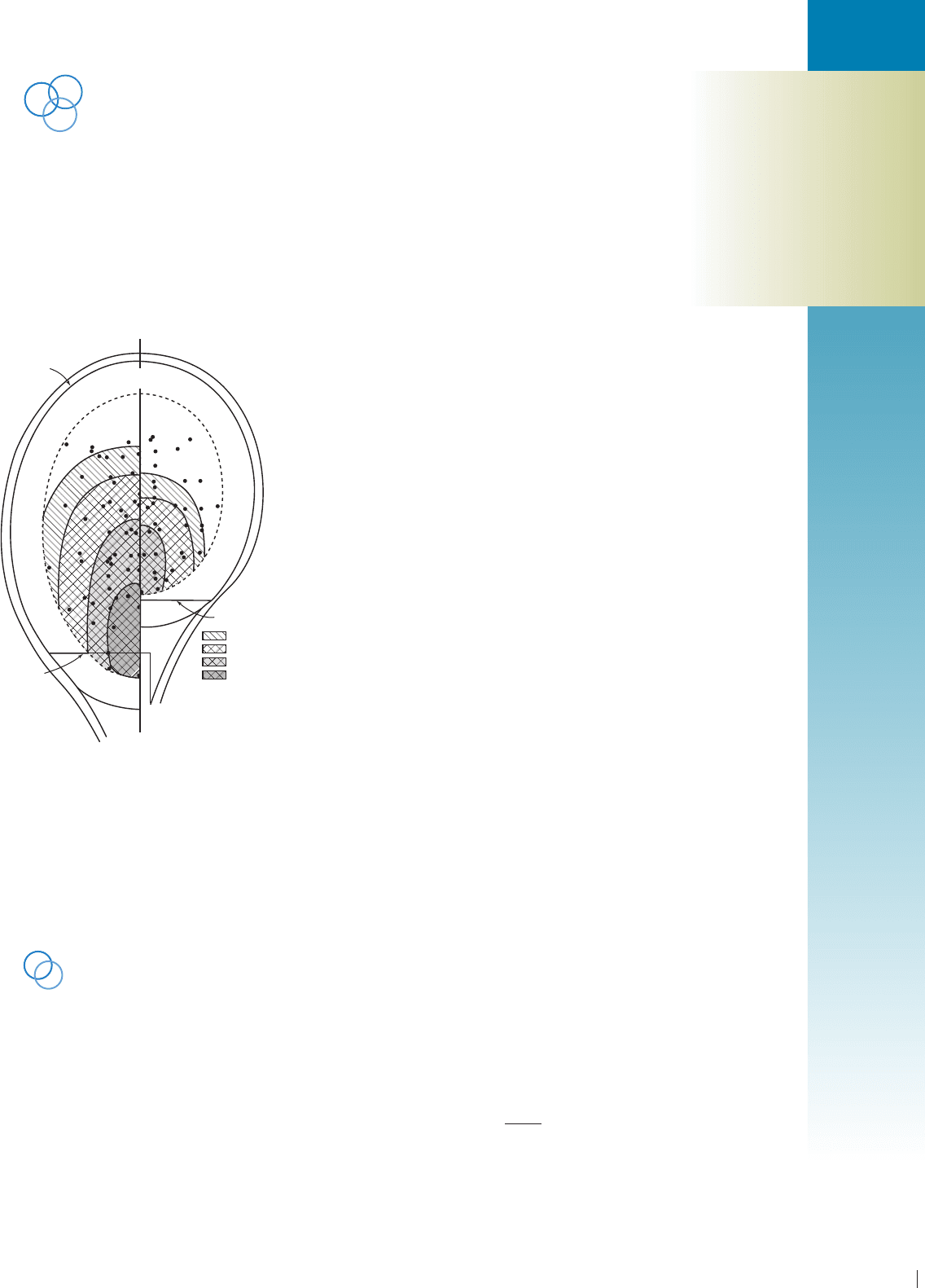
design. As the accompanying diagram shows, the sweet spot of the over-
sized racket is considerably larger than the sweet spot of the smaller
wooden racket.
In this chapter, we introduce double and triple integrals, which are needed
to compute the mass, moment of inertia and other important properties of three-
dimensional solids. The moment of inertia is a measure of the resistance of an
object to rotation. As shown in the exercises in section 14.2, compared to smaller
rackets,the larger Head rackets havea larger moment of inertia and thus, twist less
on off-center shots. Engineers use similar calculations as they test new materials
for strength and weight for the next generation of sports equipment.
14.1 DOUBLE INTEGRALS
Before we introduce the idea of a double integral for a function of two variables,
we first introduce a slight generalization of the definition of definite integral for
a function of a single variable. Recall that to find the area A under the graph of
a continuous function f defined on an interval [a, b], where f (x) ≥ 0on[a, b],
we began by partitioning the interval [a, b] into n subintervals [x
i−1
, x
i
], for
i = 1, 2,...,n, of equal width x =
b −a
n
, where
a = x
0
< x
1
< ···< x
n
= b.
901
P1: OSO/OVY P2: OSO/OVY QC: OSO/OVY T1: OSO
MHDQ256-Ch14 MHDQ256-Smith-v1.cls January 7, 2011 7:53
LT (Late Transcendental)
CONFIRMING PAGES
902 CHAPTER 14
..
Multiple Integrals 14-2
y
x
x
i1
c
i
x
i
f
(c
i
)
(c
i
,
f (c
i
))
f(c
i
)
y f(x)
y
x
a x
0
b x
n
FIGURE 14.1a FIGURE 14.1b
Approximating the area on the Area under the curve
subinterval [x
i−1
, x
i
]
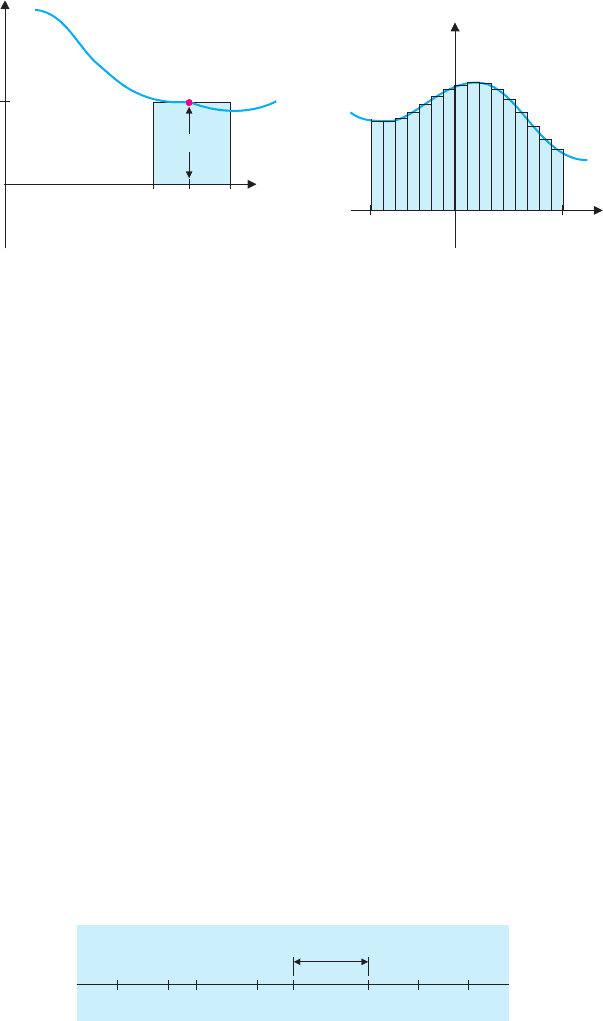
Oneachsubinterval[x
i−1
, x
i
],fori = 1, 2,...,n,weapproximatedtheareaunderthecurve
by the area of the rectangle of height f (c
i
), for some point c
i
∈ [x
i−1
, x
i
], as indicated in
Figure 14.1a. Adding together the areas of these n rectangles, we obtain an approximation
of the area, as indicated in Figure 14.1b:
A ≈
n
i=1
f (c
i
)x.
Finally, taking the limit as n →∞(which also means that x → 0), we get the exact area
(assuming that the limit exists and is the same for all choices of the evaluation points c
i
):
A = lim
n→∞
n
i=1
f (c
i
)x.
We defined the definite integral as this limit:
b
a
f (x) dx = lim
n→∞
n
i=1
f (c
i
)x. (1.1)
We generalize this by allowing partitions to be irregular (that is, where not all subin-
tervals have the same width). We need this kind of generalization, among other reasons, for
more sophisticated numerical methods for approximating definite integrals. This general-
ization is also needed for theoretical purposes; this is pursued in a more advanced course.
We proceed as above, except that we define the width of the ith subinterval [x
i−1
, x
i
]tobe
x
i
= x
i
− x
i−1
. (See Figure 14.2 for the case where n = 7.)
a x
0
x
1
x
2
x
3
x
4
x
5
x
5
x
6
b x
7
FIGURE 14.2
Irregular partition of [a, b]
An approximation of the area is then (essentially, as before)
A ≈
n
i=1
f (c
i
)x
i
,
for any choice of the evaluation points c
i
∈ [x
i−1
, x
i
], for i = 1, 2,...,n. To get the exact
area, we need to let n →∞, but since the partition is irregular, this alone will not guarantee
that all of the x
i
’s will approach zero. We take a little extra care, by defining P (the
norm of the partition)tobethelargest of all the x
i
’s. We then arrive at the following
more general definition of definite integral.