
Smith R., Minton R. Calculus
Подождите немного. Документ загружается.

P1: OSO/OVY P2: OSO/OVY QC: OSO/OVY T1: OSO
MHDQ256-Ch14 MHDQ256-Smith-v1.cls January 5, 2011 10:17
LT (Late Transcendental)
CONFIRMING PAGES
14-13 SECTION 14.1
..
Double Integrals 913
In example 1.6, we saw that changing the order of integration may make a given double
integral easier to compute. As we see in example 1.7, sometimes you will need to change
the order of integration in order to evaluate a double integral.
y
x
1
y x
R
1
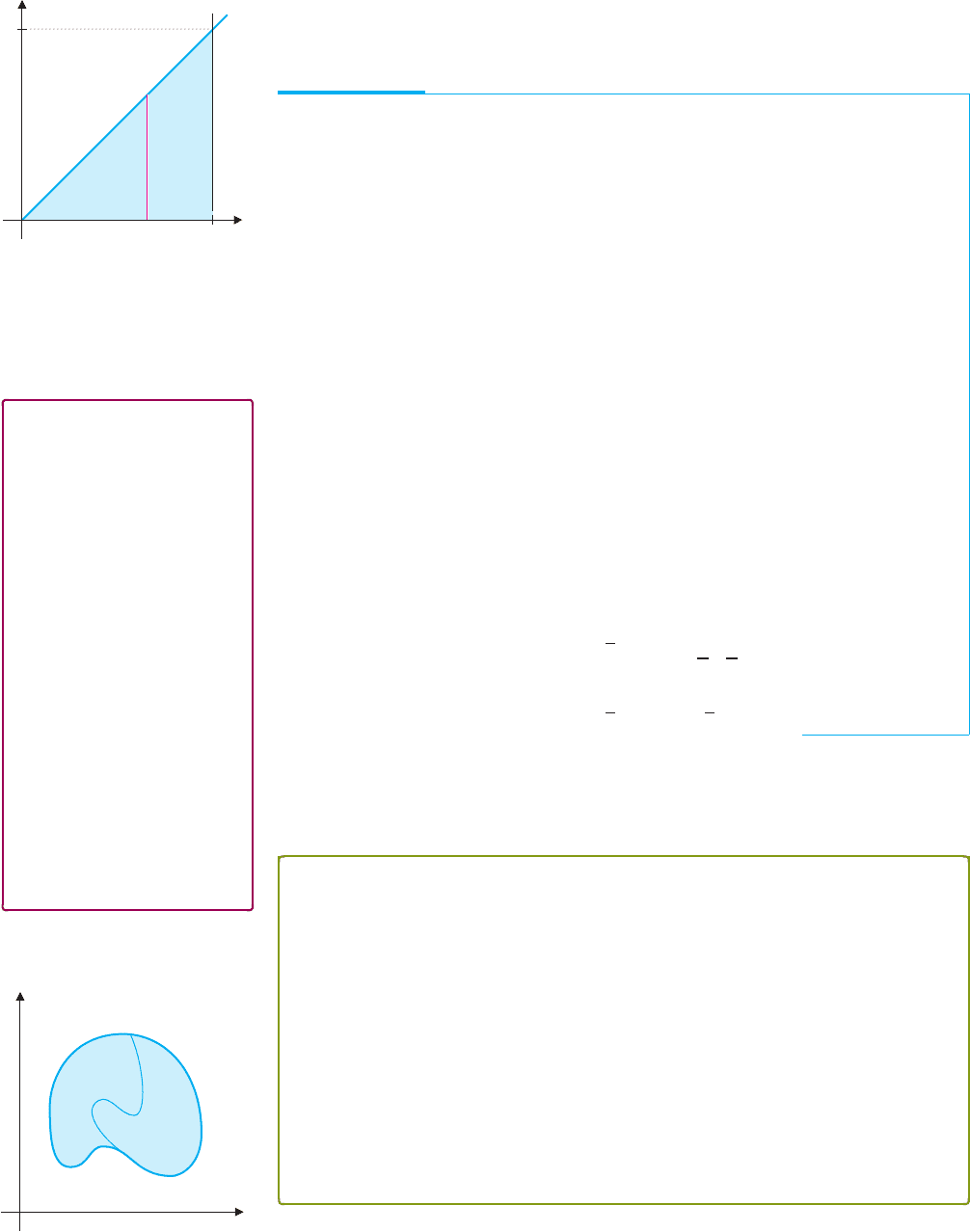
FIGURE 14.15
The region R
EXAMPLE 1.7 A Case Where We Must Switch the Order of Integration
Evaluate the iterated integral
1
0
1
y
e
x
2
dx dy.
Solution First, note that we cannot evaluate the integral the way it is presently
written, as we don’t know an antiderivative for e
x
2
. On the other hand, if we switch the
order of integration, the integral becomes quite simple, as follows. First, recognize that
for each fixed y on the interval [0, 1], x ranges from y over to 1, giving us the triangular
region of integration shown in Figure 14.15. If we switch the order of integration, notice
that for each fixed x in the interval [0, 1], y ranges from 0 up to x and we get the double
iterated integral:
1
0
1
y
e
x
2
dx dy =
1
0
x
0
e
x
2
dy dx
=
1
0
e
x
2
y
y=x
y=0
dx
=
1
0
e
x
2
xdx.
We can evaluate this last integral with the substitution u = x
2
, since du = 2xdxand
the first integration has conveniently provided us with the needed factor of x.Wehave
1
0
1
y
e
x
2
dx dy =
1
2
1
0
e
x
2
e
u
(2x)dx
du
=
1
2
e
x
2
x=1
x=0
=
1
2
(e
1
− 1).
CAUTION
Carefully study the steps
we used to change the order
of integration in example 1.7.
Notice that we did not simply
swap the two integrals, nor did
we just switch y’s to x’s on the
inside limits. When you change
the order of integration, it
is extremely important that you
sketch the region over which
you are integrating, as in Figure
14.15. This allows you to see the
orientation of the different parts
of the boundary of the region.
Failing to do this is the single
most common error made by
students at this point. This is a
skill you need to practice, as you
will use it throughout the rest of
the course. (Sketching a picture
takes only a few moments and
will help you to avoid many fatal
errors. So, do this routinely!)
We complete the section by stating several simple properties of double integrals.
THEOREM 1.4
Let f and g be integrable over the region R ⊂ R
2
and let c be any constant. Then, the
following hold:
(i)
R
cf(x, y)dA = c
R
f (x, y) dA,
(ii)
R
[ f (x, y) + g(x, y)]dA =
R
f (x, y) dA +
R
g(x, y) dA and
(iii) if R = R
1
∪ R
2
, where R
1
and R
2
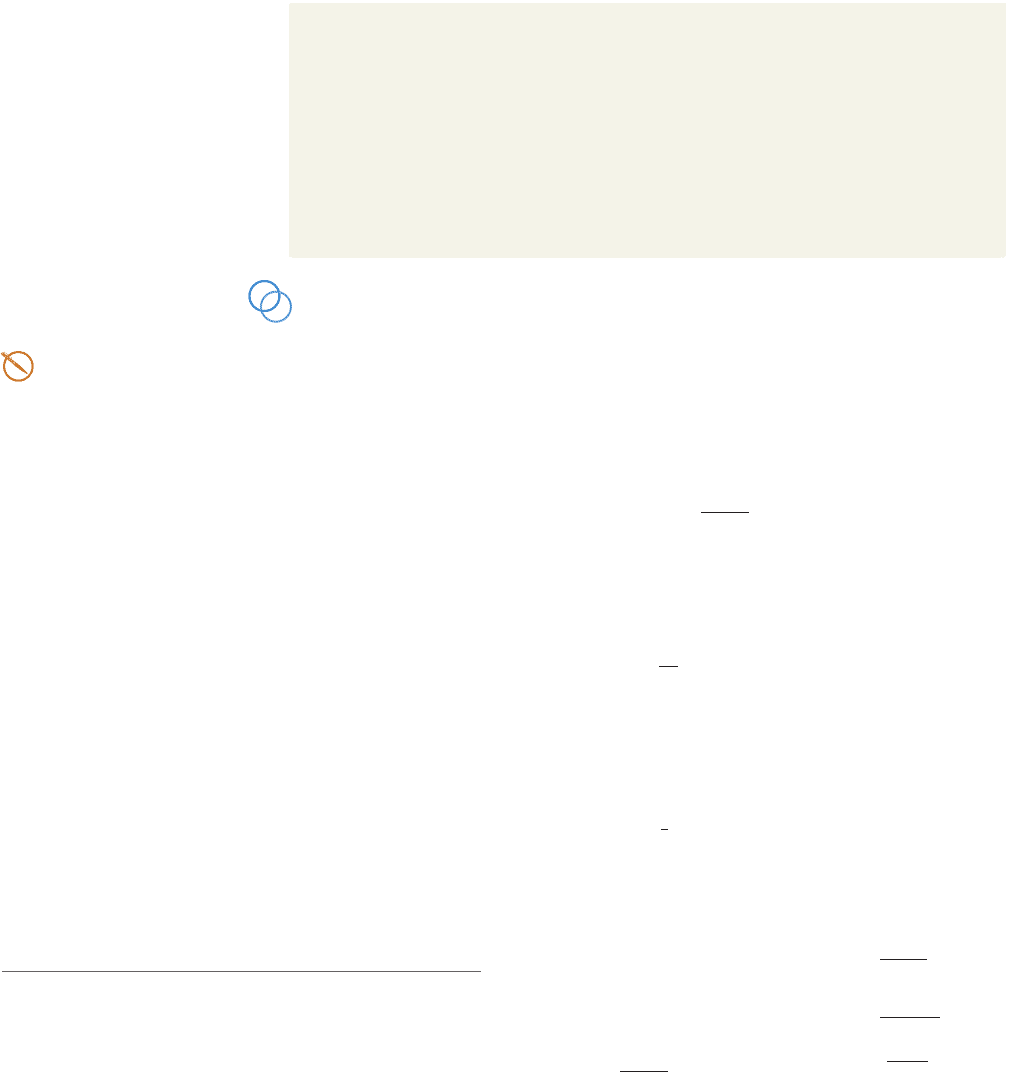
are nonoverlapping regions (as in Figure
14.16), then
R
f (x, y) dA =
R
1
f (x, y) dA +
R
2
f (x, y) dA.
y
x
R
1
R
2
FIGURE 14.16
R = R
1
∪ R
2
Each of these follows directly from the definition of double integral in (1.7) and the
proofs are left as exercises.
P1: OSO/OVY P2: OSO/OVY QC: OSO/OVY T1: OSO
MHDQ256-Ch14 MHDQ256-Smith-v1.cls January 5, 2011 10:17
LT (Late Transcendental)
CONFIRMING PAGES
914 CHAPTER 14
..
Multiple Integrals 14-14
BEYOND FORMULAS
You should think of double integrals in terms of the Rule of Three: symbolic, graphical
and numerical interpretations. Symbolically, you compute double integrals as iterated
integrals, where the greatest challenge is correctly setting up the limits of integration.
Graphically,thevolumecalculationthatmotivatesDefinition1.2isanalogoustothearea
interpretation of single integrals. Numerically, double integrals can be approximated
by Riemann sums. From your experience with single integrals and partial derivatives
in Chapter 13, what percentage of double integrals do you expect to be able to evaluate
symbolically?
EXERCISES 14.1
WRITING EXERCISES
1. If f (x, y) ≥ 0 on a region R, then
R
f (x, y)dA gives the vol-
ume of the solid above the region R in the xy-plane and below
the surface z = f (x, y). If f (x, y) ≥ 0 on a region R
1
and
f (x, y) ≤ 0 on a region R
2
, discuss the geometric meaning of
R
2
f (x, y)dA and
R
f (x, y)dA, where R = R
1
∪ R
2
.
2. The definition of
R
f (x, y)dA requires that the norm of the
partition P approaches 0. Explain why it is not enough to
simply require that the number of rectangles n in the partition
approaches ∞.
3. When computing areas between curves in section 5.1, we dis-
cussed strategies for deciding whether to integrate with respect
to x or y. Compare these strategies to those givenin this section
for deciding which variable to use as the inside variable of a
double integral.
4. Suppose you (or your software) are using Riemann sums to ap-
proximateaparticularly difficultdouble integral
R
f (x, y)dA.
Further, suppose that R = R
1
∪ R
2
and the function f (x, y)is
nearly constant on R
1
but oscillates wildly on R
2
, where R
1
and R
2
are nonoverlapping regions. Explain why you would
need more rectangles in R
2
than R
1
to get equally accurate ap-
proximations.Thus, irregular partitions can be usedto improve
the efficiency of numerical integration routines.
In exercises 1–4, compute the Riemann sum for the given func-
tion and region, a partition with n rectangles divided as indi-
cated and the given evaluation rule.
1. f (x, y) = x +2y
2
, 0 ≤ x ≤ 2, −1 ≤ y ≤ 1, evaluate at the
center of each rectangle; (a) n = 4, divide at x = 1, y = 0;
(b) n = 8, divide at x = 1, y =−0.5, y = 0, y = 0.5
2. f (x, y) = 4x
2
+ y, 1 ≤ x ≤ 5, 0 ≤ y ≤ 2, evaluate at the
center of each rectangle; (a) n = 4, divide at x = 3, y = 1;
(b) n = 8, divide at x = 2, x = 3, x = 4, y = 1
3. f (x, y) = x +2y
2
, 0 ≤ x ≤ 2, −1 ≤ y ≤ 1, evaluate at the
lowerrightofeachrectangle;(a)n = 4,divideat x = 1, y = 0;
(b) n = 8, divide at x = 0.5, x = 1, x = 1.5, y = 0
4. f (x, y) = 4x
2
+ y, 1 ≤ x ≤ 5, 0 ≤ y ≤ 2, evaluate at the up-
per left of each rectangle; (a) n = 4, divide at x = 3, y = 1;
(b) n = 8, divide at x = 3, y = 0.5, y = 1, y = 1.5
In exercises 5–8, find the volume beneath the surface and above
the rectangular region.
5. z = x
2
+ y
2
,0≤ x ≤ 3, 1 ≤ y ≤ 4
6. z = 3x
2
+ 2y, 1 ≤ x ≤ 3, 0 ≤ y ≤ 1
7. z = 6 + xe
x
+ 2y sin y, 0 ≤ x ≤ 2, 1 ≤ y ≤ 4
8. z = 4 − x
2
y + y
1 + y
2
, −1 ≤ x ≤ 1, 0 ≤ y ≤ 3
............................................................
In exercises 9 and 10, evaluate the double integral.
9.
R
(1 − ye
xy
)dA, where R ={(x, y)| 0 ≤ x ≤ 2, 0 ≤ y ≤ 3}
10.
R
(3x − 4x
√
xy) dA, where R ={(x, y)| 0 ≤ x ≤ 4, 0 ≤ y ≤ 9}
............................................................
In exercises 11–24, evaluate the iterated integral.
11.
1
0
2x
0
(x + 2y) dy dx 12.
2
0
x
2
0
(x + 3) dy dx
13.
1
0
2t
0
(4u
√
t + t)du dt 14.
π
0
2
0
θ sin(rθ) dr dθ
15.
2
0
2y
0
e
y
2
dx dy 16.
2
1
2/x
0
e
xy
dydx
17.
4
1
1/u
0
cos(uy)dydu 18.
1
0
b
2
0
3
4 + b
3
da db
19.
2
0
x
0
ye
3x
dydx 20.
1
0
x
2
0
x + 1
(y + 1)
2
dydx
21.
1
0
t
0
u
2
+ 1
t
2
+ 1
du dt 22.
1
0
v
1
√
u + v du dv
23.
1
0
x
0
(x − 2y)e
x−2y
dydx 24.
1
0
x
0
x
2
e
xy
dydx
............................................................
In exercises 25–32, find an integral equal to the volume of the
solid bounded by the given surfaces and evaluate the integral.
25. z = x
2
+ y
2
, z = 0, y = x
2
, y = 1
26. z = 3x
2
+ 2y, z = 0, y = 1 − x
2
, y = 0
27. z = 6 − x − y, z = 0, x = 4 − y
2
, x = 0
28. z = 4 − 2y, z = 0, x = y
4
, x = 1
P1: OSO/OVY P2: OSO/OVY QC: OSO/OVY T1: OSO
MHDQ256-Ch14 MHDQ256-Smith-v1.cls January 5, 2011 10:17
LT (Late Transcendental)
CONFIRMING PAGES
14-15 SECTION 14.1
..
Double Integrals 915
29. z = y
2
, z = 0, y = 0, y = x, x = 2
30. z = x
2
, z = 0, y = x, y = 4, x = 0
31. z = x
2
+ y
2
− 4, z = 0, x =−1, x = 1, y =−1, y = 1
32. z = 1 − x − y, z = 0, x = 2, x = 3, y = 3, y = 4
............................................................
In exercises 33–36, approximate the double integral.
33.
R
(2x − y)dA, where R is bounded by y = sin x and
y = 1 − x
2
34.
R
(2x − y)dA, where R is bounded by y = e
x
and y = 2 − x
2
35.
R
e
x
2
dA, where R is bounded by y = x
2
and y = 1
36.
R
y
2
+ 1dA, where R is bounded by x = 4 − y
2
and x = 0
............................................................
In exercises 37–42, change the order of integration.
37.
1
0
2x
0
f (x, y)dydx 38.
1
0
2
2x
f (x, y)dydx
39.
2
0
4
2y
f (x, y)dx dy 40.
1
0
2y
0
f (x, y)dx dy
41.
ln4
0
4
e
x
f (x, y)dydx 42.
2
1
ln y
0
f (x, y)dx dy
............................................................
In exercises 43–46, evaluate the iterated integral by first chang-
ing the order of integration.
43.
2
0
2
x
2e
y
2
dydx 44.
1
0
1
√
x
3
4 + y
3
dydx
45.
1
0
1
y
3xe
x
3
dx dy 46.
1
0
1
√
y
cos x
3
dx dy
............................................................
47. (a) Show that
1
0
2x
0
x
2
dydx =
2
0
y/2
0
x
2
dx dy.
(b) Sketch the solids whose volumes are given in part (a) and
explain why the volumes are not equal.
48. (a) Determine whether your CAS can evaluate the integrals
2
x
2e
y
2
dy and
2
0
2
x
2e
y
2
dydx.
(b) Based on your result, does it appear that your CAS can
switch orders of integration to evaluate a double integral?
............................................................
In exercises 49–52, sketch the solid whose volume is described
by the given iterated integral.
49.
(a)
3
0
6−2x
0
(6 −2x − y)dy dx (b)
1
0
6−2x
0
(6 −2x − y)dy dx
50. (a)
4
0
4−x
0
(4 − x − y) dydx (b)
2
0
4−x
0
(4 − x − y) dydx
51. (a)
2
−2
√
4−x
2
−
√
4−x
2
(4 − x
2
− y
2
)dydx
(b)
2
0
√
4−x
2
0
(4 − x
2
− y
2
)dydx
52.
(a)
1
0
√
1−x
2
0
(x
2
+ y
2
)dy dx (b)
1/2
0
√
1−x
2
0
(x
2
+ y
2
)dy dx
............................................................
In exercises 53 and 54, evaluate the iterated integral by sketch-
ing a graph and using a basic geometric formula.
53.
1
−1
√
1−x
2
−
√
1−x
2
1 − x
2
− y
2
dydx
54.
2
0
√
4−y
2
−
√
4−y
2
4 − x
2
− y
2
dx dy
............................................................
55. (a) Prove that
b
a
d
c
f (x)g(y)dydx =
b
a
f (x) dx
d
c
g(y)dy
for continuous functions f and g.
(b) Quickly evaluate
2π
0
38
15
e
−4y
2
sin xdydx.
56. Prove Theorem 1.4.
57. (a) For the table of function values here, use upper-left corner
evaluations to estimate
1
0
1
0
f (x, y)dydx.
y
x
0.0 0.25 0.5 0.75 1.0
0.0 2.2 2.0 1.7 1.4 1.0
0.25 2.3 2.1 1.8 1.6 1.1
0.5 2.5 2.3 2.0 1.8 1.4
0.75 2.8 2.6 2.3 2.2 1.8
1.0 3.2 3.0 2.8 2.7 2.5
(b) Repeat with lower-right corner evaluations.
58. (a) For the table of function values in exercise 57, use upper-
rightcornerevaluationsto estimate
1
0
0.5
0
f (x, y)dydx.
(b) Repeat with lower-left corner evaluations.
59. Forthefunctioninexercise57,useaninnerpartitionandlower-
rightcornerevaluationstoestimate
1
0
√
1−x
2
0
f (x, y)dydx.
60. Use the function in exercise 57, an inner partition and upper-
right corner evaluations to estimate
1
0
1−y
0
f (x, y)dx dy.
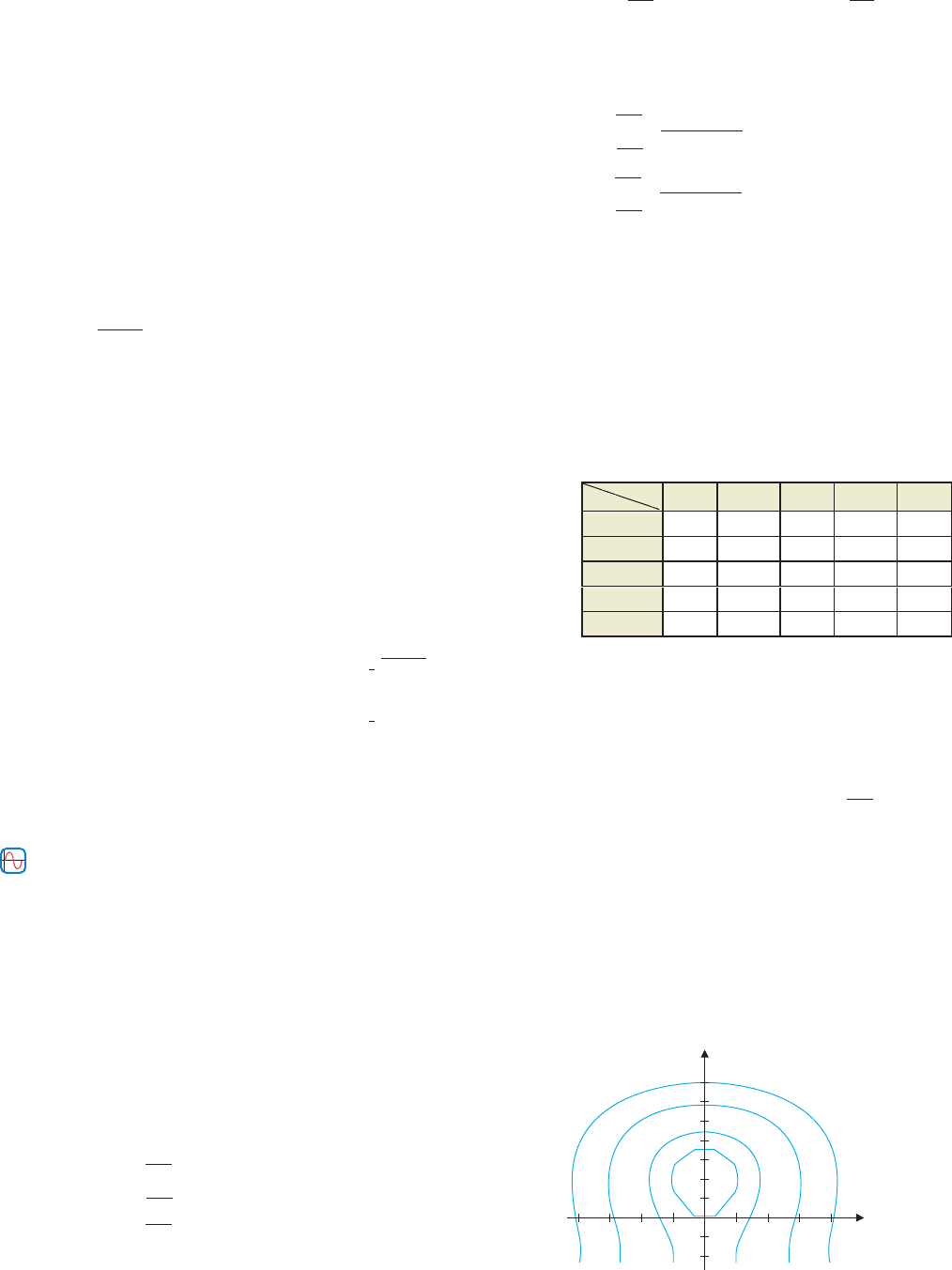
61. Use the contour plot to determine which is the best estimate of
(a)
1
−1
1
0
f (x, y)dydx:1,2or4
(b)
1
0
1−x
0
f (x, y)dydx:1,2or4.
0.2
z = 4
z = 3
z = 2
z = 1
0.4 0.6 0.8
0.4
0.2
0.4
0.6
0.8
1
1.2
1.4
0.80.60.40.2
y
x
P1: OSO/OVY P2: OSO/OVY QC: OSO/OVY T1: OSO
MHDQ256-Ch14 MHDQ256-Smith-v1.cls January 5, 2011 10:17
LT (Late Transcendental)
CONFIRMING PAGES
916 CHAPTER 14
..
Multiple Integrals 14-16
62. From the Fundamental Theorem of Calculus, we have
b
a
f
(x)dx = f (b) − f (a). Find the corresponding rule for
evaluating the double integral
d
c
b
a
f
xy
(x, y)dx dy. Use
this rule to evaluate
1
0
1
0
24xy
2
dx dy, with
f (x, y) = 3x + 4x
2
y
3
+ y
2
.
63. Determine whether the rule from exercise 62 holds for
double integrals over nonrectangular regions. Test it on
1
0
x
0
24xy
2
dydx.
64. Repeat exercise 63 with f (x, y) = 4x
2
+ 4x
2
y
3
+ sin y. Ex-
plain why you get the same value, and discuss which f is
easier to use.
65. Evaluate the integral by rewriting it as a double integral and
switching the order of integration.
(a)
2
0
[tan
−1
(4 − x) − tan
−1
x]dx
(b)
1/2
0
[sin
−1
(1 − x) − sin
−1
x]dx
66. Evaluate
2
0
2y
0
f (x, y)dx dy for (a) f (x, y) = min{2x, y}
(b) f (x, y) = min{x, y
2
}.
EXPLORATORY EXERCISES
1. As mentioned in the text, numerical methods for approximat-
ing double integrals can be troublesome. The Monte Carlo
method makes clever use of probability theory toapproximate
R
f (x, y)dA for a bounded region R. Suppose, for example,
that R is containedwithin the rectangle 0 ≤ x ≤ 1, 0 ≤ y ≤ 1.
Generate two random numbers a and b from the uniform dis-
tribution on [0, 1]; this means that every number between 0
and 1 is in some sense equally likely. Determine whether or
not the point (a, b) is in the region R and then repeat the pro-
cess a large number of times. If, for example, 64 out of 100
points generated were within R, explain why a reasonable es-
timate of the area of R is 0.64 times the area of the rectangle
0 ≤ x ≤ 1, 0 ≤ y ≤ 1. For each point (a, b) that is within R,
compute f (a, b). If the average of all of these function values
is 13.6, explain why a reasonable estimate of
R
f (x, y)dA is
(0.64)(13.6) =8.704. Use theMonte Carlo method to estimate
2
1
√
x
ln x
sin(xy)dydx. (Hint: Show that y is between ln1 = 0
and
√
2 < 2.)
2. Improper double integrals can be treated much like improper
singleintegrals.Evaluate
∞
0
∞
0
e
−2x−3y
dx dybyfirstevaluat-
ing the inside integral as lim
R→∞
R
0
e
−2x−3y
dx. To explore
whether the integral is well defined, evaluate the integral as
lim
R→∞
R
0
R
0
e
−2x−3y
dx dy
and lim
R→∞
2R
0
R
2
0
e
−2x−3y
dx dy
.
Then evaluate
R
e
−x
2
−y
dA, where R is the portion of the
xy-plane with 0 ≤ x ≤ y.
14.2 AREA, VOLUME AND CENTER OF MASS
To use double integrals to solve problems, it’s very important that you recognize what each
component of the integral represents. For this reason, we pause briefly to set up a double
iterated integral as a double sum. Consider the case of a continuous function f, where
f (x, y) ≥ 0 on some region R ⊂ R
2
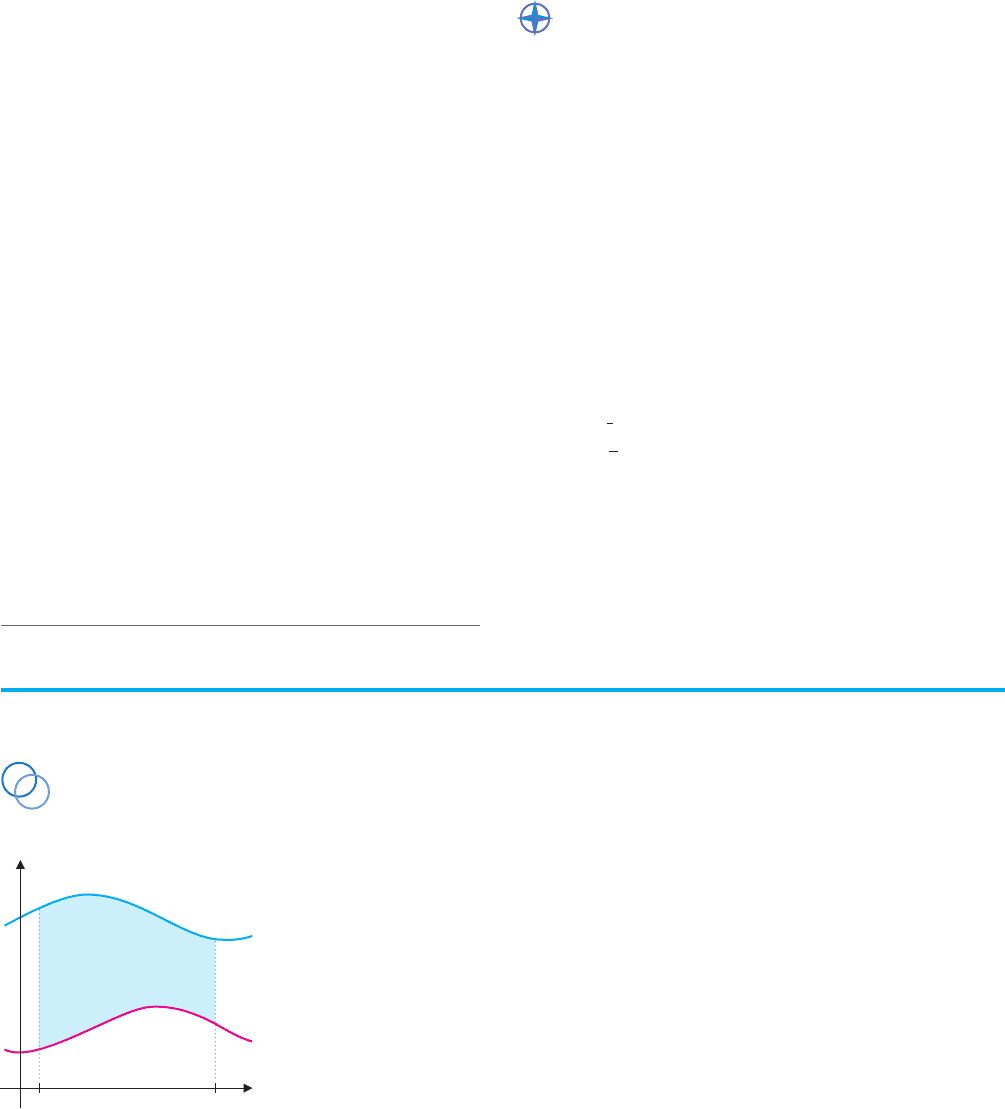
.IfR has the form
y
x
a b
y g
2
(x)
y g
1
(x)
R
FIGURE 14.17
The region R
R ={(x, y)|a ≤ x ≤ b and g
1
(x) ≤ y ≤ g
2
(x)},
as indicated in Figure 14.17, then we have from our work in section 14.1 that the volume V
lying beneath the surface z = f (x, y) and above the region R is given by
V =
b
a
A(x) dx =
b
a
g
2
(x)
g
1
(x)
f (x, y) dydx. (2.1)
Here, for each fixed x, A(x) is the area of the cross section of the solid corresponding to
that particular value of x. Our aim is to write the volume integral in (2.1) in a slightly
different way from our derivation in section 14.1. First, notice that by the definition of
definite integral, we have that
b
a
A(x)dx = lim
P
1
→0
n
i=1
A(c
i
)x
i
, (2.2)
where P
1
represents a partition of the interval [a, b], c
i
is some point in the ith subinterval
[x
i−1
, x
i
] and x
i
= x
i
− x
i−1
(the width of the ith subinterval). For each fixed x ∈ [a, b],
P1: OSO/OVY P2: OSO/OVY QC: OSO/OVY T1: OSO
MHDQ256-Ch14 MHDQ256-Smith-v1.cls January 5, 2011 10:17
LT (Late Transcendental)
CONFIRMING PAGES
14-17 SECTION 14.2
..
Area, Volume and Center of Mass 917
since A(x) is the area of the cross section, we have that
A(x) =
g
2
(x)
g
1
(x)
f (x, y) dy = lim
||P
2
||→0
m
j=1
f (x,v
j
)y
j
, (2.3)
where P
2
represents a partition of the interval [g
1
(x), g
2
(x)],v
j
is some point in the
jth subinterval [y
j−1
, y
j
] of the partition P
2
and y
j
= y
j
− y
j−1
(the width of the jth
subinterval). Putting (2.1), (2.2) and (2.3) together, we get
V = lim
P
1
→0
n
i=1
A(c
i
)x
i
= lim
P
1
→0
n
i=1
lim
P
2
→0
m
j=1
f (c
i
,v
j
)y
j
x
i
= lim
P
1
→0
lim
P
2
→0
n
i=1
m
j=1
f (c
i
,v
j
)y
j
x
i
. (2.4)
The double summation in (2.4) is called a double Riemann sum. Notice that each term
corresponds to the volume of a box of length x
i
, width y
j
and height f (c
i
,v
j
). (See
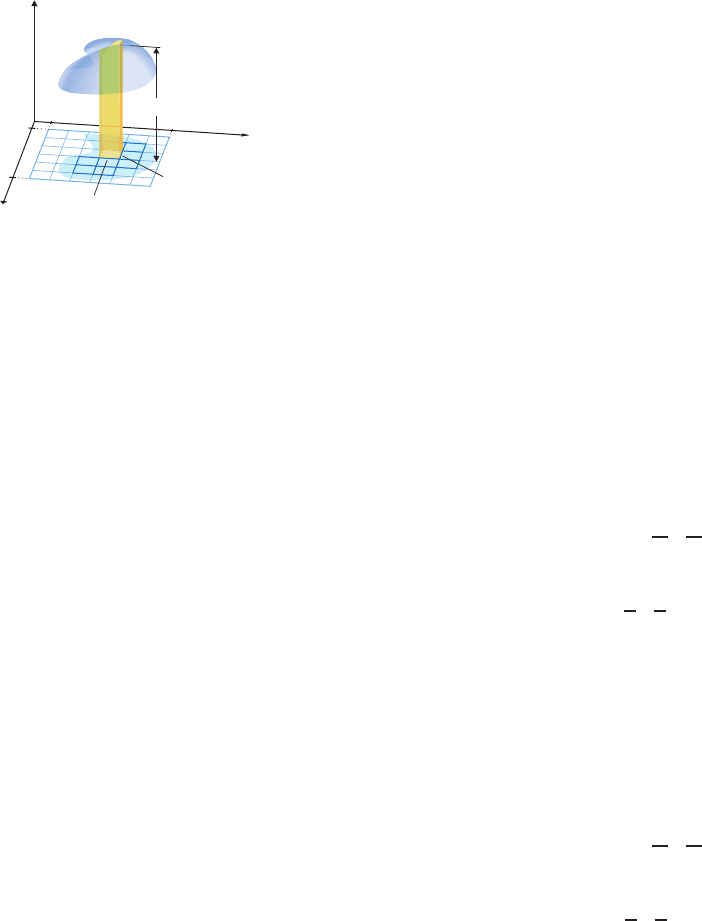
Figure 14.18.) Observe that by superimposing the two partitions, we have produced an
inner partition of the region R. If we represent this inner partition of R by P and the norm of
the partition P by P, the length of the longest diagonal of any rectangle in the partition,
we can write (2.4) with only one limit, as
x
y
z
O
x
i
y
j
f (c
i
, v
j
)
FIGURE 14.18
Volume of a typical box
V = lim
P→0
n
i=1
m
j=1
f (c
i
,v
j
)y
j
x
i
. (2.5)
When you write down an iterated integral representing volume, you can use (2.5) to help
identify each of the components as follows:
V = lim
P→0
n
i=1
m
j=1
f (c
i
,v
j
)
height
y
j
width
x
i
length
=
b
a
g
2
(x)
g
1
(x)
f (x, y)
height
dy
width
dx
length
. (2.6)
You should make at least a mental picture of the components of the integral in (2.6), keeping
in mind the corresponding components of the Riemann sum. We leave it as an exercise to
show that for a region of the form
R ={(x, y)|c ≤ y ≤ d and h
1
(y) ≤ x ≤ h
2
(y)},
we get a corresponding interpretation of the iterated integral:
V = lim
P→0
m
j=1
n
i=1
f (c
i
,v
j
)
height
x
i
length
y
j
width
=
d
c
h
2
(y)
h
1
(y)
f (x, y)
height
dx
length
dy
width
. (2.7)
Observe that for any bounded region R ⊂ R
2
,
R
1dA, which we sometimes write simply
as
R
dA, gives the volume under the surface z = 1 and above the region R in the
xy-plane. Since all of the cross sections parallel to the xy-plane are the same, the solid is a
cylinderandso, its volumeistheproduct ofitsheight(1) anditscross-sectionalarea. Thatis,
R
dA= (1) (Area of R) = Area of R. (2.8)
So, we now have the option of using a double integral to find the area of a plane region.
P1: OSO/OVY P2: OSO/OVY QC: OSO/OVY T1: OSO
MHDQ256-Ch14 MHDQ256-Smith-v1.cls January 5, 2011 10:17
LT (Late Transcendental)
CONFIRMING PAGES
918 CHAPTER 14
..
Multiple Integrals 14-18
EXAMPLE 2.1 Using a Double Integral to Find Area
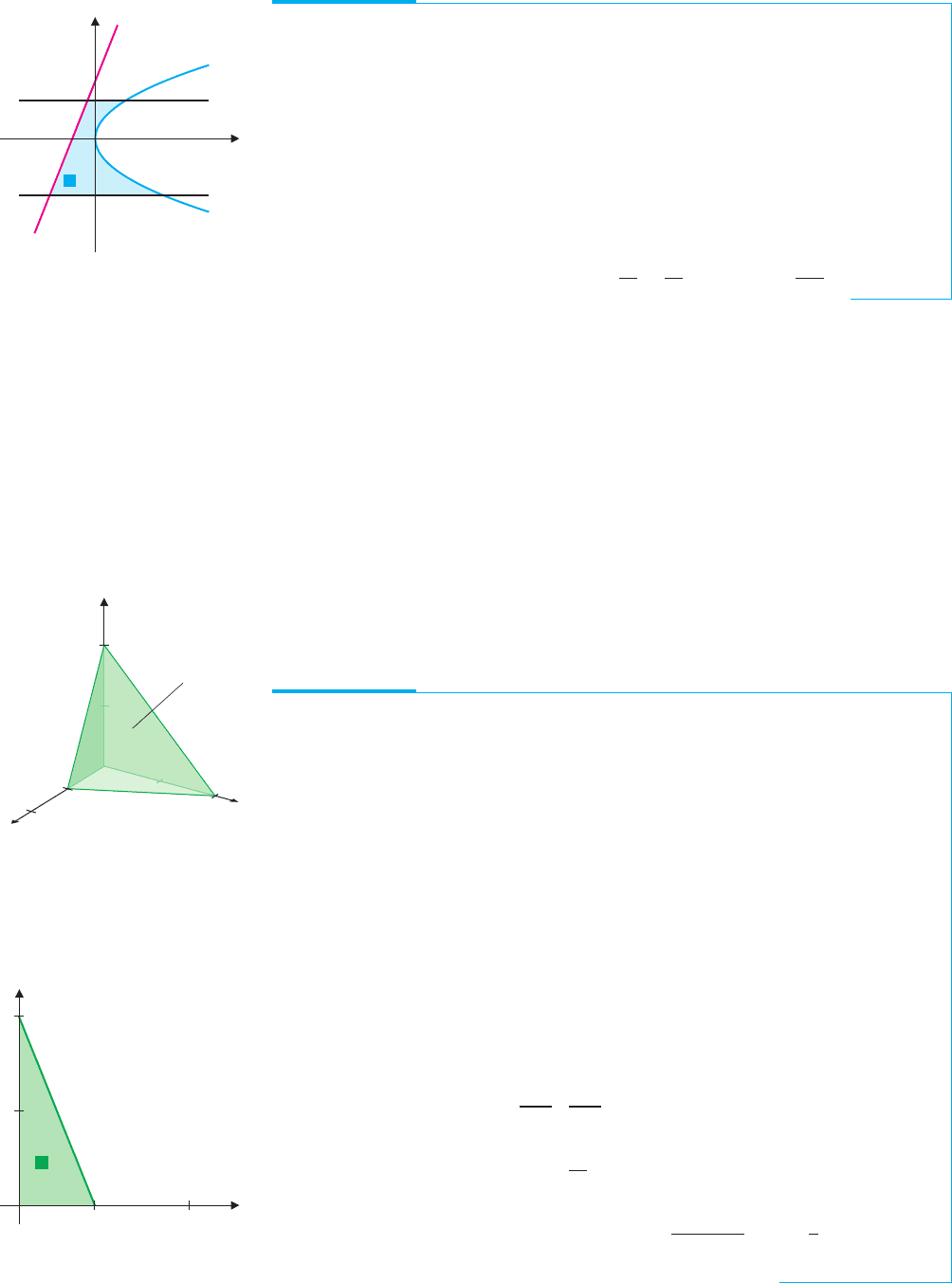
Find the area of the plane region bounded by the graphs of x = y
2
, y − x = 3, y =−3
and y = 2. (See Figure 14.19.)
y
x
y x 3
y 3
y 2
x y
2
dy
dx
R
FIGURE 14.19
The region R
Solution Note that we have indicated in the figure a small rectangle with sides dx and
dy, respectively. This helps to indicate the limits for the iterated integral. From (2.8), we
have
A =
R
dA =
2
−3
y
2
y−3
dx dy =
2
−3
x
x=y
2
x=y−3
dy
=
2
−3
[y
2
− (y − 3)]dy =
y
3
3
−
y
2
2
+ 3y
2
−3
=
175
6
.
Think about example 2.1 a little further. Recall that we had worked similar prob-
lems in section 5.1 using single integrals. In fact, you might have set up the desired area
directly as
A =
2
−3
[y
2
− (y − 3)] dy,
exactly as you see in the second line of work above. While we will sometimes use double
integrals to more easily solve familiar problems, double integrals will allow us to solve
many new problems as well.
We have already developed formulas for calculating the volume of a solid lying below
a surface of the form z = f (x, y) and above a region R (of several different forms), lying
in the xy-plane. As you will see in examples 2.2–2.4, the challenge in setting up the iterated
integrals comes in seeing the region R that the solid lies above and then determining the
limits of integration for the iterated integrals.
EXAMPLE 2.2 Using a Double Integral to Find Volume
Find the volume of the tetrahedron bounded by the plane 2x + y + z = 2 and the three
coordinate planes.
x
y
2
1
2
2x y z 2
R
z
~
FIGURE 14.20a
Tetrahedron
y
x
1 2
1
2
y 2 2x
R
dy
dx
FIGURE 14.20b
The region R
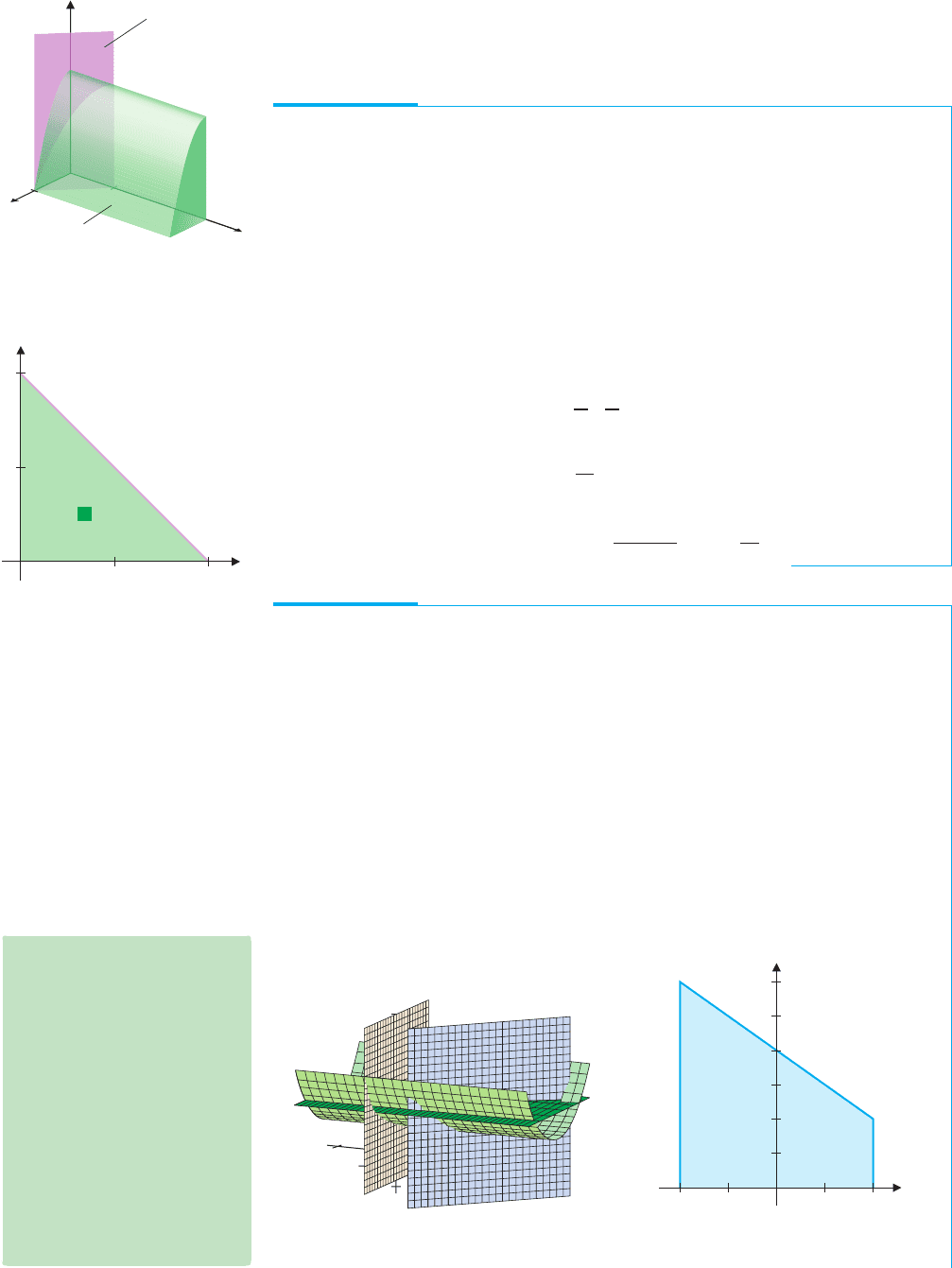
Solution Since the plane 2x + y + z = 2 intersects the coordinate axes at the points
(1, 0, 0), (0, 2, 0) and (0, 0, 2), it’s easy to sketch the solid. Simply connect the three
points of intersection with the coordinate axes and you’ll get the graph of the
tetrahedron (a four-sided object with all triangular sides) seen in Figure 14.20a. In order
to use our volume formula, though, we’ll first need to visualize the tetrahedron as a
solid lying below a surface of the form z = f (x, y) and lying above some region R in
the xy-plane. Notice that the solid lies below the plane z = 2 − 2x − y and above the
triangular region R in the xy-plane, as indicated in Figure 14.20a. Here, R is the
triangular region bounded by the x- and y-axes and the trace of the plane
2x + y + z = 2inthexy-plane. The trace is found by simply setting z = 0:
2x + y = 2. (See Figure 14.20b.) From (2.6), the volume is then
V =
1
0
2−2x
0
(2 − 2x − y)
height
dy
width
dx
length
=
1
0
2y − 2xy −
y
2
2
y=2−2x
y=0
dx
=
1
0
2(2 − 2x) − 2x(2 − 2x) −
(2 − 2x)
2
2
dx =
2
3
,
where we leave the routine details of the final calculation to you.
P1: OSO/OVY P2: OSO/OVY QC: OSO/OVY T1: OSO
MHDQ256-Ch14 MHDQ256-Smith-v1.cls January 5, 2011 10:17
LT (Late Transcendental)
CONFIRMING PAGES
14-19 SECTION 14.2
..
Area, Volume and Center of Mass 919
We cannot emphasize enough the need to draw reasonable sketches of the solid and
particularly of the base of the solid in the xy-plane. You may be lucky enough to guess the
limits of integration for a few of the simpler problems, but don’t be deceived: you need to
draw good sketches and look carefully to determine the limits of integration correctly.
EXAMPLE 2.3 Finding the Volume of a Solid
Find the volume of the solid lying in the first octant and bounded by the graphs of
z = 4 − x
2
, x + y = 2, x = 0, y = 0 and z = 0.
z
x
y
2
O
2
x y 2
z 4 x
2
FIGURE 14.21a
Solid in the first octant
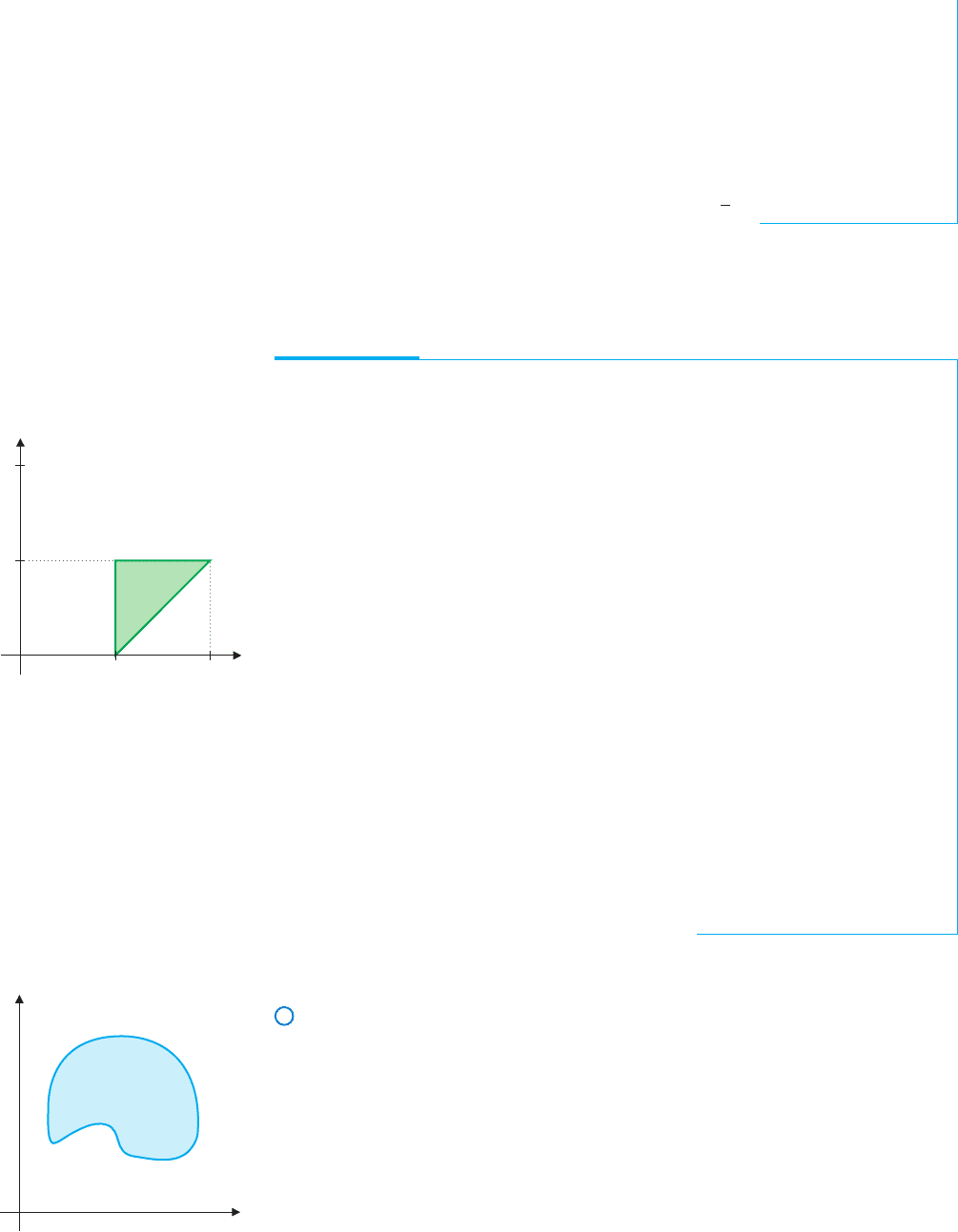
Solution First, draw a sketch of the solid. You should note that z = 4 − x
2
is a
cylinder (since there’s no y term), x + y = 2 is a plane and x = 0, y = 0 and z = 0
are the coordinate planes. (See Figure 14.21a.) Notice that the solid lies below the
surface z = 4 − x
2
and above the triangular region R in the xy-plane formed by the
x- and y-axes and the trace of the plane x + y = 2inthexy-plane (i.e., the line
x + y = 2). This is shown in Figure 14.21b. Although we could integrate with respect
to either x or y first, we integrate with respect to x first. From (2.7), we have
V =
2
0
2−y
0
(4 − x
2
)
height
dx
length
dy
width
=
2
0
4x −
x
3
3
x=2−y
x=0
dy
=
2
0
4(2 − y) −
(2 − y)
3
3
dy =
20
3
.
12
1
2
x 2 y
R
dy
dx
x
y
FIGURE 14.21b
The region R
EXAMPLE 2.4 Finding the Volume of a Solid Bounded
Above the xy-Plane
Find the volume of the solid bounded by the graphs of z = 2, z = x
2
+ 1, y = 0 and
x + y = 2.
Solution First, observe that the graph of z = x
2
+ 1 is a parabolic cylinder with axis
parallel to the y-axis. It intersects the plane z = 2 where x
2
+ 1 = 2orx =±1. This
forms a long trough, which is cut off by the planes y = 0 (the xz-plane) and x + y = 2.
(See Figure 14.22a.) The solid lies below z = 2 and above the cylinder z = x
2
+ 1. You
can view the integrand f (x, y) in (2.6) as the height of the solid above the point (x, y).
Drawing a vertical line from the xy-plane through the solid in Figure 14.22a shows that
the height of the solid is the difference between 2 and x
2
+ 1, so that f (x, y) = 2 −
(x
2
+ 1) = 1 − x
2
. In Figure 14.22a, notice that the solid lies above the region R in the
xy-plane bounded by y = 0, x + y = 2, x =−1 and x = 1. (See Figure 14.22b.)
NOTES
Notice in example 2.4 that the
limits of integration come from
the two defining surfaces for y
(that is, y = 0 and y = 2 − x) and
the x-values for the intersection of
the other two defining surfaces
z = 2 and z = x
2
+ 1. The
defining surfaces and intersections
are the sources of the limits of
integration, but don’t just guess
which one to put where: use a
sketch of the surface to see how to
arrange these elements.
15
1.25
5
1.25
z
x
x
10.51 0.5 0
y
2.5
3
2
1.5
1
0.5
R
FIGURE 14.22a FIGURE 14.22b
The solid The region R
P1: OSO/OVY P2: OSO/OVY QC: OSO/OVY T1: OSO
MHDQ256-Ch14 MHDQ256-Smith-v1.cls January 5, 2011 10:17
LT (Late Transcendental)
CONFIRMING PAGES
920 CHAPTER 14
..
Multiple Integrals 14-20
It’s easy to see from Figure 14.22b that we should integrate with respect to y first.
For each fixed x in the interval [−1, 1], y runs from 0 to 2 − x. The volume is then
V =
1
−1
2−x
0
(1 − x
2
) dydx
=
1
−1
(1 − x
2
)y
y=2−x
y=0
dx
=
1
−1
(1 − x
2
)(2 − x)dx =
8
3
.
Double integrals are used to calculate numerous quantities of interest in applications.
We present one application in example 2.5, while others can be found in the exercises.
EXAMPLE 2.5 Estimating Population
Suppose that f (x, y) = 20,000ye
−x
2
−y
2
models the population density (population per
square mile) of a species of small animals, with x and y measured in miles. Estimate the
population in the triangular-shaped habitat with vertices (1, 1), (2, 1) and (1, 0).
Solution The population in any region R is estimated by
R
f (x, y) dA =
R
20,000ye
−x
2
−y
2
dA.
[As a quick check on the reasonableness of this formula, note that f (x, y) is measured
in units of population per square mile and the area increment dA carries units of square
miles, so that the product f (x, y) dA carries the desired units of population.] Notice that
the integrand is 20,000ye
−x
2
−y
2
= 20,000e
−x
2
ye
−y
2
, which suggests that we should
integrate with respect to y first. As always, we first sketch a graph of the region R
(shown in Figure 14.23). Notice that the line through the points (1, 0) and (2, 1) has the
equation y = x − 1, so that R extends from y = x − 1uptoy = 1, as x increases from
1to2.Wenowhave
R
f (x, y) dA =
2
1
1
x−1
20,000e
−x
2
ye
−y
2
dydx
=
2
1
10,000e
−x
2
[e
−(x−1)
2
− e
−1
]dx ≈ 698,
where we approximated the last integral numerically.
y
x
1 2
1
2
R
FIGURE 14.23
Habitat region
y
x
R
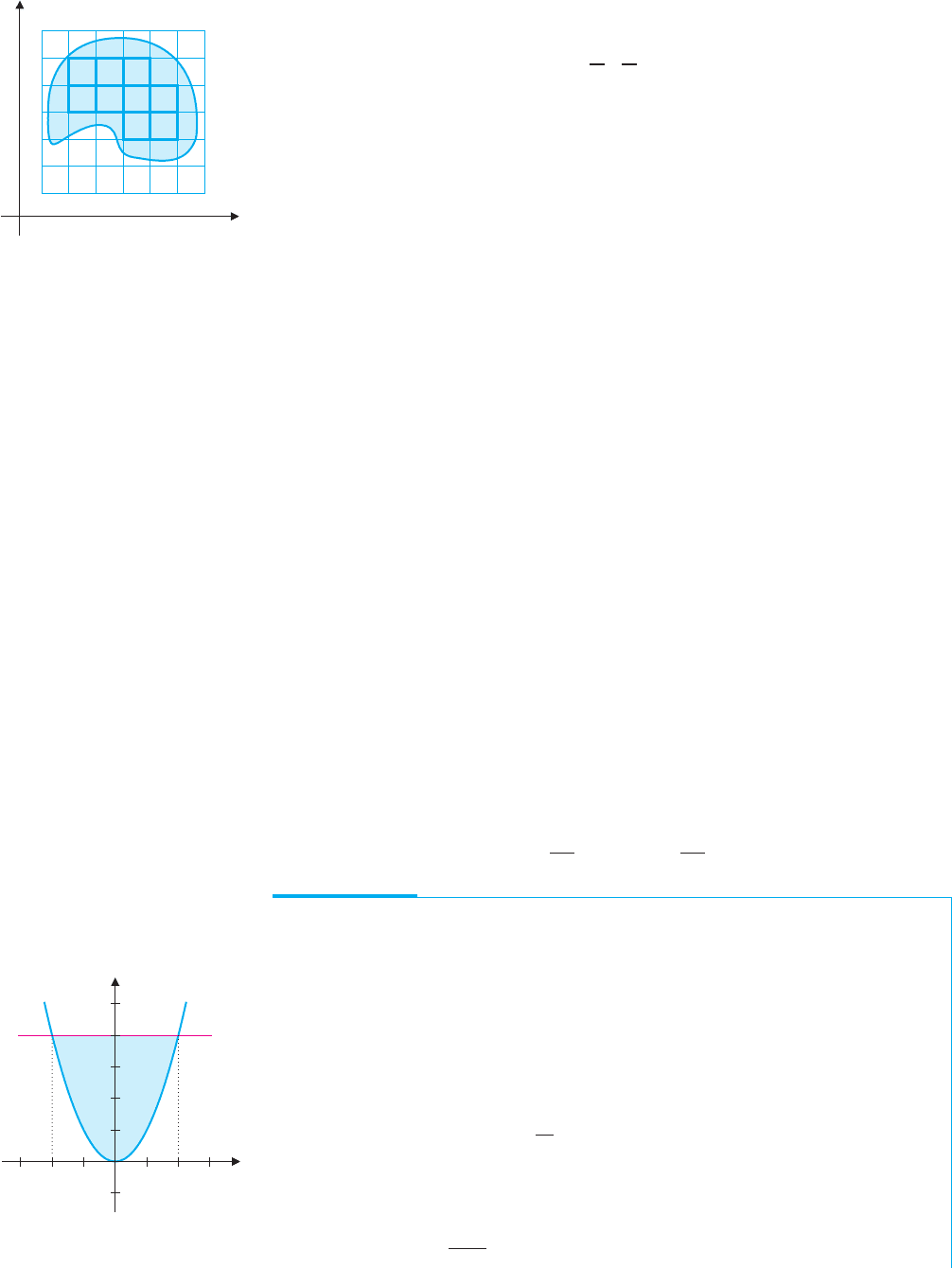
FIGURE 14.24a
Lamina
Moments and Center of Mass
We close this section by briefly discussing a physical application of double integrals. Con-
sider a thin, flat plate (a lamina) in the shape of the region R ⊂ R
2
whose density (mass
per unit area) varies throughout the plate (i.e., some areas of the plate are more dense than
others). From an engineering standpoint, it’s often important to determine where you could
place a support to balance the plate. We call this point the center of mass of the lamina.
We’ll first need to find the total mass of the plate. For a real plate, we’d simply place it on
a scale, but for our theoretical plate, we’ll need to be more clever. Suppose the lamina has
the shape of the region R shown in Figure 14.24a and has mass density (mass per unit area)
given by the function ρ(x, y). Construct an inner partition of R, as in Figure 14.24b. Notice
thatif the norm of the partition Pis small, thenthe density will be nearly constant on each
rectangle of the inner partition. So, for each i = 1, 2,...,n, pick some point (u
i
,v
i
) ∈ R
i
.
P1: OSO/OVY P2: OSO/OVY QC: OSO/OVY T1: OSO
MHDQ256-Ch14 MHDQ256-Smith-v1.cls January 5, 2011 10:17
LT (Late Transcendental)
CONFIRMING PAGES
14-21 SECTION 14.2
..
Area, Volume and Center of Mass 921
Then, the mass m
i
of the portion of the lamina corresponding to the rectangle R
i
is given
approximately by
m
i
≈ ρ(u
i
,v
i
)
mass/unit area
A
i
area
,
where A
i
denotes the area of R
i
. The total mass m of the lamina is then approximately
m ≈
n
i=1
ρ(u
i
,v
i
) A
i
.
y
x
R
1
R
2
R
3
R
4
R
5
R
6
R
7
R
8
R
9
FIGURE 14.24b
Inner partition of R
To get the mass exactly, we take the limit as P tends to zero, which you should
recognize as a double integral:
m = lim
P→0
n
i=1
ρ(u
i
,v
i
) A
i
=
R
ρ(x, y)dA. (2.9)
Notice that if you want to balance a lamina like the one shown in Figure 14.24a, you’ll
need to balance it both from left to right and from top to bottom. In the language of our
previous discussion of center of mass in section 5.6, we’ll need to find the first moments:
both left to right (we call this the moment with respect to the y-axis) and top to bottom (the
moment with respect to the x-axis). First, we approximate the moment M
y
with respect
to the y-axis. Assuming that the mass in the ith rectangle of the partition is concentrated at
the point (u
i
,v
i
), we have
M
y
≈
n
i=1
u
i
ρ(u
i
,v
i
)
(i.e., the sum of the products of the masses and their directed distances from the y-axis).
Taking the limit as P tends to zero, we get
M
y
= lim
P→0
n
i=1
u
i
ρ(u
i
,v
i
) =
R
xρ(x, y) dA. (2.10)
Similarly, looking at the sum of the products of the masses and their directed distances from
the x-axis, we get the moment M
x
with respect to the x-axis,
M
x
= lim
P→0
n
i=1
v
i
ρ(u
i
,v
i
) =
R
yρ(x, y) dA. (2.11)
The center of mass is the point (
¯
x,
¯
y) defined by
¯
x =
M
y
m
and
¯
y =
M
x
m
. (2.12)
EXAMPLE 2.6 Finding the Center of Mass of a Lamina
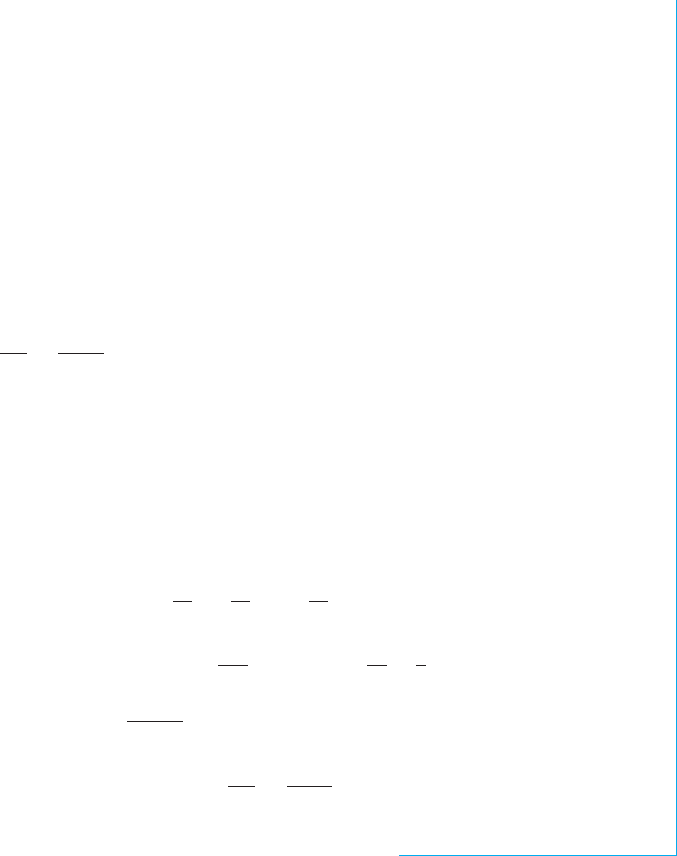
Find the center of mass of the lamina in the shape of the region bounded by the graphs
of y = x
2
and y = 4, having mass density given by ρ(x, y) = 1 +2y + 6x
2
.
y
x
22
4
2
y x
2
R
FIGURE 14.25
Lamina
Solution We sketch the region in Figure 14.25. From (2.9), we have that the total
mass of the lamina is given by
m =
R
ρ(x, y)dA =
2
−2
4
x
2
(1 + 2y + 6x
2
)dydx
=
2
−2
y + 2
y
2
2
+ 6x
2
y
y=4
y=x
2
dx
=
2
−2
[(4 + 16 + 24x
2
) − (x
2
+ x
4
+ 6x
4
)]dx
=
1696
15
≈ 113.1.
P1: OSO/OVY P2: OSO/OVY QC: OSO/OVY T1: OSO
MHDQ256-Ch14 MHDQ256-Smith-v1.cls January 5, 2011 10:17
LT (Late Transcendental)
CONFIRMING PAGES
922 CHAPTER 14
..
Multiple Integrals 14-22
We compute the moment M
y
from (2.10):
M
y
=
R
xρ(x, y) dA =
2
−2
4
x
2
x(1 +2y + 6x
2
)dydx
=
2
−2
4
x
2
(x + 2xy + 6x
3
)dydx
=
2
−2
(xy + xy
2
+ 6x
3
y)
y=4
y=x
2
dx
=
2
−2
[(4x + 16x + 24x
3
) − (x
3
+ x
5
+ 6x
5
)]dx = 0.
Note that from (2.12), this says that the x-coordinate of the center of mass is
¯
x =
M
y
m
=
0
113.1
= 0. This should not surprise you since both the region and the mass
density are symmetric with respect to the y-axis. [Notice that ρ(−x, y) = ρ(x, y).]
Next, from (2.11), we have
M
x
=
R
yρ(x, y) dA =
2
−2
4
x
2
y(1 +2y + 6x
2
)dydx
=
2
−2
4
x
2
(y + 2y
2
+ 6x
2
y) dydx
=
2
−2
y
2
2
+ 2
y
3
3
+ 6x
2
y
2
2
y=4
y=x
2
dx
=
2
−2
8 +
128
3
+ 48x
2
−
x
4
2
+
2
3
x
6
+ 3x
6
dx
=
11,136
35
≈ 318.2
and so, from (2.12) we have
¯
y =
M
x
m
≈
318.2
113.1
≈ 2.8. The center of mass is then
located at approximately
(
¯
x,
¯
y) ≈ (0, 2.8).
In example 2.6, we computed the first moments M
y
and M
x
to find the balance point
(center of mass) of the lamina in Figure 14.25. Further physical properties of this lamina
can be determined using the second moments I
y
and I
x
. Much as we defined the first
moments in equations (2.10) and (2.11), the second moment about the y-axis (often called
the moment of inertia about the y-axis) of a lamina in the shape of the region R, with
density function ρ(x, y) is defined by
I
y
=
R
x
2
ρ(x, y)dA.
Similarly, the second moment about the x-axis (also called the moment of inertia
about the x-axis) of a lamina in the shape of the region R, with density function ρ(x, y)is
defined by
I
x
=
R
y
2
ρ(x, y)dA.
Physics tells us that the larger I
y
is, the more difficult it is to rotate the lamina about the
y-axis. Similarly, the larger I
x
is, the more difficult it is to rotate the lamina about the x-axis.
We explore this briefly in example 2.7.