
Smith R., Minton R. Calculus
Подождите немного. Документ загружается.


P1: OSO/OVY P2: OSO/OVY QC: OSO/OVY T1: OSO
MHDQ256-Ch14 MHDQ256-Smith-v1.cls January 5, 2011 10:17
LT (Late Transcendental)
CONFIRMING PAGES
14-23 SECTION 14.2
..
Area, Volume and Center of Mass 923
EXAMPLE 2.7 Finding the Moments of Inertia of a Lamina
Find the moments of inertia I
y
and I
x
for the lamina in example 2.6.
Solution The region R is the same as in example 2.6 (see Figure 14.25), so that the
limits of integration are the same. We have
I
y
=
2
−2
4
x
2
x
2
(1 + 2y + 6x
2
)dydx
=
2
−2
(20x
2
+ 23x
4
− 7x
6
)dx
=
2176
15
≈ 145.07
and
I
x
=
2
−2
4
x
2
y
2
(1 + 2y + 6x
2
)dydx
=
2
−2
448
3
+ 128x
2
−
1
3
x
6
−
5
2
x
8
dx
=
61,952
63
≈ 983.37.
A comparison of the two moments of inertia shows that it is much more difficult to
rotate the lamina of Figure 14.25 about the x-axis than about the y-axis. Examine the
figure and the density function to be sure that this makes sense to you.
EXERCISES 14.2
WRITING EXERCISES
1. The double Riemann sum in (2.5) disguises the fact that the
order of integration is important. Explain how the order of
integration affects the details of the double Riemann sum.
2. Many double integrals can be set up in two steps: first identify
theintegrand f (x, y),thenidentify thetwo-dimensionalregion
R and set up the limits of integration. Explain how these two
steps are separated in examples 2.2, 2.3 and 2.4.
3. The sketches in examples 2.2, 2.3 and 2.4 are essential, but
somewhat difficult to draw. Explain each sketch, including
which surface should be drawn first, second and so on. Also,
when a previously drawn surface is cut in half by a plane,
explain how to identify which half of the cut surface to
keep.
4. The moment M
y
is the moment about the y-axis, but is used to
find the x-coordinate of the center of mass. Explain why it is
M
y
and not M
x
that is used to compute the x-coordinate of the
center of mass.
In exercises 1–6, use a double integral to compute the area of
the region bounded by the curves.
1. y = x
2
, y = 8 − x
2
2. y = x
2
, y = x +2
3. y = 2x, y = 3 − x, y = 0 4. y = 3x, y = 5 −2x, y = 0
5. y = x
2
, x = y
2
6. y = x
3
, y = x
2
............................................................
In exercises 7–22, compute the volume of the solid bounded by
the given surfaces.
7. 2x + 3y + z = 6 and the three coordinate planes
8. x + 2y − 3z = 6 and the three coordinate planes
9.
z = 4 − x
2
− y
2
and z = 0, with −1 ≤ x ≤ 1 and −1 ≤ y ≤ 1
10. z = x
2
+ y
2
, z = 0, x = 0, x = 1, y = 0, y = 1
11. z = sin y, z =−1, y = x, y = 2 − x, y = 0
12. z = cos(x + y), z = 0, y = 0, x = 0, y =
π
4
, x =
π
4
13. z = 1 − y
2
, x + y = 1 and the three coordinate planes
(first octant)
14. z = 1 − x
2
− y
2
, x + y = 1 and the three coordinate planes
15. z = x
2
+ y
2
+ 3, z = 1, y = x
2
, y = 4
16. z = x
2
+ y
2
+ 1, z =−1, y = x
2
, y = 2x + 3
17. z = x + 2, z = y − 2, x = y
2
− 2, x = y
18. z = 2x + y + 1, z =−2x, x = y
2
, x = 1
19. z − x + y
2
= 0(z ≥ 0), z = 0, x = 4
20. z + y − x
2
= 0(z ≤ 0), z = 0, y = 2
21. z = 2 − y, z =|x|, y = 0, y = 1
22. z = y
2
+ 1, z = 3 − x, x =−1
............................................................
P1: OSO/OVY P2: OSO/OVY QC: OSO/OVY T1: OSO
MHDQ256-Ch14 MHDQ256-Smith-v1.cls January 5, 2011 10:17
LT (Late Transcendental)
CONFIRMING PAGES
924 CHAPTER 14
..
Multiple Integrals 14-24
In exercises 23–26, set up a double integral for the volume
bounded by the given surfaces and estimate it numerically.
23. z =
x
2
+ y
2
, y = 4 − x
2
, first octant
24. z =
4 − x
2
− y
2
, inside x
2
+ y
2
= 1, first octant
25. z = e
xy
, x + 2y = 4 and the three coordinate planes
26. z = e
x
2
+y
2
, z = 0 and x
2
+ y
2
= 4
............................................................
In exercises 27–32, find the mass and center of mass of the
lamina with the given density.
27. Lamina bounded by y = x
3
and y = x
2
,ρ(x, y) = 4
28. Lamina bounded by y = x
4
and y = x
2
,ρ(x, y) = 4
29. Lamina bounded by x = y
2
and x = 1,ρ(x, y) = y
2
+ x + 1
30. Lamina bounded by x = y
2
and x = 4,ρ(x, y) = y + 3
31. Lamina bounded by y = x
2
(x > 0), y = 4 and x = 0,
ρ(x, y) = distance from y-axis
32. Lamina bounded by y = x
2
− 4 and y = 5,ρ(x, y) = square
of the distance from the y-axis
............................................................
33. (a) The laminae of exercises 29 and 30 are both symmetric
about the x-axis. Explain why it is not true in both exercises
that the center of mass is located on the x-axis. (b) Suppose
that a lamina is symmetric about the x-axis. State a condition
on the density function ρ(x, y) that guarantees that the center
of mass is located on the x-axis.
34. Suppose that a lamina is symmetric about the y-axis. State a
condition on the density function ρ(x, y) that guarantees that
the center of mass is located on the y-axis.
35. Suppose that f (x, y) = 15,000xe
−x
2
−y
2
is the population den-
sity of a species of small animals. Estimate the population in
the triangular region with vertices (1, 1), (2, 1) and (1, 0).
36. Suppose that f (x, y) = 15,000xe
−x
2
−y
2
is the population den-
sity of a species of small animals. Estimate the population in
the region bounded by y = x
2
, y = 0 and x = 1.
37. (a) A triangular lamina has vertices (0, 0), (0, 1) and (c, 0)
for some positive constant c. Assuming constant mass density,
show that the y-coordinate of the center of mass of the lamina
is independent of the constant c. (b) Find the x-coordinate of
the center of mass as a function of c.
38. A lamina is bounded by y = 0, y = f (x) and x = c,
where f (0) = 0, f (c) = 1, f (x) ≥ 0 for 0 ≤ x ≤ c and
f (x) = g(
x
c
) for some polynomial g. If thedensity is constant,
showthatthe y-coordinate of the center of mass is independent
of c.
39. Let T be the tetrahedron with vertices (0, 0, 0), (a, 0, 0),
(0, b, 0) and (0, 0, c). Let B be the rectangular box with the
same vertices plus (a, b, 0), (a, 0, c), (0, b, c), and (a, b, c).
(a) Show that the volume of T is
1
6
the volume of B. (b) Ex-
plain how to slice the box B to get the tetrahedron T. Identify
the percentage of volume that is sliced off each time.
40. Show that V
1
= V
2
, where V
1
is the volume under
z = 4 − x
2
− y
2
and above the xy-plane and V
2
is the volume
between z = x
2
+ y
2
and z = 4. Illustrate this with a graph.
The average value of a function f on a two-dimensional region
R of area a is defined by
1
a
R
f (x, y) dA. Use this definition in
exercises 41–44.
41. (a) Compute the average value of f (x, y) = y on the region
bounded by y = x
2
and y = 4. (b) Compare the average value
of f to the y-coordinate of the center of mass of a lamina with
the same shape and constant density.
42. (a) Compute the average value of f (x, y) = y
2
on the region
bounded by y = x
2
and y = 4. (b) In part (a), R extends from
y = 0toy = 4. Explain why the average value of f corre-
sponds to a y-value larger than 2.
43. (a) Compute the average value of f (x, y) =
x
2
+ y
2
on the region bounded by y = x
2
− 4 and y = 3x.
(b) Interpret the geometric meaning of the average value in
this case. (Hint: What does
x
2
+ y
2
represent geometri-
cally?)
44. Suppose the temperature at the point (x, y) in a region R is
given by T (x, y) = 50 + cos(2x + y), where R is bounded
by y = x
2
and y = 8 − x
2
. Estimate the average temperature
in R.
............................................................
Inexercises 45–52, use thefollowingdefinition of joint pdf (prob-
ability density function): a function f is a joint pdf on the
two-dimensional region S if f (x, y) ≥ 0 for all (x, y)inS and
S
f (x, y) dA 1. Then for any region R ⊂ S, the probability
that (x, y)isinR is given by
R
f (x, y) dA.
45. Show that f (x, y) = e
−x
e
−y
is a joint pdf in the first quadrant
x ≥ 0, y ≥ 0. (Hint: You will need to evaluate an improper
double integral as iterated improper integrals.)
46. Showthat f (x, y) = 0.3x + 0.4y is ajointpdfontherectangle
0 ≤ x ≤ 2, 0 ≤ y ≤ 1.
47. Find a constant c such that f (x, y) = c(x + 2y) is a joint pdf
on the triangle with vertices (0, 0), (2, 0) and (2, 6).
48. Find a constant c such that f (x, y) = c(x
2
+ y) is a joint pdf
on the region bounded by y = x
2
and y = 4.
49. Suppose that f (x, y) is a joint pdf on the region bounded by
y = x
2
, y = 0and x = 2.Setup adouble integral for the prob-
ability that y < x.
50. Suppose that f (x, y) is a joint pdf on the region bounded by
y = x
2
, y = 0and x = 2.Setup adouble integral for the prob-
ability that y < 2.
51. A point is selected at random from the region bounded by
y = 4 − x
2
(x > 0), x = 0and y = 0.Thismeansthatthejoint
pdf for the point is constant, f (x, y) = c. Find the value of c.
Thencompute the probabilitythat y > x for the randomlycho-
sen point.
52. A point is selected at random from the region bounded by
y = 4 − x
2
(x > 0), x = 0 and y = 0. Compute the probabil-
ity that y > 2.
P1: OSO/OVY P2: OSO/OVY QC: OSO/OVY T1: OSO
MHDQ256-Ch14 MHDQ256-Smith-v1.cls January 7, 2011 7:53
LT (Late Transcendental)
CONFIRMING PAGES
14-25 SECTION 14.2
..
Area, Volume and Center of Mass 925
APPLICATIONS
53. (a) Suppose that f (x, t) = 20e
−t/6
is the yearly rate of change
of the price per barrel of oil. If x is the number of billions of
barrels purchased and t is the number of years since 2000,
compute and interpret
10
0
4
0
f (x, t)dt dx.
(b) Repeat for f (x, t) =
20e
−t/6
, if 0 ≤ x ≤ 4
14e
−t/6
, if x > 4
.
54. (a) Estimate the moment of inertia about the y-axis of the two
ellipses R
1
bounded by x
2
+ 4y
2
= 16 and R
2
bounded by
x
2
+ 4y
2
= 36. Assuming a constant density of ρ = 1, R
1
and R
2
can be thought of as models of two tennis racket
heads. The rackets have the same shape, but the second
racket is much bigger than the first (the difference in size
is about the same as the difference between rackets of the
1960s and rackets of the 1990s).
(b) A rotation about the y-axis corresponds to the racket twist-
ing in your hand, which is undesirable. Compare the ten-
denciesof thetworacketstotwist.AsrelatedinBlandigand
Monteleone’s What Makes a Boomerang Come Back, the
larger moment of inertia is what motivated a sore-elbowed
Howard Head to construct large-headed tennis rackets in
the 1970s.
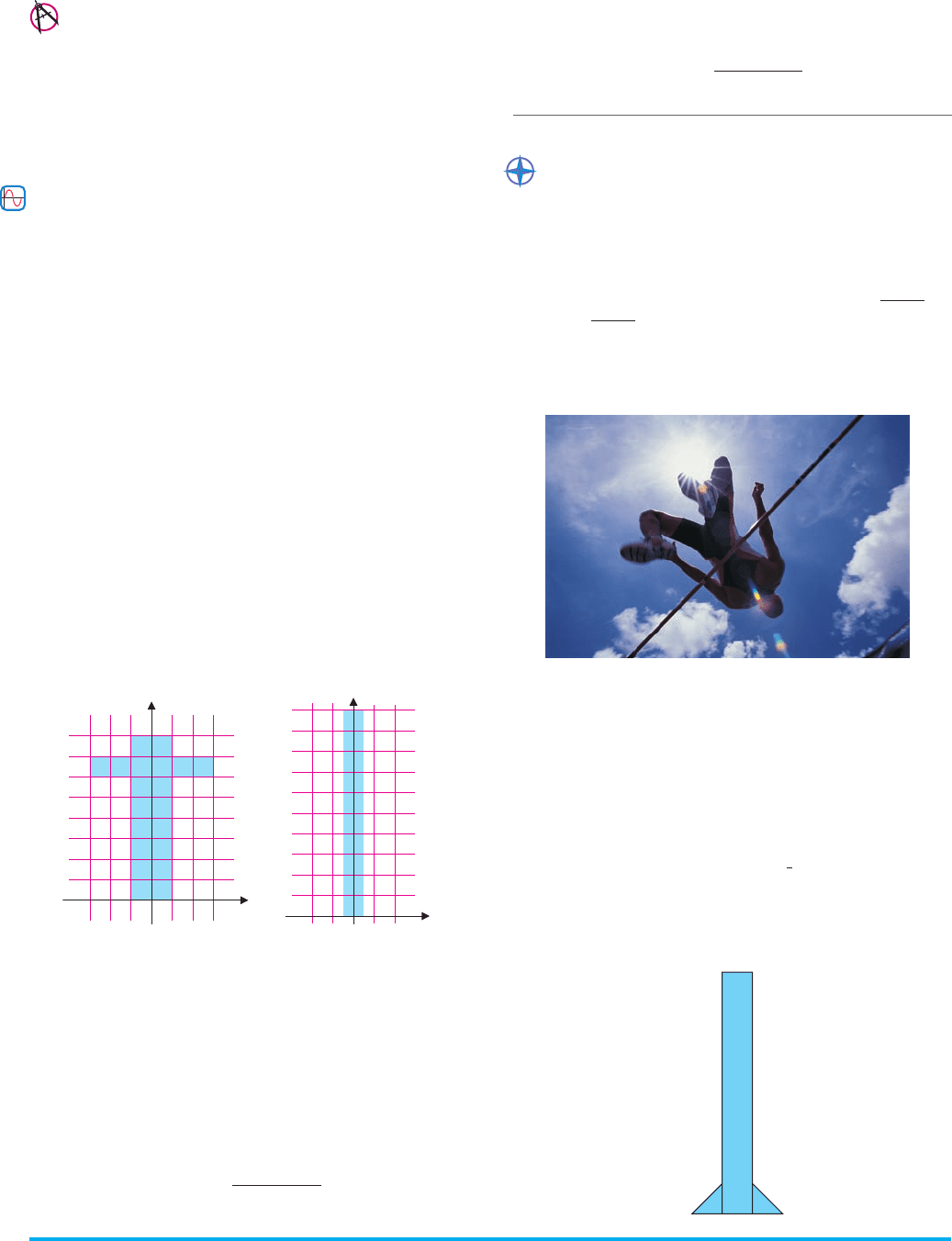
55. Figure skaters can control their rate of spin ω by varying their
body positions, utilizing the principle of conservation of an-
gular momentum. This states that in the absence of outside
forces,the quantity I
y
ω remainsconstant. Thus,reducing I
y
by
a factor of 2 will increase spin rate by a factor of 2. Compare
the spin rates of the following two crude models of a figure
skater, the first with arms extended (use ρ = 1) and the second
with arms raised and legs crossed (use ρ = 2).
y
x
y
x
56. Lamina A is in the shape of the rectangle −1 ≤ x ≤ 1 and
−5 ≤ y ≤ 5, with density ρ(x, y) = 1. It models a diver in the
“layout” position. Lamina B is in the shape of the rectangle
−1 ≤ x ≤ 1 and −2 ≤ y ≤ 2 with density ρ(x, y) = 2.5. It
models a diver in the “tuck” position. Find the moment of in-
ertia I
x
for each lamina, and explain why divers use the tuck
position to do multiple rotation dives.
57. Suppose that the function f (x, y) gives the rainfall per unit
area at the point (x, y) in a region R. State in words what
(a)
R
f (x, y)dA and (b)
R
f (x, y)dA
R
1dA
represent.
58. Suppose that the function p(x, y) gives the population density
at the point (x, y) in a region R. State in words what
(a)
R
p(x, y)dA and (b)
R
p(x, y)dA
R
1dA
represent.
EXPLORATORY EXERCISES
1. When solving projectile motion problems, we track the mo-
tion of an object’s center of mass. For a high jumper, the ath-
lete’s entirebody must clear the bar. Amazingly, a highjumper
can accomplish this without raising his or her center of mass
above the bar. To see how, suppose the athlete’s body is bent
into a shape modeled by the region between y =
√
9 − x
2
and
y =
√
8 − x
2
with the bar at the point (0, 2). Assuming con-
stant mass density, show that the center of mass is below the
bar, but the body does not touch the bar.
2. Inthis exercise,weexplorean important issue in rocketdesign.
We will work with the crude model shown, where the main
tower of the rocket is 1 unit by 8 units and each triangular fin
has height 1 and width w. First, find the y-coordinate y
1
of the
center of mass, assuming a constant density ρ(x, y) = 1. Sec-
ond,findthe y-coordinate y
2
ofthecenter of massassuming the
following density structure: the top half of the main tower has
density ρ = 1, the bottom half of the main tower has density
ρ = 2 and the fins have density ρ =
1
4
. Find thesmallest value
of w such that y
1
< y
2
. In this case, if the rocket tilts slightly,
airdragwillpushthe rocketbackin line. This stability criterion
explains why model rockets have large, lightweight fins.
P1: OSO/OVY P2: OSO/OVY QC: OSO/OVY T1: OSO
MHDQ256-Ch14 MHDQ256-Smith-v1.cls January 5, 2011 10:17
LT (Late Transcendental)
CONFIRMING PAGES
926 CHAPTER 14
..
Multiple Integrals 14-26
14.3 DOUBLE INTEGRALS IN POLAR COORDINATES
Polarcoordinates are particularly usefulfordealingwith certain double integrals,for several
reasons. Most importantly, if the region over which you are integrating is in some way
circular, polar coordinates may significantly simplify the integration. For instance,
R
(x
2
+ y
2
+ 3) dA
y
R
x
22
2
2
dy
dx
y
4 x
2
y
4 x
2
FIGURE 14.26
A circular region
might look simple enough, until we tell you that R is the circle of radius 2, centered at
the origin, as shown in Figure 14.26. Writing the top half of the circle as the graph of
y =
√
4 − x
2
and the bottom half as y =−
√
4 − x
2
, the double integral now becomes
R
(x
2
+ y
2
+ 3) dA =
2
−2
√
4−x
2
−
√
4−x
2
(x
2
+ y
2
+ 3) dydx
=
2
−2
x
2
y +
y
3
3
+ 3y
y=
√
4−x
2
y=−
√
4−x
2
dx
= 2
2
−2
(x
2
+ 3)
4 − x
2
+
1
3
(4 − x
2
)
3/2
dx.
(3.1)
We probably don’t need to convince you that the integral in (3.1) is rather unpleasant. On
the other hand, as we’ll see shortly, this double integral is simple when it’s written in polar
coordinates. We consider several types of polar regions.
y
x
u b
u a
r g
1
(u)
r g
2
(u)
R
FIGURE 14.27a
Polar region R
y
x
u b
u a
r g
1
(u)
r g
2
(u)
FIGURE 14.27b
Partition of R
y
x
u
r
r r
1
r r
2
u u
2
u u
1
FIGURE 14.27c
Elementary polar region
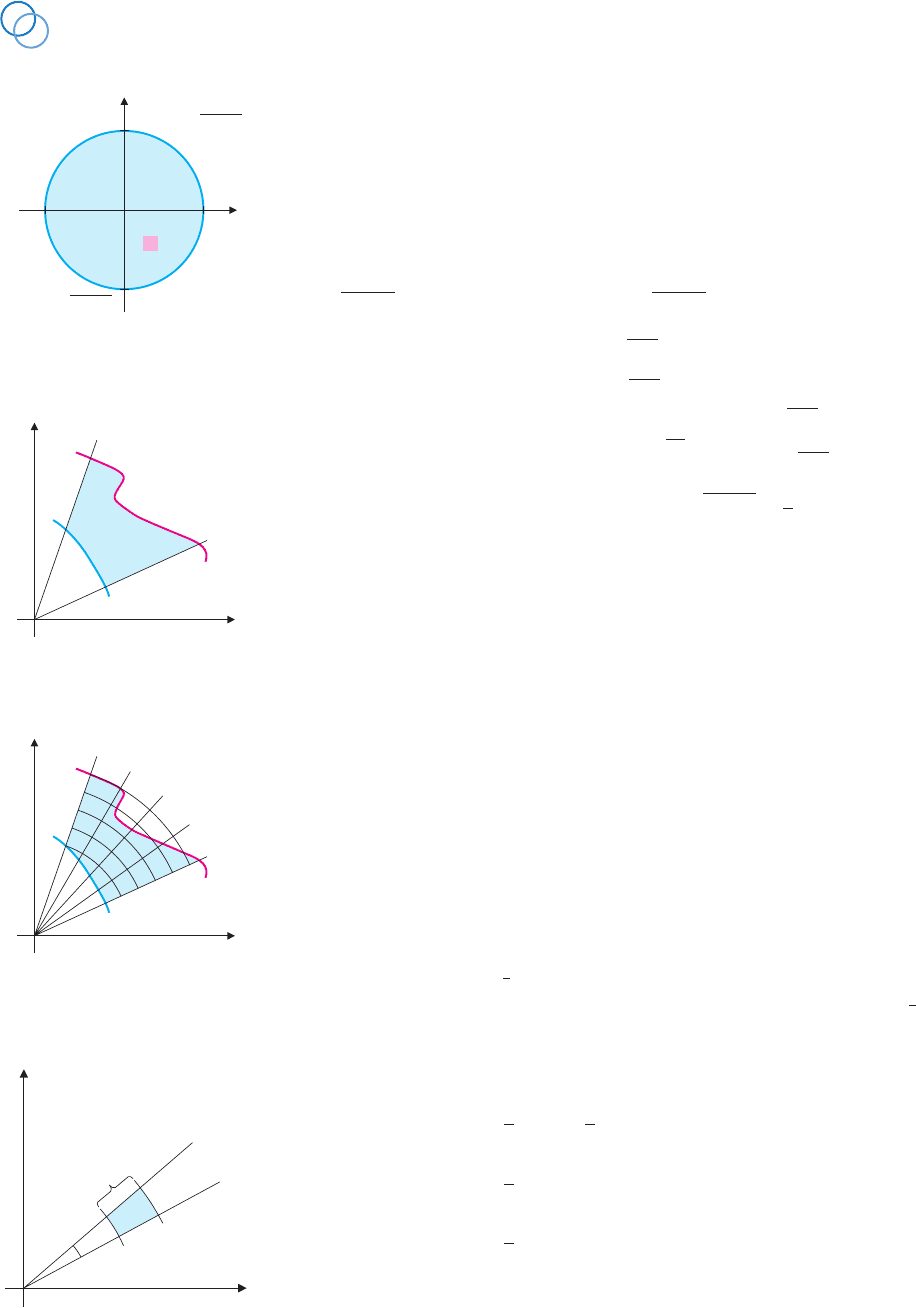
Suppose the region R can be written in the form
R ={(r,θ)|α ≤ θ ≤ β andg
1
(θ) ≤ r ≤ g
2
(θ)},
where 0 ≤ g
1
(θ) ≤ g
2
(θ), for all θ in [α, β], as pictured in Figure 14.27a. First, we
partition R, but rather than use a rectangular grid, as we have done with rectangular
coordinates, we use a partition consisting of a number of concentric circular arcs (of the
form r = constant) and rays (of the form θ = constant). We indicate such a partition of the
region R in Figure 14.27b.
Notice that rather than consisting of rectangles, the “grid” in this case is made up of
elementary polar regions, each bounded by two circular arcs and two rays (as shown in
Figure 14.27c). In an inner partition, we include only those elementary polar regions that
lie completely inside R.
We pause now briefly to calculate the area A of the elementary polar region indicated
in Figure 14.27c. Let
¯
r =
1
2
(r
1
+r
2
) be the average radius of the two concentric circular
arcsr = r
1
andr = r
2
. Recall that the area of a circular sector is givenby A =
1
2
θr
2
, where
r = radius and θ is the central angle of the sector. Consequently, we have that
A = Area of outer sector − Area of inner sector
=
1
2
θr
2
2
−
1
2
θr
2
1
=
1
2
r
2
2
−r
2
1
θ
=
1
2
(r
2
+r
1
)(r
2
−r
1
)θ
=
¯
rrθ. (3.2)
As a familiar starting point, we first consider the problem of finding the volume lying
beneath a surface z = f (r,θ), where f is continuous and f (r,θ) ≥ 0onR. Using (3.2), we
P1: OSO/OVY P2: OSO/OVY QC: OSO/OVY T1: OSO
MHDQ256-Ch14 MHDQ256-Smith-v1.cls January 5, 2011 10:17
LT (Late Transcendental)
CONFIRMING PAGES
14-27 SECTION 14.3
..
Double Integrals in Polar Coordinates 927
find that the volume V
i
lying beneath the surface z = f (r,θ) and above the ith elementary
polar region in the partition is then approximately the volume of the cylinder:
V
i
≈ f (r
i
,θ
i
)
height
A
i
area of base
= f (r
i
,θ
i
)r
i
r
i
θ
i
,
where (r
i
,θ
i
) is a point in R
i
and r
i
is the average radius in R
i
. We get an approximation to
the total volume V by summing over all the regions in the inner partition:
V ≈
n
i=1
f (r
i
,θ
i
)r
i
r
i
θ
i
.
As we have done a number of times now, we obtain the exact volume by taking the limit as
the norm of the partition P tends to zero and recognizing the iterated integral:
V = lim
P→0
n
i=1
f (r
i
,θ
i
)r
i
r
i
θ
i
=
β
α
g
2
(θ)
g
1
(θ)
f (r,θ)rdrdθ.
Inthis case, Pisthelongestdiagonalof anyelementarypolarregionin theinnerpartition.
More generally, we have the result in Theorem 3.1, which holds regardless of whether or
not f (r,θ) ≥ 0onR.
THEOREM 3.1 (Fubini’s Theorem)
Suppose that f (r,θ) is continuous on the region R ={(r,θ)|α ≤ θ ≤ β and
g
1
(θ) ≤ r ≤ g
2
(θ)}, where 0 ≤ g
1
(θ) ≤ g
2
(θ) for all θ in [α, β]. Then,
R
f (r,θ) dA =
β
α
g
2
(θ)
g
1
(θ)
f (r,θ)rdrdθ. (3.3)
NOTES
Theorem 3.1 says that to write
a double integral in polar
coordinates, we write
x = r cos θ, y = r sinθ, find the
limits of integration for r and θ
and replace dA by rdrdθ.Be
certain not to omit the factor of r
in dA = rdrdθ; this is a very
common error.
y
x
1 2 3123
5
4
3
2
1
1
R
FIGURE 14.28
r = 2 − 2 sinθ
The proof of this result is beyond the level of this text. However, the result should seem
reasonable from our development for the case where f (r,θ) ≥ 0.
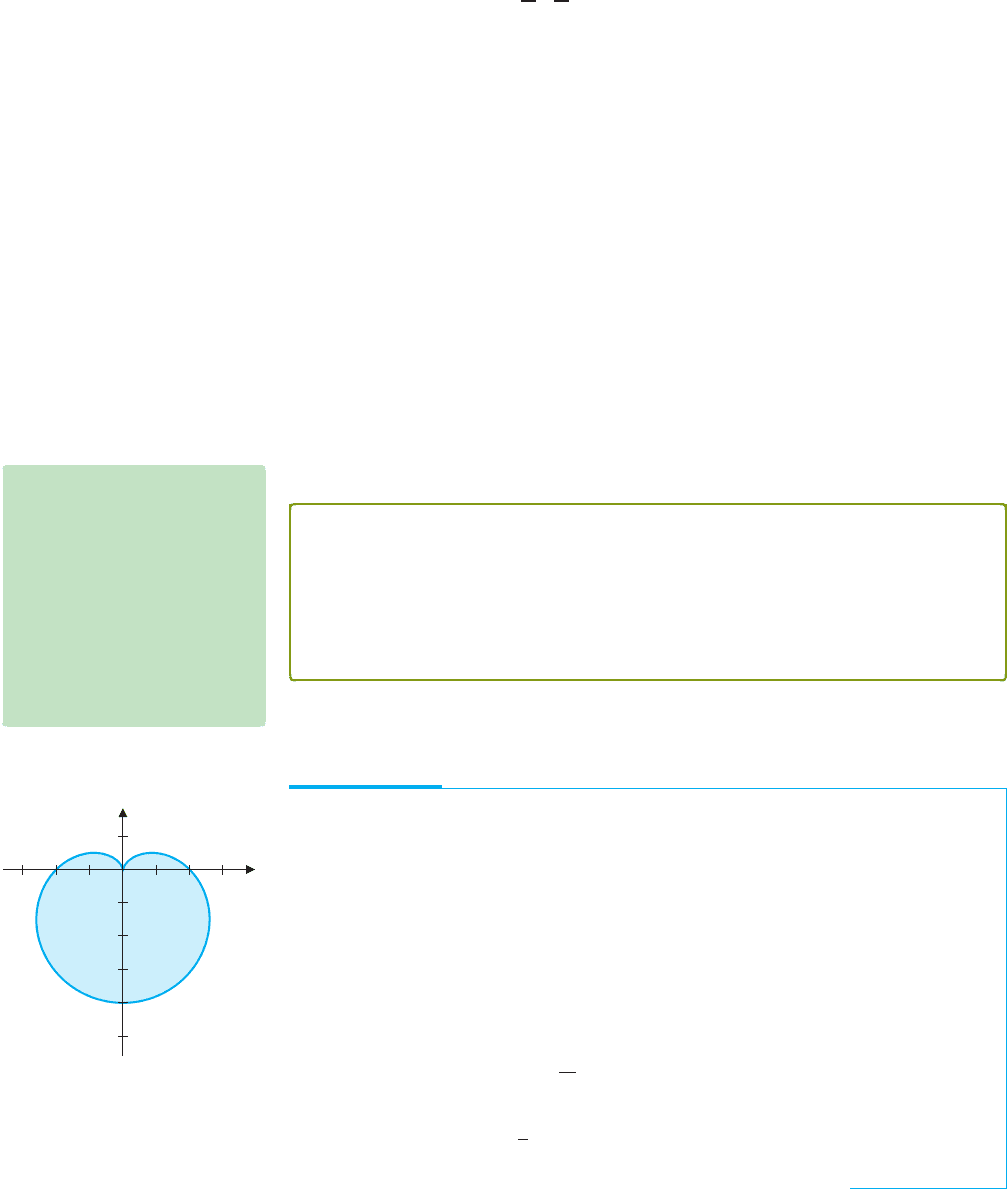
EXAMPLE 3.1 Computing Area in Polar Coordinates
Find the area inside the curve defined by r = 2 −2sin θ.
Solution From the graph of the region in Figure 14.28, note that for each fixed θ,
r ranges from 0 (corresponding to the origin) to 2 −2 sin θ (corresponding to the
cardioid). To go around the cardioid exactly once, θ ranges from 0 to 2π. From (3.3),
we then have
A =
R
dA
rdrdθ
=
2π
0
2−2sinθ
0
rdrdθ
=
2π
0
r
2
2
r=2−2sinθ
r=0
dθ
=
1
2
2π
0
[(2 − 2sinθ)
2
− 0] dθ = 6π,
where we have left the details of the final calculation as an exercise.
We now return to our introductory example and show how the introduction of polar
coordinates can dramatically simplify certain double integrals in rectangular coordinates.
P1: OSO/OVY P2: OSO/OVY QC: OSO/OVY T1: OSO
MHDQ256-Ch14 MHDQ256-Smith-v1.cls January 7, 2011 7:53
LT (Late Transcendental)
CONFIRMING PAGES
928 CHAPTER 14
..
Multiple Integrals 14-28
EXAMPLE 3.2 Evaluating a Double Integral in Polar Coordinates
Evaluate
R
(x
2
+ y
2
+ 3) dA, where R is the circle of radius 2 centered at the origin.
y
x
22
2
2
u
r 2
R
FIGURE 14.29
The region R
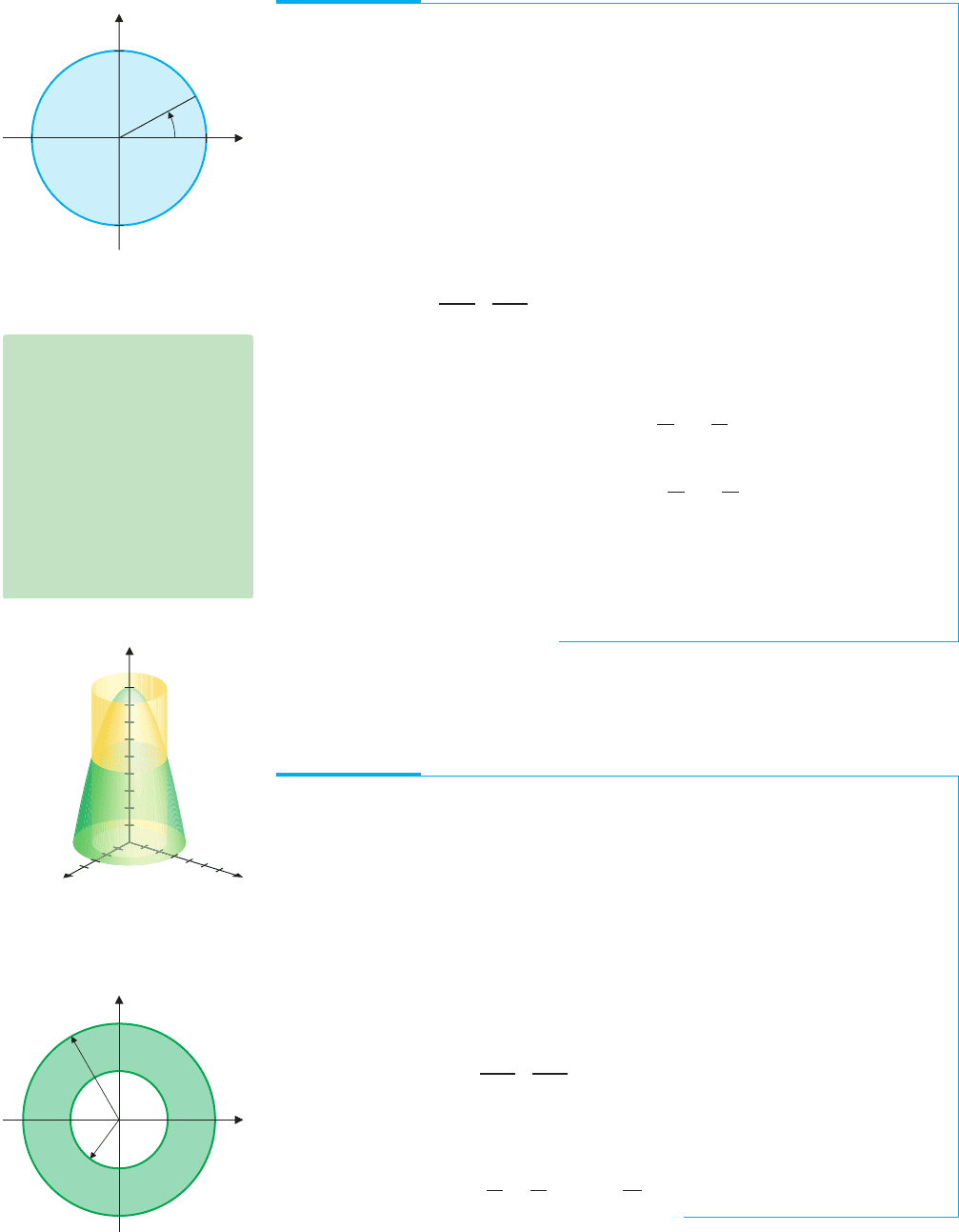
Solution First, recall from this section’s introduction that in rectangular coordinates
as in (3.1), this integral is extremely messy. From the region of integration shown in
Figure 14.29, it’s easy to see that for each fixed θ,r ranges from 0 (corresponding to the
origin) to 2 (corresponding to a point on the circle). Then, in order to go around the
circle exactly once, θ ranges from 0 to 2π. Finally, notice that the integrand contains the
quantity x
2
+ y
2
, which you should recognize as r
2
in polar coordinates. From (3.3), we
now have
R
(x
2
+ y
2
+ 3)
r
2
+ 3
dA
rdrdθ
=
2π
0
2
0
(r
2
+ 3)rdrdθ
=
2π
0
2
0
(r
3
+ 3r)dr dθ
=
2π
0
r
4
4
+ 3
r
2
2
r=2
r=0
dθ
=
2π
0
2
4
4
+ 3
2
2
2
− 0
dθ
= 10
2π
0
dθ = 20π.
Notice how simple this iterated integral was, as compared to the corresponding integral
in rectangular coordinates in (3.1).
NOTES
For double integrals of the form
b
a
d
c
f (r)dr dθ, note that the
inner integral does not depend on
θ. As a result, we can rewrite the
double integral as
b
a
1dθ
d
c
f (r)dr
= (b −a)
d
c
f (r)dr.
When dealing with double integrals, you should always consider whether the region
over which you’re integrating is in some way circular. If it is a circle or some portion of a
circle, consider using polar coordinates.
EXAMPLE 3.3 Finding Volume Using Polar Coordinates
Find the volume inside the paraboloid z = 9 − x
2
− y
2
, outside the cylinder
x
2
+ y
2
= 4 and above the xy-plane.
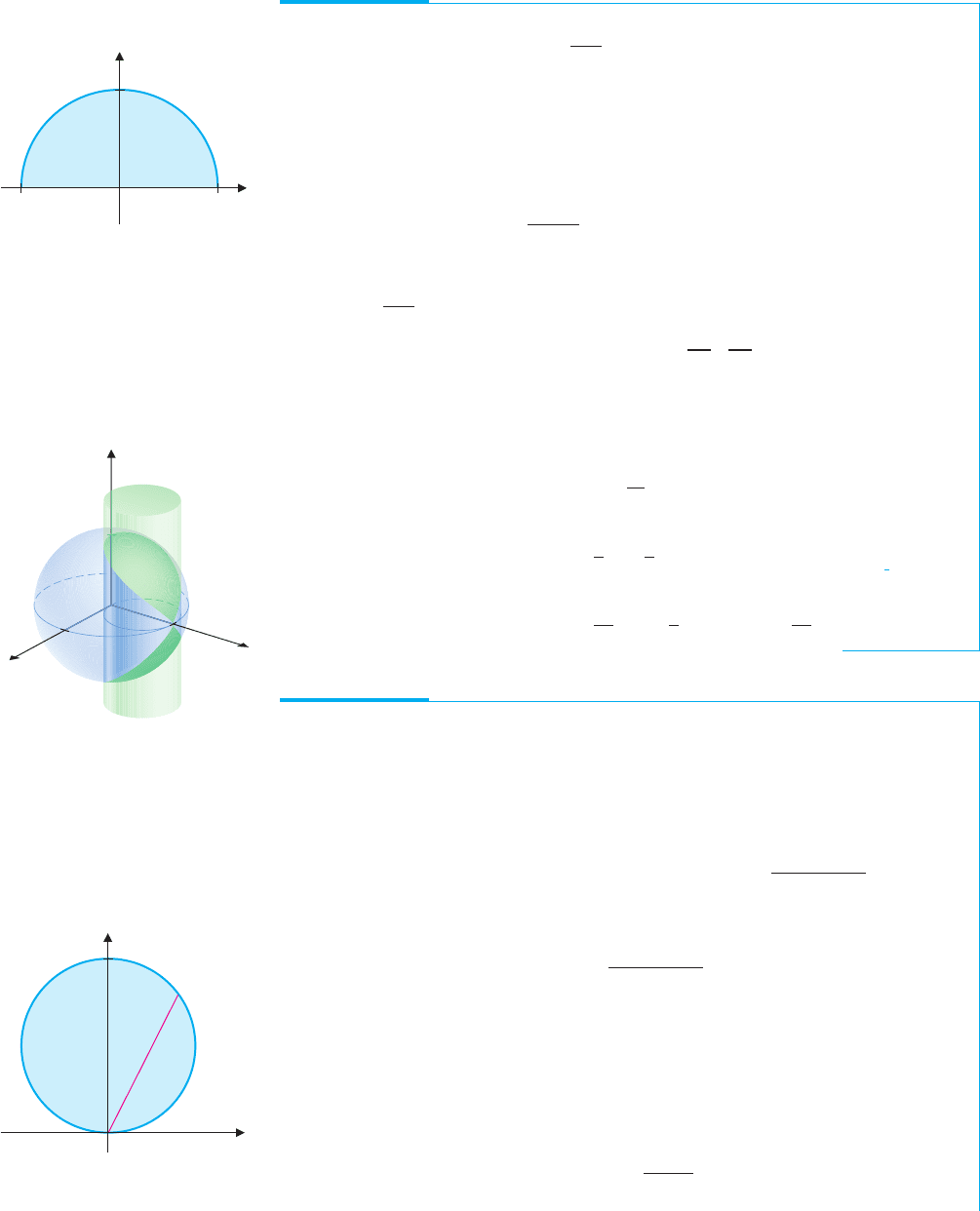
Solution Notice that the paraboloid has its vertex at the point (0, 0, 9) and the axis of
the cylinder is the z-axis. (See Figure 14.30a.) You should observe that the solid lies
below the paraboloid and above the region in the xy-plane lying between the traces of
the cylinder and the paraboloid in the xy-plane, that is, between the circles of radius 2
and 3, both centered at the origin. So, for each fixed θ ∈ [0, 2π], r ranges from 2 to 3.
We call such a region a circular annulus. (See Figure 14.30b.) From (3.3), we have
V =
R
(9 − x
2
− y
2
)
9 − r
2
dA
rdrdθ
=
2π
0
3
2
(9 − r
2
)rdrdθ
=
2π
0
3
2
(9r − r
3
)dr dθ = 2π
3
2
(9r − r
3
)dr
= 2π
9
r
2
2
−
r
4
4
r=3
r=2
=
25
2
π.
z
9 r
2
r
2
4
9
x
y
z
3
FIGURE 14.30a
Volume outside the cylinder and
inside the paraboloid
y
x
r 2
r 3
R
FIGURE 14.30b
Circular annulus
There are actually two things that you should look for when you are considering using
polar coordinates for a double integral. The first is most obvious: Is the geometry of the
P1: OSO/OVY P2: OSO/OVY QC: OSO/OVY T1: OSO
MHDQ256-Ch14 MHDQ256-Smith-v1.cls January 5, 2011 10:17
LT (Late Transcendental)
CONFIRMING PAGES
14-29 SECTION 14.3
..
Double Integrals in Polar Coordinates 929
region circular? The other is: Does the integral contain the expression x
2
+ y
2
(particularly
inside of other functions such as square roots, exponentials, etc.)? Since r
2
= x
2
+ y
2
,
changing to polar coordinates will often simplify terms of this form.
EXAMPLE 3.4 Changing a Double Integral to Polar Coordinates
Evaluate the iterated integral
1
−1
√
1−x
2
0
x
2
(x
2
+ y
2
)
2
dydx.
Solution First, you should recognize that evaluating this integral in rectangular
coordinates is nearly hopeless. (Try it and see why!) On the other hand, it does have a
term of the form x
2
+ y
2
, which we discussed above. Even more significantly, the
region over which you’re integrating turns out to be a semicircle, as follows. Reading
the inside limits of integration first, observe that for each fixed x between −1 and 1, y
ranges from y = 0uptoy =
√
1 − x
2
(the top half of the circle of radius 1 centered at
the origin). We sketch the region in Figure 14.31. From (3.3), we have
1
−1
√
1−x
2
0
x
2
(x
2
+ y
2
)
2
dydx =
R
x
2
r
2
cos
2
θ
(x
2
+ y
2
)
2
(r
2
)
2
dA
rdrdθ
Since x = r cos θ .
=
π
0
1
0
r
7
cos
2
θ dr dθ
=
π
0
r
8
8
r=1
r=0
cos
2
θ dθ
=
1
8
π
0
1
2
(1 + cos2θ)dθ
Since cos
2
θ =
1
2
(1 +cos 2θ ).
=
1
16
θ +
1
2
sin2θ
π
0
=
π
16
.
y
x
11
1
R
FIGURE 14.31
The region R
y
x
z
2
2
FIGURE 14.32a
Volume inside the sphere and inside
the cylinder
y
x
2
r 2 sin u
R
FIGURE 14.32b
The region R
EXAMPLE 3.5 Finding Volume Using Polar Coordinates
Find the volume cut out of the sphere x
2
+ y
2
+ z
2
= 4 by the cylinder x
2
+ y
2
= 2y.
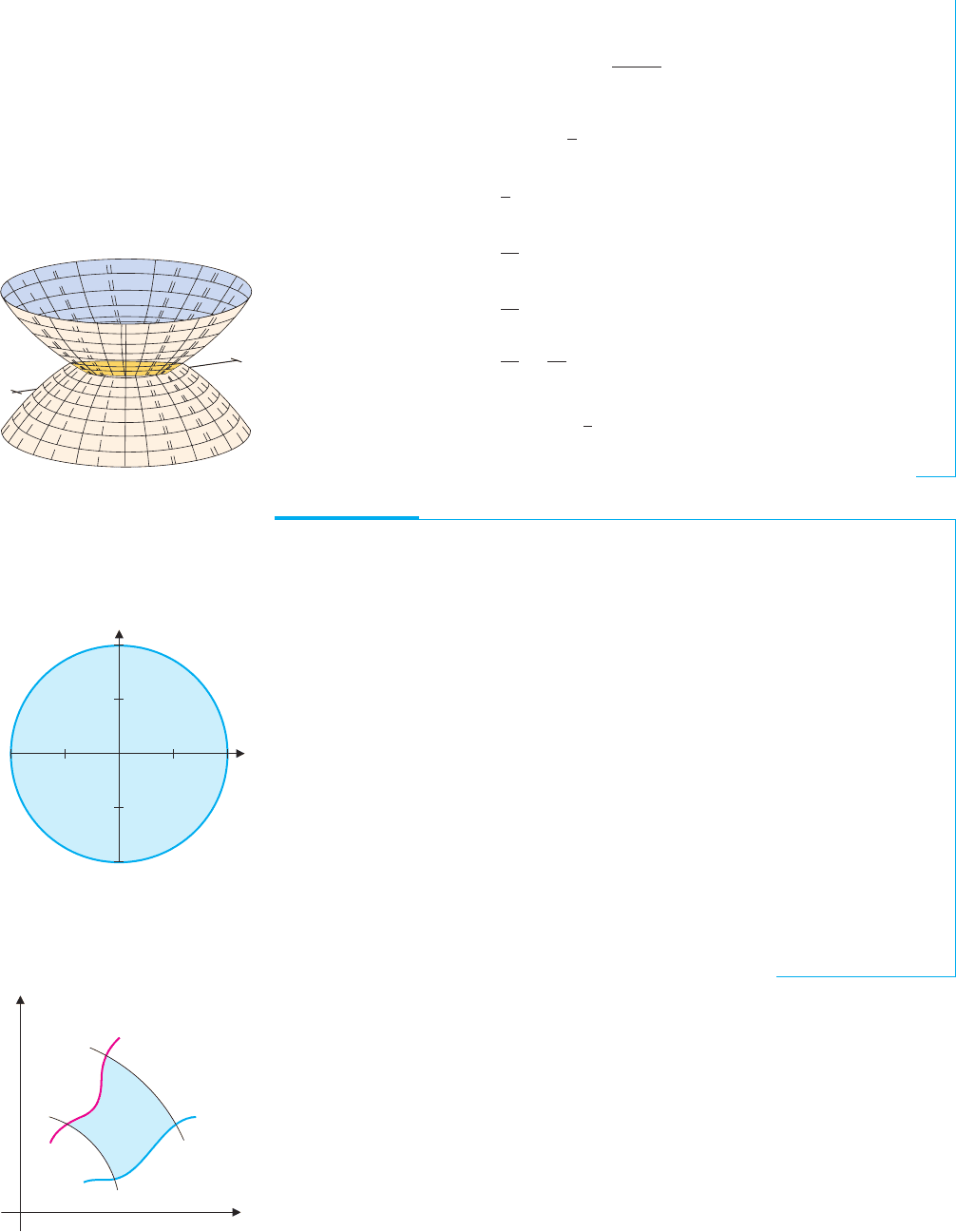
Solution We show a sketch of the solid in Figure 14.32a. (If you complete the square
in the equation of the cylinder, you’ll see that it is a circular cylinder of radius 1, whose
axis is the line: x = 0, y = 1, z = t.) Notice that equal portions of the volume lie
above and below the circle of radius 1 centered at (0, 1), indicated in Figure 14.32b. So,
we compute the volume lying below the top hemisphere z =
4 − x
2
− y
2
and above
the region R indicated in Figure 14.32b and double it. We have
V = 2
R
4 − x
2
− y
2
dA.
Since R is a circle and the integrand includes a term of the form x
2
+ y
2
, we introduce
polar coordinates. Since y = r sinθ , the circle x
2
+ y
2
= 2y becomes r
2
= 2r sinθ or
simply r = 2sin θ . This gives us
V = 2
π
0
2sinθ
0
4 − r
2
rdrdθ,
P1: OSO/OVY P2: OSO/OVY QC: OSO/OVY T1: OSO
MHDQ256-Ch14 MHDQ256-Smith-v1.cls January 5, 2011 10:17
LT (Late Transcendental)
CONFIRMING PAGES
930 CHAPTER 14
..
Multiple Integrals 14-30
since the entire circle r = 2sin θ is traced out for 0 ≤ θ ≤ π and since for each fixed
θ ∈ [0,π], r ranges from r = 0tor = 2sinθ . Notice further that by symmetry, we get
V = 4
π/2
0
2sinθ
0
4 − r
2
rdrdθ
=−2
π/2
0
2
3
(4 − r
2
)
3/2
r=2sinθ
r=0
dθ
=−
4
3
π/2
0
(4 − 4sin
2
θ)
3/2
− 4
3/2
dθ
=−
32
3
π/2
0
[(cos
2
θ)
3/2
− 1] dθ
=−
32
3
π/2
0
(cos
3
θ −1)dθ
=−
64
9
+
16
3
π ≈ 9.644.
There are several things to observe here. First, our use of symmetry was crucial. By
restricting the integral to the interval [0,
π
2
], we could write (cos
2
θ)
3/2
= cos
3
θ, which
is not true on the entire interval [0,π]. (Why not?) Second, if you think that this integral
was messy, consider what it looks like in rectangular coordinates. (It’s not pretty!)
EXAMPLE 3.6 Finding the Volume Between Two Paraboloids
Find the volume of the solid bounded by z = 8 − x
2
− y
2
and z = x
2
+ y
2
.
Solution Observe that the surface z = 8 − x
2
− y
2
is a paraboloid with vertex at the
point (0, 0, 8) and opening downward, while z = x
2
+ y
2
is a paraboloid with vertex at
the origin and opening upward. The solid is shown in Figure 14.33a. At a given point
(x, y), the height of the solid is given by
(8 − x
2
− y
2
) − (x
2
+ y
2
) = 8 − 2x
2
− 2y
2
.
We now have
V =
R
(8 − 2x
2
− 2y
2
)dA,
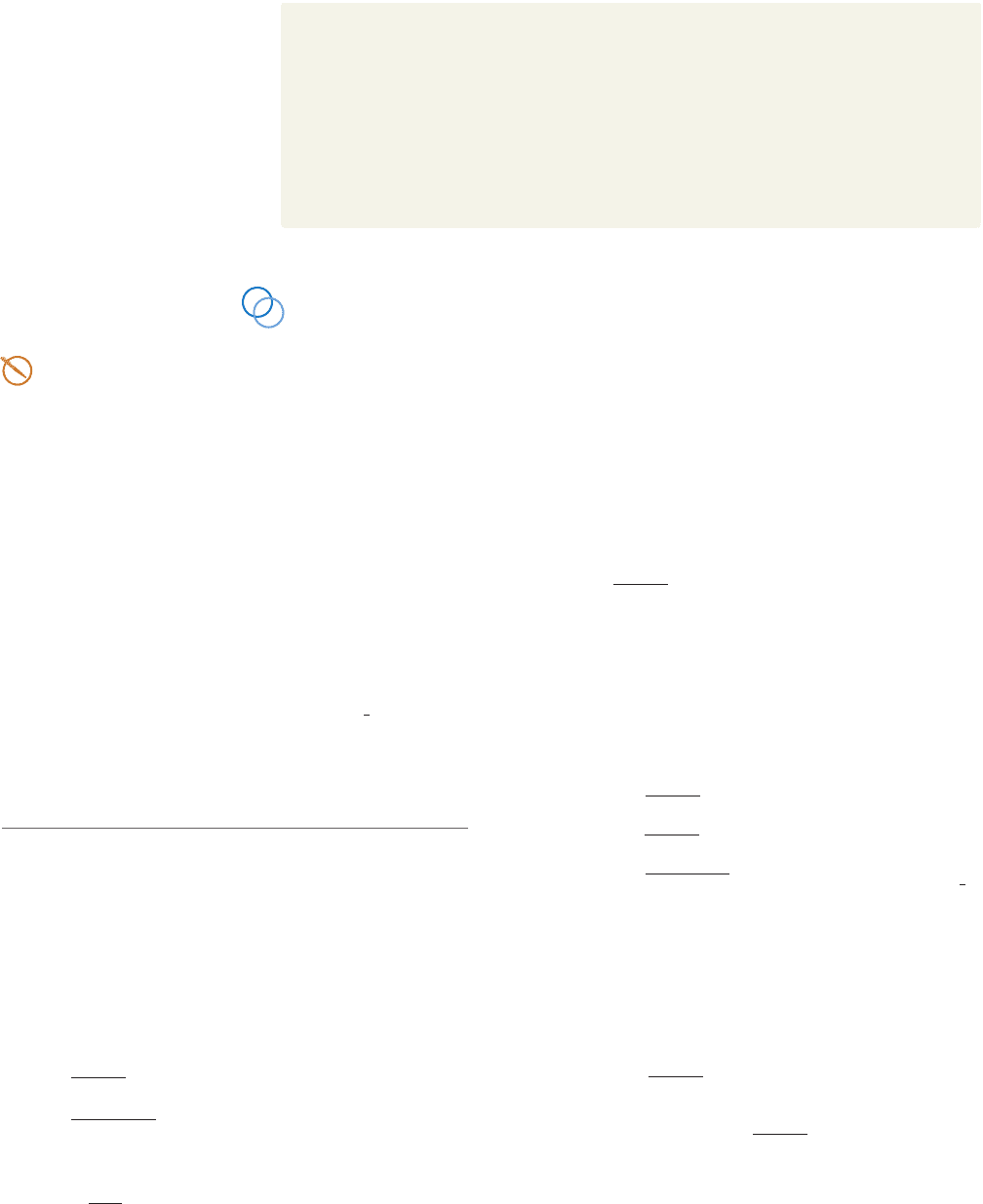
where the region of integration R is the shadow of the solid in the xy-plane. The
solid is widest at the intersection of the two paraboloids, which occurs where
8 − x
2
− y
2
= x
2
+ y
2
or x
2
+ y
2
= 4. The region of integration R is then the disk
shown in Figure 14.33b and is most easily described in polar coordinates. The integrand
becomes 8 − 2x
2
− 2y
2
= 8 − 2r
2
and we have
V =
2π
0
2
0
(8 − 2r
2
)rdrdθ = 16π.
5
5
x
FIGURE 14.33a
Intersecting paraboloids
y
x
12102
2
1
2
1
R
FIGURE 14.33b
The region R
y
x
u h
2
(r)
u h
1
(r)
r a
r b
R
FIGURE 14.34
The region R
Finally, we observe that we can also evaluate double integrals in polar coordinates by
integrating first with respect to θ. Although such integrals are uncommon (given the way in
which we change variables from rectangular to polar coordinates), we provide this for the
sake of completeness.
Suppose the region R can be written in the form
R ={(r,θ)|0 ≤ a ≤ r ≤ b and h
1
(r) ≤ θ ≤ h
2
(r)},
where h
1
(r) ≤ h
2
(r), for all r in [a, b], as pictured in Figure 14.34. Then, it can be shown
that if f (r,θ) is continuous on R,wehave
R
f (r,θ) dA =
b
a
h
2
(r)
h
1
(r)
f (r,θ)rdθ dr. (3.4)
P1: OSO/OVY P2: OSO/OVY QC: OSO/OVY T1: OSO
MHDQ256-Ch14 MHDQ256-Smith-v1.cls January 5, 2011 10:17
LT (Late Transcendental)
CONFIRMING PAGES
14-31 SECTION 14.3
..
Double Integrals in Polar Coordinates 931
BEYOND FORMULAS
This section may change the way you think of polar coordinates. While theyallowus to
describe a variety of unusual curves (roses, cardioids and so on) in a convenient form,
polar coordinates are an essential computational tool for double integrals. In section
14.6, they serve the same role in triple integrals. In general, polar coordinates are useful
in applications where some form of radial symmetry is present. Can you describe any
situations in engineering, physics or chemistry where a structure or force has radial
symmetry?
EXERCISES 14.3
WRITING EXERCISES
1. Thinking of dy dx as representing the area dA of a small rect-
angle, explain in geometric terms why
R
f (x, y)dA =
R
f (r cosθ,r sin θ )drdθ.
2. Inall of theexamplesin this section,we integrated with respect
to r first. It is perfectly legitimate to integrate with respect to θ
first. Explain why you would need functions of the form θ (r)
for the limits of integration and why a circle would satisfy this
requirement.
3. Given a double integral in rectangular coordinates as in exam-
ple 3.2 or 3.4, identify at least two indications that the integral
would be easier to evaluate in polar coordinates.
4. In section 10.5, we derived a formula A =
b
a
1
2
[ f (θ)]
2
dθ for
the area bounded by the polar curve r = f (θ) and rays θ = a
andθ = b.Discusshowthisformularelatestotheformulaused
in example 3.1. Discuss which formula is easier to remember
and which formula is more generally useful.
In exercises 1–6, find the area of the region bounded by the given
curves.
1. r = 3 +2sinθ 2. r = 2 −2cosθ
3. one leaf of r = sin3θ 4. r = 3cos θ
5. inside r = 2sin3θ, outside r = 1, first quadrant
6. inside r = 1 and outside r = 2 −2cosθ
............................................................
In exercises 7–12, use polar coordinates to evaluate the double
integral.
7.
R
x
2
+ y
2
dA, where R is the disk x
2
+ y
2
≤ 9
8.
R
x
2
+ y
2
+ 1dA, where R is the disk x
2
+ y
2
≤ 16
9.
R
e
−x
2
−y
2
dA, where R is the disk x
2
+ y
2
≤ 4
10.
R
e
−
√
x
2
+y
2
dA, where R is the disk x
2
+ y
2
≤ 1
11.
R
ydA, where R is bounded by r = 2 −cosθ
12.
R
xdA, where R is bounded by r = 1 −sinθ
............................................................
In exercises 13–16, use the most appropriate coordinate system
to evaluate the double integral.
13.
R
(x
2
+ y
2
)dA, where R is bounded by x
2
+ y
2
= 9
14.
R
2xydA, where R is bounded by y = 4 − x
2
and y = 0
15.
R
(x
2
+ y
2
)dA, where R is bounded by y = x, y = 0 and
x = 2
16.
R
cos
x
2
+ y
2
dA, where R is bounded by x
2
+ y
2
= 9
............................................................
In exercises 17–30, use an appropriate coordinate system to
compute the volume of the indicated solid.
17. Below z = x
2
+ y
2
, above z = 0, inside x
2
+ y
2
= 9
18. Below z = x
2
+ y
2
− 4, above z = 0, inside x
2
+ y
2
= 9
19. Below z =
x
2
+ y
2
, above z = 0, inside x
2
+ y
2
= 4
20. Below z =
x
2
+ y
2
, above z = 0, inside x
2
+ (y − 1)
2
= 1
21. Below z =
4 − x
2
− y
2
, above z = 1, inside x
2
+ y
2
=
1
4
22. Below z = 8 − x
2
− y
2
, above z = 3x
2
+ 3y
2
23. Below z = 6 − x − y, in the first octant
24. Below z = 4 − x
2
− y
2
, between y = x, y = 0 and x = 1
25. Below z = 4 − x
2
− y
2
, above z = x
2
+ y
2
, between y = 0
and y = x, in the first octant
26. Above z =
x
2
+ y
2
, below z = 4, above the xy-plane, be-
tween y = x and y = 2x, in the first octant
27. Below z = 2, above z =−
x
2
+ y
2
and inside x
2
+ y
2
= 1
28. Below z = x
2
+ y
2
+ 4, above z = 1 and inside x
2
+ y
2
= 2
29. The volume cut out of x
2
+ y
2
+ z
2
= 4 by the cylinder
x
2
+ y
2
= 1
30. The volume cut out of x
2
+ y
2
+ z
2
= 4 by the cylinder
r = 1 − sin θ
............................................................
P1: OSO/OVY P2: OSO/OVY QC: OSO/OVY T1: OSO
MHDQ256-Ch14 MHDQ256-Smith-v1.cls January 6, 2011 7:14
LT (Late Transcendental)
CONFIRMING PAGES
932 CHAPTER 14
..
Multiple Integrals 14-32
In exercises 31–38, evaluate the iterated integral by converting
to polar coordinates.
31.
2
−2
√
4−x
2
−
√
4−x
2
x
2
+ y
2
dydx
32.
2
−2
√
4−x
2
0
sin(x
2
+ y
2
)dydx
33.
2
0
√
4−x
2
−
√
4−x
2
e
−x
2
−y
2
dydx 34.
2
0
0
−
√
4−x
2
ydydx
35.
2
0
√
8−x
2
x
x
y
2
dydx 36.
1
0
√
2y−y
2
y
xydx dy
37.
1
0
√
1−x
2
0
e
√
x
2
+y
2
dydx 38.
2
0
0
−
√
4−x
2
2
1 + x
2
+ y
2
dydx
............................................................
39. Find the center of mass of a lamina in the shape of
x
2
+ (y − 1)
2
= 1, with density ρ(x, y) = 1/
x
2
+ y
2
.
40. Find the center of mass of a lamina in the shape of
r = 2 − 2 cosθ, with density ρ(x, y) = x
2
+ y
2
.
41. Findthemomentofinertia I
y
ofthecircularlaminaboundedby
x
2
+ y
2
= R
2
, with density ρ(x, y) = 1. If the radius doubles,
by what factor does the moment of inertia increase?
42. Repeat exercise 41 for the density function
ρ(x, y) =
x
2
+ y
2
.
43. Use a double integral to derive the formula for the volume of
a sphere of radius a.
44. Use a double integral to derive the formula for the volume of a
right circular cone of height h and base radius a. (Hint: Show
that the desired volume equals the volume under z = h and
above z =
h
a
x
2
+ y
2
.)
45. Show that the volume under the cone z = k − r and above
the xy-plane (where k > 0) grows as a cubic function of k.
Show that the volume under the paraboloid z = k − r
2
and
abovethexy-plane(wherek > 0)growsasaquadraticfunction
of k. Explain why this volume increases less rapidly than that
of the cone.
46. Show that the volume under the surface z = k −r
n
and above
the xy-plane (where k > 0) approaches a linear function of k
as n →∞. Explain why this makes sense.
47. Find the volume cut out of the sphere x
2
+ y
2
+ z
2
= 9 by the
cylinder x
2
+ y
2
= 2x.
48. Find the volume of the wedge sliced out of the sphere
x
2
+ y
2
+ z
2
= 4 by the planes y = x and y = 2x. (Keep
the portion with x ≥ 0.)
49. Set up a double integral for the volume of the piece sliced off
of the top of x
2
+ y
2
+ z
2
= 4 by the plane y + z = 2.
50. Set up a double integral for the volume of the portion of the
region below x +2y + 3z = 6 and above z = 0 cut out by the
cylinder x
2
+ 4y
2
= 4.
51. Evaluate
R
2
1 + x
2
+ y
2
dA where R is outside r = 1 and
inside r = 2sinθ.
52. Evaluate
R
ln(x
2
+ y
2
)
x
2
+ y
2
dA where R is bounded byr = 1 and
r = 2.
APPLICATIONS
53. Suppose that f (x, y) = 20,000e
−x
2
−y
2
is the population den-
sity of a species of small animals. Estimate the population in
the region bounded by x
2
+ y
2
= 1.
54. Suppose that f (x, y) = 15,000e
−x
2
−y
2
is the population den-
sity of a species of small animals. Estimate the population in
the region bounded by (x − 1)
2
+ y
2
= 1.
In exercises 55–58, compute the probability that a dart lands
in the region R, assuming that the probability is given by
R
1
π
e
−x
2
−y
2
dA.
55. A double bull’s-eye, R is the region inside r =
1
4
(inch)
56. A single bull’s-eye, R bounded by r =
1
4
and r =
1
2
57. A triple-20, R bounded byr = 3
3
4
, r = 4,θ =
9π
20
and θ =
11π
20
58. A double-20, R bounded by r = 6
1
4
, r = 6
1
2
,θ =
9π
20
and
θ =
11π
20
............................................................
59. Find the area of the triple-20 region described in exercise 57.
60. Find the area of the double-20 region described in exercise 58.
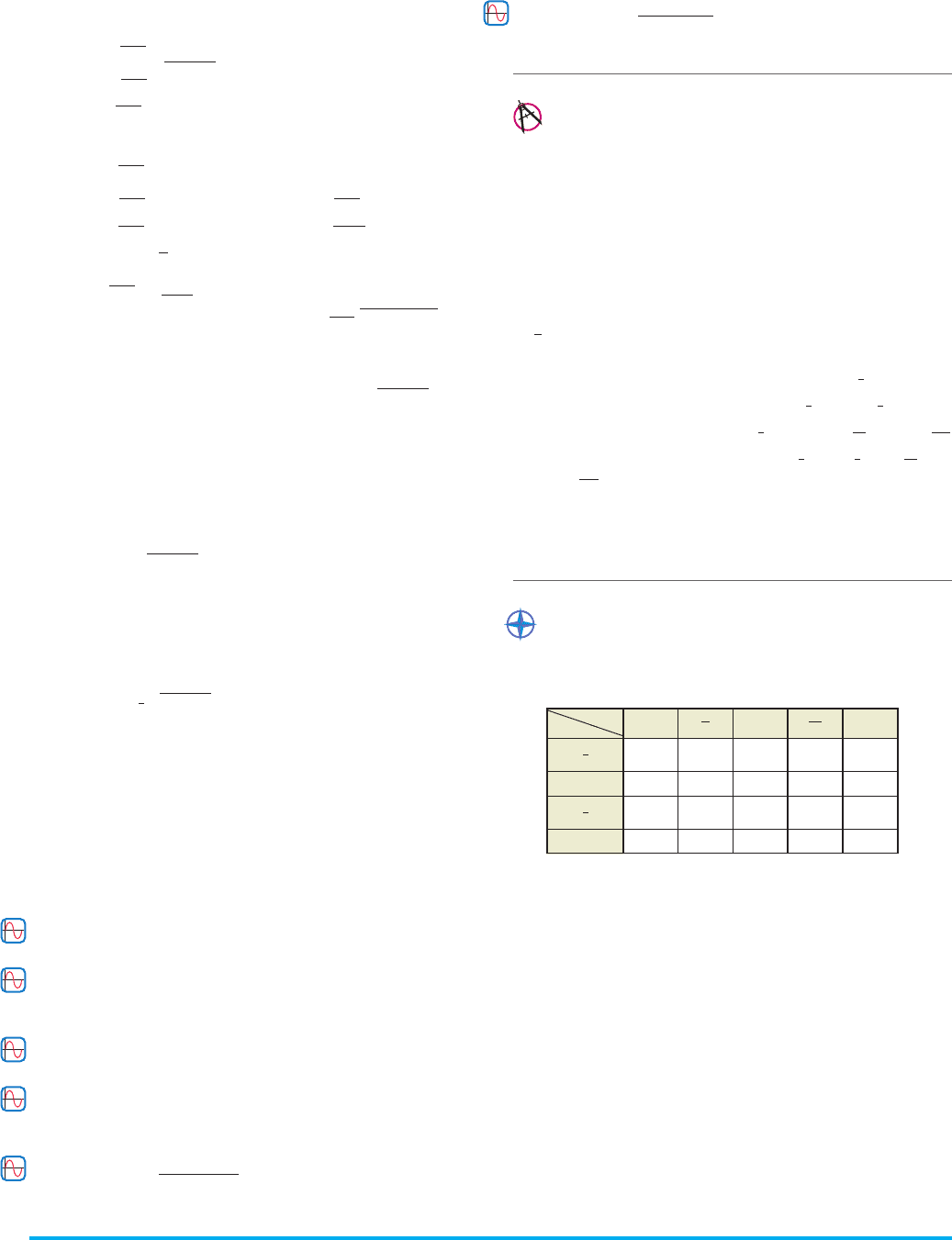
EXPLORATORY EXERCISES
1. Suppose that the following data give the density of a lamina at
different locations. Estimate the mass of the lamina.
r
θ
0
π
2
π
3π
2
2π
1
2
1.0 1.4 1.4 1.2 1.0
1 0.8 1.2 1.0 1.0 0.8
3
2
1.0 1.3 1.4 1.3 1.2
2 1.2 1.6 1.6 1.4 1.2
2. One of the most important integrals in probability theory is
∞
−∞
e
−x
2
dx.Since there is no antiderivativeofe
−x
2
among the
elementary functions, we can’t evaluate this integral directly.
A clever use of polar coordinates is needed. Start by giving the
integral a name,
∞
−∞
e
−x
2
dx = I.
Now, assuming that all the integrals converge, argue that
∞
−∞
e
−y
2
dy = I and
∞
−∞
e
−x
2
dx
∞
−∞
e
−y
2
dy =
∞
−∞
∞
−∞
e
−x
2
−y
2
dydx = I
2
.
Convert the iterated integral to polar coordinates and evaluate
it.The desired integralI issimply the squareroot of theiterated
integral. Explain why the same trick can’t be used to evaluate
1
−1
e
−x
2
dx.