
Thomas M. Cover, Joy A. Thomas. Elements of information theory
Подождите немного. Документ загружается.

9.1 GAUSSIAN CHANNEL: DEFINITIONS 265
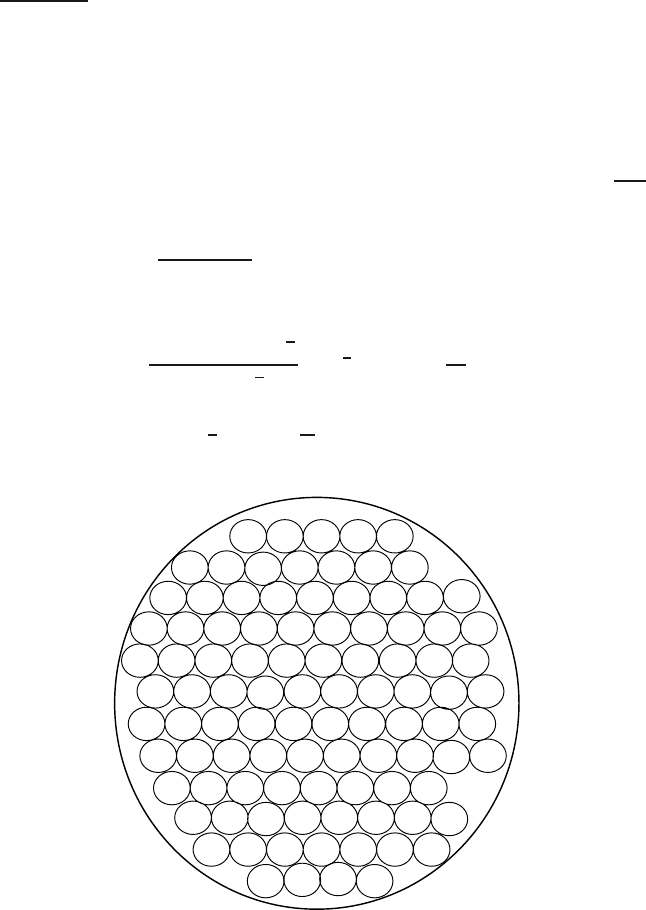
Remark We first present a plausibility argument as to why we may be
able to construct (2
nC
,n) codes with a low probability of error. Consider
any codeword of length n. The received vector is normally distributed with
mean equal to the true codeword and variance equal to the noise variance.
With high probability, the received vector is contained in a sphere of radius
√
n(N +) around the true codeword. If we assign everything within this
sphere to the given codeword, when this codeword is sent there will be
an error only if the received vector falls outside the sphere, which has
low probability.
Similarly, we can choose other codewords and their corresponding
decoding spheres. How many such codewords can we choose? The vol-
ume of an n-dimensional sphere is of the form C
n
r
n
,wherer is the
radius of the sphere. In this case, each decoding sphere has radius
√
nN.
These spheres are scattered throughout the space of received vectors. The
received vectors have energy no greater than n(P + N), so they lie in a
sphere of radius
√
n(P + N). The maximum number of nonintersecting
decoding spheres in this volume is no more than
C
n
(n(P + N))
n
2
C
n
(nN)
n
2
= 2
n
2
log
1 +
P
N
(9.22)
and the rate of the code is
1
2
log(1 +
P
N
). This idea is illustrated in Figure 9.2.
FIGURE 9.2. Sphere packing for the Gaussian channel.

266 GAUSSIAN CHANNEL
This sphere-packing argument indicates that we cannot hope to send
at rates greater than C with low probability of error. However, we can
actually do almost as well as this, as is proved next.
Proof: (Achievability). We will use the same ideas as in the proof of
the channel coding theorem in the case of discrete channels: namely,
random codes and joint typicality decoding. However, we must make
some modifications to take into account the power constraint and the fact
that the variables are continuous and not discrete.
1. Generation of the codebook. We wish to generate a codebook in
which all the codewords satisfy the power constraint. To ensure
this, we generate the codewords with each element i.i.d. accord-
ing to a normal distribution with variance P − . Since for large
n,
1
n
X
2
i
→ P − , the probability that a codeword does not sat-
isfy the power constraint will be small. Let X
i
(w), i = 1, 2,...,n,
w = 1, 2,...,2
nR
be i.i.d. ∼ N(0,P − ), forming codewords
X
n
(1), X
n
(2),...,X
n
(2
nR
) ∈ R
n
.
2. Encoding. After the generation of the codebook, the codebook is
revealed to both the sender and the receiver. To send the message
index w, the transmitter sends the wth codeword X
n
(w) in the code-
book.
3. Decoding. The receiver looks down the list of codewords {X
n
(w)}
and searches for one that is jointly typical with the received vector.
If there is one and only one such codeword X
n
(w), the receiver
declares
ˆ
W = w to be the transmitted codeword. Otherwise, the
receiver declares an error. The receiver also declares an error if the
chosen codeword does not satisfy the power constraint.
4. Probability of error . Without loss of generality, assume that code-
word 1 was sent. Thus, Y
n
= X
n
(1) + Z
n
. Define the following
events:
E
0
=
1
n
n
j=1
X
2
j
(1)>P
(9.23)
and
E
i
=
(X
n
(i), Y
n
)isinA
(n)
. (9.24)
Then an error occurs if E
0
occurs (the power constraint is violated)
or E
c
1
occurs (the transmitted codeword and the received sequence
are not jointly typical) or E
2
∪ E
3
∪···∪E
2
nR
occurs (some wrong

9.1 GAUSSIAN CHANNEL: DEFINITIONS 267
codeword is jointly typical with the received sequence). Let E denote
the event
ˆ
W = W and let P denote the conditional probability given
that W = 1. Hence,
Pr(
E|W = 1) = P(E) = P
E
0
∪ E
c
1
∪ E
2
∪ E
3
∪···∪E
2
nR
(9.25)
≤ P(E
0
) + P(E
c
1
) +
2
nR
i=2
P(E
i
), (9.26)
by the union of events bound for probabilities. By the law of large
numbers, P(E
0
) → 0asn →∞. Now, by the joint AEP (which
can be proved using the same argument as that used in the discrete
case), P(E
c
1
) → 0, and hence
P(E
c
1
) ≤ for n sufficiently large. (9.27)
Since by the code generation process, X
n
(1) and X
n
(i) are indepen-
dent, so are Y
n
and X
n
(i). Hence, the probability that X
n
(i) and Y
n
will be jointly typical is ≤ 2
−n(I (X;Y)−3)
by the joint AEP.
Now let W be uniformly distributed over {1, 2,...,2
nR
}, and con-
sequently,
Pr(
E) =
1
2
nR
λ
i
= P
(n)
e
. (9.28)
Then
P
(n)
e
= Pr(E) = Pr(E|W = 1) (9.29)
≤ P(E
0
) + P(E
c
1
) +
2
nR
i=2
P(E
i
) (9.30)
≤ + +
2
nR
i=2
2
−n(I (X;Y)−3)
(9.31)
= 2 +
2
nR
− 1
2
−n(I (X;Y)−3)
(9.32)
≤ 2 + 2
3n
2
−n(I (X;Y)−R)
(9.33)
≤ 3 (9.34)
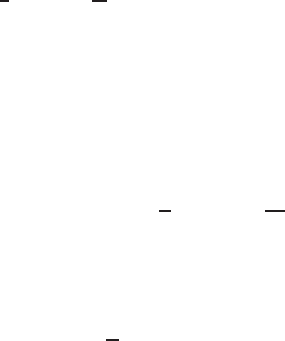
268 GAUSSIAN CHANNEL
for n sufficiently large and R<I(X;Y)− 3. This proves the exis-
tence of a good (2
nR
,n) code.
Now choosing a good codebook and deleting the worst half of the
codewords, we obtain a code with low maximal probability of error. In
particular, the power constraint is satisfied by each of the remaining code-
words (since the codewords that do not satisfy the power constraint have
probability of error 1 and must belong to the worst half of the codewords).
Hence we have constructed a code that achieves a rate arbitrarily close to
capacity. The forward part of the theorem is proved. In the next section
we show that the achievable rate cannot exceed the capacity.
9.2 CONVERSE TO THE CODING THEOREM FOR GAUSSIAN
CHANNELS
In this section we complete the proof that the capacity of a Gaussian
channel is C =
1
2
log(1 +
P
N
) by proving that rates R>Care not achiev-
able. The proof parallels the proof for the discrete channel. The main new
ingredient is the power constraint.
Proof: (Converse to Theorem 9.1.1). We must show that if P
(n)
e
→ 0for
a sequence of (2
nR
,n)codes for a Gaussian channel with power constraint
P ,then
R ≤ C =
1
2
log
1 +
P
N
. (9.35)
Consider any (2
nR
,n) code that satisfies the power constraint, that is,
1
n
n
i=1
x
2
i
(w) ≤ P, (9.36)
for w = 1, 2,...,2
nR
. Proceeding as in the converse for the discrete case,
let W be distributed uniformly over {1, 2,...,2
nR
}. The uniform distri-
bution over the index set W ∈{1, 2,...,2
nR
} induces a distribution on
the input codewords, which in turn induces a distribution over the input
alphabet. This specifies a joint distribution on W → X
n
(W ) → Y
n
→
ˆ
W .
To relate probability of error and mutual information, we can apply Fano’s
inequality to obtain
H(W|
ˆ
W) ≤ 1 + nRP
(n)
e
= n
n
, (9.37)

9.2 CONVERSE TO THE CODING THEOREM FOR GAUSSIAN CHANNELS 269
where
n
→ 0asP
(n)
e
→ 0. Hence,
nR = H(W) = I(W;
ˆ
W)+ H(W|
ˆ
W) (9.38)
≤ I(W;
ˆ
W)+ n
n
(9.39)
≤ I(X
n
;Y
n
) + n
n
(9.40)
= h(Y
n
) − h(Y
n
|X
n
) + n
n
(9.41)
= h(Y
n
) − h(Z
n
) + n
n
(9.42)
≤
n
i=1
h(Y
i
) − h(Z
n
) + n
n
(9.43)
=
n
i=1
h(Y
i
) −
n
i=1
h(Z
i
) + n
n
(9.44)
=
n
i=1
I(X
i
;Y
i
) + n
n
. (9.45)
Here X
i
= x
i
(W ),whereW is drawn according to the uniform distribution
on {1, 2,...,2
nR
}.NowletP
i
be the average power of the ith column of
the codebook, that is,
P
i
=
1
2
nR
w
x
2
i
(w). (9.46)
Then, since Y
i
= X
i
+ Z
i
and since X
i
and Z
i
are independent, the aver-
age power EY
i
2
of Y
i
is P
i
+ N . Hence, since entropy is maximized by
the normal distribution,
h(Y
i
) ≤
1
2
log 2πe(P
i
+ N). (9.47)
Continuing with the inequalities of the converse, we obtain
nR ≤
(
h(Y
i
) − h(Z
i
)
)
+ n
n
(9.48)
≤
1
2
log(2πe(P
i
+ N)) −
1
2
log 2πeN
+ n
n
(9.49)
=
1
2
log
1 +
P
i
N
+ n
n
. (9.50)

270 GAUSSIAN CHANNEL
Since each of the codewords satisfies the power constraint, so does their
average, and hence
1
n
i
P
i
≤ P. (9.51)
Since f(x) =
1
2
log(1 +x) is a concave function of x, we can apply
Jensen’s inequality to obtain
1
n
n
i=1
1
2
log
1 +
P
i
N
≤
1
2
log
1 +
1
n
n
i=1
P
i
N
(9.52)
≤
1
2
log
1 +
P
N
. (9.53)
Thus R ≤
1
2
log(1 +
P
N
) +
n
,
n
→ 0, and we have the required converse.
Note that the power constraint enters the standard proof in (9.46).
9.3 BANDLIMITED CHANNELS
A common model for communication over a radio network or a telephone
line is a bandlimited channel with white noise. This is a continuous-
time channel. The output of such a channel can be described as the
convolution
Y(t) =
(
X(t) +Z(t)
)
∗ h(t), (9.54)
where X(t) is the signal waveform, Z(t) is the waveform of the white
Gaussian noise, and h(t ) is the impulse response of an ideal bandpass
filter, which cuts out all frequencies greater than W .Inthissectionwe
give simplified arguments to calculate the capacity of such a channel.
We begin with a representation theorem due to Nyquist [396] and Shan-
non [480], which shows that sampling a bandlimited signal at a sampling
rate
1
2W
is sufficient to reconstruct the signal from the samples. Intuitively,
this is due to the fact that if a signal is bandlimited to W , it cannot change
by a substantial amount in a time less than half a cycle of the maximum
frequency in the signal, that is, the signal cannot change very much in
time intervals less than
1
2W
seconds.

9.3 BANDLIMITED CHANNELS 271
Theorem 9.3.1 Suppose that a function f(t) is bandlimited to W ,
namely, the spectrum of the function is 0 for all frequencies greater than
W . Then the function is completely determined by samples of the function
spaced
1
2W
seconds apart.
Proof: Let F(ω) be the Fourier transform of f(t).Then
f(t)=
1
2π
∞
−∞
F(ω)e
iωt
dω (9.55)
=
1
2π
2πW
−2πW
F(ω)e
iωt
dω, (9.56)
since F(ω) is zero outside the band −2πW ≤ ω ≤ 2πW. If we consider
samples spaced
1
2W
seconds apart, the value of the signal at the sample
points can be written
f
n
2W
=
1
2π
2πW
−2πW
F(ω)e
iω
n
2W
dω. (9.57)
The right-hand side of this equation is also the definition of the coefficients
of the Fourier series expansion of the periodic extension of the function
F(ω), taking the interval −2πW to 2πW as the fundamental period. Thus,
thesamplevaluesf(
n
2W
) determine the Fourier coefficients and, by exten-
sion, they determine the value of F(ω) in the interval (−2πW,2πW).
Since a function is uniquely specified by its Fourier transform, and since
F(ω) is zero outside the band W , we can determine the function uniquely
from the samples.
Consider the function
sinc(t) =
sin(2πWt)
2πWt
. (9.58)
This function is 1 at t = 0andis0fort = n/2W , n = 0. The spectrum
of this function is constant in the band (−W,W) and is zero outside this
band. Now define
g(t) =
∞
n=−∞
f
n
2W
sinc
t −
n
2W
. (9.59)
From the properties of the sinc function, it follows that g(t) is bandlim-
ited to W and is equal to f(n/2W) at t = n/2W . Since there is only

272 GAUSSIAN CHANNEL
one function satisfying these constraints, we must have g(t) = f(t).This
provides an explicit representation of f(t) in terms of its samples.
A general function has an infinite number of degrees of freedom—the
value of the function at every point can be chosen independently. The
Nyquist–Shannon sampling theorem shows that a bandlimited function
has only 2W degrees of freedom per second. The values of the function
at the sample points can be chosen independently, and this specifies the
entire function.
If a function is bandlimited, it cannot be limited in time. But we can
consider functions that have most of their energy in bandwidth W and
have most of their energy in a finite time interval, say (0,T). We can
describe these functions using a basis of prolate spheroidal functions.We
do not go into the details of this theory here; it suffices to say that there
are about 2TW orthonormal basis functions for the set of almost time-
limited, almost bandlimited functions, and we can describe any function
within the set by its coordinates in this basis. The details can be found
in a series of papers by Landau, Pollak, and Slepian [340, 341, 500].
Moreover, the projection of white noise on these basis vectors forms
an i.i.d. Gaussian process. The above arguments enable us to view the
bandlimited, time-limited functions as vectors in a vector space of 2TW
dimensions.
Now we return to the problem of communication over a bandlimited
channel. Assuming that the channel has bandwidth W , we can represent
both the input and the output by samples taken 1/2W seconds apart. Each
of the input samples is corrupted by noise to produce the corresponding
output sample. Since the noise is white and Gaussian, it can be shown
that each noise sample is an independent, identically distributed Gaussian
random variable.
If the noise has power spectral density N
0
/2 watts/hertz and bandwidth
W hertz, the noise has power
N
0
2
2W = N
0
W and each of the 2WT noise
samples in time T has variance N
0
WT/2WT = N
0
/2. Looking at the
input as a vector in the 2TW-dimensional space, we see that the received
signal is spherically normally distributed about this point with covariance
N
0
2
I .
Now we can use the theory derived earlier for discrete-time Gaussian
channels, where it was shown that the capacity of such a channel is
C =
1
2
log
1 +
P
N
bits per transmission. (9.60)
Let the channel be used over the time interval [0,T]. In this case, the
energy per sample is PT/2WT = P/2W , the noise variance per sample

9.3 BANDLIMITED CHANNELS 273
is
N
0
2
2W
T
2WT
= N
0
/2, and hence the capacity per sample is
C =
1
2
log
1 +
P
2W
N
0
2
=
1
2
log
1 +
P
N
0
W
bits per sample.
(9.61)
Since there are 2W samples each second, the capacity of the channel can
be rewritten as
C = W log
1 +
P
N
0
W
bits per second. (9.62)
This equation is one of the most famous formulas of information theory. It
gives the capacity of a bandlimited Gaussian channel with noise spectral
density N
0
/2 watts/Hz and power P watts.
A more precise version of the capacity argument [576] involves con-
sideration of signals with a small fraction of their energy outside the
bandwidth W of the channel and a small fraction of their energy outside
the time interval (0,T). The capacity above is then obtained as a limit as
the fraction of energy outside the band goes to zero.
If we let W →∞in (9.62), we obtain
C =
P
N
0
log
2
e bits per second (9.63)
as the capacity of a channel with an infinite bandwidth, power P ,and
noise spectral density N
0
/2. Thus, for infinite bandwidth channels, the
capacity grows linearly with the power.
Example 9.3.1 (Telephone line) To allow multiplexing of many chan-
nels, telephone signals are bandlimited to 3300 Hz. Using a bandwidth of
3300 Hz and a SNR (signal-to-noise ratio) of 33 dB (i.e., P/N
0
W =
2000) in (9.62), we find the capacity of the telephone channel to be
about 36,000 bits per second. Practical modems achieve transmission rates
up to 33,600 bits per second in both directions over a telephone channel.
In real telephone channels, there are other factors, such as crosstalk, inter-
ference, echoes, and nonflat channels which must be compensated for to
achieve this capacity.
The V.90 modems that achieve 56 kb/s over the telephone channel
achieve this rate in only one direction, taking advantage of a purely digital
channel from the server to final telephone switch in the network. In this
case, the only impairments are due to the digital-to-analog conversion at
this switch and the noise in the copper link from the switch to the home;
274 GAUSSIAN CHANNEL
these impairments reduce the maximum bit rate from the 64 kb/s for the
digital signal in the network to the 56 kb/s in the best of telephone lines.
The actual bandwidth available on the copper wire that links a home to
a telephone switch is on the order of a few megahertz; it depends on the
length of the wire. The frequency response is far from flat over this band.
If the entire bandwidth is used, it is possible to send a few megabits per
second through this channel; schemes such at DSL (Digital Subscriber
Line) achieve this using special equipment at both ends of the telephone
line (unlike modems, which do not require modification at the telephone
switch).
9.4 PARALLEL GAUSSIAN CHANNELS
In this section we consider k independent Gaussian channels in parallel
with a common power constraint. The objective is to distribute the total
power among the channels so as to maximize the capacity. This channel
models a nonwhite additive Gaussian noise channel where each parallel
component represents a different frequency.
Assume that we have a set of Gaussian channels in parallel as illustrated
in Figure 9.3. The output of each channel is the sum of the input and
Gaussian noise. For channel j ,
Y
j
= X
j
+ Z
j
,j= 1, 2,...,k, (9.64)
with
Z
j
∼ N(0,N
j
), (9.65)
and the noise is assumed to be independent from channel to channel. We
assume that there is a common power constraint on the total power used,
that is,
E
k
j=1
X
2
j
≤ P. (9.66)
We wish to distribute the power among the various channels so as to
maximize the total capacity.
The information capacity of the channel C is
C = max
f(x
1
,x
2
,...,x
k
):
EX
2
i
≤P
I(X
1
,X
2
,...,X
k
; Y
1
,Y
2
,...,Y
k
). (9.67)