
Thomas M. Cover, Joy A. Thomas. Elements of information theory
Подождите немного. Документ загружается.

9.4 PARALLEL GAUSSIAN CHANNELS 275
Z
1
Y
1
X
1
Z
k
Y
k
X
k
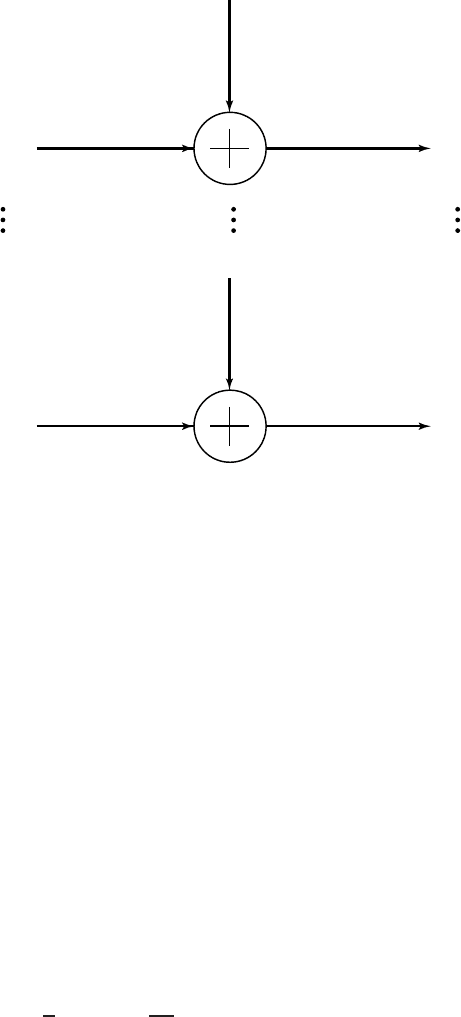
FIGURE 9.3. Parallel Gaussian channels.
We calculate the distribution that achieves the information capacity for
this channel. The fact that the information capacity is the supremum of
achievable rates can be proved by methods identical to those in the proof
of the capacity theorem for single Gaussian channels and will be omitted.
Since Z
1
,Z
2
,...,Z
k
are independent,
I(X
1
,X
2
,...,X
k
; Y
1
,Y
2
,...,Y
k
)
= h(Y
1
,Y
2
,...,Y
k
) − h(Y
1
,Y
2
,...,Y
k
|X
1
,X
2
,...,X
k
)
= h(Y
1
,Y
2
,...,Y
k
) − h(Z
1
,Z
2
,...,Z
k
|X
1
,X
2
,...,X
k
)
= h(Y
1
,Y
2
,...,Y
k
) − h(Z
1
,Z
2
,...,Z
k
) (9.68)
= h(Y
1
,Y
2
,...,Y
k
) −
i
h(Z
i
) (9.69)
≤
i
h(Y
i
) − h(Z
i
) (9.70)
≤
i
1
2
log
1 +
P
i
N
i
, (9.71)

276 GAUSSIAN CHANNEL
where P
i
= EX
2
i
,and
P
i
= P . Equality is achieved by
(X
1
,X
2
,...,X
k
) ∼ N
0,
P
1
0 ··· 0
0 P
2
··· 0
.
.
.
.
.
.
.
.
.
.
.
.
00··· P
k
. (9.72)
So the problem is reduced to finding the power allotment that max-
imizes the capacity subject to the constraint that
P
i
= P .Thisisa
standard optimization problem and can be solved using Lagrange multi-
pliers. Writing the functional as
J(P
1
,...,P
k
) =
1
2
log
1 +
P
i
N
i
+ λ
P
i
(9.73)
and differentiating with respect to P
i
,wehave
1
2
1
P
i
+ N
i
+ λ = 0 (9.74)
or
P
i
= ν − N
i
. (9.75)
However, since the P
i
’s must be nonnegative, it may not always be possi-
ble to find a solution of this form. In this case, we use the Kuhn–Tucker
conditions to verify that the solution
P
i
= (ν − N
i
)
+
(9.76)
is the assignment that maximizes capacity, where ν is chosen so that
(ν − N
i
)
+
= P. (9.77)
Here (x)
+
denotes the positive part of x:
(x)
+
=
!
x if x ≥ 0,
0ifx<0.
(9.78)
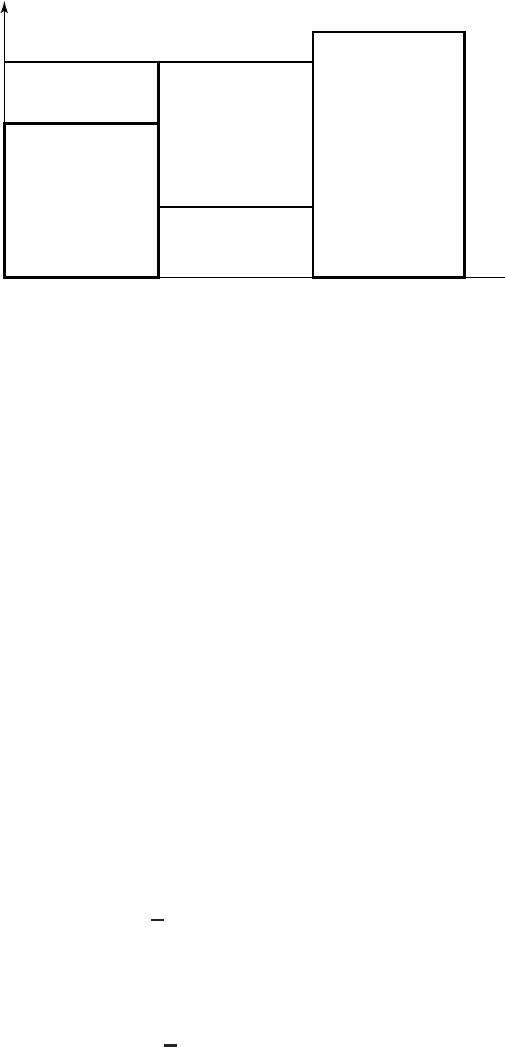
This solution is illustrated graphically in Figure 9.4. The vertical levels
indicate the noise levels in the various channels. As the signal power is
increased from zero, we allot the power to the channels with the lowest
9.5 CHANNELS WITH COLORED GAUSSIAN NOISE 277
Power
Channel 1 Channel 2 Channel 3
P
1
n
P
2
N
1
N
2
N
3
FIGURE 9.4. Water-filling for parallel channels.
noise. When the available power is increased still further, some of the
power is put into noisier channels. The process by which the power is
distributed among the various bins is identical to the way in which water
distributes itself in a vessel, hence this process is sometimes referred to
as water-filling.
9.5 CHANNELS WITH COLORED GAUSSIAN NOISE
In Section 9.4, we considered the case of a set of parallel independent
Gaussian channels in which the noise samples from different channels
were independent. Now we will consider the case when the noise is depen-
dent. This represents not only the case of parallel channels, but also the
case when the channel has Gaussian noise with memory. For channels
with memory, we can consider a block of n consecutive uses of the chan-
nel as n channels in parallel with dependent noise. As in Section 9.4, we
will calculate only the information capacity for this channel.
Let K
Z
be the covariance matrix of the noise, and let K
X
be the input
covariance matrix. The power constraint on the input can then be writ-
ten as
1
n
i
EX
2
i
≤ P, (9.79)
or equivalently,
1
n
tr(K
X
) ≤ P. (9.80)

278 GAUSSIAN CHANNEL
Unlike Section 9.4, the power constraint here depends on n; the capacity
will have to be calculated for each n.
Just as in the case of independent channels, we can write
I(X
1
,X
2
,...,X
n
;Y
1
,Y
2
,...,Y
n
) = h(Y
1
,Y
2
,...,Y
n
)
− h(Z
1
,Z
2
,...,Z
n
). (9.81)
Here h(Z
1
,Z
2
,...,Z
n
) is determined only by the distribution of the noise
and is not dependent on the choice of input distribution. So finding the
capacity amounts to maximizing h(Y
1
,Y
2
,...,Y
n
). The entropy of the
output is maximized when Y is normal, which is achieved when the input
is normal. Since the input and the noise are independent, the covariance
of the output Y is K
Y
= K
X
+ K
Z
and the entropy is
h(Y
1
,Y
2
,...,Y
n
) =
1
2
log
(2πe)
n
|K
X
+ K
Z
|
. (9.82)
Now the problem is reduced to choosing K
X
so as to maximize |K
X
+
K
Z
|, subject to a trace constraint on K
X
. To do this, we decompose K
Z
into its diagonal form,
K
Z
= QQ
t
, where QQ
t
= I. (9.83)
Then
|K
X
+ K
Z
|=|K
X
+ QQ
t
| (9.84)
=|Q||Q
t
K
X
Q + ||Q
t
| (9.85)
=|Q
t
K
X
Q + | (9.86)
=|A + |, (9.87)
where A = Q
t
K
X
Q. Since for any matrices B and C,
tr(BC) = tr(CB), (9.88)
we have
tr(A) = tr(Q
t
K
X
Q) (9.89)
= tr(QQ
t
K
X
) (9.90)
= tr(K
X
). (9.91)

9.5 CHANNELS WITH COLORED GAUSSIAN NOISE 279
Now the problem is reduced to maximizing |A + | subject to a trace
constraint tr(A) ≤ nP .
Now we apply Hadamard’s inequality, mentioned in Chapter 8. Hada-
mard’s inequality states that the determinant of any positive definite matrix
K is less than the product of its diagonal elements, that is,
|K|≤
"
i
K
ii
(9.92)
with equality iff the matrix is diagonal. Thus,
|A + |≤
"
i
(A
ii
+ λ
i
) (9.93)
with equality iff A is diagonal. Since A is subject to a trace constraint,
1
n
i
A
ii
≤ P, (9.94)
and A
ii
≥ 0, the maximum value of
#
i
(A
ii
+ λ
i
) is attained when
A
ii
+ λ
i
= ν. (9.95)
However, given the constraints, it may not always be possible to satisfy
this equation with positive A
ii
. In such cases, we can show by the standard
Kuhn–Tucker conditions that the optimum solution corresponds to setting
A
ii
= (ν − λ
i
)
+
, (9.96)
where the water level ν is chosen so that
A
ii
= nP . This value of A
maximizes the entropy of Y and hence the mutual information. We can
use Figure 9.4 to see the connection between the methods described above
and water-filling.
Consider a channel in which the additive Gaussian noise is a stochas-
tic process with finite-dimensional covariance matrix K
(n)
Z
. If the process
is stationary, the covariance matrix is Toeplitz and the density of eigen-
values on the real line tends to the power spectrum of the stochastic
process [262]. In this case, the above water-filling argument translates to
water-filling in the spectral domain.
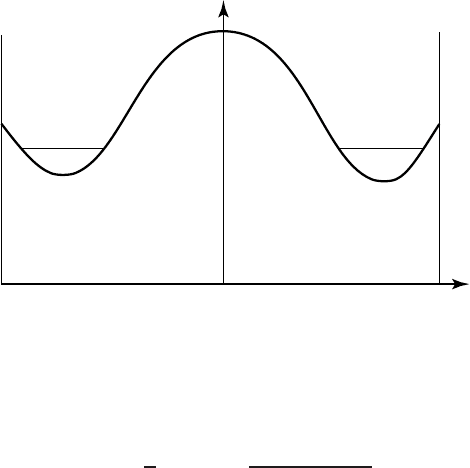
Hence, for channels in which the noise forms a stationary stochastic
process, the input signal should be chosen to be a Gaussian process with
a spectrum that is large at frequencies where the noise spectrum is small.
280 GAUSSIAN CHANNEL
F
(
w
)
w
FIGURE 9.5. Water-filling in the spectral domain.
This is illustrated in Figure 9.5. The capacity of an additive Gaussian
noise channel with noise power spectrum N(f) can be shown to be [233]
C =
π
−π
1
2
log
1 +
(
ν − N(f)
)
+
N(f)
df, (9.97)
where ν is chosen so that
$
(ν − N(f))
+
df = P .
9.6 GAUSSIAN CHANNELS WITH FEEDBACK
In Chapter 7 we proved that feedback does not increase the capacity for
discrete memoryless channels, although it can help greatly in reducing
the complexity of encoding or decoding. The same is true of an additive
noise channel with white noise. As in the discrete case, feedback does not
increase capacity for memoryless Gaussian channels.
However, for channels with memory, where the noise is correlated
from time instant to time instant, feedback does increase capacity. The
capacity without feedback can be calculated using water-filling, but we do
not have a simple explicit characterization of the capacity with feedback.
In this section we describe an expression for the capacity in terms of the
covariance matrix of the noise Z. We prove a converse for this expression
for capacity. We then derive a simple bound on the increase in capacity
due to feedback.
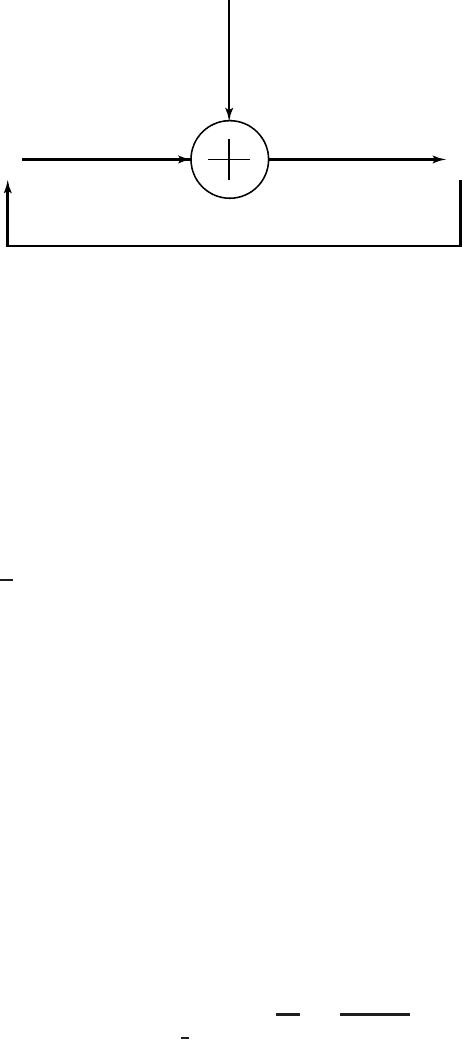
The Gaussian channel with feedback is illustrated in Figure 9.6. The
output of the channel Y
i
is
Y
i
= X
i
+ Z
i
,Z
i
∼ N(0,K
(n)
Z
). (9.98)
9.6 GAUSSIAN CHANNELS WITH FEEDBACK 281
Z
i
Y
i
X
i
FIGURE 9.6. Gaussian channel with feedback.
The feedback allows the input of the channel to depend on the past values
of the output.
A (2
nR
,n) code for the Gaussian channel with feedback consists of
a sequence of mappings x
i
(W, Y
i−1
),whereW ∈{1, 2,...,2
nR
} is the
input message and Y
i−1
is the sequence of past values of the output. Thus,
x(W, ·) is a code function rather than a codeword. In addition, we require
that the code satisfy a power constraint,
E
%
1
n
n
i=1
x
2
i
(w, Y
i−1
)
&
≤ P, w ∈{1, 2,...,2
nR
}, (9.99)
where the expectation is over all possible noise sequences.
We characterize the capacity of the Gaussian channel is terms of the
covariance matrices of the input X and the noise Z. Because of the feed-
back, X
n
and Z
n
are not independent; X
i
depends causally on the past
values of Z. In the next section we prove a converse for the Gaussian
channel with feedback and show that we achieve capacity if we take X
to be Gaussian.
We now state an informal characterization of the capacity of the channel
with and without feedback.
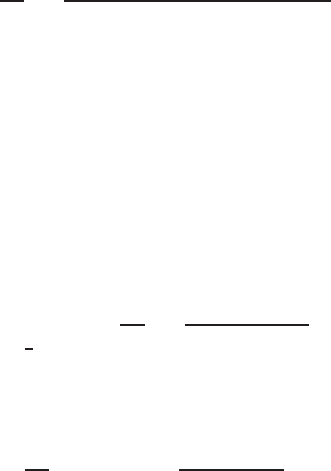
1. With feedback . The capacity C
n,FB
in bits per transmission of the
time-varying Gaussian channel with feedback is
C
n,FB
= max
1
n
tr(K
(n)
X
)≤P
1
2n
log
|K
(n)
X+Z
|
|K
(n)
Z
|
, (9.100)
282 GAUSSIAN CHANNEL
where the maximization is taken over all X
n
of the form
X
i
=
i−1
j=1
b
ij
Z
j
+ V
i
,i= 1, 2,...,n, (9.101)
and V
n
is independent of Z
n
. To verify that the maximization over
(9.101) involves no loss of generality, note that the distribution on
X
n
+ Z
n
achieving the maximum entropy is Gaussian. Since Z
n
is
also Gaussian, it can be verified that a jointly Gaussian distribu-
tion on (X
n
,Z
n
,X
n
+ Z
n
) achieves the maximization in (9.100).
But since Z
n
= Y
n
− X
n
, the most general jointly normal causal
dependence of X
n
on Y
n
is of the form (9.101), where V
n
plays the
role of the innovations process. Recasting (9.100) and (9.101) using
X = BZ + V and Y = X + Z, we can write
C
n,FB
= max
1
2n
log
|(B + I)K
(n)
Z
(B + I)
t
+ K
V
|
|K
(n)
Z
|
, (9.102)
where the maximum is taken over all nonnegative definite K
V
and
strictly lower triangular B such that
tr(BK
(n)
Z
B
t
+ K
V
) ≤ nP . (9.103)
Note that B is 0 if feedback is not allowed.
2. Without feedback. The capacity C
n
of the time-varying Gaussian
channel without feedback is given by
C
n
= max
1
n
tr(K
(n)
X
)≤P
1
2n
log
|K
(n)
X
+ K
(n)
Z
|
|K
(n)
Z
|
. (9.104)
This reduces to water-filling on the eigenvalues {λ
(n)
i
} of K
(n)
Z
. Thus,
C
n
=
1
2n
n
i=1
log
1 +
(λ − λ
(n)
i
)
+
λ
(n)
i
, (9.105)
where (y)
+
= max{y, 0} and where λ is chosen so that
n
i=1
(λ − λ
(n)
i
)
+
= nP . (9.106)
9.6 GAUSSIAN CHANNELS WITH FEEDBACK 283
We now prove an upper bound for the capacity of the Gaussian channel
with feedback. This bound is actually achievable [136], and is therefore
the capacity, but we do not prove this here.
Theorem 9.6.1 For a Gaussian channel with feedback, the rate R
n
for
any sequence of (2
nR
n
,n) codes with P
(n)
e
→ 0 satisfies
R
n
≤ C
n,FB
+
n
, (9.107)
with
n
→ 0 as n →∞,whereC
n,FB
is defined in (9.100).
Proof: Let W be uniform over 2
nR
, and therefore the probability of error
P
(n)
e
is bounded by Fano’s inequality,
H(W|
ˆ
W) ≤ 1 + nR
n
P
(n)
e
= n
n
, (9.108)
where
n
→ 0asP
(n)
e
→ 0. We can then bound the rate as follows:
nR
n
= H(W) (9.109)
= I(W;
ˆ
W)+ H(W|
ˆ
W) (9.110)
≤ I(W;
ˆ
W)+ n
n
(9.111)
≤ I(W;Y
n
) + n
n
(9.112)
=
I(W;Y
i
|Y
i−1
) + n
n
(9.113)
(a)
=
h(Y
i
|Y
i−1
) − h(Y
i
|W,Y
i−1
,X
i
,X
i−1
,Z
i−1
)
+ n
n
(9.114)
(b)
=
h(Y
i
|Y
i−1
) − h(Z
i
|W,Y
i−1
,X
i
,X
i−1
,Z
i−1
)
+ n
n
(9.115)
(c)
=
h(Y
i
|Y
i−1
) − h(Z
i
|Z
i−1
)
+ n
n
(9.116)
= h(Y
n
) − h(Z
n
) + n
n
, (9.117)
where (a) follows from the fact that X
i
is a function of W and the past
Y
i
’s, and Z
i−1
is Y
i−1
− X
i−1
, (b) follows from Y
i
= X
i
+ Z
i
and the
fact that h(X + Z|X) = h(Z|X), and (c) follows from the fact Z
i
and
(W, Y
i−1
,X
i
) are conditionally independent given Z
i−1
. Continuing the

284 GAUSSIAN CHANNEL
chain of inequalities after dividing by n,wehave
R
n
≤
1
n
h(Y
n
) − h(Z
n
)
+
n
(9.118)
≤
1
2n
log
|K
(n)
Y
|
|K
(n)
Z
|
+
n
(9.119)
≤ C
n,FB
+
n
, (9.120)
by the entropy maximizing property of the normal.
We have proved an upper bound on the capacity of the Gaussian chan-
nel with feedback in terms of the covariance matrix K
(n)
X+Z
. We now derive
bounds on the capacity with feedback in terms of K
(n)
X
and K
(n)
Z
,which
will then be used to derive bounds in terms of the capacity without feed-
back. For simplicity of notation, we will drop the superscript n in the
symbols for covariance matrices.
We first prove a series of lemmas about matrices and determinants.
Lemma 9.6.1 Let X and Z be n-dimensional random vectors. Then
K
X+Z
+ K
X−Z
= 2K
X
+ 2K
Z
. (9.121)
Proof
K
X+Z
= E(X + Z)(X + Z)
t
(9.122)
= EXX
t
+ EXZ
t
+ EZX
t
+ EZZ
t
(9.123)
= K
X
+ K
XZ
+ K
ZX
+ K
Z
. (9.124)
Similarly,
K
X−Z
= K
X
− K
XZ
− K
ZX
+ K
Z
. (9.125)
Adding these two equations completes the proof.
Lemma 9.6.2 For two n × n nonnegative definite matrices A and B,if
A − B is nonnegative definite, then |A|≥|B|.
Proof: Let C = A − B.SinceB and C are nonnegative definite, we
can consider them as covariance matrices. Consider two independent nor-
mal random vectors X
1
∼ N(0,B) and X
2
∼ N(0,C).LetY = X
1
+ X
2
.