
Thomas M. Cover, Joy A. Thomas. Elements of information theory
Подождите немного. Документ загружается.

PROBLEMS 295
(a) What is the capacity of this channel? This should be a pleasant
surprise.
(b) How would you signal to achieve capacity?
9.15 Discrete input, continuous output channel .LetPr{X = 1}=p,
Pr{X = 0}=1 − p,andletY = X + Z,whereZ is uniform over
the interval [0,a], a>1, and Z is independent of X.
(a) Calculate
I(X;Y) = H(X)− H(X|Y).
(b) Now calculate I(X;Y) the other way by
I(X;Y) = h(Y ) − h(Y |X).
(c) Calculate the capacity of this channel by maximizing over p.
9.16 Gaussian mutual information. Suppose that (X, Y, Z) are jointly
Gaussian and that X → Y → Z forms a Markov chain. Let X and
Y have correlation coefficient ρ
1
and let Y and Z have correlation
coefficient ρ
2
.FindI(X;Z).
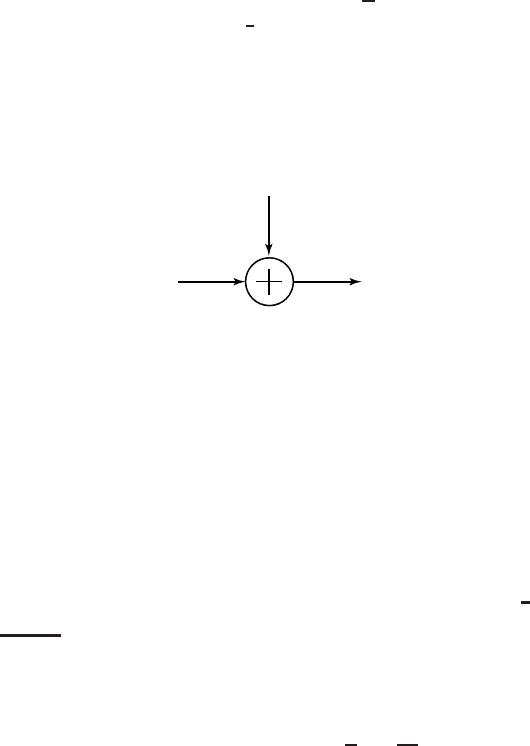
9.17 Impulse power. Consider the additive white Gaussian channel
Z
i
Y
i
X
i
∑
where Z
i
∼ N(0,N), and the input signal has average power con-
straint P .
(a) Suppose that we use all our power at time 1 (i.e., EX
2
1
= nP
and EX
2
i
= 0fori = 2, 3,...,n). Find
max
f(x
n
)
I(X
n
;Y
n
)
n
,
where the maximization is over all distributions f(x
n
) subject
to the constraint EX
2
1
= nP and EX
2
i
= 0fori = 2, 3,...,n.
296 GAUSSIAN CHANNEL
(b) Find
max
f(x
n
): E
1
n
n
i=1
X
2
i
≤P
1
n
I(X
n
;Y
n
)
and compare to part (a).
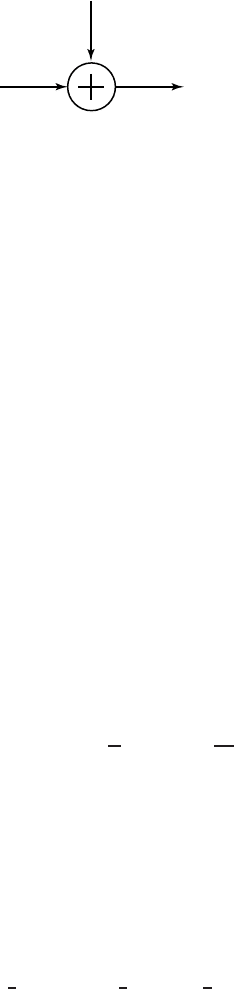
9.18 Gaussian channel with time-varying mean. Find the capacity of
the following Gaussian channel:
Z
i
X
i
Y
i
Let Z
1
,Z
2
,... be independent and let there be a power constraint
P on x
n
(W ). Find the capacity when:
(a) µ
i
= 0, for all i.
(b) µ
i
= e
i
,i= 1, 2,.... Assume that µ
i
is known to the trans-
mitter and receiver.
(c) µ
i
unknown, but µ
i
i.i.d. ∼ N(0,N
1
) for all i.
9.19 Parametric form for channel capacity. Consider m parallel Gaus-
sian channels, Y
i
= X
i
+ Z
i
,whereZ
i
∼ N(0,λ
i
) and the noises
X
i
are independent random variables. Thus, C =
m
i=1
1
2
log(1 +
(λ−λ
i
)
+
λ
i
),whereλ is chosen to satisfy
m
i=1
(λ − λ
i
)
+
= P . Show
that this can be rewritten in the form
P(λ) =
i:λ
i
≤λ
(λ − λ
i
)
C(λ) =
i:λ
i
≤λ
1
2
log
λ
λ
i
.
Here P(λ) is piecewise linear and C(λ) is piecewise logarithmic
in λ.
9.20 Robust decoding. Consider an additive noise channel whose out-
put Y is given by
Y = X + Z,
where the channel input X is average power limited,
EX
2
≤ P,
PROBLEMS 297
and the noise process {Z
k
}
∞
k=−∞
is i.i.d. with marginal distribution
p
Z
(z) (not necessarily Gaussian) of power N,
EZ
2
= N.
(a) Show that the channel capacity, C = max
EX
2
≤P
I(X;Y),is
lower bounded by C
G
,where
C
G
=
1
2
log
1 +
P
N
(i.e., the capacity C
G
corresponding to white Gaussian noise).
(b) Decoding the received vector to the codeword that is closest to
it in Euclidean distance is in general suboptimal if the noise is
non-Gaussian. Show, however, that the rate C
G
is achievable
even if one insists on performing nearest-neighbor decoding
(minimum Euclidean distance decoding) rather than the optimal
maximum-likelihood or joint typicality decoding (with respect
to the true noise distribution).
(c) Extend the result to the case where the noise is not i.i.d. but is
stationary and ergodic with power N.
(Hint for b and c: Consider a size 2
nR
random codebook whose
codewords are drawn independently of each other according to a
uniform distribution over the n-dimensional sphere of radius
√
nP .)
(a) Using a symmetry argument, show that conditioned on the
noise vector, the ensemble average probability of error depends
on the noise vector only via its Euclidean norm z.
(b) Use a geometric argument to show that this dependence is
monotonic.
(c) Given a rate R<C
G
, choose some N
>N such that
R<
1
2
log
1 +
P
N
.
Compare the case where the noise is i.i.d.
N(0,N
) to the case
at hand.
(d) Conclude the proof using the fact that the above ensemble of
codebooks can achieve the capacity of the Gaussian channel
(no need to prove that).
298 GAUSSIAN CHANNEL
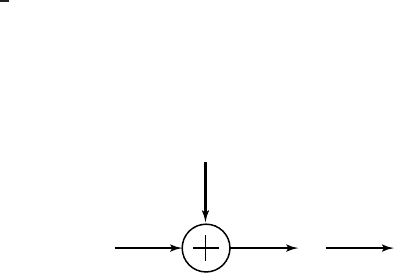
9.21 Mutual information game. Consider the following channel:
Z
XY
Throughout this problem we shall constrain the signal power
EX = 0,EX
2
= P, (9.176)
and the noise power
EZ = 0,EZ
2
= N, (9.177)
and assume that X and Z are independent. The channel capacity is
given by I(X;X + Z).
Now for the game. The noise player chooses a distribution on Z to
minimize I(X;X + Z), while the signal player chooses a distribu-
tion on X to maximize I(X;X + Z). Letting X
∗
∼ N(0,P),Z
∗
∼
N(0,N), show that Gaussian X
∗
and Z
∗
satisfy the saddlepoint
conditions
I(X;X + Z
∗
) ≤ I(X
∗
;X
∗
+ Z
∗
) ≤ I(X
∗
;X
∗
+ Z). (9.178)
Thus,
min
Z
max
X
I(X;X + Z) = max
X
min
Z
I(X;X + Z) (9.179)
=
1
2
log
1 +
P
N
, (9.180)
and the game has a value. In particular, a deviation from normal
for either player worsens the mutual information from that player’s
standpoint. Can you discuss the implications of this?
Note: Part of the proof hinges on the entropy power inequality from
Section 17.8, which states that if X and Y are independent random
n-vectors with densities, then
2
2
n
h(X+Y)
≥ 2
2
n
h(X)
+ 2
2
n
h(Y)
. (9.181)
HISTORICAL NOTES 299
9.22 Recovering the noise. Consider a standard Gaussian channel Y
n
=
X
n
+ Z
n
, where Z
i
is i.i.d. ∼ N(0,N), i = 1, 2,...,n, and
1
n
n
i=1
X
2
i
≤ P. Here we are interested in recovering the noise Z
n
and we don’t care about the signal X
n
. By sending X
n
= (0, 0,...,
0), the receiver gets Y
n
= Z
n
and can fully determine the value of
Z
n
. We wonder how much variability there can be in X
n
and still
recover the Gaussian noise Z
n
. Use of the channel looks like
Z
n
Z
n
(
Y
n
)
X
n
Y
n
^
Argue that for some R>0, the transmitter can arbitrarily send one
of 2
nR
different sequences of x
n
without affecting the recovery of
the noise in the sense that
Pr{
ˆ
Z
n
= Z
n
}→0asn →∞.
For what R is this possible?
HISTORICAL NOTES
The Gaussian channel was first analyzed by Shannon in his original
paper [472]. The water-filling solution to the capacity of the colored
noise Gaussian channel was developed by Shannon [480] and treated in
detail by Pinsker [425]. The time-continuous Gaussian channel is treated
in Wyner [576], Gallager [233], and Landau, Pollak, and Slepian [340,
341, 500].
Pinsker [421] and Ebert [178] argued that feedback at most doubles
the capacity of a nonwhite Gaussian channel; the proof in the text is
from Cover and Pombra [136], who also show that feedback increases
the capacity of the nonwhite Gaussian channel by at most half a bit.
The most recent feedback capacity results for nonwhite Gaussian noise
channels are due to Kim [314].

CHAPTER 10
RATE DISTORTION THEORY
The description of an arbitrary real number requires an infinite number
of bits, so a finite representation of a continuous random variable can
never be perfect. How well can we do? To frame the question appropri-
ately, it is necessary to define the “goodness” of a representation of a
source. This is accomplished by defining a distortion measure which is a
measure of distance between the random variable and its representation.
The basic problem in rate distortion theory can then be stated as follows:
Given a source distribution and a distortion measure, what is the minimum
expected distortion achievable at a particular rate? Or, equivalently, what
is the minimum rate description required to achieve a particular distortion?
One of the most intriguing aspects of this theory is that joint descriptions
are more efficient than individual descriptions. It is simpler to describe an
elephant and a chicken with one description than to describe each alone. This
is true even for independent random variables. It is simpler to describe X
1
and X
2
together (at a given distortion for each) than to describe each by itself.
Why don’t independent problems have independent solutions? The answer
is found in the geometry. Apparently, rectangular grid points (arising from
independent descriptions) do not fill up the space efficiently.
Rate distortion theory can be applied to both discrete and continuous
random variables. The zero-error data compression theory of Chapter 5
is an important special case of rate distortion theory applied to a discrete
source with zero distortion. We begin by considering the simple problem
of representing a single continuous random variable by a finite number
of bits.
10.1 QUANTIZATION
In this section we motivate the elegant theory of rate distortion by showing
how complicated it is to solve the quantization problem exactly for a single
Elements of Information Theory, Second Edition, By Thomas M. Cover and Joy A. Thomas
Copyright 2006 John Wiley & Sons, Inc.
301
302 RATE DISTORTION THEORY
random variable. Since a continuous random source requires infinite preci-
sion to represent exactly, we cannot reproduce it exactly using a finite-rate
code. The question is then to find the best possible representation for any
given data rate.
We first consider the problem of representing a single sample from the
source. Let the random variable be represented be X and let the represen-
tation of X be denoted as
ˆ
X(X). If we are given R bits to represent X,
the function
ˆ
X can take on 2
R
values. The problem is to find the optimum
set of values for
ˆ
X (called the reproduction points or code points)and
the regions that are associated with each value
ˆ
X.
For example, let X ∼
N(0,σ
2
), and assume a squared-error distortion
measure. In this case we wish to find the function
ˆ
X(X) such that
ˆ
X takes
on at most 2
R
values and minimizes E(X −
ˆ
X(X))
2
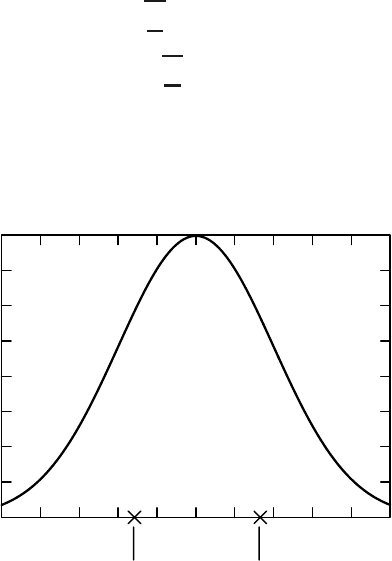
. If we are given one
bit to represent X, it is clear that the bit should distinguish whether or
not X>0. To minimize squared error, each reproduced symbol should
be the conditional mean of its region. This is illustrated in Figure 10.1.
Thus,
ˆ
X(x) =
2
π
σ if x ≥ 0,
−
2
π
σ if x<0.
(10.1)
If we are given 2 bits to represent the sample, the situation is not as
simple. Clearly, we want to divide the real line into four regions and use
0
0.05
0.1
0.15
0.2
0.25
0.3
0.35
0.4
−2.5
−2 −1.5
−.79 +.79
−1 −0.5 0 0.5 1 1.5 2 2.5
x
f
(
x
)
FIGURE 10.1. One-bit quantization of Gaussian random variable.
10.2 DEFINITIONS 303
a point within each region to represent the sample. But it is no longer
immediately obvious what the representation regions and the reconstruc-
tion points should be. We can, however, state two simple properties of
optimal regions and reconstruction points for the quantization of a single
random variable:
•
Given a set {
ˆ
X(w)} of reconstruction points, the distortion is mini-
mized by mapping a source random variable X to the representation
ˆ
X(w) that is closest to it. The set of regions of
X defined by this
mapping is called a Vor onoi or Dirichlet partition defined by the
reconstruction points.
•
The reconstruction points should minimize the conditional expected
distortion over their respective assignment regions.
These two properties enable us to construct a simple algorithm to find a
“good” quantizer: We start with a set of reconstruction points, find the opti-
mal set of reconstruction regions (which are the nearest-neighbor regions
with respect to the distortion measure), then find the optimal reconstruc-
tion points for these regions (the centroids of these regions if the distortion
is squared error), and then repeat the iteration for this new set of recon-
struction points. The expected distortion is decreased at each stage in the
algorithm, so the algorithm will converge to a local minimum of the dis-
tortion. This algorithm is called the Lloyd algorithm [363] (for real-valued
random variables) or the generalized Lloyd algorithm [358] (for vector-
valued random variables) and is frequently used to design quantization
systems.
Instead of quantizing a single random variable, let us assume that we
are given a set of n i.i.d. random variables drawn according to a Gaussian
distribution. These random variables are to be represented using nR bits.
Since the source is i.i.d., the symbols are independent, and it may appear
that the representation of each element is an independent problem to be
treated separately. But this is not true, as the results on rate distortion
theory will show. We will represent the entire sequence by a single index
taking 2
nR
values. This treatment of entire sequences at once achieves a
lower distortion for the same rate than independent quantization of the
individual samples.
10.2 DEFINITIONS
Assume that we have a source that produces a sequence X
1
,X
2
,...,X
n
i.i.d. ∼ p(x), x ∈ X. For the proofs in this chapter, we assume that the
304 RATE DISTORTION THEORY
Encoder Decoder
X
n
X
n
f
n
(
X
n
) {1,2,...,2
nR
}
∋
^
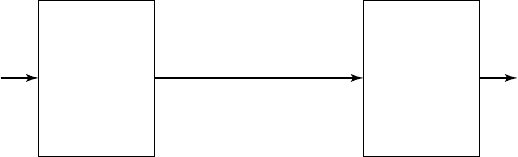
FIGURE 10.2. Rate distortion encoder and decoder.
alphabet is finite, but most of the proofs can be extended to continuous
random variables. The encoder describes the source sequence X
n
by an
index f
n
(X
n
) ∈{1, 2,...,2
nR
}. The decoder represents X
n
by an estimate
ˆ
X
n
∈
ˆ
X, as illustrated in Figure 10.2.
Definition A distortion function or distortion measure is a mapping
d :
X ×
ˆ
X → R
+
(10.2)
from the set of source alphabet-reproduction alphabet pairs into the set of
nonnegative real numbers. The distortion d(x, ˆx) is a measure of the cost
of representing the symbol x by the symbol ˆx.
Definition A distortion measure is said to be bounded if the maximum
value of the distortion is finite:
d
max
def
= max
x∈X , ˆx∈
ˆ
X
d(x, ˆx) < ∞. (10.3)
In most cases, the reproduction alphabet
ˆ
X is the same as the source
alphabet
X.
Examples of common distortion functions are
•
Hamming (probability of error) distortion. The Hamming distortion
is given by
d(x, ˆx) =
0ifx = ˆx
1ifx = ˆx,
(10.4)
which results in a probability of error distortion, since Ed(X,
ˆ
X) =
Pr(X =
ˆ
X).