
Thomas M. Cover, Joy A. Thomas. Elements of information theory
Подождите немного. Документ загружается.


10.2 DEFINITIONS 305
•
Squared-error distortion. The squared-error distortion,
d(x, ˆx) = (x − ˆx)
2
, (10.5)
is the most popular distortion measure used for continuous alphabets.
Its advantages are its simplicity and its relationship to least-squares
prediction. But in applications such as image and speech coding,
various authors have pointed out that the mean-squared error is not an
appropriate measure of distortion for human observers. For example,
there is a large squared-error distortion between a speech waveform
and another version of the same waveform slightly shifted in time,
even though both would sound the same to a human observer.
Many alternatives have been proposed; a popular measure of distortion
in speech coding is the Itakura–Saito distance, which is the relative entropy
between multivariate normal processes. In image coding, however, there is
at present no real alternative to using the mean-squared error as the distortion
measure.
The distortion measure is defined on a symbol-by-symbol basis. We
extend the definition to sequences by using the following definition:
Definition The distortion between sequences x
n
and ˆx
n
is defined by
d(x
n
, ˆx
n
) =
1
n
n
i=1
d(x
i
, ˆx
i
). (10.6)
So the distortion for a sequence is the average of the per symbol dis-
tortion of the elements of the sequence. This is not the only reasonable
definition. For example, one may want to measure the distortion between
two sequences by the maximum of the per symbol distortions. The the-
ory derived below does not apply directly to this more general distortion
measure.
Definition A (2
nR
,n)-rate distortion code consists of an encoding func-
tion,
f
n
: X
n
→{1, 2,...,2
nR
}, (10.7)
and a decoding (reproduction) function,
g
n
: {1, 2,...,2
nR
}→
ˆ
X
n
. (10.8)
306 RATE DISTORTION THEORY
The distortion associated with the (2
nR
,n) code is defined as
D = Ed(X
n
,g
n
(f
n
(X
n
))), (10.9)
where the expectation is with respect to the probability distribution on X:
D =
x
n
p(x
n
)d(x
n
,g
n
(f
n
(x
n
))). (10.10)
The set of n-tuples g
n
(1), g
n
(2),...,g
n
(2
nR
), denoted by
ˆ
X
n
(1),...,
ˆ
X
n
(2
nR
), constitutes the codebook,andf
−1
n
(1),...,f
−1
n
(2
nR
) are the
associated assignment regions.
Many terms are used to describe the replacement of X
n
by its quantized
version
ˆ
X
n
(w). It is common to refer to
ˆ
X
n
as the vector quantiza-
tion, reproduction, reconstruction, representation, source code,orestimate
of X
n
.
Definition A rate distortion pair (R, D) is said to be achievable if
there exists a sequence of (2
nR
,n)-rate distortion codes (f
n
,g
n
) with
lim
n→∞
Ed(X
n
,g
n
(f
n
(X
n
))) ≤ D.
Definition The rate distortion region for a source is the closure of the
set of achievable rate distortion pairs (R, D).
Definition The rate distortion function R(D) is the infimum of rates R
such that (R, D) is in the rate distortion region of the source for a given
distortion D.
Definition The distortion rate function D(R) is the infimum of all dis-
tortions D such that (R, D) is in the rate distortion region of the source
for a given rate R.
The distortion rate function defines another way of looking at the
boundary of the rate distortion region. We will in general use the rate
distortion function rather than the distortion rate function to describe this
boundary, although the two approaches are equivalent.
We now define a mathematical function of the source, which we call
the information rate distortion function. The main result of this chapter
is the proof that the information rate distortion function is equal to the
rate distortion function defined above (i.e., it is the infimum of rates that
achieve a particular distortion).
10.3 CALCULATION OF THE RATE DISTORTION FUNCTION 307
Definition The information rate distortion function R
(I )
(D) for a source
X with distortion measure d(x, ˆx) is defined as
R
(I )
(D) = min
p( ˆx|x):
(x, ˆx)
p(x)p(ˆx|x)d(x,ˆx)≤D
I(X;
ˆ
X), (10.11)
where the minimization is over all conditional distributions p( ˆx|x) for
which the joint distribution p(x, ˆx) = p(x)p( ˆx|x) satisfies the expected
distortion constraint.
Paralleling the discussion of channel capacity in Chapter 7, we initially
consider the properties of the information rate distortion function and
calculate it for some simple sources and distortion measures. Later we
prove that we can actually achieve this function (i.e., there exist codes with
rate R
(I )
(D) with distortion D). We also prove a converse establishing
that R ≥ R
(I )
(D) for any code that achieves distortion D.
The main theorem of rate distortion theory can now be stated as follows:
Theorem 10.2.1 The rate distortion function for an i.i.d. source X
with distribution p(x) and bounded distortion function d(x, ˆx) is equal to
the associated information rate distortion function. Thus,
R(D) = R
(I )
(D) = min
p( ˆx|x):
(x, ˆx)
p(x)p(ˆx|x)d(x,ˆx)≤D
I(X;
ˆ
X) (10.12)
is the minimum achievable rate at distortion D.
This theorem shows that the operational definition of the rate distortion
function is equal to the information definition. Hence we will use R(D)
from now on to denote both definitions of the rate distortion function.
Before coming to the proof of the theorem, we calculate the information
rate distortion function for some simple sources and distortions.
10.3 CALCULATION OF THE RATE DISTORTION FUNCTION
10.3.1 Binary Source
We now find the description rate R(D) required to describe a Bernoulli(p)
source with an expected proportion of errors less than or equal to D.
Theorem 10.3.1 The rate distortion function for a Bernoulli(p) source
with Hamming distortion is given by
R(D) =
H(p) − H(D), 0 ≤ D ≤ min{p, 1 −p},
0,D>min{p, 1 −p}.
(10.13)
308 RATE DISTORTION THEORY
Proof: Consider a binary source X ∼ Bernoulli(p) with a Hamming
distortion measure. Without loss of generality, we may assume that p<
1
2
.
We wish to calculate the rate distortion function,
R(D) = min
p( ˆx|x):
(x, ˆx)
p(x)p(ˆx|x)d(x,ˆx)≤D
I(X;
ˆ
X). (10.14)
Let ⊕ denote modulo 2 addition. Thus, X ⊕
ˆ
X = 1 is equivalent to X =
ˆ
X. We do not minimize I(X;
ˆ
X) directly; instead, we find a lower bound
and then show that this lower bound is achievable. For any joint distribu-
tion satisfying the distortion constraint, we have
I(X;
ˆ
X) = H(X)− H(X|
ˆ
X) (10.15)
= H(p)− H(X ⊕
ˆ
X|
ˆ
X) (10.16)
≥ H(p)− H(X ⊕
ˆ
X) (10.17)
≥ H(p)− H(D), (10.18)
since Pr(X =
ˆ
X) ≤ D and H(D) increases with D for D ≤
1
2
. Thus,
R(D) ≥ H(p) − H(D). (10.19)
We now show that the lower bound is actually the rate distortion function
by finding a joint distribution that meets the distortion constraint and
has I(X;
ˆ
X) = R(D).For0≤ D ≤ p, we can achieve the value of the
rate distortion function in (10.19) by choosing (X,
ˆ
X) to have the joint
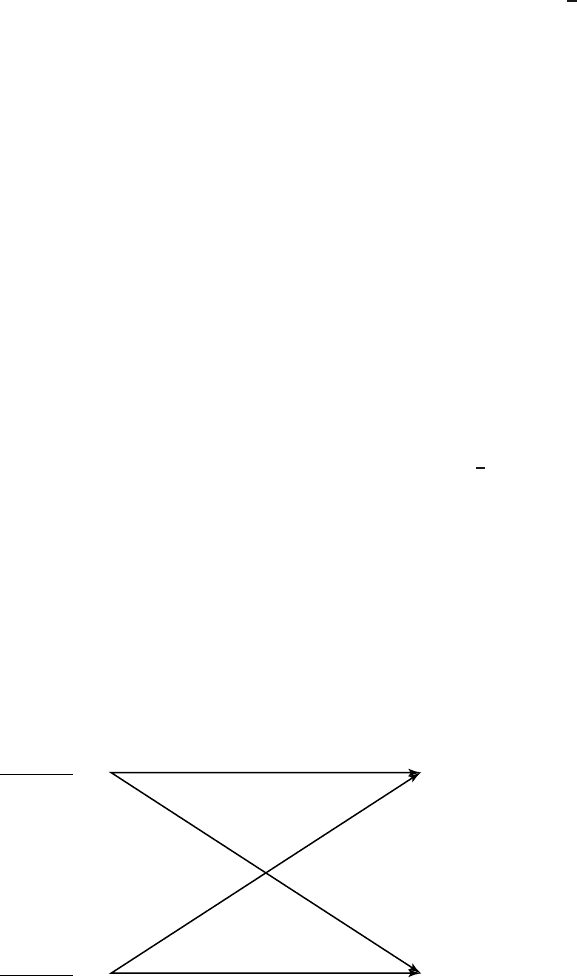
distribution given by the binary symmetric channel shown in Figure 10.3.
1 −
D
1 −
p
−
D
1 − 2
D
1 −
D
D
D
X
0
1
01 −
p
p
1
p
−
D
1 − 2
D
X
^
FIGURE 10.3. Joint distribution for binary source.
10.3 CALCULATION OF THE RATE DISTORTION FUNCTION 309
We choose the distribution of
ˆ
X at the input of the channel so that the
output distribution of X is the specified distribution. Let r = Pr(
ˆ
X = 1).
Then choose r so that
r(1 − D) + (1 − r)D = p, (10.20)
or
r =
p − D
1 − 2D
. (10.21)
If D ≤ p ≤
1
2
,thenPr(
ˆ
X = 1) ≥ 0andPr(
ˆ
X = 0) ≥ 0. We then have
I(X;
ˆ
X) = H(X) − H(X|
ˆ
X) = H(p)− H(D), (10.22)
and the expected distortion is Pr(X =
ˆ
X) = D.
If D ≥ p, we can achieve R(D) = 0 by letting
ˆ
X = 0 with probability
1. In this case, I(X;
ˆ
X) = 0andD = p. Similarly, if D ≥ 1 − p, we can
achieve R(D) = 0 by setting
ˆ
X = 1 with probability 1. Hence, the rate
distortion function for a binary source is
R(D) =
H(p) − H(D), 0 ≤ D ≤ min{p, 1 −p},
0,D>min{p, 1 −p}.
(10.23)
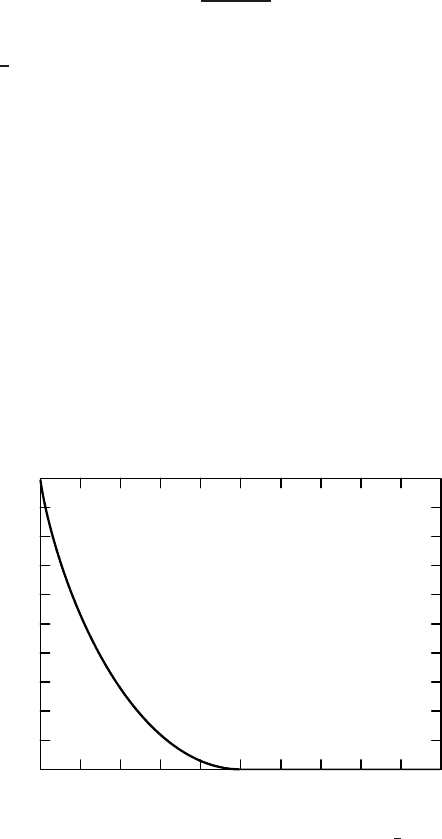
This function is illustrated in Figure 10.4.
0
0.1
0.2
0.3
0.4
0.5
0.6
0.7
0.8
0.9
1
0
0.1 0.2 0.3 0.4 0.5 0.6 0.7 0.8 0.9 1
D
R
(
D
)
FIGURE 10.4. Rate distortion function for a Bernoulli (
1
2
) source.

310 RATE DISTORTION THEORY
The above calculations may seem entirely unmotivated. Why should
minimizing mutual information have anything to do with quantization?
The answer to this question must wait until we prove Theorem 10.2.1.
10.3.2 Gaussian Source
Although Theorem 10.2.1 is proved only for discrete sources with a
bounded distortion measure, it can also be proved for well-behaved contin-
uous sources and unbounded distortion measures. Assuming this general
theorem, we calculate the rate distortion function for a Gaussian source
with squared-error distortion.
Theorem 10.3.2 The rate distortion function for a
N(0,σ
2
) source with
squared-error distortion is
R(D) =
1
2
log
σ
2
D
, 0 ≤ D ≤ σ
2
,
0,D>σ
2
.
(10.24)
Proof: Let X be ∼
N(0,σ
2
). By the rate distortion theorem extended
to continuous alphabets, we have
R(D) = min
f(ˆx|x):E(
ˆ
X−X)
2
≤D
I(X;
ˆ
X). (10.25)
As in the preceding example, we first find a lower bound for the rate
distortion function and then prove that this is achievable. Since E(X −
ˆ
X)
2
≤ D, we observe that
I(X;
ˆ
X) = h(X) − h(X|
ˆ
X) (10.26)
=
1
2
log(2πe)σ
2
− h(X −
ˆ
X|
ˆ
X) (10.27)
≥
1
2
log(2πe)σ
2
− h(X −
ˆ
X) (10.28)
≥
1
2
log(2πe)σ
2
− h(N(0,E(X−
ˆ
X)
2
)) (10.29)
=
1
2
log(2πe)σ
2
−
1
2
log(2πe)E(X −
ˆ
X)
2
(10.30)
≥
1
2
log(2πe)σ
2
−
1
2
log(2πe)D (10.31)
=
1
2
log
σ
2
D
, (10.32)
10.3 CALCULATION OF THE RATE DISTORTION FUNCTION 311
where (10.28) follows from the fact that conditioning reduces entropy and
(10.29) follows from the fact that the normal distribution maximizes the
entropy for a given second moment (Theorem 8.6.5). Hence,
R(D) ≥
1
2
log
σ
2
D
. (10.33)
To find the conditional density f(ˆx|x) that achieves this lower bound,
it is usually more convenient to look at the conditional density f(x|ˆx),
which is sometimes called the test channel (thus emphasizing the duality of
rate distortion with channel capacity). As in the binary case, we construct
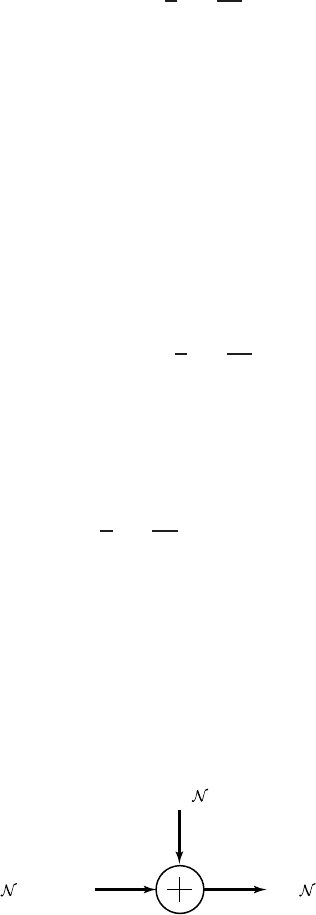
f(x|ˆx) to achieve equality in the bound. We choose the joint distribution
as shown in Figure 10.5. If D ≤ σ
2
, we choose
X =
ˆ
X + Z,
ˆ
X ∼
N(0,σ
2
− D), Z ∼ N(0,D), (10.34)
where
ˆ
X and Z are independent. For this joint distribution, we calculate
I(X;
ˆ
X) =
1
2
log
σ
2
D
, (10.35)
and E(X −
ˆ
X)
2
= D, thus achieving the bound in (10.33). If D>σ
2
,we
choose
ˆ
X = 0 with probability 1, achieving R(D) = 0. Hence, the rate
distortion function for the Gaussian source with squared-error distortion is
R(D) =
1
2
log
σ
2
D
, 0 ≤ D ≤ σ
2
,
0,D>σ
2
,
(10.36)
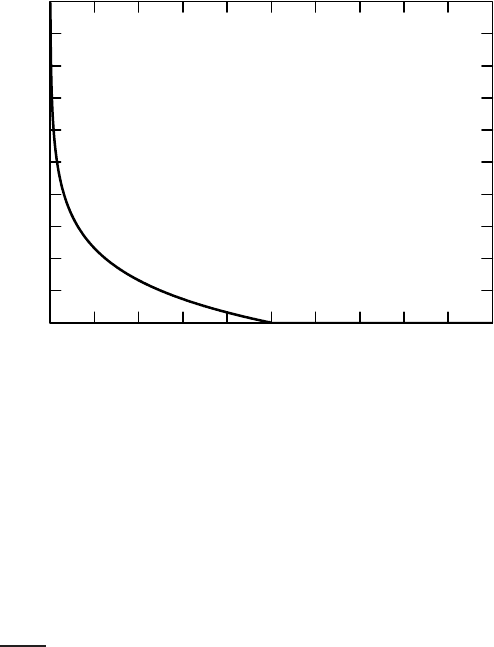
as illustrated in Figure 10.6.
We can rewrite (10.36) to express the distortion in terms of the rate,
D(R) = σ
2
2
−2R
. (10.37)
Z
~
(0,
D
)
X
~
(0, s
2
−
D
)
^
X
~
(0,s
2
)
FIGURE 10.5. Joint distribution for Gaussian source.
312 RATE DISTORTION THEORY
0
0.5
1
1.5
2
2.5
3
3.5
4
4.5
5
0
0.2 0.4 0.6 0.8 1 1.2 1.4 1.6 1.8 2
D
R
(
D
)
FIGURE 10.6. Rate distortion function for a Gaussian source.
Each bit of description reduces the expected distortion by a factor of 4.
With a 1-bit description, the best expected square error is σ
2
/4. We can
compare this with the result of simple 1-bit quantization of a
N(0,σ
2
)
random variable as described in Section 10.1. In this case, using the two
regions corresponding to the positive and negative real lines and repro-
duction points as the centroids of the respective regions, the expected dis-
tortion is
(π−2)
π
σ
2
= 0.3633σ
2
(see Problem 10.1). As we prove later, the
rate distortion limit R(D) is achieved by considering long block lengths.
This example shows that we can achieve a lower distortion by consider-
ing several distortion problems in succession (long block lengths) than can
be achieved by considering each problem separately. This is somewhat
surprising because we are quantizing independent random variables.
10.3.3 Simultaneous Description of Independent Gaussian
Random Variables
Consider the case of representing m independent (but not identically dis-
tributed) normal random sources X
1
,...,X
m
,whereX
i
are ∼ N(0,σ
2
i
),
with squared-error distortion. Assume that we are given R bits with which
to represent this random vector. The question naturally arises as to how
we should allot these bits to the various components to minimize the
total distortion. Extending the definition of the information rate distortion

10.3 CALCULATION OF THE RATE DISTORTION FUNCTION 313
function to the vector case, we have
R(D) = min
f(ˆx
m
|x
m
):Ed(X
m
,
ˆ
X
m
)≤D
I(X
m
;
ˆ
X
m
), (10.38)
where d(x
m
, ˆx
m
) =
m
i=1
(x
i
− ˆx
i
)
2
. Now using the arguments in the pre-
ceding example, we have
I(X
m
;
ˆ
X
m
) = h(X
m
) − h(X
m
|
ˆ
X
m
) (10.39)
=
m
i=1
h(X
i
) −
m
i=1
h(X
i
|X
i−1
,
ˆ
X
m
) (10.40)
≥
m
i=1
h(X
i
) −
m
i=1
h(X
i
|
ˆ
X
i
) (10.41)
=
m
i=1
I(X
i
;
ˆ
X
i
) (10.42)
≥
m
i=1
R(D
i
) (10.43)
=
m
i=1
1
2
log
σ
2
i
D
i
+
, (10.44)
where D
i
= E(X
i
−
ˆ
X
i
)
2
and (10.41) follows from the fact that condi-
tioning reduces entropy. We can achieve equality in (10.41) by choosing
f(x
m
|ˆx
m
) =
m
i=1
f(x
i
|ˆx
i
) and in (10.43) by choosing the distribution of
each
ˆ
X
i
∼ N(0,σ
2
i
− D
i
), as in the preceding example. Hence, the prob-
lem of finding the rate distortion function can be reduced to the following
optimization (using nats for convenience):
R(D) = min
D
i
=D
m
i=1
max
1
2
ln
σ
2
i
D
i
, 0
. (10.45)
Using Lagrange multipliers, we construct the functional
J(D) =
m
i=1
1
2
ln
σ
2
i
D
i
+ λ
m
i=1
D
i
, (10.46)

314 RATE DISTORTION THEORY
and differentiating with respect to D
i
and setting equal to 0, we have
∂J
∂D
i
=−
1
2
1
D
i
+ λ = 0 (10.47)
or
D
i
= λ
. (10.48)
Hence, the optimum allotment of the bits to the various descriptions
results in an equal distortion for each random variable. This is possible if
the constant λ
in (10.48) is less than σ
2
i
for all i. As the total allowable
distortion D is increased, the constant λ
increases until it exceeds σ
2
i
for some i. At this point the solution (10.48) is on the boundary of the
allowable region of distortions. If we increase the total distortion, we must
use the Kuhn–Tucker conditions to find the minimum in (10.46). In this
case the Kuhn–Tucker conditions yield
∂J
∂D
i
=−
1
2
1
D
i
+ λ, (10.49)
where λ is chosen so that
∂J
∂D
i
= 0ifD
i
<σ
2
i
≤ 0ifD
i
≥ σ
2
i
.
(10.50)
It is easy to check that the solution to the Kuhn–Tucker equations is given
by the following theorem:
Theorem 10.3.3 (Rate distortion for a parallel Gaussian source) Let
X
i
∼ N(0,σ
2
i
), i = 1, 2,...,m, be independent Gaussian random vari-
ables, and let the distortion measure be d(x
m
, ˆx
m
) =
m
i=1
(x
i
− ˆx
i
)
2
.
Then the rate distortion function is given by
R(D) =
m
i=1
1
2
log
σ
2
i
D
i
, (10.51)
where
D
i
=
λ if λ<σ
2
i
,
σ
2
i
if λ ≥ σ
2
i
,
(10.52)
where λ is chosen so that
m
i=1
D
i
= D.