
Thomas M. Cover, Joy A. Thomas. Elements of information theory
Подождите немного. Документ загружается.


10.6 STRONGLY TYPICAL SEQUENCES AND RATE DISTORTION 325
Rate distortion for the Gaussian source. Consider a Gaussian source of
variance σ
2
.A(2
nR
,n) rate distortion code for this source with distortion
D is a set of 2
nR
sequences in R
n
such that most source sequences of
length n (all those that lie within a sphere of radius
√
nσ
2
) are within a
distance
√
nD of some codeword. Again, by the sphere-packing argument,
it is clear that the minimum number of codewords required is
2
nR(D)
=
σ
2
D
n
2
. (10.105)
The rate distortion theorem shows that this minimum rate is asymptotically
achievable (i.e., that there exists a collection of spheres of radius
√
nD
that cover the space except for a set of arbitrarily small probability).
The above geometric arguments also enable us to transform a good
code for channel transmission into a good code for rate distortion. In both
cases, the essential idea is to fill the space of source sequences: In channel
transmission, we want to find the largest set of codewords that have a large
minimum distance between codewords, whereas in rate distortion, we wish
to find the smallest set of codewords that covers the entire space. If we
have any set that meets the sphere packing bound for one, it will meet the
sphere packing bound for the other. In the Gaussian case, choosing the
codewords to be Gaussian with the appropriate variance is asymptotically
optimal for both rate distortion and channel coding.
10.6 STRONGLY TYPICAL SEQUENCES AND RATE
DISTORTION
In Section 10.5 we proved the existence of a rate distortion code of
rate R(D) with average distortion close to D. In fact, not only is the
average distortion close to D, but the total probability that the distor-
tion is greater than D + δ is close to 0. The proof of this is similar
to the proof in Section 10.5; the main difference is that we will use
strongly typical sequences rather than weakly typical sequences. This
will enable us to give an upper bound to the probability that a typical
source sequence is not well represented by a randomly chosen codeword
in (10.94). We now outline an alternative proof based on strong typical-
ity that will provide a stronger and more intuitive approach to the rate
distortion theorem.
We begin by defining strong typicality and quoting a basic theorem
bounding the probability that two sequences are jointly typical. The
properties of strong typicality were introduced by Berger [53] and were

326 RATE DISTORTION THEORY
explored in detail in the book by Csisz
´
ar and K
¨
orner [149]. We will
define strong typicality (as in Chapter 11) and state a fundamental lemma
(Lemma 10.6.2).
Definition A sequence x
n
∈ X
n
is said to be -strongly typical with
respect to a distribution p(x) on
X if:
1. For all a ∈
X with p(a) > 0, we have
1
n
N(a|x
n
) − p(a)
<
|X|
. (10.106)
2. For all a ∈
X with p(a) = 0, N(a|x
n
) = 0.
N(a|x
n
) is the number of occurrences of the symbol a in the sequence
x
n
.
The set of sequences x
n
∈ X
n
such that x
n
is strongly typical is called
the strongly typical set and is denoted A
∗(n)
(X) or A
∗(n)
when the random
variable is understood from the context.
Definition A pair of sequences (x
n
,y
n
) ∈ X
n
× Y
n
is said to be -
strongly typical with respect to a distribution p(x,y) on
X × Y if:
1. For all (a, b) ∈
X × Y with p(a, b) > 0, we have
1
n
N(a,b|x
n
,y
n
) − p(a, b)
<
|X||Y|
. (10.107)
2. For all (a, b) ∈
X × Y with p(a, b) = 0, N(a,b|x
n
,y
n
) = 0.
N(a,b|x
n
,y
n
) is the number of occurrences of the pair (a, b) in the pair
of sequences (x
n
,y
n
).
The set of sequences (x
n
,y
n
) ∈ X
n
× Y
n
such that (x
n
,y
n
) is strongly
typical is called the strongly typical set and is denoted A
∗(n)
(X, Y ) or
A
∗(n)
. From the definition, it follows that if (x
n
,y
n
) ∈ A
∗(n)
(X, Y ),then
x
n
∈ A
∗(n)
(X). From the strong law of large numbers, the following
lemma is immediate.
Lemma 10.6.1 Let (X
i
,Y
i
) be drawn i.i.d. ∼ p(x, y).ThenPr(A
∗(n)
)
→ 1 as n →∞.
We will use one basic result, which bounds the probability that an
independently drawn sequence will be seen as jointly strongly typical
10.6 STRONGLY TYPICAL SEQUENCES AND RATE DISTORTION 327
with a given sequence. Theorem 7.6.1 shows that if we choose X
n
and
Y
n
independently, the probability that they will be weakly jointly typical
is ≈ 2
−nI (X;Y)
. The following lemma extends the result to strongly typical
sequences. This is stronger than the earlier result in that it gives a lower
bound on the probability that a randomly chosen sequence is jointly typical
with a fixed typical x
n
.
Lemma 10.6.2 Let Y
1
,Y
2
,...,Y
n
be drawn i.i.d. ∼ p(y).Forx
n
∈
A
∗(n)
(X), the probability that (x
n
,Y
n
) ∈ A
∗(n)
is bounded by
2
−n(I (X;Y)+
1
)
≤ Pr((x
n
,Y
n
) ∈ A
∗(n)
) ≤ 2
−n(I (X;Y)−
1
)
, (10.108)
where
1
goes to 0 as → 0 and n →∞.
Proof: We will not prove this lemma, but instead, outline the proof in
Problem 10.16 at the end of the chapter. In essence, the proof involves
finding a lower bound on the size of the conditionally typical set.
We will proceed directly to the achievability of the rate distortion
function. We will only give an outline to illustrate the main ideas. The
construction of the codebook and the encoding and decoding are similar
to the proof in Section 10.5.
Proof: Fix p( ˆx|x). Calculate p( ˆx) =
x
p(x)p(ˆx|x).Fix>0. Later
we will choose appropriately to achieve an expected distortion less than
D + δ.
Generation of codebook: Generate a rate distortion codebook
C consist-
ing of 2
nR
sequences
ˆ
X
n
drawn i.i.d. ∼
i
p( ˆx
i
). Denote the sequences
ˆ
X
n
(1),...,
ˆ
X
n
(2
nR
).
Encoding: Given a sequence X
n
, index it by w if there exists a w such
that (X
n
,
ˆ
X
n
(w)) ∈ A
∗(n)
, the strongly jointly typical set. If there is more
than one such w, send the first in lexicographic order. If there is no such
w,letw = 1.
Decoding: Let the reproduced sequence be
ˆ
X
n
(w).
Calculation of distortion: As in the case of the proof in Section 10.5, we
calculate the expected distortion over the random choice of codebook as
D = E
X
n
,C
d(X
n
,
ˆ
X
n
) (10.109)
= E
C
x
n
p(x
n
)d(x
n
,
ˆ
X
n
(x
n
)) (10.110)
=
x
n
p(x
n
)E
C
d(x
n
,
ˆ
X
n
), (10.111)
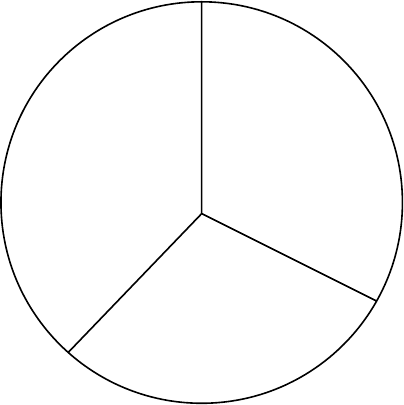
328 RATE DISTORTION THEORY
Nontypical sequences
Typical
sequences
with
jointly
typical
codeword
Typical
sequences
without
jointly
typical
codeword
FIGURE 10.8. Classes of source sequences in rate distortion theorem.
where the expectation is over the random choice of codebook. For a fixed
codebook
C, we divide the sequences x
n
∈ X
n
into three categories, as
shown in Figure 10.8.
•
Nontypical sequences x
n
/∈ A
∗(n)
. The total probability of these
sequences can be made less than by choosing n large enough. Since
the individual distortion between any two sequences is bounded by
d
max
, the nontypical sequences can contribute at most d
max
to the
expected distortion.
•
Typical sequences x
n
∈ A
∗(n)
such that there exists a codeword
ˆ
X
n
(w)
that is jointly typical with x
n
. In this case, since the source sequence
and the codeword are strongly jointly typical, the continuity of the
distortion as a function of the joint distribution ensures that they
are also distortion typical. Hence, the distortion between these x
n
and their codewords is bounded by D + d
max
, and since the total
probability of these sequences is at most 1, these sequences contribute
at most D + d
max
to the expected distortion.
•
Typical sequences x
n
∈ A
∗(n)
such that there does not exist a code-
word
ˆ
X
n
that is jointly typical with x
n
.LetP
e
be the total probability
of these sequences. Since the distortion for any individual sequence
is bounded by d
max
, these sequences contribute at most P
e
d
max
to the
expected distortion.
10.7 CHARACTERIZATION OF THE RATE DISTORTION FUNCTION 329
The sequences in the first and third categories are the sequences that
may not be well represented by this rate distortion code. The probability
of the first category of sequences is less than for sufficiently large n.The
probability of the last category is P
e
, which we will show can be made
small. This will prove the theorem that the total probability of sequences
that are not well represented is small. In turn, we use this to show that
the average distortion is close to D.
Calculation of P
e
: We must bound the probability that there is no code-
word that is jointly typical with the given sequence X
n
. From the joint
AEP, we know that the probability that X
n
and any
ˆ
X
n
are jointly typical
is
.
=2
−nI (X;
ˆ
X)
. Hence the expected number of jointly typical
ˆ
X
n
(w) is
2
nR
2
−nI (X;
ˆ
X)
, which is exponentially large if R>I(X;
ˆ
X).
But this is not sufficient to show that P
e
→ 0. We must show that the
probability that there is no codeword that is jointly typical with X
n
goes
to zero. The fact that the expected number of jointly typical codewords is
exponentially large does not ensure that there will at least one with high
probability. Just as in (10.94), we can expand the probability of error as
P
e
=
x
n
∈A
∗(n)
p(x
n
)
1 − Pr((x
n
,
ˆ
X
n
) ∈ A
∗(n)
)
2
nR
. (10.112)
From Lemma 10.6.2 we have
Pr((x
n
,
ˆ
X
n
) ∈ A
∗(n)
) ≥ 2
−n(I (X;
ˆ
X)+
1
)
. (10.113)
Substituting this in (10.112) and using the inequality (1 − x)
n
≤ e
−nx
,we
have
P
e
≤ e
−(2
nR
2
−n(I (X;
ˆ
X)+
1
))
, (10.114)
whichgoesto0asn →∞if R>I(X;
ˆ
X) +
1
. Hence for an appropriate
choice of and n, we can get the total probability of all badly represented
sequences to be as small as we want. Not only is the expected distortion
close to D, but with probability going to 1, we will find a codeword whose
distortion with respect to the given sequence is less than D + δ.
10.7 CHARACTERIZATION OF THE RATE DISTORTION
FUNCTION
We have defined the information rate distortion function as
R(D) = min
q(ˆx|x):
(x, ˆx)
p(x)q( ˆx|x)d(x,ˆx)≤D
I(X;
ˆ
X), (10.115)

330 RATE DISTORTION THEORY
where the minimization is over all conditional distributions q(ˆx|x) for
which the joint distribution p(x)q( ˆx|x) satisfies the expected distortion
constraint. This is a standard minimization problem of a convex function
over the convex set of all q(ˆx|x) ≥ 0 satisfying
ˆx
q(ˆx|x) = 1forallx
and
q(ˆx|x)p(x)d(x, ˆx) ≤ D.
We can use the method of Lagrange multipliers to find the solution.
We set up the functional
J(q)=
x
ˆx
p(x)q( ˆx|x) log
q(ˆx|x)
x
p(x)q( ˆx|x)
+λ
x
ˆx
p(x)q( ˆx|x)d(x, ˆx) (10.116)
+
x
ν(x)
ˆx
q(ˆx|x), (10.117)
where the last term corresponds to the constraint that q(ˆx|x) is a condi-
tional probability mass function. If we let q(ˆx) =
x
p(x)q( ˆx|x) be the
distribution on
ˆ
X induced by q(ˆx|x), we can rewrite J(q) as
J(q)=
x
ˆx
p(x)q( ˆx|x) log
q(ˆx|x)
q(ˆx)
+λ
x
ˆx
p(x)q( ˆx|x)d(x, ˆx) (10.118)
+
x
ν(x)
ˆx
q(ˆx|x). (10.119)
Differentiating with respect to q(ˆx|x),wehave
∂J
∂q(ˆx|x)
= p(x) log
q(ˆx|x)
q(ˆx)
+ p(x) −
x
p(x
)q( ˆx|x
)
1
q(ˆx)
p(x)
+λp(x)d(x, ˆx) + ν(x) = 0. (10.120)
Setting log µ(x) = ν(x)/p(x), we obtain
p(x)
log
q(ˆx|x)
q(ˆx)
+ λd(x, ˆx) + log µ(x)
= 0 (10.121)

10.7 CHARACTERIZATION OF THE RATE DISTORTION FUNCTION 331
or
q(ˆx|x) =
q(ˆx)e
−λd(x, ˆx)
µ(x)
. (10.122)
Since
ˆx
q(ˆx|x) = 1, we must have
µ(x) =
ˆx
q(ˆx)e
−λd(x, ˆx)
(10.123)
or
q(ˆx|x) =
q(ˆx)e
−λd(x, ˆx)
ˆx
q(ˆx)e
−λd(x, ˆx)
. (10.124)
Multiplying this by p(x) and summing over all x, we obtain
q(ˆx) = q(ˆx)
x
p(x)e
−λd(x, ˆx)
ˆx
q(ˆx
)e
−λd(x, ˆx
)
. (10.125)
If q(ˆx) > 0, we can divide both sides by q(ˆx) and obtain
x
p(x)e
−λd(x, ˆx)
ˆx
q(ˆx
)e
−λd(x, ˆx
)
= 1 (10.126)
for all ˆx ∈
ˆ
X. We can combine these |
ˆ
X| equations with the equation
defining the distortion and calculate λ and the |
ˆ
X| unknowns q(ˆx).We
can use this and (10.124) to find the optimum conditional distribution.
The above analysis is valid if q(ˆx) is unconstrained (i.e., q(ˆx) > 0for
all ˆx). The inequality condition q(ˆx) > 0 is covered by the Kuhn–Tucker
conditions, which reduce to
∂J
∂q(ˆx|x)
= 0ifq(ˆx|x) > 0,
(10.127)
≥ 0ifq(ˆx|x) = 0.
Substituting the value of the derivative, we obtain the conditions for the
minimum as
x
p(x)e
−λd(x, ˆx)
ˆx
q(ˆx
)e
−λd(x, ˆx
)
= 1ifq(ˆx) > 0,
(10.128)
≤ 1ifq(ˆx) = 0.
(10.129)
332 RATE DISTORTION THEORY
This characterization will enable us to check if a given q(ˆx) is a solution
to the minimization problem. However, it is not easy to solve for the
optimum output distribution from these equations. In the next section we
provide an iterative algorithm for computing the rate distortion function.
This algorithm is a special case of a general algorithm for finding the
minimum relative entropy distance between two convex sets of probability
densities.
10.8 COMPUTATION OF CHANNEL CAPACITY AND THE RATE
DISTORTION FUNCTION
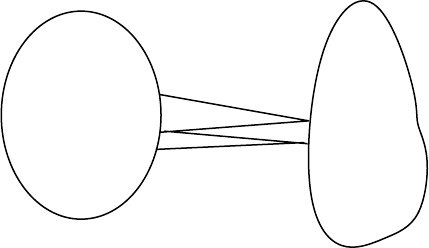
Consider the following problem: Given two convex sets A and B in
R
n
as shown in Figure 10.9, we would like to find the minimum distance
between them:
d
min
= min
a∈A,b∈B
d(a,b), (10.130)
where d(a,b) is the Euclidean distance between a and b. An intuitively
obvious algorithm to do this would be to take any point x ∈ A,andfind
the y ∈ B that is closest to it. Then fix this y and find the closest point in
A. Repeating this process, it is clear that the distance decreases at each
stage. Does it converge to the minimum distance between the two sets?
Csisz
´
ar and Tusn
´
ady [155] have shown that if the sets are convex and
if the distance satisfies certain conditions, this alternating minimization
algorithm will indeed converge to the minimum. In particular, if the sets
are sets of probability distributions and the distance measure is the relative
entropy, the algorithm does converge to the minimum relative entropy
between the two sets of distributions.
A
B
FIGURE 10.9. Distance between convex sets.

10.8 COMPUTATION OF CHANNEL CAPACITY AND RATE DISTORTION FUNCTION 333
To apply this algorithm to rate distortion, we have to rewrite the rate
distortion function as a minimum of the relative entropy between two sets.
We begin with a simple lemma. A form of this lemma comes up again
in theorem 13.1.1, establishing the duality of channel capacity universal
data compression.
Lemma 10.8.1 Let p(x)p(y|x) be a given joint distribution. Then the
distribution r(y) that minimizes the relative entropy D(p(x)p(y|x)||p(x)
r(y)) is the marginal distribution r
∗
(y) corresponding to p(y|x):
D(p(x)p(y|x)||p(x)r
∗
(y)) = min
r(y)
D(p(x)p(y|x)||p(x)r(y)), (10.131)
where r
∗
(y) =
x
p(x)p(y|x).Also,
max
r(x|y)
x,y
p(x)p(y|x) log
r(x|y)
p(x)
=
x,y
p(x)p(y|x) log
r
∗
(x|y)
p(x)
,
(10.132)
where
r
∗
(x|y) =
p(x)p(y|x)
x
p(x)p(y|x)
. (10.133)
Proof
D(p(x)p(y|x)||p(x)r(y)) − D(p(x)p(y|x)||p(x)r
∗
(y))
=
x,y
p(x)p(y|x) log
p(x)p(y|x)
p(x)r(y)
(10.134)
−
x,y
p(x)p(y|x) log
p(x)p(y|x)
p(x)r
∗
(y)
(10.135)
=
x,y
p(x)p(y|x) log
r
∗
(y)
r(y)
(10.136)
=
y
r
∗
(y) log
r
∗
(y)
r(y)
(10.137)
= D(r
∗
||r) (10.138)
≥ 0. (10.139)

334 RATE DISTORTION THEORY
The proof of the second part of the lemma is left as an exercise.
We can use this lemma to rewrite the minimization in the definition of
the rate distortion function as a double minimization,
R(D) = min
r(ˆx)
min
q(ˆx|x):
p(x)q( ˆx|x)d(x,ˆx)≤D
x
ˆx
p(x)q( ˆx|x) log
q(ˆx|x)
r(ˆx)
.
(10.140)
If A is the set of all joint distributions with marginal p(x) that satisfy the
distortion constraints and if B the set of product distributions p(x)r( ˆx)
with arbitrary r(ˆx), we can write
R(D) = min
q∈B
min
p∈A
D(p||q). (10.141)
We now apply the process of alternating minimization, which is called the
Blahut–Arimoto algorithm in this case. We begin with a choice of λ and
an initial output distribution r(ˆx) and calculate the q(ˆx|x) that minimizes
the mutual information subject to the distortion constraint. We can use the
method of Lagrange multipliers for this minimization to obtain
q(ˆx|x) =
r(ˆx)e
−λd(x, ˆx)
ˆx
r(ˆx)e
−λd(x, ˆx)
. (10.142)
For this conditional distribution q(ˆx|x), we calculate the output distribu-
tion r(ˆx) that minimizes the mutual information, which by Lemma 10.8.1
is
r(ˆx) =
x
p(x)q( ˆx|x). (10.143)
We use this output distribution as the starting point of the next iteration.
Each step in the iteration, minimizing over q(·|·) and then minimizing over
r(·), reduces the right-hand side of (10.140). Thus, there is a limit, and
the limit has been shown to be R(D) by Csisz
´
ar [139], where the value
of D and R(D) depends on λ. Thus, choosing λ appropriately sweeps out
the R(D) curve.
A similar procedure can be applied to the calculation of channel capac-
ity. Again we rewrite the definition of channel capacity,
C = max
r(x)
I(X;Y) = max
r(x)
x
y
r(x)p(y|x)log
r(x)p(y|x)
r(x)
x
r(x
)p(y|x
)
(10.144)