
Thomas M. Cover, Joy A. Thomas. Elements of information theory
Подождите немного. Документ загружается.

10.4 CONVERSE TO THE RATE DISTORTION THEOREM 315
s
2
i
l
s
2
1
s
2
1
s
2
2
s
2
3
^
s
2
4
s
2
5
s
2
4
^
s
2
6
s
2
6
^
D
1
D
2
D
3
D
4
D
5
D
6
X
1
X
2
X
3
X
4
X
5
X
6
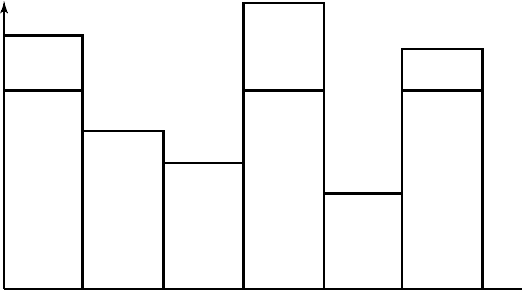
FIGURE 10.7. Reverse water-filling for independent Gaussian random variables.
This gives rise to a kind of reverse water-filling, as illustrated in
Figure 10.7. We choose a constant λ and only describe those random vari-
ables with variances greater than λ. No bits are used to describe random
variables with variance less than λ. Summarizing, if
X ∼
N(0,
σ
2
1
··· 0
.
.
.
.
.
.
.
.
.
0 ··· σ
2
m
), then
ˆ
X ∼
N(0,
ˆσ
2
1
··· 0
.
.
.
.
.
.
.
.
.
0 ··· ˆσ
2
m
),
and E(X
i
−
ˆ
X
i
)
2
= D
i
,whereD
i
= min{λ, σ
2
i
}. More generally, the rate
distortion function for a multivariate normal vector can be obtained by
reverse water-filling on the eigenvalues. We can also apply the same argu-
ments to a Gaussian stochastic process. By the spectral representation
theorem, a Gaussian stochastic process can be represented as an inte-
gral of independent Gaussian processes in the various frequency bands.
Reverse water-filling on the spectrum yields the rate distortion function.
10.4 CONVERSE TO THE RATE DISTORTION THEOREM
In this section we prove the converse to Theorem 10.2.1 by showing that
we cannot achieve a distortion of less than D if we describe X atarate
less than R(D),where
R(D) = min
p( ˆx|x):
(x, ˆx)
p(x)p(ˆx|x)d(x,ˆx)≤D
I(X;
ˆ
X). (10.53)
316 RATE DISTORTION THEORY
The minimization is over all conditional distributions p( ˆx|x) for which
the joint distribution p(x, ˆx) = p(x)p(ˆx|x) satisfies the expected distor-
tion constraint. Before proving the converse, we establish some simple
properties of the information rate distortion function.
Lemma 10.4.1 (Convexity of R(D)) The rate distortion function R(D)
given in (10.53) is a nonincreasing convex function of D.
Proof: R(D) is the minimum of the mutual information over increas-
ingly larger sets as D increases. Thus, R(D) is nonincreasing in D.To
prove that R(D) is convex, consider two rate distortion pairs, (R
1
,D
1
)
and (R
2
,D
2
), which lie on the rate distortion curve. Let the joint distribu-
tions that achieve these pairs be p
1
(x, ˆx) = p(x)p
1
( ˆx|x) and p
2
(x, ˆx) =
p(x)p
2
( ˆx|x). Consider the distribution p
λ
= λp
1
+ (1 − λ)p
2
. Since the
distortion is a linear function of the distribution, we have D(p
λ
) = λD
1
+
(1 − λ)D
2
. Mutual information, on the other hand, is a convex function
of the conditional distribution (Theorem 2.7.4), and hence
I
p
λ
(X;
ˆ
X) ≤ λI
p
1
(X;
ˆ
X) + (1 − λ)I
p
2
(X;
ˆ
X). (10.54)
Hence, by the definition of the rate distortion function,
R(D
λ
) ≤ I
p
λ
(X;
ˆ
X) (10.55)
≤ λI
p
1
(X;
ˆ
X) + (1 − λ)I
p
2
(X;
ˆ
X) (10.56)
= λR(D
1
) + (1 −λ)R(D
2
), (10.57)
which proves that R(D) is a convex function of D.
The converse can now be proved.
Proof: (Converse in Theorem 10.2.1). We must show for any source X
drawn i.i.d. ∼ p(x) with distortion measure d(x, ˆx) and any (2
nR
,n) rate
distortion code with distortion ≤ D, that the rate R of the code satis-
fies R ≥ R(D). In fact, we prove that R ≥ R(D) even for randomized
mappings f
n
and g
n
, as long as f
n
takes on at most 2
nR
values.
Consider any (2
nR
,n) rate distortion code defined by functions f
n
and
g
n
as given in (10.7) and (10.8). Let
ˆ
X
n
=
ˆ
X
n
(X
n
) = g
n
(f
n
(X
n
)) be the
reproduced sequence corresponding to X
n
. Assume that Ed(X
n
,
ˆ
X
n
) ≥ D

10.4 CONVERSE TO THE RATE DISTORTION THEOREM 317
for this code. Then we have the following chain of inequalities:
nR
(a)
≥ H(f
n
(X
n
)) (10.58)
(b)
≥ H(f
n
(X
n
)) − H(f
n
(X
n
)|X
n
) (10.59)
= I(X
n
;f
n
(X
n
)) (10.60)
(c)
≥ I(X
n
;
ˆ
X
n
) (10.61)
= H(X
n
) − H(X
n
|
ˆ
X
n
) (10.62)
(d)
=
n
i=1
H(X
i
) − H(X
n
|
ˆ
X
n
) (10.63)
(e)
=
n
i=1
H(X
i
) −
n
i=1
H(X
i
|
ˆ
X
n
,X
i−1
,...,X
1
) (10.64)
(f)
≥
n
i=1
H(X
i
) −
n
i=1
H(X
i
|
ˆ
X
i
) (10.65)
=
n
i=1
I(X
i
;
ˆ
X
i
) (10.66)
(g)
≥
n
i=1
R(Ed(X
i
,
ˆ
X
i
)) (10.67)
= n
1
n
n
i=1
R(Ed(X
i
,
ˆ
X
i
))
(10.68)
(h)
≥ nR
1
n
n
i=1
Ed(X
i
,
ˆ
X
i
)
(10.69)
(i)
= nR(Ed(X
n
,
ˆ
X
n
)) (10.70)
(j)
= nR(D), (10.71)
where
(a) follows from the fact that the range of f
n
is at most 2
nR
(b) follows from the fact that H(f
n
(X
n
)|X
n
) ≥ 0
318 RATE DISTORTION THEORY
(c) follows from the data-processing inequality
(d) follows from the fact that the X
i
are independent
(e) follows from the chain rule for entropy
(f) follows from the fact that conditioning reduces entropy
(g) follows from the definition of the rate distortion function
(h) follows from the convexity of the rate distortion function (Lemma
10.4.1) and Jensen’s inequality
(i) follows from the definition of distortion for blocks of length n
(j) follows from the fact that R(D) is a nonincreasing function of D and
Ed(X
n
,
ˆ
X
n
) ≤ D
This shows that the rate R of any rate distortion code exceeds the rate
distortion function R(D) evaluated at the distortion level D = Ed(X
n
,
ˆ
X
n
)
achieved by that code.
A similar argument can be applied when the encoded source is passed
through a noisy channel and hence we have the equivalent of the source
channel separation theorem with distortion:
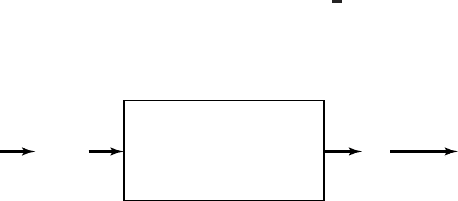
Theorem 10.4.1 (Source–channel separation theorem with distortion)
Let V
1
,V
2
,...,V
n
be a finite alphabet i.i.d. source which is encoded as
a sequence of n input symbols X
n
of a discrete memoryless channel with
capacity C. The output of the channel Y
n
is mapped onto the reconstruction
alphabet
ˆ
V
n
= g(Y
n
).LetD = Ed(V
n
,
ˆ
V
n
) =
1
n
n
i=1
Ed(V
i
,
ˆ
V
i
) be the
average distortion achieved by this combined source and channel coding
scheme. Then distortion D is achievable if and only if C>R(D).
Channel Capacity
C
V
n
V
n
Y
n
X
n
(
V
n
)
^
Proof: See Problem 10.17.
10.5 ACHIEVABILITY OF THE RATE DISTORTION FUNCTION
We now prove the achievability of the rate distortion function. We begin
with a modified version of the joint AEP in which we add the condition
that the pair of sequences be typical with respect to the distortion measure.
10.5 ACHIEVABILITY OF THE RATE DISTORTION FUNCTION 319
Definition Let p(x, ˆx) be a joint probability distribution on X ×
ˆ
X and
let d(x, ˆx) be a distortion measure on
X ×
ˆ
X.Forany>0, a pair of
sequences (x
n
, ˆx
n
) is said to be distortion -typical or simply distortion
typical if
−
1
n
log p(x
n
) − H(X)
< (10.72)
−
1
n
log p( ˆx
n
) − H(
ˆ
X)
< (10.73)
−
1
n
log p(x
n
, ˆx
n
) − H(X,
ˆ
X)
< (10.74)
|d(x
n
, ˆx
n
) − Ed(X,
ˆ
X)| <. (10.75)
The set of distortion typical sequences is called the distortion typical set
and is denoted A
(n)
d,
.
Note that this is the definition of the jointly typical set (Section 7.6)
with the additional constraint that the distortion be close to the expected
value. Hence, the distortion typical set is a subset of the jointly typical
set (i.e., A
(n)
d,
⊂ A
(n)
). If (X
i
,
ˆ
X
i
) are drawn i.i.d ∼ p(x, ˆx), the distortion
between two random sequences
d(X
n
,
ˆ
X
n
) =
1
n
n
i=1
d(X
i
,
ˆ
X
i
) (10.76)
is an average of i.i.d. random variables, and the law of large numbers
implies that it is close to its expected value with high probability. Hence
we have the following lemma.
Lemma 10.5.1 Let (X
i
,
ˆ
X
i
) be drawn i.i.d. ∼ p(x, ˆx).ThenPr(A
(n)
d,
) →
1 as n →∞.
Proof: The sums in the four conditions in the definition of A
(n)
d,
are
all normalized sums of i.i.d random variables and hence, by the law of
large numbers, tend to their respective expected values with probability 1.
Hence the set of sequences satisfying all four conditions has probability
tending to 1 as n →∞.
The following lemma is a direct consequence of the definition of the
distortion typical set.
320 RATE DISTORTION THEORY
Lemma 10.5.2 For all (x
n
, ˆx
n
) ∈ A
(n)
d,
,
p( ˆx
n
) ≥ p( ˆx
n
|x
n
)2
−n(I (X;
ˆ
X)+3)
. (10.77)
Proof: Using the definition of A
(n)
d,
, we can bound the probabilities
p(x
n
), p( ˆx
n
) and p(x
n
, ˆx
n
) for all (x
n
, ˆx
n
) ∈ A
(n)
d,
, and hence
p( ˆx
n
|x
n
) =
p(x
n
, ˆx
n
)
p(x
n
)
(10.78)
= p( ˆx
n
)
p(x
n
, ˆx
n
)
p(x
n
)p( ˆx
n
)
(10.79)
≤ p( ˆx
n
)
2
−n(H (X,
ˆ
X)−)
2
−n(H (X)+)
2
−n(H (
ˆ
X)+)
(10.80)
= p( ˆx
n
)2
n(I (X;
ˆ
X)+3)
, (10.81)
and the lemma follows immediately.
We also need the following interesting inequality.
Lemma 10.5.3 For 0 ≤ x, y ≤ 1, n>0,
(1 − xy)
n
≤ 1 −x + e
−yn
. (10.82)
Proof: Let f(y) = e
−y
− 1 + y.Thenf(0) = 0andf
(y) =−e
−y
+
1 > 0fory>0, and hence f(y) > 0fory>0. Hence for 0 ≤ y ≤ 1,
we have 1 −y ≤ e
−y
, and raising this to the nth power, we obtain
(1 − y)
n
≤ e
−yn
. (10.83)
Thus, the lemma is satisfied for x = 1. By examination, it is clear that
the inequality is also satisfied for x = 0. By differentiation, it is easy
to see that g
y
(x) = (1 − xy)
n
is a convex function of x, and hence for
0 ≤ x ≤ 1, we have
(1 − xy)
n
= g
y
(x) (10.84)
≤ (1 −x)g
y
(0) + xg
y
(1) (10.85)
= (1 −x)1 + x(1 − y)
n
(10.86)
≤ 1 −x + xe
−yn
(10.87)
≤ 1 −x + e
−yn
. (10.88)
We use the preceding proof to prove the achievability of Theorem 10.2.1.

10.5 ACHIEVABILITY OF THE RATE DISTORTION FUNCTION 321
Proof: (Achievability in Theorem 10.2.1). Let X
1
,X
2
,...,X
n
be drawn
i.i.d. ∼ p(x) and let d(x, ˆx) be a bounded distortion measure for this
source. Let the rate distortion function for this source be R(D). Then for
any D,andanyR>R(D), we will show that the rate distortion pair
(R, D) is achievable by proving the existence of a sequence of rate dis-
tortion codes with rate R and asymptotic distortion D.Fixp( ˆx|x),where
p( ˆx|x) achieves equality in (10.53). Thus, I(X;
ˆ
X) = R(D). Calculate
p( ˆx) =
x
p(x)p(ˆx|x). Choose δ>0. We will prove the existence of a
rate distortion code with rate R and distortion less than or equal to D + δ.
Generation of codebook: Randomly generate a rate distortion codebook
C consisting of 2
nR
sequences
ˆ
X
n
drawn i.i.d. ∼
n
i=1
p( ˆx
i
). Index these
codewords by w ∈{1, 2,...,2
nR
}. Reveal this codebook to the encoder
and decoder.
Encoding: Encode X
n
by w if there exists a w such that (X
n
,
ˆ
X
n
(w)) ∈
A
(n)
d,
, the distortion typical set. If there is more than one such w,sendthe
least. If there is no such w,letw = 1. Thus, nR bits suffice to describe
the index w of the jointly typical codeword.
Decoding: The reproduced sequence is
ˆ
X
n
(w).
Calculation of distortion: As in the case of the channel coding theorem,
we calculate the expected distortion over the random choice of codebooks
C as
D = E
X
n
,C
d(X
n
,
ˆ
X
n
), (10.89)
where the expectation is over the random choice of codebooks and over
X
n
.
For a fixed codebook
C and choice of >0, we divide the sequences
x
n
∈ X
n
into two categories:
•
Sequences x
n
such that there exists a codeword
ˆ
X
n
(w) that is dis-
tortion typical with x
n
[i.e., d(x
n
, ˆx
n
(w)) < D + ]. Since the total
probability of these sequences is at most 1, these sequences contribute
at most D + to the expected distortion.
•
Sequences x
n
such that there does not exist a codeword
ˆ
X
n
(w)
that is distortion typical with x
n
.LetP
e
be the total probability of
these sequences. Since the distortion for any individual sequence is
bounded by d
max
, these sequences contribute at most P
e
d
max
to the
expected distortion.
Hence, we can bound the total distortion by
Ed(X
n
,
ˆ
X
n
(X
n
)) ≤ D + + P
e
d
max
, (10.90)
322 RATE DISTORTION THEORY
which can be made less than D + δ for an appropriate choice of if P
e
is
small enough. Hence, if we show that P
e
is small, the expected distortion
is close to D and the theorem is proved.
Calculation of P
e
: We must bound the probability that for a random
choice of codebook
C and a randomly chosen source sequence, there is
no codeword that is distortion typical with the source sequence. Let J(
C)
denote the set of source sequences x
n
such that at least one codeword in
C is distortion typical with x
n
.Then
P
e
=
C
P(C)
x
n
:x
n
/∈J(C)
p(x
n
). (10.91)
This is the probability of all sequences not well represented by a code,
averaged over the randomly chosen code. By changing the order of sum-
mation, we can also interpret this as the probability of choosing a code-
book that does not well represent sequence x
n
, averaged with respect to
p(x
n
). Thus,
P
e
=
x
n
p(x
n
)
C:x
n
/∈J(C)
p(C). (10.92)
Let us define
K(x
n
, ˆx
n
) =
1if(x
n
, ˆx
n
) ∈ A
(n)
d,
,
0if(x
n
, ˆx
n
)/∈ A
(n)
d,
.
(10.93)
The probability that a single randomly chosen codeword
ˆ
X
n
does not well
represent a fixed x
n
is
Pr((x
n
,
ˆ
X
n
)/∈ A
(n)
d,
) = Pr(K(x
n
,
ˆ
X
n
) = 0) = 1 −
ˆx
n
p( ˆx
n
)K(x
n
, ˆx
n
),
(10.94)
and therefore the probability that 2
nR
independently chosen codewords do
not represent x
n
, averaged over p(x
n
),is
P
e
=
x
n
p(x
n
)
C:x
n
/∈J(C)
p(C) (10.95)
=
x
n
p(x
n
)
1 −
ˆx
n
p( ˆx
n
)K(x
n
, ˆx
n
)
2
nR
. (10.96)
10.5 ACHIEVABILITY OF THE RATE DISTORTION FUNCTION 323
We now use Lemma 10.5.2 to bound the sum within the brackets. From
Lemma 10.5.2, it follows that
ˆx
n
p( ˆx
n
)K(x
n
, ˆx
n
) ≥
ˆx
n
p( ˆx
n
|x
n
)2
−n(I (X;
ˆ
X)+3)
K(x
n
, ˆx
n
), (10.97)
and hence
P
e
≤
x
n
p(x
n
)
1 − 2
−n(I (X;
ˆ
X)+3)
ˆx
n
p( ˆx
n
|x
n
)K(x
n
, ˆx
n
)
2
nR
.
(10.98)
We now use Lemma 10.5.3 to bound the term on the right-hand side
of (10.98) and obtain
1 − 2
−n(I (X;
ˆ
X)+3)
ˆx
n
p( ˆx
n
|x
n
)K(x
n
, ˆx
n
)
2
nR
≤ 1 −
ˆx
n
p( ˆx
n
|x
n
)K(x
n
, ˆx
n
) + e
−(2
−n(I (X;
ˆ
X)+3)
2
nR
)
. (10.99)
Substituting this inequality in (10.98), we obtain
P
e
≤ 1 −
x
n
ˆx
n
p(x
n
)p( ˆx
n
|x
n
)K(x
n
, ˆx
n
) + e
−2
−n(I (X;
ˆ
X)+3)
2
nR
.
(10.100)
The last term in the bound is equal to
e
−2
n(R−I(X;
ˆ
X)−3)
, (10.101)
which goes to zero exponentially fast with n if R>I(X;
ˆ
X) + 3. Hence
if we choose p(ˆx|x) to be the conditional distribution that achieves the
minimum in the rate distortion function, then R>R(D) implies that
R>I(X;
ˆ
X) and we can choose small enough so that the last term in
(10.100) goes to 0.
The first two terms in (10.100) give the probability under the joint
distribution p(x
n
, ˆx
n
) that the pair of sequences is not distortion typical.
Hence, using Lemma 10.5.1, we obtain
1 −
x
n
ˆx
n
p(x
n
, ˆx
n
)K(x
n
, ˆx
n
) = Pr((X
n
,
ˆ
X
n
)/∈ A
(n)
d,
)<
(10.102)
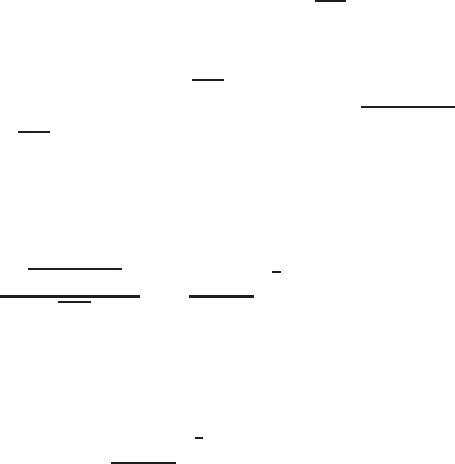
324 RATE DISTORTION THEORY
for n sufficiently large. Therefore, by an appropriate choice of and n,
we can make P
e
as small as we like.
So, for any choice of δ>0, there exists an and n such that over all
randomly chosen rate R codes of block length n, the expected distortion
is less than D + δ. Hence, there must exist at least one code
C
∗
with this
rate and block length with average distortion less than D + δ.Sinceδ was
arbitrary, we have shown that (R, D) is achievable if R>R(D).
We have proved the existence of a rate distortion code with an expected
distortion close to D and a rate close to R(D). The similarities between
the random coding proof of the rate distortion theorem and the random
coding proof of the channel coding theorem are now evident. We will
explore the parallels further by considering the Gaussian example, which
provides some geometric insight into the problem. It turns out that channel
coding is sphere packing and rate distortion coding is sphere covering.
Channel coding for the Gaussian channel. Consider a Gaussian channel,
Y
i
= X
i
+ Z
i
,wheretheZ
i
are i.i.d. ∼ N(0,N) and there is a power
constraint P on the power per symbol of the transmitted codeword. Con-
sider a sequence of n transmissions. The power constraint implies that
the transmitted sequence lies within a sphere of radius
√
nP in R
n
.The
coding problem is equivalent to finding a set of 2
nR
sequences within
this sphere such that the probability of any of them being mistaken for
any other is small—the spheres of radius
√
nN around each of them are
almost disjoint. This corresponds to filling a sphere of radius
√
n(P + N)
with spheres of radius
√
nN. One would expect that the largest number
of spheres that could be fit would be the ratio of their volumes, or, equiv-
alently, the nth power of the ratio of their radii. Thus, if M is the number
of codewords that can be transmitted efficiently, we have
M ≤
(
√
n(P + N))
n
(
√
nN)
n
=
P + N
N
n
2
. (10.103)
The results of the channel coding theorem show that it is possible to do
this efficiently for large n; it is possible to find approximately
2
nC
=
P + N
N
n
2
(10.104)
codewords such that the noise spheres around them are almost disjoint
(the total volume of their intersection is arbitrarily small).