
Thomas M. Cover, Joy A. Thomas. Elements of information theory
Подождите немного. Документ загружается.

HISTORICAL NOTES 345
10.19 Rate distortion with two constraints.LetX
i
be iid ∼ p(x).We
are given two distortion functions, d
1
(x, ˆx) and d
2
(x, ˆx).We
wish to describe X
n
at rate R and reconstruct it with distortions
Ed
1
(X
n
,
ˆ
X
n
1
) ≤ D
1
,andEd
2
(X
n
,
ˆ
X
n
2
) ≤ D
2
, as shown here:
X
n
−→ i(X
n
) −→ (
ˆ
X
n
1
(i),
ˆ
X
n
2
(i))
D
1
= Ed
1
(X
n
1
,
ˆ
X
n
1
)
D
2
= Ed
2
(X
n
1
,
ˆ
X
n
2
).
Here i(·) takes on 2
nR
values. What is the rate distortion function
R(D
1
,D
2
)?
10.20 Rate distortion. Consider the standard rate distortion problem,
X
i
i.i.d. ∼ p(x), X
n
→ i(X
n
) →
ˆ
X
n
, |i(·)|=2
nR
. Consider two
distortion criteria d
1
(x, ˆx) and d
2
(x, ˆx). Suppose that d
1
(x, ˆx) ≤
d
2
(x, ˆx) for all x ∈ X, ˆx ∈
ˆ
X. Let R
1
(D) and R
2
(D) be the cor-
responding rate distortion functions.
(a) Find the inequality relationship between R
1
(D) and R
2
(D).
(b) Suppose that we must describe the source {X
i
} at the mini-
mum rate R achieving d
1
(X
n
,
ˆ
X
n
1
) ≤ D and d
2
(X
n
,
ˆ
X
n
2
) ≤ D.
Thus,
X
n
→ i(X
n
) →
ˆ
X
n
1
(i(X
n
))
ˆ
X
n
2
(i(X
n
))
and |i(·)|=2
nR
.
Find the minimum rate R.
HISTORICAL NOTES
The idea of rate distortion was introduced by Shannon in his original
paper [472]. He returned to it and dealt with it exhaustively in his 1959
paper [485], which proved the first rate distortion theorem. Meanwhile,
Kolmogorov and his school in the Soviet Union began to develop rate
distortion theory in 1956. Stronger versions of the rate distortion theorem
have been proved for more general sources in the comprehensive book by
Berger [52].
The inverse water-filling solution for the rate distortion function for
parallel Gaussian sources was established by McDonald and Schultheiss
346 RATE DISTORTION THEORY
[381]. An iterative algorithm for the calculation of the rate distortion
function for a general i.i.d. source and arbitrary distortion measure was
described by Blahut [65], Arimoto [25], and Csisz
´
ar [139]. This algorithm
is a special case of a general alternating minimization algorithm due to
Csisz
´
ar and Tusn
´
ady [155].

CHAPTER 11
INFORMATION THEORY
AND STATISTICS
We now explore the relationship between information theory and statistics.
We begin by describing the method of types, which is a powerful technique
in large deviation theory. We use the method of types to calculate the
probability of rare events and to show the existence of universal source
codes. We also consider the problem of testing hypotheses and derive the
best possible error exponents for such tests (the Chernoff–Stein lemma).
Finally, we treat the estimation of the parameters of a distribution and
describe the role of Fisher information.
11.1 METHOD OF TYPES
The AEP for discrete random variables (Chapter 3) focuses our attention
on a small subset of typical sequences. The method of types is an even
more powerful procedure in which we consider sequences that have the
same empirical distribution. With this restriction, we can derive strong
bounds on the number of sequences with a particular empirical distribution
and the probability of each sequence in this set. It is then possible to derive
strong error bounds for the channel coding theorem and prove a variety
of rate distortion results. The method of types was fully developed by
Csisz
´
ar and K
¨
orner [149], who obtained most of their results from this
point of view.
Let X
1
,X
2
,...,X
n
be a sequence of n symbols from an alphabet X =
{a
1
,a
2
,...,a
|X |
}. We use the notation x
n
and x interchangeably to denote
a sequence x
1
,x
2
,...,x
n
.
Definition The type P
x
(or empirical probability distribution) of a se-
quence x
1
,x
2
,...,x
n
is the relative proportion of occurrences of each
Elements of Information Theory, Second Edition, By Thomas M. Cover and Joy A. Thomas
Copyright 2006 John Wiley & Sons, Inc.
347
348 INFORMATION THEORY AND STATISTICS
symbol of X (i.e., P
x
(a) = N(a|x)/n for all a ∈ X,whereN(a|x) is the
number of times the symbol a occurs in the sequence x ∈
X
n
).
The type of a sequence x is denoted as P
x
. It is a probability mass
function on
X. (Note that in this chapter, we will use capital letters to
denote types and distributions. We also loosely use the word distribution
to mean a probability mass function.)
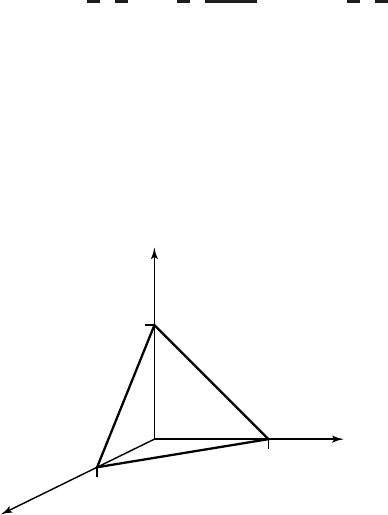
Definition The probability simplex in
R
m
is the set of points x =
(x
1
,x
2
,...,x
m
) ∈ R
m
such that x
i
≥ 0,
m
i=1
x
i
= 1.
The probability simplex is an (m − 1)-dimensional manifold in
m-dimensional space. When m = 3, the probability simplex is the
set of points {(x
1
,x
2
,x
3
) : x
1
≥ 0,x
2
≥ 0,x
3
≥ 0,x
1
+ x
2
+ x
3
= 1}
(Figure 11.1). Since this is a triangular two-dimensional flat in
R
3
,we
use a triangle to represent the probability simplex in later sections of this
chapter.
Definition Let
P
n
denote the set of types with denominator n.
For example, if
X ={0, 1}, the set of possible types with denominator
n is
P
n
=
(P (0), P (1)) :
0
n
,
n
n
,
1
n
,
n − 1
n
,...,
n
n
,
0
n
. (11.1)
Definition If P ∈
P
n
, the set of sequences of length n and type P is
called the type class of P , denoted T(P):
T(P)={x ∈
X
n
: P
x
= P }. (11.2)
The type class is sometimes called the composition class of P .
x
2
x
3
x
1
x
1
+
x
2
+
x
3
= 1
1
1
1
FIGURE 11.1. Probability simplex in R
3
.

11.1 METHOD OF TYPES 349
Example 11.1.1 Let X ={1, 2, 3}, a ternary alphabet. Let x = 11321.
Then the type P
x
is
P
x
(1) =
3
5
,P
x
(2) =
1
5
,P
x
(3) =
1
5
. (11.3)
The type class of P
x
is the set of all sequences of length 5 with three 1’s,
one 2, and one 3. There are 20 such sequences, and
T(P
x
) ={11123, 11132, 11213,...,32111}. (11.4)
The number of elements in T(P) is
|T(P)|=
5
3, 1, 1
=
5!
3! 1! 1!
= 20. (11.5)
The essential power of the method of types arises from the following
theorem, which shows that the number of types is at most polynomial
in n.
Theorem 11.1.1
|
P
n
|≤(n + 1)
|X |
. (11.6)
Proof: There are |
X| components in the vector that specifies P
x
.The
numerator in each component can take on only n + 1 values. So there are
at most (n + 1)
|X |
choices for the type vector. Of course, these choices
are not independent (e.g., the last choice is fixed by the others). But this
is a sufficiently good upper bound for our needs.
The crucial point here is that there are only a polynomial number of
types of length n. Since the number of sequences is exponential in n,it
follows that at least one type has exponentially many sequences in its
type class. In fact, the largest type class has essentially the same number
of elements as the entire set of sequences, to first order in the exponent.
Now, we assume that the sequence X
1
,X
2
,...,X
n
is drawn i.i.d.
according to a distribution Q(x). All sequences with the same type have
the same probability, as shown in the following theorem. Let Q
n
(x
n
) =
n
i=1
Q(x
i
) denote the product distribution associated with Q.
Theorem 11.1.2 If X
1
,X
2
,...,X
n
are drawn i.i.d. according to Q(x),
the probability of x depends only on its type and is given by
Q
n
(x) = 2
−n(H (P
x
)+D(P
x
||Q))
. (11.7)

350 INFORMATION THEORY AND STATISTICS
Proof
Q
n
(x) =
n
i=1
Q(x
i
) (11.8)
=
a∈X
Q(a)
N(a|x)
(11.9)
=
a∈X
Q(a)
nP
x
(a)
(11.10)
=
a∈X
2
nP
x
(a) log Q(a)
(11.11)
=
a∈X
2
n(P
x
(a) log Q(a)−P
x
(a) log P
x
(a)+P
x
(a) log P
x
(a))
(11.12)
= 2
n
a∈X
(−P
x
(a) log
P
x
(a)
Q(a)
+P
x
(a) log P
x
(a))
(11.13)
= 2
n(−D(P
x
||Q)−H(P
x
))
. (11.14)
Corollary If x is in the type class of Q,then
Q
n
(x) = 2
−nH (Q)
. (11.15)
Proof: If x ∈ T(Q),thenP
x
= Q, which can be substituted into (11.14).
Example 11.1.2 The probability that a fair die produces a particular
sequence of length n with precisely n/6 occurrences of each face (n is a
multiple of 6) is 2
−nH (
1
6
,
1
6
,...,
1
6
)
= 6
−n
. This is obvious. However, if the
die has a probability mass function (
1
3
,
1
3
,
1
6
,
1
12
,
1
12
, 0), the probability of
observing a particular sequence with precisely these frequencies is pre-
cisely 2
−nH (
1
3
,
1
3
,
1
6
,
1
12
,
1
12
,0)
for n a multiple of 12. This is more interesting.
We now give an estimate of the size of a type class T(P).
Theorem 11.1.3 (Size of a type class T(P)) For any type P ∈
P
n
,
1
(n + 1)
|X |
2
nH (P )
≤|T(P)|≤2
nH (P )
. (11.16)
Proof: The exact size of T(P)is easy to calculate. It is a simple combi-
natorial problem—the number of ways of arranging nP (a
1
), nP (a
2
),...,

11.1 METHOD OF TYPES 351
nP (a
|X |
) objects in a sequence, which is
|T(P)|=
n
nP (a
1
), nP (a
2
),...,nP(a
|X |
)
. (11.17)
This value is hard to manipulate, so we derive simple exponential bounds
on its value.
We suggest two alternative proofs for the exponential bounds. The first
proof uses Stirling’s formula [208] to bound the factorial function, and
after some algebra, we can obtain the bounds of the theorem. We give an
alternative proof. We first prove the upper bound. Since a type class must
have probability ≤ 1, we have
1 ≥ P
n
(T (P )) (11.18)
=
x∈T(P)
P
n
(x) (11.19)
=
x∈T(P)
2
−nH (P )
(11.20)
=|T(P)|2
−nH (P )
, (11.21)
using Theorem 11.1.2. Thus,
|T(P)|≤2
nH (P )
. (11.22)
Now for the lower bound. We first prove that the type class T(P)
has the highest probability among all type classes under the probability
distribution P :
P
n
(T (P )) ≥ P
n
(T (
ˆ
P)) for all
ˆ
P ∈ P
n
. (11.23)
We lower bound the ratio of probabilities,
P
n
(T (P ))
P
n
(T (
ˆ
P))
=
|T(P)|
a∈X
P(a)
nP (a)
|T(
ˆ
P)|
a∈X
P(a)
n
ˆ
P(a)
(11.24)
=
n
nP (a
1
), nP (a
2
),...,nP (a
|X |
)
a∈X
P(a)
nP (a)
n
n
ˆ
P(a
1
), n
ˆ
P(a
2
),...,n
ˆ
P(a
|X |
)
a∈X
P(a)
n
ˆ
P(a)
(11.25)
=
a∈X
(n
ˆ
P(a))!
(nP (a))!
P(a)
n(P (a)−
ˆ
P(a))
. (11.26)

352 INFORMATION THEORY AND STATISTICS
Now using the simple bound (easy to prove by separately considering the
cases m ≥ n and m<n)
m!
n!
≥ n
m−n
, (11.27)
we obtain
P
n
(T (P ))
P
n
(T (
ˆ
P))
≥
a∈X
(nP (a))
n
ˆ
P(a)−nP (a)
P(a)
n(P (a)−
ˆ
P(a))
(11.28)
=
a∈X
n
n(
ˆ
P(a)−P(a))
(11.29)
= n
n
(
a∈X
ˆ
P(a)−
a∈X
P(a)
)
(11.30)
= n
n(1−1)
(11.31)
= 1. (11.32)
Hence, P
n
(T (P )) ≥ P
n
(T (
ˆ
P)). The lower bound now follows easily
from this result, since
1 =
Q∈P
n
P
n
(T (Q)) (11.33)
≤
Q∈P
n
max
Q
P
n
(T (Q)) (11.34)
=
Q∈P
n
P
n
(T (P )) (11.35)
≤ (n + 1)
|X |
P
n
(T (P )) (11.36)
= (n + 1)
|X |
x∈T(P)
P
n
(x) (11.37)
= (n + 1)
|X |
x∈T(P)
2
−nH (P )
(11.38)
= (n + 1)
|X |
|T(P)|2
−nH (P )
, (11.39)
where (11.36) follows from Theorem 11.1.1 and (11.38) follows from
Theorem 11.1.2.
We give a slightly better approximation for the binary case.

11.1 METHOD OF TYPES 353
Example 11.1.3 (Binary alphabet) In this case, the type is defined
by the number of 1’s in the sequence, and the size of the type class is
therefore
n
k
. We show that
1
n + 1
2
nH
k
n
≤
n
k
≤ 2
nH
k
n
. (11.40)
These bounds can be proved using Stirling’s approximation for the fac-
torial function (Lemma 17.5.1). But we provide a more intuitive proof
below.
We first prove the upper bound. From the binomial formula, for any p,
n
k=0
n
k
p
k
(1 − p)
n−k
= 1. (11.41)
Since all the terms of the sum are positive for 0 ≤ p ≤ 1, each of the
terms is less than 1. Setting p = k/n and taking the kth term, we get
1 ≥
n
k
k
n
k
1 −
k
n
n−k
(11.42)
=
n
k
2
k log
k
n
+(n−k) log
n−k
n
(11.43)
=
n
k
2
n
k
n
log
k
n
+
n−k
n
log
n−k
n
(11.44)
=
n
k
2
−nH
k
n
. (11.45)
Hence,
n
k
≤ 2
nH
k
n
. (11.46)
For the lower bound, let S be a random variable with a binomial
distribution with parameters n and p. The most likely value of S is
S =np . This can easily be verified from the fact that
P(S = i + 1)
P(S = i)
=
n − i
i + 1
p
1 − p
(11.47)
and considering the cases when i<np and when i>np. Then, since
there are n + 1 terms in the binomial sum,
354 INFORMATION THEORY AND STATISTICS
1 =
n
k=0
n
k
p
k
(1 − p)
n−k
≤ (n + 1) max
k
n
k
p
k
(1 − p)
n−k
(11.48)
= (n + 1)
n
np
p
np
(1 − p)
n−np
. (11.49)
Now let p = k/n.Thenwehave
1 ≤ (n + 1)
n
k
k
n
k
1 −
k
n
n−k
, (11.50)
which by the arguments in (11.45) is equivalent to
1
n + 1
≤
n
k
2
−nH
k
n
, (11.51)
or
n
k
≥
2
nH
k
n
n + 1
. (11.52)
Combining the two results, we see that
n
k
.
= 2
nH
k
n
. (11.53)
A more precise bound can be found in theorem 17.5.1 when k = 0orn.
Theorem 11.1.4 (Probability of type class) for any P ∈
P
n
and any
distribution Q, the probability of the type class T(P)under Q
n
is 2
−nD(P ||Q)
to first order in the exponent. More precisely,
1
(n + 1)
|X |
2
−nD(P ||Q)
≤ Q
n
(T (P )) ≤ 2
−nD(P ||Q)
. (11.54)
Proof: We have
Q
n
(T (P )) =
x∈T(P)
Q
n
(x) (11.55)
=
x∈T(P)
2
−n(D(P ||Q)+H(P))
(11.56)
=|T(P)|2
−n(D(P ||Q)+H(P))
, (11.57)