
Thomas M. Cover, Joy A. Thomas. Elements of information theory
Подождите немного. Документ загружается.


15.9 RATE DISTORTION WITH SIDE INFORMATION 585
(j) follows from Jensen’s inequality and the convexity of the conditional
rate distortion function (Lemma 15.9.1)
(k) follows from the definition of D = E[
1
n
n
i=1
d(X
i
,
ˆ
X
i
)]
It is easy to see the parallels between this converse and the converse
for rate distortion without side information (Section 10.4). The proof of
achievability is also parallel to the proof of the rate distortion theorem
using strong typicality. However, instead of sending the index of the
codeword that is jointly typical with the source, we divide these codewords
into bins and send the bin index instead. If the number of codewords in
each bin is small enough, the side information can be used to isolate
the particular codeword in the bin at the receiver. Hence again we are
combining random binning with rate distortion encoding to find a jointly
typical reproduction codeword. We outline the details of the proof below.
Proof: (Achievability of Theorem 15.9.1). Fix p(w|x) and the function
f(w,y). Calculate p(w) =
x
p(x)p(w|x).
Generation of codebook: Let R
1
= I(X;W)+ . Generate 2
nR
i.i.d.
codewords W
n
(s) ∼
n
i=1
p(w
i
), and index them by s ∈{1, 2,...,2
nR
1
}.
Let R
2
= I(X;W)− I(Y;W) + 5. Randomly assign the indices s ∈
{1, 2,...,2
nR
1
} to one of 2
nR
2
bins using a uniform distribution over
the bins. Let B(i) denote the indices assigned to bin i. There are approx-
imately 2
n(R
1
−R
2
)
indices in each bin.
Encoding: Given a source sequence X
n
, the encoder looks for a code-
word W
n
(s) such that (X
n
,W
n
(s)) ∈ A
∗(n)
. If there is no such W
n
,the
encoder sets s = 1. If there is more than one such s, the encoder uses the
lowest s. The encoder sends the index of the bin in which s belongs.
Decoding: The decoder looks for a W
n
(s) such that s ∈ B(i) and
(W
n
(s), Y
n
) ∈ A
∗(n)
. If he finds a unique s, he then calculates
ˆ
X
n
,where
ˆ
X
i
= f(W
i
,Y
i
). If he does not find any such s or more than one such s,
he sets
ˆ
X
n
= ˆx
n
,where ˆx
n
is an arbitrary sequence in
ˆ
X
n
. It does not
matter which default sequence is used; we will show that the probability
of this event is small.
Analysis of the probability of error: As usual, we have various error
events:
1. The pair (X
n
,Y
n
)/∈ A
∗(n)
. The probability of this event is small for
large enough n by the weak law of large numbers.
2. The sequence X
n
is typical, but there does not exist an s such that
(X
n
,W
n
(s)) ∈ A
∗(n)
. As in the proof of the rate distortion theorem,
586 NETWORK INFORMATION THEORY
the probability of this event is small if
R
1
>I(W;X). (15.317)
3. The pair of sequences (X
n
,W
n
(s)) ∈ A
∗(n)
but (W
n
(s), Y
n
)/∈ A
∗(n)
(i.e., the codeword is not jointly typical with the Y
n
sequence). By
the Markov lemma (Lemma 15.8.1), the probability of this event is
small if n is large enough.
4. There exists another s
with the same bin index such that (W
n
(s
),
Y
n
) ∈ A
∗(n)
. Since the probability that a randomly chosen W
n
is
jointly typical with Y
n
is ≈ 2
−nI (Y ;W)
, the probability that there is
another W
n
in the same bin that is typical with Y
n
is bounded by
the number of codewords in the bin times the probability of joint
typicality, that is,
Pr(∃s
∈ B(i) : (W
n
(s
), Y
n
) ∈ A
∗(n)
) ≤ 2
n(R
1
−R
2
)
2
−n(I (W ;Y)−3)
,
(15.318)
which goes to zero since R
1
− R
2
<I(Y;W) − 3.
5. If the index s is decoded correctly, (X
n
,W
n
(s)) ∈ A
∗(n)
. By item 1
we can assume that (X
n
,Y
n
) ∈ A
∗(n)
. Thus, by the Markov lemma,
we have (X
n
,Y
n
,W
n
) ∈ A
∗(n)
and therefore the empirical joint dis-
tribution is close to the original distribution p(x,y)p(w|x) that we
started with, and hence (X
n
,
ˆ
X
n
) will have a joint distribution that
is close to the distribution that achieves distortion D.
Hence with high probability, the decoder will produce
ˆ
X
n
such that the
distortion between X
n
and
ˆ
X
n
is close to nD. This completes the proof
of the theorem.
The reader is referred to Wyner and Ziv [574] for details of the proof.
After the discussion of the various situations of compressing distributed
data, it might be expected that the problem is almost completely solved,
but unfortunately, this is not true. An immediate generalization of all
the above problems is the rate distortion problem for correlated sources,
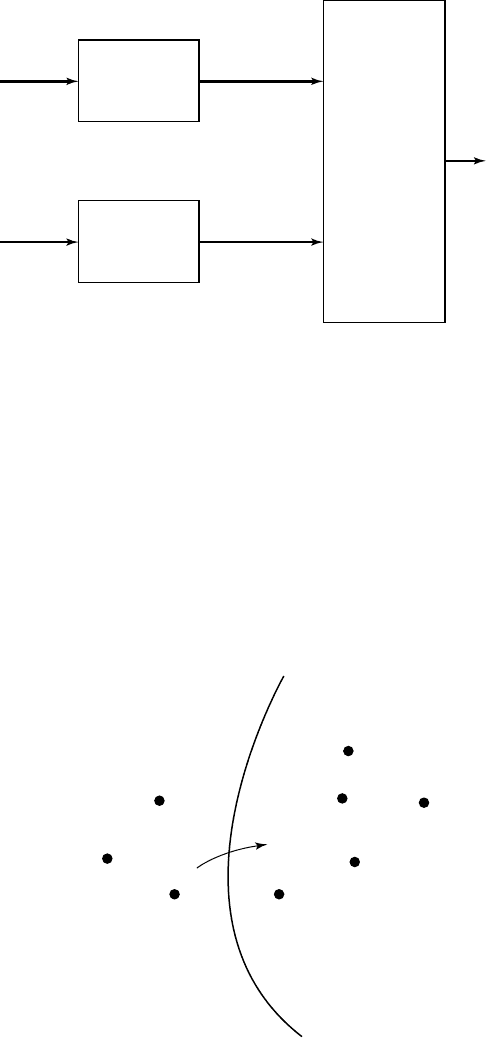
illustrated in Figure 15.34. This is essentially the Slepian–Wolf problem
with distortion in both X and Y . It is easy to see that the three dis-
tributed source coding problems considered above are all special cases
of this setup. Unlike the earlier problems, though, this problem has not
yet been solved and the general rate distortion region remains
unknown.
15.10 GENERAL MULTITERMINAL NETWORKS 587
X
n
(
X
n
,
Y
n
)
Encoder 1
i
(
x
n
) ∈ 2
nR
1
j
(
y
n
) ∈ 2
nR
2
Decoder
Y
n
Encoder 2
^^
FIGURE 15.34. Rate distortion for two correlated sources.
15.10 GENERAL MULTITERMINAL NETWORKS
We conclude this chapter by considering a general multiterminal network
of senders and receivers and deriving some bounds on the rates achievable
for communication in such a network. A general multiterminal network
is illustrated in Figure 15.35. In this section, superscripts denote node
indices and subscripts denote time indices. There are m nodes, and node
i has an associated transmitted variable X
(i)
and a received variable Y
(i)
.
S
S
c
(
X
(1)
,
Y
(1)
)
(
X
(
m
)
,
Y
(
m
)
)
FIGURE 15.35. General multiterminal network.
588 NETWORK INFORMATION THEORY
The node i sends information at rate R
(ij )
to node j . We assume that all
the messages W
(ij )
being sent from node i to node j are independent and
uniformly distributed over their respective ranges {1, 2,...,2
nR
(ij)
}.
The channel is represented by the channel transition function
p(y
(1)
,...,y
(m)
|x
(1)
,...,x
(m)
), which is the conditional probability mass
function of the outputs given the inputs. This probability transition func-
tion captures the effects of the noise and the interference in the network.
The channel is assumed to be memoryless (i.e., the outputs at any time
instant depend only the current inputs and are conditionally independent
of the past inputs).
Corresponding to each transmitter–receiver node pair is a message
W
(ij )
∈{1, 2,...,2
nR
(ij)
}. The input symbol X
(i)
at node i depends on
W
(ij )
,j ∈{1,...,m} and also on the past values of the received symbol
Y
(i)
at node i. Hence, an encoding scheme of block length n consists of
a set of encoding and decoding functions, one for each node:
•
Encoders: X
(i)
k
(W
(i1)
,W
(i2)
,...,W
(im)
, Y
(i)
1
,Y
(i)
2
,...,Y
(i)
k−1
), k = 1,
...,n. The encoder maps the messages and past received symbols
into the symbol X
(i)
k
transmitted at time k.
•
Decoders:
ˆ
W
(ji)
Y
(i)
1
,...,Y
(i)
n
,W
(i1)
,...,W
(im)
, j = 1, 2,...,m.
The decoder j at node i maps the received symbols in each block and
his own transmitted information to form estimates of the messages
intended for him from node j , j = 1, 2,...,m.
Associated with every pair of nodes is a rate and a corresponding
probability of error that the message will not be decoded correctly,
P
(n)
e
(ij )
= Pr
ˆ
W
(ij )
Y
(j)
,W
(j1)
,...,W
(jm)
= W
(ij )
, (15.319)
where P
(n)
e
(ij )
is defined under the assumption that all the messages are
independent and distributed uniformly over their respective ranges.
Asetofrates{R
(ij )
} is said to be achievable if there exist encoders and
decoders with block length n with P
(n)
e
(ij )
→ 0asn →∞for all i, j ∈
{1, 2,...,m}. We use this formulation to derive an upper bound on the
flow of information in any multiterminal network. We divide the nodes
into two sets, S and the complement S
c
. We now bound the rate of flow
of information from nodes in S to nodes in S
c
. See [514]
15.10 GENERAL MULTITERMINAL NETWORKS 589
Theorem 15.10.1 If the information rates {R
(ij )
} are achievable, there
exists some joint probability distribution p(x
(1)
,x
(2)
,...,x
(m)
) such that
i∈S,j∈S
c
R
(ij )
≤ I(X
(S)
;Y
(S
c
)
|X
(S
c
)
) (15.320)
for all S ⊂{1, 2,...,m}. Thus, the total rate of flow of information across
cut sets is bounded by the conditional mutual information.
Proof: The proof follows the same lines as the proof of the converse
for the multiple access channel. Let T ={(i, j) : i ∈ S, j ∈ S
c
} be the set
of links that cross from S to S
c
,andletT
c
be all the other links in the
network. Then
n
i∈S,j∈S
c
R
(ij )
(15.321)
(a)
=
i∈S,j∈S
c
H
W
(ij )
(15.322)
(b)
= H
W
(T )
(15.323)
(c)
= H
W
(T )
|W
(T
c
)
(15.324)
= I
W
(T )
;Y
(S
c
)
1
,...,Y
(S
c
)
n
|W
(T
c
)
(15.325)
+ H
W
(T )
|Y
(S
c
)
1
,...,Y
(S
c
)
n
,W
(T
c
)
(15.326)
(d)
≤ I
W
(T )
;Y
(S
c
)
1
,...,Y
(S
c
)
n
|W
(T
c
)
+ n
n
(15.327)
(e)
=
n
k=1
I
W
(T )
;Y
(S
c
)
k
|Y
(S
c
)
1
,...,Y
(S
c
)
k−1
,W
(T
c
)
+ n
n
(15.328)
(f)
=
n
k=1
H
Y
(S
c
)
k
|Y
(S
c
)
1
,...,Y
(S
c
)
k−1
,W
(T
c
)
− H
Y
(S
c
)
k
|Y
(S
c
)
1
,...,Y
(S
c
)
k−1
,W
(T
c
)
,W
(T )
+ n
n
(15.329)

590 NETWORK INFORMATION THEORY
(g)
≤
n
k=1
H
Y
(S
c
)
k
|Y
(S
c
)
1
,...,Y
(S
c
)
k−1
,W
(T
c
)
,X
(S
c
)
k
− H
Y
(S
c
)
k
|Y
(S
c
)
1
,...,Y
(S
c
)
k−1
,W
(T
c
)
,W
(T )
,X
(S)
k
,X
(S
c
)
k
+ n
n
(15.330)
(h)
≤
n
k=1
H
Y
(S
c
)
k
|X
(S
c
)
k
− H
Y
(S
c
)
k
|X
(S
c
)
k
,X
(S)
k
+ n
n
(15.331)
=
n
k=1
I
X
(S)
k
;Y
(S
c
)
k
|X
(S
c
)
k
+ n
n
(15.332)
(i)
= n
1
n
n
k=1
I
X
(S)
Q
;Y
(S
c
)
Q
|X
(S
c
)
Q
,Q= k
+ n
n
(15.333)
(j)
= nI
X
(S)
Q
;Y
(S
c
)
Q
|X
(S
c
)
Q
,Q
+ n
n
(15.334)
= n
H
Y
(S
c
)
Q
|X
(S
c
)
Q
,Q
− H
Y
(S
c
)
Q
|X
(S)
Q
,X
(S
c
)
Q
,Q
+ n
n
(15.335)
(k)
≤ n
H
Y
(S
c
)
Q
|X
(S
c
)
Q
− H
Y
(S
c
)
Q
|X
(S)
Q
,X
(S
c
)
Q
,Q
+ n
n
(15.336)
(l)
= n
H
Y
(S
c
)
Q
|X
(S
c
)
Q
− H
Y
(S
c
)
Q
|X
(S)
Q
,X
(S
c
)
Q
+ n
n
(15.337)
= nI
X
(S)
Q
;Y
(S
c
)
Q
|X
(S
c
)
Q
+ n
n
, (15.338)
where
(a) follows from the fact that the messages W
(ij )
are uniformly dis-
tributed over their respective ranges {1, 2,...,2
nR
(ij)
}
(b) follows from the definition of W
(T )
={W
(ij )
: i ∈ S, j ∈ S
c
} and
the fact that the messages are independent
(c) follows from the independence of the messages for T and T
c
(d) follows from Fano’s inequality since the messages W
(T )
can be
decoded from Y
(S)
and W
(T
c
)
(e) is the chain rule for mutual information
(f) follows from the definition of mutual information
(g) follows from the fact that X
(S
c
)
k
is a function of the past received
symbols Y
(S
c
)
and the messages W
(T
c
)
and the fact that adding
conditioning reduces the second term
15.10 GENERAL MULTITERMINAL NETWORKS 591
(h) follows from the fact that Y
(S
c
)
k
depends only on the current input
symbols X
(S)
k
and X
(S
c
)
k
(i) follows after we introduce a new timesharing random variable Q
distributed uniformly on {1, 2,...,n}
(j) follows from the definition of mutual information
(k) follows from the fact that conditioning reduces entropy
(l) follows from the fact that Y
(S
c
)
Q
depends only on the inputs X
(S)
Q
and
X
(S
c
)
Q
and is conditionally independent of Q
Thus, there exist random variables X
(S)
and X
(S
c
)
with some arbitrary
joint distribution that satisfy the inequalities of the theorem.
The theorem has a simple max-flow min-cut interpretation. The rate of
flow of information across any boundary is less than the mutual informa-
tion between the inputs on one side of the boundary and the outputs on
the other side, conditioned on the inputs on the other side.
The problem of information flow in networks would be solved if the
bounds of the theorem were achievable. But unfortunately, these bounds
are not achievable even for some simple channels. We now apply these
bounds to a few of the channels that we considered earlier.
•
Multiple-access channel. The multiple access channel is a network
with many input nodes and one output node. For the case of a two-user
multiple-access channel, the bounds of Theorem 15.10.1 reduce to
R
1
≤ I(X
1
;Y |X
2
), (15.339)
R
2
≤ I(X
2
;Y |X
1
), (15.340)
R
1
+ R
2
≤ I(X
1
,X
2
;Y) (15.341)
for some joint distribution p(x
1
,x
2
)p(y|x
1
,x
2
). These bounds coin-
cide with the capacity region if we restrict the input distribution to
be a product distribution and take the convex hull (Theorem 15.3.1).
•
Relay channel. For the relay channel, these bounds give the upper
bound of Theorem 15.7.1 with different choices of subsets as shown
in Figure 15.36. Thus,
C ≤ sup
p(x,x
1
)
min
{
I(X,X
1
;Y),I(X;Y, Y
1
|X
1
)
}
. (15.342)
This upper bound is the capacity of a physically degraded relay chan-
nel and for the relay channel with feedback [127].
592 NETWORK INFORMATION THEORY
X
Y
1
:
X
1
Y
S
1
S
2
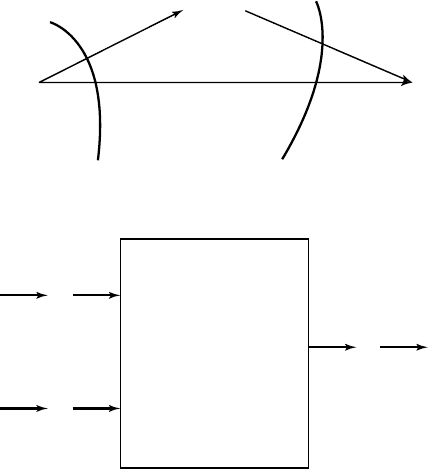
FIGURE 15.36. Relay channel.
p
(
y
|
x
1
,
x
2
)
X
1
X
2
U
(
U
,
V
)
V
Y
^^
FIGURE 15.37. Transmission of correlated sources over a multiple-access channel.
To complement our discussion of a general network, we should mention
two features of single-user channels that do not apply to a multiuser
network.
•
Source–channel separation theorem. In Section 7.13 we discussed
the source–channel separation theorem, which proves that we can
transmit the source noiselessly over the channel if and only if the
entropy rate is less than the channel capacity. This allows us to char-
acterize a source by a single number (the entropy rate) and the channel
by a single number (the capacity). What about the multiuser case?
We would expect that a distributed source could be transmitted over
a channel if and only if the rate region for the noiseless coding of the
source lay within the capacity region of the channel. To be specific,
consider the transmission of a distributed source over a multiple-
access channel, as shown in Figure 15.37. Combining the results of
Slepian–Wolf encoding with the capacity results for the multiple-
access channel, we can show that we can transmit the source over
the channel and recover it with a low probability of error if
H(U|V)≤ I(X
1
;Y |X
2
,Q), (15.343)
15.10 GENERAL MULTITERMINAL NETWORKS 593
H(V|U) ≤ I(X
2
;Y |X
1
,Q), (15.344)
H(U,V) ≤ I(X
1
,X
2
;Y |Q) (15.345)
for some distribution p(q)p(x
1
|q)p(x
2
|q)p(y|x
1
,x
2
). This condition
is equivalent to saying that the Slepian–Wolf rate region of the source
has a nonempty intersection with the capacity region of the multiple-
access channel.
But is this condition also necessary? No, as a simple example illus-
trates. Consider the transmission of the source of Example 15.4.2
over the binary erasure multiple-access channel (Example 15.3.3).
The Slepian–Wolf region does not intersect the capacity region, yet
it is simple to devise a scheme that allows the source to be transmit-
ted over the channel. We just let X
1
= U and X
2
= V , and the value
of Y will tell us the pair (U, V ) with no error. Thus, the conditions
(15.345) are not necessary.
The reason for the failure of the source–channel separation theorem
lies in the fact that the capacity of the multiple-access channel
increases with the correlation between the inputs of the channel.
Therefore, to maximize the capacity, one should preserve the cor-
relation between the inputs of the channel. Slepian–Wolf encoding,
on the other hand, gets rid of the correlation. Cover et al. [129] pro-
posed an achievable region for transmission of a correlated source
over a multiple access channel based on the idea of preserving the
correlation. Han and Costa [273] have proposed a similar region for
the transmission of a correlated source over a broadcast channel.
•
Capacity regions with feedback. Theorem 7.12.1 shows that feedback
does not increase the capacity of a single-user discrete memoryless
channel. For channels with memory, on the other hand, feedback
enables the sender to predict something about the noise and to combat
it more effectively, thus increasing capacity.
What about multiuser channels? Rather surprisingly, feedback does
increase the capacity region of multiuser channels, even when the
channels are memoryless. This was first shown by Gaarder and Wolf
[220], who showed how feedback helps increase the capacity of the
binary erasure multiple-access channel. In essence, feedback from the
receiver to the two senders acts as a separate channel between the two
senders. The senders can decode each other’s transmissions before the
receiver does. They then cooperate to resolve the uncertainty at the
receiver, sending information at the higher cooperative capacity rather
than the noncooperative capacity. Using this scheme, Cover and
Leung [133] established an achievable region for a multiple-access

594 NETWORK INFORMATION THEORY
channel with feedback. Willems [557] showed that this region was
the capacity for a class of multiple-access channels that included the
binary erasure multiple-access channel. Ozarow [410] established the
capacity region for a two-user Gaussian multiple-access channel. The
problem of finding the capacity region for a multiple-access channel
with feedback is closely related to the capacity of a two-way channel
with a common output.
There is as yet no unified theory of network information flow. But there
can be no doubt that a complete theory of communication networks would
have wide implications for the theory of communication and computation.
SUMMARY
Multiple-access channel. The capacity of a multiple-access channel
(
X
1
× X
2
,p(y|x
1
,x
2
), Y) is the closure of the convex hull of all (R
1
,R
2
)
satisfying
R
1
<I(X
1
;Y |X
2
), (15.346)
R
2
<I(X
2
;Y |X
1
), (15.347)
R
1
+ R
2
<I(X
1
,X
2
;Y) (15.348)
for some distribution p
1
(x
1
)p
2
(x
2
) on X
1
× X
2
.
The capacity region of the m-user multiple-access channel is the closure
of the convex hull of the rate vectors satisfying
R(S) ≤ I(X(S);Y |X(S
c
)) for all S ⊆{1, 2,...,m} (15.349)
for some product distribution p
1
(x
1
)p
2
(x
2
) ···p
m
(x
m
).
Gaussian multiple-access channel. The capacity region of a two-user
Gaussian multiple-access channel is
R
1
≤ C
P
1
N
, (15.350)
R
2
≤ C
P
2
N
, (15.351)