
Thomas M. Cover, Joy A. Thomas. Elements of information theory
Подождите немного. Документ загружается.


SUMMARY 595
R
1
+ R
2
≤ C
P
1
+ P
2
N
, (15.352)
where
C(x) =
1
2
log(1 +x). (15.353)
Slepian–Wolf coding. Correlated sources X and Y can be described
separately at rates R
1
and R
2
and recovered with arbitrarily low prob-
ability of error by a common decoder if and only if
R
1
≥ H(X|Y), (15.354)
R
2
≥ H(Y|X), (15.355)
R
1
+ R
2
≥ H(X,Y). (15.356)
Broadcast channels. The capacity region of the degraded broadcast
channel X → Y
1
→ Y
2
is the convex hull of the closure of all (R
1
,R
2
)
satisfying
R
2
≤ I(U;Y
2
), (15.357)
R
1
≤ I(X;Y
1
|U) (15.358)
for some joint distribution p(u)p(x|u)p(y
1
,y
2
|x).
Relay channel. The capacity C of the physically degraded relay chan-
nel p(y, y
1
|x, x
1
) is given by
C = sup
p(x,x
1
)
min
{
I(X,X
1
;Y),I(X;Y
1
|X
1
)
}
, (15.359)
where the supremum is over all joint distributions on
X × X
1
.
Source coding with side information. Let (X, Y ) ∼ p(x,y).IfY is
encoded at rate R
2
and X is encoded at rate R
1
, we can recover X with
an arbitrarily small probability of error iff
R
1
≥ H(X|U), (15.360)
R
2
≥ I(Y;U) (15.361)
for some distribution p(y, u) such that X → Y → U .
596 NETWORK INFORMATION THEORY
Rate distortion with side information. Let (X, Y ) ∼ p(x, y).The
rate distortion function with side information is given by
R
Y
(D) = min
p(w|x)
min
f :Y ×W→
ˆ
X
I(X;W)− I(Y;W), (15.362)
where the minimization is over all functions f and conditional distri-
butions p(w|x), |
W|≤|X|+1, such that
x
w
y
p(x, y)p(w|x)d(x, f (y, w)) ≤ D. (15.363)
PROBLEMS
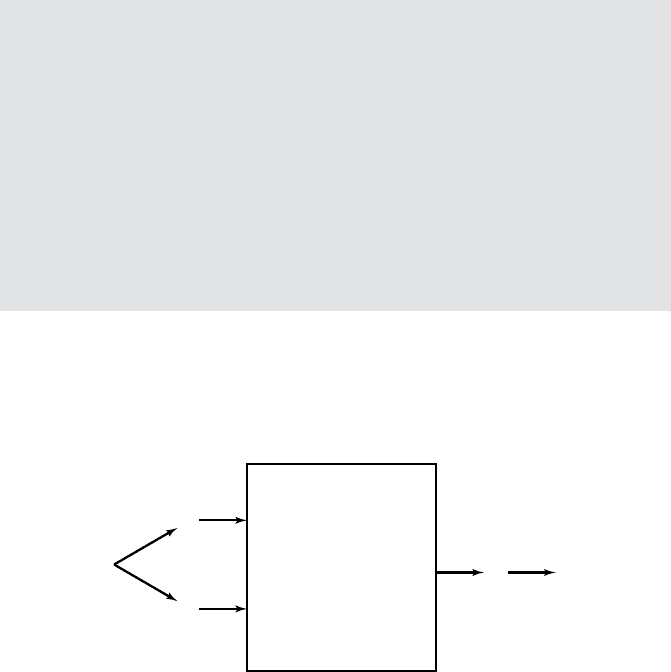
15.1 Cooperative capacity of a multiple-access channel
p
(
y
|
x
1
,
x
2
)
X
1
X
2
(
W
1
,
W
2
)
(
W
1
,
W
2
)
Y
^^
(a) Suppose that X
1
and X
2
have access to both indices W
1
∈
{1, 2
nR
},W
2
∈{1, 2
nR
2
}. Thus, the codewords X
1
(W
1
,
W
2
), X
2
(W
1
,W
2
) depend on both indices. Find the capacity
region.
(b) Evaluate this region for the binary erasure multiple access
channel Y = X
1
+ X
2
,X
i
∈{0, 1}. Compare to the noncoop-
erative region.
15.2 Capacity of multiple-access channels. Find the capacity region
for each of the following multiple-access channels:
(a) Additive modulo 2 multiple-access channel. X
1
∈{0, 1},
X
2
∈{0, 1},Y = X
1
⊕ X
2
.
(b) Multiplicative multiple-access channel. X
1
∈{−1, 1},
X
2
∈{−1, 1},Y = X
1
· X
2
.

PROBLEMS 597
15.3 Cut-set interpretation of capacity region of multiple-access chan-
nel. For the multiple-access channel we know that (R
1
,R
2
) is
achievable if
R
1
<I(X
1
;Y | X
2
), (15.364)
R
2
<I(X
2
;Y | X
1
), (15.365)
R
1
+ R
2
<I(X
1
,X
2
;Y) (15.366)
for X
1
,X
2
independent. Show, for X
1
,X
2
independent that
I(X
1
;Y | X
2
) = I(X
1
;Y, X
2
).
X
1
Y
X
2
S
1
S
2
S
3
Interpret the information bounds as bounds on the rate of flow
across cut sets S
1
,S
2
,andS
3
.
15.4 Gaussian multiple-access channel capacity.FortheAWGN
multiple-access channel, prove, using typical sequences, the
achievability of any rate pairs (R
1
,R
2
) satisfying
R
1
<
1
2
log
1 +
P
1
N
, (15.367)
R
2
<
1
2
log
1 +
P
2
N
, (15.368)
R
1
+ R
2
<
1
2
log
1 +
P
1
+ P
2
N
. (15.369)

598 NETWORK INFORMATION THEORY
The proof extends the proof for the discrete multiple-access chan-
nel in the same way as the proof for the single-user Gaussian
channel extends the proof for the discrete single-user channel.
15.5 Converse for the Gaussian multiple-access channel . Prove the
converse for the Gaussian multiple-access channel by extending
the converse in the discrete case to take into account the power
constraint on the codewords.
15.6 Unusual multiple-access channel. Consider the following
multiple-access channel:
X
1
= X
2
= Y ={0, 1}.If(X
1
,X
2
) =
(0, 0),thenY = 0. If (X
1
,X
2
) = (0, 1),thenY = 1. If (X
1
,X
2
) =
(1, 0),thenY = 1. If (X
1
,X
2
) = (1, 1),thenY = 0 with proba-
bility
1
2
and Y = 1 with probability
1
2
.
(a) Show that the rate pairs (1,0) and (0,1) are achievable.
(b) Show that for any nondegenerate distribution p(x
1
)p(x
2
),we
have I(X
1
,X
2
;Y) < 1.
(c) Argue that there are points in the capacity region of this
multiple-access channel that can only be achieved by time-
sharing; that is, there exist achievable rate pairs (R
1
,R
2
) that
lie in the capacity region for the channel but not in the region
defined by
R
1
≤ I(X
1
;Y |X
2
), (15.370)
R
2
≤ I(X
2
;Y |X
1
), (15.371)
R
1
+ R
2
≤ I(X
1
,X
2
;Y) (15.372)
for any product distribution p(x
1
)p(x
2
). Hence the operation
of convexification strictly enlarges the capacity region. This
channel was introduced independently by Csisz
´
ar and K
¨
orner
[149] and Bierbaum and Wallmeier [59].
15.7 Convexity of capacity region of broadcast channel.LetC ⊆ R
2
be the capacity region of all achievable rate pairs R = (R
1
,R
2
)
for the broadcast channel. Show that C is a convex set by using
a time-sharing argument. Specifically, show that if R
(1)
and R
(2)
are achievable, λR
(1)
+ (1 − λ)R
(2)
is achievable for 0 ≤ λ ≤ 1.
15.8 Slepian–Wolf for deterministically related sources.Findand
sketch the Slepian–Wolf rate region for the simultaneous data
compression of (X, Y ),wherey = f(x) is some deterministic
function of x.
PROBLEMS 599
15.9 Slepian–Wolf .LetX
i
be i.i.d. Bernoulli(p). Let Z
i
be i.i.d. ∼
Bernoulli(r), and let Z be independent of X. Finally, let Y =
X ⊕ Z (mod 2 addition). Let X be described at rate R
1
and Y
be described at rate R
2
. What region of rates allows recovery of
X, Y with probability of error tending to zero?
15.10 Broadcast capacity depends only on the conditional marginals.
Consider the general broadcast channel (X, Y
1
× Y
2
,p(y
1
,y
2
| x)).
Show that the capacity region depends only on p(y
1
| x) and p(y
2
|
x). To do this, for any given ((2
nR
1
, 2
nR
2
), n) code, let
P
(n)
1
= P {
ˆ
W
1
(Y
1
) = W
1
}, (15.373)
P
(n)
2
= P {
ˆ
W
2
(Y
2
) = W
2
}, (15.374)
P
(n)
= P {(
ˆ
W
1
,
ˆ
W
2
) = (W
1
,W
2
)}. (15.375)
Then show that
max{P
(n)
1
,P
(n)
2
}≤P
(n)
≤ P
(n)
1
+ P
(n)
2
.
The result now follows by a simple argument. (Remark: The
probability of error P
(n)
does depend on the conditional joint
distribution p(y
1
,y
2
| x). But whether or not P
(n)
can be driven
to zero [at rates (R
1
,R
2
)] does not [except through the conditional
marginals p(y
1
| x), p(y
2
| x)].)
15.11 Converse for the degraded broadcast channel . The following
chain of inequalities proves the converse for the degraded dis-
crete memoryless broadcast channel. Provide reasons for each of
the labeled inequalities.
Setup for converse for degraded broadcast channel capacity:
(W
1
,W
2
)
indep.
→ X
n
(W
1
,W
2
) → Y
n
1
→ Y
n
2
.
•
Encoding f
n
:2
nR
1
× 2
nR
2
→ X
n
•
Decoding: g
n
: Y
n
1
→ 2
nR
1
,h
n
: Y
n
2
→ 2
nR
2
.LetU
i
=
(W
2
,Y
i−1
1
).Then
nR
2
·
≤
Fano
I(W
2
;Y
n
2
) (15.376)
(a)
=
n
i=1
I(W
2
;Y
2i
| Y
i−1
2
) (15.377)
600 NETWORK INFORMATION THEORY
(b)
=
i
(H (Y
2i
| Y
i−1
2
) − H(Y
2i
| W
2
,Y
i−1
2
)) (15.378)
(c)
≤
i
(H (Y
2i
) − H(Y
2i
| W
2
,Y
i−1
2
,Y
i−1
1
)) (15.379)
(d)
=
i
(H (Y
2i
) − H(Y
2i
| W
2
,Y
i−1
1
)) (15.380)
(e)
=
n
i=1
I(U
i
;Y
2i
). (15.381)
Continuation of converse: Give reasons for the labeled inequali-
ties:
nR
1
·
≤
Fano
I(W
1
;Y
n
1
) (15.382)
(f)
≤ I(W
1
;Y
n
1
,W
2
) (15.383)
(g)
≤ I(W
1
;Y
n
1
| W
2
) (15.384)
(h)
=
n
i−1
I(W
1
;Y
1i
| Y
i−1
1
,W
2
) (15.385)
(i)
≤
n
i=1
I(X
i
;Y
1i
| U
i
). (15.386)
Now let Q be a time-sharing random variable with Pr(Q = i) =
1/n, i = 1, 2,...,n. Justify the following:
R
1
≤ I(X
Q
;Y
1Q
|U
Q
,Q), (15.387)
R
2
≤ I(U
Q
;Y
2Q
|Q) (15.388)
for some distribution p(q)p(u|q)p(x|u, q)p(y
1
,y
2
|x). By appro-
priately redefining U , argue that this region is equal to the convex
closure of regions of the form
R
1
≤ I(X;Y
1
|U), (15.389)
R
2
≤ I(U;Y
2
) (15.390)
for some joint distribution p(u)p(x|u)p(y
1
,y
2
|x).
PROBLEMS 601
15.12 Capacity points.
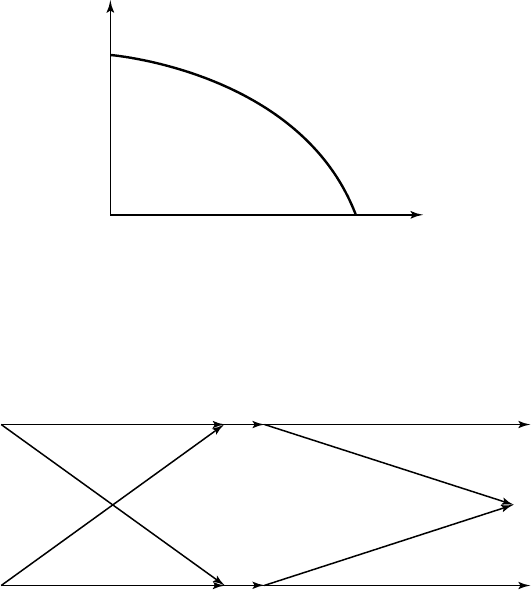
(a) For the degraded broadcast channel X → Y
1
→ Y
2
, find the
points a and b where the capacity region hits the R
1
and R
2
axes.
R
2
R
1
b
a
(b) Show that b ≤ a.
15.13 Degraded broadcast channel. Find the capacity region for the
degraded broadcast channel shown below.
X
p
1 −
p
1 −
p
1 − a
1 − a
a
a
p
Y
2
Y
1
15.14 Channels with unknown parameters. We are given a binary
symmetric channel with parameter p. The capacity is C = 1 −
H(p). Now we change the problem slightly. The receiver knows
only that p ∈{p
1
,p
2
} (i.e., p = p
1
or p = p
2
,wherep
1
and p
2
are given real numbers). The transmitter knows the actual value
of p. Devise two codes for use by the transmitter, one to be used
if p = p
1
, the other to be used if p = p
2
, such that transmission
to the receiver can take place at rate ≈ C(p
1
) if p = p
1
and at
rate ≈ C(p
2
) if p = p
2
. (Hint: Devise a method for revealing
p to the receiver without affecting the asymptotic rate. Prefixing
the codeword by a sequence of 1’s of appropriate length should
work.)
602 NETWORK INFORMATION THEORY
15.15 Two-way channel. Consider the two-way channel shown in
Figure 15.6. The outputs Y
1
and Y
2
depend only on the current
inputs X
1
and X
2
.
(a) By using independently generated codes for the two senders,
show that the following rate region is achievable:
R
1
<I(X
1
;Y
2
|X
2
), (15.391)
R
2
<I(X
2
;Y
1
|X
1
) (15.392)
for some product distribution p(x
1
)p(x
2
)p(y
1
,y
2
|x
1
,x
2
).
(b) Show that the rates for any code for a two-way channel with
arbitrarily small probability of error must satisfy
R
1
≤ I(X
1
;Y
2
|X
2
), (15.393)
R
2
≤ I(X
2
;Y
1
|X
1
) (15.394)
for some joint distribution p(x
1
,x
2
)p(y
1
,y
2
|x
1
,x
2
).
The inner and outer bounds on the capacity of the two-way
channel are due to Shannon [486]. He also showed that the inner
bound and the outer bound do not coincide in the case of the
binary multiplying channel
X
1
= X
2
= Y
1
= Y
2
={0, 1}, Y
1
=
Y
2
= X
1
X
2
. The capacity of the two-way channel is still an open
problem.
15.16 Multiple-access channel . Let the output Y of a multiple-access
channel be given by
Y = X
1
+ sgn(X
2
),
where X
1
,X
2
are both real and power limited,
E(X
2
1
) ≤ P
1
,
E(X
2
2
) ≤ P
2
,
and sgn(x) =
1,x>0,
−1,x≤ 0.
Note that there is interference but no noise in this channel.
(a) Find the capacity region.
(b) Describe a coding scheme that achieves the capacity region.
PROBLEMS 603
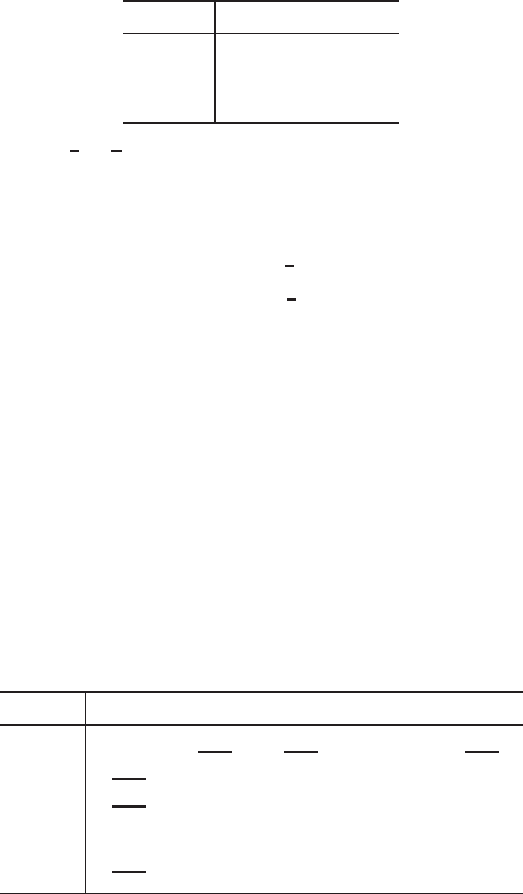
15.17 Slepian–Wolf .Let(X, Y ) have the joint probability mass func-
tion p(x,y):
p(x, y) 123
1 αβ β
2
βα β
3
ββ α
where β =
1
6
−
α
2
.(Note: This is a joint, not a conditional, prob-
ability mass function.)
(a) Find the Slepian–Wolf rate region for this source.
(b) What is Pr{X = Y } in terms of α?
(c) What is the rate region if α =
1
3
?
(d) What is the rate region if α =
1
9
?
15.18 Square channel . What is the capacity of the following multiple-
access channel?
X
1
∈{−1, 0, 1},
X
2
∈{−1, 0, 1},
Y = X
2
1
+ X
2
2
.
(a) Find the capacity region.
(b) Describe p
∗
(x
1
), p
∗
(x
2
) achieving a point on the boundary of
the capacity region.
15.19 Slepian–Wolf . Two senders know random variables U
1
and U
2
,
respectively. Let the random variables (U
1
,U
2
) have the following
joint distribution:
U
1
\U
2
012··· m − 1
0 α
β
m−1
β
m−1
···
β
m−1
1
γ
m−1
00··· 0
2
γ
m−1
00··· 0
.
.
.
.
.
.
.
.
.
.
.
.
.
.
.
.
.
.
m − 1
γ
m−1
00··· 0
where α + β + γ = 1. Find the region of rates (R
1
,R
2
) that would
allow a common receiver to decode both random variables reliably.
604 NETWORK INFORMATION THEORY
15.20 Multiple access
(a) Find the capacity region for the multiple-access channel
Y = X
X
2
1
,
where
X
1
{2, 4} ,X
2
{1, 2}.
(b) Suppose that the range of X
1
is {1, 2}. Is the capacity region
decreased? Why or why not?
15.21 Broadcast channel . Consider the following degraded broadcast
channel.
1 − a
1
1 − a
1
a
1
a
1
0
1
0
1
1
E
XY
1
1 − a
2
1 − a
2
a
2
a
2
0
1
E
Y
2
(a) What is the capacity of the channel from X to Y
1
?
(b) What is the channel capacity from X to Y
2
?
(c) What is the capacity region of all (R
1
,R
2
) achievable for this
broadcast channel? Simplify and sketch.
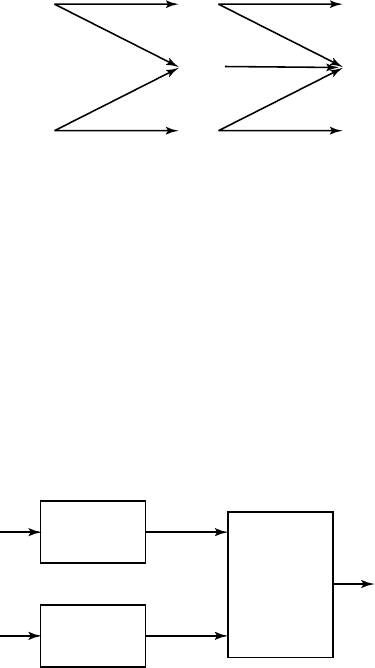
15.22 Stereo. The sum and the difference of the right and left ear sig-
nals are to be individually compressed for a common receiver. Let
Z
1
be Bernoulli (p
1
) and Z
2
be Bernoulli (p
2
) and suppose that
Z
1
and Z
2
are independent. Let X = Z
1
+ Z
2
,andY = Z
1
− Z
2
.
(a) What is the Slepian–Wolf rate region of achievable (R
X
,R
Y
)?
R
X
Decoder (
X
,
Y
)
X
R
Y
Y
^^