
Van Dyke R.M, Alcock S.E. (ред.) Archaeologies of Memory
Подождите немного. Документ загружается.

Echoes of Empire: Vijayanagara 21
and 1340s, this area was, to a significant extent, a political “no-man’s land,” not under
the protection of any strong polity. Further, a bend in the Tungabhadra River
provided a small arable zone in this otherwise semi-arid and rugged landscape
(Morrison 1995). The region was also highly defensible; the high granitic outcrops
of the southern extent of the Deccan Plateau both impeded movement and provided
abundant raw materials for the construction of massive fortifications.
Along with the above-mentioned strategic reasons, it is also significant that the
sparsely populated locale where Vijayanagara was founded was a place sacred to wor-
shippers of both Shiva and Vishnu.These sacred associations were written on the land-
scape of the Vijayanagara region, inscribed in holy hills, the river, and other natural
and constructed features, the latter including a Neolithic ash mound of the third
millennium bc (believed to be the cremation ground of Vali, see below) and
pre-Vijayanagara temples. These features provided a powerful source of memory and
legitimation with which Vijayanagara’s Sangama and subsequent kings sought to
affiliate themselves.
As noted earlier, several small pre-Vijayanagara temples existed in the region where
Vijayanagara was later founded. Most important of these was a complex of shrines
dedicated to Virupaksha, a manifestation of the major Hindu deity Shiva. The
earliest documented temple to Virupaksha, the “lord of Hemakuta,” dates to the
ninth–tenth centuries. Later shrines were added in the twelfth century ad, by which
time the male Virupaksha was already linked with the goddess Pampa. The Virupak-
sha temple was expanded throughout the subsequent Vijayanagara period and remains
today a major center of worship and pilgrimage.
By the Vijayanagara period, Virupaksha had become far more important in local
religious traditions than his consort. Yet Pampa is the oldest documented deity of
the area. The earliest inscriptional references to Pampa can be traced to the seventh
century ad , and she was likely important long before then. Pampa appears to have
been a local, aquatic goddess, associated with the Tungabhadra River, and with the
power of a particular eponymous place on the river (modern Hampi). Verghese
(1995:16–17) argues that this local, perhaps even “pre-Hindu,” folk goddess, became
Sanskritized, or brought into Hindu orthodoxy, during the pre-Vijayanagara period
through her marriage to Shiva (Virupaksha). Following this, her stature diminished as
Virupaksha’s rose, but (and I will return to this below), Pampa nonetheless remained
important in local beliefs.
The second major sacred association of the Vijayanagara region lay with Vishnu,
the other major deity of orthodox Hinduism, in his form (avatar) as the god-king
Rama, whose adventures are recounted in the Ramayana epic. The relevant portion
of this tale concerns Rama’s exploits and travels as he tried to rescue his wife Sita,
who had been kidnapped by the ten-headed demon Ravana and taken to (Sri) Lanka.
In his quest, Rama and his brother Lakshmana came to Kishkinda, kingdom of the
monkey deities. On top of a hill called Matanga he encountered Sugriva, the dis-
possessed lord of the monkey kingdom. Through his valor, Rama helped Sugriva to
overthrow his rebellious brother Vali. After Sugriva’s enthronement, his liege Hanuman
traveled to Lanka and rescued Sita while Rama awaited her return atop Malyavanta
Hill.
22 Carla M. Sinopoli
The recognition of the Vijayanagara region as Kishkinda is not as ancient as its
association with the river goddess Pampa. Nor are there any pre-Vijayanagara period
Ramayana temples or images at the site. However,Verghese (1995) has suggested that
a small number of textual sources indicate that the Ramayana association had begun
as early as the eleventh century. Nonetheless, it is not until the late fourteenth- early
fifteenth-century Vijayanagara “building boom” in the region that these associations
were made materially manifest and were mapped onto the landscape through the con-
struction of temples and countless sacred images, as well as in urban plan. Key struc-
tures, routes of movement, and urban layout were linked with features of the sacred
landscape, including Matanga Hill, Malyavanta Hill, Anjanadri (Hanuman’s birthplace),
and other sites linked with Ramayana events (Fritz 1986, 1992; Fritz and Michell
1989; see figure 2.1).
Most striking of the structures associated with the Ramayana is an early fifteenth-
century temple dedicated to Rama. This temple lies due south of Matanga Hill
in the heart of the royal administrative and palace zone of the capital, which Fritz,
Michell, and Nagaraja Rao (1985) have termed the “Royal Center” (see figure 2.1).
The Ramachandra temple was constructed relatively early in the empire’s history,
during the reign of a king of the first, Sangama, dynasty (the temple does not have
a foundation inscription, but is believed to date to the reign of Devaraya I, 1406–1422
ad; Michell 1992a:17–20). It is a comparatively small temple complex, consisting of
a walled enclosure containing the central temple, as well as subsidiary shrines, wells,
and columned pavilions. The events of the Ramayana are depicted in a series of
narrative friezes on the structure’s exterior and on the interior compound wall (see
plate 2.1).
It is important to point out that the kings who were responsible for the con-
struction of this temple were not primarily devotees of Rama. Instead, their tutelary
deity was the Shaivite deity Virupaksha, discussed above. Even before the Sangamas
sponsored the construction of a Rama temple, they had constructed a temple to Viru-
paksha in the Vijayanagara royal center. So why build a temple to Rama at all? And
why place it at such a critical location in the city – at the nexus of key administra-
tive and royal structures and the focus of multiple transport and processional routes?
As noted, no foundational inscription occurs on the temple. However, a fascinat-
ing, albeit brief, inscription on its principal shrine helps to date the shrine and to
link the temple with the non-Ramayana dimensions of the sacred landscape. The
Sanskrit inscription reads
As Vani blesses king Bhoka,Tripuramba king Vatsaraja, and Kali king Vikramarka, so does
Pampa now bless Devaraya. (trans. Rajasekhara 1992:27)
In this text, the Vijayanagara king Devaraya is explicitly linked with three great kings
of the distant past, each of whom was protected by a powerful goddess. Like those
earlier rulers, Devaraya has a protector – Pampa, the ancient goddess of this place.
The Shaivite affiliations of the Sangama kings were well established. Through
affiliating themselves with the expanding Rama cult, the Sangama rulers broadened
their ties to encompass the powerful Vaishnava sects of the period, and associated

Echoes of Empire: Vijayanagara 23
themselves with a particular god – one linked with the land and with potent values
concerning kingship and royal authority. However, by building a temple to Rama the
Sangama kings did not disavow their prior loyalties. Indeed, the reference to Pampa
in the above mentioned inscription demonstrates that these ties continued to be
emphasized even as Vijayanagara’s rulers added a new strand in their web of con-
nections to the landscape, to the people they sought to rule, and to the sacred past.
Construction of the Rama temple was an act of addition rather than replacement.
Plate 2.1 The Ramachandra temple
24 Carla M. Sinopoli
The increasing importance of the Ramayana and the expanded recognition of the
Vijayanagara area as Kishkinda were not restricted to the political elite. Instead, this
appears to have been a widespread phenomenon of the period. From the fourteenth
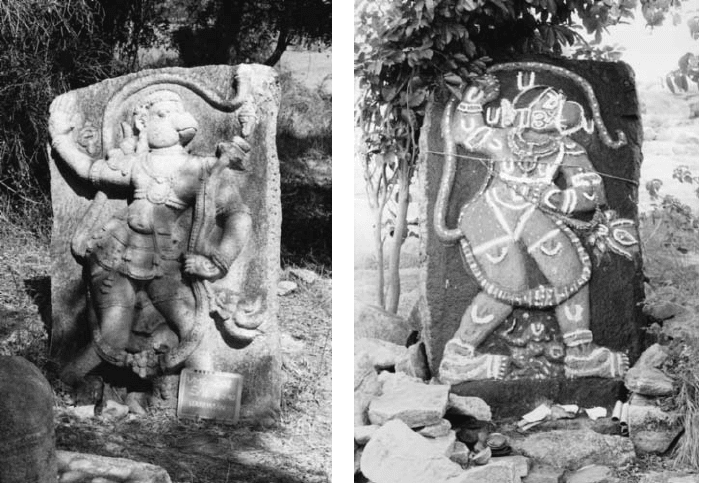
through sixteenth centuries, hundreds (probably thousands) of images of Hanuman
were carved on boulders and stone slabs throughout the Vijayanagara urban and sub-
urban landscape. Representations of Hanuman significantly outnumber those of any
other single deity at Vijayanagara and in its metropolitan region. Hanuman images
occur in a broad array of contexts – along roads, near wells and agricultural features,
and in countless small shrines in towns, villages, and rural settlements. These images
vary considerably in artistic quality from finely wrought sculptures that follow classi-
cal conventions and proportions (e.g., plate 2.2a) to more “folksy” images carved by
less skilled artisans (e.g., plate 2.2b). The extent to which the Vijayanagara kings
encouraged the expansion of the Kishkinda cult in the capital is unknown, but it does
seem clear that the explicit linking of the ruler with Rama, through the construc-
tion of the Ramachandra temple, was a deliberate act that had important consequences
in legitimating their rule.
Temple architecture
The sacred geographies of the Vijayanagara region discussed above served to assert
connections between the Vijayanagara throne, the imperial capital, and the territories
Plate 2.2 a and b Hanuman sculpture in Vijayanagara metropolitan region. Image 2.2a is a
finely wrought image, while 2.2b is a more folksy representation, with distorted proportions
(the pigment is recent, indicating that this Vijayanagara period image is currently in worship)
(a)
(b)
Echoes of Empire: Vijayanagara 25
of the gods. In this section, I continue my focus on the religious realm, but from a
somewhat different perspective. Rather than consider the content of Vijayanagara
temples in terms of the deities worshipped, I address the form of temples, and how
Vijayanagara sacred architecture provided an important context for the recognition
and reconfiguration of the past through the creation of a distinctive imperial
architectural style.
As noted earlier, a number of small temples in the Vijayanagara region date to the
pre-imperial period, from the ninth–tenth through early fourteenth centuries. These
temples are typically relatively small and simple, with pyramidal stone towers and
simple unadorned exteriors. In form and construction, they belong to local architec-
tural traditions of the inland and upland areas of the peninsula.The earliest Vijayana-
gara temples of the mid- to late fourteenth century also adhere to this tradition. No
radical changes in temple architecture corresponded with the initial founding of the
city and empire; instead, architectural referents continued to be to local antecedents
and traditions.
As Vijayanagara hegemony and claims to imperial status expanded beyond their
upland core in the late fourteenth and early fifteenth centuries, a marked change
occurred in both the scale and the style of temples. The result was a new and dis-
tinctive form of sacred architecture that spread across the empire and became increas-
ingly elaborated over time. Architectural historian George Michell (1994:188) has
described Vijayanagara imperial temple architecture as “revivalist,” specifically, as imi-
tating the architecture of the Chola empire, whose heartland lay in the fertile river
valleys of the southeast coast. The Ramachandra temple (plate 2.1, and above) is
among the earliest of the revivalist temples at Vijayanagara and its construction likely
involved the importation of architects and master builders from Tamil-speaking regions
to the imperial capital (Michell 1994:192). Over the next century, this revivalist style
spread across imperial territories, producing a uniform and recognizable Vijayanagara
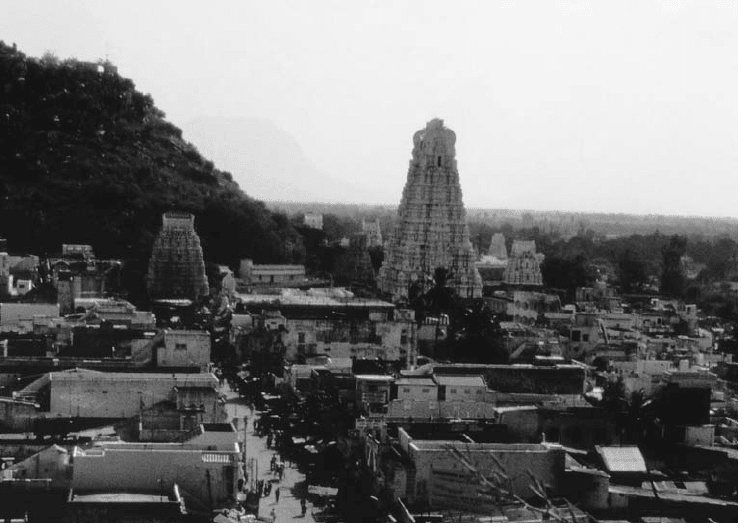
temple style. Vijayanagara temples also increased in physical scale over time. By the
sixteenth century, temple gateways, or gopura, towered over surrounding settlements,
creating a distinctive and highly visible feature that marked the presence of the gods
and their royal benefactors (see plate 2.3).
Over the last decade, several historians of Vijayanagara (e.g., Stein 1989;Talbot n.d.)
have argued that Vijayanagara political and economic forms are best understood as
having evolved out of upland Telugu and Kannada traditions of state organization.
This perspective stands in marked contrast to traditional understandings of Vijayana-
gara, which sought Chola roots for Vijayanagara practices (e.g., Nilakanta Sastri 1966;
Stein 1980). If these more recent arguments are correct, and I believe they are, why
then did temple architecture in particular draw on a distant southern tradition that
lay hundreds of kilometers and several centuries removed from Vijayanagara, especially
as other forms of complex and sculpturally elaborate temple architecture lay some-
what nearer to hand in Kannada- and Telugu-speaking zones that comprised the core
of the empire?
Michell views the development of Vijayanagara revivalist temple style as the result
of a deliberate strategy by the imperial rulers to make imperial claims. This was
accomplished in two ways. First, adopting the style of an earlier empire allowed
Vijayanagara’s kings to call upon memories of past (Chola) grandeur to portray a
26 Carla M. Sinopoli
message of continuity and legitimacy. Second, the style adopted was that of a physi-
cally distant empire in preference to more proximate available alternatives. Given the
wide-ranging polity that the Sangama kings were attempting to form, this emphasis
on distance may have been part of a deliberate attempt to make a claim to universal
status as rulers of the entire south. The result was a “temple style that would give
expression to their imperial ambitions” (Michell 1994:195). In the sacred realm, then,
the new Vijayanagara architectural style was grounded in the past.
New architectural forms and new forms of power
Reference to the Hindu and South Indian past was, however, not the only architec-
tural mode through which Vijayanagara’s rulers expressed their visions of empire.
While temple architecture drew on historical knowledge and contexts, Vijayanagara
administrative or “courtly” architecture expressed very different kinds of relations and
political ideologies, based in the present rather than in memory. And while temple
architecture involved the relations of political authority to sacred authority,Vijayana-
gara courtly architecture was mainly about the political; it was as Michell (1992b:168)
described, “a means of defining the king’s world.”
The world of a Vijayanagara ruler was a large one. It included the polities and
peoples of the south who had been variously incorporated into the empire. It also
Plate 2.3 Sixteenth century temple gopuram (Kalahasti, Tamil Nadu)
Echoes of Empire: Vijayanagara 27
included other South Asian states and empires: particularly the five Deccani Sultanates
to Vijayanagara’s north and the large Hindu Gajapati state in Orissa, to its northeast.
These polities were Vijayanagara’s major enemies, and also its peers, and the relations
among these states included warfare, trade, and diplomacy.Vijayanagara was also part
of an international world; maritime commerce linked South India with East and
Southeast Asia, the Middle East, and by the sixteenth century, directly with Europe.
Like temple architecture,Vijayanagara courtly architecture also entailed borrowing
from other traditions. But here the references were not to the distant past, but to the
newly configured political landscape and to new conceptions of kingship and author-
ity that had emerged in the wake of the withdrawal of the Delhi Sultanate from the
peninsula. As a result, the Vijayanagara king was a participant in a much broader polit-
ical sphere than rulers of prior South Indian states. This had a dramatic impact on
Vijayanagara political ideologies and political practices, with changes manifest in the
emergence of new royal rituals, such as the “Robes of Honor” ceremony that was
reported on by Portuguese visitors to the capital (Gordon 1996), as well as the adop-
tion of new royal titles including the wonderfully multivalent “Sultan of the Hindu
kings” (Wagoner 1996).
The new concept of kingly authority and royal ritual that emerged in South India
during the Vijayanagara period drew creatively upon the political traditions and mate-
rial forms of northern Muslim states. A distinctive Vijayanagara courtly architecture
developed in the fifteenth and sixteenth centuries, and perhaps earlier (Michell, per-
sonal communications). It was restricted to public or royal structures, was found only
at major imperial cities, and had clear associations with the architecture of the Deccani
Sultanates (Michell and Zebrowski 1999). As such, Vijayanagara courtly architecture
merged features from within and beyond imperial territories in the creation of an
imperial style of public architecture.
Vijayanagara courtly architecture was distinctive in its building technologies as well
as in external form. Structures in this category were built of small crudely cut stone
blocks set in thick mortar and covered in plaster (Michell 1995:129), a marked con-
trast to the dry stone masonry technologies that characterized Vijayanagara temple
and defensive architecture. Stylistic features derived from the north include domes,
arches, and building layouts structured as a “geometric manipulation of one or more
domed and vaulted chambers” (Michell 1992c:48). Features drawn from within the
empire include stepped temple-like roofs, plaster decoration, and elaborately carved
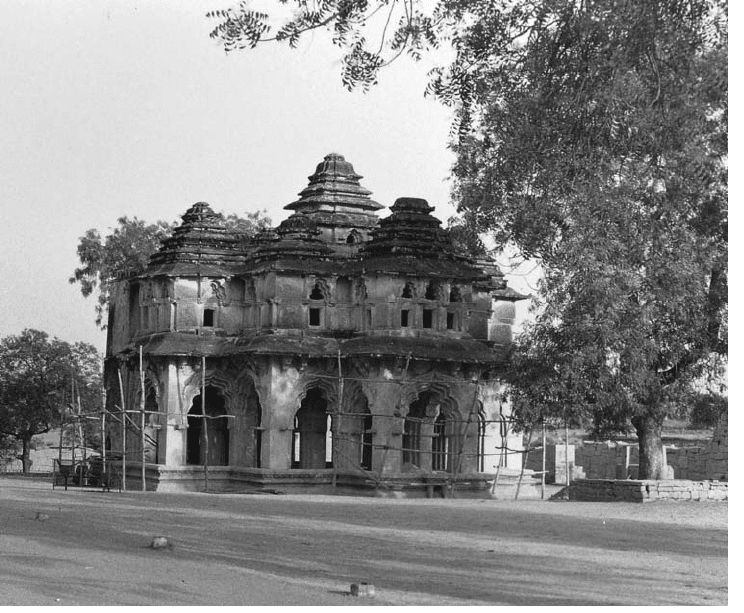
multi-tiered stone foundations. One of the best examples of this style at the capital
is a structure in the royal center that is popularly referred to as the Lotus Mahal,
which likely functioned as a reception hall (see plate 2.4). This structure combines
ornate Islamic style arches decorated with incised plaster motifs with a temple-like
sculpted basement and tiered roof. Other structures of this distinctive style found at
Vijayanagara and the later capitals of Chandragiri, Penukonda, and Vellore include
palaces, watchtowers, baths or water-tanks, and administrative buildings.
It is important to stress that Vijayanagara courtly structures did not simply mimic
northern styles; instead, this was something new and distinctive, expressing very dif-
ferent kinds of identities and relations than are evident in contemporaneous temple
architecture. It is also important to emphasize that the kinds of transformations evident
28 Carla M. Sinopoli
in courtly architecture are also evident in several other cultural spheres.These include
military and administrative organization, as well as the patterns of royal dress and royal
titles noted earlier, all of which also manifest an awareness of and participation in a
political landscape extending far behind the bounds of the Vijayanagara empire. It is
perhaps in this transformed political and ideological landscape where we see the most
radical breaks with the past, and the creation of new and different memory commu-
nities. That these new alliances occur at the same time that very different communi-
ties and connections are being expressed through sacred architecture and in literary
texts attests to the simultaneity of multiple constructions of Vijayanagara imperial
identities and the multiple audiences for those constructions.
Discussion
The discussion presented above paints a picture of a state very much in control of its
“message,” consciously manipulating existing beliefs, as well as new geopolitical situ-
ations, to meet specific ends. This is, to a large extent, a false picture. Certainly some
Plate 2.4 Vijayanagara courtly architecture: Pavilion in the Royal Center
Echoes of Empire: Vijayanagara 29
of the processes described above, particularly the links made by Sangama kings to the
God Rama, appear to have been the result of deliberate, conscious, political strategies
by Vijayanagara elites. Other trends, such as changing elite clothing fashions and the
emergence of new forms of Vijayanagara courtly architecture were likely far less deli-
berate, and emerged instead as a more gradual outgrowth of Vijayanagara’s partici-
pation in an expanded and transformed political universe.
Vijayanagara as Memory
I noted earlier that the Deccani Sultanates were both peers and foes of Vijayanagara.
In 1565, the foes won out. A major battle occurred to the north of the Vijayanagara
capital that pitted Vijayanagara’s armies against a confederation of three sultanates.
Vijayanagara was defeated and its first capital was hastily abandoned. Over the course
of the next century, Vijayanagara’s rulers shifted ever further south to the cities of
Penukonda, Chandragiri, and Vellore. Although each of these successive capitals was
given the name Vijayanagara to link it to the former site of imperial grandeur, with
each shift the empire became smaller and its authority weakened. As Vijayanagara
declined (beginning even before the 1565 defeat), numerous smaller states rose to
prominence across the empire’s former territories. By the early seventeenth century
(and even earlier in some areas), numerous large and small polities had emerged, with
the largest and most effective of the successor states based in the southern and eastern
parts of the former Vijayanagara territories. The rulers of these new “nayaka” states
were the descendants of regional rulers or nayakas.The nayakas were military leaders,
often from upland Telugu-speaking regions (modern Andhra Pradesh), who had risen
to prominence as regional rulers in the Tamil-speaking south in the sixteenth century.
From the beginning, many of these rulers had sought independence from the empire
and nayaka political ideologies from the sixteenth century on thus involved a complex
dynamic that both acknowledged Vijayanagara authority and legitimated resistance to
it. The decline of the empire following the 1565 battle provided the opportunity for
that resistance to take hold and for the nayaka states to declare themselves as
autonomous polities.
However, even as the empire was fragmenting,Vijayanagara as memory and source
of authority became extraordinarily important. We see this most strongly in the
courtly literature and temple architecture of the nayaka states of the seventeenth and
eighteenth centuries. In a recent book on the period, the central paradox of nayaka
kingship has been defined as “the tension between inflated claims, and the limited
scale” of their polities (Narayana Rao, Shulman, and Subrahmanyam 1992:xi). These
were small states compared to their predecessor and many were fragile and short-
lived. Yet, their rhetoric of kingship was vast, entailing, in many cases, claims to the
mantle of Vijayanagara’s legitimacy.
This pattern is evident in the origin stories of several nayaka states. For example,
the origin story of the Madurai nayaka state (which is preserved in several versions)
involves a complex recounting of interactions between the archetypal great emperor
of Vijayanagara, Krisnadevaraya (1509–1529 ad) and the first ruler of Madurai and
30 Carla M. Sinopoli
his eldest son. Extant versions of this complicated story probably date to the early
eighteenth century, 200 years after Krisnadevaraya’s death, and involve murder, rebel-
lion, and threats of patricide. The Madurai story recounts the tale of the warrior
Nagama, a powerful nayaka who recaptured the Madurai region for Vijayanagara, but
then refused to hand it over. Nagama’s son Visvanatha remained loyal to the emperor
and turned against his father to regain the land for Krisnadevaraya. Following his
victory, Nagama brought his defeated father to stand judgment before the emperor.
The ruler acknowledged the heroism of the son by releasing the father to his custody.
And then, moved by the heroism and loyalty of Visvanatha, Krisnadevaraya told
his courtiers that Visvanatha “deserves a throne equal to our own” (Narayana Rao,
Shulman, and Subrahmanyam 1992:49). Thus, he offered Visvanatha kingship of the
South, saying (as the story goes):
You have saved my throne . . . Moreover, we have said that we would create a kingdom
for you equal to ours...If you don’t take control of the southern country, the situa-
tion won’t be good. If it weren’t for you the country would be without a king, and we
would have to be reborn ourselves to struggle with those palegallu. You had best hurry
south to be king. (Narayana Rao, Shulman, and Subrahmanyam 1992:51)
The “reluctant” Visvanatha agrees. However, to properly begin his rule, Visvanatha
requests and is granted a gift from the king: the “protective goddess of Vijayanagara
Durgamahalakshmi,” who he installs in his capital of Madurai (Narayana Rao,
Shulman, and Subrahmanyam 1992:51). As the Vijayanagara imperial center to the
north declines and is abandoned, Madurai rises to glory, bearing the mantle of
Vijayanagara’s greatness.
This tale contains elements found in many origin stories associated with the nayaka
kingdoms. These include accounts of the self-made nature of the nayakas, whose
success is due to their heroic acts rather than to their lineage (which was, in fact,
often undistinguished). Also present in these tales, though not discussed here, are ref-
erences to the wealth and territory that these heroes’ efforts yielded. A further criti-
cal component is the establishment of connections to higher sources of authority:
most often to Vijayanagara. These linkages were not transferred through heredity, but
through acts of personal loyalty, and through the transfer of the symbols and rights
of legitimate rule from a past ruler to his successor.
Like the references to the Chola period found in Vijayanagara temple architecture,
the nayaka historical references are restricted to a particular time and place in history.
The place is the first city of Vijayanagara and the time is the reign of Krisnadevaraya,
arguably the most effective, and certainly the most remembered of Vijayanagara kings.
Krisnadevaraya’s rule marked the political apogee of the empire, when it reached its
greatest geographic extent and greatest unity and wealth. Thus, an important Telugu
royal text of the early 1600s, the Rayavacakamu or “Tidings of the King,” was com-
posed as if it had been written in the court of Krisnadevaraya, despite the fact that
Krisnadevaraya had been dead for nearly 80 years by the time it was composed
(Wagoner 1993). For the nayaka states, Vijayanagara had become the model and
memory on which to build a state.