
Van Dyke R.M, Alcock S.E. (ред.) Archaeologies of Memory
Подождите немного. Документ загружается.

Ancestral Presence, Commemorative Practice 41
conjoin to animate such spaces. Yet evidence also posits more domestic utilization
since troughs and mortars were found in the front rooms of houses NE14 and SW1.
This should not be surprising given that Egyptian households were the sites of multi-
functional room usage.We lack information about the specific rituals or practices that
were employed to transform space, if indeed this was deemed necessary. Sacred and
mundane are inherently Western taxonomies and such rigid separation of the spheres
in a domestic contexts was not in accord with New Kingdom culture (Meskell
2001:199–201).
The second room, or divan room, possessed the highest frequency of ritual finds
and revolved around the socio-ritual lives of the elite men of the household. These
divans tend to be constructed in brick, are sometimes stone-lined, and always abut a
major wall. The central focus within the elite male sphere would be the divan itself,
which has a long history in later Egypt and the Middle East as a symbol of male
activity, status, power relations and hospitality amongst other elite males. Just as Room
1 with the lit clos has a constellation of associated features signifying its ritual focus,
the divan room has its own specific markers. In NE12 it is a cultic cupboard, in SE6
an altar, and more frequently we see false doors, painted red and yellow, embedded
in the walls. Nebamentet, the house owner of SE7, had a false door and a wall paint-
ing; Nebamun, next door in SE8, had a divan bordered by stone with two pilasters
against the western wall, plus red false doors with a central yellow band (Bruyère
1930:275). In mainstream mortuary practice, false doors were niched structures
through which one’s spirit could move back and forth freely, between this world and
the other, to receive offerings.They were common throughout Egyptian history, dating
back to the beginning of the Dynastic period, though they are not generally consid-
ered part of the domestic repertoire. In many cultures the door is a multivalent
signifier, since it embodies both material and immaterial aspects:
How concrete everything becomes in the world of the spirit when an object, a mere
door, can give images of hesitation, temptation, desire, security, welcome and respect. If
one were to give an account of all the doors one would like to re-open, one would
have to tell the story of one’s entire life. But is he who opens a door and he who closes
it the same being? The gestures that make us conscious of security or freedom are rooted
in a profound depth of being. Indeed, it is because of this “depth” that they become so
normally symbolical. (Bachelard 1994:224)
In a household context false doors provided a portal between the world of the living
and the dead and were an ever-present reminder of the deceased’s eternal presence.
Iconographic motifs present on the stelae are similar to those shown on inscribed
false doors where the deceased is the recipient of food offerings (Friedman 1985).
False doors facilitated contact with the spirits of ancestors, a view reinforced by the
frequency of ancestor-related artifacts such as busts, statues and stelae that have
been found in this room. We have to remember that Egyptian art fixed an event or
individual in the memory, and thus formed a true memorial.
In order to apprehend the Egyptian material, we have to divorce ourselves from
Western notions of art as a specific discursive category.While not eschewing the power
of aesthetics, Egyptian representations were not solely “to be looked at.” In Egypt, the
42 Lynn Meskell
term for sculptor was “he who keeps alive,” which underscores the significance of
the image as a living materiality. In pharaonic, Graeco-Roman and Late Antique
times there was little distinction between the statue of a deity and the deity itself.
Artemidorus, in his Interpretation of Dreams, argued that it made no difference whether
one saw a statue of a goddess or the deity herself in the flesh, since a divine numen
was present in both. Spirit animated the statue and thus one could actively petition
it (Belting 1994:37), harking back to the pharaonic idea that the cult statue was
equivalent to, and should be treated like, the divine body of the deity. Statues were
provided with clean clothes each day, in addition to food and drink offerings in an
ongoing daily routine of verbal and material sustenance. Altars piled high with
provisions were set up, incense burned and libations poured. These are all actions
which would have been familiar to the villagers at Deir el Medina, particularly in
their veneration of Amenhotep III and his mother. Moreover, once the mouth of an
image had been touched, that image could house the spiritual elements, thus provid-
ing the material entity for eternal life (Forman and Quirke 1996:32). Images were
thus called upon to play active roles and fill gaps in the social fabric of daily life. As
Belting (1994:45) contends, “many religions are concerned to make visible an object
of veneration, to protect it and to approach it with the same piety that they would
lavish on the higher being; symbolic acts toward the image thus reveal one’s inner
attitude.” From an anthropological perspective, a statue in a temple was believed to
be the body of the divinity, and also a spirit-medium, that likewise provides the divin-
ity with a temporary body. Both are treated as theoretically on a par, despite the fact
that the former is an artifact and the latter is a living deity (Gell 1998:7). Whereas
this was possible for deified or royal personages, it did not always extend to the rep-
resentations of the rest of society. In the Ramesside Period that availability was
extended to ordinary people and could encompass the veneration of ancestral images.
The villagers of Deir el Medina called upon the deceased members of their own
families, now in the realm of effective spirits and known as the 33· iqr n R
j
, “effec-
tive spirits of Re.” We know this from the stelae they inscribed and erected in their
houses and chapels. These practices probably occurred in the second room or divan
room since most ritual finds emanate from there, as do the ritual fixtures and niches
into which the stelae were placed. Examples have been found in houses C6 (those
naming the individuals Baki and Mose); in SW5 (Khamuy and Pennub); and in SW2
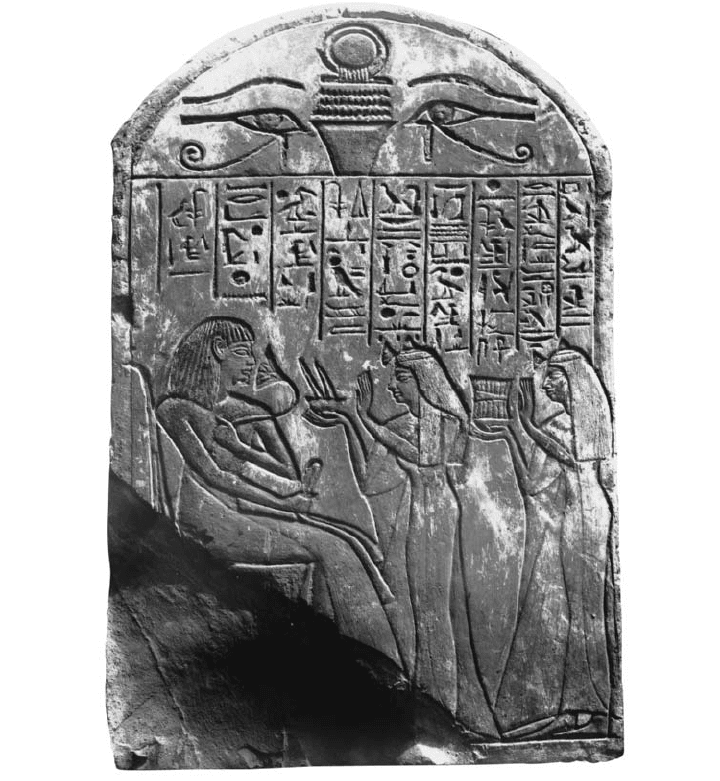
(Khonsu, and for the woman, Sherire; see Plate 3.2). They are small round-topped
limestone stelae, generally less than 25cm high. They date from the end of the
Eighteenth Dynasty, Nineteenth and Twentieth Dynasties with a preponderance in the
Nineteenth Dynasty (Demarée 1983:283). They were dedicated to one, two or three
individuals, usually without mention of their relations: in only a few cases do wives
or children occur as offerants or dedicators (Demarée 1983:174). Some individuals
had more than one stela devoted to them, suggesting that they were especially
remembered or venerated within the community.The 33· iqr n R
j
were human beings
who had been admitted to the afterworld, but more immediately they were deceased
relatives who could be called upon in times of need.Their effectiveness was sustained
by the ongoing practices of their descendants in the family cult. The materiality of
the stela acted as a conduit for transactions between this world and the next,
Ancestral Presence, Commemorative Practice 43
establishing contact with family members past and present. The fact that more men
are named as dedicants and deified ancestors fits well with the location of these objects
in the divan room, the area of greatest male potency.
The dedicators are not always depicted or named, but they could also include women
(Friedman 1994:112). In most instances a seated man is depicted, smelling a lotus –
which had associations of breath, rebirth and cyclicality – held in one hand. The
other hand is either outstretched toward a table of offerings or holds the ankh sign,
symbolizing life. These objects span the Eighteenth to Twentieth Dynasties and
additional examples have been discovered at sites such as Amarna and Gurob. Others
Plate 3.2 Stela of Khonsu, Nineteenth Dynasty, from Deir el Medina (see Demarée
1983:106–9)
44 Lynn Meskell
come from the palace of Merenptah at Memphis, the mortuary temple of Ramesses
III, various West Bank Theban temples and Aniba in Nubia. Cultic activities sur-
rounding these images were enacted in houses, chapels, tomb environs, and temples.
Stela size and portability facilitated movement from and around a number of
contexts. Find spots of the stelae in the Deir el Medina dwellings, in proximity to
wall niches in the first and second rooms, suggest that their placement was in ritual
recesses such as these.
Related finds are the so-called ancestor busts, which were painted limestone or
sandstone anthropomorphic votives, often depicted with floral collars around the neck.
They were activated in much the same manner as the stelae, through offerings and
invocations. Ancestor busts have been discovered in various locations – domestic,
mortuary and temple – from the Delta to the Third Cataract along the Nile.
Approximately half of the extant 150 examples come from Deir el Medina, while
the rest come from 14 other sites including the Faiyum, Gurob, Abydos, Karnak,
Sesebi, Saqqara and Sedment (Keith-Bennett 1988:45; Friedman 1994:114). Another
limestone bust of uncertain gender has recently been found in the excavations of the
New Kingdom houses at Memphis (Giddy 1999:43).The fact that several unfinished
examples were found at Deir el Medina verifies that they were made locally, perhaps
when times of need were greatest. Such objects gather the universe in and around
themselves: a past that goes back generations inheres in the material world and is
redolent of power and fate (Bachelard 1994:84).They were tangible sites of embodied
memory that simultaneously operated as a conduit between worlds. Moreover, they
were not art objects or even objects in our sense, but were considered social agents
themselves (Gell 1998:5). Persons or social agents, in contexts such as these, could be
substituted by what Western interpreters would classify as art objects.
Ancestor busts, like stelae, were probably placed in niches, given the number
discovered in domestic contexts. It has been suggested that their similarity to images
in Books of the Dead (BD) and Books of the Netherworld would imply an additional
funerary role (Keith-Bennett 1988:50). They are largely uninscribed, lacking names
or titles, yet most scholars assume they are male due to the presence of red paint
which characterizes male skin coloring.Yet red was also a magical color with potent
associations, commonly found in the decoration of the first two rooms in the village
houses, and also common on female figurines. Given the ritual potency of the name
in Egyptian ritual practice, however, what might it signify that most busts were unin-
scribed or unnamed? One interpretation might be that the busts were generic figures
and could evince or manifest any male relative who could be called upon. Perhaps
multiple memories could reside in their material form.Their lack of specificity might
also designate them as objects of forgetting, material places where fixed memory was
deemed unnecessary. This potentially would make them very different from ancestor
stelae.
Florence Friedman (1985:97) has argued that ancestor busts are an abbreviated form
of the statue of the kneeling man presenting a stela that we witness in so many niched
pyramidia at Deir el Medina.They could be moved about the village from houses to
chapels and required offerings of food and recitations, in the same manner as other
images and statues of the deceased. One spell in the Book of the Dead states: as for
Ancestral Presence, Commemorative Practice 45
him who knows this spell, he will be an effective spirit and he will not die again in the realm
of the dead (Faulkner 1985:175). Other spells, such as BD 100 and 101, allowed the
spirit to travel on the solar barque of Re in the company of the other gods. Such
spells, spoken by the living, assisted the deceased in the netherworld, and the rewards
of their homage would hopefully filter back to those same individuals in an ultimate
circle of reciprocity.The efficacy of spells was literally magnified by contemplation of
the bust. The desire was to facilitate the progress from a deceased state, transforming
the individual into an active and powerful being in the realm of the divine.
On one stela a man is shown worshipping in front of an ancestor bust, so we can
assume that such practices of active supplication were indeed undertaken (Demarée
1983). We have entered a domain where “objects” merge with “people” by virtue of
the existence of social relations between persons and things (Gell 1998:12), and
between persons and persons via things. Anthropologists such as Gell have theorized
how objects migrate across categories, having a certain agency that inheres in their
materiality:
Agency is attributable to those persons (and things) who/which are seen as initiating
causal sequences of a particular type, that is, events caused by acts of mind or will or
intention, rather than the mere concatenation of physical events. An agent is one who
“causes events to happen” in their vicinity. As a result of this exercise of agency, certain
events transpire (not necessarily the specific events which were “intended” by the agent).
Whereas chains of physical/material cause-and-effect consist of “happenings” which can
be explained by physical laws which ultimately govern the universe as a whole, agents
initiate “actions” which are “caused” by themselves, by their intentions, not by the
physical laws of the cosmos. An agent is the source, the origin, of causal events,
independently of the state of the physical universe. (Gell 1998:16)
Other influential studies, like those conducted for medieval icons, have highlighted
the relationship between the holy image and memory: images are imbued with
moments from a narrative, although they are not narratives themselves (Belting
1994:10). Just as the portrait claims a certain power through its historicity, the image
of the ancestor also performs as the receptacle of a certain life history.They have both
a presence and a history. I would add, that in the Egyptian context, such objects were
perceived as agents in themselves with appreciable timelines and active trajectories.
Ancestral images acted as a mnemonic to reactivate the presence of a known
individual and to capitalize on the ascendancy of the “effective spirit.” Just as the
mummified body formed the material substance that anchored the ethereal com-
ponents of the deceased, ancestral images also constitute the material repository for
the immaterial being. In the Egyptian cultic sphere it was not the art of memory, but
the content of memory that was salient. And it operated between dual poles, being
both retrospective and prospective simultaneously (Belting 1994:10). In this manner
cultic objects were similar to an entire genre of writing, called “letters to the dead,”
that called upon deceased family members to intercede in the world of the living. In
O. Louvre 698 we read one such letter from the Deir el Medina scribe Butehamun
who petitioned his dead wife, Ikhtay, to speak favorably to the gods on his behalf
(McDowell 1999:106):
46 Lynn Meskell
If one can hear me
(in) the place where you are,
tell the Lords of Eternity,
“Let (me) petition for my brother,”
so that I may make [. . .] in [their] hearts,
whether they are great or small.
It is you who will speak with a good speech in the necropolis.
Indeed, I did not commit an abomination against you
while you were on earth,
and I hold to my behavior.
Swear to god in every manner,
saying “What I have said will be done!”
I will not oppose your will in any utterance
until I reach you.
[May you act] for me (in) every good manner,
if one can hear.
Other letters were more transparently self-serving. For example, sometime in the
Nineteenth Dynasty a man wrote to his dead wife, Ankhiry, believing that she was
maliciously interfering in his life. He writes: What have I done against you wrongfully
for you to get into this evil disposition in which you are? What have I done against you? As
for what you have done, it is your laying hands on me even though I committed no wrong
against you (Wente 1990:216). He then vigorously states his loyalty, the fact that he
did not divorce her, or cheat on her, how much he tried to please her and so on. To
conclude, he implores that even three years after her death, he had not entered into
a relationship with another woman or become involved with various women in his
own household. It is the materiality of the letter itself – and its undoubted placement
near the tomb – which marks its efficacy.
Ancestor busts or stelae similarly evoked a sense of the deceased and invoked their
presence and potency to intervene in contemporary affairs. Ritual practice inheres in
place. The position of the image, within the house or chapel, localized within the
community itself, was crucial to the salience of the devotion and its desired results.
Stelae or ancestor busts placed in the house were in the image of the deceased while
representations of the deceased in statue form were traditionally situated at the tomb
chapel. Both received offerings and were associated with a deceased individual, and
thus were concurrently part of domestic and funerary cults. Once again, the individu-
als depicted on stelae were recently deceased members of the community who were
being implored or appeased. Rather than the long dead, these were the fathers, sons,
brothers, and husbands of the villagers who were part of living memory.The effective
spirit could retain human form but could miraculously commune with deities such as
Re and Osiris in the netherworld (Friedman 1994:114). Dedicants would have been
keen to propitiate the deceased, since their perceived actions could impact on the living
positively or negatively.When the image was venerated, a ritual memory exercise was
accomplished. When this was coupled with larger festive offerings and performances,
the effect must have been heightened: festivals were just such performances. At their
core, festivals were fundamentally acts of commemoration and remembrance.
Ancestral Presence, Commemorative Practice 47
Festive Practice Remembered
Festivals provided occasions for a variety of pursuits: ritual, religious, social, sexual,
sensory, visceral and so on. All these domains coexisted as overlapping spheres inte-
grating both the living and the dead. Jan Assmann (1989:7) has offered one inter-
pretation, influenced by Bakhtin’s (1984) writing on European carnivals, through his
textual analysis of Rabelais, and the social functionalism of Luhmann. He describes
Egyptian festivals as highly stylized events, where everyday life is transformed into art.
Following diverse scholarship on carnivale he argues that festivals forged social links,
as one can imagine for any community. Assmann posits that society was less divided
in antiquity, and that spheres of life – between households, between work and leisure,
between public and private – were less distinct than in modern contexts. As such,
festivals acted to produce difference. They had codes, moral values, and norms sig-
nificantly different to those governing actions in other situations; they entailed a break
with formal decorum. In festival time one could legitimately follow your heart, whereas
social decorum would traditionally promote keeping the heart under control (Meskell
2002).
Cross-culturally, festivals take place in a supranormal time and space in which
people experience themselves differently for the period of celebration, whether it be
ecstatic encounter or sensual/sexual activity. Employing Bakhtin’s (1984) insights in
an Egyptian context proves even more illuminating than Assmann has indicated. The
feast is always related to time: cosmic, biological, or historic. Festivals were linked to
moments of crisis, the breaking points in the natural cycle or in the life of human
society. Death and revival constituted such moments, as did change and renewal,
leading to a more festive perception of the world. Whether organized by the state or
more informally, such festivals did not create an alternative existential order; rather,
they reinforced the existing one. People were released from the mundane and utili-
tarian, providing a taste of utopian possibilities.Yet festivals cannot be separated from
bodily life, the earth, nature and the cosmos, which also entails a dialogue with death
and existential reflections on being.
Rituals and commemorative ceremonies act as mnemonic devices that share two
key features, formalism and performativity. Commemorative ceremonies such as fes-
tivals are distinguished from other rituals by explicit reference to prototypical histor-
ical or mythological persons and events, and by their use of ritual re-enactment. The
latter is crucial to the constitution and shaping of communal memory (Connerton
1989:61). Religious festivals were not simply social celebrations – they actualized
belief in a multiplicity of related spheres. One commonly overlooked was the possi-
bility of communing with deceased ancestors. We have already seen the potency and
popularity of the cult of the dead through ancestor veneration and through inter-
connected fear and affection for the deceased. In the New Kingdom there were fes-
tivals of the gods, of the king, and of the dead. The Beautiful Festival of the Wadi is
a key example of a festival of the dead, which took place between the harvest and
the Nile flood. In it, the divine boat of the god Amun traveled from the Karnak
temple to the necropolis of Western Thebes. A large procession followed, and living
48 Lynn Meskell
and dead were thought to commune near the graves, which became houses of the joy
of the heart on that occasion. It is likely that the images of deceased individuals were
carried along in the procession and then returned to the grave. On a smaller scale, a
family festival also took place as part of wider celebrations in which the deceased
again took part (Bleeker 1967:137). In this way a link was forged between celebrat-
ing the gods and the dead in a single, all-encompassing event.
Festivals involved the entire community at Deir el Medina. Such groups “provide
individuals with frameworks within which their memories are localised by a kind of
mapping. We situate what we recollect within the mental spaces provided by the
group” (Connerton 1989:37). Following Halbwachs, these mental spaces always have
material referents and refer back to the material spaces that particular social groups
occupy. Since physical objects change so little, particularly at the pre-industrial village
level, they offer a sense of permanence and stability, or an illusion of rediscovering
the past in the present, that is crucial at festival time. Those embodied moments
were commemorative ceremonies that significantly shaped communal memory, as
Connerton (1989:50) articulates:
Carnival is here seen as an act in which “the people” organise themselves “in their own
way” as a collectivity in which the individual members become an inseparable part of
the human mass, such that “the people” become aware of their sensual–material bodily
unity. By enabling such a collective body to coalesce, popular-festive forms may then be
said to provide the people with a symbolic representation not of present categories but
of utopia, the image of a future state in which there occurs the “victory of all the
people’s material abundance, freedom, equality, brotherhood.” The rites of the carnival
represent and foreshadow the rights of the people.
In theory, during festival times people were freed from the tedium of daily life, yet
they were not entirely disengaged from the spheres of living and dead. Past, present
and future fused at these conjunctures. People escaped into a sensual, intoxicating
realm and could be transported into a state of elation (Bataille 1993:90). Festive events
constituted the highlights and crises in the rhythm of the religious life of both com-
munity and individual (Bleeker 1967:24), as they were inflected with narratives of the
life course: sowing and harvesting, seasonal festivals, calendrical dates, family festivals,
religious events, festivals honoring divine figures, and the commemoration of indi-
viduals and happenings. The word for festival – hb – was written with the determi-
native for a hut and a dish or bowl.The former was a primitive “tabernacle” or simple
temple; the latter was used in purification or libation ceremonies (Bleeker 1967:27).
In depictions of festivals, such as the Opet festival shown in the Luxor temple, small,
temporary huts are sometimes shown covered in leaves and associated with jars pre-
sumably containing beer or wine. Festivals were predominantly the domain of the
goddess Hathor, also known by the epithet, Lady of Drunkenness. In principle, the
consumption of alcoholic beverages provided a medium through which ancestors and
deities could be vividly recalled and approached. Remembering entails evoking a con-
crete image within the mind, fostered by the imagination: memory and imagination
are to some degree interchangeable. Unlike the materiality of the ancestor busts and
Ancestral Presence, Commemorative Practice 49
stelae, festivals were inherently social occasions, where memory was enhanced by
immaterial external stimuli: singing, dancing, drinking, and other sensory pleasures.
Festivals such as these were inherently performative and embodied spheres, although
this aspect of social memory – what Connerton has specifically referred to as bodily
social memory – has long been neglected.
In the Egyptian context, the phenomenological experience of festivals and funer-
als had much in common, and the ritual practices of the two may have been com-
parable. Festivals and funerals were both powerful episodes in the Egyptian lifecycle,
sharing many of the same symbols, practices, rituals, and paraphernalia. Tomb scenes
such as those of Paheri at el Kab probably parallel the activities enjoyed at festivals,
demonstrating an overlap in iconographies. At festivals, drinks were raised and partic-
ipants were exhorted for your ka, drink the good intoxicating drink, celebrate a beautiful day
(Tylor and Griffith 1894).The phrase “celebrate a beautiful day” probably links to the
presence of Hathor at the festival, bestowing benevolence and joy upon the dead.
Both festivals and funerals were transitional moments that served many functions:
emotional expression and remembering, feasting, social interaction, religious obser-
vance, and communing with the gods. Key to each was the reinstatement of dead
individuals, through commemorating their lives and their continued presence among
the living. The entire notion of personhood, situated temporally and spatially, is a
component of innumerable cultural institutions and practices. Egyptian conceptions
of self traversed life and death, since both worlds were porous, and both contexts of
existence possessed a shared substrate. Ancestral shrines, tombs, memorials, and sacred
sites and so on, are all associated with the extension of personhood beyond the con-
fines of biological life (Gell 1998:223).
Disjunctive Memories: the Memnonia
The Theban West Bank was invested with meaning because of its mortuary associa-
tions, its vast temples, and its ritual festivals which continued on a yearly schedule. It
remained important through time because it contained the sites of sacred events like
the Festival of the Wadi. Such places were invested with cosmological and mythic sig-
nificance, enacted by humans, making reference to symbolically potent features of the
natural topography. This was a dynamic locale, and memories of mythic, cosmologi-
cal, ritual, and funerary significance fused together to create a set of shared memo-
ries and experiences for the people of pharaonic Egypt. It was a sacred geography,
known as the “Memnonia.”
The “Memnonia” was a fluid toponym that could be used interchangeably to mean
the administrative district with its southern border somewhere south of Medinet Habu
and the northern between Deir el Medina and the Dra abu’l Nagga; the town of
Djeme which grew up around Medinet Habu; or a collective term for the whole
Western necropolis, including Deir el Medina (Montserrat and Meskell 1997:182).
While names create locales, these taxonomies can be permeable and overlapping. At
Deir el Medina, the impact of the desert setting, its views across to the monuments
50 Lynn Meskell
of the East Bank, its proximity to other religious sites, its vestiges of hundreds of
tombs, chapels and pyramidia, and the ritual associations of its temple all suggest an
enigmatic quality that could draw people to the site. The presence of rock graffiti
dating to Roman times suggests that travelers passed through Deir el Medina on their
way to visit the popular tourist destination of the Valley of the Kings. A characteris-
tic of Graeco-Roman culture was the “allure of the peripheral” where the visitor
might experience firsthand the exotic, true and most ancient (Frankfurter 1998a:19).
Specific individuals were so overcome by the awe-inspiring landscape and the
monumental remains at Deir el Medina that they were impelled to record their ex-
perience of the place by making an obeisance (or proskynema). Proskynemata may be
seen as expressions of awe and piety, a way of propitiating the dangerous aspects of
local deities to obtain a sort of safe-conduct through their domain. At Deir el Medina
and its environs, Roman travelers made proskynemata in the presence of the great gods in
the holy mountain (Montserrat and Meskell 1997:183).Those who witnessed the stand-
ing architectural remains at the site and the adjacent temple were emotionally moved.
They failed to realize that they were surveying the remnants of a workmen’s village
that did not constitute holy ground. In this sense they were not performing acts
of cultural memory, but were constituting new, hybrid forms of commemorative
practice.
Here we confront an historically layered landscape, imbued with visible remnants
from the past, inspiring an ongoing system of activities; that milieu and those activ-
ities are linked by rules as to what is expected and appropriate (Frankfurter 1998b).
Rutherford (2000) has similarly demonstrated the interleaved and multiple reinter-
pretations of the monuments at Abydos, although with less disjuncture than we see
at Deir el Medina. Diachronically, this mutual interaction between people and land-
scape changed drastically, despite the explicit religiosity, so that most travelers in later
times had no real, cultural point of contact – although they certainly experienced
embodied responses.Visitors assumed that Deir el Medina constituted sacred ground,
yet they could not comprehend fully the pharaonic mechanisms by which it was
activated. Hundreds of years had passed, and whilst the practices of ritual and
commemoration may seem superficially analogous, the discursive reasons for their
enactments were very different. From my perspective, this is not social memory, in
the sense of a continuous body of knowledge passed on between generations or other
social groups. However, if one relied exclusively on material responses, lacking the
textual documentation, we might conclude that this represented long-term memorial
practice. Thus it affords us a cautionary tale in the ascription and conflation of
meaning and cultural continuity.
Different cultural groups mark and organize space differently. Space and time can
act together to reinforce one another, leading to greater overall effect. Even in an
established mortuary locale such as Deir el Medina, this can be clearly seen after the
departure of the original New Kingdom occupants. Spatial organization and identity
retained importance, although their parameters shifted. If one looks at the long-term
choreography of the site, one can also see that real cultural difference was operative.
Hundreds of years after the site’s abandonment, in Ptolemaic times, the site attracted
other, more regular visitors who performed more mundane activities. The tombs of