
Van Dyke R.M, Alcock S.E. (ред.) Archaeologies of Memory
Подождите немного. Документ загружается.

Echoes of Empire: Vijayanagara 31
Nayaka architecture
Nayaka temple and administrative architecture also provides evidence for references
to the Vijayanagara past, and for the exaggerated claims to power that dominated the
period. Vijayanagara architectural forms continue, but become greatly elaborated in
scale and ornateness. Many nayaka period constructions entailed expansions of exist-
ing temple complexes, either Vijayanagara or Chola constructions (or both). Often this
involved fully enclosing the existing structures within new and elaborate enclosure
walls or temple structures, so that the earlier structures were completely hidden from
view. The past remained at the core of these structures, but the outward veneer was
entirely of the present. In particular, the most visible part of temple complexes, the
gopura or towered temple gateways of the nayaka period, were enormous; for example,
the gopuram of the Tiruvannamalai temple (Tamil Nadu) built by the Thanjavur nayaka
rulers reached a height of 66 meters (Michell 1995:91).
Sculptural elements also became greatly elaborated in scale and ornateness during
the nayaka period. And it was during this time that portraiture – of rulers, their con-
sorts, and elite temple donors – became well established. There are a small number
of portrait sculptures from the Vijayanagara period, but most Vijayanagara depictions
of rulers are highly stylized and do not make reference to specific individuals (that
is, most often kings are depicted as small seated figures beneath a parasol, often shown
as the endpoints of large processional scenes). By the seventeenth century, detailed,
individualized, life-sized stone and bronze sculptural portraits had become widespread.
Rulers and their queens were depicted in elaborate costume and with distinctive facial
features.This new emphasis on portraiture is in keeping with the depictions of nayaka
kings as “self-made” heroic leaders evident in the origin stories discussed above, and
also with the enormous claims to royal authority and power that characterize the
period as a whole.
It is important to emphasize that all of the elaboration typical of the post-Vijayana-
gara period – in royal rhetoric, architectural forms, and artistic representation – occurs
at precisely the time when state authority was at its weakest.As noted, while the poli-
ties that many nayaka kings ruled were small compared to Vijayanagara, their claims
to universal rule and legitimacy were not. And many of these claims were based in
the past, as nayaka kings traced their ascendancy to their service to the deceased
emperors of Vijayanagara.This is, at the very least, a cautionary tale for archaeologists:
the most monumental constructions of a state may refer as much to memories of
power as to its actual presence.
Conclusions
This paper has addressed the deployment of the past and the constructions of new
pasts during two periods in South Indian history. For the most part, my emphasis has
been on acts of rulers and their courts and the creation of messages of state author-
ity (see also Papalexandrou, this volume). The forms and content of messages created
32 Carla M. Sinopoli
by political elites extended far beyond those considered in this paper. Music, theater,
political ceremonies, and temple rituals, among others, all no doubt played important
roles in creating and presenting images of imperial power. Here, I have focused on
the material construction and (re)presentation of memory by examining landscape
and urban layout, and temple and administrative architecture – dimensions that struc-
tured and constituted the spaces inhabited and experienced by Vijayanagara’s residents.
I have explored how Vijayanagara authority was linked to the sacred, mythic past of
the region (see also Meskell and Prent, this volume), incorporating South India’s two
major Hindu traditions,Vaisnavism and Saivism. This was a sacred landscape prior to
Vijayanagara ascendancy, and Vijayanagara’s rulers emphasized and expanded upon
these sacred associations in support of their own legitimacy.
Vijayanagara temple architecture drew on the more recent memories of Chola
imperial grandeur and architectural tradition, much as nayaka sacred architecture drew
on those of Vijayanagara. In both of these cases, the past was used in claims of
universality and legitimacy, and these claims were expressed in the universalizing
idiom of the sacred domain. In administrative or “courtly” architecture,Vijayanagara’s
kings did not make claims on the past, but instead, with their northern neighbors,
were involved in the creation of a very new architectural form. I have suggested that
these forms were directed outward, toward the global political milieu in which
Vijayanagara participated, and that they were part of broader political, economic, and
ideological changes that affected all of peninsular India during the fourteenth through
seventeenth centuries.
For the most part, I have not considered in detail who the audiences were for
these various imperial constructions and messages, nor how they responded. Certainly,
the audiences were diverse – rulers and elites of neighboring states, subject elites,
powerful religious leaders and communities, and the many linguistic, ethnic, and caste
communities that populated the empire.At Vijayanagara, there is considerable evidence
that the association of the city with the sacred landscape of Ramayana was widely
accepted. However, we do not know the extent to which the diverse non-elite wor-
shippers of Rama drew the associations between the god and the Vijayanagara king
that the court clearly intended.While we have various monumental and textual routes
to considering elite responses, much more archaeological research needs to be done
beyond the bounds of the imperial capital to examine the multiple non-elites of the
Vijayanagara period.
As I noted at the start of this paper, memories of Vijayanagara continue to be
important today in India, where they are deployed in various ways in national and
regional political discourse. As in the past, these memories are multivocal and at times
competing – involving diverse religious communities, multiple linguistic and ethnic
communities (i.e., both Kannada and Telugu speakers lay claim to the empire), and
the state, all with somewhat different claims to the memory of empire.
References Cited
Fritz, J. M. 1986: Vijayanagara: authority and meaning of a south Indian imperial capital.
American Anthropologist 88, pp. 44–55.
Echoes of Empire: Vijayanagara 33
Fritz, J. M. 1992: Urban context. In The Ramachandra Temple at Vijayanagara, by A. L. Dallapic-
cola, J. M. Fritz, G. Michell and S. Rajasekhara. New Delhi: Manohar, pp. 1–14.
Fritz, J. M. and Michell, G. A. 1989: Interpreting the plan of a medieval Hindu capital:
Vijayanagara. World Archaeology 19, pp. 105–29.
Fritz, J. M., Michell, G. A. and Nagaraja Rao, M. S. 1985: Where Kings and Gods Meet: The
Royal Center at Vijayanagara. Tucson: University of Arizona Press.
Gordon, S. 1996: “Robes of honour:” A “transactional” kingly ceremony. The Indian Economic
and Social History Review 33, pp. 227–42.
Michell, G. 1992a: Historical context. In The Ramachandra Temple at Vijayanagara, by A. L.
Dallapiccola, J. M. Fritz, G. Michell and S. Rajasekhara. New Delhi: Manohar, pp. 17–23.
Michell, G. 1992b: Royal architecture and imperial style at Vijayanagara. In The Powers of Art:
Patronage in Indian Culture, ed. B. S. Miller. Delhi: Oxford University Press, pp. 168–79.
Michell, G. 1992c: The Vijayanagara Courtly Style. New Delhi: Manohar.
Michell, G. 1994: Revivalism as the imperial mode: Religious architecture during the Vijayana-
gara period.” In Perceptions of South Asia’s Visible Past, ed. C. B. Asher and T. R. Metcalf. Delhi:
Oxford and IBH, pp. 187–98.
Michell, G. 1995: Architecture and Art of Southern India:Vijayanagara and the Successor States. The
New Cambridge History of India I:6. Cambridge: Cambridge University Press.
Michell, G. and Zebrowski, M. 1999: Architecture and Art of the Deccan Sultanates. The New
Cambridge History of India I:7. Cambridge: Cambridge University Press.
Morrison, K. D. 1995: Fields of Victory: Vijayanagara and the Course of Intensification. Berkeley:
Contribution 52, Archaeological Research Facility, University of California, Berkeley.
Morrison, K. D. 2001: Coercion, resistance, and hierarchy: local processes and imperial strate-
gies in the Vijayanagara empire. In Empires: Perspectives from Archaeology and History, ed.
S. E. Alcock, T. N. D’Altroy, K. D. Morrison and C. M. Sinopoli. Cambridge: Cambridge
University Press, pp. 252–78.
Narayana Rao, V., Shulman, D. and Subrahmanyam, S. 1992: Symbols of Substance: Court and
State in Nayaka Period Tamil Nadu. Delhi: Oxford University Press.
Nilakanta Sastri, K. A. 1966: A History of South India from Prehistoric Times to Vijayanagar. Madras:
Oxford University Press.
Rajasekhara, S. 1992: Inscriptions. In The Ramachandra Temple at Vijayanagara, by A. L.
Dallapiccola, J. M. Fritz, G. Michell and S. Rajasekhara. New Delhi: Manohar, pp. 27–30.
Sinopoli, C. M. and Morrison, K. D. in press: The regional landscapes of the imperial city of
Vijayanagara: Report on the Vijayanagara Metropolitan Survey Project. South Asian Archae-
ology 1999, ed. K. R. van Kooij and E. Raven. Groningen: Egbert Forsten Publishing.
Stein, B. 1980: Peasant State and Society in Medieval South India. Dehli: Oxford University Press.
Stein, B. 1985: Vijayanagara and the transition to patrimonial systems. In Vijayanagara: City
and Empire, ed. A. L. Dallapiccola and M. Z. Ave-Lallemant.Weisbaden: Franz Steiner Verlag,
pp. 73–87.
Stein, B. 1989: Vijayanagara. The New Cambridge History of India I:2. Cambridge: Cambridge
University Press.
Stein, B. 1998: A History of India. Oxford: Blackwell.
Talbot, C. n.d.: The Nayakas of Vijayanagara Andhra: A Preliminary Prosopography. Unpublished
ms. in possession of author.
Verghese,A. 1995: Religious Traditions at Vijayanagara as Viewed through its Monuments. New Delhi:
Manohar.
Wagoner, P. B. 1993: Tidings of the King: A Translation and Ethnohistorical Analysis of the Rayãvã-
cakamu. Honolulu: University of Hawaii Press.
Wagoner, P. B. 1996:“Sultan among Hindu kings:” Dress, titles, and the Islamicization of Hindu
culture at Vijayanagara. Journal of Asian Studies 55, pp. 851–80.
3
Memory’s Materiality: Ancestral
Presence, Commemorative Practice
and Disjunctive Locales
Lynn Meskell
I would like to thank Gay Robins for reading an early draft of the paper and to the editors
for their close reading of the text. My thanks also to Richard Parkinson and Tania Watkins
from the British Museum for assistance with the photographs and to Scott Kremkau for helping
prepare the manuscript.
Introduction
Archaeological materials operate in thirdspace, a dialectical position that recursively
shapes individuals and is concurrently shaped by us (Soja 2000). But such materials
can be desired, reified and performed in very different ways according to the complex
needs of different communities through time. Outlining these negotiations within the
Egyptian landscape, we might effectively disentangle instances of commemorative
practice (short term memory and performance) from what has been marked as cul-
tural memory (long term memorialization), positing additional or altogether different
valences – even disjunctive associations through changing temporalities and cultural
hybridity.The following topoanalysis (Bachelard 1994) examines two culturally diverse
moments in time, both set within the same geographic locale centered on Deir el
Medina in the Theban West Bank (see Map 3.1). The first focuses on the New
Kingdom (ca. 1539–1075 bc, Eighteenth–Twentieth Dynasties) village known as the
“Place of Truth” and its specific material culture devoted to ancestor veneration.The
second relates to the afterlife of the village and the revisioning of the site by later
occupants and travelers to the West Bank.
Deir el Medina today is remarkably well preserved. It includes some 68 houses
within an enclosure wall and approximately 400 tombs surrounding the village. The
tombs were largely constructed in the New Kingdom but contained material from
many centuries afterwards, since the site was continually reused for mortuary pur-
poses. The first settlement was probably constructed at the outset of the Eighteenth
Dynasty (ca. 1539–1295 bc). It was expanded during the Nineteenth and Twentieth
Dynasties (ca. 1295–1185 bc and 1185–1075 bc, respectively) when the team of
workmen was increased as the scale of the royal tombs grew more and more ambi-

Tell ed Daba/Qantir
Sile
Tanis
Bubastis
Heliopolis
Memphis
Buto
Tell el Moqdam
Tell el Yahudiya
Giza
Saqqara
Kahun
Gurob
Heracleopolis
Hermopolis
Tuna el Gebel
Amarna
Asiut
Abydos
Dendera
Ballas
Coptos
Karnak
Western Thebes
Deir el Medina
Armant
Esna
Thebes
Heirakonpolis
Edfu
el Kab
Gebel el Silsila
Kom Ombo
Elephantine
Beit el Wali
Gerf Hussein
Quban
Amada
Aniba
Toshka
Abu Simbel
Sera
Buhen
Semna
Amara
Soleb
Kom el Hisn
Marsa Matruh
Timna
Serabit el Khadim
Wadi Maghara
Gebel at Teir
Dakhleh
Oasis
Kharga Oasis
Selima
Oasis
N
Eastern
Desert
Sinai
Palestine
Mediterranean Sea
Siwa Oasis
Bahariyeh
Oasis
Faiyum
Red
Sea
Nile River
0
Archaeological
Site
100
km
Map 3.1 Map of New Kingdom Egypt, showing location of Deir el Medina in the Theban
West Bank
36 Lynn Meskell
tious. The official role of the village came to an end during the reign of Ramesses
XI, when civil unrest led to the site’s abandonment. More information has been
gleaned from this community than from any other in pharaonic history. Its highly
literate occupants left a wealth of documentary data, and the favorable desertic con-
ditions have preserved both houses and tombs. Whilst the textual data have received
much scholarly attention, the material remains of Deir el Medina have only recently
been analyzed systematically (Meskell 1997, 1999b).
New Kingdom commemorative practices, evidenced at Deir el Medina, were
associated with remembering deceased individuals, as part of a belief system that
engendered ongoing recursive gestures which were embedded within a social and
physical landscape that conjoined living and dead communities.The reality of the past
resides in the artifacts of its representation (see Foucault 1972). Focusing on the lived
memories housed in intimate spaces the material expression of memory can be
accessed through ancestor busts, stelae, and household features (Meskell 1998), whereas
its immaterial aspects are often preserved in textual references to funerary practices
and festivals.
After the New Kingdom, the preserved remains of the village and its adjacent
cemeteries took on new meanings for the surrounding communities in Ptolemaic
(332–30 bc) and Roman times (30 bc–395 ad). The residues of the past were
inescapable in daily life and often monumentalized, as evidenced by the re-envisioned
landscape around the West Bank, known collectively as the Memnonia. Deir el
Medina’s materiality remained directly available, visually and sensually, to later groups,
yet the inhering cultural specificities were dramatically altered. From a “past in the
past” perspective, I contend that the site became a numinous locale, without any
recognition of its utilitarian purpose or, indeed, its past residents. From a hermeneutic
standpoint, the specificities of memory can only endure within sustained contexts
(Halbwachs 1992 [1950]). Memory cannot be transmitted without continual revision
and refashioning. This entails diverse moments of modification, reuse, ignoring and
forgetting (see Küchler 1993), and investing with new meanings.Thus the socio-spatial
disjunctures at Deir el Medina are not surprising, but they are potent reminders of
the erasure of memory and the ontological difficulties in assuming coherence of
meaning over the long term. What may superficially appear to reflect continuity
and memorialization might instead represent a palimpsest of meanings and a protean
attitude to locality.
Collectivizing Memory
Places of memory anchor the past in the present and, alternately, the present in the
past. The long, interleaved history of Egyptian monuments and cultural landscapes
would imply a fruitful context for the analysis of memory and the re-working of
memory. One might expect that the influential works of Aries, Bachelard, Halbwachs,
Hobsbawm or Connerton could be applied to the Egyptian data, yet theoretical devel-
opments in this field have been negligible.The concept of memory has only recently
attracted scholarly attention in Egyptological research (Baines and Lacovara 2002;
Ancestral Presence, Commemorative Practice 37
McDowell 1992, 1999; Richards 1999), but the degree to which long-term social
memory was a pervasive theme is debatable. From texts and iconography one can
demonstrate that the villagers at Deir el Medina had a very limited sense of the past
and could remember scarcely more than two generations back in regard to their own
commemorative family practices.There are very few written references to events even
as recent as 20 years in the past (McDowell 1992).Yet popular in the cultic life of the
village were the deified royals, Amenhotep I and his mother Ahmose Nefertari (see
Cerny 1927), who were probably regarded as the founders of the village. They were
the divinized patrons of the community whose images were the objects of devotion
and supplication (Friedman 1994:111). Memory of them seems to have extended back
many generations to the beginning of the Eighteenth Dynasty. Many statues, stelae,
offering tables, and wall paintings attest their ongoing popularity.They were depicted
in numerous tomb paintings dating to the much later reigns of Ramesside pharaohs
such as those evidenced in the tombs of Khabekhenet (tomb 2), Ken (tomb 4),
Neferabet (tomb 5), Ramose (tomb 7), Penbuy (tomb 10), Raweben (tomb 210),
Neferhotep (tomb 216), Nebenmaat (tomb 219), Ramose (tomb 250), Inherkhau (tomb
299),and Nakhtamun (tomb 335).Scenes in Khabekhenet’s tomb suggest that the image
of Amenhotep was carried in procession during festival time, and festivals dedicated to
the royal couple were the most numerous and diverse within Deir el Medina ( Valbelle
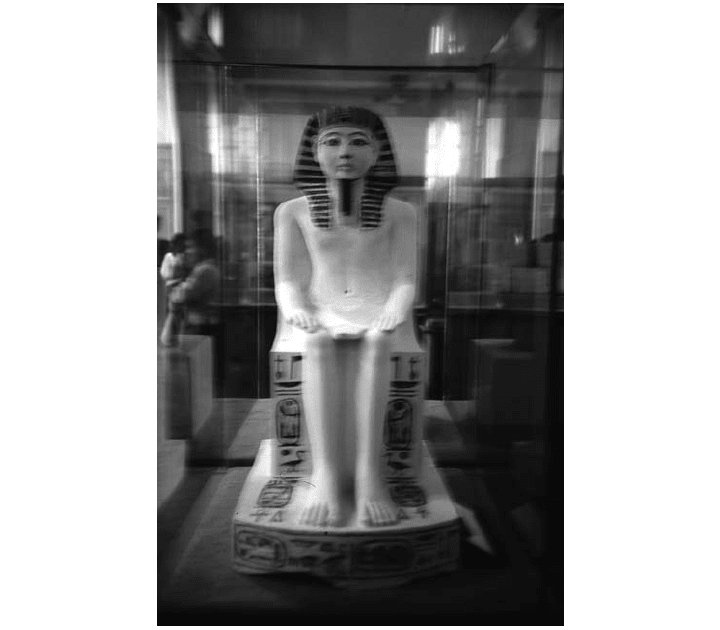
1985:322–5). Perhaps the statue now in the Turin museum represents this type of
performative cult statue (Plate 3.1). Processions depicting these images also appear
in other media such as limestone stela. Cultic images and objects were the focus of
dedication in the house and in the chapel areas, and were important foci within the
tombs, suggesting some form of collective memory was operative.
Amenhotep I had another history within the village, as an oracle in statue form,
a sort of afterlife for his divine image on earth. This statue of the dead king
performed its oracular functions. Archaeologically, the remains of such activity might
be located within Chapel D in the north of the site.This represents one of the major
buildings devoted to Amenhotep I and Ahmose Nefertari, since it yielded more
statuary than any other structure within the necropolis. Bruyère pointed out that tomb
1244 ran underneath this chapel and its roof formed a slab that could be opened to
reveal the tomb and the statue underneath (Bomann 1991:72–3). It has been sug-
gested that the cult statue would have been taken from its naos shrine, transported
across the necropolis and set outside the tomb of Kaha (360). The pronouncements
of the oracle were taken very seriously. In one recorded case the oracle ordered the
policeman Amenkha to pay for a donkey belonging to Hormin the draughtsman,
with serious repercussions if he failed to comply (McDowell 1999: 174):
The god ordered the policeman Amenkha [to pay] 9 deben.
First month of winter, day 10. He reported him again and he ordered him to pay yet
again, for the third time. He made him take an oath of the lord, saying, “If I renege and
dispute again, I will get 100 blows of a stick, and the donkey will be counted against me
double.”
Aside from the more performative oracular functions, there were more frequent,
mundane activities associated with the cult of Amenhotep I, specifically devotion to
38 Lynn Meskell
his image in statue form.Texts from the site reveal that there were at least three daily
rituals at dawn, midday and in the evening. Most significant were the morning rituals
which served to awaken the god’s image, and to wash, dress and feed it at the start
of a new day (McDowell 1999). In this way the statue literally became Amenhotep
I, and moved from being an object to being the deity himself (see below).There were
also festivals dedicated to the deified pharaoh, perhaps the most public displays of
commemoration involving whole communities such as Deir el Medina, which
involved preparation of food, drink, and floral bouquets (McDowell 1999:96):
Year 7, third month of winter, day 29. The Great Festival of King Amenophis, the Lord of the
Village was being held. The gang rejoiced before him for 4 solid days of drinking together with
their children and their wives.There were 60 of inside (the village) and 60 of outside.
This set of practices fits nicely with Connerton’s (1989:7) view of recollection as
operating in two distinct arenas of social activity: commemorative ceremonies and bodily
practices. Festivals certainly constitute commemorative ceremonies, while the ritual
Plate 3.1 Statue of Amenhotep I, Turin Museum
Ancestral Presence, Commemorative Practice 39
devotions directed toward the cult statue constitute a set of bodily practices, for both
the participants and the recipient.
Egyptian culture embodied a strong “sense” of the past; they were surrounded by
its materiality, but it did not always evoke feelings of reverence. At Deir el Medina,
the villagers incorporated older funerary monuments into new constructions and
regularly robbed tombs in the process of burial preparations. In the vital area of the
world of the dead, they inhabited and inspired to inhabit a doubly dead landscape in
which the funerary monuments around them provided a model of achievement, even
in their decayed form, as well as a physical environment into which they awkwardly
inserted their current passage to a deceased status through destruction, usurpation,
and reuse (Baines and Lacovara 2002). In Egyptian culture, death was not considered
as the end of one’s existence nor of one’s effectiveness on earth. The dead were
powerful beings who could intervene in the world of the living in both benevolent
and malevolent ways. Ancestor busts and stelae are testament to this interplay since
they provided a focus for these spheres of interaction and attest to the dead’s will-
ingness to intercede in the terrestrial. It is often said that the dead kept the living in
line. But it is important in this contextual setting not to conflate social memory, which
suggests the long-term, with commemoration, which refers to short-term practices
operating only over a few generations.
While prior studies and observations are salient to the present work, it is note-
worthy that Egyptologists have exerted most energy on mortuary analysis rather than
on examining the role of memory in a lived context.The aim of the first part of this
paper is thus to undertake an intimate study of dwelling and remembering. One of
the most compelling studies that fuses memory, phenomenology and domestic space
was conducted by Gaston Bachelard almost fifty years ago, although it has received
little attention from archaeologists. His biographical and experiential approach to
interior places, termed a topoanalysis, converges on the sites of our intimate lives
(1994:8). Since memories are motionless, their spatialization transforms them into
something more tangible, localizing a memory in time. The house embodies a com-
munity of memories in every room and corner, within its fixtures and features. As he
famously remarked, the house is lived and an entire past come to dwell there. Its
materiality constitutes a body of images that confer a sense of stability, specifically
when one considers the sorts of social and ritual practices that ensured ancestral
presence in the New Kingdom. This materialization of memory might form part of
the dynamic rivalry between house and universe to which Bachelard refers. It is not
simply a day to day existence with a narrative thread, but a co-penetrating series of
memories about dwelling, about episodes, people and things.
My current work focuses on the households at Deir el Medina, the workmen’s
community that was responsible for the construction of the royal tombs on the
Theban West Bank. The sixty-eight houses at Deir el Medina were divided and par-
titioned into a number of rooms ranging from three to ten, the most common number
being between four and six. These strip houses had total residential areas ranging
between 40 to 120sq.m, the average being 72sq.m (Valbelle 1985:117).The first room
of the house was between 8 and 24sq.m, whereas the second room was larger,
40 Lynn Meskell
somewhere between 14 and 26sq.m. That second room was usually at a higher ele-
vation, allowing light to filter through window grilles high in the upper walls.A series
of smaller rooms lay toward the back of the house, between 3 and 6sq.m in area.
These have been designated as cooking and processing areas because of their archae-
ological emplacements: ovens, grinders, basins, and querns. It was in this area of the
house that almost all of the staircases which allowed for roof access were located
(Meskell 1998:234–7). For the purposes of this paper, the first two rooms are the most
salient, specifically the second room where it is most likely that ancestor busts and
stelae were situated.
Housing Memories and Material Biographies
The Deir el Medina houses were recorded in some detail in the 1930s by Bernard
Bruyère (1939) and offer substantive evidence for ritual life. The majority of wall
paintings and fixtures were located in the first and second rooms. This first room was
notionally female-oriented space, with imagery and fixtures that centered around elite,
married, sexually potent, fertile females of the household. As a space, it was laden with
what we would describe as sexual and ritual images.Yet this room may also have been
used for sleeping, eating and general domestic duties for many hours of the day.This
space is usually designated the room of the enclosed bed, or lit clos. The majority of
the houses have conclusive evidence of this bed-like structure. Its dimensions were
roughly 1.7m long, 80cm wide, and 75cm above floor level (Friedman 1994:97).The
enclosed bed was associated with an amalgam of features: white walls, paintings,
moldings, niches, Bes decorations, cultic cupboards, shrines and so on. In house SE5,
for example, the lit clos was plastered, with molded and painted figures of Bes, a male
deity associated with women, sexuality, fertility, music and magic. House C5 has a lit
clos with an associated Bes painting, and in house SW6, where a woman named
Iyneferty lived, there are also Bes decorations.
However, it is unlikely in the extreme that the structure actually functioned as a
bed, or birthing bed, and such interpretations have been extensively critiqued. Yet
many of the associated representations do deal with the theme of birth, and one could
argue that these images and features housed and mnemonically activated memory: the
memories of successive births and generations of family. Recently, additional archae-
ological evidence from individual houses at Deir el Medina and Amarna has been
marshaled to suggest a more general link between cultic practices and the lit clos
(Robins 1996:29–30). At Deir el Medina, and presumably at other sites, these fixtures
had numerous social and religious associations (Meskell 1998). In house NE15 and
in Iyneferty’s house (SW6), the lit clos is built with an associated cultic cupboard.
These shrine-like constructions or niches were the repository of ritual stelae, statues
of deities such as Meretseger or Hathor, or ancestor busts. As Bachelard hints
(1994:79), every cupboard and niche has a history, and a mute tumult of memories
returns throughout temporal interactions with those fixtures. In many daily scenarios
the mundane element of household spaces and features would be prevalent, whereas
at moments of ritual or commemorative significance time and materiality would