
Velten K. Mathematical Modeling and Simulation: Introduction for Scientists and Engineers
Подождите немного. Документ загружается.


2.7 Other Phenomenological Modeling Approaches 115
moving averages, or the fft package that can be used to compute fast discrete
Fourier transformations. While these packages are a part of R’s base distribution,
there is also a number of contributed signal processing packages that can be ac-
cessed via R’s internet site at www.r-project.org, including several packages that can
be used to perform wavelet-based signal processing (examples are the
wavelets,
waveslim,andwavetresh packages).

117
3
Mechanistic Models I: ODEs
3.1
Distinguished Role of Differential Equations
As was explained, mechanistic models use information about the internal ‘‘mechan-
ics’’ of a system (Definition 1.6.1). Referring to Figure 1.2, the main difference
between phenomenological models (discussed in Chapter 2) and mechanistic mod-
els lies in the fact that phenomenological models treat the system as a black box,
while in the mechanistic modeling procedure one virtually takes a look inside
the system and uses this information in the model. This chapter and the follow-
ing Chapter 4 treat differential equations, which is probably the most widely used
mathematical structure of mechanistic models in science and engineering. Differ-
ential equations arise naturally, for example, as mathematical models of physical
systems. Roughly speaking, differential equations are simply ‘‘equations involving
derivatives of an unknown function’’. Their distinguished role among mechanistic
models used in science and engineering can be explained by the fact that both
scientists and engineers aim at the understanding or optimization of processes
within systems.
The word ‘‘process’’ itself already indicates that a process involves a situation
where ‘‘something happens’’, that is, where some quantities of interest change
their values. Absolutely static ‘‘processes’’ where virtually ‘‘nothing happens’’ would
be hardly of any interest to scientists or engineers. Now if it is true that some
quantities of interest relating to a process under consideration change their values,
then it is also true that such a process involves rates of changes of these quantities,
which means in mathematical terms that it involves derivatives – and this is
how ‘‘equations containing derivatives of an unknown function’’ or differential
equations come into play. In many of the examples treated below it will turn out
that it is natural to use rates of changes to formulate the mathematics behind the
process, and hence to write down differential equations, while it would not have
been possible to find appropriate equations without derivatives.

118 3 Mechanistic Models I: ODEs
Note 3.1.1 (Distinguished role of differential equations)
1. Mechanistic models consider the processes running inside a
system.
2. Typical processes investigated in science and engineering
involve rates of changes of quantities of interest.
3. Mathematically, this translates into equations involving
derivatives of unknown functions, i.e. differential equations.
Differential equations are classified into ordinary and partial differential equations.
It is common to use ODE and PDE as abbreviations for ordinary and partial
differential equations, respectively. This section is devoted to ODEs that involve
derivatives with respect to only one variable (time in many cases), while PDEs
(treated in Chapter 4) involve derivatives with respect to more than one variable
(typically, time and/or space variables). In Section 3.2, mechanistic modeling is
introduced as some kind of ‘‘systems archaeology’’, along with some first simple
ODE examples that are used throughout this chapter. The procedure to set up ODE
models is explained in Section 3.4, and Section 3.5 provides a theoretical framework
for ODEs. Then, Sections 3.6–3.8 explain how you can solve ODEs either in closed
form (i.e. in terms of explicit formulas) or using numerical procedures on the
computer. ODE models usually need to be fitted to experimental data, that is, their
parameters need to be determined such that the deviation of the solution of the
ODE from experimental data is minimized (similar to the regression problems
discussed in Chapter 2). Appropriate methods are introduced in Section 3.9, before
a number of additional example applications are discussed in Section 3.10.
3.2
Introductory Examples
3.2.1
Archaeology Analogy
If one wants to explain what it really is that makes mechanistic modeling a very
special and exciting thing to do, then this can hardly be done better than by
the ‘‘archaeology analogy’’ of the French twentieth century philosopher Jacques
Derrida [94]:
Note 3.2.1 (Derrida’s archaeology analogy) ‘‘Imagine an explorer arrives in
a little-known region where his interest is aroused by an expanse of ruins,
with remains of walls, fragments of columns, and tablets with half-effaced
and unreadable inscriptions. He may content himself with inspecting what lies

3.2 Introductory Examples 119
exposed to his view, with questioning the inhabitants (...)wholiveinthe
vicinity, about what tradition tells them of the history and meaning of these
archaeological remains, and with noting what they tell him – and he proceeds
upon his journey. But he may act differently. He may have brought picks,
shovels, and spades with him, and he may set the inhabitants to work with these
implements. Together with them he may start upon the ruins, clearing away
rubbish and, beginning from the visible remains, uncover what is buried. If his
work is crowned with success, the discoveries are self-explanatory: the ruined
walls are part of the ramparts of a palace or a treasure house; fragments of
columns can be filled out into a temple; the numerous inscriptions, which by
good luck, may be bilingual, reveal an alphabet and a language, and, when they
have been deciphered and translated, yield undreamed-of information about the
events of the remote past ...’’
Admittedly, one may not necessarily consider archaeology as an exciting thing to
do, particularly when it is about sitting for hours at inconvenient places, scratching
dirt from pot sherds, and so on. However, what Derrida describes is what might be
called the exciting part of archaeology: revealing secrets, uncovering the buried, and
exploring the unknown. And this is exactly what is done in mechanistic modeling.
A mechanistic modeler is what might be called a system archaeologist. Looking back
at Figure 1.2, he is someone who virtually tries to break up the solid system box
in the figure, thereby trying to uncover the hidden internal system mechanics. A
phenomenological modeler, in contrast, just walks around the system, collecting
and analyzing the data which it produces. As Derrida puts it, he contents himself
‘‘with inspecting what lies exposed to view’’.
The exploration of subsurface structures by archeologists based on ground-
penetrating radar provides a nice allegory for the procedure in mechanistic mod-
eling. In this method, the archaeologist walks along a virtual x axis, producing
scattered data along that x axis similar to a number of datasets that are inves-
tigated below. In the phenomenological approach, one would be content with
an explanation of these data in terms of the input signal sent into the soil, for
example, using appropriate methods from Chapter 2, and with no attempt toward
an understanding of the soil structures generating the data. What the archaeologist
does, however, is mechanistic modeling: based on appropriate models of the mea-
surement procedure, he gains information about subsurface structures. Magnetic
resonance imaging (MRI) and computed tomography (CT) are perhaps the most
fascinating technologies of this kind – everybody knows these fantastically detailed
pictures of the inside of the human body.
Note 3.2.2 (Objective of mechanistic modeling) Datasets contain information
about the internal mechanics of the data-generating system. Mechanistic mod-
eling means to uncover the hidden internal mechanics of a system similar to
an archaeologist, who explores subsurface structures using ground-penetrating
radar data.
120 3 Mechanistic Models I: ODEs
3.2.2
Body Temperature
Now let us try to become system archaeologists for ourselves, starting with simple
data sets and considerations. To begin with, suppose you do not feel so good
today and decide to measure your body temperature. Using a modern clinical
thermometer, you will have the result within a few seconds, usually indicated
by a beep signal of your thermometer. You know that your thermometer needs
these few seconds to bridge the gap between room and body temperature. Modern
clinical thermometers usually have a display where this process of adjustment
can be monitored, or better: could be monitored if you could see the display
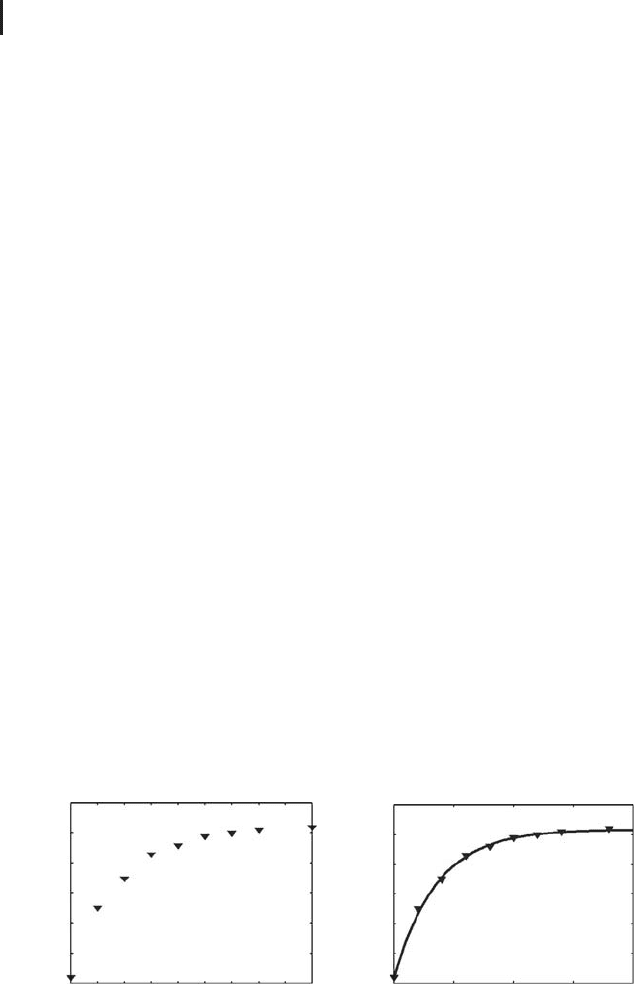
during measurement. Be that as it may, the dataset in Figure 3.1a shows data
produced by the author using a clinical thermometer. The figure was produced
using the dataset
fever.csv and the Maxima program FeverDat.mac from
the book software (see the description of the book software in Appendix A).
FeverDat.mac does two things: it reads the data from fever.csv using Maxima’s
read_nested_list command, and then it plots these data using the plot2d
command (see FeverDat.mac and Maxima’s help pages for the exact syntax of
these commands).
3.2.2.1 Phenomenological Model
Remembering what we have learned about phenomenological modeling in the
previous chapter, it is quite obvious what can be done here. The data points follow
a very simple and regular pattern, and hence it is natural to use an explicit function
T(t) describing that pattern, which can then be fitted to the data using nonlinear
regression as described in Section 2.4. Clearly, the data in Figure 3.1a describe an
essentially exponential pattern (imagine a 180
◦
counterclockwise rotation of the
data). Mathematically, this pattern can be described by the function
T(t) = T
b
− (T
b
− T
0
) ·e
−r · t
(3.1)
38
37
36
35
34
Temperature (°C)
33
32
38
37
36
35
34
Temperature (°C)
33
32
t (min)
0 2 4 6 8 10 12 14 16 18
05
t (min)
(a) (b)
10 15 20
Fig. 3.1 (a) Body temperature data. (b) Body temperature
data (triangles) and function T(t)fromEquation3.4.

3.2 Introductory Examples 121
The parameters of this function have natural interpretations: T
0
is the initial
temperature since T(0) = T
0
, T
b
is the body temperature since lim
t→∞
T(t) = T
b
,
and r controls the rate of temperature adjustment between T
0
and T
b
.AsFigure3.1a
shows, the values of T
0
and T
b
should be slightly above 32 and 37
◦
C, respectively.
Based on
fever.csv,letussetT
0
= 32.2andT
b
= 37.2. To estimate r,we
can, for example, substitute the datapoint (t = 10, T = 36.9) from
fever.csv in
Equation 3.1
36.9 = 37.2 −5 · e
−r · 10
(3.2)
which leads to
r =−
ln(0.06)
10
≈ 0.281 (3.3)
Note that Equation 3.3 can also be obtained using Maxima’s solve command, see
the code
FeverSolve.mac in the book software. Similar to the code (1.7) discussed
in Section 1.5.2, the
solve command produces several solutions here. Nine of
these solutions are complex numbers, while one of the solutions corresponds to
Equation 3.3. Using Equation 3.3, T(t) can now be written as
T(t) = 37.2 − 5 · e
ln(0.06)/10
· t (3.4)
Plotting this function together with the body temperature data from Figure 3.1a,
Figure 3.1b is obtained. Again, this plot was generated using Maxima:see
FeverExp.mac in the book software. As the figure shows, the function T(t) fits the
data very well. Remember our discussion of nonlinear regression in Section 2.4
where a quantity called pseudo-R
2
was introduced in formula (2.35) as a measure
of the quality of fit. Here, the Maxima program
FeverExp.mac computes an
pseudo-R
2
value of 99.8%, indicating an almost perfect fit of the model to the data.
Comparing Equation 2.35 with its implementation in
FeverExp.mac,youwillnote
that
n
i=1
(y
i
−
ˆ
y
i
)
2
is realized in the form (y-yprog).(y-yprog),wherethe‘‘.’’
denotes the scalar product of vectors, which multiplies vectors with components
y
i
−
ˆ
y
i
in this case (see the Maxima help pages for more details on Maxima’s vector
operation syntax). Note that the parameters of the model T(t) have been obtained
here using heuristic arguments. Alternatively, they could also be estimated using
the nonlinear regression procedure described in Section 2.4.
3.2.2.2 Application
The model in Equation 3.4 can now be used to answer all kinds of questions related
to the body temperature data. For example, it could be used to estimate the variation
ofthetotalmeasurementtime(i.e.thetimeuntilthefinalmeasurementvalueis
achieved) with varying starting temperatures of the thermometer. Or, it could be
used to accelerate the measurement procedure using estimates of T
b
based on the
available data, and so on. Remember our definition of mathematical models in
Section 1.4 above: a mathematical model is a set of mathematical statements that
122 3 Mechanistic Models I: ODEs
21
20.5
20
19.5
19
Temperature (°C)
18.5
18
010
t (min)
20 30 40 50 6
0
(
a
)(
b
)
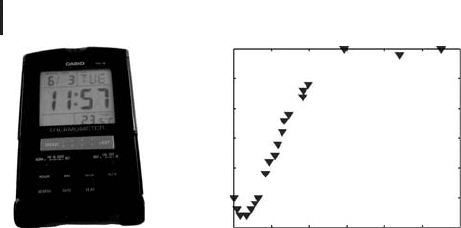
Fig. 3.2 (a) Alarm clock with temperature sensor. (b) Room
temperature data.
can be used to answer a question which we have related to a system. As was pointed
out there and in Note 1.2.2, the best mathematical model is the smallest and
simplest set of mathematical statements that can answer the given question. In this
sense, we can say that the phenomenological model (3.4) is the best mathematical
model of the body temperature data probably with respect to most questions that
we might have regarding the body temperature data. In Section 3.4.1, however,
we will see that Equation 3.4 can also be derived from a mechanistic modeling
approach.
3.2.3
Alarm Clock
Let us consider now a data set very similar to the body temperature data, but
with a little complication that will lead us beyond the realms of phenomenological
modeling. Suppose you enter a warm room with a temperature sensor in your hand,
and you write down the temperature output of that sensor beginning with time t = 0
corresponding to the moment when you enter the warm room. At a first glance,
this is a situation perfectly similar to the body temperature measurement, and you
would probably expect a qualitative pattern of your data similar to Figure 3.1a.
Now suppose that your data look as shown in Figure 3.2b; that is, your data are
qualitatively different from those in Figure 3.1a, showing an initial decrease in the
temperature even after you entered the warm room at time 0. Figure 3.2b has been
produced using the Maxima code
RoomDat.mac and the data room.csv in the
book software (similar to
FeverDat.mac discussed in Section 3.2.2).
3.2.3.1 Need for a Mechanistic Model
In principle, these data could be treated using a phenomenological model as
before. To achieve this, we would just have to find some suitable function T(t),
which exhibits the same qualitative behavior as the data shown in Figure 3.2b.
For example, a polynomial could be used for T(t) (see the polynomial regression
example in Section 2.2.6) or T(t) could be expressed as a combination of a function

3.2 Introductory Examples 123
similar to Equation 3.1 with a second-order polynom. Afterwards, the parameters
of T(t) would have to be adjusted such that T(t) really matches the data, similar
to our treatment of the body temperature data. As before, the function T(t)could
then be used, for example, to estimate the total measurement time depending
on the starting temperature, and so on. However, it is obvious that any estimate
obtained in this way would be relatively uncertain as long as we do not understand
the initial decrease in the temperature in Figure 3.2b. For example, if we would
use the phenomenological model T(t) to estimate the total measurement time for
a range of starting temperatures, then we would implicitly assume a similar initial
decrease in the temperature for the entire range of starting temperatures under
consideration – but can this be assumed? We do not know unless we understand
the initial decrease in the temperature.
The initial decrease in the temperature data shown in Figure 3.2b contains
informationaboutthesystemthatshouldbeusedifwewanttoanswerour
questions regarding the system with a maximum of precision. The data virtually
want to tell us something about the system, just as ground-penetrating radar
data tell the archaeologist something about subsurface structures. To construct
a phenomenological model of temperature data, only the data themselves are
required, that is, one virtually just looks at the display of the device generating
the temperature data. Now we have to change our point of view toward a look
at the data-generating device itself, and this means we shift toward mechanistic
modeling.
Note 3.2.3 (Information content of ‘‘strange effects’’) Mechanistic models
should be used particularly in situations where ‘‘strange effects’’ similar to the
alarm clock data can be observed. They provide a means to explain such effects
and to explore the information content of such data.
3.2.3.2 Applying the Modeling and Simulation Scheme
Figure 3.2a shows the device that produced the data in Figure 3.2b: an alarm
clock with temperature display. The data in Figure 3.2b were produced when
the author performed a test of the alarm clock’s temperature sensor, measuring
the temperature inside a lecture room. Initially, he was somewhat puzzled by the
decrease in the measurements after entering the warm lecture room, but of course
the explanation is simple. The alarm clock was cheap and its temperature sensor
an unhasty and lethargic one – an unbeatable time span of 30 min is required to
bridge the gap between 18 and 21
◦
C in Figure 3.2b. Before the author entered the
lecture room at time t = 0, he and the alarm clock were outdoors for some time
at an ambient temperature around 12
◦
C. The initial decrease in the temperature
measurements, thus, obviously meant that the author had disturbed the sensor
inside the alarm clock when it still tried to attain that 12
◦
C.
Now to set up a mechanistic mathematical model that can describe the pattern of
thedatainFigure3.2b,wecanfollowthestepsofthemodeling and simulation scheme
described in Note 1.2.3 (Section 1.2.2). This scheme begins with the definitions step,

124 3 Mechanistic Models I: ODEs
where a question to be answered or a problem to be solved is defined. Regarding
Figure 3.2b, a natural question would be
Q
1
: How can the initial decrease of the temperature data be explained?
Alternatively, we could start with the problem
Q
2
: Predict the final temperature value based on the first few data points.
In the systems analysis step oftheschemeinNote1.2.3,wehavetoidentitythose
parts of the system that are relevant for Q
1
and Q
2
. Remember the car example in
Section 1.1, where the systems analysis step led us from the system ‘‘car’’ in its
entire complexity to a very simplified car model comprising only tank and battery
(Figure 1.1). Here, our starting point is the system ‘‘alarm clock’’ in its entire
complexity, and we need to find a simplified model of the alarm clock now in the
systems analysis step, guided by our questions Q
1
and Q
2
.Obviously,anydetailsof
the alarm clock not related to the temperature measurement can be skipped in our
simplified model – just as any details of the car not related to the problem ‘‘The
car is not starting’’ were skipped in the simplified model of Figure 1.1.
Undoubtedly, the temperature sensor is an indispensable ingredient of any
simplified model that is expected to answer our questions Q
1
and Q
2
.Now
remember that we stated in Note 1.2.2 that the simplest model is the best model,
and that one, thus, should always start with the simplest imaginable model. We
have the simplest possible representation of the temperature sensor in our model
if we just consider the temperature T
s
displayed by the sensor, treating the sensor’s
internal construction as a black box. Another essential ingredient of the simplified
model is the ambient temperature T
a
that is to be measured by the sensor. With
these two ingredients, we arrive at the simplified alarm clock model in Figure 3.3,
which we call Model A. Note that Model A is not yet a mathematical model, but
rather what we have called a conceptual model in Section 1.2.5. Model A represents
an intermediate step that is frequently used in the development of mathematical
models. It identifies state variables T
s
and T
a
of the model to be developed and it
provides an approximate sketch of their relationship, with T
s
being drawn inside a
Ambient temperature T
a
(b)(a)
Sensor temperature T
s
Internal temperature T
l
Ambient temperature T
a
Sensor temperature T
s
Fig. 3.3 Simplified models of the alarm clock: (a) Model A and (b) Model B.