
Versteeg H., Malalasekra W. An Introduction to Computational Fluid Dynamics: The Finite Volume Method
Подождите немного. Документ загружается.

5.10 TVD SCHEMES 167
Inspection of the forms (5.69) and (5.70) shows that the ratio of upwind-side
gradient to downwind-side gradient (
φ
P
−
φ
W
)/(
φ
E
−
φ
P
) determines the
value of function
ψ
and the nature of the scheme. Therefore, we let
ψ
=
ψ
(r) (5.71)
with
r =
The general form of the east face value
φ
e
within a discretisation scheme for
convective flux may be written as
φ
e
=
φ
P
+
ψ
(r)(
φ
E
−
φ
P
) (5.72)
For the UD scheme
ψ
(r) = 0
For the CD scheme
ψ
(r) = 1
For the LUD scheme
ψ
(r) = r
For the QUICK scheme
ψ
(r) = (3 + r)/4
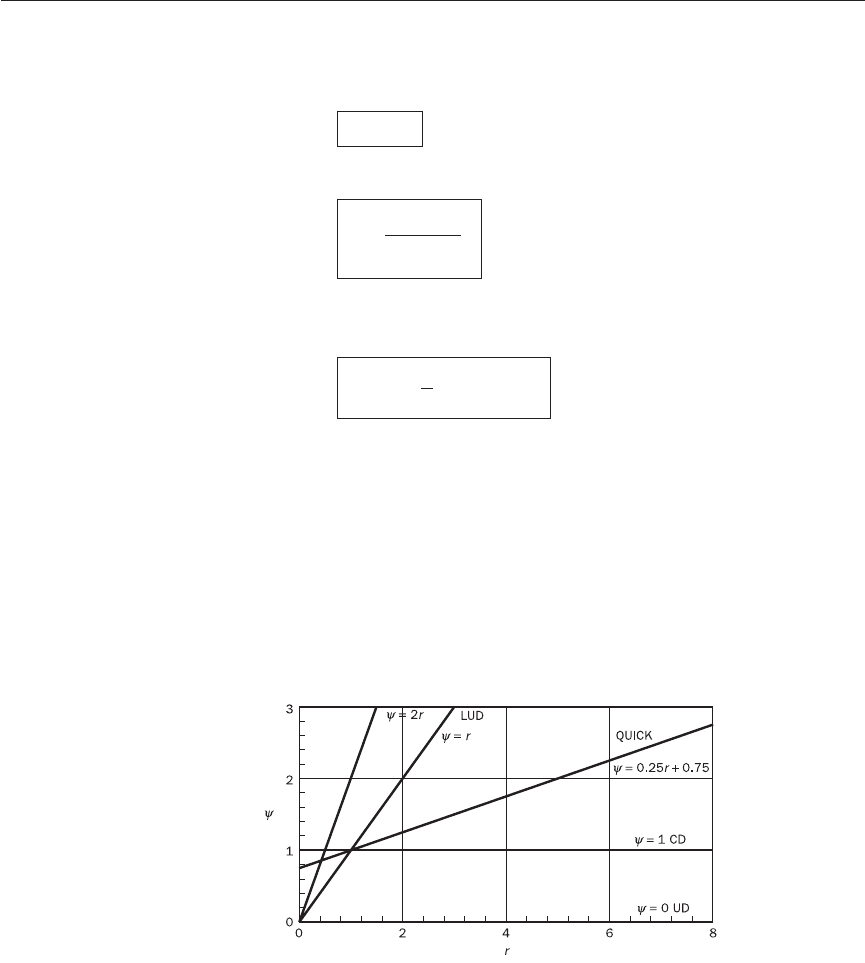
Figure 5.21 shows the
ψ
(r) vs. r relationships for these four schemes. This
diagram is known as the r–
ψ
diagram. All the above expressions assume that
the flow direction is positive (i.e. from west to east). It can be shown that
similar expressions exist for negative flow direction and r will still be the ratio
of upwind-side gradient to downwind-side gradient.
1
2
D
E
F
φ
P
−
φ
W
φ
E
−
φ
P
A
B
C
Figure 5.21 The function
ψ
for
various discretisation schemes
5.10.2 Total variation and TVD schemes
From our earlier discussion we know that the UD scheme is the most stable
scheme and does not give any wiggles, whereas the CD and QUICK schemes
have higher-order accuracy and give rise to wiggles under certain conditions.
Our goal is to find a scheme with a higher-order of accuracy without wiggles.
In our introduction to this topic it was noted that TVD schemes were
ANIN_C05.qxd 29/12/2006 04:36PM Page 167
initially developed for time-dependent gas dynamics. In this context it has
been established that the desirable property for a stable, non-oscillatory,
higher-order scheme is monotonicity preserving. For a scheme to preserve
monotonicity, (i) it must not create local extrema and (ii) the value of an
existing local minimum must be non-decreasing and that of a local maximum
must be non-increasing. In simple terms, monotonicity-preserving schemes
do not create new undershoots and overshoots in the solution or accentuate
existing extremes.
These properties of monotonicity-preserving schemes have implications
for the so-called total variation of discretised solutions. Consider the dis-
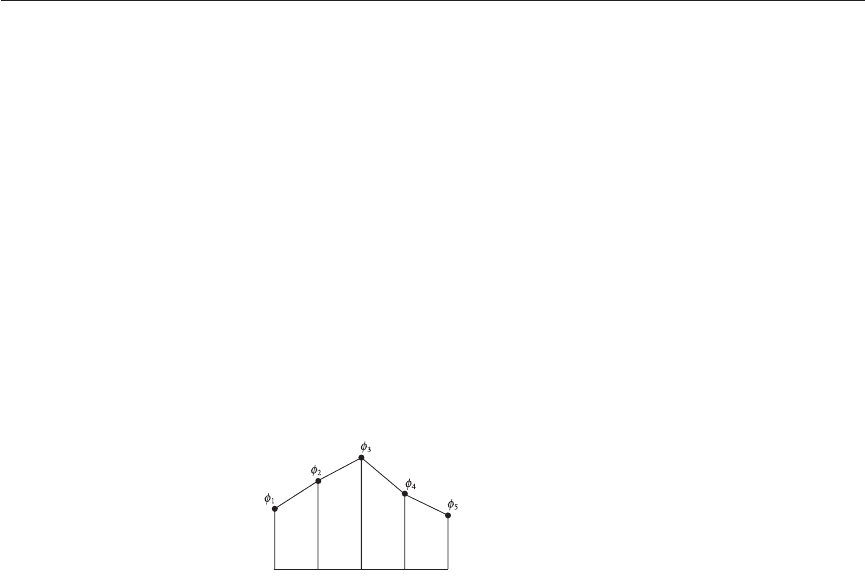
crete data set shown in Figure 5.22 (Lien and Leschziner, 1993). The total
variation for this set of data is defined as
TV(
φ
) =|
φ
2
−
φ
1
|+|
φ
3
−
φ
2
|+|
φ
4
−
φ
3
|+|
φ
5
−
φ
4
|
=|
φ
3
−
φ
1
|+|
φ
5
−
φ
3
| (5.73)
For monotonicity to be satisfied, this total variation must not increase (see
Lien and Leschziner, 1993).
168 CHAPTER 5 FINITE VOLUME METHOD FOR C---D PROBLEMS
Figure 5.22 An example of a
discrete data set for illustrating
total variation
Monotonicity-preserving schemes have the property that the total variation
of the discrete solution should diminish with time. Hence the term total
variation diminishing or TVD. In the literature (Harten, 1983, 1984; Sweby,
1984) the total variation has been considered for transient one-dimensional
transport equations. Total variation is therefore considered at every time
step and a solution is said to be total variation diminishing (or TVD) if
TV(
φ
n +1
) ≤ TV(
φ
n
) where n and n + 1 refer to consecutive time steps. In the
next sections we show how this property is also linked to desirable behaviour
of discretisation schemes for steady convection–diffusion problems.
5.10.3 Criteria for TVD schemes
Sweby (1984) has given necessary and sufficient conditions for a scheme
to be TVD in terms of the r −
ψ
relationship:
• If 0 < r < 1 the upper limit is
ψ
(r) = 2r, so for TVD schemes
ψ
(r) ≤ 2r
• If r ≥ 1 the upper limit is
ψ
(r) = 2, so for TVD schemes
ψ
(r) ≤ 2
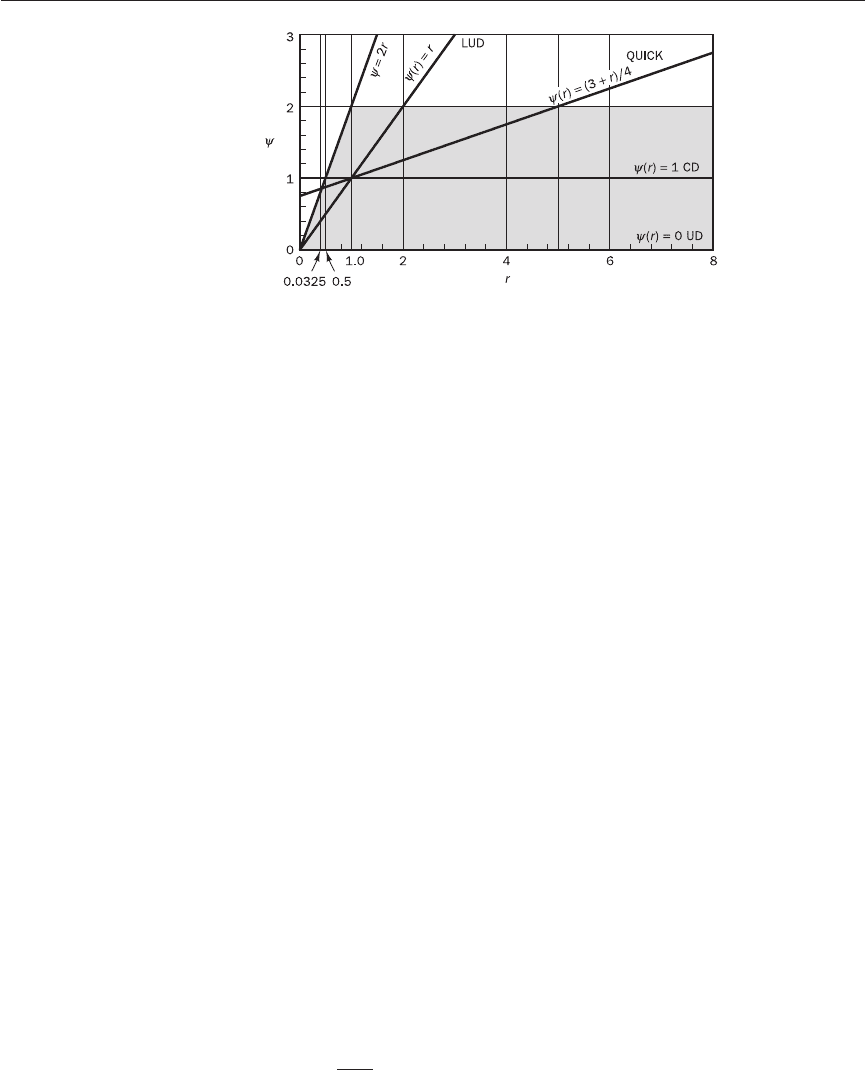
Figure 5.23 shows the shaded TVD region in a r–
ψ
diagram along with the
r–
ψ
relationships for all the finite difference schemes we have discussed so far.
It can be seen that according to Sweby’s criteria:
• the UD scheme is TVD
• the LUD scheme is not TVD for r > 2.0
• the CD scheme is not TVD for r < 0.5
• the QUICK scheme is not TVD for r < 3/7 and r > 5
ANIN_C05.qxd 29/12/2006 04:36PM Page 168
5.10 TVD SCHEMES 169
Figure 5.23
Except for UD, all the above schemes are outside the TVD region for
certain values of r. The idea of designing a TVD scheme is to introduce
a modification to the above schemes so as to force the r–
ψ
relationship
to remain within the shaded region for all possible values of r. This would
imply that, in order to make the scheme TVD, we must constrain or limit the
range of possible values of the additional convective flux F
e
ψ
(r)(
φ
E
−
φ
P
)/2,
which was originally introduced to make the scheme higher-order. Hence,
the function
ψ
(r) is called a flux limiter function.
Sweby (1984) also introduced the following requirement for second-
order accuracy in terms of the relationship
ψ
=
ψ
(r):
• The flux limiter function of a second-order accurate scheme should pass
through the point (1, 1) in the r–
ψ
diagram
Figure 5.23 confirms that the CD and QUICK schemes, which are both
second-order accurate, satisfy this criterion, but the (first-order) UD scheme
does not.
Sweby also showed that the range of possible second-order schemes
is bounded by the central difference and linear upwind schemes:
• If 0 < r < 1 the lower limit is
ψ
(r) = r, the upper limit is
ψ
(r) = 1, so for
TVD schemes r ≤
ψ
(r) ≤ 1
• If r ≥ 1 the lower limit is
ψ
(r) = 1, the upper limit is
ψ
(r) = r, so for
TVD schemes 1 ≤
ψ
(r) ≤ r
The choice of
ψ
(r) for a scheme dictates the order of the scheme and its
boundedness properties. Any second-order limited scheme could be based
on a limiter function which lies between
ψ
(r) = r and
ψ
(r) = 1, goes through
(1, 1) and stays below the upper limit. Any weighted average of the CD and
LUD schemes that stays within the bounded region would, therefore, result
in a second-order TVD scheme. Figure 5.24 shows the resulting shaded area
for second-order TVD schemes.
Sweby finally introduced the symmetry property for limiter functions:
=
ψ
(1/r) (5.74)
A limiter function that satisfies the symmetry property (5.74) ensures that
backward- and forward-facing gradients are treated in the same fashion with-
out the need for special coding.
ψ
(r)
r
ANIN_C05.qxd 29/12/2006 04:36PM Page 169
170 CHAPTER 5 FINITE VOLUME METHOD FOR C---D PROBLEMS
Figure 5.25 All limiter
functions in a r–
ψ
diagram
5.10.4 Flux limiter functions
Over the years a number of limiters that satisfy Sweby’s requirements have
been developed and successfully used. Below we give some of the most pop-
ular limiter functions found in the literature:
Name Limiter function
ψ
(r) Source
Van Leer Van Leer (1974)
Van Albada Van Albada et al. (1982)
Min-Mod
ψ
(r) =
!
min(r, 1) if r > 0 Roe (1985)
@
0 if r ≤ 0
SUPERBEE max[0, min(2r, 1), min(r, 2)] Roe (1985)
Sweby max[0, min(
β
r, 1), min(r,
β
)] Sweby (1984)
QUICK max[0, min(2r, (3 + r)/4, 2)] Leonard (1988)
UMIST max[0, min(2r, (1 + 3r)/4, Lien and Leschziner
(3 + r)/4, 2)] (1993)
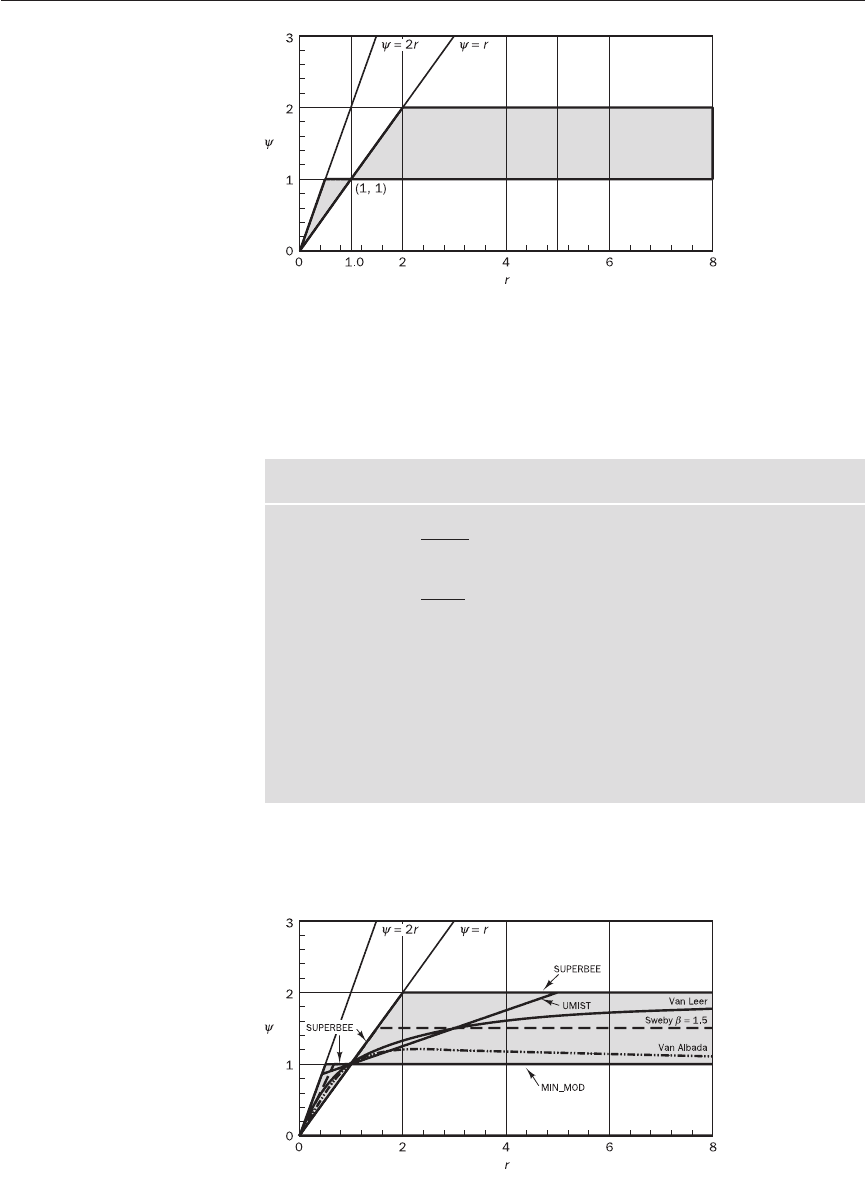
To compare the limiter functions we have plotted them all on the same r–
ψ
diagram in Figure 5.25. Separate figures for individual functions are shown
in Appendix D.
r + r
2
1 + r
2
r +|r|
1 + r
Figure 5.24 Region for a
second-order TVD scheme
ANIN_C05.qxd 29/12/2006 04:36PM Page 170

5.10 TVD SCHEMES 171
All the limiter functions stay inside the TVD region and pass through the
point (1, 1) on the r–
ψ
diagram, so they all represent second-order accurate
TVD discretisation schemes. Figure 5.25 shows that Van Leer and Van
Albada’s limiters are smooth functions, whereas all the others are piecewise
linear expressions. The Min-Mod limiter function exactly traces the lower
limit of the TVD region, whereas Roe’s SUPERBEE scheme follows the
upper limit. Sweby’s expression is a generalisation of the Min-Mod and
SUPERBEE limiters by means of a single parameter
β
. The limiter becomes
the Min-Mod limiter when
β
= 1 and the SUPERBEE limiter of Roe when
β
= 2. To stay within the TVD region we only consider the range of values
1 ≤
β
≤ 2. Figure 5.25 shows Sweby’s limiter when
β
= 1.5. It is relatively
easy to verify that Leonard’s QUICK limiter function is the only one that is
non-symmetric, whereas all the others are symmetric limiters. Lien and
Leschziner’s UMIST limiter function was designed as a symmetrical version
of the QUICK limiter.
5.10.5 Implementation of TVD schemes
To demonstrate the most important aspects of the implementation of a TVD
scheme we consider the now familiar one-dimensional convection–diffusion
equation
(
ρ
u
φ
) =Γ (5.3)
The diffusion term is discretised using central differencing as before, but the
convective flux is now evaluated using a TVD scheme. In our usual notation
the discretised form of the equation is as follows:
F
e
φ
e
− F
w
φ
w
= D
e
(
φ
E
−
φ
P
) − D
w
(
φ
P
−
φ
W
) (5.75)
For flow in the positive x-direction u > 0 and the values of
φ
e
and
φ
w
using a
TVD scheme may be written as
φ
e
=
φ
P
+
ψ
(r
e
)(
φ
E
−
φ
P
) (5.76a)
φ
w
=
φ
W
+
ψ
(r
w
)(
φ
P
−
φ
W
) (5.76b)
where r
e
= and r
w
=
Note that r for each face flux term is the local ratio of upstream gradient to
downstream gradient. The limiter functions
ψ
(r
e
) and
ψ
(r
w
) can be any of
the functions described above. Substitution of (5.76a) and (5.76b) into equa-
tion (5.75) gives
F
e
φ
P
+
ψ
(r
e
)(
φ
E
−
φ
P
) − F
w
φ
W
+
ψ
(r
w
)(
φ
P
−
φ
W
)
= D
e
(
φ
E
−
φ
P
) − D
w
(
φ
P
−
φ
W
)
J
K
L
1
2
G
H
I
J
K
L
1
2
G
H
I
D
E
F
φ
W
−
φ
WW
φ
P
−
φ
W
A
B
C
D
E
F
φ
P
−
φ
W
φ
E
−
φ
P
A
B
C
1
2
1
2
J
K
L
d
φ
dx
G
H
I
d
dx
d
dx
ANIN_C05.qxd 29/12/2006 04:36PM Page 171

This can be rearranged to yield
[D
e
+ F
e
+ D
w
]
φ
P
= [D
w
+ F
w
]
φ
W
+ D
e
φ
E
− F
e
ψ
(r
e
)(
φ
E
−
φ
P
) + F
w
ψ
(r
w
)(
φ
P
−
φ
W
) (5.77)
This can be written as
a
P
φ
P
= a
W
φ
W
+ a
E
φ
E
+ S
u
DC
(5.78a)
where a
W
= D
w
+ F
w
(5.78b)
a
E
= D
e
(5.78c)
a
P
= a
W
+ a
E
+ (F
e
− F
w
) (5.78d)
S
u
DC
=−F
e
ψ
(r
e
)(
φ
E
−
φ
P
) + F
w
ψ
(r
w
)(
φ
P
−
φ
W
) (5.78e)
It should be noted that the coefficients a
W
, a
E
and a
P
are those of the UD
scheme, which provides numerical stability to the TVD schemes. The
contribution arising from the additional flux with the limiter function is
introduced through the source term as a deferred correction S
u
DC
. We have
come across this practice before in section 5.9.3 when we discussed Hayase’s
implementation of the QUICK scheme. Deferred correction avoids the
occurrence of stability problems due to negative coefficients in the discretised
equation, whilst ensuring that the final converged solution has the desired
TVD behaviour. As mentioned earlier, the above derivation is for the positive
flow direction. To note the flow direction we use a superscript ‘+’. Therefore
both r
e
and r
w
are replaced with r
w
+
and r
e
+
. We rewrite the source term as
S
u
DC
=−F
e
ψ
(r
e
+
)(
φ
E
−
φ
P
) + F
w
ψ
(r
w
+
)(
φ
P
−
φ
W
) (5.79)
For u < 0, i.e. flow in the negative x-direction, the discretised form of the
equation is as before:
F
e
φ
e
− F
w
φ
w
= D
e
(
φ
E
−
φ
P
) − D
w
(
φ
P
−
φ
W
) (5.80)
Values of
φ
e
and
φ
w
using a TVD scheme are now
φ
e
=
φ
E
+
ψ
(r
e
−
)(
φ
P
−
φ
E
) (5.81a)
φ
w
=
φ
P
+
ψ
(r
w
−
)(
φ
W
−
φ
P
) (5.81b)
where r
e
−
= and r
w
−
=
Here we use the superscript ‘−’ to indicate that the flow direction is in the
negative x-direction. Note that r is still the local ratio of upstream gradient
to downstream gradient. Substitution of (5.81a) and (5.81b) into equation
(5.80) gives
D
E
F
φ
E
−
φ
P
φ
P
−
φ
W
A
B
C
D
E
F
φ
EE
−
φ
E
φ
E
−
φ
P
A
B
C
1
2
1
2
J
K
L
1
2
G
H
I
J
K
L
1
2
G
H
I
J
K
L
1
2
G
H
I
J
K
L
1
2
G
H
I
J
K
L
1
2
G
H
I
J
K
L
1
2
G
H
I
172 CHAPTER 5 FINITE VOLUME METHOD FOR C---D PROBLEMS
ANIN_C05.qxd 29/12/2006 04:36PM Page 172

5.10 TVD SCHEMES 173
F
e
φ
E
+
ψ
(r
e
−
)(
φ
P
−
φ
E
) − F
w
φ
P
+
ψ
(r
w
−
)(
φ
W
−
φ
P
)
= D
e
(
φ
E
−
φ
P
) − D
w
(
φ
P
−
φ
W
)
The usual rearrangement yields
[D
e
− F
w
+ D
w
]
φ
P
= D
w
φ
W
+ [D
e
− F
e
]
φ
E
+ F
e
ψ
(r
e
−
)(
φ
E
−
φ
P
) − F
w
ψ
(r
w
−
)(
φ
P
−
φ
W
) (5.82)
This can be written as
a
P
φ
P
= a
W
φ
W
+ a
E
φ
E
+ S
u
DC
(5.83a)
where a
W
= D
w
(5.83b)
a
E
= D
e
− F
e
(5.83c)
a
P
= a
W
+ a
E
+ (F
e
− F
w
) (5.83d)
S
u
DC
= F
e
ψ
(r
e
−
)(
φ
E
−
φ
P
) − F
w
ψ
(r
w
−
)(
φ
P
−
φ
W
) (5.83e)
Again the expressions for the main coefficients are the same as for the UD
scheme. We note that F
w
and F
e
are negative when the flow is in the negative
x-direction, so coefficients a
W
, a
E
and a
P
will always be positive. Combining
expressions (5.78a–e) and (5.83a–e) we obtain a set of expressions valid for
both positive and negative flow directions. Thus the TVD scheme for one-
dimensional convection–diffusion problems may be written as
a
P
φ
P
= a
W
φ
W
+ a
E
φ
E
+ S
u
DC
(5.84)
with central coefficient
a
P
= a
W
+ a
E
+ (F
e
− F
w
)
The neighbour coefficients and deferred correction source term of TVD
schemes are as follows:
TVD neighbour coefficients
a
W
D
w
+ max(F
w
, 0)
a
E
D
e
+ max(−F
e
, 0)
TVD deferred correction source term
S
u
DC
F
e
[(1 −
α
e
)
ψ
(r
e
−
) −
α
e
.
ψ
(r
e
+
)](
φ
E
−
φ
P
)
+ F
w
[
α
w
.
ψ
(r
w
+
) − (1 −
α
w
)
ψ
(r
w
−
)](
φ
P
−
φ
W
)
1
2
1
2
J
K
L
1
2
G
H
I
J
K
L
1
2
G
H
I
J
K
L
1
2
G
H
I
J
K
L
1
2
G
H
I
J
K
L
1
2
G
H
I
J
K
L
1
2
G
H
I
ANIN_C05.qxd 29/12/2006 04:36PM Page 173

174 CHAPTER 5 FINITE VOLUME METHOD FOR C---D PROBLEMS
where
α
w
= 1 for F
w
> 0 and
α
e
= 1 for F
e
> 0
α
w
= 0 for F
w
< 0 and
α
e
= 0 for F
e
< 0
Treatment at the boundaries
At inlet/outlet boundaries it is necessary to generate upstream/downstream
values to evaluate the values of r. These can be obtained using the extra-
polated mirror node practice that was demonstrated for the QUICK scheme
in Example 5.4 (see section 5.9.1).
Consider an inlet with given boundary value
φ
=
φ
A
and convective mass
flux per unit area: F = F
A
. The TVD discretised equation is
F
e
φ
P
+
ψ
(r
e
)(
φ
E
−
φ
P
) − F
A
φ
A
= D
e
(
φ
E
−
φ
P
) − D
A
*(
φ
P
−
φ
A
)
(D
e
+ F
e
+ D
A
*)
φ
P
= D
e
φ
E
+ (D
A
* + F
A
)
φ
A
− F
e
ψ
(r
e
)(
φ
E
−
φ
P
)
with D
A
* =Γ/
δ
x
The problem is to find
r
e
=
for the deferred correction term. The gradient ratio contains a missing nodal
value
φ
=
φ
W
.
Leonard mirror node extrapolation gives
φ
o
= 2
φ
A
−
φ
P
so r
e
==
A further discussion on boundary conditions for higher-order schemes is
available in Leonard (1988).
Extension to two and three dimensions
Extension of the TVD expressions to two dimensions is straightforward.
The discretised equation using a TVD scheme in a two-dimensional
Cartesian grid arrangement is given by
a
P
φ
P
= a
W
φ
W
+ a
E
φ
E
+ a
S
φ
S
+ a
N
φ
N
+ S
u
DC
(5.85)
with central coefficient
a
P
= a
W
+ a
E
+ a
S
+ a
N
+ (F
e
− F
w
) + (F
n
− F
s
)
The neighbour coefficients and deferred correction source term of TVD
schemes are as follows:
2(
φ
P
−
φ
A
)
φ
E
−
φ
P
D
E
F
φ
P
−
φ
o
φ
E
−
φ
P
A
B
C
D
E
F
φ
P
−
φ
W
φ
E
−
φ
P
A
B
C
1
2
J
K
L
1
2
G
H
I
ANIN_C05.qxd 29/12/2006 04:36PM Page 174

5.10 TVD SCHEMES 175
TVD neighbour coefficients
a
W
D
w
+ max(F
w
, 0)
a
E
D
e
+ max(−F
e
, 0)
a
S
D
s
+ max(F
s
, 0)
a
N
D
n
+ max(−F
n
, 0)
TVD deferred correction source term
S
u
DC
1
–
2
F
e
[(1 −
α
e
)
ψ
(r
e
−
) −
α
e
.
ψ
(r
e
+
)](
φ
E
−
φ
P
)
+
1
–
2
F
w
[
α
w
.
ψ
(r
w
+
) − (1 −
α
w
)
ψ
(r
w
−
)](
φ
P
−
φ
W
)
+
1
–
2
F
n
[(1 −
α
n
)
ψ
(r
n
−
) −
α
n
.
ψ
(r
n
+
)](
φ
N
−
φ
P
)
+
1
–
2
F
s
[
α
s
.
ψ
(r
s
+
) − (1 −
α
s
)
ψ
(r
s
−
)](
φ
P
−
φ
S
)
where
α
w
= 1 for F
w
> 0 and
α
e
= 1 for F
e
> 0
α
w
= 0 for F
w
< 0 and
α
e
= 0 for F
e
< 0
α
s
= 1 for F
s
> 0 and
α
n
= 1 for F
n
> 0
α
s
= 0 for F
s
< 0 and
α
n
= 0 for F
n
< 0
We note that the deferred correction source term now also includes terms re-
lated to south and north. The extension to three dimensions is straightforward.
5.10.6 Evaluation of TVD schemes
TVD schemes are generalisations of existing discretisation schemes, so they
inherently satisfy all the necessary requirements of transportiveness, conser-
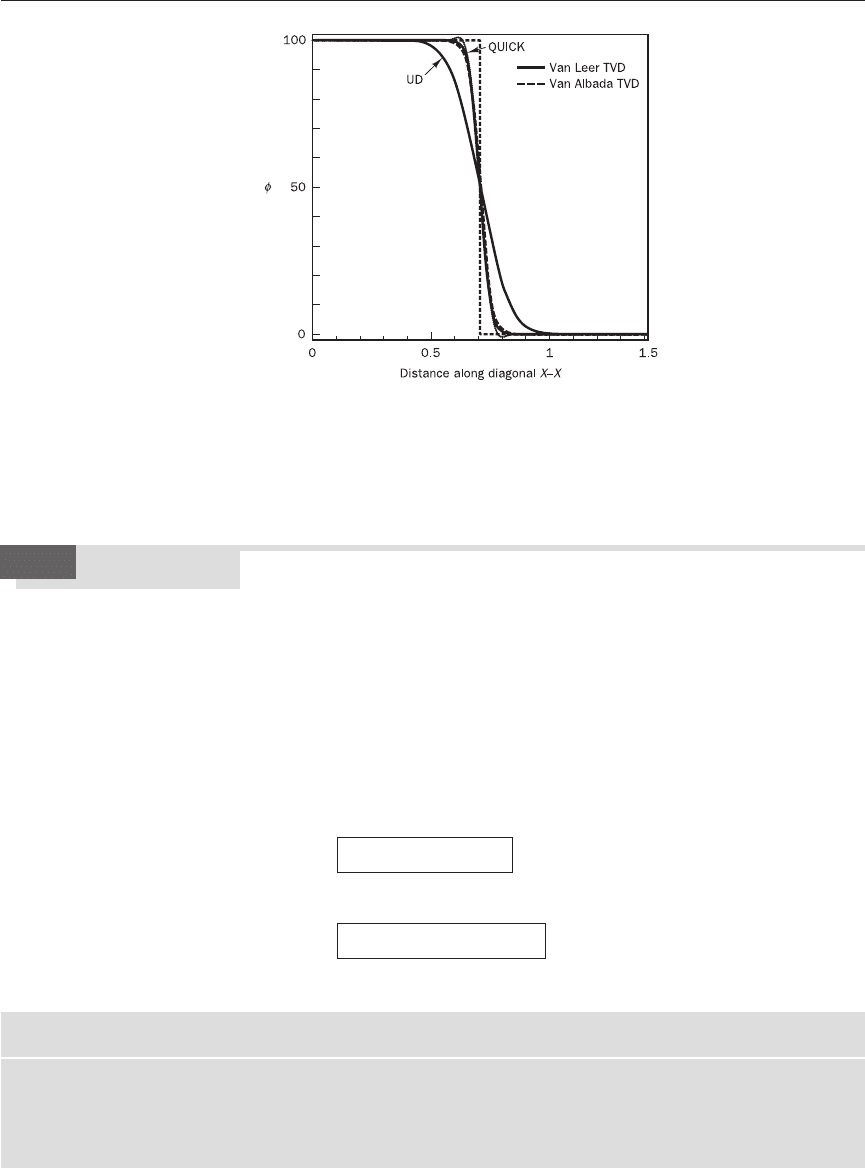
vativeness and boundedness. In Figure 5.26 we compare the performance
of two TVD schemes – Van Leer and Van Albada – with the UD and
Leonard’s QUICK schemes. The problem is the 2D source-free pure con-
vection of a transported quantity
φ
with the flow at 45° to the lines of a 50 ×
50 grid, which we considered previously in section 5.6.1. The exact solution
to this problem is a step function at x ≈ 0.7. It can be seen that TVD solu-
tions show far less false diffusion than the UD scheme and are almost as close
to the exact solution as the QUICK scheme. Moreover, they do not show any
non-physical overshoots and undershoots. The two TVD solutions are quite
close to each other, which is also a recurring feature in more broadly based
performance comparisons in the literature.
Lien and Leschziner (1993) note that the more complex limiter functions
take up more computer CPU time. Compared with an ordinary scheme, a
calculation employing any TVD scheme would require more CPU time due
to additional calculation overhead associated with evaluating the extra source
terms (see section 5.10.5). The UMIST scheme, for example, was found to
require 15% more CPU than the standard QUICK scheme (Lien and
Leschziner, 1993). However, the advantage is that a TVD scheme guarantees
wiggle-free solutions. There is no convincing argument in favour of any par-
ticular TVD scheme and the choice appears to be a matter of individual pref-
erence. The reader is also referred to the work of Darwish and Moukalled
ANIN_C05.qxd 29/12/2006 04:36PM Page 175
176 CHAPTER 5 FINITE VOLUME METHOD FOR C---D PROBLEMS
Summary
Figure 5.26 Comparison of two
TVD schemes: Van Leer and
Van Albada with UD and
QUICK
(2003), who describe the application of TVD schemes to unstructured mesh
systems (see also Chapter 11).
We have discussed the problems of discretising the convection–diffusion equa-
tion under the assumption that the flow field is known. The crucial issue is the
formulation of suitable expressions for the values of the transported property
φ
at cell faces when accounting for the convective contribution in the equation:
• All the finite volume schemes presented in this chapter describe the
effects of simultaneous convection and diffusion by means of discretised
equations whose coefficients are weighted combinations of the
convective mass flux per unit area F and the diffusion conductance D.
• The discretised equations for a general internal node for the central,
upwind and hybrid differencing and the power-law schemes of a one-
dimensional convection–diffusion problem take the following form:
a
P
φ
P
= a
W
φ
W
+ a
E
φ
E
(5.86)
with
a
P
= a
W
+ a
E
+ (F
e
− F
w
)
• The neighbour coefficients for these schemes are
Scheme a
W
a
E
Central differencing D
w
+ F
w
/2 D
e
− F
e
/2
Upwind differencing D
w
+ max(F
w
, 0) D
e
+ max(0, −F
e
)
Hybrid differencing max[F
w
, (D
w
+ F
w
/2), 0] max[−F
e
, (D
e
− F
e
/2), 0]
Power law D
w
max[0, (1 − 0.1|Pe
w
|)
5
] + max(F
w
, 0) D
e
max[0, (1 − 0.1|Pe
e
|)
5
] + max(−F
e
, 0)
5.11
ANIN_C05.qxd 29/12/2006 04:36PM Page 176