
Versteeg H., Malalasekra W. An Introduction to Computational Fluid Dynamics: The Finite Volume Method
Подождите немного. Документ загружается.


5.11 SUMMARY 177
• The boundary conditions enter the discretised equations via source
terms. Their treatment is specific to each discretisation scheme.
• Discretisation schemes that possess conservativeness, boundedness and
transportiveness give physically realistic results and stable iterative
solutions:
– The central differencing method is not suitable for general-purpose
convection–diffusion problems because it lacks transportiveness and
gives unrealistic solutions at large values of the cell Peclet number.
– Upwind, hybrid and power-law differencing all possess
conservativeness, boundedness and transportiveness and are highly
stable, but suffer from false diffusion in multi-dimensional flows if
the velocity vector is not parallel to one of the co-ordinate
directions.
• The discretised equations of the standard QUICK method of Leonard
(1979) have the following form for a general internal node point:
a
P
φ
P
= a
W
φ
W
+ a
E
φ
E
+ a
WW
φ
WW
+ a
EE
φ
EE
(5.87)
where
a
P
= a
W
+ a
E
+ a
WW
+ a
EE
+ (F
e
− F
w
)
The neighbour coefficients of the standard QUICK scheme are
Standard QUICK
a
W
D
w
+
α
w
F
w
+
α
e
F
e
+ (1 −
α
w
)F
w
a
WW
−
α
w
F
w
a
E
D
e
−
α
e
F
e
− (1 −
α
e
)F
e
− (1 −
α
w
)F
w
a
EE
(1 −
α
e
)F
e
with
α
w
= 1 for F
w
> 0 and
α
e
= 1 for F
e
> 0
α
w
= 0 for F
w
< 0 and
α
e
= 0 for F
e
< 0
• Higher-order schemes, such as QUICK, can minimise false diffusion
errors but are less computationally stable. This manifests itself as
small over- and undershoots in the solution of some problems
including those with large gradients of
φ
, which can potentially lead to
non-physical behaviour, e.g. negative turbulence properties k and
ε
,
in extreme cases. Nevertheless, if used with care and judgement the
QUICK scheme can give very accurate solutions of
convection–diffusion problems.
1
8
1
8
6
8
3
8
1
8
3
8
1
8
6
8
ANIN_C05.qxd 29/12/2006 04:36PM Page 177

178 CHAPTER 5 FINITE VOLUME METHOD FOR C---D PROBLEMS
• The discretised equations of the TVD schemes have the following form
for a general internal node point:
a
P
φ
P
= a
W
φ
W
+ a
E
φ
E
+ S
u
DC
(5.88)
where
a
P
= a
W
+ a
E
+ (F
e
− F
w
)
The neighbour coefficients and deferred correction source term of TVD
schemes are as follows:
TVD neighbour coefficients
a
W
a
W
= D
w
+ max(F
w
, 0)
a
E
a
E
= D
e
+ max(−F
e
, 0)
TVD deferred correction source term
S
u
DC
1
–
2
F
e
[(1 −
α
e
)
ψ
(r
e
−
) −
α
e
.
ψ
(r
e
+
)](
φ
E
−
φ
P
)
+
1
–
2
F
w
[
α
w
.
ψ
(r
w
+
) − (1 −
α
w
)
ψ
(r
w
−
)](
φ
P
−
φ
W
)
with
α
w
= 1 for F
w
> 0 and
α
e
= 1 for F
e
> 0
α
w
= 0 for F
w
< 0 and
α
e
= 0 for F
e
< 0
• The most frequently used limiter functions are
Name Limiter function
ψψ
(r)
Van Leer
Van Albada
Min-Mod
ψ
(r) =
!
min(r, 1) if r > 0
@
0 if r ≤ 0
Roe’s SUPERBEE max[0, min(2r, 1), min(r, 2)]
Sweby max[0, min(
β
r, 1), min(r,
β
)]
QUICK max[0, min(2r, (3 + r)/4, 2)]
UMIST max[0, min(2r, (1+ 3r)/4, (3 + r)/4, 2)]
• The performance of the limiter functions has been found to be fairly
similar: all TVD discretisations based on the above limiter functions
give second-order accurate solutions that are free from non-physical
wiggles, so all are suitable for general-purpose CFD computations.
r + r
2
1 + r
2
r +|r|
1 + r
ANIN_C05.qxd 29/12/2006 04:36PM Page 178

The convection of a scalar variable
φ
depends on the magnitude and direc-
tion of the local velocity field. To develop our methods in the previous chap-
ter we assumed that the velocity field was somehow known. In general the
velocity field is, however, not known and emerges as part of the overall solu-
tion process along with all other flow variables. In this chapter we look at the
most popular strategies for computing the entire flow field.
Transport equations for each velocity component – momentum equations
– can be derived from the general transport equation (2.39) by replacing the
variable
φ
by u, v and w respectively. Every velocity component appears in
each momentum equation, and the velocity field must also satisfy the con-
tinuity equation. This can be clearly shown by considering the equations
governing a two-dimensional laminar steady flow:
x-momentum equation
(
ρ
uu) + (
ρ
vu) =
µ
+
µ
−+S
u
(6.1)
y-momentum equation
(
ρ
uv) + (
ρ
vv) =
µ
+
µ
−+S
v
(6.2)
continuity equation
(
ρ
u) + (
ρ
v) = 0 (6.3)
The pressure gradient term, which forms the main momentum source term
in most flows of engineering importance, has been written separately to
facilitate the discussion that follows.
The solution of equation set (6.1)–(6.3) presents us with two new problems:
• The convective terms of the momentum equations contain non-linear
quantities: for example, the first term of equation (6.1) is the x-
derivative of
ρ
u
2
.
• All three equations are intricately coupled because every velocity
component appears in each momentum equation and in the continuity
equation. The most complex issue to resolve is the role played by the
∂
∂
y
∂
∂
x
∂
p
∂
y
D
E
F
∂
v
∂
y
A
B
C
∂
∂
y
D
E
F
∂
v
∂
x
A
B
C
∂
∂
x
∂
∂
y
∂
∂
x
∂
p
∂
x
D
E
F
∂
u
∂
y
A
B
C
∂
∂
y
D
E
F
∂
u
∂
x
A
B
C
∂
∂
x
∂
∂
y
∂
∂
x
Chapter six Solution algorithms for pressure---
velocity coupling in steady flows
Introduction6.1
ANIN_C06.qxd 29/12/2006 09:59 AM Page 179

pressure. It appears in both momentum equations, but there is evidently
no (transport or other) equation for the pressure.
If the pressure gradient is known, the process of obtaining discretised equa-
tions for velocities from the momentum equations is exactly the same as that
for any other scalar, and the schemes explained in Chapter 5 are applicable.
In general-purpose flow computations we also wish to calculate the pressure
field as part of the solution, so its gradient is not normally known beforehand.
If the flow is compressible the continuity equation may be used as the trans-
port equation for density and, in addition to (6.1)–(6.3), the energy equation
is the transport equation for temperature. The pressure may then be obtained
from density and temperature by using the equation of state p = p(
ρ
, T ).
However, if the flow is incompressible the density is constant and hence by
definition not linked to the pressure. In this case coupling between pressure
and velocity introduces a constraint in the solution of the flow field: if the
correct pressure field is applied in the momentum equations the resulting
velocity field should satisfy continuity.
Both the problems associated with the non-linearities in the equation set
and the pressure–velocity linkage can be resolved by adopting an iterative
solution strategy such as the SIMPLE algorithm of Patankar and Spalding
(1972). In this algorithm the convective fluxes per unit mass F through cell
faces are evaluated from so-called guessed velocity components. Further-
more, a guessed pressure field is used to solve the momentum equations, and
a pressure correction equation, deduced from the continuity equation, is
solved to obtain a pressure correction field, which is in turn used to update
the velocity and pressure fields. To start the iteration process we use initial
guesses for the velocity and pressure fields. As the algorithm proceeds our
aim must be progressively to improve these guessed fields. The process
is iterated until convergence of the velocity and pressure fields. The main
features of the SIMPLE algorithm and its more recent enhancements will be
discussed in this chapter.
The solution procedure for the transport of a general property
φ
developed
in Chapter 5 will, of course, be enlisted to solve the momentum equations.
Matters are, however, not completely straightforward since there are prob-
lems associated with the pressure source terms of the momentum equations
that need special treatment.
The finite volume method starts, as always, with the discretisation of the
flow domain and of the relevant transport equations (6.1)–(6.3). First we
need to decide where to store the velocities. It seems logical to define these
at the same locations as the scalar variables such as pressure, temperature
etc. However, if velocities and pressures are both defined at the nodes of an
ordinary control volume a highly non-uniform pressure field can act like a
uniform field in the discretised momentum equations. This can be demon-
strated with the simple two-dimensional situation shown in Figure 6.1,
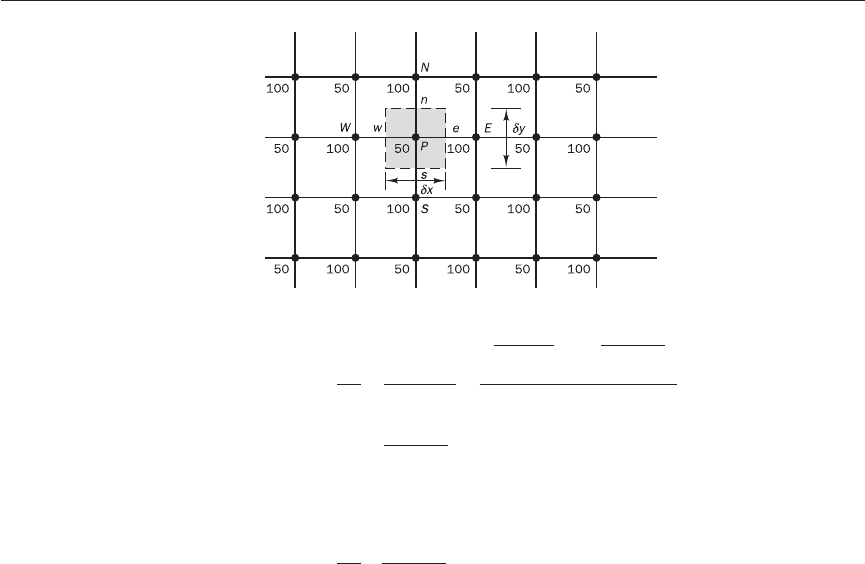
where a uniform grid is used for simplicity. Let us assume that we have
somehow obtained a highly irregular ‘checker-board’ pressure field with
values as shown in Figure 6.1.
If pressures at e and w are obtained by linear interpolation the pressure
gradient term
∂
p/
∂
x in the u-momentum equation is given by
180 CHAPTER 6 ALGORITHMS FOR PRESSURE---VELOCITY COUPLING
The staggered
grid
6.2
ANIN_C06.qxd 29/12/2006 09:59 AM Page 180
6.2 THE STAGGERED GRID 181
−
==
= (6.4)
Similarly, the pressure gradient
∂
p/
∂
y for the v-momentum equation is
evaluated as
= (6.5)
The pressure at the central node (P) does not appear in (6.4) and (6.5).
Substituting the appropriate values from the ‘checker-board’ pressure field
in Figure 6.1 into (6.4)–(6.5) we find that all the discretised gradients are
zero at all the nodal points even though the pressure field exhibits spatial
oscillations in both directions. As a result, this pressure field would give the
same (zero) momentum source in the discretised equations as a uniform
pressure field. This behaviour is obviously non-physical.
It is clear that, if the velocities are defined at the scalar grid nodes, the
influence of pressure is not properly represented in the discretised momentum
equations. A remedy for this problem is to use a staggered grid for velocity
components (Harlow and Welch, 1965). The idea is to evaluate scalar vari-
ables, such as pressure, density, temperature etc., at ordinary nodal points
but to calculate velocity components on staggered grids centred around the
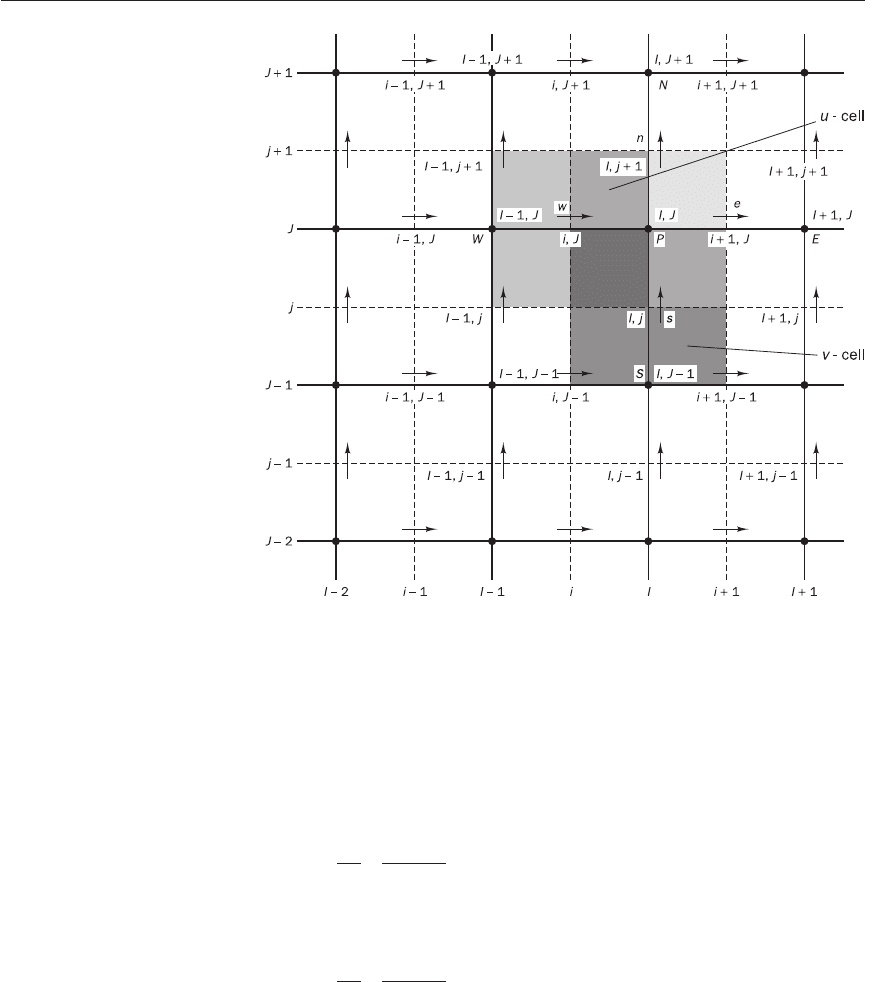
cell faces. The arrangement for a two-dimensional flow calculation is shown
in Figure 6.2.
The scalar variables, including pressure, are stored at the nodes marked
(
•
). The velocities are defined at the (scalar) cell faces in between the nodes
and are indicated by arrows. Horizontal (→) arrows indicate the locations for
u-velocities and vertical (↑) ones denote those for v-velocity. In addition to
the E, W, N, S notation Figure 6.2 also introduces a new system of notation
based on a numbering of grid lines and cell faces. It will be explained and
used later on in this chapter.
For the moment we continue to use the original E, W, N, S notation; the
u-velocities are stored at scalar cell faces e and w and the v-velocities at
faces n and s. In a three-dimensional flow the w-component is evaluated
at cell faces t and b. We observe that the control volumes for u and v are
p
N
− p
S
2
δ
y
∂
p
∂
y
p
E
− p
W
2
δ
x
δ
x
p
e
− p
w
δ
x
∂
p
∂
x
D
E
F
p
P
+ p
W
2
A
B
C
D
E
F
p
E
+ p
P
2
A
B
C
Figure 6.1 A ‘checker-board’
pressure field
ANIN_C06.qxd 29/12/2006 09:59 AM Page 181
different from the scalar control volumes and from each other. The scalar
control volumes are sometimes referred to as the pressure control volumes
because, as we will see later, the discretised continuity equation is turned
into a pressure correction equation, which is evaluated on scalar control
volumes.
In the staggered grid arrangement, the pressure nodes coincide with
the cell faces of the u-control volume. The pressure gradient term
∂
p/
∂
x is
given by
= (6.6)
where
δ
x
u
is the width of the u-control volume. Similarly
∂
p/
∂
y for the v-
control volume shown is given by
= (6.7)
where
δ
y
v
is the width of the v-control volume.
If we consider the ‘checker-board’ pressure field again, substitution of the
appropriate nodal pressure values into equations (6.6) and (6.7) now yields
very significant non-zero pressure gradient terms. The staggering of the
velocity avoids the unrealistic behaviour of the discretised momentum equa-
tion for spatially oscillating pressures like the ‘checker-board’ field. A further
advantage of the staggered grid arrangement is that it generates velocities at
p
P
− p
S
δ
y
v
∂
p
∂
y
p
P
− p
W
δ
x
u
∂
p
∂
x
182 CHAPTER 6 ALGORITHMS FOR PRESSURE---VELOCITY COUPLING
Figure 6.2
ANIN_C06.qxd 29/12/2006 09:59 AM Page 182

6.3 THE MOMENTUM EQUATIONS 183
exactly the locations where they are required for the scalar transport –
convection–diffusion – computations. Hence, no interpolation is needed to
calculate velocities at the scalar cell faces.
As mentioned earlier, if the pressure field is known, the discretisation of
velocity equations and the subsequent solution procedure is the same as that
of a scalar equation. Since the velocity grid is staggered the new notation
based on grid line and cell face numbering will be used. In Figure 6.2
the unbroken grid lines are numbered by means of capital letters. In the
x-direction the numbering is ..., I − 1, I, I + 1, . . . etc. and in the y-
direction ..., J − 1, J, J + 1, . . . etc. The dashed lines that construct the cell
faces are denoted by lower case letters ..., i − 1, i, i + 1,...and..., j − 1,
j, j + 1, . . . in the x- and y-directions respectively.
A subscript system based on this numbering allows us to define the loca-
tions of grid nodes and cell faces with precision. Scalar nodes, located at the
intersection of two grid lines, are identified by two capital letters: e.g. point
P in Figure 6.2 is denoted by (I, J ). The u-velocities are stored at the e- and
w-cell faces of a scalar control volume. These are located at the intersection
of a line defining a cell boundary and a grid line and are, therefore, defined
by a combination of a lower case letter and a capital, e.g. the w-face of the cell
around point P is identified by (i, J). For the same reasons the storage loca-
tions for the v-velocities are combinations of a capital and a lower case letter:
e.g. the s-face is given by (I, j).
We may use forward or backward staggered velocity grids. The uniform
grids in Figure 6.2 are backward staggered since the i-location for the
u-velocity u
i, J
is at a distance of −
1
–
2
δ
x
u
from the scalar node (I, J). Likewise,
the j-location for the v-velocity v
I, j
is −
1
–
2
δ
y
v
from node (I, J ).
Expressed in the new co-ordinate system the discretised u-momentum
equation for the velocity at location (i, J ) is given by
a
i, J
u
i, J
=∑a
nb
u
nb
−∆V
u
+ D∆V
u
or
a
i, J
u
i, J
=∑a
nb
u
nb
+ (p
I−1, J
− p
I, J
)A
i, J
+ b
i, J
(6.8)
where ∆V
u
is the volume of the u-cell, b
i, J
= D∆V
u
is the momentum source
term, A
i, J
is the (east or west) cell face area of the u-control volume. The
pressure gradient source term in (6.8) has been discretised by means of a
linear interpolation between the pressure nodes on the u-control volume
boundaries.
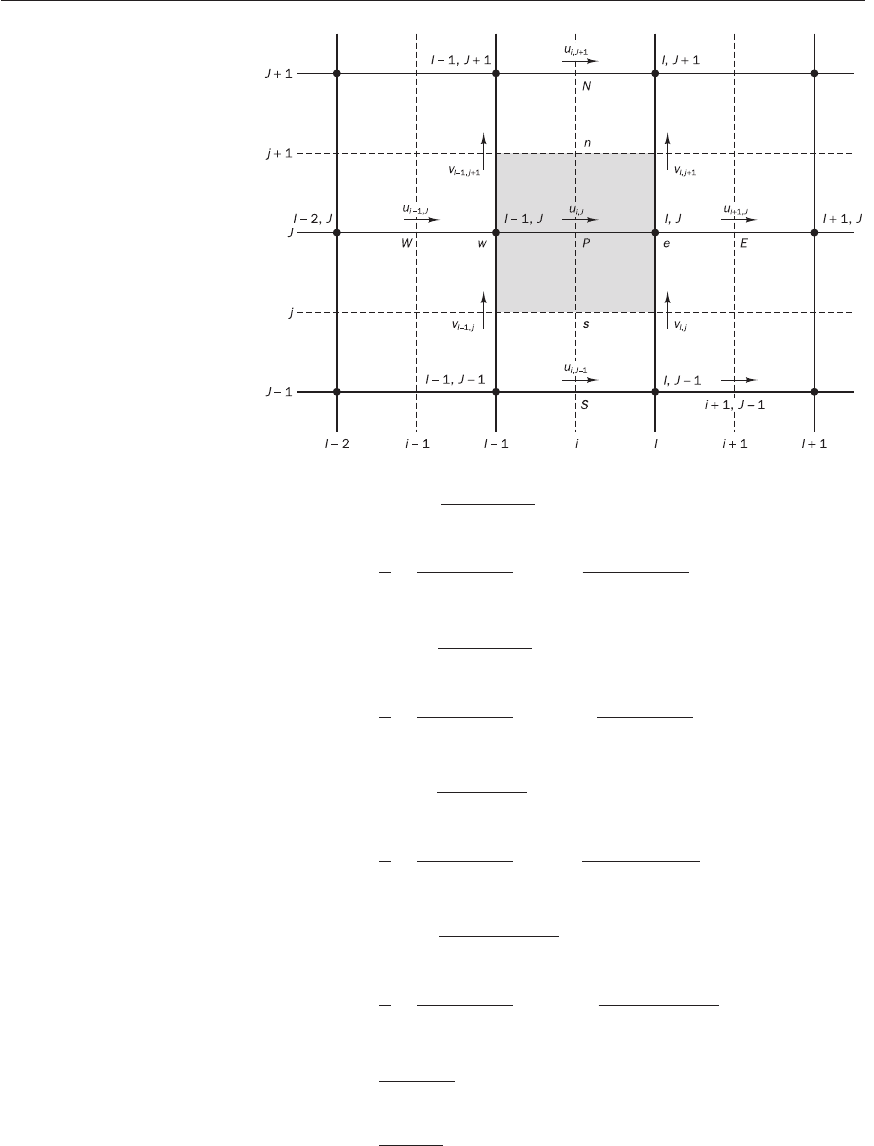
In the new numbering system the E, W, N and S neighbours involved in
the summation ∑a
nb
u
nb
are (i − 1, J), (i + 1, J), (i, J − 1) and (i, J + 1). Their
locations and the prevailing velocities are shown in more detail in Figure 6.3.
The values of coefficients a
i, J
and a
nb
may be calculated with any of the
differencing methods (upwind, hybrid, QUICK, TVD) suitable for con-
vection–diffusion problems. The coefficients contain combinations of the
convective flux per unit mass F and the diffusive conductance D at u-control
volume cell faces. Applying the new notation system we give the values of F
and D for each of the faces e, w, n and s of the u-control volume:
p
I, J
− p
I−1, J
δ
x
u
The momentum
equations
6.3
ANIN_C06.qxd 29/12/2006 09:59 AM Page 183
F
w
= (
ρ
u)
w
=
= u
i, J
+ u
i−1, J
(6.9a)
F
e
= (
ρ
u)
e
=
= u
i+1, J
+ u
i, J
(6.9b)
F
s
= (
ρ
v)
s
=
= v
I, j
+ v
I−1, j
(6.9c)
F
n
= (
ρ
v)
n
=
= v
I, j+1
+ v
I−1, j+1
(6.9d)
D
w
= (6.9e)
D
e
= (6.9f )
Γ
I, J
x
i+1
− x
i
Γ
I−1, J
x
i
− x
i −1
J
K
L
D
E
F
ρ
I−1, J+1
+
ρ
I−1, J
2
A
B
C
D
E
F
ρ
I, J+1
+
ρ
I, J
2
A
B
C
G
H
I
1
2
F
I, j+1
+ F
I−1, j+1
2
J
K
L
D
E
F
ρ
I−1, J
+
ρ
I−1, J−1
2
A
B
C
D
E
F
ρ
I, J
+
ρ
I, J−1
2
A
B
C
G
H
I
1
2
F
I, j
+ F
I−1, j
2
J
K
L
D
E
F
ρ
I, J
+
ρ
I−1, J
2
A
B
C
D
E
F
ρ
I+1, J
+
ρ
I, J
2
A
B
C
G
H
I
1
2
F
i+1, J
+ F
i, J
2
J
K
L
D
E
F
ρ
I−1, J
+
ρ
I−2, J
2
A
B
C
D
E
F
ρ
I, J
+
ρ
I−1, J
2
A
B
C
G
H
I
1
2
F
i, J
+ F
i −1, J
2
184 CHAPTER 6 ALGORITHMS FOR PRESSURE---VELOCITY COUPLING
Figure 6.3 A u-control volume
and its neighbouring velocity
components
ANIN_C06.qxd 29/12/2006 09:59 AM Page 184
6.3 THE MOMENTUM EQUATIONS 185
D
s
= (6.9g)
D
n
= (6.9h)
The formulae (6.9) show that where scalar variables or velocity components
are not available at a u-control volume cell face, a suitable two- or four-point
average is formed over the nearest points where values are available. During
each iteration the u- and v-velocity components used to evaluate the above
expressions are those obtained as the outcome of the previous iteration (or
the initial guess in the first iteration). It should be noted that these known
u- and v-values contribute to the coefficients a in equation (6.8). These are
distinct from u
i, J
and u
nb
in this equation, which denote the unknown scalars.
By analogy the v-momentum equation becomes
a
I, j
v
I, j
=∑a
nb
v
nb
+ (p
I, J−1
− p
I, J
)A
I, j
+ b
I, j
(6.10)
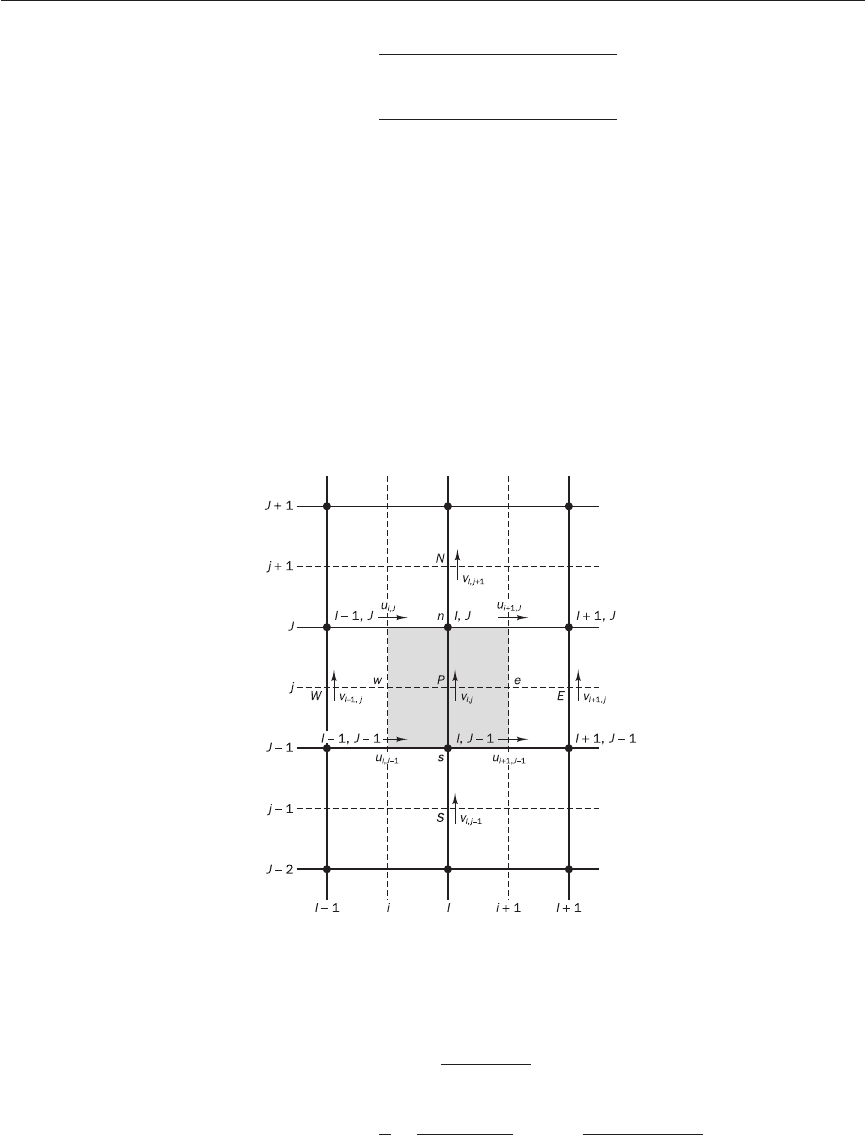
The neighbours involved in the summation ∑a
nb
v
nb
and prevailing velocities
are as shown in Figure 6.4.
Γ
I−1, J+1
+Γ
I, J+1
+Γ
I−1, J
+Γ
I, J
4( y
J+1
− y
J
)
Γ
I−1, J
+Γ
I, J
+Γ
I−1, J−1
+Γ
I, J−1
4( y
J
− y
J−1
)
Figure 6.4 A v-control volume
and its neighbouring velocity
components
Coefficients a
I, j
and a
nb
again contain combinations of the convective flux
per unit mass F and the diffusive conductance D at v-control volume cell
faces. Their values are obtained by the same averaging procedure adopted for
the u-control volume and are given below:
F
w
= (
ρ
u)
w
=
= u
i, J
+ u
i, J −1
(6.11a)
J
K
L
D
E
F
ρ
I−1, J−1
+
ρ
I, J−1
2
A
B
C
D
E
F
ρ
I, J
+
ρ
I−1, J
2
A
B
C
G
H
I
1
2
F
i, J
+ F
i, J−1
2
ANIN_C06.qxd 29/12/2006 09:59 AM Page 185

186 CHAPTER 6 ALGORITHMS FOR PRESSURE---VELOCITY COUPLING
The SIMPLE
algorithm
6.4
F
e
= (
ρ
u)
e
=
= u
i+1, J
+ u
i+1, J −1
(6.11b)
F
s
= (
ρ
v)
s
=
= v
I, j−1
+ v
I, j
(6.11c)
F
n
= (
ρ
v)
n
=
= v
I, j
+ v
I, j+1
(6.11d)
D
w
= (6.11e)
D
e
= (6.11f )
D
s
= (6.11g)
D
n
= (6.11h)
Again at each iteration level the values of F are computed using the u- and
v- velocity components resulting from the previous iteration.
Given a pressure field p, discretised momentum equations of the form
(6.8) and (6.10) can be written for each u- and v-control volume and then
solved to obtain the velocity fields. If the pressure field is correct the result-
ing velocity field will satisfy continuity. As the pressure field is unknown, we
need a method for calculating pressure.
The acronym SIMPLE stands for Semi-Implicit Method for Pressure-
Linked Equations. The algorithm was originally put forward by Patankar
and Spalding (1972) and is essentially a guess-and-correct procedure for the
calculation of pressure on the staggered grid arrangement introduced above.
The method is illustrated by considering the two-dimensional laminar steady
flow equations in Cartesian co-ordinates.
To initiate the SIMPLE calculation process a pressure field p* is guessed.
Discretised momentum equations (6.8) and (6.10) are solved using the
guessed pressure field to yield velocity components u* and v* as follows:
a
i, J
u *
i, J
=∑a
nb
u*
nb
+ (p *
I−1, J
− p *
I, J
)A
i, J
+ b
i, J
(6.12)
Γ
I, J
y
j+1
− y
j
Γ
I, J−1
y
j
− y
j−1
Γ
I, J−1
+Γ
I+1, J−1
+Γ
I, J
+Γ
I+1, J
4(x
I+1
− x
I
)
Γ
I−1, J−1
+Γ
I, J−1
+Γ
I−1, J
+Γ
I, J
4(x
I
− x
I−1
)
J
K
L
D
E
F
ρ
I, J+1
+
ρ
I, J
2
A
B
C
D
E
F
ρ
I, J
+
ρ
I, J−1
2
A
B
C
G
H
I
1
2
F
I, j
+ F
I, j+1
2
J
K
L
D
E
F
ρ
I, J
+
ρ
I, J−1
2
A
B
C
D
E
F
ρ
I, J−1
+
ρ
I, J−2
2
A
B
C
G
H
I
1
2
F
I, j−1
+ F
I, j
2
J
K
L
D
E
F
ρ
I, J−1
+
ρ
I+1, J−1
2
A
B
C
D
E
F
ρ
I+1, J
+
ρ
I, J
2
A
B
C
G
H
I
1
2
F
i+1, J
+ F
i+1, J −1
2
ANIN_C06.qxd 29/12/2006 09:59 AM Page 186