
Versteeg H., Malalasekra W. An Introduction to Computational Fluid Dynamics: The Finite Volume Method
Подождите немного. Документ загружается.

5.6 THE UPWIND DIFFERENCING SCHEME 147
Example 5.2
Solution
or
[D
w
+ (D
e
− F
e
) + (F
e
− F
w
)]
φ
P
= D
w
φ
W
+ (D
e
− F
e
)
φ
E
(5.30)
Identifying the coefficients of
φ
W
and
φ
E
as a
W
and a
E
, equations (5.27) and
(5.30) can be written in the usual general form
a
P
φ
P
= a
W
φ
W
+ a
E
φ
E
(5.31)
with central coefficient
a
P
= a
W
+ a
E
+ (F
e
− F
w
)
and neighbour coefficients
a
W
a
E
F
w
> 0, F
e
> 0 D
w
+ F
w
D
e
F
w
< 0, F
e
< 0 D
w
D
e
− F
e
A form of notation for the neighbour coefficients of the upwind differ-
encing method that covers both flow directions is given below:
a
W
a
E
D
w
+ max(F
w
, 0) D
e
+ max(0, −F
e
)
Solve the problem considered in Example 5.1 using the upwind differencing
scheme for (i) u = 0.1 m/s, (ii) u = 2.5 m/s with the coarse five-point grid.
The grid shown in Figure 5.3 is again used here for the discretisation. The
discretisation equation at internal nodes 2, 3 and 4 and the relevant neigh-
bour coefficients are given by (5.31) and its accompanying tables. Note that
in this example F = F
e
= F
w
=
ρ
u and D = D
e
= D
w
=Γ/
δ
x everywhere.
At the boundary node 1, the use of upwind differencing for the convec-
tive terms gives
F
e
φ
P
− F
A
φ
A
= D
e
(
φ
E
−
φ
P
) − D
A
(
φ
P
−
φ
A
) (5.32)
And at node 5
F
B
φ
P
− F
w
φ
W
= D
B
(
φ
B
−
φ
P
) − D
w
(
φ
P
−
φ
W
) (5.33)
At the boundary nodes we have D
A
= D
B
= 2Γ/
δ
x = 2D and F
A
= F
B
= F, and
as usual the boundary conditions enter the discretised equations as source
contributions:
a
P
φ
P
= a
W
φ
W
+ a
E
φ
E
+ S
u
(5.34)
with
a
P
= a
W
+ a
E
+ (F
e
− F
w
) − S
P
ANIN_C05.qxd 29/12/2006 04:36PM Page 147
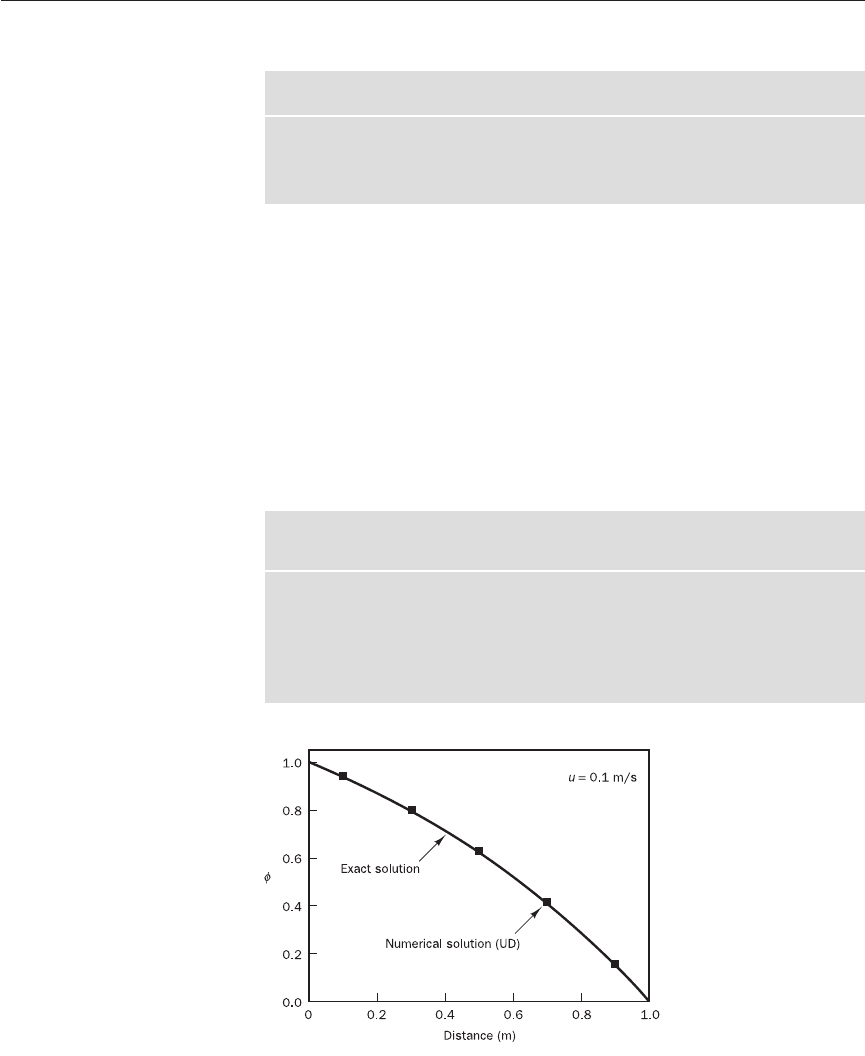
148 CHAPTER 5 FINITE VOLUME METHOD FOR C---D PROBLEMS
Table 5.6
Node Distance Finite volume Analytical Difference Percentage
solution solution error
1 0.1 0.9337 0.9387 0.005 0.53
2 0.3 0.7879 0.7963 0.008 1.05
3 0.5 0.6130 0.6224 0.009 1.51
4 0.7 0.4031 0.4100 0.007 1.68
5 0.9 0.1512 0.1505 −0.001 −0.02
Figure 5.12 Comparison of the
upwind difference numerical
results and the analytical solution
for Case 1
Case 2
u = 2.5 m/s: F =
ρ
u = 2.5, D =Γ/
δ
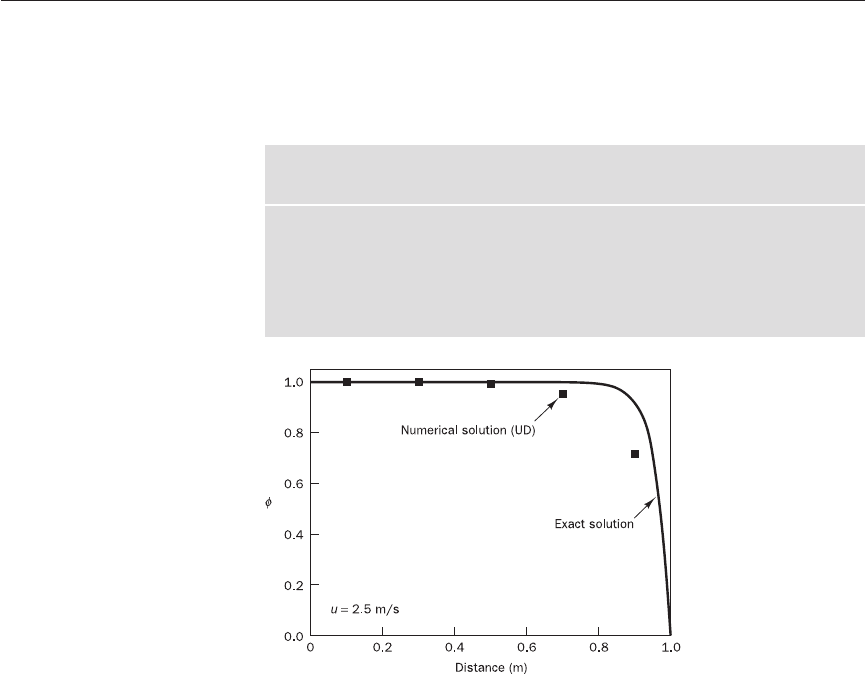
x = 0.1/0.2 = 0.5 now Pe = 5. The numer-
ical results are compared with the analytical solution in Table 5.7 and Fig-
ure 5.13.
and
Node a
W
a
E
S
P
S
u
10D −(2D + F )(2D + F )
φ
A
2, 3, 4 D + FD 00
5 D + F 0 −2D 2D
φ
B
The reader will by now be familiar with the process of calculating
coefficients and constructing and solving the matrix equation. For the sake
of brevity we leave this as an exercise and concentrate on the evaluation of
the results. The analytical solution is again given by equation (5.15) and is
compared with the numerical, upwind differencing, solution.
Case 1
u = 0.1 m/s: F =
ρ
u = 0.1, D =Γ/
δ
x = 0.1/0.2 = 0.5 so Pe = F/D = 0.2. The
results are summarised in Table 5.6, and Figure 5.12 shows that the upwind
differencing (UD) scheme produces good results at this cell Peclet number.
ANIN_C05.qxd 29/12/2006 04:36PM Page 148
5.6 THE UPWIND DIFFERENCING SCHEME 149
The central differencing scheme failed to produce a reasonable result with
the same grid resolution. The upwind scheme produces a much more realistic
solution that is, however, not very close to the exact solution near boundary B.
Table 5.7
Node Distance Finite volume Analytical Difference Percentage
solution solution error
1 0.1 0.9998 1.0000 0.0002 0.02
2 0.3 0.9987 0.9999 0.001 0.13
3 0.5 0.9921 0.9999 0.008 0.79
4 0.7 0.9524 0.9994 0.047 4.71
5 0.9 0.7143 0.9179 0.204 22.18
Figure 5.13 Comparison of
the upwind difference numerical
results and the analytical solution
for Case 2
5.6.1 Assessment of the upwind differencing scheme
Conservativeness: The upwind differencing scheme utilises consistent
expressions to calculate fluxes through cell faces: therefore it can be easily
shown that the formulation is conservative.
Boundedness: The coefficients of the discretised equation are always posi-
tive and satisfy the requirements for boundedness. When the flow satisfies
continuity the term (F
e
− F
w
) in a
P
(see (5.31)) is zero and gives a
P
= a
W
+ a
E
,
which is desirable for stable iterative solutions. All the coefficients are
positive and the coefficient matrix is diagonally dominant, hence no ‘wiggles’
occur in the solution.
Transportiveness: The scheme accounts for the direction of the flow so
transportiveness is built into the formulation.
Accuracy: The scheme is based on the backward differencing formula so the
accuracy is only first-order on the basis of the Taylor series truncation error
(see Appendix A).
Because of its simplicity the upwind differencing scheme has been
widely applied in early CFD calculations. It can be easily extended to
ANIN_C05.qxd 29/12/2006 04:36PM Page 149
multi-dimensional problems by repeated application of the upwind strategy
embodied in the coefficients of (5.31) in each co-ordinate direction. A major
drawback of the scheme is that it produces erroneous results when the flow
is not aligned with the grid lines. The upwind differencing scheme causes
the distributions of the transported properties to become smeared in such
problems. The resulting error has a diffusion-like appearance and is referred
to as false diffusion. The effect can be illustrated by calculating the trans-
port of scalar property
φ
using upwind differencing in a domain where the
flow is at an angle to a Cartesian grid.
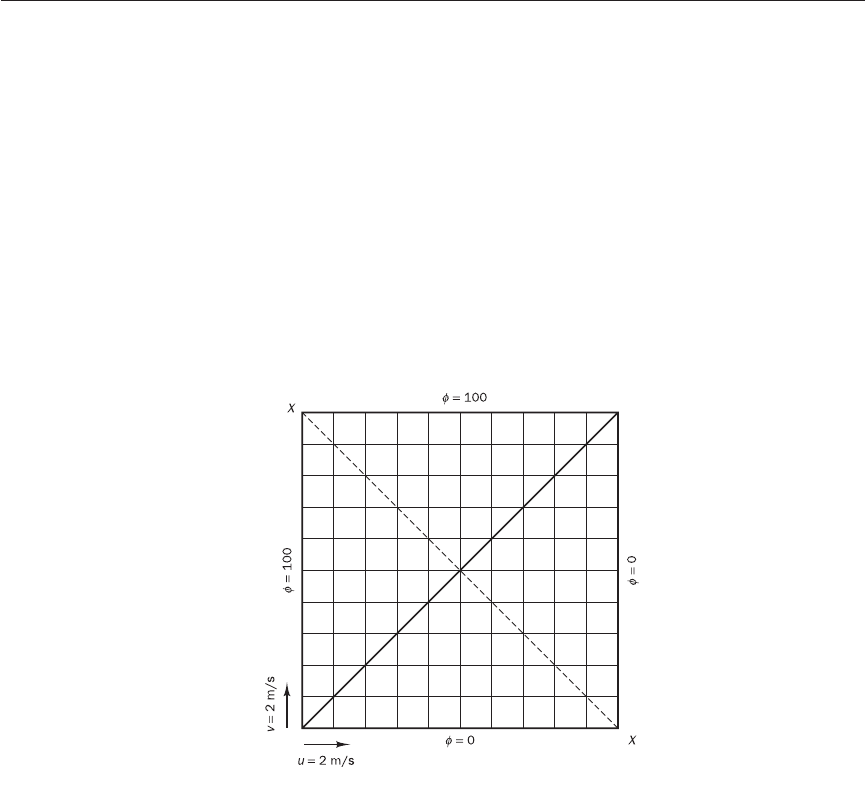
In Figure 5.14 we have a domain where u = v = 2 m/s everywhere so the
velocity field is uniform and parallel to the diagonal (solid line) across the
grid. The boundary conditions for the scalar are
φ
= 0 along the south and
east boundaries, and
φ
= 100 on the west and north boundaries. At the first
and the last nodes where the diagonal intersects the boundary a value of 50
is assigned to property
φ
.
150 CHAPTER 5 FINITE VOLUME METHOD FOR C---D PROBLEMS
Figure 5.14 Flow domain for
the illustration of false diffusion
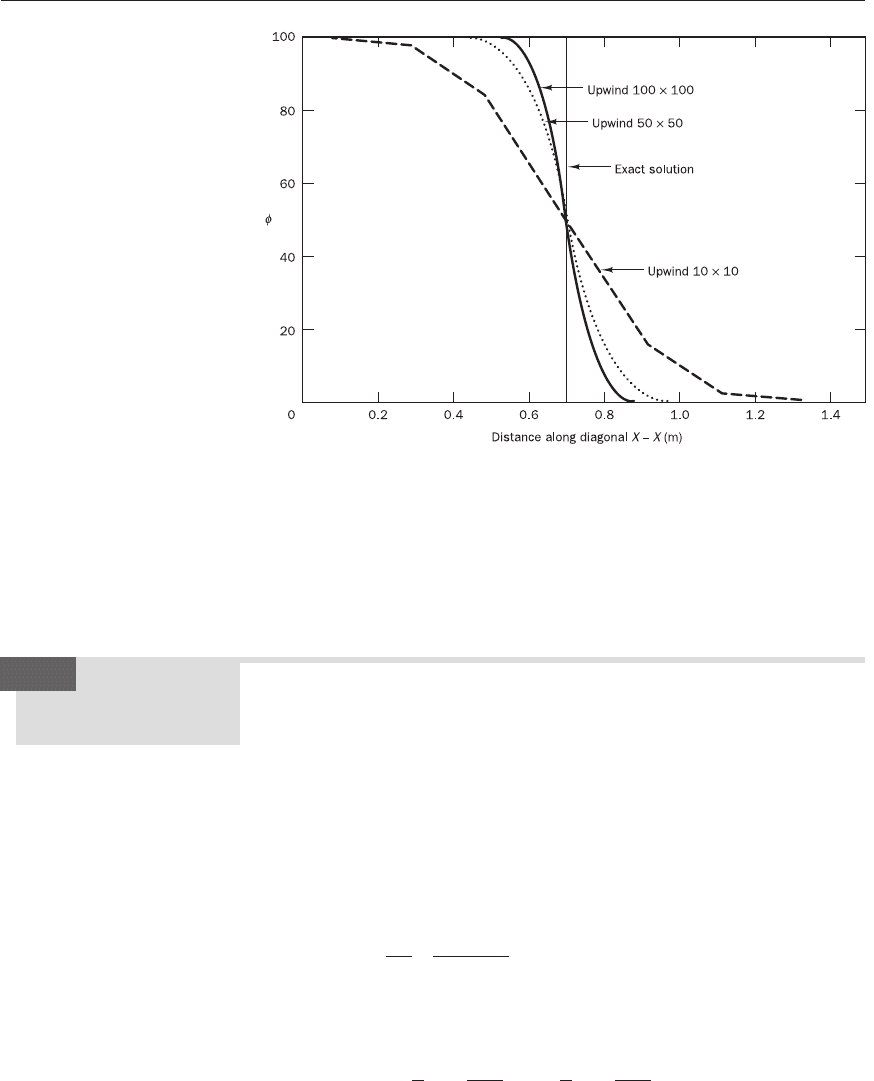
To identify the false diffusion due to the upwind scheme, a pure convec-
tion process is considered without physical diffusion. There are no source
terms for
φ
and a steady state solution is sought. The correct solution is
known in this case. As the flow is parallel to the solid diagonal the value of
φ
at all nodes above the diagonal should be 100 and below the diagonal it
should be zero. The degree of false diffusion can be illustrated by calculating
the distribution of
φ
and plotting the results along the diagonal (X–X). Since
there is no physical diffusion the exact solution exhibits a step change of
φ
from 100 to zero when the diagonal X–X crosses the solid diagonal. The cal-
culated results for different grids are shown in Figure 5.15 together with the
exact solution. The numerical results show badly smeared profiles.
The error is largest for the coarsest grid, and the figure shows that
refinement of the grid can, in principle, overcome the problem of false
diffusion. The results for 50 × 50 and 100 × 100 grids show profiles that
are closer to the exact solution. In practical flow calculations, however,
the degree of grid refinement required to eliminate false diffusion can be
prohibitively expensive. Trials have shown that, in high Reynolds number
ANIN_C05.qxd 29/12/2006 04:36PM Page 150
5.7 THE HYBRID DIFFERENCING SCHEME 151
flows, false diffusion can be large enough to give physically incorrect results
(Leschziner, 1980; Huang et al., 1985). Therefore, the upwind differencing
scheme is not entirely suitable for accurate flow calculations and considerable
research has been directed towards finding improved discretisation schemes.
The hybrid differencing scheme of Spalding (1972) is based on a combina-
tion of central and upwind differencing schemes. The central differencing
scheme, which is second-order accurate, is employed for small Peclet num-
bers (Pe < 2) and the upwind scheme, which is first-order accurate but
accounts for transportiveness, is employed for large Peclet numbers (Pe ≥ 2).
As before, we develop the discretisation of the one-dimensional convection–
diffusion equation without source terms. This equation can be interpreted
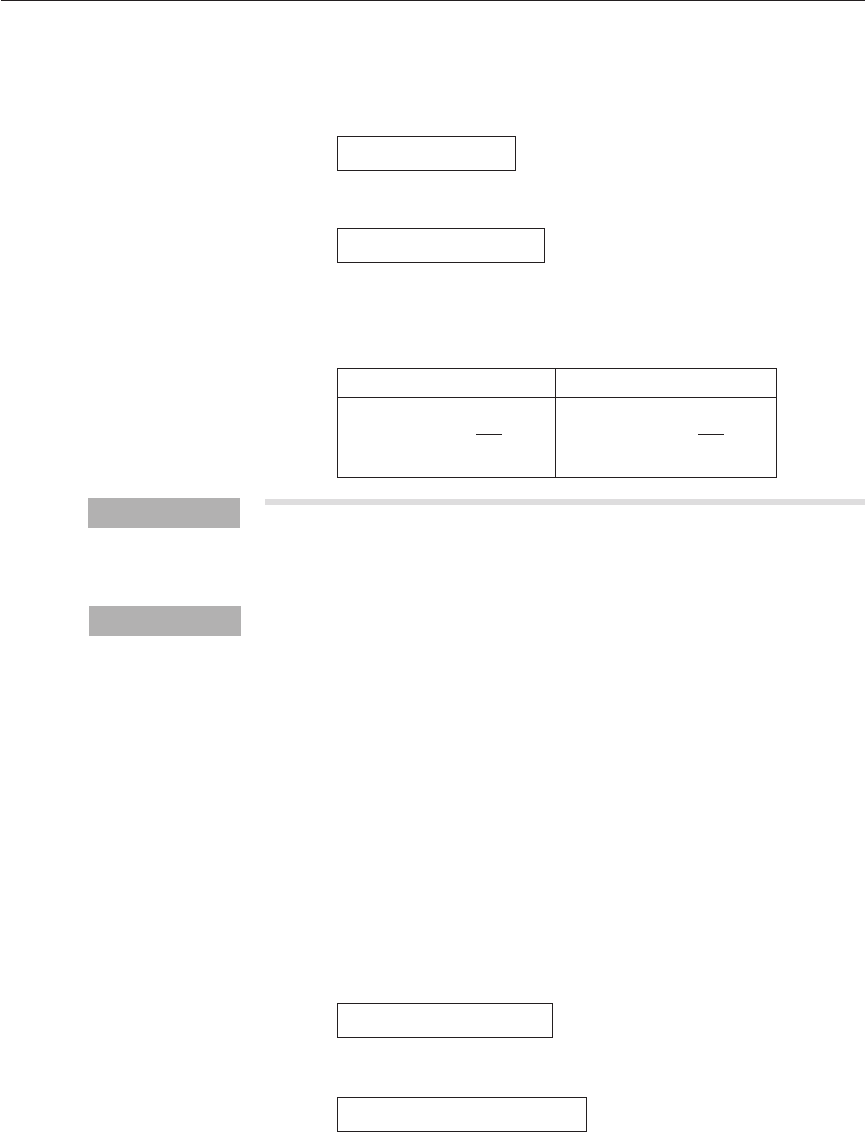
as a flux balance equation. The hybrid differencing scheme uses piecewise
formulae based on the local Peclet number to evaluate the net flux through
each control volume face. The Peclet number is evaluated at the face of the
control volume. For example, for a west face,
Pe
w
== (5.35)
The hybrid differencing formula for the net flux per unit area through the
west face is as follows:
q
w
= F
w
1 +
φ
W
+ 1 −
φ
P
for −2 < Pe
w
< 2
q
w
= F
w
φ
W
for Pe
w
≥ 2 (5.36)
q
w
= F
w
φ
P
for Pe
w
≤−2
J
K
L
D
E
F
2
Pe
w
A
B
C
1
2
D
E
F
2
Pe
w
A
B
C
1
2
G
H
I
(
ρ
u)
w
Γ
w
/
δ
x
WP
F
w
D
w
Figure 5.15
The hybrid
differencing
scheme
5.7
ANIN_C05.qxd 29/12/2006 04:36PM Page 151
152 CHAPTER 5 FINITE VOLUME METHOD FOR C---D PROBLEMS
It can be easily seen that for low Peclet numbers this is equivalent to using
central differencing for the convection and diffusion terms, but when |Pe|>2
it is equivalent to upwinding for convection and setting the diffusion to zero.
The general form of the discretised equation is
a
P
φ
P
= a
W
φ
W
+ a
E
φ
E
(5.37)
The central coefficient is given by
a
P
= a
W
+ a
E
+ (F
e
− F
w
)
After some rearrangement it is easy to verify that the neighbour coeffi-
cients for the hybrid differencing scheme for steady one-dimensional
convection–diffusion can be written as follows:
a
W
a
E
max F
w
, D
w
+ , 0 max −F
e
, D
e
− , 0
Solve the problem considered in Case 2 of Example 5.1 using the hybrid
scheme for u = 2.5 m/s. Compare a 5-node solution with a 25-node
solution.
If we use the 5-node grid and the data of Case 2 of Example 5.1 and u =
2.5 m/s we have: F = F
e
= F
w
=
ρ
u = 2.5 and D
=
D
e
= D
w
=Γ/
δ
x = 0.5 and
hence a Peclet number Pe
w
= Pe
e
=
ρ
u
δ
x/Γ=5. Since the cell Peclet number
Pe is greater than 2 the hybrid scheme uses the upwind expression for the
convective terms and sets the diffusion to zero.
The discretised equation at internal nodes 2, 3 and 4 is defined by (5.37)
and its coefficients. We also need to introduce boundary conditions at nodes
1 and 5, which need special treatment. At the boundary node 1 we write
F
e
φ
P
− F
A
φ
A
= 0 − D
A
(
φ
P
−
φ
A
) (5.38)
and at node 5
F
B
φ
P
− F
w
φ
W
= D
B
(
φ
B
−
φ
P
) − 0 (5.39)
It can be seen that the diffusive flux at the boundary is entered on the right
hand side and the convective fluxes are given by means of the upwind
method. We note that F
A
= F
B
= F and D
B
= 2Γ/
δ
x = 2D so the discretised
equation can be written as
a
P
φ
P
= a
W
φ
W
+ a
E
φ
E
+ S
u
(5.40)
with
a
P
= a
W
+ a
E
+ (F
e
− F
w
) − S
P
and
J
K
L
D
E
F
F
e
2
A
B
C
G
H
I
J
K
L
D
E
F
F
w
2
A
B
C
G
H
I
Example 5.3
Solution
ANIN_C05.qxd 29/12/2006 04:36PM Page 152

5.7 THE HYBRID DIFFERENCING SCHEME 153
Table 5.8
Node a
W
a
E
S
u
S
P
a
P
= a
W
+ a
E
− S
P
1 0 0 3.5
φ
A
−3.5 3.5
2 2.5 0 0 0 2.5
3 2.5 0 0 0 2.5
4 2.5 0 0 0 2.5
5 2.5 0 1.0
φ
B
−1.0 3.5
Table 5.9
Node Distance Finite volume Analytical Difference Percentage
solution solution error
1 0.1 1.0 1.0000 0.0 0.0
2 0.3 1.0 0.9999 −0.0001 −0.01
3 0.5 1.0 0.9999 −0.0001 −0.01
4 0.7 1.0 0.9994 −0.0006 −0.06
5 0.9 0.7143 0.9179 0.204 22.18
Node a
W
a
E
S
P
S
u
100−(2D + F )(2D + F )
φ
A
2,3,4 F 00 0
5 F 0 −2D 2D
φ
B
Substitution of numerical values gives the coefficients summarised in
Table 5.8.
The matrix form of the equation set is
G 3.50000JG
φ
1
JG3.5J
H−2.5 2.5 0 0 0KH
φ
2
KH0K
H 0 −2.5 2.5 0 0KH
φ
3
K = H 0K (5.41)
H 00−2.5 2.5 0KH
φ
4
KH0K
I 000−2.5 3.5LI
φ
5
LI0L
The solution to the above system is
G
φ
1
JG1.0J
H
φ
2
KH1.0K
H
φ
3
K = H 1.0K (5.42)
H
φ
4
KH1.0K
I
φ
5
LI0.7143L
Comparison with the analytical solution
The numerical results are compared with the analytical solution in Table 5.9
and, since the cell Peclet number is high, they are the same as those for pure
ANIN_C05.qxd 29/12/2006 04:36PM Page 153
154 CHAPTER 5 FINITE VOLUME METHOD FOR C---D PROBLEMS
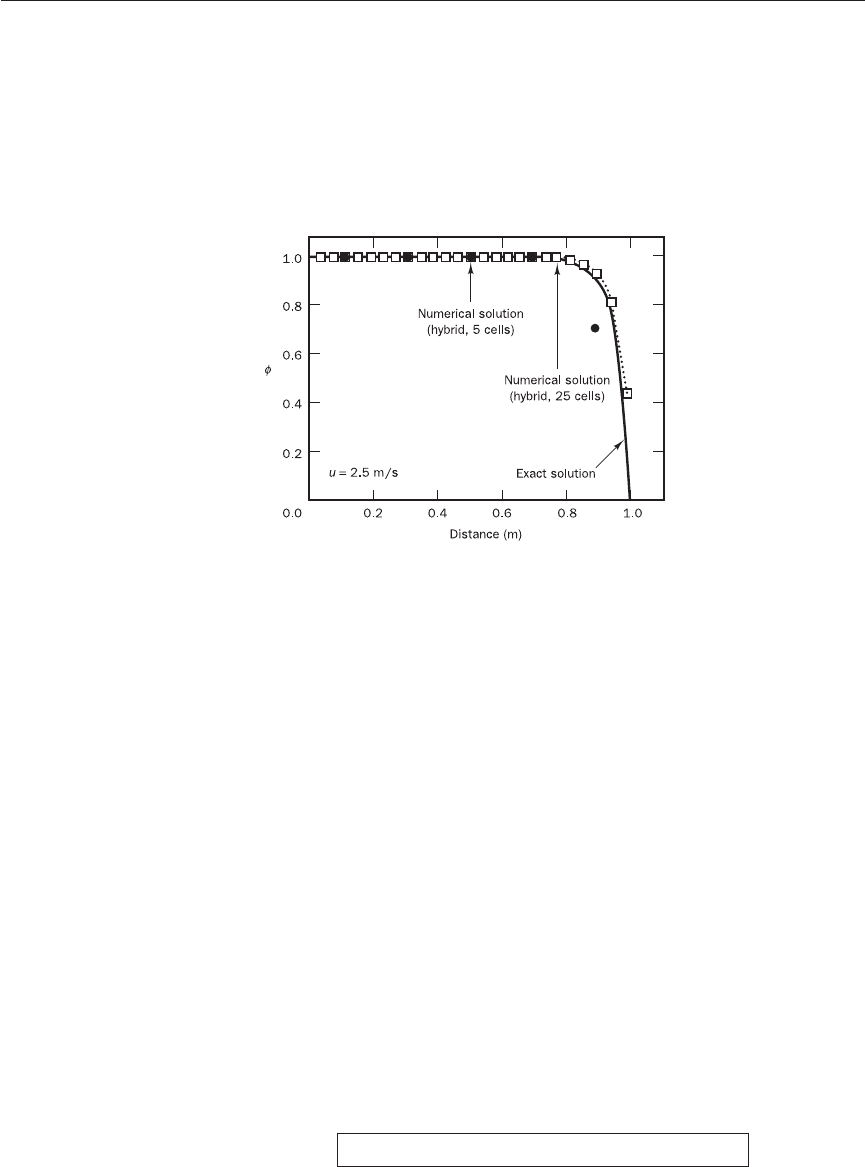
Figure 5.16
upwind differencing. When the grid is refined to an extent that the cell
Pe < 2, the scheme reverts to central differencing and produces an accurate
solution. This illustrated by using a 25-node grid with
δ
x = 0.04 m so F = D
= 2.5. The results computed on both the coarse and the fine grids are shown
in Figure 5.16 together with the analytical solution. Now Pe = 1, the hybrid
scheme reverts to central differencing, and it can be seen that the solution
obtained with the fine grid is remarkably good.
5.7.1 Assessment of the hybrid differencing scheme
The hybrid difference scheme exploits the favourable properties of the
upwind and central differencing schemes. It switches to upwind differencing
when central differencing produces inaccurate results at high Pe numbers.
The scheme is fully conservative and since the coefficients are always posi-
tive it is unconditionally bounded. It satisfies the transportiveness require-
ment by using an upwind formulation for large values of Peclet number. The
scheme produces physically realistic solutions and is highly stable when
compared with higher-order schemes such as QUICK to be discussed later
in the chapter. Hybrid differencing has been widely used in various CFD
procedures and has proved to be very useful for predicting practical flows.
The disadvantage is that the accuracy in terms of Taylor series truncation
error is only first-order.
5.7.2 Hybrid differencing scheme for multi-dimensional
convection---diffusion
The hybrid differencing scheme can easily be extended to two- and three-
dimensional problems by repeated application of the derivation in each
new co-ordinate direction. The discretised equation that covers all cases is
given by
a
P
φ
P
= a
W
φ
W
+ a
E
φ
E
+ a
S
φ
S
+ a
N
φ
N
+ a
B
φ
B
+ a
T
φ
T
(5.43)
ANIN_C05.qxd 29/12/2006 04:36PM Page 154

5.8 THE POWER-LAW SCHEME 155
The power-law
scheme
with central coefficient
a
P
= a
W
+ a
E
+ a
S
+ a
N
+ a
B
+ a
T
+∆F
and the coefficients of this equation for the hybrid differencing scheme
are as follows:
One-dimensional flow Two-dimensional flow Three-dimensional flow
a
W
max F
w
, D
w
+ , 0 max F
w
, D
w
+ , 0 max F
w
, D
w
+ , 0
a
E
max −F
e
, D
e
− , 0 max −F
e
, D
e
− , 0 max −F
e
, D
e
− , 0
a
S
–maxF
s
, D
s
+ , 0 max F
s
, D
s
+ , 0
a
N
–max−F
n
, D
n
− , 0 max −F
n
, D
n
− , 0
a
B
––maxF
b
, D
b
+ , 0
a
T
––max−F
t
, D
t
− , 0
∆FF
e
− F
w
F
e
− F
w
+ F
n
− F
s
F
e
− F
w
+ F
n
− F
s
+ F
t
− F
b
In the above expressions the values of F and D are calculated with the
following formulae:
Face w e s n b t
F (
ρ
u)
w
A
w
(
ρ
u)
e
A
e
(
ρ
v)
s
A
s
(
ρ
v)
n
A
n
(
ρ
w)
b
A
b
(
ρ
w)
t
A
t
DA
w
A
e
A
s
A
n
A
b
A
t
Modifications to these coefficients to cater for boundary conditions in two
and three dimensions are available in the form of expressions such as (5.40).
The power-law differencing scheme of Patankar (1980) is a more accurate
approximation to the one-dimensional exact solution and produces better
results than the hybrid scheme. In this scheme diffusion is set to zero when
Γ
t
δ
x
PT
Γ
b
δ
x
BP
Γ
n
δ
y
PN
Γ
s
δ
y
SP
Γ
e
δ
x
PE
Γ
w
δ
x
WP
J
K
L
D
E
F
F
t
2
A
B
C
G
H
I
J
K
L
D
E
F
F
b
2
A
B
C
G
H
I
J
K
L
D
E
F
F
n
2
A
B
C
G
H
I
J
K
L
D
E
F
F
n
2
A
B
C
G
H
I
J
K
L
D
E
F
F
s
2
A
B
C
G
H
I
J
K
L
D
E
F
F
s
2
A
B
C
G
H
I
J
K
L
D
E
F
F
e
2
A
B
C
G
H
I
J
K
L
D
E
F
F
e
2
A
B
C
G
H
I
J
K
L
D
E
F
F
e
2
A
B
C
G
H
I
J
K
L
D
E
F
F
w
2
A
B
C
G
H
I
J
K
L
D
E
F
F
w
2
A
B
C
G
H
I
J
K
L
D
E
F
F
w
2
A
B
C
G
H
I
5.8
ANIN_C05.qxd 29/12/2006 04:36PM Page 155

156 CHAPTER 5 FINITE VOLUME METHOD FOR C---D PROBLEMS
cell Pe exceeds 10. If 0 < Pe < 10 the flux is evaluated by using a polynomial
expression. For example, the net flux per unit area at the west control volume
face is evaluated using
q
w
= F
w
[
φ
W
−
β
w
(
φ
P
−
φ
W
)] for 0 < Pe < 10 (5.44a)
where
β
w
= (1 − 0.1Pe
w
)
5
/Pe
w
and
q
w
= F
w
φ
W
for Pe > 10 (5.44b)
The coefficients of the one-dimensional discretised equation utilising the
power-law scheme for steady one-dimensional convection–diffusion
are given by
central coefficient: a
P
= a
W
+ a
E
+ (F
e
− F
w
)
and
a
W
a
E
D
w
max[0, (1 − 0.1|Pe
w
|)
5
] + max[F
w
, 0] D
e
max[0, (1 − 0.1|Pe
e
|)
5
] + max[−F
e
, 0]
Properties of the power-law differencing scheme are similar to those of the
hybrid scheme. The power-law differencing scheme is more accurate for
one-dimensional problems since it attempts to represent the exact solution
more closely. The scheme has proved to be useful in practical flow calculations
and can be used as an alternative to the hybrid scheme. In some commercial
computer codes, e.g. FLUENT version 6.2, this scheme is available as a dis-
cretisation option for the user to choose (FLUENT documentation, 2006).
The accuracy of hybrid and upwind schemes is only first-order in terms of
Taylor series truncation error (TSTE). The use of upwind quantities ensures
that the schemes are very stable and obey the transportiveness requirement,
but the first-order accuracy makes them prone to numerical diffusion errors.
Such errors can be minimised by employing higher-order discretisation.
Higher-order schemes involve more neighbour points and reduce the dis-
cretisation errors by bringing in a wider influence. The central differencing
scheme, which has second-order accuracy, proved to be unstable and does
not possess the transportiveness property. Formulations that do not take into
account the flow direction are unstable and, therefore, more accurate higher-
order schemes, which preserve upwinding for stability and sensitivity to
the flow direction, are needed. Below we discuss in some detail Leonard’s
QUICK scheme, which is the oldest of these higher-order schemes.
5.9.1 Quadratic upwind differencing scheme: the QUICK scheme
The quadratic upstream interpolation for convective kinetics (QUICK)
scheme of Leonard (1979) uses a three-point upstream-weighted quadratic
interpolation for cell face values. The face value of
φ
is obtained from a
quadratic function passing through two bracketing nodes (on each side of the
face) and a node on the upstream side (Figure 5.17).
Higher-order
differencing
schemes for
convection---diffusion
problems
5.9
ANIN_C05.qxd 29/12/2006 04:36PM Page 156