
Versteeg H., Malalasekra W. An Introduction to Computational Fluid Dynamics: The Finite Volume Method
Подождите немного. Документ загружается.

5.3 THE CENTRAL DIFFERENCING SCHEME 137
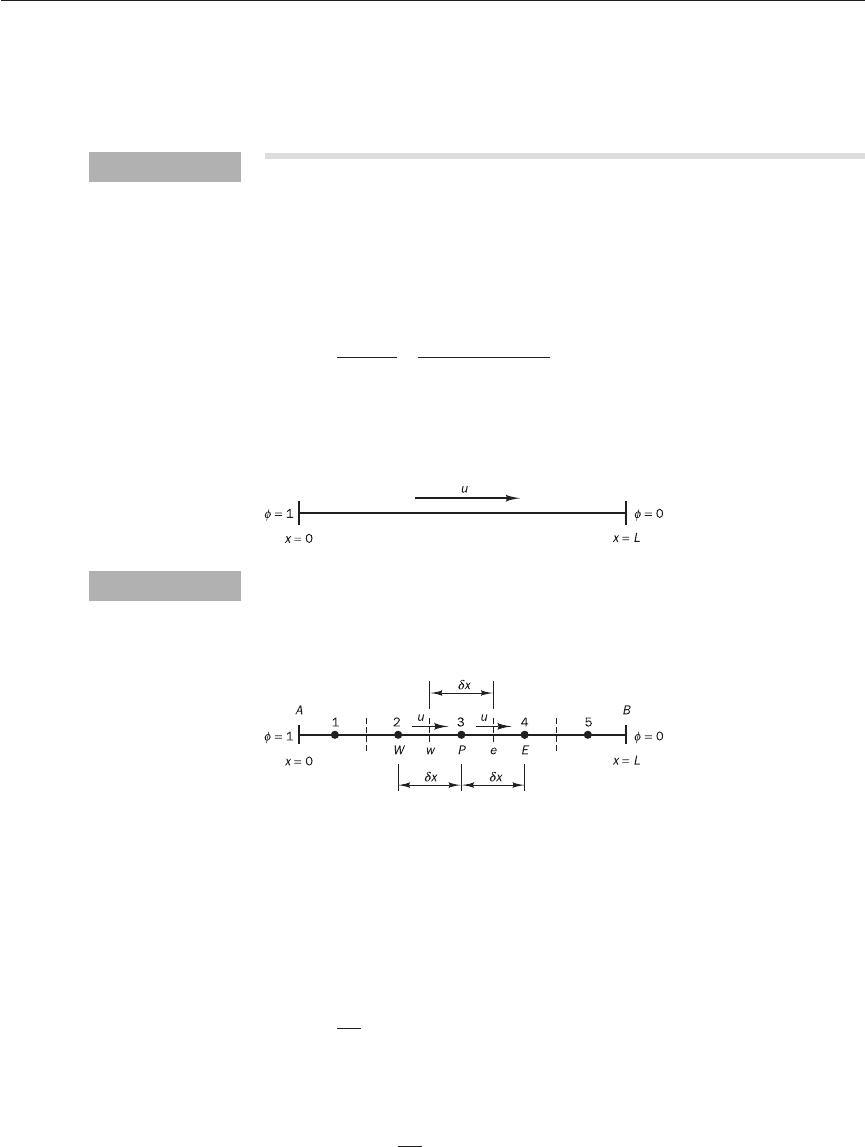
Figure 5.2
Figure 5.3 The grid used for
discretisation
additional terms to account for convection. To solve a one-dimensional
convection–diffusion problem we write discretised equations of the form
(5.14) for all grid nodes. This yields a set of algebraic equations that is solved
to obtain the distribution of the transported property
φ
. The process is now
illustrated by means of a worked example.
A property
φ
is transported by means of convection and diffusion through
the one-dimensional domain sketched in Figure 5.2. The governing equation
is (5.3); the boundary conditions are
φ
0
= 1 at x = 0 and
φ
L
= 0 at x = L. Using
five equally spaced cells and the central differencing scheme for convection
and diffusion, calculate the distribution of
φ
as a function of x for (i) Case 1:
u = 0.1 m/s, (ii) Case 2: u = 2.5 m/s, and compare the results with the
analytical solution
= (5.15)
(iii) Case 3: recalculate the solution for u = 2.5 m/s with 20 grid nodes and
compare the results with the analytical solution. The following data apply:
length L = 1.0 m,
ρ
= 1.0 kg/m
3
, Γ=0.1 kg/m.s.
exp(
ρ
ux/Γ) − 1
exp(
ρ
uL/Γ) − 1
φ
−
φ
0
φ
L
−
φ
0
Example 5.1
Solution
The method of solution is demonstrated using the simple grid shown in
Figure 5.3. The domain has been divided into five control volumes giving
δ
x = 0.2 m. Note that F =
ρ
u, D =Γ/
δ
x, F
e
= F
w
= F and D
e
= D
w
= D
everywhere. The boundaries are denoted by A and B.
The discretisation equation (5.14) and its coefficients apply at internal
nodal points 2, 3 and 4, but control volumes 1 and 5 need special treatment
since they are adjacent to the domain boundaries. We integrate governing
equation (5.3) and use central differencing for both the diffusion terms and
the convective flux through the east face of cell 1. The value of
φ
is given
at the west face of this cell (
φ
w
=
φ
A
= 1) so we do not need to make any
approximations in the convective flux term at this boundary. This yields the
following equation for node 1:
(
φ
P
+
φ
E
) − F
A
φ
A
= D
e
(
φ
E
−
φ
P
) − D
A
(
φ
P
−
φ
A
) (5.16)
For control volume 5, the
φ
-value at the east face is known (
φ
e
=
φ
B
= 0). We
obtain
F
B
φ
B
− (
φ
P
+
φ
W
) = D
B
(
φ
B
−
φ
P
) − D
w
(
φ
P
−
φ
W
) (5.17)
F
w
2
F
e
2
ANIN_C05.qxd 29/12/2006 04:36PM Page 137

138 CHAPTER 5 FINITE VOLUME METHOD FOR C---D PROBLEMS
The matrix form of the equation set using
φ
A
= 1 and
φ
B
= 0 is
G 1.55 −0.45 0 0 0 J G
φ
1
JG1.1J
H−0.55 1.0 −0.45 0 0 K H
φ
2
KH0 K
H 0 −0.55 1.0 −0.45 0 K H
φ
3
K = H0 K (5.19)
H 00−0.55 1.0 −0.45K H
φ
4
KH0 K
I 000−0.55 1.45L I
φ
5
LI0 L
The solution to the above system is
G
φ
1
JG0.9421J
H
φ
2
KH0.8006K
H
φ
3
K = H0.6276K (5.20)
H
φ
4
KH0.4163K
I
φ
5
LI0.1579L
Table 5.1
Node a
W
a
E
S
u
S
P
a
P
= a
W
+ a
E
− S
P
1 0 0.45 1.1
φ
A
−1.1 1.55
2 0.55 0.45 0 0 1.0
3 0.55 0.45 0 0 1.0
4 0.55 0.45 0 0 1.0
5 0.55 0 0.9
φ
B
−0.9 1.45
Rearrangement of equations (5.16) and (5.17), noting that D
A
=
D
B
= 2Γ/
δ
x
= 2D and F
A
=
F
B
=
F, gives discretised equations at boundary nodes of the
following form:
a
P
φ
P
= a
W
φ
W
+ a
E
φ
E
+ S
u
(5.18)
with central coefficient
a
P
= a
W
+ a
E
+ (F
e
− F
w
) − S
P
and
Node a
W
a
E
S
P
S
u
10 D − F /2 −(2D + F)(2D + F )
φ
A
2, 3, 4 D + F /2 D − F /2 0 0
5 D + F /2 0 −(2D − F )(2D − F )
φ
B
To introduce the boundary conditions we have suppressed the link to the
boundary side and entered the boundary flux through the source terms.
(i) Case 1
u = 0.1 m/s: F =
ρ
u = 0.1, D =Γ/
δ
x = 0.1/0.2 = 0.5 gives the coefficients as
summarised in Table 5.1.
ANIN_C05.qxd 29/12/2006 04:36PM Page 138
5.3 THE CENTRAL DIFFERENCING SCHEME 139
Comparison with the analytical solution
Substitution of the data into equation (5.15) gives the exact solution of the
problem:
φ
(x) =
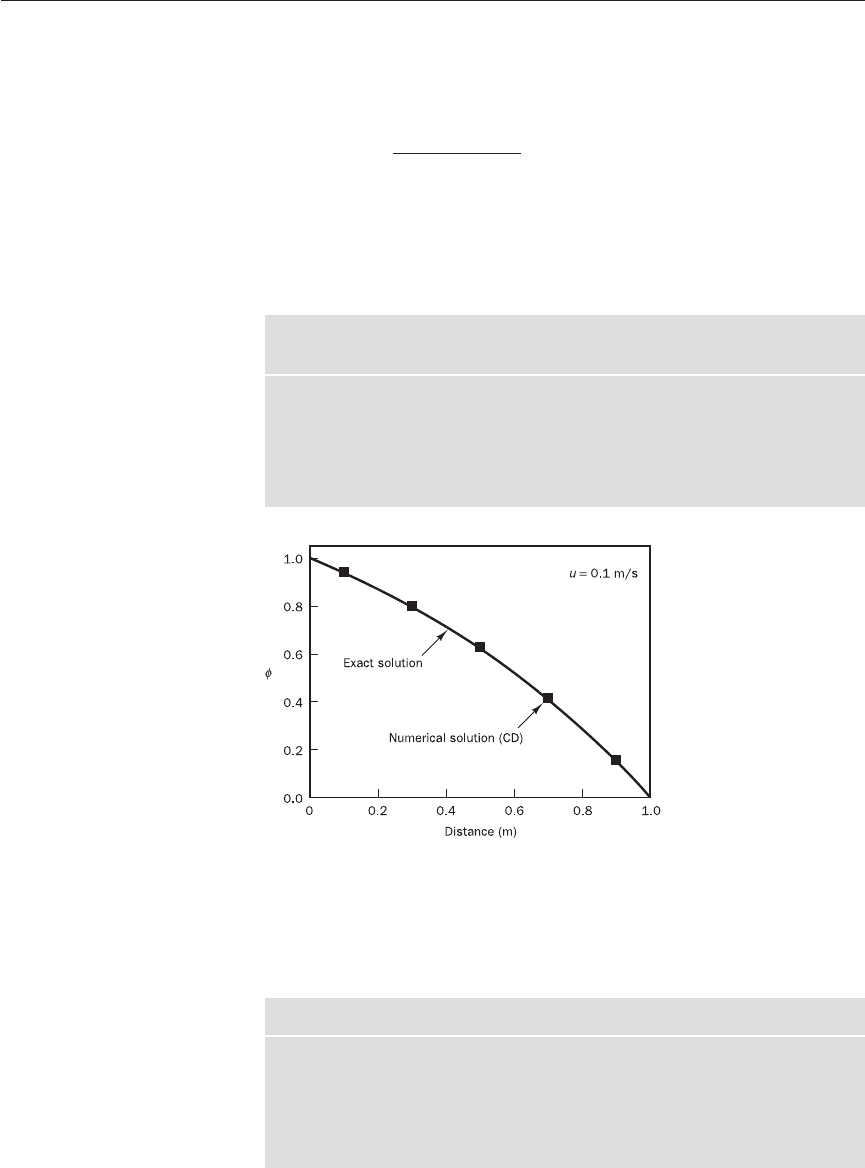
The numerical and analytical solutions are compared in Table 5.2 and in
Figure 5.4. Given the coarseness of the grid the central differencing (CD)
scheme gives reasonable agreement with the analytical solution.
2.7183 − exp(x)
1.7183
Figure 5.4 Comparison of
numerical and analytical
solutions for Case 1
(ii) Case 2
u = 2.5 m/s: F =
ρ
u = 2.5, D =Γ/
δ
x = 0.1/0.2 = 0.5 gives the coefficients as
summarised in Table 5.3.
Table 5.3
Node a
W
a
E
S
u
S
P
a
P
= a
W
+ a
E
− S
P
10−0.75 3.5
φ
A
−3.5 2.75
2 1.75 −0.75 0 0 1.0
3 1.75 −0.75 0 0 1.0
4 1.75 −0.75 0 0 1.0
5 1.75 0 −1.5
φ
B
1.5 0.25
Table 5.2
Node Distance Finite volume Analytical Difference Percentage
solution solution error
1 0.1 0.9421 0.9387 −0.003 −0.36
2 0.3 0.8006 0.7963 −0.004 −0.53
3 0.5 0.6276 0.6224 −0.005 −0.83
4 0.7 0.4163 0.4100 −0.006 −1.53
5 0.9 0.1579 0.1505 −0.007 −4.91
ANIN_C05.qxd 29/12/2006 04:36PM Page 139
Comparison of numerical and analytical solution
The matrix equations are formed from the coefficients in Table 5.3 by the
same method used in Case 1 and subsequently solved. The analytical solu-
tion for the data that apply here is
φ
(x) = 1 +
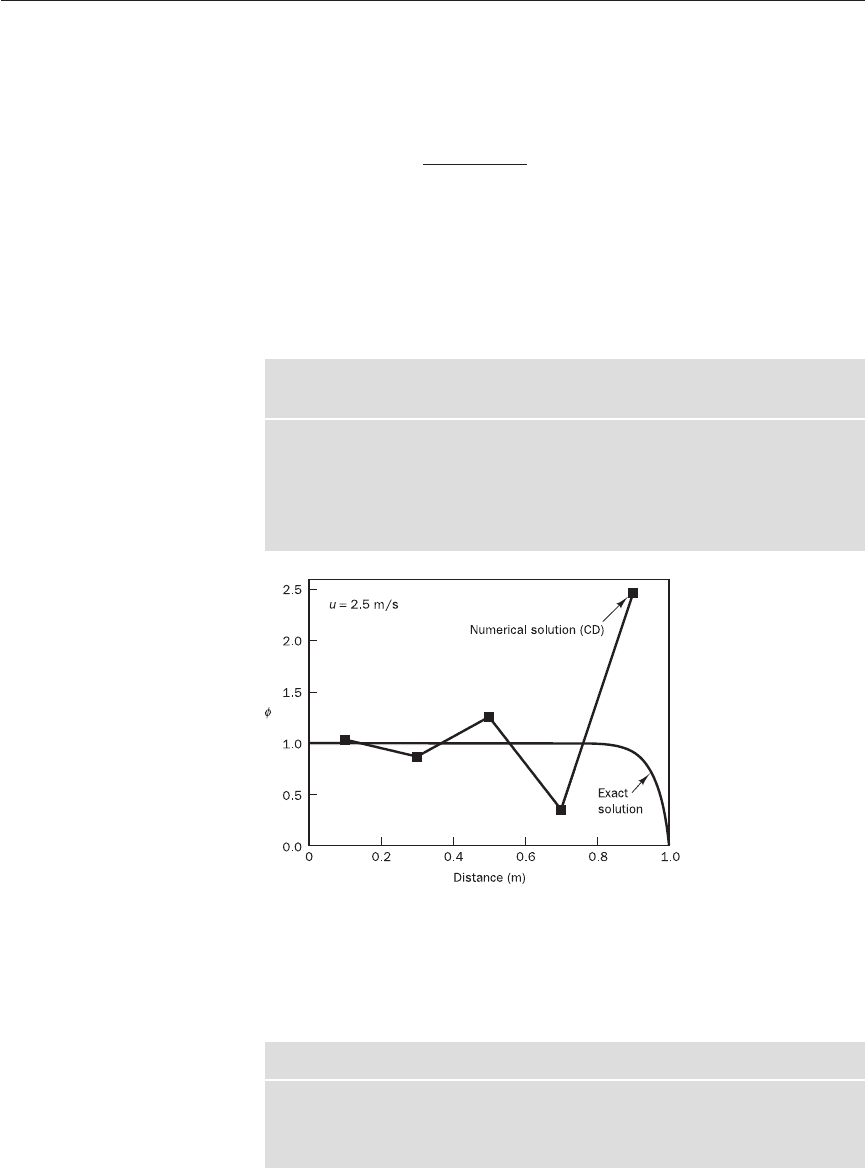
The numerical and analytical solutions are compared in Table 5.4 and shown
in Figure 5.5. The central differencing scheme produces a solution that
appears to oscillate about the exact solution. These oscillations are often
called ‘wiggles’ in the literature; the agreement with the analytical solution is
clearly not very good.
1 − exp(25x)
7.20 × 10
10
140 CHAPTER 5 FINITE VOLUME METHOD FOR C---D PROBLEMS
Figure 5.5 Comparison of
numerical and analytical
solutions for Case 2
Table 5.4
Node Distance Finite volume Analytical Difference Percentage
solution solution error
1 0.1 1.0356 1.0000 −0.035 −3.56
2 0.3 0.8694 0.9999 0.131 13.05
3 0.5 1.2573 0.9999 −0.257 −25.74
4 0.7 0.3521 0.9994 0.647 64.70
5 0.9 2.4644 0.9179 −1.546 −168.48
(iii) Case 3
u = 2.5 m/s: a grid of 20 nodes gives
δ
x = 0.05, F =
ρ
u = 2.5, D =Γ/
δ
x
= 0.1/0.05 = 2.0. The coefficients are summarised in Table 5.5 and the
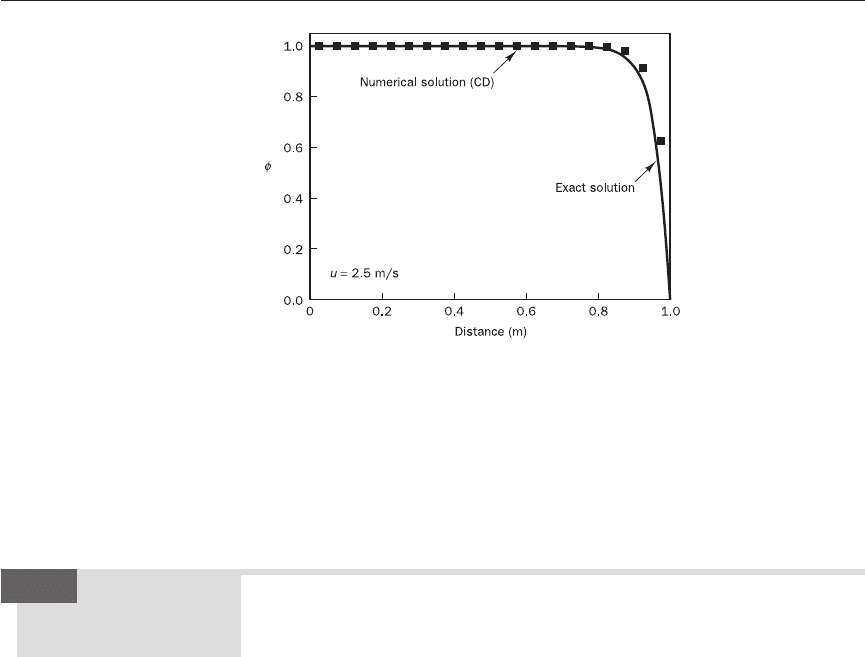
resulting solution is compared with the analytical solution in Figure 5.6.
Table 5.5
Node a
W
a
E
S
u
S
P
a
P
= a
W
+ a
E
− S
P
1 0 0.75 6.5
φ
A
−6.5 7.25
2–19 3.25 0.75 0 0 4.00
20 3.25 0 1.5
φ
B
−1.5 4.75
ANIN_C05.qxd 29/12/2006 04:36PM Page 140
5.4 PROPERTIES OF DISCRETISATION SCHEMES 141
The agreement between the numerical results and the analytical solution
is now good. Comparison of the data for this case with the one computed on
the five-point grid of Case 2 shows that grid refinement has reduced the F/D
ratio from 5 to 1.25. The central differencing scheme seems to yield accurate
results when the F/D ratio is low. The influence of the F/D ratio and the
reasons for the appearance of ‘wiggles’ in central difference solutions when
this ratio is high will be discussed below.
The failure of central differencing in certain cases involving combined con-
vection and diffusion forces us to take a more in-depth look at the properties
of discretisation schemes. In theory numerical results may be obtained that
are indistinguishable from the ‘exact’ solution of the transport equation
when the number of computational cells is infinitely large, irrespective of the
differencing method used. However, in practical calculations we can only use
a finite – sometimes quite small – number of cells, and our numerical results
will only be physically realistic when the discretisation scheme has certain
fundamental properties. The most important ones are:
• Conservativeness
• Boundedness
• Transportiveness
5.4.1 Conservativeness
Integration of the convection–diffusion equation over a finite number of
control volumes yields a set of discretised conservation equations involving
fluxes of the transported property
φ
through control volume faces. To ensure
conservation of
φ
for the whole solution domain the flux of
φ
leaving a
control volume across a certain face must be equal to the flux of
φ
entering
the adjacent control volume through the same face. To achieve this the flux
through a common face must be represented in a consistent manner – by
one and the same expression – in adjacent control volumes.
For example, consider the one-dimensional steady state diffusion prob-
lem without source terms shown in Figure 5.7.
Figure 5.6 Comparison of
numerical and analytical
solutions for Case 3
Properties
of discretisation
schemes
5.4
ANIN_C05.qxd 29/12/2006 04:36PM Page 141
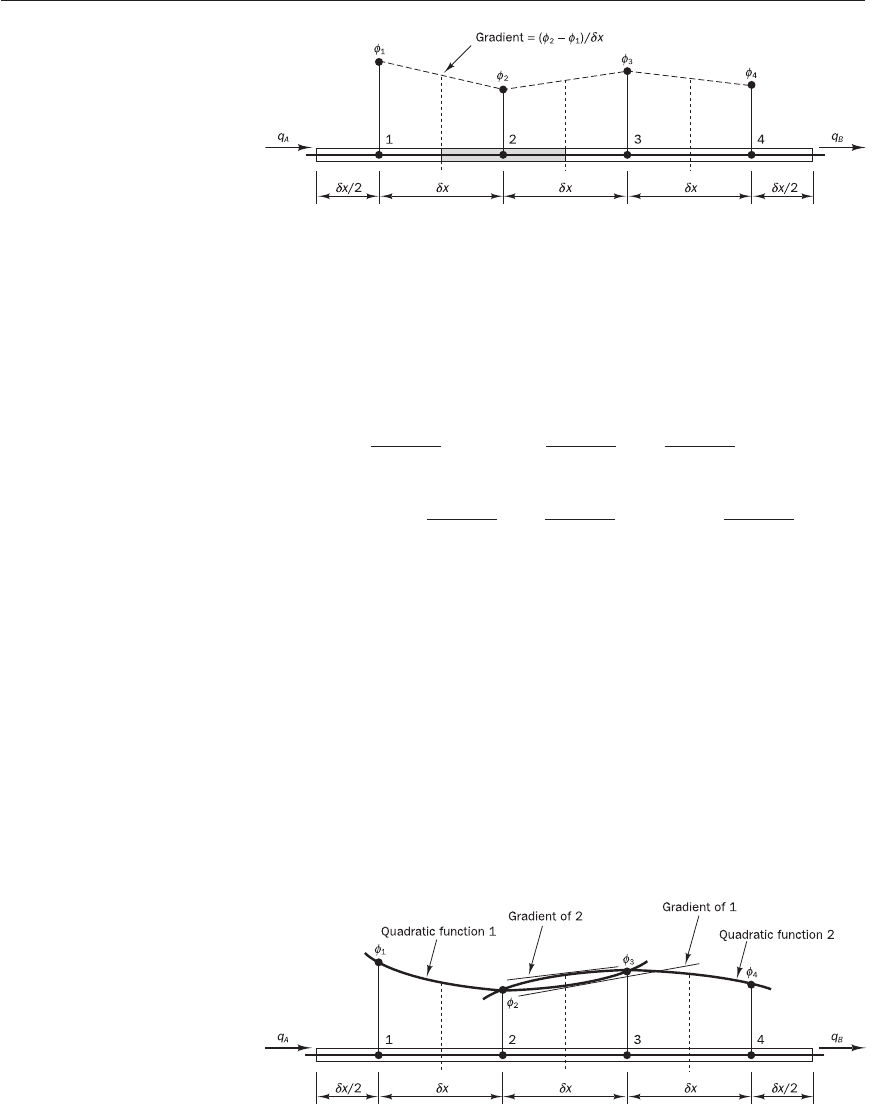
The fluxes across the domain boundaries are denoted by q
A
and q
B
. Let us
consider four control volumes and apply central differencing to calculate the
diffusive flux across the cell faces. The expression for the flux leaving the
element around node 2 across its west face is Γ
w
2
(
φ
2
−
φ
1
)/
δ
x and the flux
entering across its east face is Γ
e
2
(
φ
3
−
φ
2
)/
δ
x. An overall flux balance may be
obtained by summing the net flux through each control volume, taking into
account the boundary fluxes for the control volumes around nodes 1 and 4:
Γ
e
1
− q
A
+Γ
e
2
−Γ
w
2
+Γ
e
3
−Γ
w
3
+ q
B
−Γ
w
4
= q
B
− q
A
(5.21)
Since Γ
e
1
=Γ
w
2
, Γ
e
2
=Γ
w
3
and Γ
e
3
=Γ
w
4
the fluxes across control volume faces
are expressed in a consistent manner and cancel out in pairs when summed
over the entire domain. Only the two boundary fluxes q
A
and q
B
remain in the
overall balance, so equation (5.21) expresses overall conservation of property
φ
. Flux consistency ensures conservation of
φ
over the entire domain for the
central difference formulation of the diffusion flux.
Inconsistent flux interpolation formulae give rise to unsuitable schemes
that do not satisfy overall conservation. For example, let us consider the
situation where a quadratic interpolation formula, based on values at 1, 2 and
3, is used for control volume 2, and a quadratic profile, based on values at
points 2, 3 and 4, is used for control volume 3.
As shown in Figure 5.8, the resulting quadratic profiles can be quite
different.
J
K
L
(
φ
4
−
φ
3
)
δ
x
G
H
I
J
K
L
(
φ
3
−
φ
2
)
δ
x
(
φ
4
−
φ
3
)
δ
x
G
H
I
J
K
L
(
φ
2
−
φ
1
)
δ
x
(
φ
3
−
φ
2
)
δ
x
G
H
I
J
K
L
(
φ
2
−
φ
1
)
δ
x
G
H
I
142 CHAPTER 5 FINITE VOLUME METHOD FOR C---D PROBLEMS
Figure 5.7 Example of
consistent specification of
diffusive fluxes
Figure 5.8 Example of
inconsistent specification of
diffusive fluxes
Consequently, the flux values calculated at the east face of control volume 2
and the west face of control volume 3 may be unequal if the gradients of the
ANIN_C05.qxd 29/12/2006 04:36PM Page 142

5.4 PROPERTIES OF DISCRETISATION SCHEMES 143
two curves are different at the cell face. If this is the case the two fluxes do
not cancel out when summed and overall conservation is not satisfied. The
example should not suggest to the reader that quadratic interpolation is
entirely bad. Further on we will meet a quadratic discretisation practice – the
so-called QUICK scheme – that is consistent.
5.4.2 Boundedness
The discretised equations at each nodal point represent a set of algebraic
equations that needs to be solved. Normally iterative numerical techniques
are used to solve large equation sets. These methods start the solution
process from a guessed distribution of the variable
φ
and perform successive
updates until a converged solution is obtained. Scarborough (1958) has
shown that a sufficient condition for a convergent iterative method
can be expressed in terms of the values of the coefficients of the discretised
equations:
! ≤ 1 at all nodes
@
< 1 at one node at least
(5.22)
Here a ′
P
is the net coefficient of the central node P (i.e. a
P
− S
P
), and the
summation in the numerator is taken over all the neighbouring nodes (nb). If
the differencing scheme produces coefficients that satisfy the above criterion
the resulting matrix of coefficients is diagonally dominant. To achieve
diagonal dominance we need large values of net coefficient (a
P
−
S
P
) so the
linearisation practice of source terms should ensure that S
P
is always
negative. If this is the case −S
P
is always positive and adds to a
P
.
Diagonal dominance is a desirable feature for satisfying the ‘boundedness’
criterion. This states that in the absence of sources the internal nodal
values of property
φ
should be bounded by its boundary values. Hence
in a steady state conduction problem without sources and with boundary
temperatures of 500°C and 200°C, all interior values of T should be less than
500°C and greater than 200°C. Another essential requirement for bounded-
ness is that all coefficients of the discretised equations should have
the same sign (usually all positive). Physically this implies that an increase
in the variable
φ
at one node should result in an increase in
φ
at neighbour-
ing nodes. If the discretisation scheme does not satisfy the boundedness
requirements it is possible that the solution does not converge at all, or, if it
does, that it contains ‘wiggles’. This is powerfully illustrated by the results
of Case 2 of Example 5.1. In all other worked examples we have developed
discretised equations with positive coefficients a
P
and a
nb
, but in Case 2 most
of the east coefficients were negative (see Table 5.3), and the solution con-
tained large under- and overshoots!
5.4.3 Transportiveness
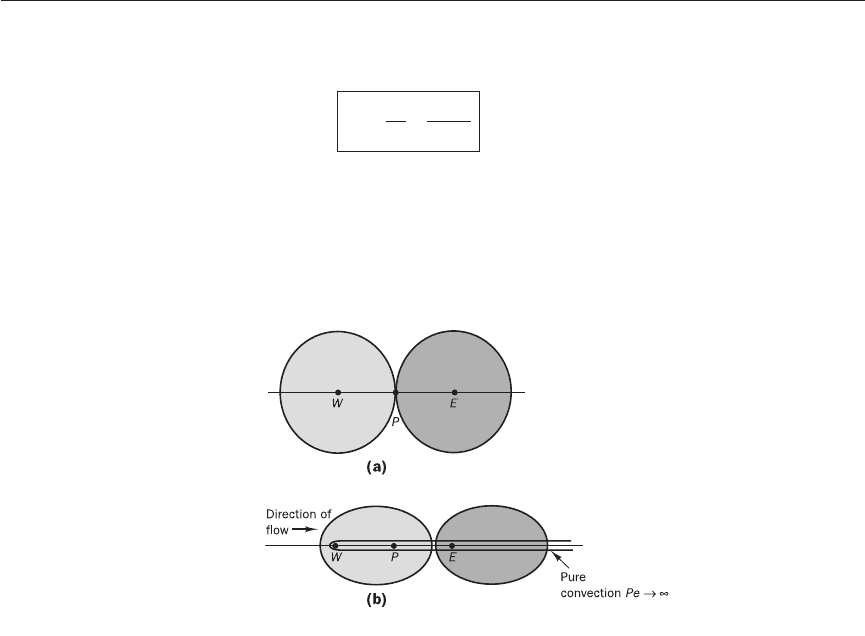
The transportiveness property of a fluid flow (Roache, 1976) can be illus-
trated by considering the effect at a point P due to two constant sources of
φ
at nearby points W and E on either side as shown in Figure 5.9. We define
∑|a
nb
|
|a′
P
|
ANIN_C05.qxd 29/12/2006 04:36PM Page 143
144 CHAPTER 5 FINITE VOLUME METHOD FOR C---D PROBLEMS
Figure 5.9 Distribution of
φ
in the vicinity of two sources
at different Peclet numbers:
(a) pure convection, Pe → 0;
(b) diffusion and convection
the non-dimensional cell Peclet number as a measure of the relative strengths
of convection and diffusion:
Pe == (5.23)
where
δ
x = characteristic length (cell width)
The lines in Figure 5.9 indicate the general shape of contours of constant
φ
(say
φ
= 1) due to both sources for different values of Pe. The value of
φ
at any point can be thought of as the sum of contributions due to the two
sources.
ρ
u
Γ/
δ
x
F
D
Let us consider two extreme cases to identify the extent of the influence
at node P due to the sources at W and E:
• no convection and pure diffusion (Pe → 0)
• no diffusion and pure convection (Pe →∞)
In the case of pure diffusion the fluid is stagnant (Pe → 0) and the contours
of constant
φ
will be concentric circles centred around W and E since the
diffusion process tends to spread
φ
equally in all directions. Figure 5.9a
shows that both
φ
= 1 contours pass through P, indicating that conditions at
this point are influenced by both sources at W and E. As Pe increases the
contours change shape from circular to elliptical and are shifted in the direc-
tion of the flow as shown in Figure 5.9b. Influencing becomes increasingly
biased towards the upstream direction at large values of Pe, so, in the present
case where the flow is in the positive x-direction, conditions at P will be
mainly influenced by the upstream source at W. In the case of pure convec-
tion (Pe →∞) the elliptical contours are completely stretched out in the flow
direction. All of property
φ
emanating from the sources at W and E is imme-
diately transported downstream. Thus, conditions at P are now unaffected
by the downstream source at E and completely dictated by the upstream
source at W. Since there is no diffusion
φ
P
is equal to
φ
W
. If the flow is in the
negative x-direction we would find that
φ
P
is equal to
φ
E
. It is very important
that the relationship between the directionality of influencing and the flow
direction and magnitude of the Peclet number, known as the transportive-
ness, is borne out in the discretisation scheme.
ANIN_C05.qxd 29/12/2006 04:36PM Page 144

5.5 ASSESSMENT OF THE CENTRAL DIFFERENCING SCHEME 145
Assessment of
the central
differencing scheme
for convection---
diffusion problems
Conservativeness: The central differencing scheme uses consistent expres-
sions to evaluate convective and diffusive fluxes at the control volume faces.
The discussions in section 5.4.1 show that the scheme is conservative.
Boundedness:
(i) The internal coefficients of discretised scalar transport equation (5.14) are
a
W
a
E
a
P
D
w
+ D
e
− a
W
+ a
E
+ (F
e
− F
w
)
A steady one-dimensional flow field is also governed by the
discretised continuity equation (5.10). This equation states that
(F
e
− F
w
) is zero when the flow field satisfies continuity. Thus the
expression for a
P
in (5.14) becomes equal to a
P
= a
W
+ a
E
. The
coefficients of the central differencing scheme satisfy the Scarborough
criterion (5.22).
(ii) With a
E
= D
e
− F
e
/2 the convective contribution to the east coefficient
is negative; if the convection dominates it is possible for a
E
to be
negative. Given that F
w
> 0 and F
e
> 0 (i.e. the flow is unidirectional),
for a
E
to be positive D
e
and F
e
must satisfy the following condition:
F
e
/D
e
= Pe
e
< 2 (5.24)
If Pe
e
is greater than 2 the east coefficient will be negative. This
violates one of the requirements for boundedness and may lead to
physically impossible solutions.
In the example of section 5.3 we took Pe = 5 in Case 2 so condition (5.24) is
violated. The consequences were evident in the results, which showed large
‘undershoots’ and ‘overshoots’. Taking Pe less than 2 in Cases 1 and 3 gave
bounded answers close to the analytical solution.
Transportiveness: The central differencing scheme introduces influencing
at node P from the directions of all its neighbours to calculate the convective
and diffusive flux. Thus the scheme does not recognise the direction of the
flow or the strength of convection relative to diffusion. It does not possess
the transportiveness property at high Pe.
Accuracy: The Taylor series truncation error of the central differencing
scheme is second-order (see Appendix A for further details). The require-
ment for positive coefficients in the central differencing scheme as given
by formula (5.24) implies that the scheme will be stable and accurate only if
Pe = F/D < 2. It is important to note that the cell Peclet number, as defined
by (5.23), is a combination of fluid properties (
ρ
and Γ), a flow property (u)
and a property of the computational grid (
δ
x). So for given values of
ρ
and
Γ it is only possible to satisfy condition (5.24) if the velocity is small, hence
in diffusion-dominated low Reynolds number flows, or if the grid spacing is
small. Owing to this limitation central differencing is not a suitable discretisa-
tion practice for general-purpose flow calculations. This creates the need for
discretisation schemes which possess more favourable properties. Below we
discuss the upwind, hybrid, power-law, QUICK and TVD schemes.
F
e
2
F
w
2
5.5
ANIN_C05.qxd 29/12/2006 04:36PM Page 145
One of the major inadequacies of the central differencing scheme is its inabil-
ity to identify flow direction. The value of property
φ
at a west cell face is
always influenced by both
φ
P
and
φ
W
in central differencing. In a strongly
convective flow from west to east, the above treatment is unsuitable because
the west cell face should receive much stronger influencing from node W
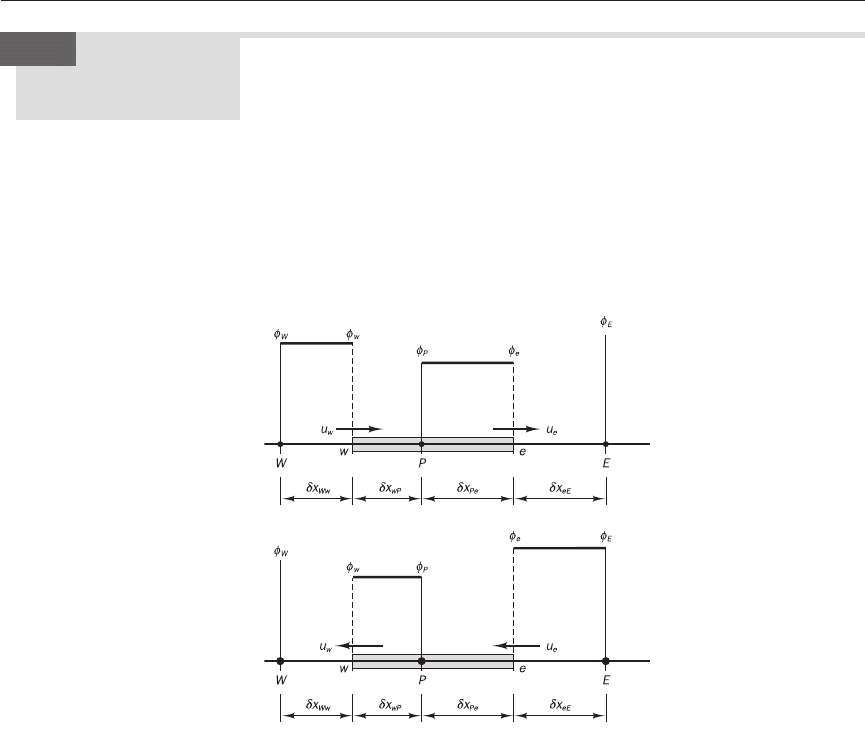
than from node P. The upwind differencing or ‘donor cell’ differencing
scheme takes into account the flow direction when determining the value at
a cell face: the convected value of
φ
at a cell face is taken to be equal to the
value at the upstream node. In Figure 5.10 we show the nodal values used to
calculate cell face values when the flow is in the positive direction (west
to east) and in Figure 5.11 those for the negative direction.
146 CHAPTER 5 FINITE VOLUME METHOD FOR C---D PROBLEMS
Figure 5.10
Figure 5.11
The upwind
differencing
scheme
5.6
When the flow is in the positive direction, u
w
> 0, u
e
> 0 (F
w
> 0, F
e
> 0),
the upwind scheme sets
φ
w
=
φ
W
and
φ
e
=
φ
P
(5.25)
and the discretised equation (5.9) becomes
F
e
φ
P
− F
w
φ
W
= D
e
(
φ
E
−
φ
P
) − D
w
(
φ
P
−
φ
W
) (5.26)
which can be rearranged as
(D
w
+ D
e
+ F
e
)
φ
P
= (D
w
+ F
w
)
φ
W
+ D
e
φ
E
to give
[(D
w
+ F
w
) + D
e
+ (F
e
− F
w
)]
φ
P
= (D
w
+ F
w
)
φ
W
+ D
e
φ
E
(5.27)
When the flow is in the negative direction, u
w
< 0, u
e
< 0 (F
w
< 0, F
e
< 0), the
scheme takes
φ
w
=
φ
P
and
φ
e
=
φ
E
(5.28)
Now the discretised equation is
F
e
φ
E
− F
w
φ
P
= D
e
(
φ
E
−
φ
P
) − D
w
(
φ
P
−
φ
W
) (5.29)
ANIN_C05.qxd 29/12/2006 04:36PM Page 146