
Versteeg H., Malalasekra W. An Introduction to Computational Fluid Dynamics: The Finite Volume Method
Подождите немного. Документ загружается.


6.10 WORKED EXAMPLES OF THE SIMPLE ALGORITHM 207
0.17769p′
C
= 0.11909p′
B
+ 0.058593p′
D
+ 0.18279
0.081093p′
D
= 0.058593p′
C
+ 0.02249p′
E
+ 0.25882
Nodes are A and E are boundary nodes so they need special treatment.
• Pressure nodes A and E
The pressure corrections are set to zero for both nodes:
p′
A
= 0.0
p′
E
= 0.0
At node E this follows the practice of Example 6.1, because the static
pressure is given at the nozzle exit. If the static pressure p
A
at inlet was
given this would also apply at node A without reservation. However, in
this problem we are working with a given stagnation pressure, so we
need to be careful. We note that p
A
is fixed by Equation (6.65) if the
stagnation pressure p
0
and velocity u
1
are known. At the stage in the
SIMPLE algorithm where we start to solve the pressure correction
equations, we have available the guessed velocity u*
1
as a result of solving
the discretised momentum equation. Whilst it is true that this velocity is
constantly updated as the iterations proceed, we may regard that at each
iteration level the static pressure p
A
is temporarily fixed by p
0
and the
current value of u*
1
, thus justifying the use of p′
A
= 0.0.
Substitution of p′
A
= 0.0 and p ′
E
= 0.0 into the pressure correction equations
for internal nodes B, C and D yields the following system of equations:
0.26161p′
B
= 0.11909p′
C
− 0.06830
0.17769p′
C
= 0.11909p′
B
+ 0.058593p′
D
+ 0.18279
0.081093p′
D
= 0.058593p′
C
+ 0.25882
These three equations can be solved to give the pressure correction at nodes
B, C and D. The resulting solution is
p′
A
p′
B
p′
C
p′
D
p′
E
0.0 1.63935 4.17461 6.20805 0.0
Corrected nodal pressures are now calculated using these pressure
corrections:
p
B
= p*
B
+ p′
B
= 7.5 + 1.63935 = 9.13935
p
C
= p*
C
+ p′
C
= 5.0 + 4.17461 = 9.17461
p
D
= p*
D
+ p′
D
= 2.5 + 6.20805 = 8.70805
Corrected velocities at the end of the first iteration are
u
1
= u*
1
+ d
1
(p′
A
− p′
B
) = 2.19935 + 0.31670 × [0.0 − 1.63935] = 1.68015 m/s
u
2
= u*
2
+ d
2
(p′
B
− p′
C
) = 3.02289 + 0.34027 × [1.63935 − 4.17461] = 2.16020 m/s
u
3
= u*
3
+ d
3
(p′
C
− p′
D
) = 3.50087 + 0.23437 × [4.17461 − 6.20805] = 3.02428 m/s
u
4
= u*
4
+ d
4
(p′
D
− p′
E
) = 4.10926 + 0.15 × [6.20805 − 0.0] = 5.04047 m/s
We can also calculate the corrected nodal pressure at A using equation (6.65):
p
A
= p
0
−
1
–
2
ρ
u
2
1
(A
1
/A
A
)
2
= 10 −
1
–
2
× 1.0 × (1.68015 × 0.45/0.5)
2
= 8.85671
ANIN_C06.qxd 29/12/2006 09:59 AM Page 207
208 CHAPTER 6 ALGORITHMS FOR PRESSURE---VELOCITY COUPLING
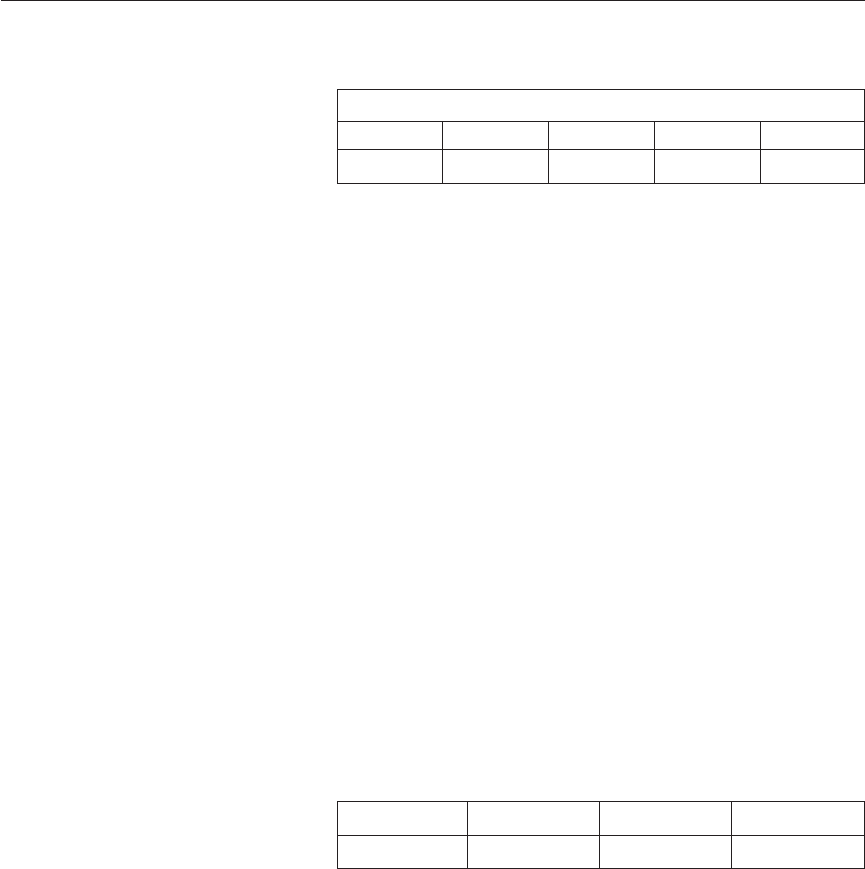
First, we check whether the velocity field satisfies continuity. The mass flow
rates
ρ
uA calculated at u-nodes are
Continuity check
Node 1234
ρ
uA 0.75607 0.75607 0.75607 0.75607
The exact mass flow rate from Bernoulli’s equation is 0.44721 kg/s, so the
error in the computed mass flow rate is +69%. This is not a problem, because
we would not expect the solution after one iteration to be accurate. Never-
theless, the fact that the mass flow rate at all four velocity nodes is exactly the
same highlights an important feature of SIMPLE, which also applies in
more complex multi-dimensional problems: the algorithm aims to supply
a continuity-satisfying velocity field at the end of each iteration cycle. The
close link with this key conservation principle has proved to be a major
strength of the SIMPLE algorithm and its variants.
The computed velocity solution at the end of an iteration cycle is not yet
in balance with the computed pressure field, i.e. momentum is not yet con-
served. Of course this is due to the fact that the entries in the discretised
momentum equations were computed on the basis of an assumed initial
velocity field. Therefore, we need to perform iterations until both continuity
and momentum equations are satisfied.
Under-relaxation
In the iteration process the SIMPLE algorithm requires under-relaxation.
For the next iteration we use under-relaxation factors for both velocity and
pressure (say 0.8 for both) and start the next solution cycle with the follow-
ing velocity and pressure fields:
u
new
= (1 − 0.8) × u
old
+ 0.8 × u
calculated
p
new
= (1 − 0.8) × p
old
+ 0.8 × p
calculated
The velocity field for the next iteration is
u
1
m/s u
2
m/s u
3
m/s u
4
m/s
1.78856 2.29959 3.21942 5.36571
As explained in section 6.4, equations (6.36) and (6.37), a
P
, S
u
and d values
of the discretised momentum equations are also under-relaxed. Note that,
for illustration purposes, these under-relaxation measures were not included
in the a
P
, S
u
and d values of the discretised momentum equations shown
earlier. In practice under-relaxation is used from the start of the calculation:
hence the resulting solution with the above under-relaxation measures would
be slightly different from the one shown.
Iterative convergence and residuals
If we substitute the under-relaxed velocity and pressure fields into the
discretised momentum equations they will not satisfy the equations unless
by chance we have computed the final solution in one iteration (e.g. due to
ANIN_C06.qxd 29/12/2006 09:59 AM Page 208

6.10 WORKED EXAMPLES OF THE SIMPLE ALGORITHM 209
a fortunate choice of initial velocity and pressure fields). For example, the
discretised momentum equation at node 1 in the next iteration is
1.20425u
1
= 1.98592
The difference between the left and right hand sides of the discretised
momentum equation at every velocity node is called the momentum
residual. Substituting the current velocity value of u
1
= 1.78856 yields:
u-momentum residual at node 1 = 1.20425 × 1.78856 − 1.98592 = 0.16795
If the iteration sequence is convergent this residual should decrease to show
an improving balance between the computed velocity and pressure fields.
Ideally, we would like to stop the iteration process when mass and momen-
tum are exactly balanced in the discretised pressure correction and momen-
tum equations. In practice, the finite precision of number representation
in computing machinery would make this impossible and, even if it were
possible to compute with very high precision, this would take far too much
computing time. Our aim is to truncate the iterative sequence when we are
sufficiently close to exact balance that further improvement is of limited
practical value.
We calculate momentum residuals at all velocity nodes and monitor the
sum of absolute values of the residuals as an indication of satisfactory progress
of the calculation sequence. We note that residuals can be positive as well
as negative. Using the sum of absolute values prevents spurious indication
of convergence due to cancellation between positive and negative contribu-
tions. We accept the solution when the sum of absolute residuals is less than
a predetermined small value (say 10
−5
). It should be noted that this is a weak
test to determine the point where the iterative sequence can be truncated.
A decreasing sum of residuals could be due to residuals that decrease by
roughly the same amount at every node or due to a small number of decreas-
ing residuals in conjunction with others that do not decrease much at all. In
a grid with a large number of nodes a few increasing residuals might even
be hidden amongst a much larger number of strongly decreasing residuals.
Nevertheless, summed residuals calculations are routinely used as conver-
gence indicator in fluid flow calculations. For a further discussion of the use
of residuals and iterative convergence the reader is referred to Chapter 10.
Application of under-relaxation factors of 0.8 for both u and p and allowing
a maximum sum of absolute momentum residuals of 10
−5
yields convergence
in 19 iterations. The solution is given in the table below
Converged pressure and velocity field after 19 iterations
Pressure (Pa) Velocity (m/s)
Node Computed Exact Error (%) Node Computed Exact Error (%)
A 9.22569 9.60000 −3.9 1 1.38265 0.99381 39.1
B 9.00415 9.37500 −4.0 2 1.77775 1.27775 39.1
C 8.25054 8.88889 −7.2 3 2.48885 1.78885 39.1
D 6.19423 7.50000 −17.4 4 4.14808 2.98142 39.1
E0 0 –
Solution
ANIN_C06.qxd 29/12/2006 09:59 AM Page 209
210 CHAPTER 6 ALGORITHMS FOR PRESSURE---VELOCITY COUPLING
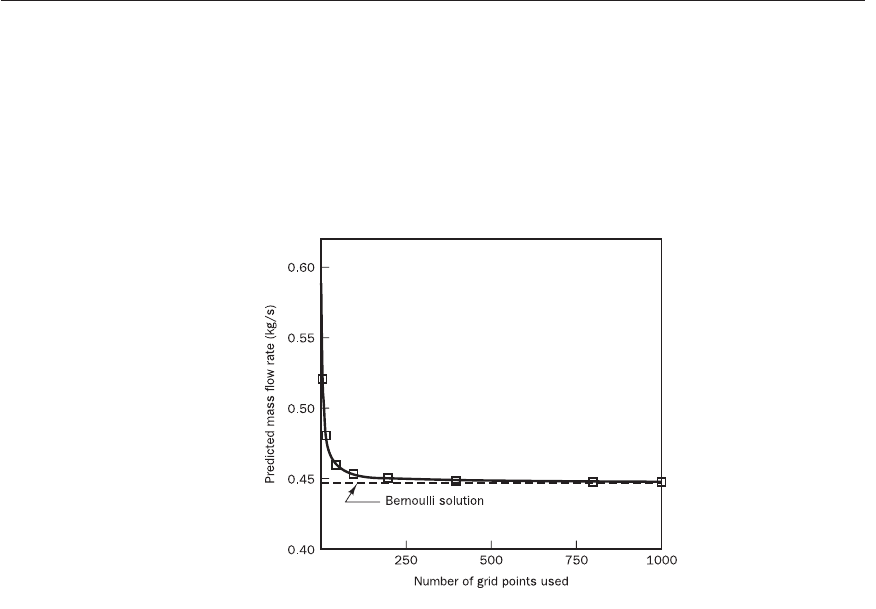
Figure 6.12 Predicted mass flow
rate with different grids
The converged mass flow rate for this five-node grid is 0.62221 kg/s, which
is 39% higher than the exact value. By refining the grid we can get progres-
sively closer solution to the exact solution. Using grids with 10, 20 and
50 nodal points yields mass flow rates of 0.5205, 0.4805 and 0.4597 kg/s,
respectively. This illustrates how the error in the solution can be reduced by
systematic grid refinement. If the grid is further refined to say 200, 500 and
1000 grid nodes the computed mass flow rate converges to the exact solution
of 0.44721 kg/s. This is graphically illustrated in Figure 6.12.
Some comments on exit boundary conditions
Finally, we briefly discuss the issue of the downstream boundary condition.
In Example 6.1 the exit pressure was set to p
D
= 0. Solution of the pressure
correction equations yields the pressures at nodes other than D as gauge
pressures (relative to p
D
). Say the absolute pressure at D had a non-zero
reference value p
Abs,D
= p
ref
at this location. The absolute pressure field
at node N can be found by adding the absolute pressure at D to the gauge
pressure at N: p
Abs,N
= p
Ref
+ p
Gauge,N
. If the absolute pressure is known at
some other reference location R in the computational domain (p
Abs,R
= p
Ref
)
the absolute pressure at node N can be obtained by means of p
Abs,N
= p
Ref
+
(p
Gauge,N
– p
Gauge,R
). In constant-property flows the actual value of p
ref
is imma-
terial, since pressure differences appear in the source terms in the discre-
tised momentum equations. When we solve problems involving fluids with
properties that depend on the absolute pressure (e.g. compressible flows) we
modify the SIMPLE algorithm by including one more iterative structures to
update the fluid properties as new absolute pressures become available.
As we have seen in section 2.10 it is also possible to use an outflow
boundary condition at the downstream boundary in conjunction with a given
inlet velocity. The outflow boundary condition requires the gradient of the
velocity to be zero at the downstream boundary. This can be implemented
by equating the velocities at the two nodes that straddle the boundary, i.e. by
setting
u
5
= u
4
(6.70)
ANIN_C06.qxd 29/12/2006 09:59 AM Page 210

6.11 SUMMARY 211
In Example 6.1 we have seen that a fixed pressure boundary condition is
implemented by setting the pressure correction to zero, which reduces the
original system of pressure correction equations by one equation. Equation
(6.70) cannot provide a pressure, so if this zero velocity gradient boundary
condition was used in Example 6.1 we would have only three pressure
correction equations for nodes A, B and C, but four (unknown) pressure
corrections p′
A
, p′
B
, p′
C
, p′
D
. Thus, it appears as if we are one equation short.
To overcome this problem we note again that pressure differences are
important in the discretised momentum equation and use the above device
of setting an arbitrary reference pressure at the exit plane: p
D
= p
ref
. For the
sake of expediency it is easiest to set p
D
= p
ref
= 0. Having fixed the pressure
we may set the pressure correction equal to zero, solve the pressure correc-
tion equation as in the above examples and obtain the pressure solution as a
gauge pressure.
The most popular solution algorithms for pressure and velocity calculations
with the finite volume method have been discussed. They all possess the
following common characteristics:
• The problems associated with the non-linearity of the momentum
equations and the coupling between transport equations are tackled by
adopting an iterative solution strategy.
• Velocity components are defined on staggered grids to avoid problems
associated with pressure field oscillations of high spatial frequency.
• In the staggered grid arrangement velocities are stored at the cell faces
of scalar control volumes. The discretised momentum equations are
solved on staggered control volumes whose cell faces contain the
pressure nodes.
• The SIMPLE algorithm is an iterative procedure for the calculation of
pressure and velocity fields. Starting from an initial pressure field p* its
principal steps are:
– solve discretised momentum equation to yield intermediate velocity
field (u*, v*)
– solve the continuity equation in the form of an equation for pressure
correction p′
– correct pressure and velocity by means of
p
I, J
= p*
I, J
+ p′
I, J
u
i, J
= u*
i, J
+ d
i, J
(p′
I−1, J
− p′
I, J
)
v
I, j
= v*
I, j
+ d
I, j
(p′
I, J −1
− p′
I, J
)
– solve all other discretised transport equations for scalars
φ
– repeat until p, u, v and
φ
fields have all converged.
• Refinements to SIMPLE have produced more economical and stable
iteration methods.
• The steady state PISO algorithm adds an extra correction step to
SIMPLE to enhance its performance per iteration.
• It is unclear which of the procedures is the best for general-purpose
computation.
• Under-relaxation is required in all methods to ensure stability of the
iteration process.
Summary6.11
ANIN_C06.qxd 29/12/2006 09:59 AM Page 211

In the previous chapters we have discussed methods of discretising the
governing equations of fluid flow and heat transfer. This process results in
a system of linear algebraic equations which needs to be solved. The com-
plexity and size of the set of equations depends on the dimensionality of the
problem, the number of grid nodes and the discretisation practice. Although
any valid procedure can be used to solve the algebraic equations, the avail-
able computer resources set a powerful constraint. There are two families
of solution techniques for linear algebraic equations: direct methods and
indirect or iterative methods. Simple examples of direct methods are
Cramer’s rule matrix inversion and Gaussian elimination. The number of
operations to the solution of a system of N equations with N unknowns by
means of a direct method can be determined beforehand and is of the order
of N
3
. The simultaneous storage of all N
2
coefficients of the set of equations
in core memory is required.
Iterative methods are based on the repeated application of a relatively
simple algorithm leading to eventual convergence after a – sometimes large
– number of repetitions. Well-known examples are the Jacobi and Gauss–
Seidel point-iterative methods. The total number of operations, typically of
the order of N per iteration cycle, cannot be predicted in advance. Stronger
still, it is not possible to guarantee convergence unless the system of equations
satisfies fairly exacting criteria. The main advantage of iterative solution
methods is that only non-zero coefficients of the equations need to be stored
in core memory.
The one-dimensional conduction example in Chapter 4, section 4.3, led
to a tri-diagonal system – a system with only three non-zero coefficients per
equation. When QUICK differencing is applied to a convection–diffusion
problem this gives rise to a penta-diagonal system that has five non-zero
coefficients, which is somewhat more complex to deal with. Nevertheless,
the finite volume method usually yields systems of equations, each of which
has a vast majority of zero entries. Since the systems arising from realistic
CFD problems can be very large – up to 100 000 to 1 million equations – we
find that iterative methods are generally much more economical than direct
methods.
Thomas (1949) developed a technique for rapidly solving tri-diagonal
systems that is now called the Thomas algorithm or the tri-diagonal matrix
algorithm (TDMA). The TDMA is actually a direct method for one-
dimensional situations, but it can be applied iteratively, in a line-by-line
fashion, to solve multi-dimensional problems and is widely used in CFD
programs. It is computationally inexpensive and has the advantage that it
Chapter seven
Solution of discretised equations
Introduction7.1
ANIN_C07.qxd 29/12/2006 04:48PM Page 212
7.2 THE TDMA 213
requires a minimum amount of storage. In this chapter the TDMA is
explained in detail in sections 7.2 to 7.5.
The Jacobi and Gauss–Seidel methods are general-purpose point-iterative
algorithms that are easily implementable, but their convergence rate can be
slow when the system of equations is large. They were not initially consid-
ered suitable for general-purpose CFD procedures. However, more recently
multigrid acceleration techniques have been developed that have improved
the convergence rates of iterative solvers to such an extent that they are now
the method of choice in commercial CFD codes. Point-iterative techniques
and multigrid accelerators will be described in sections 7.6 and 7.7. This
chapter closes with a brief discussion of alternative methods.
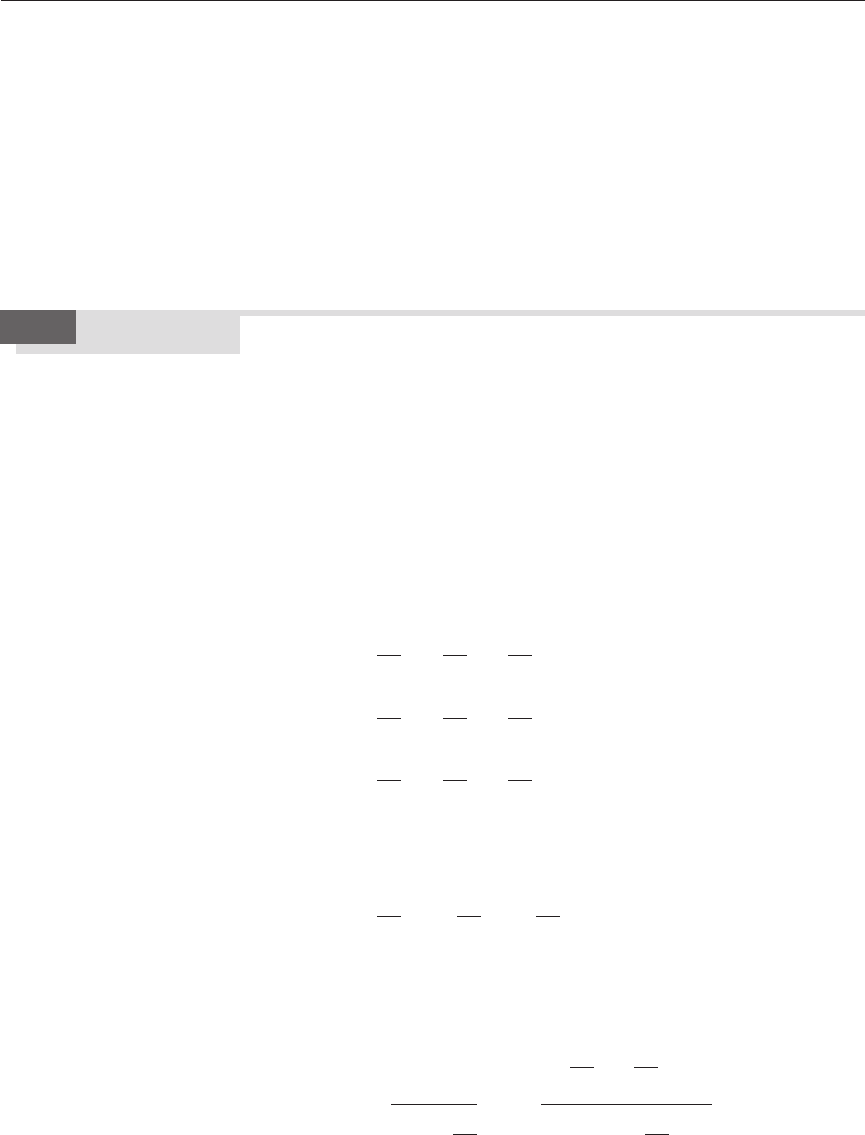
Consider a system of equations that has a tri-diagonal form
φ
1
= C
1
(7.1a)
−
β
2
φ
1
+ D
2
φ
2
−
α
2
φ
3
= C
2
(7.1b)
−
β
3
φ
2
+ D
3
φ
3
−
α
3
φ
4
= C
3
(7.1c)
−
β
4
φ
3
+ D
4
φ
4
−
α
4
φ
5
= C
4
.
.
......= ..
−
β
n
φ
n−1
+ D
n
φ
n
−
α
n
φ
n+1
= C
n
(7.1n)
φ
n+1
= C
n+1
(7.1n+1)
In the above set of equations
φ
1
and
φ
n+1
are known boundary values. The
general form of any single equation is
−
β
j
φ
j−1
+ D
j
φ
j
−
α
j
φ
j+1
= C
j
(7.2)
Equations (7.1b–n) of the above set can be rewritten as
φ
2
=
φ
3
+
φ
1
+ (7.3a)
φ
3
=
φ
4
+
φ
2
+ (7.3b)
φ
4
=
φ
5
+
φ
3
+ (7.3c)
..
..
..
φ
n
=
φ
n+1
+
φ
n−1
+ (7.3n−1)
These equations can be solved by forward elimination and back-substitution.
The forward elimination process starts by removing
φ
2
from equation
(7.3b) by substitution from equation (7.3a) to give
β
3
φ
1
++C
3
φ
3
=
φ
4
+ (7.4a)
D
3
−
β
3
D
3
−
β
3
α
2
D
2
α
2
D
2
J
K
K
K
K
L
G
H
H
H
H
I
D
E
E
E
E
F
α
3
A
B
B
B
B
C
D
E
F
C
2
D
2
β
2
D
2
A
B
C
C
n
D
n
β
n
D
n
α
n
D
n
C
4
D
4
β
4
D
4
α
4
D
4
C
3
D
3
β
3
D
3
α
3
D
3
C
2
D
2
β
2
D
2
α
2
D
2
The TDMA7.2
ANIN_C07.qxd 29/12/2006 04:48PM Page 213

If we adopt the notation
A
2
= and C ′
2
=
φ
1
+ (7.4b)
equation (7.4a) can be written as
φ
3
=
φ
4
+ (7.4c)
If we let
A
3
= and C ′
3
=
equation (7.4c) can be recast as
φ
3
= A
3
φ
4
+ C ′
3
(7.5)
Formula (7.5) can now be used to eliminate
φ
3
from (7.3c) and the procedure
can be repeated up to the last equation of the set. This constitutes the
forward elimination process.
For the back-substitution we use the general form of recurrence
relationship (7.5):
φ
j
= A
j
φ
j+1
+ C ′
j
(7.6a)
where
A
j
= (7.6b)
C ′
j
= (7.6c)
The formulae can be made to apply at the boundary points j = 1 and j = n + 1
by setting the following values for A and C ′:
A
1
= 0 and C ′
1
=
φ
1
A
n+1
= 0 and C ′
n+1
=
φ
n+1
In order to solve a system of equations it is first arranged in the form of
equation (7.2) and
α
j
,
β
j
, D
j
and C
j
are identified. The values of A
j
and C ′
j
are
subsequently calculated starting at j = 2 and going up to j = n using (7.6b–c).
Since the value of
φ
is known at boundary location (n + 1) the values for
φ
j
can be obtained in reverse order (
φ
n
,
φ
n−1
,
φ
n−2
,...,
φ
2
) by means of the
recurrence formula (7.6a). The method is simple and easy to incorporate into
CFD programs. A Fortran subroutine for the TDMA is given in Anderson
et al. (1984).
In the above derivation of the TDMA we assumed that boundary values
φ
1
and
φ
n+1
were given. To implement a fixed gradient (or flux) boundary
condition, e.g. at j = 1, the coefficient
β
2
in equation (7.1b) is set to zero and
the flux across the boundary is incorporated in source term C
2
. The actual
value of the variable at the boundary is now not directly used in the formu-
lation. The absence of the first or the last value does not pose a problem in
applying the TDMA, as will be illustrated in examples below.
β
j
C ′
j−1
+ C
j
D
j
−
β
j
A
j−1
α
j
D
j
−
β
j
A
j−1
β
3
C ′
2
+ C
3
D
3
−
β
3
A
2
α
3
D
3
−
β
3
A
2
D
E
F
β
3
C′
2
+ C
3
D
3
−
β
3
A
2
A
B
C
D
E
F
α
3
D
3
−
β
3
A
2
A
B
C
C
2
D
2
β
2
D
2
α
2
D
2
214 CHAPTER 7 SOLUTION OF DISCRETISED EQUATIONS
ANIN_C07.qxd 29/12/2006 04:48PM Page 214
7.4 APPLICATION OF THE TDMA TO 3D PROBLEMS 215
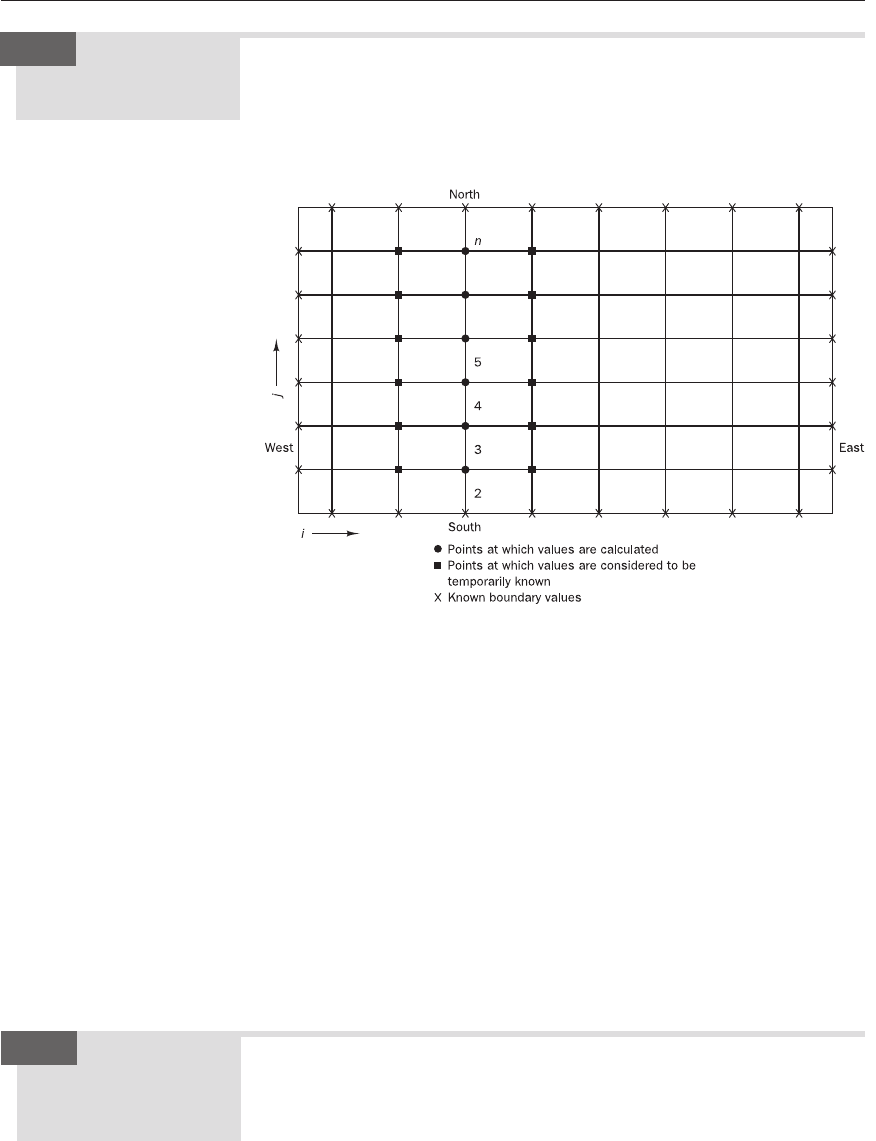
The TDMA can be applied iteratively to solve a system of equations for
two-dimensional problems. Consider the grid in Figure 7.1 and a general
two-dimensional discretised transport equation of the form
a
P
φ
P
= a
W
φ
W
+ a
E
φ
E
+ a
S
φ
S
+ a
N
φ
N
+ b (7.7)
Figure 7.1 Line-by-line
application of the TDMA
To solve the system the TDMA is applied along chosen, e.g. north–south
(n–s), lines. The discretised equation is rearranged in the form
−a
S
φ
S
+ a
P
φ
P
− a
N
φ
N
= a
W
φ
W
+ a
E
φ
E
+ b (7.8)
The right hand side of (7.8) is assumed to be temporarily known. Equation
(7.8) is in the form of equation (7.2) where
α
j
≡ a
N
,
β
j
≡ a
S
, D
j
≡ a
P
and C
j
≡
a
W
φ
W
+ a
E
φ
E
+ b. Now we can solve along the n–s direction of the chosen line
for values j = 2, 3, 4,..., n as shown in Figure 7.1.
Subsequently the calculation is moved to the next north–south line. The
sequence in which lines are moved is known as the sweep direction. If we
sweep from west to east the values of
φ
W
to the west of a point P are known
from the calculations on the previous line. Values of
φ
E
to its east, however,
are unknown so the solution process must be iterative. At each iteration cycle
φ
E
is taken to have its value at the end of the previous iteration or a given
initial value (e.g. zero) at the first iteration. The line-by-line calculation pro-
cedure is repeated several times until a converged solution is obtained.
For three-dimensional problems the TDMA is applied line by line on a
selected plane and then the calculation is moved to the next plane, scanning
the domain plane by plane. For example, to solve along a n–s line in the x–y
plane of Figure 7.2, a discretised transport equation is written as
−a
S
φ
S
+ a
P
φ
P
− a
N
φ
N
= a
W
φ
W
+ a
E
φ
E
+ a
B
φ
B
+ a
T
φ
T
+ b (7.9)
Application of
the TDMA to two-
dimensional problems
7.3
Application of
the TDMA to
three-dimensional
problems
7.4
ANIN_C07.qxd 29/12/2006 04:48PM Page 215
216 CHAPTER 7 SOLUTION OF DISCRETISED EQUATIONS
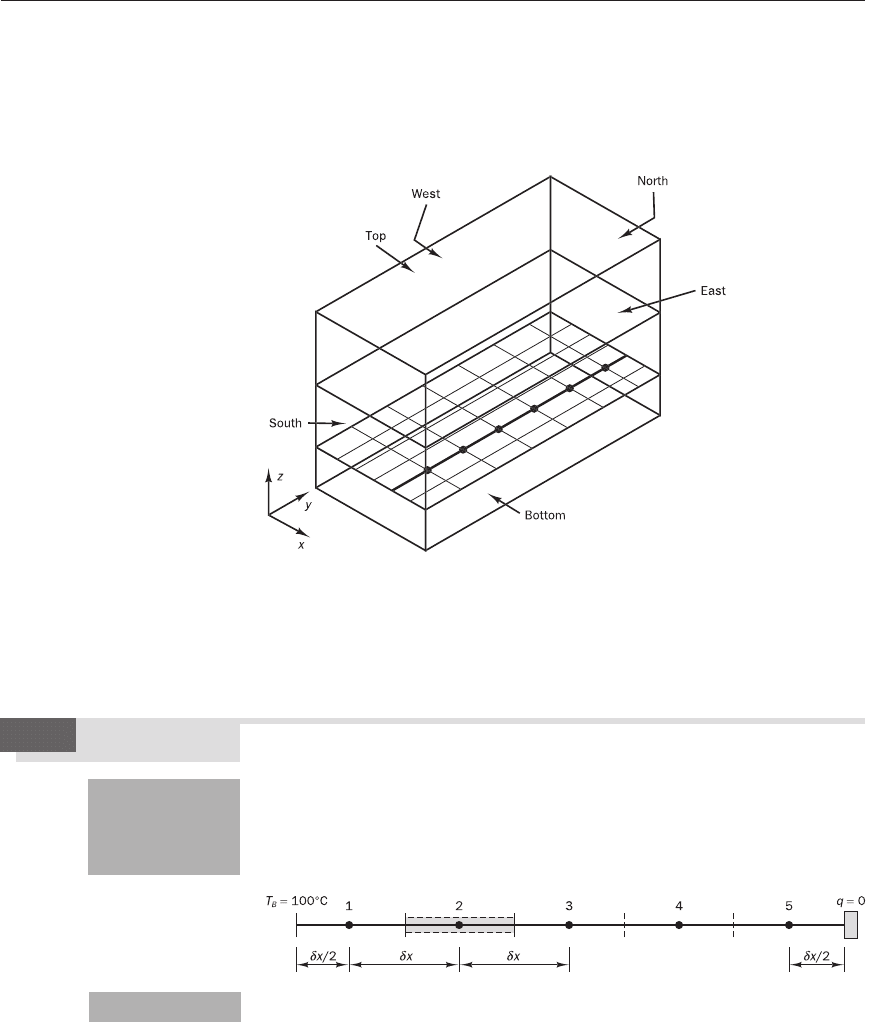
Figure 7.3 The grid for
Example 7.1
The values at W and E as well as those at B and T on the right hand side of
Equation (7.9) are considered to be temporarily known. Using the TDMA,
values of
φ
along a selected north–south line are computed. The calculation
is moved to the next line and subsequently swept through the whole plane
until all unknown values on each line have been calculated. After completion
of one plane the process is moved on to the next plane.
Figure 7.2 Application of the
TDMA in a three-dimensional
geometry
In two- and three-dimensional computations the convergence can often
be accelerated by alternating the sweep direction so that all boundary
information is fed into the calculation more effectively. To solve along an
east–west line in the present three-dimensional case the discretised equation
is rearranged as follows:
−a
W
φ
W
+ a
P
φ
P
− a
E
φ
E
= a
S
φ
S
+ a
N
φ
N
+ a
B
φ
B
+ a
T
φ
T
+ b (7.10)
We consider the one-dimensional steady state conductive/convective heat
transfer from a bar of material discussed first in Example 4.3 of section 4.3. The
geometry is shown in Figure 7.3. The temperature on the left hand boundary
is taken to be 100°C and the right hand side boundary is insulated so the heat
flux across it is zero. Heat is lost to the surroundings by convective heat
transfer. Solve the matrix equation (4.49) for this problem using the TDMA.
The matrix equation found in section 4.3 was
G20 −5000JG
φ
1
JG1100J
H−515−500KH
φ
2
KH100K
H 0 −515−50KH
φ
3
K = H 100K (4.49)
H 00−515−5KH
φ
4
KH100K
I 000−510LI
φ
5
LI100L
The general form of the equation used in the TDMA is
−
β
j
φ
j−1
+ D
j
φ
j
−
α
j
φ
j+1
= C
j
(7.2)
Examples7.5
Solution
Example 7.1
An illustration
of the TDMA in
one dimension
ANIN_C07.qxd 29/12/2006 04:48PM Page 216