
Versteeg H., Malalasekra W. An Introduction to Computational Fluid Dynamics: The Finite Volume Method
Подождите немного. Документ загружается.

11.8 DISCRETISATION OF THE DIFFUSION TERM 317
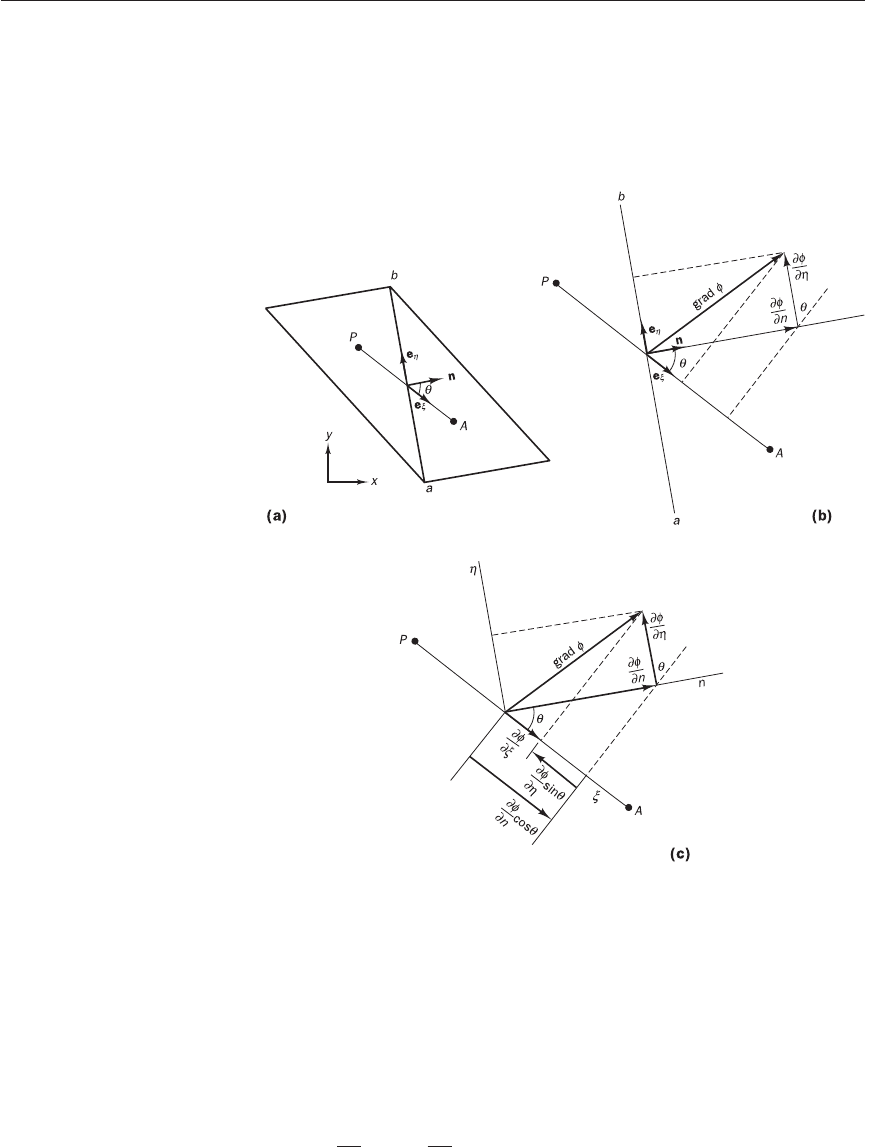
Before developing an expression for the cross-diffusion term, we note that
the central difference on the right hand side of Equation (11.8) is of course
only actually an approximation of
∂φ
/
∂ξ
, whereas the left hand side actually
requires n . grad
φ
=
∂φ
/
∂
n. If the mesh is orthogonal
∂φ
/
∂ξ
=
∂φ
/
∂
n and
the central difference approximation is correct, but if the mesh is non-
orthogonal
∂φ
/
∂ξ
may be very different from
∂φ
/
∂
n.
Figure 11.17 Definition sketch
for evaluation of cross-diffusion
term
Figures 11.17b–c show that
∂φ
/
∂ξ
corresponds to the length of the pro-
jection of vector grad
φ
in the direction of
ξ
. Using the expression (11.9) we
can also represent grad
φ
as the vector sum of the two components (
∂φ
/
∂
n)n
and (
∂φ
/
∂η
)e
η
, as shown in Figure 11.17b. To get an improved estimate for
the normal flux n . grad
φ
=
∂φ
/
∂
n we examine the relationship between the
projection of grad
φ
in the direction of
ξ
, i.e.
∂φ
/
∂ξ
, and the projections
in that direction of the two components (
∂φ
/
∂
n)n . e
ξ
and (
∂φ
/
∂η
)e
η
. e
ξ
of
grad
φ
. Figure 11.17 illustrates how the lengths of the projections of the
two component vectors can be calculated if the angle between the n- and
ξ
-
directions is denoted by
θ
:
n . e
ξ
= cos(
θ
) (11.13)
∂φ
∂
n
∂φ
∂
n
ANIN_C11.qxd 29/12/2006 04:43PM Page 317
and
e
η
. e
ξ
= − sin(
θ
) (11.14)
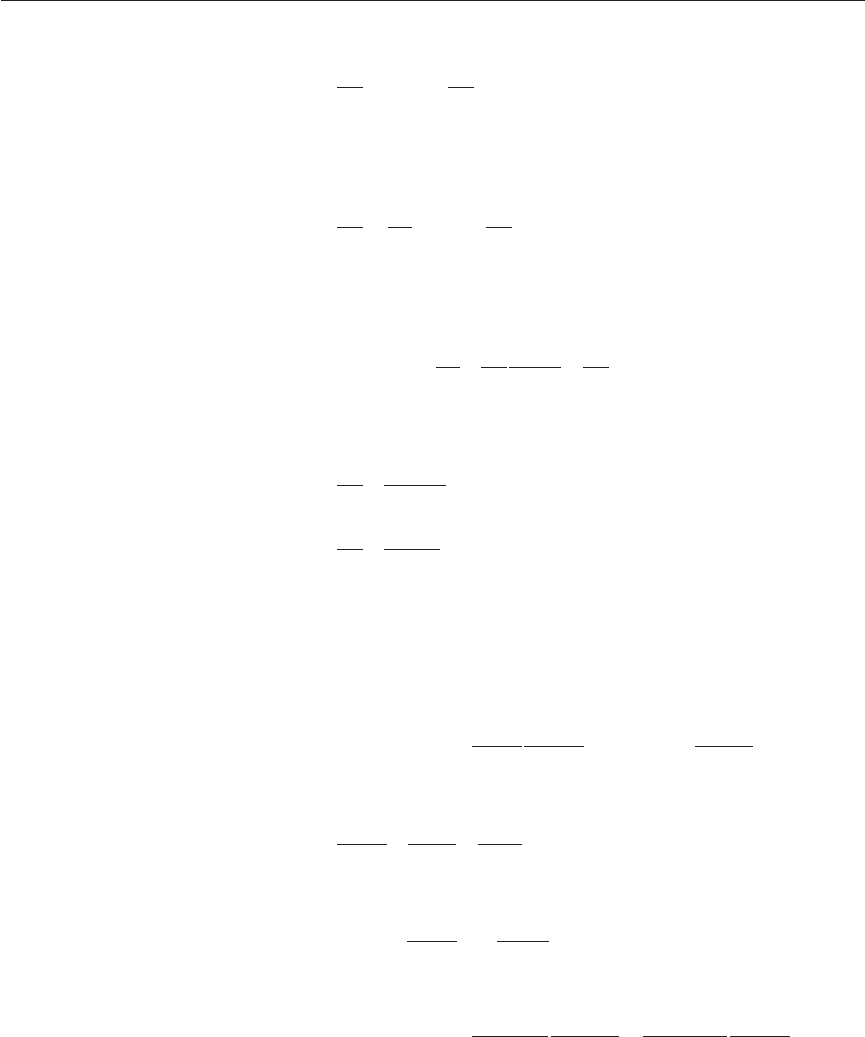
The magnitude of the component of grad
φ
in the direction of
ξ
is just
∂φ
/
∂ξ
,
which is also equal to the sum of the two projections (11.13) and (11.14).
Hence,
= cos(
θ
) − sin(
θ
) (11.15)
We remember that n . grad
φ
=
∂φ
/
∂
n and rearrange (11.15) to obtain the
following expression for the normal component of the diffusive flux required
in equation (11.8):
n . grad
φ
== +tan(
θ
) (11.16)
The two gradients of the transported quantity
φ
on the right hand side of
expression (11.16) may both be approximated using central differencing:
= (11.17)
= (11.18)
where ∆
ξ
= d
PA
is the distance between points A and P
and ∆
η
= d
ab
is the distance between vertices a and b (=∆A
i
)
In the literature
∂φ
/
∂ξ
and
∂φ
/
∂η
are called the direct gradient and cross-
diffusion, respectively. Substitution of central difference approximations
(11.17) and (11.18) into equation (11.16) yields
n . grad
φ
∆A
i
=+∆A
i
tan(
θ
) (11.19)
It is straightforward to see in Figure 11.17 that
== (11.20)
and
tan(
θ
) ==− (11.21)
Thus, (11.19) can be written in vector form as follows:
n . grad
φ
∆A
i
=− (11.22)
Direct gradient term Cross-diffusion term
The factors n . n∆A
i
/n . e
ξ
and e
ξ
. e
η
∆A
i
/n . e
ξ
can be calculated from
the grid geometry. An alternative derivation to obtain equation (11.22) is
presented in Appendix F.
φ
b
−
φ
a
∆
η
e
ξ
. e
η
∆A
i
n . e
ξ
φ
A
−
φ
P
∆
ξ
n . n∆A
i
n . e
ξ
e
ξ
. e
η
n . e
ξ
sin(
θ
)
cos(
θ
)
n . n
n . e
ξ
1
n . e
ξ
1
cos(
θ
)
φ
b
−
φ
a
∆
η
φ
A
−
φ
P
∆
ξ
∆A
i
cos(
θ
)
φ
b
−
φ
a
∆
η
∂φ
∂η
φ
A
−
φ
P
∆
ξ
∂φ
∂ξ
∂φ
∂η
1
cos(
θ
)
∂φ
∂ξ
∂φ
∂
n
∂φ
∂η
∂φ
∂
n
∂φ
∂ξ
∂φ
∂η
∂φ
∂η
318 CHAPTER 11 METHODS FOR DEALING WITH COMPLEX GEOMETRIES
1
4
4
2
4
4
3
1
4
4
2
4
4
3
ANIN_C11.qxd 29/12/2006 04:43PM Page 318
11.8 DISCRETISATION OF THE DIFFUSION TERM 319
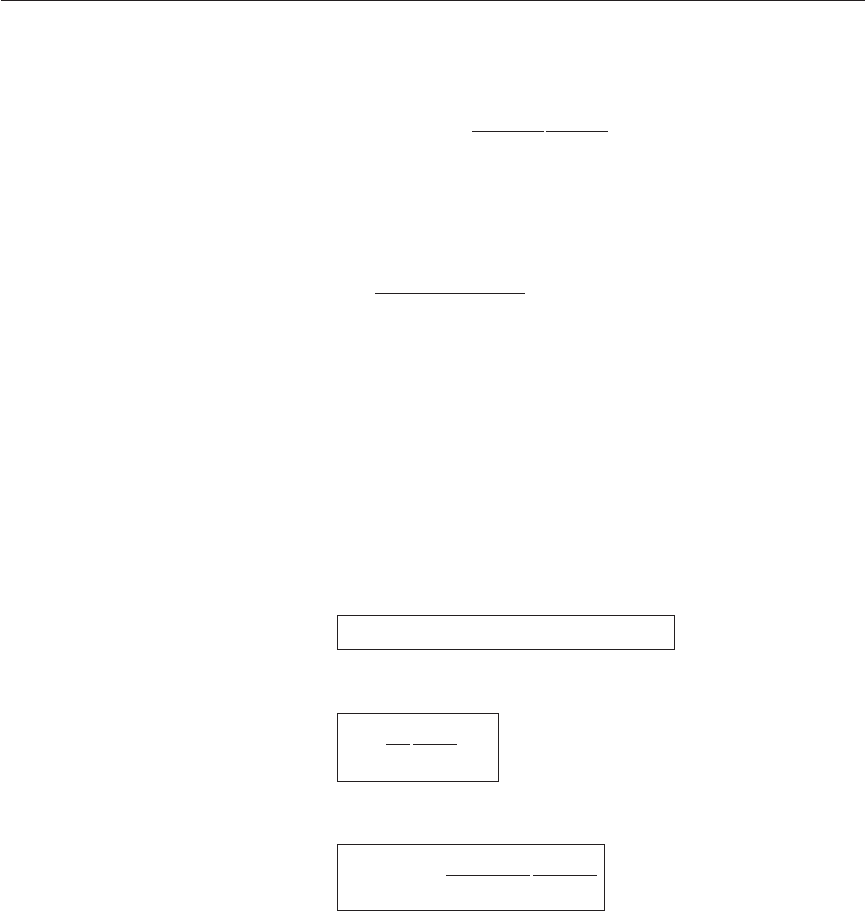
Usually the cross-diffusion term is treated as a source term in the discret-
ised form. Therefore separating the cross-diffusion term equation (11.22) is
written as
n . grad
φ
∆A
i
=+S
D-cross
(11.23)
To evaluate the cross-diffusion term the gradient of
φ
along the line ab is
required. There are number of methods used for this calculation. One possibil-
ity is to interpolate nodal values of
φ
to calculate
φ
a
and
φ
b
and use them to cal-
culate the gradient. Simple averaging over neighbouring nodes would lead to
φ
a
= (11.24)
where N is the number of nodes surrounding the vertex a. Alternatively a
distance-weighted average may be used, which is more accurate but more
expensive to compute.
The gradient reconstruction methods described in the next section could
also be used to evaluate the gradient at vertices, and then linear interpolation
may be used to get the gradient at the face centre.
It can be seen that when the grid is orthogonal the unit vector e
ξ
and
the unit normal n are the same. Moreover, unit vectors e
ξ
and e
η
are per-
pendicular, so their dot product is zero and, hence, the cross-diffusion term
in equation (11.22) vanishes. Now, the flux is given by equation (11.8).
In summary, for unstructured grids the diffusion flux through each
control volume face is evaluated as follows:
n . Γ grad
φ
∆A
i
= D
i
(
φ
A
−
φ
P
) + S
D-cross,i
(11.25)
where
D
i
= ∆A
i
and
S
D-cross,i
=−Γ
It should be noted that the diffusive flux parameter D
i
has dimensions (kg/s)
of a mass flow rate. This is different from the diffusion conductance D
(units kg/m
2
.s) that was used in Chapters 4 to 6, since D
i
includes the
control surface element area ∆A
i
.
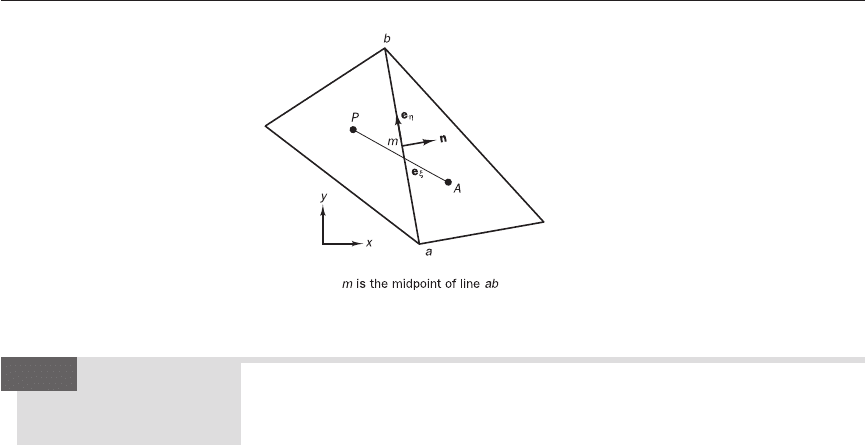
Figure 11.18 shows that there is a further error term due to the fact that
the central differences involved in the control surface element integration are
only second-order accurate if they are evaluated using the midpoint value of
n . grad
φ
∆A
i
. This is not the case if the lines PA and ab do not intersect at
the midpoint m of ab when the grid is non-orthogonal. This error increases
with increasing skewness and aspect ratio, so it is important that every effort
is made to control skew and aspect ratios in unstructured grids.
φ
b
−
φ
a
∆
η
e
ξ
. e
η
∆A
i
n . e
ξ
n . n
n . e
ξ
Γ
∆
ξ
φ
P
+
φ
A
+
φ
B
+ ...
N
φ
A
−
φ
P
∆
ξ
n . n∆A
i
n . e
ξ
ANIN_C11.qxd 29/12/2006 04:43PM Page 319
320 CHAPTER 11 METHODS FOR DEALING WITH COMPLEX GEOMETRIES
Figure 11.18 Geometric
sketch for skewed grid with
misalignment between midpoint
m of line ab and intersection
point of lines PA and ab
The convective term of equations (11.4) and (11.6) is
n
i
. (
ρφ
u)dA (11.26)
The area integral is evaluated as a sum of integrals over all control surface
elements ∆A
i
. Each of these integrals is approximated by the dot product
of the outward unit normal vector n
i
and a representative convective flux
vector (
ρφ
u) multiplied by control surface element area ∆A
i
. We define con-
vective flux parameter F
i
, which is equal to the mass flow rate normal to the
surface element:
F
i
= n
i
. (
ρ
u)dA ≅ n
i
. (
ρ
u)∆A
i
(11.27)
Again we note that the units of the convective flux parameter F
i
are those of
a mass flow rate (kg/s), in contrast to the dimensions of the convective mass
flux per unit area F used throughout Chapters 5 and 6, which has units
kg/m
2
.s.
The last step in equation (11.27) involves an approximation of the inte-
grand by means of a single representative velocity. A second-order accurate
calculation of F
i
using a single value is midpoint rule integration, which
requires the velocity vector u at the centre of the face i. In staggered grid
arrangements the face velocities are available from the momentum equation
and stored at face centres. On the other hand, in co-located grids it is neces-
sary to use interpolated face velocity components for the calculation of mass
flux through the face. Special interpolation techniques are employed to over-
come the ‘checker-board’ pressure problem for a co-located arrangement.
We postpone discussion of these details until section 11.14.
On the assumption that we somehow have a suitable interpolated value
for the face velocity we can write the convective flux of transported quantity
φ
across the control surface in terms of the product as F
i
φ
i
:
n
i
. (
ρφ
u)dA = F
i
φ
i
(11.28)
where
φ
i
is the value of
φ
at the centre of surface area element i.
∑
all surfaces
∆A
i
∑
all surfaces
∆A
i
∆A
i
∑
all surfaces
Discretisation
of the convective
term
11.9
ANIN_C11.qxd 29/12/2006 04:43PM Page 320
11.9 DISCRETISATION OF THE CONVECTIVE TERM 321
As before, we also need to develop methods to generate face centre values
φ
i
of the transported quantity which satisfy the requirements of conserva-
tiveness, boundedness and transportiveness that were formulated in Chapter
5. It should be noted that the treatment for general flow variable
φ
is also
applicable to velocity components u, v and w without change.
Upwind differencing scheme in unstructured grids
To calculate the convective flux we may utilise the upwind approach, which
was introduced in section 5.6. The convective flux is F
i
φ
i
:
For F
i
> 0
φ
i
=
φ
P
For F
i
< 0
φ
i
=
φ
A
This is exact if the flow vector u is also in the direction of PA (see Figure 11.15).
In a general situation the velocity vector may or may not be in the direction
of PA. We have also established in earlier discussions that when the flow
vector is not in the direction of discretisation (i.e. PA) the upwind scheme
gives false diffusion. This strongly suggests that we should consider using
a higher-order scheme or a TVD scheme for the calculation of the convec-
tive flux.
Higher-order differencing schemes in unstructured grids
Recall that in 1D Cartesian grids the linear upwind differencing scheme
given by equation (5.65) is
φ
e
=
φ
P
+∆x
where (
φ
P
−
φ
W
)/∆x is the gradient at P and ∆x/2 is distance from P to the
face e. The scheme uses an upwind-biased estimate of the gradient at P to
calculate the face value
φ
i
=
φ
e
. This can be extended formally to unstructured
meshes by using a Taylor series expansion of
φ
about the centroid P:
φ
(x, y) =
φ
P
+ (∇
φ
)
P
. ∆r + O (|∆r |
2
) (11.29)
where (∇
φ
)
P
is the gradient of
φ
at point P.
If we take ∆r as the distance vector from P to the face (see Figure 11.15)
then the face value of the transported quantity
φ
can be evaluated by means
of
φ
i
=
φ
P
+ (∇
φ
)
P
. ∆r (11.30)
Equation (11.29) indicates that the magnitude of the neglected terms is
proportional to the square of the distance between node P and the face i, so
this is a second-order approximation.
To use equation (11.30) in an unstructured grid to calculate
φ
i
we need
∇
φ
at the point P. In the literature there are several methods available to
calculate this quantity. One popular method is to use the so-called least-
squares gradient reconstruction at P.
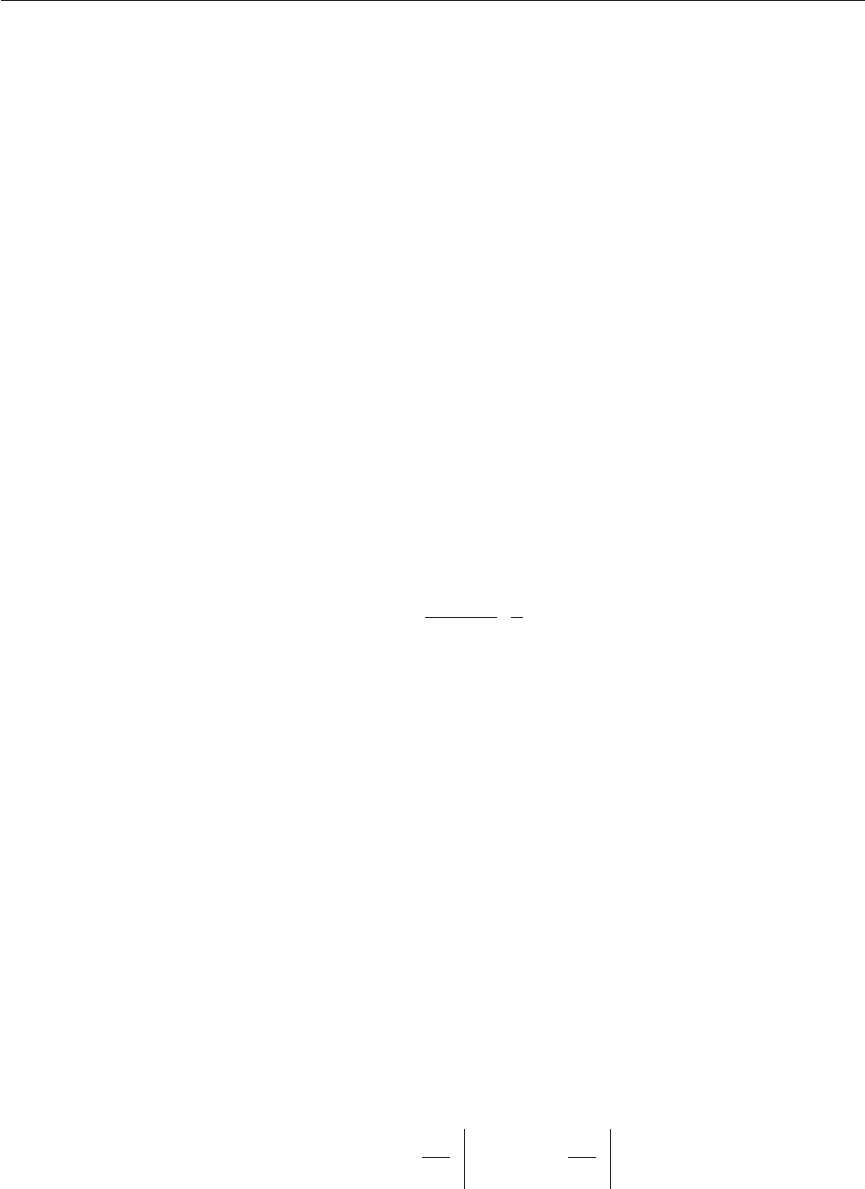
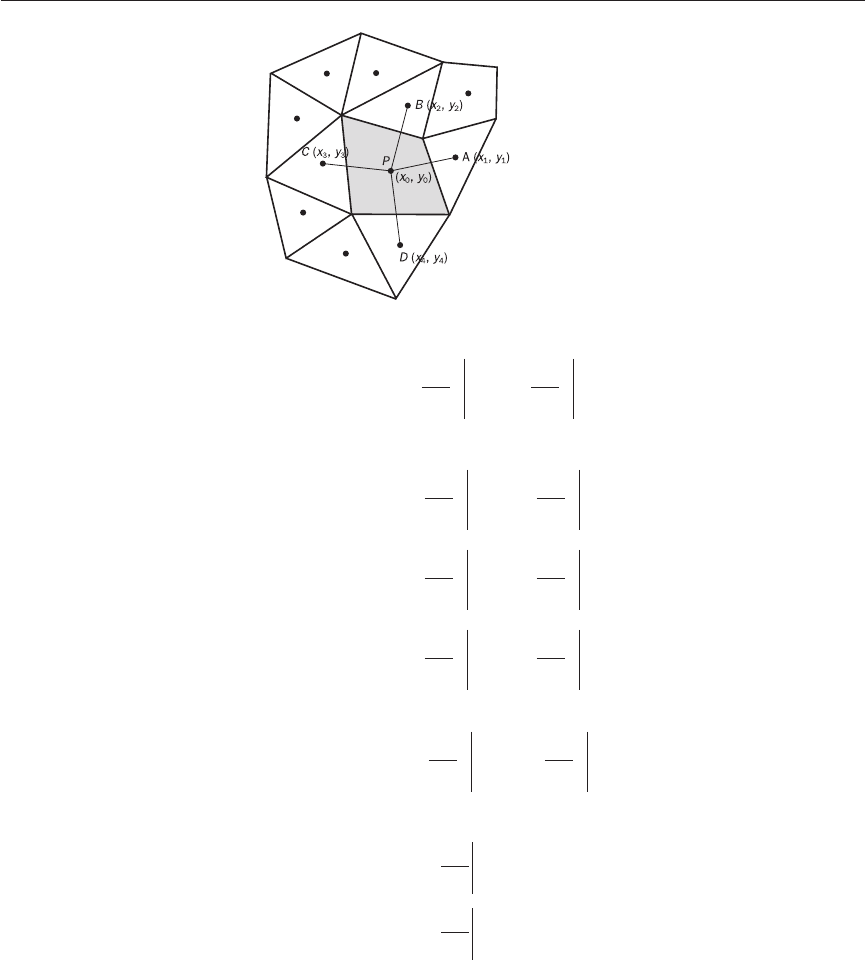
Referring to Figure 11.19, the values of the transported quantity
φ
at each
node surrounding the centre may be expressed as follows:
φ
i
=
φ
0
+
0
(x
i
− x
0
) +
0
(y
i
− y
0
) (11.31)
D
E
F
∂φ
∂
y
A
B
C
D
E
F
∂φ
∂
x
A
B
C
1
2
D
E
F
φ
P
−
φ
W
∆x
A
B
C
ANIN_C11.qxd 29/12/2006 04:43PM Page 321
322 CHAPTER 11 METHODS FOR DEALING WITH COMPLEX GEOMETRIES
Figure 11.19 A control volume
and its neighbour nodes
Written in another form
φ
i
=
φ
0
+
0
∆x
i
+
0
∆y
i
(11.32)
For each node surrounding ‘0’ we have
φ
1
−
φ
0
=
0
∆x
1
+
0
∆y
1
(11.33a)
φ
2
−
φ
0
=
0
∆x
2
+
0
∆y
2
(11.33b)
φ
3
−
φ
0
=
0
∆x
3
+
0
∆y
3
(11.33c)
φ
N
−
φ
0
=
0
∆x
N
+
0
∆y
N
(11.33n)
This set of equations can be assembled into a matrix equation as follows:
G∆x
1
∆y
1
JG J G
φ
1
−
φ
0
J
H∆x
2
∆y
2
KH K H
φ
2
−
φ
0
K
H∆x
3
∆y
3
KH K = H
φ
3
−
φ
0
K (11.34)
HKH K H K
I∆x
N
∆y
N
LI L I
φ
N
−
φ
0
L
This represents an overdetermined system of linear equations, in the form
AX = B, which may be solved for X = [
∂φ
/
∂
x|
0
∂φ
/
∂
y|
0
] using the least-squares
approach. Multiplying both sides of the equation by transpose A
T
we obtain
A
T
AX = A
T
B (11.35)
Then A
T
A becomes a 2 × 2 matrix that can be easily inverted to solve for X.
Since matrix A depends on geometry only, this calculation needs to be done
once for each node. The required gradient vector is obtained from
X = (A
T
A)
−1
A
T
B (11.36)
D
E
F
∂φ
∂
y
A
B
C
D
E
F
∂φ
∂
x
A
B
C
D
E
F
∂φ
∂
y
A
B
C
D
E
F
∂φ
∂
x
A
B
C
D
E
F
∂φ
∂
y
A
B
C
D
E
F
∂φ
∂
x
A
B
C
D
E
F
∂φ
∂
y
A
B
C
D
E
F
∂φ
∂
x
A
B
C
D
E
F
∂φ
∂
y
A
B
C
D
E
F
∂φ
∂
x
A
B
C
0
0
∂φ
∂
y
∂φ
∂
x
ANIN_C11.qxd 29/12/2006 04:43PM Page 322
11.9 DISCRETISATION OF THE CONVECTIVE TERM 323
Anderson and Bonhaus (1994) commented that this procedure can be very
inaccurate when the grid is highly stretched. For such applications these
authors recommended the QR decomposition method. Details of the QR
decomposition method can be found in Golub and Van Loan (1989). Further
details on gradient reconstruction can be found in Haselbacher and Blazek
(2000).
TVD schemes in unstructured grids
The concept of TVD schemes for the calculation of convective fluxes was
introduced in Chapter 5. As explained there, higher-order schemes such as
QUICK can be accommodated in the TVD framework, which is the most
general form of discretisation scheme. Darwish and Moukalled (2003) have
provided a detailed discussion on the use of TVD schemes in unstructured
meshes. Here we summarise their development.
In the usual notation for Cartesian grids it was shown, in section 5.10, that
for the positive flow direction, the face value of
φ
using a TVD scheme may
be written as
φ
i
=
φ
P
+ (
φ
E
−
φ
P
) (11.37)
where r is the ratio of the upwind-side gradient to the downwind-side gradi-
ent given by
r = (11.38)
Here E is the downstream node and W is the upstream node. In relation to a
face of an unstructured cell A is equivalent to E .
However, in unstructured grid arrangements the value of r cannot be
written in the same way because the upstream nodal value (assuming flow
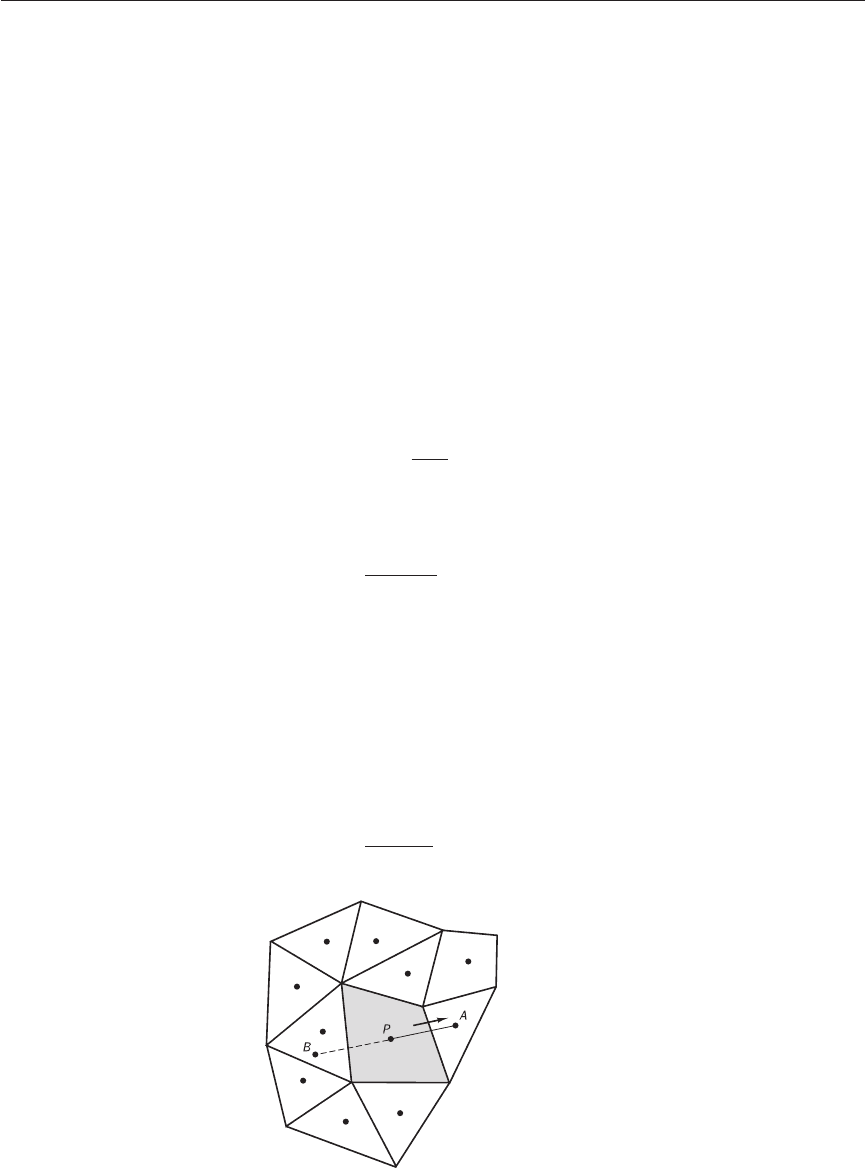
is positive along P to A) equivalent to W is not available. We need to con-
struct an upstream ‘dummy’ node B as shown in Figure 11.20 to be able to use
the standard approach. Details of such procedures can be found in Whitaker
et al. (1989) and Cabello et al. (1994). The value
φ
B
at dummy node B might
be calculated by averaging over nearby nodal values. Thus, if
φ
B
was available
r = (11.39)
φ
P
−
φ
B
φ
A
−
φ
P
φ
P
−
φ
W
φ
E
−
φ
P
ψ
(r)
2
Figure 11.20 Upwind dummy
node reconstruction for higher-
order schemes
ANIN_C11.qxd 29/12/2006 04:43PM Page 323
324 CHAPTER 11 METHODS FOR DEALING WITH COMPLEX GEOMETRIES
Figure 11.21 Selection of
upstream and downstream nodes
depending on flow direction
Treatment of
source terms
Finally the source term in equation (11.4) is treated in the same way as we
did in Cartesian coordinates:
SdV = D∆V (11.43)
where ∆V is the volume of the control volume
D is the average of S over the control volume
A second-order accurate approximation of integral (11.43) is obtained
using the midpoint rule, which replaces the average D by the nodal value
of the source function S evaluated at the centroid of the control volume.
The source term is introduced to the discretised equation as before by using
D∆V = S
u
− S
p
φ
P
. In 2D the volume is the area of the cell multiplied by
unit dimension in the direction normal to the 2D plane. In 3D ∆V is the vol-
ume of the control volume and can be calculated using standard geometrical
relationships and vector algebra. Kordula and Vinokur (1983), for example,
give a method to calculate volumes in an efficient manner.
CV
In the absence of
φ
B
, Darwish and Moukalled (2003) recommend
r =−1 (11.40)
Here r
PA
is the distance vector between nodes P and A. The flow can be from
P to A or from A to P. To generalise the above expression we should adopt
the notation ‘U’ for upstream and ‘D’ for downstream:
r =−1 (11.41)
The TVD expression for convective flux can also be written as
φ
i
=
φ
U
+ (
φ
D
−
φ
U
) (11.42)
where U denotes the upstream node and D denotes the downstream node.
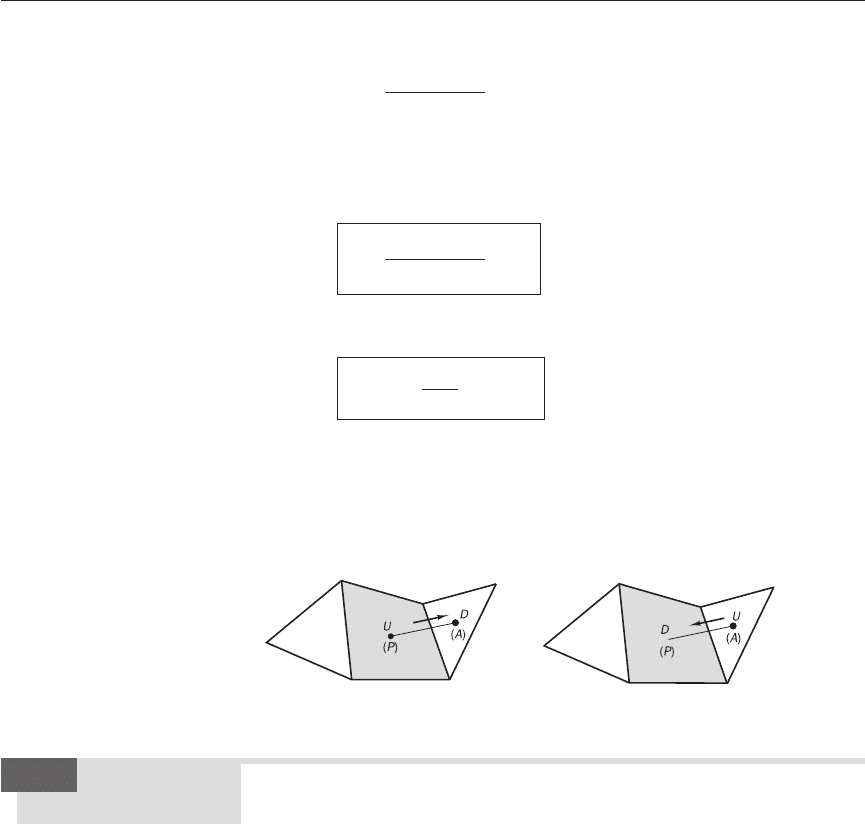
Depending on the direction of the flow vector along the line joining centroids
of the cells, the upstream and downstream points have to be selected appro-
priately and allocated to P and A: see Figure 11.21. The interested reader
should consult Darwish and Moukalled (2003) for further details.
ψ
(r)
2
J
K
L
(2∇
φ
P
. r
PA
)
φ
D
−
φ
U
G
H
I
J
K
L
(2∇
φ
P
. r
PA
)
φ
A
−
φ
P
G
H
I
11.10
ANIN_C11.qxd 29/12/2006 04:43PM Page 324

11.11 ASSEMBLY OF DISCRETISED EQUATIONS 325
The diffusion flux through a face is
D
i
(
φ
A
−
φ
P
) + S
D-cross,i
(11.44)
Using a TVD scheme for convective flux and treating the TVD contribution
as deferred correction as outlined in Chapter 5, the convective flux through
a face is
F
i
[
φ
U
+
ψ
(r)(
φ
D
−
φ
U
)/2] (11.45)
The source term for the volume is
S
u
+ S
p
φ
P
(11.46)
When these are substituted into steady flow equation (11.4)
n . (
ρφ
u)dA = n . (Γ grad
φ
)dA + S
φ
dV (11.47)
we obtain
F
i
[
φ
U
+
ψ
(r)(
φ
D
−
φ
U
)/2] = [D
i
(
φ
A
−
φ
P
) + S
D-cross,i
]
+ (S
u
+ S
p
φ
P
) (11.48)
In the above equation A stands for the centroid of each control volume
surrounding the point P. For the convective terms U and D have to be
appropriately allocated to P and A depending on the flow direction across the
face. The use of vector algebra in the derivation of the relevant equations,
in conjunction with the definitions of the unit normal vectors and velocity
vectors, takes care of the flow direction. We automatically recover the correct
magnitude and sign of F
i
.
The above equation can be rearranged as
a
P
φ
P
=∑a
nb
φ
nb
+ S
u
+ S
DC
u
+∑S
D-cross,i
(11.49)
where a
P
=∑a
nb
− S
P
+∑F
i
Here S
u
DC
is a source term arising from deferred corrections from TVD or
higher-order schemes (see section 5.10). ∑S
D-cross,i
is the source term due to
cross-diffusion and ∑F
i
is the mass imbalance over all faces. Note that the
system of equations arising from the discretisation process is no longer a
banded matrix, since, depending on the shape of the control volume, the
nodes for transported quantity
φ
may be connected to an arbitrary number
of neighbouring nodes in an unstructured mesh. Solution of the system
therefore requires techniques such as the multigrid method described in
Chapter 7 or the conjugate gradient method.
Application of the unstructured equations to Cartesian grids
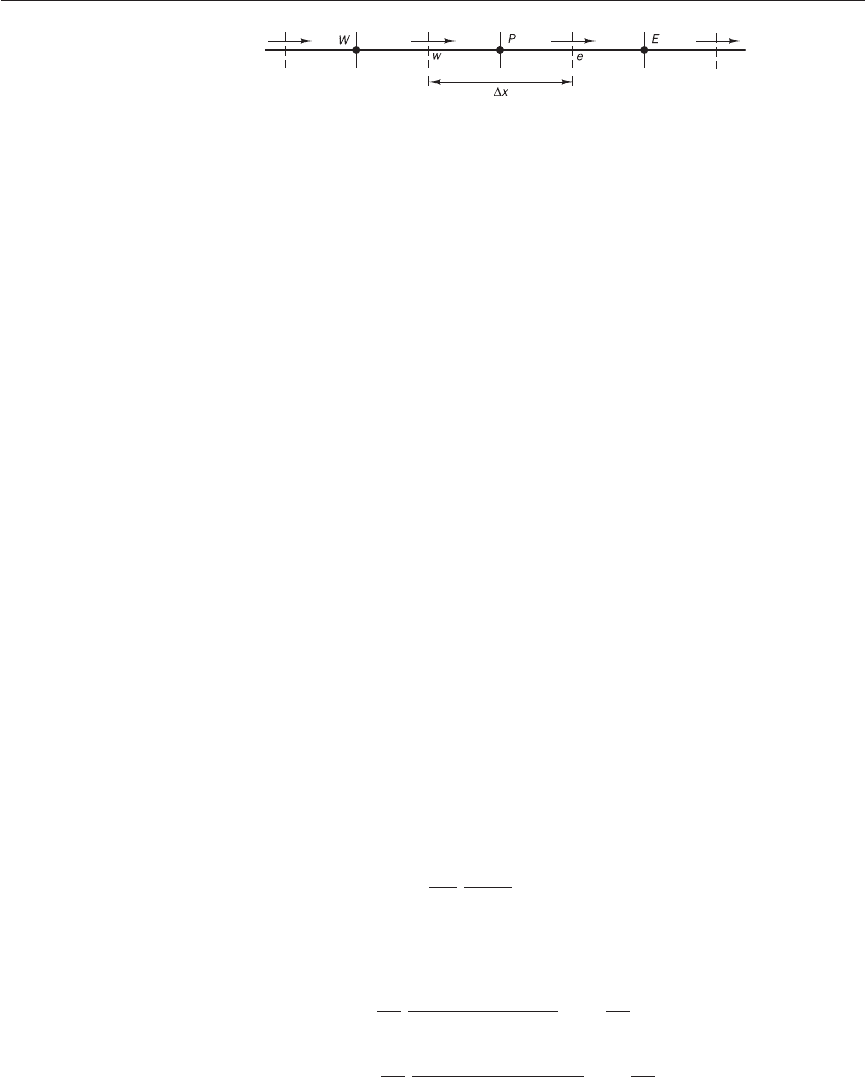
We solve a source-free 1D convection–diffusion problem shown in Fig-
ure 11.22 using upwind differencing to demonstrate that we can recover
the Cartesian discretised equations presented in section 5.6 from equation
(11.48).
∑
all surfaces
∑
all surfaces
CV
A
A
Assembly of
discretised
equations
11.11
ANIN_C11.qxd 29/12/2006 04:43PM Page 325
326 CHAPTER 11 METHODS FOR DEALING WITH COMPLEX GEOMETRIES
Figure 11.22 A 1D fluid flow
problem
The essential parameters used in equation (11.48) are control volume width
=∆x, the distance between nodes ∆
ξ
=∆x. For equally spaced control vol-
umes the distance between nodes is the same, i.e. ∆x
PE
=∆x
WP
=∆x. The
outward normal vector for the east face is
n
e
= 1i + 0j
The vector e
ξ
for the line PE is
e
PE
= 1i + 0j
and the area of the east face is
∆A
e
= 1.0
The outward normal vector for the west face is
n
w
=−1i + 0j
The vector e
ξ
for the line PW is
e
PW
=−1i + 0j
The area of the west face is
∆A
w
= 1.0
and the convection velocity vector is
u = ui + 0j
We use the standard notation for fluid properties adopted in the previous
chapters: the diffusion coefficient is denoted by Γ and the density by
ρ
.
Since the faces of the control volumes are perpendicular to the lines
joining nodes, no cross-diffusion terms arise in this orthogonal grid. Hence,
S
D-cross
= 0 and there is no source term. Thus, the diffusion flux is given by
(11.22):
n . Γ grad
φ
∆A
i
= D
i
(
φ
A
−
φ
P
)
where D
i
=∆A
i
Diffusion flux parameters D
i
for the west and east faces from equation
(11.24) are
D
e
= 1.0 ==D
D
w
= 1.0 ==D
The mass flow rate through the east face is
F
e
=
ρ
(1i + 0j) . (ui + 0j)1.0 =
ρ
u = F
Γ
∆x
(−1i + 1j) . (−1i + 1j)
(−1i + 1j) . (−1i + 1j)
Γ
∆x
Γ
∆x
(1i + 0j) . (1i + 0j)
(1i + 0j) . (1i + 0j)
Γ
∆x
n . n
n . e
ξ
Γ
∆x
ANIN_C11.qxd 29/12/2006 04:43PM Page 326