
Versteeg H., Malalasekra W. An Introduction to Computational Fluid Dynamics: The Finite Volume Method
Подождите немного. Документ загружается.


10.5 VERIFICATION AND VALIDATION 297
(i) comprehensive documentation of problem geometry and boundary con-
ditions, (ii) detailed measurements of distributions of flow properties, such
as velocity components, static/total pressure, temperature etc., and (iii)
complementary overall measurements, e.g. mass flow rate, overall pressure
drop etc. Naturally, we should limit ourselves to information from trusted
sources to generate a sufficiently credible validation. Several public-access
databanks have now emerged to support CFD validation work. The most
prominent ones are:
• ERCOFTAC: http://ercoftac.mech.surrey.ac.uk/ – the leading
database with links to refereed experimental datasets and high-quality
CFD simulations including LES and DNS
• NASA: http://www.larc.nasa.gov/reports/reports.htm/ – NACA and
NASA reports in downloadable form
• Flownet: http://dataserv.inria.fr/flownet/ – EU database
• Overview of current validation resources:
http://www.cfd-online.com/Resources/refs.html
The following journals have been useful to authors in the past:
• Annual Review of Fluid Mechanics
• Journal of Fluid Mechanics
• AIAA Journal
• Journal of Fluids Engineering, Transactions of the ASME
• Journal of Heat Transfer, Transactions of the ASME
• International Journal of Heat and Mass Transfer
• International Journal of Heat and Fluid Flow
• Combustion and Flame
• Physics of Fluids
• Experiments in Fluids
• International Journal of Wind Engineering and Industrial Aerodynamics
• Journal of Power Engineering, Transactions of the ASME
• Journal of Turbomachinery, Transactions of the ASME
• Proceedings of the IMechE, Part C: Journal of Mechanical Engineering
Science
If suitable experimental results for a comprehensive validation are not avail-
able, it will be necessary to identify a dataset for a closely related problem. If
the problem chosen for validation is sufficiently close to the actual problem
to be studied, we should be able to apply roughly the same CFD approach in
both cases. However, we have already seen that some flow problems can be
very sensitive to apparently minor changes in the boundary conditions or
problem geometry. So care must be taken in the formulation of validation
cases, and past experience should play an important role in the justification
of the chosen approach.
In the absence of high-quality measurements, we may have to settle for
comparison of CFD output against other data in academic or industrial
journals. The Engineering Science Data Unit (ESDU) database also provides
a particularly comprehensive collection of carefully refereed engineering
design information with many fluid flow data items (http://www.esdu.com/
– readers should be aware that a subscription fee is payable for access to this
database). Finally, it should be noted that a sufficient level of confidence
in CFD simulations can only be achieved through rigorous verification
and validation. If the search for validation data draws a complete blank it is
ANIN_C10.qxd 29/12/2006 10:02 AM Page 297

essential that a reasonable programme of experimentation be undertaken
alongside CFD to provide solid foundations for design recommendations.
Our review of the subject has shown that the scope for errors and uncertainty
in the study of complex industrial systems with CFD is huge, due to the
large variety of user inputs and modelling choices that must be made. The pur-
pose of verification and validation activities is the quantification of errors and
uncertainty. Best practice guidelines, on the other hand, seek to define routes
to maximise the accuracy and level of confidence in CFD models within the
constraints of existing knowledge and available resources. We review the two
most influential sets of guidelines, AIAA (1998) and ERCOFTAC (2000),
which set out the main rules for the conduct of CFD modelling studies
with a view to confidence building in industrial applications. In the pre-
vious material of this section we have broadly followed the development
of the concepts of error, uncertainty, verification and validation in these
references. Here we highlight some further aspects of the two sets of guide-
lines that have not already been covered in this section.
AIAA guide (1998)
The AIAA guide was the first to be compiled and gives particular emphasis
to CFD in complex systems. It develops the foundations of quality assurance
and software engineering in CFD through cross-references with sources in
other fields and explains the approach to verification and validation for
confidence building in CFD results. In addition to this, two further issues
are raised that require careful attention:
• The AIAA guide notes that the processes of verification and validation
can only demonstrate satisfactory performance of a CFD code for
specific instances of its use through comparisons of the code output
with high-quality benchmark solutions and high-quality experiments.
This notion stems from the complexity of industrial fluid flow problems
and the wide range of numerical parameters that need to be selected as
user inputs to generate CFD results.
This cautious position implies that, given the present state of the art, it
is not possible to validate a CFD code for a new real-life industrial flow
problem without high-quality experimental data for this actual problem. In
our summary of validation we have suggested that we would probably be
confident of a satisfactory outcome of a CFD model of a new, real-life prob-
lem if we had demonstrated satisfactory performance in a case that is in some
sense sufficiently close. We believe that this is justifiable if there is a sub-
stantial peripheral knowledge base available, e.g. in the form of background
knowledge of the fundamentals of fluid dynamics and associated topics,
experimental data and operating experience with existing designs or similar
devices on the market. In an industrial setting this is often the case and can
be exploited to help decide which problem is sufficiently well understood
and close to a new flow problem to help with validation activities.
The AIAA guide also contains specific recommendations for the conduct
of modelling studies in cases with complex systems for which it is recognised
that it is impossible or too expensive to obtain high-quality data on the full
system. Below we summarise the approach:
298 CHAPTER 10 ERRORS AND UNCERTAINTY IN CFD MODELLING
Guidelines for
best practice
in CFD
10.6
ANIN_C10.qxd 29/12/2006 10:02 AM Page 298

10.6 GUIDELINES FOR BEST PRACTICE IN CFD 299
• The credibility of the predictions of a CFD model is directly affected
by the level of complexity of the problem to be tackled. Real-life flow
problems include many sources of complexity associated with multi-
dimensional and/or unsteady flow, geometric complexity, complex flow
physics and/or chemistry. It is unrealistic to expect the same level of
confidence for CFD models of very complex systems (aeroengine,
furnace etc.) and of simple unit problems (e.g. internal flow through
a straight pipe or orifice, external flow around an aerofoil or obstacle).
The AIAA guide suggests that a building block approach be applied
to the modelling of complex systems. The complexity of the full system
is reduced by decomposition into simpler sub-systems. This process
of complexity reduction is carried through in successive stages and
ends with the identification of a series of simple unit problems for
which high-quality experimental data are available and, therefore,
comprehensive validation is possible. Lessons learnt in connection
with the conduct of CFD simulations (numerical parameter choices,
meshing practice etc.) should be implemented as the study progresses
back upwards through the various stages of sub-systems in the direction
of increased complexity. At each stage CFD results are compared with
experimental data to refine the modelling approach, whilst taking note
that problem definition and measured data are likely to be less precise
as we approach the real-life flow system.
Thus, the AIAA guide provides a comprehensive strategy for the modelling
of complex industrial flow problems, which (i) builds on strong founda-
tions of well-validated simple unit problems, (ii) systematically increases
the complexity of the models, (iii) incorporates all learning experiences and
(iv) exploits the maximum number of opportunities for validation on the way
from simple unit problems to the full problem.
ERCOFTAC guidelines (2000)
The ERCOFTAC guidelines provide an authoritative set of best practice
rules for the conduct of less complex flow problems. The focus is on the pre-
diction of single phase fluid flow and heat transfer and methods to quantify
and minimise all sources of error and uncertainty. The document contains an
extended section on the application of classical turbulence models, i.e. those
based on Reynolds-averaged Navier–Stokes equations. The guide is aimed
at less experienced users, and its practical implementation in CFD modelling
is facilitated by the provision of extensive checklists. Moreover, eight case
studies are presented with application of the guidelines and demonstrations
of the achievable accuracy in flows ranging in complexity from a sudden pipe
expansion to a low-speed centrifugal compressor.
We would encourage all readers to strive to develop a high-quality CFD
approach based on the AIAA and ERCOFTAC guidelines and urge them
to consult both references and further industry-specific guidelines such
as MARNET-CFD (https://pronet.wsatkins.co.uk/marnet/guidelines/
guide.html), Chen and Srebric (2001, 2002) and Srebric and Chen (2002)
for more detailed advice. Moreover, we also draw attention to emerging
networks, such as QNET (http://www.qnet-cfd.net/) and eFluids (http://
www.efluids.com/), devoted to the dissemination of information relating to
fluid mechanics as well as best practice in CFD.
ANIN_C10.qxd 29/12/2006 10:02 AM Page 299

In order to open up CFD simulations to independent scrutiny within indus-
trial organisations it is essential to have a comprehensive and uniform system
of reporting. This is also useful as a basis for archiving simulations for future
use with the ultimate aim of preserving past learning experiences and spread-
ing best practice throughout groups of users within an organisation. First we
suggest a list of items necessary for documentation of user input.
Input documentation
• General description of the problem and purpose of CFD simulation
• Code chosen for solution of problem
• Computing platform used for run
• Schematic diagram of the region of interest with all key dimensions,
flow inlets and outlets
• Boundary conditions – include comments on/justifications of
assumptions made and known areas of approximation or lack of
information
• Initial conditions for transient flow simulations or field initialisations for
steady flow studies
• Fluid properties – include comments/justifications of assumptions and
data sources
• Modelling option selections: (i) laminar/turbulent + turbulence model +
near-wall treatment, (ii) combustion model, (iii) other physical models −
with comments/justifications on selections
• Grid design: temporal mesh, space mesh including one or more
diagrams of the grid that are sufficiently clear to illustrate the approach
to mesh design – also give written comments on compromises and
details of grid-independence study
• Solution algorithm choices – particularly non-default choices; note that
default settings may change as a CFD code evolves, so a comprehensive
summary of all the main selections (first/second-order schemes,
multigrid options, segregated/coupled solver etc.) is preferable for
long-term archiving
• Iterative convergence criteria choices: settings of truncation levels for
residuals and choice of additional target quantities for convergence
monitoring
• Brief summary of particular aspects of simulation design that required
special attention to get simulation to work and to get accurate results,
also noting unresolved problem issues
Next, we list items to assist scrutiny and confidence building in result
analysis and reporting.
Result interpretation and reporting
Alongside options for alphanumeric output, commercial CFD codes have
the ability to produce a wide variety of result visualisations, such as:
• Velocity vector plots
• Streaklines and particle paths
• Contour plots of flow variable
• Profile plots
300 CHAPTER 10 ERRORS AND UNCERTAINTY IN CFD MODELLING
Reporting/
documentation
of CFD simulation
inputs and results
10.7
ANIN_C10.qxd 29/12/2006 10:02 AM Page 300

10.7 REPORTING/DOCUMENTATION OF CFD SIMULATION 301
• Grid display
• View manipulation
It is important to note that high-quality presentation is not necessarily syn-
onymous with high-quality results. Less experienced users should not be
taken in by the power of the post-processing capabilities of a CFD code.
Before communicating the findings of a CFD study and drawing conclusions
it is essential that the quality of the results is checked thoroughly by verifica-
tion and validation. Below, we summarise the main elements to be checked
and documented:
• Verification study: give estimates of numerical errors. For high-accuracy
work all key target quantities should be shown to be independent of
iterative convergence criterion and mesh. Diagrams of spatial
distributions of residuals can help illustrate regions of unacceptably high
residuals even if global residuals are sufficiently low to indicate iterative
convergence. Identify where compromises were necessary if the results
are still grid dependent.
• Quantification of input uncertainty: the main problem is generally
specification of the boundary conditions; where necessary also consider
fluid properties.
• Validation study: summarise method used to validate CFD approach;
outline how the AIAA building block approach was applied if a complex
system is studied; give comments on how improved match with
experimental data was achieved by changes to the modelling strategy.
• Further confidence in the results can be built by analysis of the results
using basic knowledge of fluid dynamics and conservation laws. This
might involve consistency checks to identify where results are different
from expectations. An obvious check would be a test of global mass,
momentum, energy and species conservation by balancing the fluxes in
and out of the region of interest with the sum of all sources and sinks
inside the domain.
We have previously noted that time constraints and computer resources
often determine the acceptable degree of convergence of a CFD simulation.
This means that global conservation checks will not show exact balance of
all the relevant fluxes and rates of creation and destruction. However, a
significant departure from global conservation indicates problems.
Whilst we have made it clear that the only true quality check is validation,
it is advisable to apply a range of common-sense quality tests where new flow
problems are investigated. These can be based on a general understanding
of fluid mechanics and/or specific knowledge of the application that is being
studied. Here we give some items (trivial and profound) that might be
checked when the outcome of a CFD simulation is evaluated:
• Fluid flows from high to low pressure (in pressure-driven flows)
• Static pressure decreases when velocity increases (Bernoulli’s theorem
for inviscid flows)
• Friction losses cause a decrease of total pressure in the direction of flow
(viscous flow)
• Entropy must increase in the flow direction in a flow without heat
transfer (consequence of second law of thermodynamics)
• The speed of a fluid near a stationary wall is smaller than the speed
further away from the wall (boundary layer formation)
ANIN_C10.qxd 29/12/2006 10:02 AM Page 301

• Flow adopts a fully developed state after a sufficiently long distance in a
straight duct with constant cross-section
• Boundary layers rapidly separate under the influence of an adverse
pressure gradient (pressure increases in the direction of flow outside the
boundary layer)
• Flows will usually separate at corners
• If a flow separates there is always recirculation
• A flow emerging into a large expanse of fluid from a small hole generally
forms a jet
• Pressures are higher at the outside of a bend (or curved streamline) and
lower at the inside due to centrifugal forces
• Pressure increases with depth in a liquid due to gravity
• Heat flows from regions of high to low temperature
• Hot fluid rises and cold fluid sinks under the influence of gravity
• Turbulence is generated in regions with sheared flow, i.e. where velocity
gradients are high
It is obviously not possible to give a comprehensive list of items, and we
should aim to develop specific checks for the flow problem to be studied
based on our knowledge of fluid dynamics, heat transfer etc. and compre-
hensive research of the background to the problem.
Trust and confidence are essential issues in industrial applications of CFD
modelling. In this chapter we have defined:
• Errors: deficiencies in a CFD model that are not caused by lack of
knowledge
• Uncertainty: deficiencies in a CFD model that are caused by lack of
knowledge
The main sources of errors are:
• Numerical errors: roundoff, truncation of iterative sequences,
discretisation error
• Coding errors
• User errors
In our discussion of iterative convergence we have introduced the definition
of the most commonly used convergence indicator: the normalised global
residual. We have also touched on the importance of good mesh design for
the control of the level and distribution of discretisation errors.
The main sources of uncertainty are:
• Input uncertainty: model deficiencies associated with limited or
inaccurate knowledge of domain geometry, boundary conditions or fluid
properties
• Physical model uncertainty: model deficiencies due to limited accuracy
or lack of validity of submodels or simplifying assumptions
We have given examples of each of these sources of modelling error and
uncertainty and discussed their effect on CFD results. To quantify the
errors and uncertainty in CFD results we have defined the processes of
verification and validation:
302 CHAPTER 10 ERRORS AND UNCERTAINTY IN CFD MODELLING
Summary10.8
ANIN_C10.qxd 29/12/2006 10:02 AM Page 302

10.8 SUMMARY 303
• Verification: the process of determining the match between the CFD
results and the conceptual model of the fluid flow to quantify errors
• Validation: the process of determining the match between the CFD
results and the real flow problem to quantify uncertainty
Given the dominant contribution of discretisation errors in many practical
CFD simulations we have stressed the important role played by systematic
mesh refinement studies in the verification process, resulting in the follow-
ing estimates of error in a fine and coarse solution:
E
U,1
= (10.7a)
E
U,2
= r
p
(10.7b)
We have also introduced the grid convergence index proposed by Roache:
GCI
U
= F
S
E
U
(10.8)
and discussed his proposal to use the actual order T of discretisation error
decay, which can be obtained from a grid-refinement study using two
refinement levels (i.e. three grids):
T = ln
ln(r) (10.9)
We have outlined the crucial part played by validation and given pointers to
trusted, high-quality sources of experimental data that can be used for the
validation of CFD codes and models.
Finally, we have summarised brief extracts from the prominent AIAA
and ERCOFTAC guidelines for best practice in CFD, which have been
developed to help users get the best possible results out of CFD with avail-
able computing resources. We have also made some recommendations for
uniform reporting and documentation of CFD models and their results.
D
E
F
U
3
− U
2
U
2
− U
1
A
B
C
D
E
F
U
2
− U
1
1 − r
p
A
B
C
U
2
− U
1
1 − r
p
ANIN_C10.qxd 29/12/2006 10:02 AM Page 303
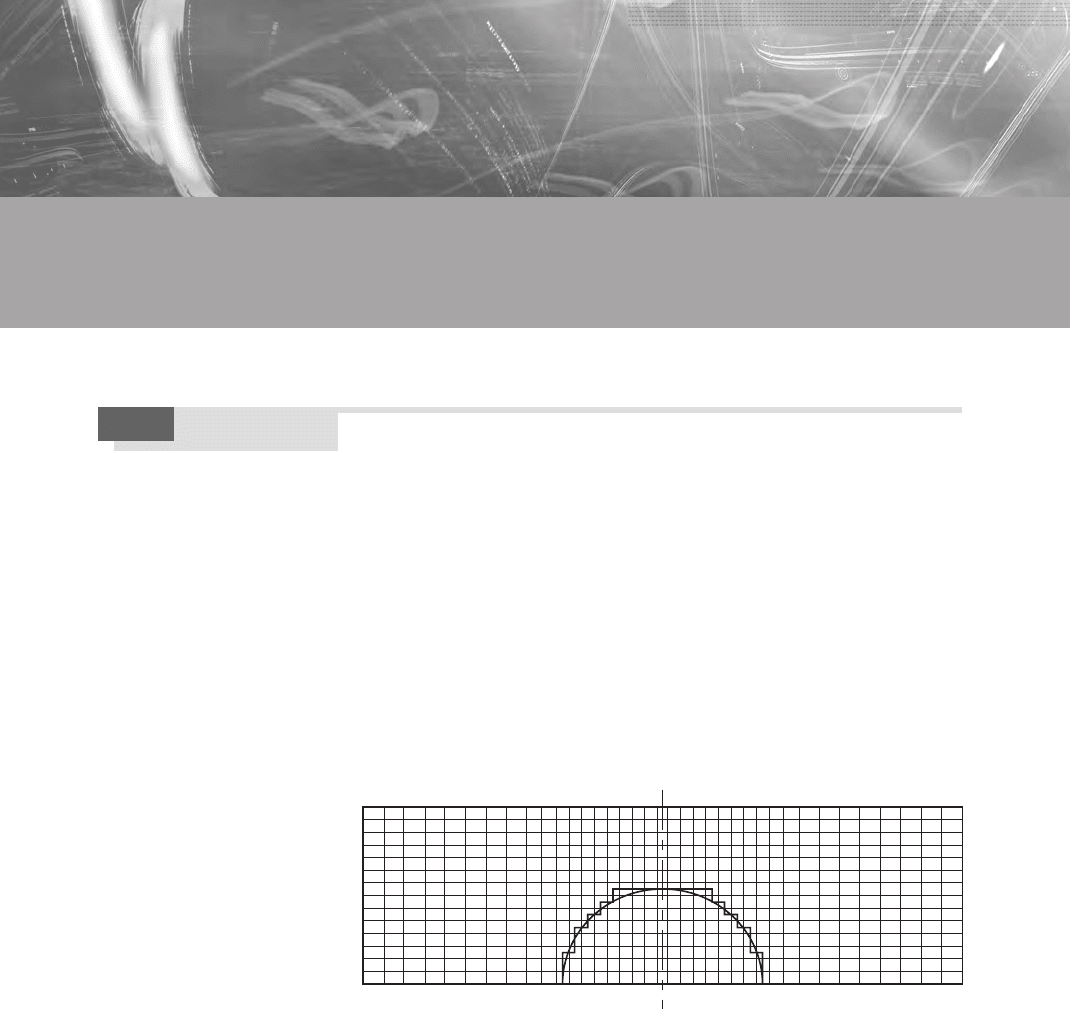
Techniques of solving fluid flow equations shown in earlier chapters were
based on discretisation procedures using the Cartesian co-ordinate system.
This is the simplest context, which allowed us to introduce the funda-
mentals of the finite volume method in a form that is easiest to understand.
Extension of the methods developed in Chapters 4 to 6 to other orthogonal
co-ordinate systems (cylindrical, axisymmetric three-dimensional or spher-
ical co-ordinates) is relatively straightforward, provided that we write down
the governing equations using the appropriate form of the div and grad
operators for the chosen co-ordinate system (see Bird et al. (2002) for relevant
operator definitions). However, many engineering problems involve com-
plex geometries that do not fit exactly in Cartesian co-ordinates or one of
the other systems. When the flow boundary does not coincide with the
co-ordinate lines of a structured grid, we could proceed by approximating
the geometry. This is illustrated in Figure 11.1, where we consider a two-
dimensional calculation of the flow past a half cylinder.
Chapter eleven Methods for dealing with
complex geometries
Introduction11.1
Figure 11.1 Cartesian grid
arrangement for the prediction
of flow over a half cylinder
The only way to represent the curved surface of the half cylinder in a
Cartesian co-ordinate system is to use a stepwise approximation. Such an
approximate boundary description is tedious and time consuming to set up.
Moreover, the cells inside the solid part of the cylinder do not take part in
the calculations, so they need to be blocked out, which represents a waste of
computer storage and resources. Finally, the stepwise representation of the
smooth cylinder wall introduces errors in the computation of wall shear
stresses, heat fluxes etc. These errors can be reduced by introducing a very
fine Cartesian mesh to cover the wall region, but the structure of grid lines
causes further wastage of computer storage due to unnecessary refinement in
interior regions where this is of minimal interest.
ANIN_C11.qxd 29/12/2006 04:43PM Page 304

11.2 BODY-FITTED GRIDS FOR COMPLEX GEOMETRIES 305
This example clearly shows that CFD methods based on Cartesian or
cylindrical co-ordinate systems have limitations in irregular geometries.
Practically important flows with complex geometry are plentiful and include
building configurations, furnaces, modern pent-roof combustion chambers
in internal combustion (IC) engines, intake and exhaust ports and flow pas-
sages, flow past aerofoils, gas turbine combustors, turbomachinery and many
more. In such cases it would obviously be much more advantageous to work
with grids that can handle curvature and geometric complexity more naturally.
CFD methods for complex geometries are classified into two groups:
(i) structured curvilinear grid arrangements and (ii) unstructured grid
arrangements. A Cartesian grid is an example of a structured method. In
a structured grid arrangement:
• Grid points are placed at the intersections of co-ordinates lines
• Interior grid points have a fixed number of neighbouring grid points
• Grid points can be mapped into a matrix; their location in the grid
structure and in the matrix is given by indices (I, J in two dimensions
and I, J, K in three dimensions)
Structured curvilinear grids or body-fitted grids are based on mapping of
the flow domain onto a computational domain with a simple shape. These
techniques can deal effectively with flows such as the above half-cylinder
problem. Unfortunately, it proves to be quite difficult to find viable map-
pings when the geometry becomes very complex. In these cases it is often
advantageous to be able to sub-divide the flow domain into several different
sub-regions or blocks, each of which is meshed separately and joined up
correctly with its neighbours. This leads to so-called block-structured
grids, which are considerably more flexible than Cartesian or body-fitted
meshes. The basics of body-fitted and block-structured grid methods are
summarised in sections 11.2–11.5.
For the most complex geometries it may be necessary to use many blocks,
and the logical extension of this idea is the unstructured grid, where each
mesh cell is a block. This gives unlimited geometric flexibility and allows the
most efficient use of computing resources for complex flows, so this tech-
nique is now widely used in industrial CFD. We examine the main elements
of the finite volume method for unstructured grids in some more detail in
sections 11.6–11.11.
Methods based on body-fitted grid systems have been developed to deal with
curved boundary flows such as the flow over an aerofoil (Rhie and Chow,
1983; Peric, 1985; Demirdzic et al., 1987; Shyy et al., 1988; Karki and
Patankar, 1988). There are two types of body-fitted co-ordinate system:
(i) orthogonal curvilinear co-ordinates and (ii) non-orthogonal co-ordinates.
In an orthogonal mesh the grid lines are perpendicular at intersections.
Figure 11.2 shows an example of an orthogonal curvilinear mesh for the
calculation of flow around an aerofoil.
In Figure 11.3 we present a non-orthogonal body-fitted grid for the
half-cylinder problem mentioned above. Here the grid lines do not intersect
at 90° angles. In both types of body-fitted grid all the domain boundaries
coincide with co-ordinate lines, so geometrical details can be incorporated
accurately without the need for stepwise approximations. Furthermore, as
Body-fitted co-
ordinate grids for
complex geometries
11.2
ANIN_C11.qxd 29/12/2006 04:43PM Page 305
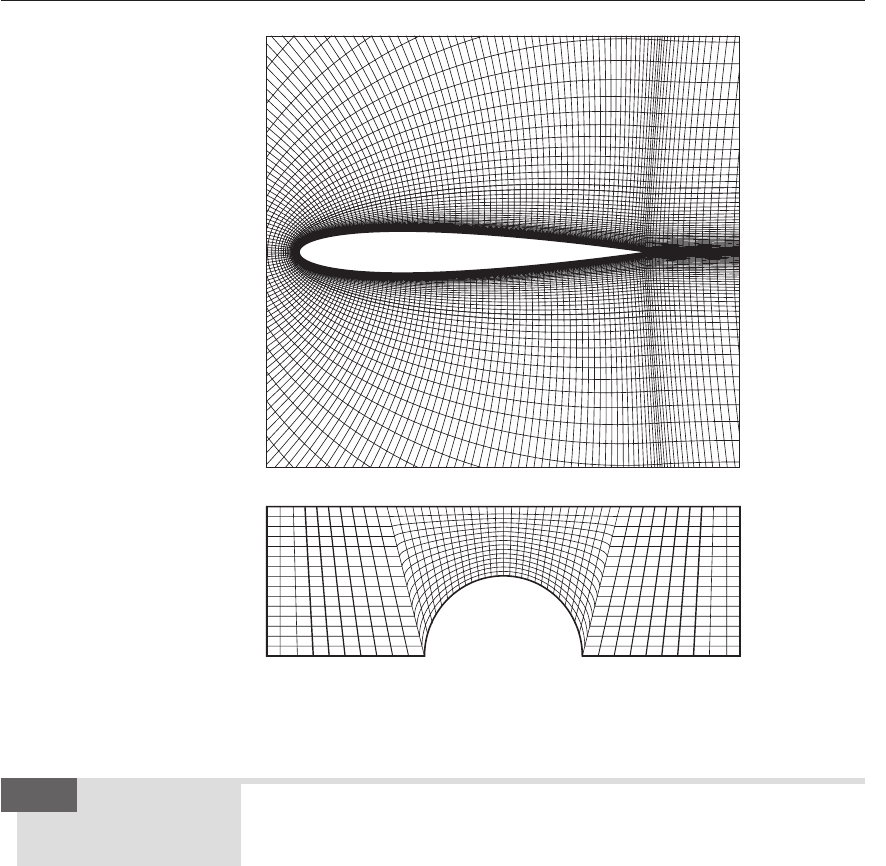
Figure 11.2 demonstrates, the grid can be refined easily to capture important
flow features, e.g. in regions with large gradients such as boundary layers.
Figure 11.4 shows part of a heat exchanger tube bank where CFD can be
used to predict the flow field. Considering symmetry, only the shaded region
of the geometry needs to be considered. Figure 11.5a shows a Cartesian grid
arrangement to predict this flow. We use a 40 × 15 mesh, block the cylinder
off with dead solid wall cells that do not take part in the calculation, and
approximate the surface by means of steps. Figure 11.6a illustrates a non-
orthogonal body-fitted grid for the same problem with the same number of
cells (i.e. 40 × 15). Now the whole grid occupies the computational domain
and the cylinder surfaces can be more accurately represented. Comparison
of Figures 11.5a and 11.6a confirms that only about 75% of the cells in the
Cartesian grid are available to represent the flow region; the remaining 25%
are wasted in dealing with the objects.
The resulting velocity predictions are shown in Figures 11.5b and 11.6b,
respectively. The latter shows much improved definition of the flow in the
regions with large curvature near the inlet and outlet. This clearly demon-
strates the advantage of the body-fitted grid: computational resources are
utilised more efficiently, so flow details can be captured with coarser grids
compared with Cartesian-based methods (see Peric, 1985; Rodi et al., 1989).
306 CHAPTER 11 METHODS FOR DEALING WITH COMPLEX GEOMETRIES
Figure 11.2 An example of
an orthogonal curvilinear mesh
for calculating flow around an
aerofoil
Source: Haselbacher (1999)
Figure 11.3 Use of a non-
orthogonal body-fitted grid
arrangement for the prediction
of flow over a cylinder
Cartesian vs.
curvilinear grids
--- an example
11.3
ANIN_C11.qxd 29/12/2006 04:43PM Page 306