
Versteeg H., Malalasekra W. An Introduction to Computational Fluid Dynamics: The Finite Volume Method
Подождите немного. Документ загружается.

11.14 STAGGERED VS. CO-LOCATED GRID ARRANGEMENTS 337
velocity components (Figure 11.28a) the calculated u- and v-velocity com-
ponents do not represent fluxes normal to the surface due to the gradual
direction change except in the first and last elements. This can be overcome
by using contravariant, grid-oriented velocity components as shown in
Figure 11.28b, but the governing equations and derivation of the discretised
equations are much more complex. Details of some of these special proce-
dures can be found in Hirt et al. (1974), Rhie and Chow (1983), Peric (1985),
Reggio and Camarero (1986) and Rodi et al. (1989), among others.
Here we concentrate on the co-located velocity arrangement used in con-
junction with Cartesian velocity components (Figure 11.28c). In Chapter 6
we discussed the ‘checker-board’ pressure field effect and the reason for
using a staggered grid. Therefore, when a co-located arrangement is used for
pressure and velocity values we need to ensure correct pressure–velocity
coupling. In the next section we explain some details of the special measures
that are used in a 1D Cartesian grid with a co-located arrangement and their
extension to unstructured grids. We limit our discussion to the Rhie and
Chow (1983) interpolation method, which is the most common practice in
co-located unstructured grids and also in curvilinear structured meshes.
Before we explain the handling of pressure–velocity coupling in co-located
arrangements we briefly revisit the staggered arrangement for a 1D grid (see
Figure 11.29).
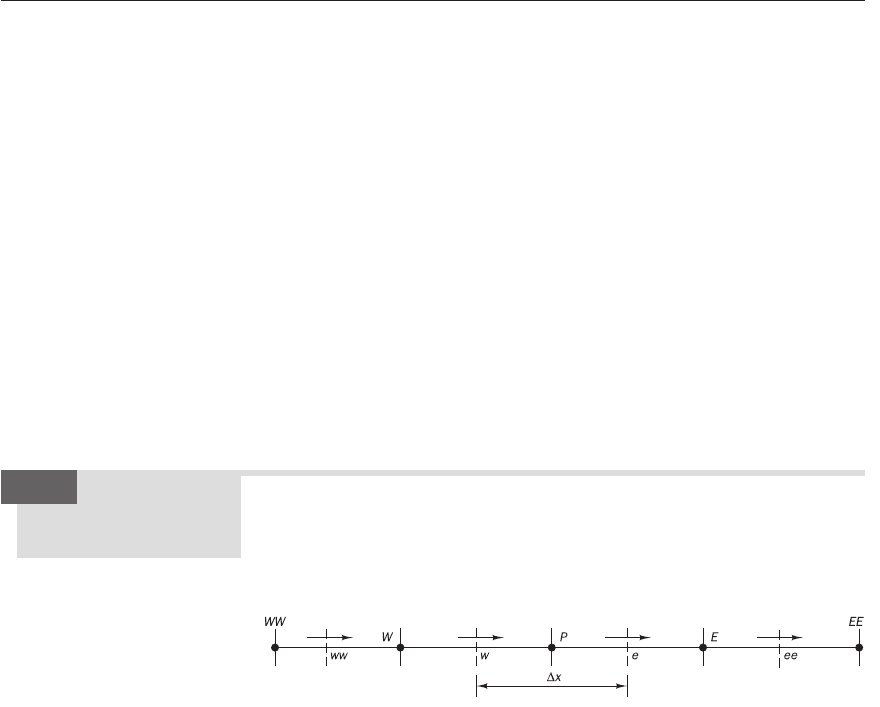
Figure 11.29 A 1D staggered
grid arrangement
In this arrangement the u-momentum equation is solved at location e, and
using standard notation the discretised form at velocity node e is
a
Pe
u
e
=∑a
nb
u
nb
+ (p
P
− p
E
)A
e
+ b (11.75)
The pressure difference that contributes to the momentum equation is
(p
P
− p
E
), which straddles the node e. The velocity u
e
lies on the face of the
scalar control volume centred at P. The continuity equation is applied to
this scalar control volume to derive the pressure correction equation of the
SIMPLE algorithm. As we saw in section 6.2, the main advantage of a stag-
gered arrangement is its capability to deal with a ‘checker-board’ pressure
field. Although this works very well for Cartesian and cylindrical mesh
systems, the arrangement is not entirely convenient for unstructured and
body-fitted mesh systems. In addition to the disadvantages mentioned in
section 11.13 the storage of geometric data related to four different sets of
variables in 3D flows (scalars, u-, v- and w-velocity components) is inefficient.
This can be avoided by storing all variables at one single location, which is
the co-located arrangement.
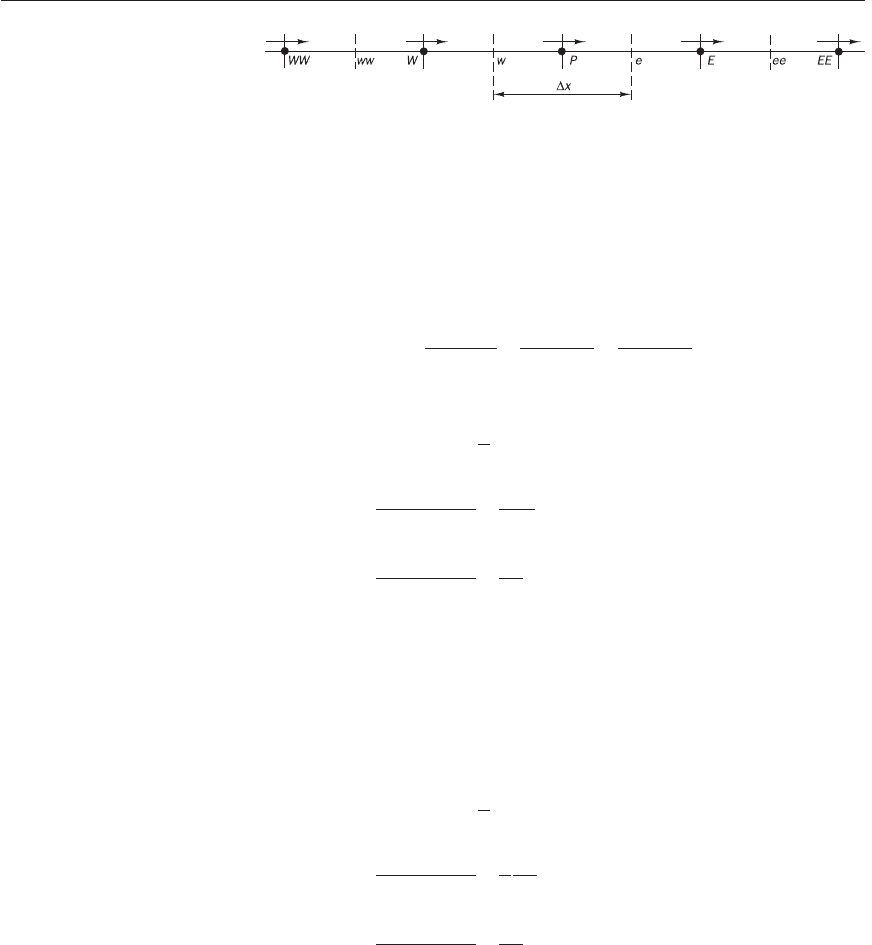
Now consider the 1D co-located arrangement shown in Figure 11.30,
where velocity u is stored and calculated at the location P.
Staggered vs.
co-located grid
arrangements
11.14
ANIN_C11.qxd 29/12/2006 04:43PM Page 337
338 CHAPTER 11 METHODS FOR DEALING WITH COMPLEX GEOMETRIES
Figure 11.30 A 1D co-located
grid arrangement
The discretised u-momentum equation at node P is
a
P
P
u
P
=∑a
nb
u
nb
+ (p
w
− p
e
)A
P
+ b
P
(11.76)
Pressures are also stored at node locations W, P, E etc., so now we need to
interpolate to find the required face pressures p
w
and p
e
. If we use linear
interpolation, which is second-order accurate (i.e. truncation error ∝∆x
2
) on
this uniform grid, we obtain
(p
e
− p
w
) =−= (11.77)
The discretised equation (11.76) now becomes
a
P
P
u
P
=∑a
nb
u
nb
+ (p
W
− p
E
)A
P
+ b
P
(11.78)
u
P
=+(p
W
− p
E
) (11.79a)
u
P
=+(p
W
− p
E
) (11.79b)
where d
P
= A
P
/a
P
P
It can be seen that the momentum equation at point P does not involve
the pressure at the point P, but uses nodal pressures from adjacent control
volumes.
Similarly, the discretised u-momentum equation at node E is
a
P
E
u
E
=∑a
nb
u
nb
+ (p
ee
− p
e
)A
E
+ b
E
(11.80)
a
P
E
u
E
=∑a
nb
u
nb
+ (p
P
− p
EE
)A
E
+ b
E
(11.81)
u
E
=+(p
P
− p
EE
) (11.82a)
u
E
=+(p
P
− p
EE
) (11.82b)
where d
P
= A
E
/a
P
E
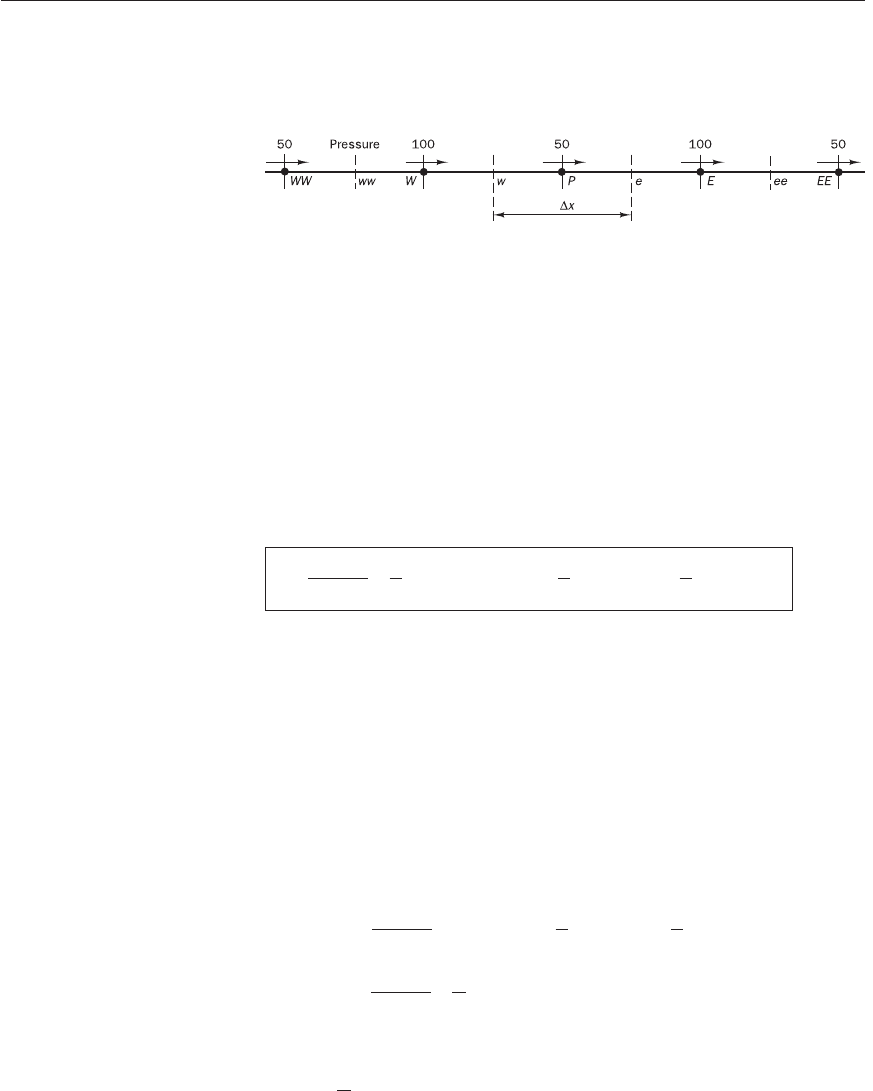
We now consider a varying pressure field as shown in Figure 11.31. On
physical grounds, we expect that the large pressure differences between nodes
P and E and between nodes W and P would drive flows into the control volume
surrounding node P across the e and w faces, respectively, and act as sizeable
momentum sources. However, pressure difference (p
W
− p
E
) acting in the
discretised momentum equations for u
P
is zero. Similar considerations apply
to the pressure gradient terms in the equations for u
W
and u
E
, which are also
d
E
2
∑a
nb
u
nb
+ b
E
a
P
E
A
E
a
P
E
1
2
∑a
nb
u
nb
+ b
E
a
P
E
1
2
d
P
2
∑a
nb
u
nb
+ b
P
a
P
P
A
P
a
P
P
1
2
∑a
nb
u
nb
+ b
P
a
P
P
1
2
(p
W
− p
E
)
2
(p
P
+ p
W
)
2
(p
E
+ p
P
)
2
ANIN_C11.qxd 29/12/2006 04:43PM Page 338
11.14 STAGGERED VS. CO-LOCATED GRID ARRANGEMENTS 339
Figure 11.31 A highly varying
pressure field
zero. This is the ‘checker-board’ problem described earlier in Chapter 6,
which is responsible for non-physical solutions as a consequence of the
linear interpolation for pressure differences in a co-located arrangement.
Velocities on the faces e and w are used (in 1D) to discretise the con-
tinuity equation, which then gives the pressure correction equation. If the
driving pressure is not properly represented in the face velocities, we can-
not expect the pressure correction equation to yield a correct solution. For
example, the cell face velocity u
e
in the co-located arrangement has to be
interpolated using u
P
and u
E
from equations (11.79) and (11.82). As it is, the
interpolated expression for u
e
will not contain a pressure gradient across
the faces of the control volume and the resulting solution can be oscillatory.
Rhie and Chow (1983) suggest that a higher-order term should be included
to prevent this effect.
Rhie and Chow’s interpolation practice is to obtain the cell face
velocity u
e
as
u
e
=+(d
P
+ d
E
)(p
P
− p
E
) − d
P
(p
W
− p
E
) − d
E
(p
P
− p
EE
) (11.83)
The face velocity u
e
is now directly linked to the driving pressure difference
(p
P
− p
E
) across the face e.
The first term on the right hand side of (11.83) is the average of the velo-
cities straddling face e. Comparison of the sum of (11.79b) and (11.82b) with
(11.83) reveals that the last two terms in (11.83) remove the troublesome
effects due to the pressure differences between nodes of adjacent control vol-
umes. This is replaced by a driving effect
1
–
2
(d
P
+ d
E
)(p
P
− p
E
) involving the
difference of pressures between the nodes straddling face e.
It remains to be shown that the three pressure terms in (11.83) represent
the addition of a higher-order (i.e. small) term. We assume constant values
for d everywhere and write Rhie and Chow’s interpolated face velocity u
e
as
follows:
u
e
=+d(p
P
− p
E
) − d(p
W
− p
E
) − d (p
P
− p
EE
)
=+[4(p
P
− p
E
) − (p
W
− p
E
) − (p
P
− p
EE
)] (11.84)
Thus, the pressure term is
(p
EE
− 3p
E
+ 3p
P
− p
W
) (11.85)
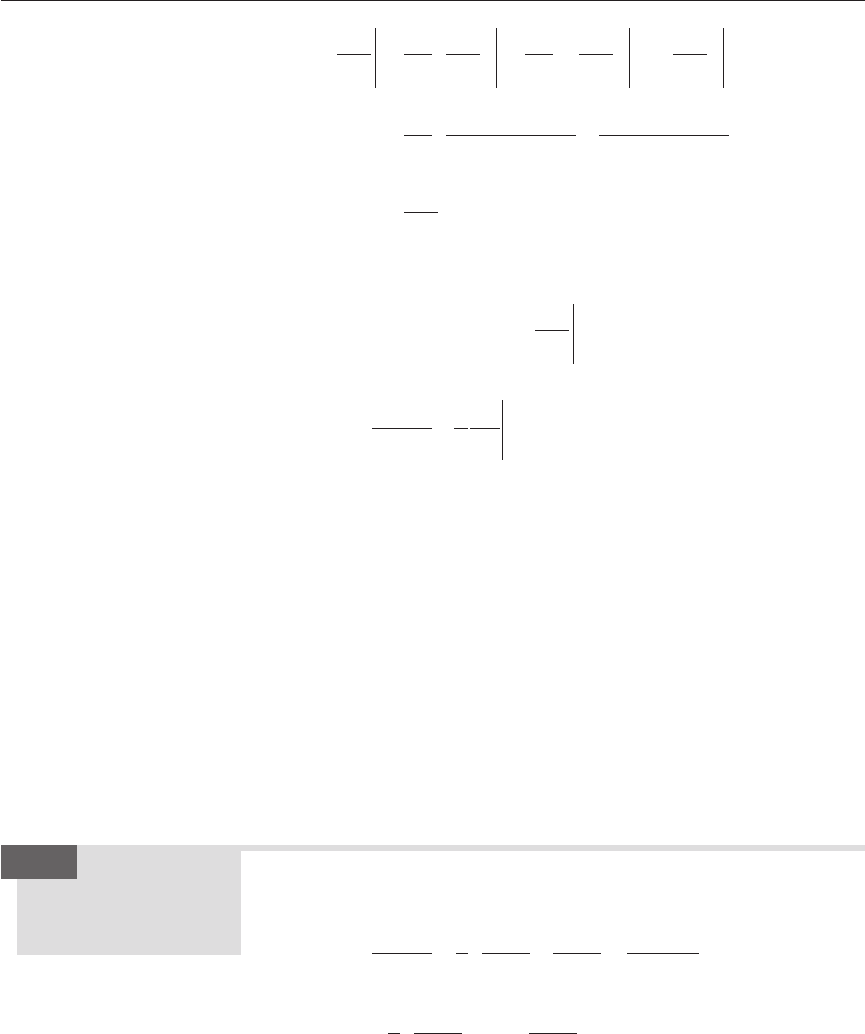
To identify the meaning of this term we consider the third derivative of pres-
sure across face e:
d
4
d
4
u
P
+ u
E
2
1
4
1
4
u
P
+ u
E
2
1
4
1
4
1
2
u
P
+ u
E
2
ANIN_C11.qxd 29/12/2006 04:43PM Page 339
e
=
e
=
E
−
P
=−
= (p
EE
− 3p
E
+ 3p
P
− p
W
) (11.86)
In (11.86) the approximation of the second derivative of pressure involves
central differencing. Hence,
(p
EE
− 3p
E
+ 3p
P
− p
W
) =
e
∆x
3
(11.87)
Comparing (11.87) with the pressure term (11.85) we deduce that
u
e
=+
e
∆x
3
(11.88)
This shows that Rhie and Chow’s pressure interpolation practice involves
the addition of a third-order pressure gradient term. Since the remainder
of the method is at best second-order accurate, this addition does not com-
promise the solution accuracy. Its beneficial effect is to provide damping of
the spurious oscillations due to the co-located arrangement, so it is called a
pressure smoothing term or added dissipation term. The damping is caused
by the restored linkage between the pressure differences across the control
volume faces and the face velocities, which appear in the continuity equation.
The source term of the latter equation is the mass imbalance, which, in a
constant density flow, involves differences between the cell face velocities,
so the addition of a third-order pressure gradient term to each of these
velocities is equivalent to adding a fourth-order pressure gradient term to
their differences in the resulting pressure correction equation. The Rhie and
Chow procedure has been extremely successful in co-located curvilinear
body-fitted and unstructured grids.
The extension of the face velocity interpolation expression (11.83) to
unstructured meshes is straightforward. First, it is rewritten as follows:
u
e
=+ +
− (∇p
P
) + (∇p
E
) (11.89)
The first term is the average of the nodal velocities straddling face e, the sec-
ond term is the pressure difference across the face multiplied by the average
of d values at P and E, and the third term involves an average of the product
d(∇p) at nodes P and E, where
D
E
F
A
E
∆x
a
E
A
P
∆x
a
P
A
B
C
1
2
D
E
F
(p
P
− p
E
)
∆x
A
B
C
D
E
F
A
E
∆x
a
E
A
P
∆x
a
P
A
B
C
1
2
u
P
+ u
E
2
∂
3
p
∂
x
3
d
4
u
P
+ u
E
2
∂
3
p
∂
x
3
1
∆x
3
J
K
L
(p
E
− 2p
P
+ p
W
)
∆x
2
(p
EE
− 2p
E
+ p
P
)
∆x
2
G
H
I
1
∆x
J
K
L
D
E
F
∂
2
p
∂
x
2
A
B
C
D
E
F
∂
2
p
∂
x
2
A
B
C
G
H
I
1
∆x
D
E
F
∂
2
p
∂
x
2
A
B
C
∂
∂
x
∂
3
p
∂
x
3
340 CHAPTER 11 METHODS FOR DEALING WITH COMPLEX GEOMETRIES
Extension of the
face velocity
interpolation method to
unstructured meshes
11.15
ANIN_C11.qxd 29/12/2006 04:43PM Page 340
11.15 EXTENSION OF THE FACE VELOCITY INTERPOLATION METHOD 341
(∇p)
P
= and (∇p)
E
=
We also note that ∆V = A∆x = the volume of the mesh element.
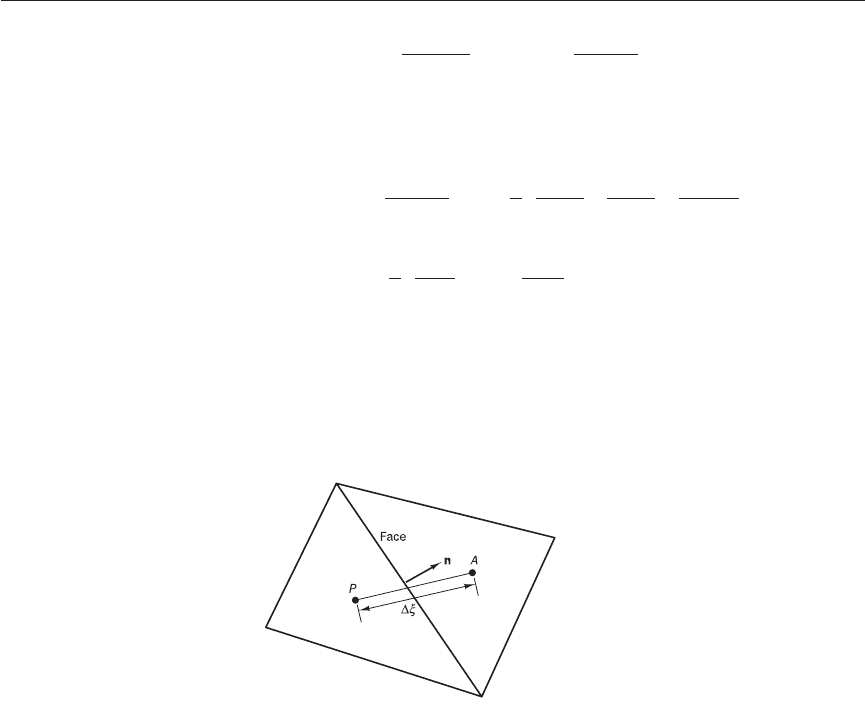
It is easy to generalise expression (11.89) to find the face velocity u
f
in an
unstructured mesh as shown in Figure 11.32 by using vector notation:
u
f
= . n ++
− (∇p)
P
+ (∇p)
A
. e
ξ
(11.90)
where ∆
ξ
is the distance between the nodes
∆V is the volume of the control volume
The gradients (∇p)
P
and (∇p)
A
in equation (11.90) can be evaluated using an
appropriate gradient reconstruction method (see section 11.9).
J
K
L
∆V
A
a
A
∆V
P
a
P
G
H
I
1
2
D
E
F
p
P
− p
A
∆
ξ
A
B
C
D
E
F
∆V
A
a
A
∆V
P
a
P
A
B
C
1
2
D
E
F
u
P
+ u
A
2
A
B
C
p
P
− p
EE
2∆x
P
W
− P
E
2∆x
Figure 11.32 Control volume
face of an arbitrary-shaped cell
Using the above expression (11.90) to find interpolated face velocities we
can derive the SIMPLE algorithm for co-located meshes by following the
steps of the standard algorithm. Velocity corrections and pressure correc-
tions are used as in the standard algorithm for Cartesian grids:
Corrected velocity is obtained from u = u* + u′ (11.91)
Corrected pressure is obtained from p = p* + p′ (11.92)
For example, for the 1D situation shown in Figure 11.30, as in the standard
SIMPLE algorithm the velocity correction at a face is obtained from
u ′
e
= d
e
(p ′
P
− p ′
E
) (11.93)
Using interpolated face velocities (11.83) and velocity corrections (11.93) the
mass fluxes across the faces of the control volume are calculated.
Discretisation of the continuity equation using these mass fluxes gives the
pressure correction equation in the form
a
p
p ′
P
=∑a
nb
p′
nb
+ b′ (11.94)
where a
E
=
ρ
d
e
A
e
, a
W
=
ρ
d
w
A
w
, a
P
= a
W
+ a
E
and b′=F *
w
− F *
e
for 1D. Similar
expressions are available for 2D, 3D and for unstructured arrangements.
ANIN_C11.qxd 29/12/2006 04:43PM Page 341

We have considered the different mesh arrangements that can be used to
discretise the flow equations with the finite volume method. The available
options can be categorised as structured and unstructured mesh arrange-
ments. The category of structured meshes includes the following:
• Cartesian meshes involve the governing equations in their simplest form,
but the discretisation of flow problems with curved domain boundaries
is inaccurate.
• Body-fitted meshes are based on the mapping of the physical domain
onto a computational domain. The approach can accommodate curved
boundaries, but equations in curvilinear co-ordinates are much more
complex, and there are severe difficulties in finding viable mappings for
very complex geometry (pent-roof IC engine geometry).
• Block-structured meshes are built up out of sub-regions, each of which
is meshed separately. This technique can overcome many of the
difficulties associated with complex geometries and enables improved
mesh quality in complex cases.
The category of unstructured meshes does not involve a structure of
grid lines. Control volumes may have arbitrary shapes, which simplifies the
meshing of complex geometries. The approach is now widely used in indus-
trial CFD. We have outlined the following:
• Special expressions for the diffusion and convection fluxes across
control volume boundaries in unstructured grids to:
(i) account for cross-diffusion effects due to non-orthogonality
(ii) cope with the absence of clear upwind co-ordinate direction to
handle convection
(iii) avoid false diffusion by higher-order upwind or TVD convection
schemes.
• Rhie and Chow’s pressure interpolation for pressure–velocity coupling
in a co-located arrangement for economical storage of pressure and
velocity data. This special pressure–velocity coupling prevents the
checker-board pressure effect, i.e. spurious oscillations in the solution.
• The SIMPLE algorithm can be used without further modification to
solve flow problems.
342 CHAPTER 11 METHODS FOR DEALING WITH COMPLEX GEOMETRIES
Summary11.16
ANIN_C11.qxd 29/12/2006 04:43PM Page 342

Combustion is one of the most important processes in engineering, which
involves turbulent fluid flow, heat transfer, chemical reaction, radiative heat
transfer and other complicated physical and chemical processes. Typical
engineering applications include internal combustion engines, power station
combustors, aeroengines, gas turbine combustors, boilers, furnaces, and
much other combustion equipment. It is important to be able to predict the
flow, temperatures, resulting species concentrations and emissions from
various combustion systems for the design and improvement of combustion
equipment, particularly with the current concerns about CO
2
and other
emission levels and their effects on the environment. CFD lends itself very
well to the modelling of combustion. Combustion processes are governed
by basic transport equations for fluid flow and heat transfer with additional
models for combustion chemistry, radiative heat transfer and other important
sub-processes. In this chapter we attempt to outline some of the popular
CFD modelling techniques used for combustion modelling. Combustion is a
complex subject, and combustion modelling therefore requires a considerable
amount of knowledge and experience. The material presented in this chapter
is very much introductory, allowing a novice combustion modeller to gain
knowledge of some basic CFD-based techniques with a view to understand-
ing more advanced and detailed techniques in the specialist literature.
There are many types of combustion processes. Gaseous fuel combustion,
liquid fuel combustion, spray combustion, solid fuel combustion, pulverised
fuel combustion are a few of the many other processes used in a wide variety
of application areas. To illustrate the application of CFD we concentrate on
gaseous combustion. For other processes the reader should consult the
relevant literature to find out how CFD has been successfully applied in areas
like spray combustion (Beck and Watkins, 2004), pulverised coal combustion
(Lockwood et al., 1980, 1986), diesel and spark ignition engines (Blunsdon
et al., 1992, 1993; Henson and Malalasekera, 2000) as a modelling tool.
Gaseous combustion involves a chemical reaction between a fuel and an
oxidant that are both in the gas phase. There are two categories of gaseous
combustion processes: premixed combustion and non-premixed combus-
tion. For example, combustion in a spark ignition internal combustion
engine (petrol engine) can be categorised as premixed combustion, as the fuel
(gasoline) is mixed with air prior to combustion, which takes place after spark
ignition. Similarly the flame in the familiar Bunsen burner is also premixed
combustion, as air is allowed to mix with gas prior to combustion. By con-
trast a jet flame where the fuel enters ambient air and is allowed to burn is an
example of a non-premixed flame. The gaseous fuel mixes with the oxidant
stream (air) and then combustion takes place where the conditions are right
Chapter twelve CFD modelling of combustion
Introduction12.1
ANIN_C12.qxd 29/12/2006 04:44PM Page 343

for combustion. Non-premixed flames are also called diffusion flames
because fuel and oxygen are introduced to the combustion zone in two or
more separate streams and are subsequently brought together due to diffu-
sion and mixing prior to combustion.
The bulk of this chapter is concerned with the modelling of non-premixed
combustion. We do not intend discuss combustion theory in detail here, but
outline some important sub-topics first: (i) thermodynamics of combustion,
(ii) enthalpies of formation, (iii) transport processes, (iv) chemical kinetics,
(v) equilibrium in gases, (vi) adiabatic flame temperatures. The reader should
be familiar with the fundamentals of these basic concepts in order to appreciate
the modelling techniques used to apply CFD to combustion calculations.
The reader is referred to standard combustion texts such as Warnatz et al.
(2001), Kuo (1986), Turns (2000), Williams (1985) etc. for thorough treat-
ments of the fundamentals of combustion processes. Next we explain in
some detail the calculation of non-premixed combustion, and conclude the
chapter with a brief description of CFD modelling of premixed combustion.
We use the volume V and the absolute temperature T as the two variables
to describe the thermodynamic state of a combusting fluid system. Initially,
the system contains fuel and air as reactants – referred to by subscript R – at
a state of (V
1
, T
1
). After combustion has taken place the system contains
reaction products – indicated by subscript P – at a state of (V
2
, T
2
). We may
apply the first law of thermodynamics to this system. If the system bound-
aries are adiabatic and the process is a non-flow process the first law of ther-
modynamics indicates that the heat released by the chemical reaction should
be equal to the change in the internal energy U between initial state ‘1’ and
final state ‘2’. In order to avoid accounting problems in the internal energy
balance the heat release is evaluated at a reference state:
U
P 2
− U
R1
= (U
P 2
− U
P 0
) + (U
P 0
− U
R 0
) + (U
R 0
− U
R1
) (12.1)
In the above equation U is the total internal energy and subscript ‘0’ denotes
the reference state. The reactants are first considered to be brought from
their initial state ‘1’ to state ‘0’ at which the reaction takes place and then the
resulting products are taken to state ‘2’. The term (U
P 0
− U
R 0
) is called the
internal energy of combustion and given the notation ∆U
0
.
Usually reactants and products are gaseous mixtures. In this case the
internal energy changes associated with bringing reactants from state ‘1’ to
state ‘0’ and products from state ‘0’ to state ‘2’ can be expressed in terms of
temperature by assuming mean values for the specific heat c
v
:
U
R 0
− U
R1
= m
i
c
vi
(T
0
− T
1
)
U
P 2
− U
P 0
= m
i
c
vi
(T
2
− T
0
)
Here m
i
is the mass of species i in the mixture and c
vi
is the mean specific heat
at constant volume of species i.
Similarly for open systems involving flow processes we need to consider
changes of enthalpy (kinetic energy changes are small compared with the
heat released during combustion processes and can often be neglected):
all products
∑
i
all reactants
∑
i
344 CHAPTER 12 CFD MODELLING OF COMBUSTION
Application of
the first law of
thermodynamics to a
combustion system
12.2
ANIN_C12.qxd 29/12/2006 04:44PM Page 344

12.3 ENTHALPY OF FORMATION 345
H
P2
− H
R1
= (H
P2
− H
P0
) + (H
P0
− H
R0
) + (H
R0
− H
R1
) (12.2)
where H is total enthalpy and the change of enthalpy at the reference state
(H
P0
− H
R0
) =∆H
0
is called the enthalpy of combustion. Assuming mean
c
p
-values for products and reactants we have
H
R0
− H
R1
= m
i
c
pi
(T
0
− T
1
)
H
P 2
− H
P 0
= m
i
c
pi
(T
2
− T
0
)
The reference state is usually taken as 25°C and 1 atm (101.3 kPa)
pressure. Property values at this standard reference state are indicated by
subscript ‘0’. For various fuels, values of ∆u
0
and ∆h
0
(per kmol) are available
in thermodynamic property tables such as Rogers and Mayhew (1994).
For example,
CH
4
(vap) + O
2
→ CO
2
+ H
2
O(vap)
From tables, heat of combustion for this reaction is ∆h
0
=−802310 kJ/kmol,
at 25°C.
Depending on the phase of the products (vapour or liquid) ∆h
0
values can
be different. The higher value is obtained when the components of products
such as water are in a condensed state. Since it is not possible to list ∆h
0
for
all fuels and mixtures a more fundamental property known as enthalpy of
formation is widely used in combustion calculations.
The enthalpy of formation ∆h
f
is defined as the increase in enthalpy when
a compound is formed from its constituent elements in their natural forms
at standard temperature and pressure. The elements themselves have zero
enthalpy of formations in their naturally occurring states. For example,
values of ∆h
f
for O
2
, N
2
, H
2
and C are zero as they are formed from their
elements. However, CO
2
is formed by the reaction C
(graphite)
+ O
2
→ CO
2
.
A large amount of heat is liberated during this exothermic reaction. The
enthalpy of formation is −393 520 kJ/kmol of CO
2
. Enthalpy of formation
values for various reactions are available in thermodynamic and combustion
reference sources (Rogers and Mayhew, 1994; Kuo, 2005). To calculate the
enthalpy of combustion for a fuel (sometimes called the enthalpy of reaction)
we may view the reaction as a recombination of elements of the fuel. Thus,
the enthalpy of reaction may be calculated using enthalpies of formation.
For example, combustion of CH
4
may be broken down to
CH
4
(vap) + 2O
2
→ C + 2H
2
+ 2O
2
→ CO
2
+ 2H
2
O(vap)
∆h
combustion
= (∆h
CO
2
+ 2∆h
H
2
O
) − (∆h
CH
4
+ 2∆h
O
2
)
Individual heat of formation values in kJ/kmol are
C
( graphite )
+ O
2
→ CO
2
∆h
CO
2
=−393 520 kJ/kmol of CO
2
H
2
+ O
2
→ H
2
O(vap) ∆h
H
2
O
=−241 830 kJ/kmol of H
2
O
C
(graphite)
+ 2H
2
→ CH
4
∆h
CH
4
=−74 870 kJ/kmol of CH
4
1
2
all products
∑
i
all reactants
∑
i
Enthalpy of
formation
12.3
ANIN_C12.qxd 29/12/2006 04:44PM Page 345

For combustion of CH
4
∆h
combustion
= (−393 520 − 2 × 241 830) − (−74 870 + 2 × 0)
=−802 310 kJ/kmol of CH
4
Before and after combustion the gaseous volume will usually contain a mix-
ture of species. It is therefore important to consider the basic properties of
such mixtures.
The mole fraction of species k in a mixture is defined as
X
k
== (12.3)
where n
1
, n
2
etc. indicate the number of moles of each species (k) in the
mixture, and n
total
is the total number of moles in the mixture.
Partial pressure is defined as
p
k
= p = X
k
p (12.4)
where p is the total pressure (which is the sum of all partial pressures by
definition). Alternatively
X
k
= (12.5)
The mass fraction of species k in a mixture is defined as
Y
k
== (12.6)
where m
1
, m
2
etc. indicate the mass of each species in the mixture, and m
total
is the total mass. By definition
X
k
= 1 (12.7)
Y
k
= 1 (12.8)
The mole fractions and mass fractions are related by
Y
k
= X
k
(12.9)
X
k
= Y
k
(12.10)
Here (MW )
k
stands for molecular weight of species ‘k’ and (MW )
mix
is the
molecular weight of the mixture given by
(MW )
mix
= X
k
(MW )
k
(12.11)
all species
∑
k
(MW )
mix
(MW )
k
(MW )
k
(MW )
mix
all species
∑
k
all species
∑
k
m
k
m
total
m
k
m
1
+ m
2
+ m
3
+ ...+ m
N
p
k
p
n
k
n
total
n
k
n
total
n
k
n
1
+ n
2
+ n
3
+ ...+ n
N
346 CHAPTER 12 CFD MODELLING OF COMBUSTION
Some important
relationships and
properties of gaseous
mixtures
12.4
ANIN_C12.qxd 29/12/2006 04:44PM Page 346