
Woodward D. Lloyd George and the Generals
Подождите немного. Документ загружается.

because he saw no great leader among the Unionists. He once told Miss
Stevenson,” ‘But who is there who would make a fitting Prime Minister? Bonar
Law is limp and lifeless; Balfour can never make up his mind about anything.
There is no one.’”
9
What worried him now was that if he accepted a figurehead
position in the War Office, he would only prop up Asquith’s sagging government
without effecting any change in the direction of the war.
10
As Lloyd George edged closer to the War Office, the lobbying of the “soldiers’
party,” as Aitken called it, kept pace with its mounting alarm. Sir John French
visited Asquith and pleaded with him. For the sake of the army the prime minister
must himself take the War Office. Lord Derby, a favorite of the army, could be
made his second-in-command to run things. This was also the sentiment of the
Army Council.
11
The soldiers’ friends on Fleet Street had their say, especially the
volatile H.A.Gwynne, the editor of the Unionist Morning Post. Gwynne, a former
war correspondent in the Balkans, South Africa, and China, considered himself
the protector of the soldiers against civilian interference, and his paper was little
more than the mouthpiece of the War Office. In leading articles, the Morning Post
suggested that “the War Office would be suited ill indeed to Mr. LLOYD
GEORGE’s qualities.” The dynamic Welshman was portrayed as “an energiser
rather than an administrator.”
12
On June 19, Gwynne came more to the point: “If
Mr. LLOYD GEORGE would only learn that his task is to give the soldiers free
play to run the war upon their own lines…if he is to be appointed we implore him
to make no rash experiments and not to presume that the business of war may be
learnt in a month or a year.” On the opposite end of the political spectrum, the
liberal Daily Chronicle offered similar advice: “There is room for an outstanding
man, but he must be a man content to work and shine in his own orbit, without
infringing on the orbit of the Chief of the Imperial General Staff.”
13
Lloyd George’s bid for the War Office presented Asquith with a real dilemma.
If he supported Lloyd George on his terms, the “soldiers’ party” would be inflamed
and Robertson might resign. With public trust in the army high, this would
endanger his government. On the other hand, Asquith recognized that “L.G. will
not be pleased if his demands are refused.”
14
If the minister of munitions resigned,
Bonar Law might follow him. Even if Asquith’s government survived this blow,
an unlikely event, Lloyd George would be more dangerous without than within
the government. To placate his headstrong colleague, Asquith offered him the
olive branch of the vicepresidency of the War Committee, which was tantamount
to making him the vice-premier.
15
Forcing Robertson to modify his arrangement
with Kitchener, however, was out of the question. Gambling that Lloyd George’s
threat of resignation was a bluff, Asquith delayed, hoping that in the end he could
mollify all parties by steering a middle course.
On June 17, Lloyd George drafted a long and artful memorandum. Combining
reasonableness with the threat to resign, he asserted that he could not accept the
War Office “under the humiliating conditions to which poor Kitchener had been
reduced.” He denied any intention of interfering with strategy. On the other hand,
he argued that if he, as secretary of state for war, were to persuade the Allies to
LLOYD GEORGE AND THE GENERALS 87
pull together, he must “possess real power and influence,” including the right to
remove incompetent generals.
16
This self-serving memorandum was destined to
gather dust in the Lloyd George Papers. Instead, a short note was sent. “I have
given a good deal of consideration to your kind offer of the War Secretaryship,”
Lloyd George wrote. “I have come to the conclusion that I shall be rendering a
greater service to the country in this emergency by not accepting it. As I told you
at our interview I thought that I could be of greater use in another sphere. I am
still of that opinion.”
17
There the matter seemed to end. Or did it? Lloyd George’s vague letter might
be read as a letter of resignation. But as usual he trembled at the brink. Advice
was sought from Bonar Law, Rufus D.Isaacs (Lord Reading), Aitken, Edward
Russell of the Liverpool Post, Sir Arthur Lee, and others.
18
The avenues of actions
open to him—and their advantages and disadvantages—were outlined in a letter
from Lee, a shrewd Conservative politician and the military secretary to the
Ministry of Munitions. Lee encouraged Lloyd George to reject a figurehead
position in the War Office, which would involve “yourself in difficulties compared
with which the Irish bog would be easy travelling.” If allowed to retain his position
as minister of munitions, Lloyd George should accept Asquith’s offer of the vice-
presidency of the War Committee. “You would have been acknowledged by the
Cabinet and the country as the only alternative Prime Minister,” Lee wrote, and
resignation later would have a decisive impact. But “to resign now ‘because you
could not get the War Office on your own terms’ would give your enemies a handle
for dangerous misrepresentations and enable them to exploit the sneer: ‘what was
good enough for Kitchener was not good enough for him.’”
19
Meanwhile, Asquith was receiving equally Machiavellian advice from Edwin
S.Montagu, the Liberal politician. Montagu suggested to the prime minister that
it would be advantageous to have the government’s leading critic in the War Office
during the forthcoming offensive, which was certain to result in heavy casualties.
What better way to silence the Welshman?
20
Asquith’s calm and unhurried diplomacy was rewarded. Lloyd George had
backed himself into a corner by his maneuvering after Kitchener’s death. If he
rejected the War Office, resignation was the alternative he had given himself.
Speaking his mind about the conduct of the war would be satisfying. But the timing
was wrong. He would be branded as unpatriotic if he took on the generals on the
eve of Britain’s s greatest offensive to date. Until the “Westerners” failed, he would
find little, if any, support for increasing his role in military policy at the expense
of one of the nation’s most trusted soldiers—Robertson. After much agonizing,
Lloyd George must have decided that boring from within the soldiers’ citadel was
preferable to an uncertain future of being a critic of war policy in the wilderness.
There was always the chance that he could gain acceptance for his ideas in Allied
conferences. After further discussion with Asquith, he decided to take the plunge
on June 24.
21
As for the Kitchener-Robertson compact, which gave the C.I.G.S.
authority never possessed by another British general, the prime minister let Lloyd
George attempt to make the best deal he could for himself. With no pressure on
88 WIZARD IN THE WAR OFFICE
him from the prime minister, of course, Robertson was unwilling to budge an inch
on any fundamental issue.
22
On June 26, in response to an uncompromising letter from Wully that reiterated
the terms of the Kitchener-Robertson compact, Lloyd George fired a Parthian shot,
making clear his unhappiness with Robertson’s definition of the role of the
secretary of state for war. While accepting Robertson’s s position as the War
Committee’s sole adviser on strategy, he insisted that he “be kept informed of
everything”—not, as Robertson had written, “all that he should know.”
Demanding that he be involved in every stage of the formulation of military policy,
he wrote: “It would be humiliating and intolerable if I were to hear your policy
expounded for the first time to the War Committee.… Political considerations (I
mean international politics) and questions of equipment—both in my sphere—are
just as essential to the decisions of war problems as knowledge of military
strategy.”
23
Lloyd George scored many debating points in this war of letters, but Robertson
clearly won the battle. Meanwhile, Asquith moved to pacify the soldiers (and the
palace) by appointing Lord Derby as War Office undersecretary. Sandwiched
between Robertson and Derby, even the shifty Lloyd George might be kept at bay.
On July 7, the Welshman formally took the seals of office. “We felt just like
children going to a new school,”
24
wrote Stevenson of the move from the Ministry
of Munitions to the War Office. To his critics, the new look at the War Office
bordered on the atmosphere of a children’s playground. The change from the
formal and very private Kitchener regime was striking. There was now a steady
procession of newsmen, politicians, foreign leaders, and secretaries to and from
Lloyd George’s cavernous new office.
Lloyd George realized that his every action as head of the War Office was being
carefully scrutinized. Yet within eleven days after he took office he suggested
strategy to the War Committee that was anathema to Robertson. With the Somme
offensive underway, Robertson was even more sensitive than usual about
“sideshows.” Earlier he had gotten the government to adopt a passive policy in
Mesopotamia and Egypt.
25
He had also labored unsuccessfully to reduce or
liquidate the “Eastern” venture, which caused him the greatest anxiety—the
Eastern Army at Salonika. With this background, one can imagine his
consternation when Lloyd George pushed his Balkanite ideas on July 18. The
French had been pressing the British to launch an attack against Bulgaria to protect
Rumania when that country joined the Entente. The ministers, advised by
Robertson, however, had only been willing to accept a limited British role to
occupy the Bulgarians in Macedonia while Rumania mobilized.
26
By mid-July,
however, it became obvious that the French were contemplating a big offensive.
When this was discussed by Britain’s war leaders, Lloyd George “pointed out that
there was another side to the question, which was whether it would not be an
advantage to cut out Bulgaria and clear a road to Roumania. This would have the
effect of cutting off the Turks. He thought it was worth considering. It would
LLOYD GEORGE AND THE GENERALS 89
prevent the supply of ammunition to the Turks, and stop Germany from getting
food supplies from the east, and would open up a new road to Russia.”
27
When Robertson immediately challenged this view, Lloyd George made no
response. He was conscious that his new position made it extremely difficult for
him to disagree with the government’s sole adviser on strategy. He possessed not
a single ally in the War Committee with the possible exception of Bonar Law, and
as secretary of state for war he was expected to work in harmony with the C.I.G.S.
For the rest of July and the month of August there existed surprising harmony
between Lloyd George and Wully. Robertson gave him copies of official
communications between himself and the commanders in the various theaters,
information which had been denied him before he went to the War Office. (The
C.I.G.S., however, continued to carry on a secret and unofficial correspondence
with his commanders in chief through “R” telegrams and “secret and personal”
letters to limit any anti-“Western” views which might undermine the strategic
advice he was giving the government.)
Robertson’s task during this period was to maintain the government’s
commitment to the great offensive underway on the Continent. A considerable
handicap was that he was as much in the dark about Haig’s progress as the civilians.
Haig’s initial attempt at a breakthrough had been an unmitigated disaster, and he
had fallen back on the strategy of wearing down the German army. As fresh
assaults were launched, Robertson—who had little more than press communiques
to go on—began to press Haig for some encouraging news to give the civilians.
“If you would send me a short letter which I could read to the War Committee I
am sure it would be to their general interest, and to your interest in particular,”
28
he wrote on July 7. Haig responded with a letter which emphasized the growing
demoralization of the German army.
29
Haig’s optimism, however, was not enough
to allay the restiveness of the civilians about the heavy casualties that lay ahead:
and for what—the conquest of a few thousand yards of German trenches? “The
Powers that be,” Robertson wrote Haig as July came to an end, “are beginning to
get a little uneasy in regard to the situation…. In general, what is bothering them
is the probability that we may soon have to face a bill of 2 to 300,000 casualties
with no very great gains additional to the present. It is thought that the primary
object—relief of pressure on Verdun—has to some extent been achieved.”
30
Another problem for Robertson was an extremely critical analysis of the Somme
offensive by Churchill, which was circulated to the cabinet with an introduction
by F.E.Smith on August l.
31
Hankey suspected that Lloyd George had a hand in
this memorandum, but there is no evidence to support his suspicions.
32
Robertson
certainly did not include Lloyd George with the critics of the Somme offensive,
writing Haig on August 1 that “LG is all right provided I can say I am satisfied,
and to enable me to do this it is necessary you should keep me acquainted with
your views.”
33
On August 5, Wully read a letter from Haig to the War Committee that stressed
the relief of Verdun and the assistance given to Russia’s great offensive by tying
down German soldiers in the West. There was, on the reverse side of the coin, no
90 WIZARD IN THE WAR OFFICE
hint of victory in the near future, with Haig emphasizing that his attack must “go
well into the autumn” and that another great offensive should be launched in
1917.
34
Lloyd George joined with the other members of the War Committee in
refuting Churchill’s criticisms and Robertson was instructed to send Haig a letter
“assuring him that he might count on full support from home.”
35
By simultaneous attacks the Allies were putting immense pressure on the
Central Powers. Despite his antipathy to frontal assaults with heavy casualties,
Lloyd George approved of Haig’s now deliberate and unhurried tactics, for the
British army was making enormous inroads on German resources on the Somme,
with the Germans foolishly attempting to retake every lost yard of trench.
“Everything is going marvellously here,” Esher reported to Lloyd George. “We
have got the Boches by the throat at last.”
36
The Russians under General Brusilov
finally had their steamroller moving against the warweary Austrians. Meanwhile,
the Italians applied the pressure on the Isonzo while the tenacious French defense
of Verdun took a heavy toll from the attacking Germans.
Lloyd George had feared that the Germans would take advantage of the
generals’ preoccupation with the West, giving up ground gradually, and winning
spectacular victories in the East as they had done in 1915.
37
But, as he told the
House of Commons in a survey of the war on August 22, Berlin’s s response had
been to play into Britain’s hands, throwing men and guns against the British on
the Somme, weakening their attack on Verdun and giving the Russians free reign
in the East.
38
In late August, two events occurred which quickly eroded Lloyd George’s
always fragile support of the Somme offensive. First, on August 27, after weeks
of haggling with the Entente over compensation for belligerency, Rumania
declared war on Germany and Austria-Hungary. Two days later, Erich von
Falkenhayn, the chief of the general staff and the architect of the costly German
assault on Verdun, was demoted. His successor was the hero of Tannenberg—the
sixty-nine-year-old Field Marshal Paul von Hindenburg. Lloyd George feared that
this change in command might signal a shift to the East in German military power.
On September 2, the day after Bulgaria declared war on Rumania, Lloyd George
expressed concern to Major-General Frederick B.Maurice, the director of military
operations, that Rumania might go the way of Serbia. Dissatisfied with the
response he received, he penned a note to Maurice:
We cannot afford another Serbian tragedy. We were warned early in 1915
that the Germans meant in confederation with the Bulgars to wipe Serbia
out. In spite of the fact, when the attack came we had not purchased a single
mule to aid the Serbians through Salonika. The result was when our troops
landed there, owing to lack of equipment and appropriate transport, they
could not go inland and Serbia was crushed….
I therefore once more urge that the General Staff should consider what
action we could in conjunction with France and Italy take immediately to
LLOYD GEORGE AND THE GENERALS 91
relieve the pressure on Roumania if a formidable attack developed against
her.
39
Although Robertson maintains in his memoirs that he has no recollection of such
a note, it is certain that Maurice informed him of the Welshman’s views for he
wrote Haig that “L.G. has got the Servian fit again.”
40
Robertson’s unyielding
position was that the best defense of Rumania was to continue hammering the
Germans on the Somme. If strong pressure were maintained, he argued, the
Germans could only hope to throw Rumania back on the defensive—not destroy
her.
41
Robertson’s strategy was ratified by the War Committee on September 12
without any opposition from Lloyd George.
42
The secretary of state for war was
away, touring the western front.
Lloyd George’s visit to the western front in mid-September was to have
important consequences for his future relations with the high command. The Battle
of the Somme was essentially an artillery battle; and Lloyd George was concerned
that general headquarters was mishandling its most destructive weapon. From
various sources he learned that the French on the Somme were making better
tactical use of artillery. The British artillery plan “followed conventional and rigid
lines, being based upon an estimate of the destructive and protective power of the
guns and the capacity of the infantry. Subordinate artillery commanders were
allowed little initiative.” The French commanders, however, emphasized
coordination between the more experienced French gunners and infantry,
postponing their attacks until the officers in the trenches were satisfied that the
enemy’s defenses were smashed. The difference between French and British
tactics was written in blood. The British Expeditionary Force lost thousands
“‘mopping up’ ground which had not been conquered by the artillery,” while the
French tended to expend metal rather than life.
43
Lloyd George’s view of the war up close reinforced his view that the generals
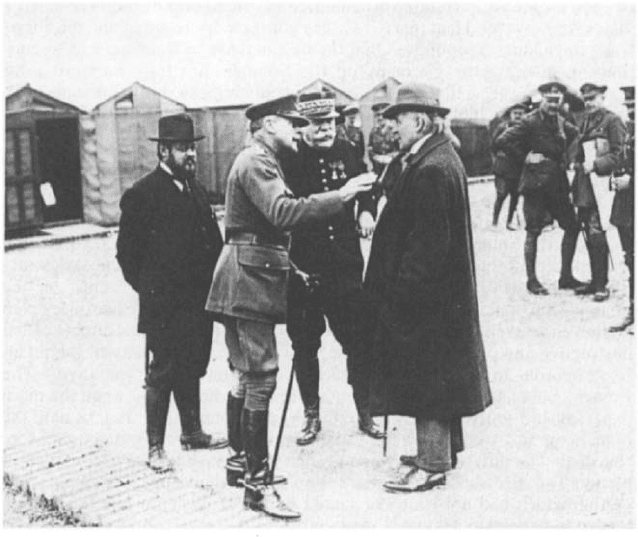
were hidebound and unimaginative. With Haig he motored to General Cavan’s
headquarters to meet with General Joffre, passing through many squadrons of
British cavalry on their way to the front. When Lloyd George inquired about their
function, Haig explained that they were being brought forward to exploit the
anticipated breakthrough of the intensified British attack in mid-September. Later,
in the presence of Haig and Joffre, Lloyd George dared express misgiving about
the utility of horse soldiers in trench warfare. His doubts were brushed aside, with
Joffre remarking “that he expected the French cavalry to ride through the broken
German lines on his front the following morning.”
44
As for the soldiers, the more they saw of Lloyd George the politician, the less
they thought of him. He could do nothing right in their eyes; even his table manners
were faulted. His tour of the front was just a “joy ride.” As Haig wrote his wife,
“Breakfast with newspaper men, & posings for the Cinema Shows, pleased him
more than anything else. No doubt with the ulterior object of catching votes!”
45
Philip Sassoon, Haig’s private secretary, was similarly acid in his comments: “I
was sorry we hadn’t an elephant for them to ride.”
46
92 WIZARD IN THE WAR OFFICE
A much more serious criticism of Lloyd George’s conduct concerned his private
interview with General Ferdinand Foch in which he quizzed the French general
about differences in French and British artillery tactics and casualty figures.
47
When Foch told Haig of this interview, the British com mander in chief was aghast,
commenting in his diary: “Unless I had been told of this conversation personally
by Gen Foch, I would not have believed that a British Minister could have been
so ungentlemanly as to go to a foreigner and put such questions regarding his own
subordinates.”
48
General headquarters’s reaction to this incident is very revealing of both its
intense rivalry with the French and its hostility to politicians who had their own
views on military questions. To be sure, Lloyd George knew that he was running
the risk of insulting the generals if they learned of his impolitic talk with Foch.
But what was protocol when the lives of thousands of soldiers were at stake? Lloyd
George wanted the facts, and he had reason to believe that he would not get them
from general headquarters. (Throughout the long Battle of the Somme British
artillery tactics underwent no fundamental changes.)
49
Albert Thomas looks on as Lloyd George expresses his doubts to Sir Douglas Haig
and General Joffre about the use of cavalry in trench warfare.
LLOYD GEORGE AND THE GENERALS 93
If anything, Lloyd George had reason to complain about the “ungentlemanly”
behavior of Haig’s supporters who used the press against him. Sassoon
immediately wrote Northcliffe about the Foch interview and the powerful press
lord went on the offensive.
50
Although Lloyd George had attempted to neutralize
Northcliffe on his return from France with talk of “too large casualties in
proportion to the results gained,” the latter would tolerate no criticism of the
generals, implied or otherwise.
51
The Times began to heap praise on the leadership
of the British Expeditionary Force and, as a hit at Lloyd George, linked success
or failure to the supply of guns and shells provided by the Ministry of Munitions.
Gwynne of the Morning Post was more blunt, delivering a dark warning to Lloyd
George in a leading article: “The Army is perfectly aware of what took place
during the recent visit of the WAR MINISTER to France. That particular form of
what the French call ‘gaffe’ must not be repeated; and we may mention that in
case of its repetition we shall feel it our duty to publish the facts of the
occurrence.”
52
Lloyd George, although infuriated by this press campaign, was all too aware
that it was political suicide to be linked with criticism of Haig, who was the
embodiment of the army in the public mind. His response, published in the
Morning Post, was full of praise for the army and its leaders. He also denied that
he had gone beyond “his legitimate sphere” on his tour of the front.
53
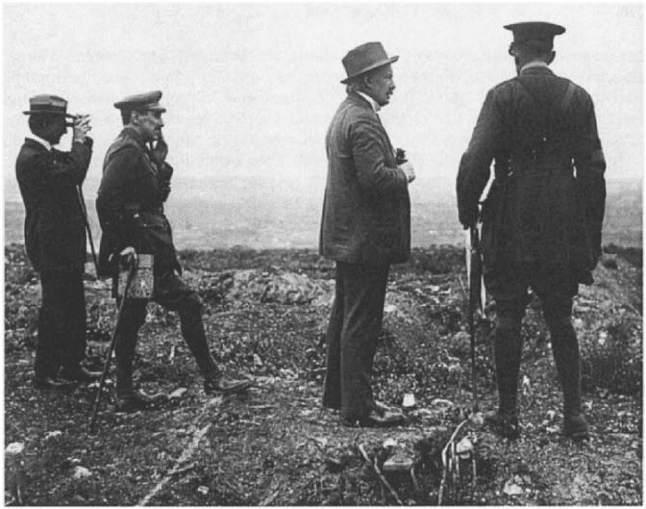
Lloyd George and Lord Reading watch a bombardment during the Somme offensive.
94 WIZARD IN THE WAR OFFICE
Despite the turmoil in the army and press about his talk with Foch, Lloyd George
refused to let the matter die, persuading Robertson to agree to the dispatch of Sir
John French, who now was commander in chief of the home forces, on a tour of
the French front to acquaint himself with French artillery tactics to assist him in
the training of troops in Britain.
54
Another obvious motive of Lloyd George’s was
to collect evidence that would confirm his low opinion of Haig and his
subordinates.
55
During the height of the brouhaha over the Foch interview, Robertson
uncharacteristically held his tongue. When word reached the War Office of Lloyd
George’s talk with the French general, he was eager for a showdown. But Haig,
when asked for the facts of the incident, counseled that “the wisest course is to let
the matter drop.”
56
Robertson took this advice for the moment. “Consumed by
dislike and suspicion of Lloyd George,”
57
however, he believed that he soon must
put the Welshman in his place. His anger was provoked by more than Lloyd
George’s implied criticism of Haig and the British red-hatted staff. His worst fears
of Lloyd George at the War Office were being realized. The dynamic and
irrepressible Welshman was pushing strategy upon the ministers that was
independent of the general staff.
In September Robertson’s attempt to have British arms play a generally passive
role in the East was under attack, with Lloyd George leading the charge. The
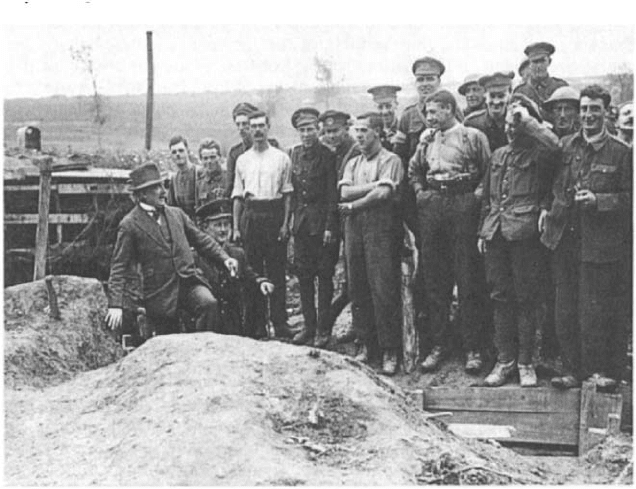
A photographic opportunity: Lloyd George in the trenches.
LLOYD GEORGE AND THE GENERALS 95
obscure port of Rabegh on the Red Sea between Medina and Mecca became a
focal point of this tug of war. In early June, Sherif Hussein of Mecca, the ruler of
Hejaz, led his people in revolt against the Turks. Mecca fell quickly and Medina
was beseiged. When Turkish reinforcements were sent south from Syria to
Medina, British ministers became concerned that the Turks would continue their
advance all the way to Mecca and crush the revolt.
Lloyd George, perhaps taking advantage of Robertson’s absence, took the lead
on September 1 in advocating military intervention at Rabegh to block the Turkish
road to Mecca.
58
Fearing another “side show” in Arabia, Robertson adamantly
rejected the idea of sending even a brigade to Rabegh. The usually supine War
Committee, however, was reluctant to accept the advice of the general staff. On
September 18, Lloyd George suggested that
it was a matter of first class importance to help the Sherif if we could.
Otherwise our prestige would go. The Chief of the Imperial General Staff
could not see how it could be done. He suggested that the Committee should
record their view that it was of the highest importance that the Sherif should
be supported in every way, and invite the General Staff to say what, if
anything[,] could be done. It was important to say whether Sir A.Murray
could spare a brigade or not. That was a question for the Staff; the question
of the policy of giving assistance to the Sherif was one for the Committee.
The committee readily agreed with Lloyd George that policy must be decided by
the civilians and that political considerations justified the proposed military
operation. Robertson was instructed, “in consultation with the Admiralty War
Staff, to advise as soon as possible what action, if any, he considered could be
taken to avert this possibility [Turkish conquest of Mecca].”
59
As the imperial-minded ministers haggled with the apostle of the “Western”
school of thought over intervention in the Hejaz, developments in the Balkans
began to pose a greater threat to the generals’ “Western” stance. First, there was
the increasingly obvious pro-German position of King Constantine’s government.
As usual Lloyd George favored decisive action over caution when the Balkans
were concerned. After Rumania came into the war, he was convinced that all the
British and French needed “to do was to give a little push, and Greece would come
in.”
60
Robertson, supported by the Foreign Office, however, was hostile to any
action which would involve Britain more deeply in either Greek politics or the
Salonikan venture.
As British policy toward the confused Greek political situation remained in
limbo, Lloyd George’s impatience grew. Returning to London from his visit to
the western front, he got the Greek situation placed on the agenda of the War
Committee. Attacking the indecisiveness of his colleagues, he accused them of
being “too tender.” The British were now the “laughing stock of Europe.” The
correct policy was to send to Athens a message “by a 14” gun.”
61
96 WIZARD IN THE WAR OFFICE