
Yam, Kit L. (ed.). The Wiley encyclopedia of packaging technology
Подождите немного. Документ загружается.


the melt right up to the gates by use of a sprue heater,
manifold heaters, and nozzle heaters. Past the gates, the
melt flows into the cavities. As the molten plastic solidifies
during cooling, the parts typically shrink 1–2% of their
diameter, causing them to adhere to the cores. When the
mold opens, parts are ejected from the cores and drop
between the mold halves.
Runner System. There are basically two types of runner
systems: cold and hot. In cold runner systems, the melt in
the flow channels between the nozzle and the gates is
allowed to cool and solidify during each cycle and must be
ejected along with the parts before the next cycle begins.
Cold runner systems are simpler to design and are less
expensive than hot runner systems. A disadvantage is that
the plastic of the cold runner must be reprocessed or
scrapped, which adds costs and environmental concerns.
The introduction of scrap material to virgin resin can
adversely affect process repeatability and part quality.
Also, the cold runner can significantly slow the cycle at
which the mold operates, since the cold runner must be
cooled before ejection. For these reasons, hot runner sys-
tems have been extensively used in packaging applications.
To ensure consistent quality, the hot runner system
should be balanced so that it supplies melt to each cavity
at the same pressure and temperature. Flow balance is
maximized by ensuring that each flow channel from the
nozzle to the cavity gates has an equal length and an equal
number of turns. True balance can only be achieved
through engineering of the hot runner system with the
use of material software to help identify problamatic areas
of flow through computer simulation. This allows the
engineer to test out various processing and design scenar-
iors before any manufacturing commmences. In cases
where the material characteristics or part requirements
inhibit an engineered approach, artificially balanced sys-
tems can use sequence controls and shut-offs to control the
material flow. Temperature balance is achieved through
uniform heating and insulation. Hot runner molds with up
to 128 cavities operate reliably with this balanced ap-
proach. The hot runner system should also have manifold
flow channels with smooth, radiused corners to reduce
friction and pressure drop. As a result, there should be no
dead spots where plastic can be trapped and degrade.
Cooling. Cooling time is a key variable in the total
molding cycle. To decrease cooling time and thus increase
productivity, gun drilled cooling channels are located near
the molding surface. High coolant flow rates are necessary
to achieve high heat-transfer rates. In addition, metals
with excellent heat-conductivity properties such as be-
ryllium copper can be used for inserts to improve heat
transfer where high heat is generated, such as around the
gates. Beryllium copper has approximately 10 times the
coefficient of thermal conductivity of steel. With a well-
designed cooling system, typical thin-walled packaging
parts can be cooled rapidly. Total cycle times as short as
1.5 s are now possible. It is also important for the cooling
system to maintain the cores and cavities at approxi-
mately the same temperature. This prevents excessive
wear between interlocking faces due to differences in
thermal expansion between the mold halves.
Traditionally, gun drilling of channels has been used to
allow for water flow around the cores and cavities. As
demands have increased for increased productivity, re-
duced cycle times, improved part quality, and reduced
mold maintenance, new mold cooling technologies have
emerging.
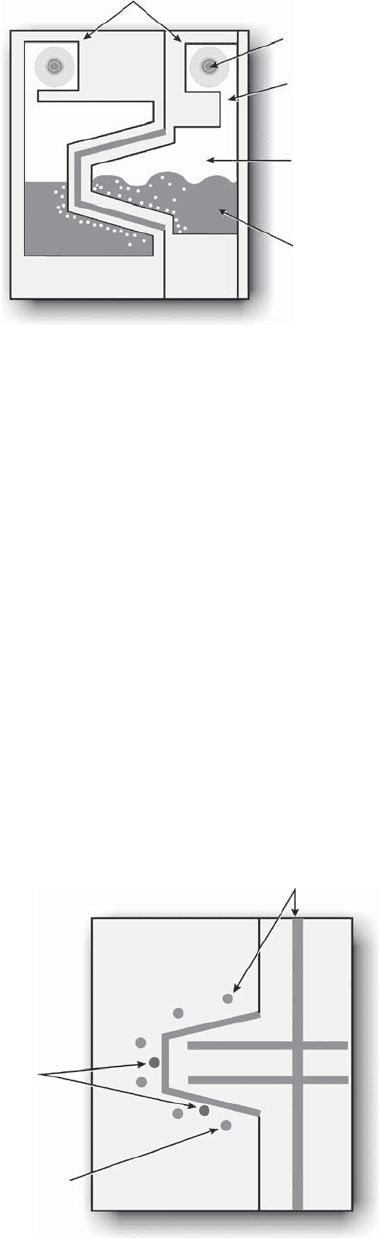
A proven approach has been the use of evaporative
cooling technology to simplify the design and manufactur-
ing requirements of mold cooling by replacing gun-drilled
water lines. Evaporative cooling is achieved through a
‘‘cooling chamber’’ or water pocket that completely envel-
ops mold cooling surfaces. The water chamber ensures
even heat distribution without the engineering compro-
mise often associated with gun drilling. Using heat ex-
changers, evaporative cooling condenses the water, which
in turn is recycled throughout the sealed chamber. The
turbulent flow of the water reduces any buildup of sludge
within the chamber that may impede mold cooling. To
reduce or eliminate corrosion issues, air is removed from
the cooling chamber prior to production. Use of a mold
temperature controller automatically senses and adjusts
water flow to regulate heat levels during processing. The
advantages of evaporative cooling are both environmental
(reduced waster water, reduced energy costs) and design-
oriented (reduced engineering costs, reduced manufactur-
ing costs, simplified mold construction), resulting in
improved reliability. See Figures 4 and 5 for a detailed
view of evaporative versus gun-drilled cooling.
Part Ejection. There are two basic methods of part ejec-
tion: mechanical and air. Mechanical ejection commonly
uses stripper rings or pins surrounding each mold core, or a
moving core cap to physically push the parts off the cores.
The stripper rings can be activated by hydraulic cylinders
Table 1. Classification of Molds
Lifetime Cycles Definition SPI Classification Estimated Build Time (weeks)
Greater than 1 MM Super high production 101 12–20
Less than 1 MM Medium production 102 8–12
Less than 500 M Low production 103 6–8
Less than 100 M Low production 104 6–8
Less than 500 Low production 105 5–6
Low cavity high cycles Pilot mold (class 101) PM 8–12
Less than 500 Prototype PT o6
Source: Courtes y of TecMar Group.
588 INJECTION MOLDING FOR PACKAGING APPLICATIONS
attached to the machine platen, air cylinders in the mold,
or a mechanical linkage tied to the motion of the machine
platen. Air ejection uses blasts of air to loosen and blow the
parts off the cores. Air ejection is the more popular method
because it involves fewer moving parts and, hence, less
maintenance. The mold can also be more compact.
Alignment. The proper alignment of core and cavity is
critical in thin-wall molding. Slight misalignment leads to
preferential filling of the thicker part of the cavity, which
causes a pressure imbalance around the core and cavity,
thus further shifting the core. The overall result is uneven
wall thickness in the molded part. In extreme cases, it can
result in (a) incomplete filling of the cavity (i.e., a short
shot) and (b) rejected parts. To achieve satisfactory part
quality, center-to-center alignment of the core and cavity
within 70.2 mil (70.005 mm) may be necessary.
There are different methods of aligning the cores and
cavities of packaging molds. One common method is a
stripper ring that uses tapers on the stripper ring to align
the core and cavity. This popular method of alignment has
disadvantages for thin-wall molding, where alignment
forces cause relatively rapid wear of the stripper rings.
Since the stripper rings form part of the molding surface,
excessive wear in this area reduces part quality. To avoid a
drop in part quality, frequent mold maintenance is re-
quired. Wear is not critical if the locking rings are not part
of the molding surface. Either air or mechanical ejection
can be used with this approach.
The floating-core method is a more recent design that is
suitable for some packaging applications. The cores and
locking rings are not rigidly fixed to the core plate, but are
allowed to float to more easily align themselves with the
cavities. Easier alignment results in less wear on the
aligning tapers. This method can also be used with either
air or mechanical ejection.
Mold Materials. High-quality mold materials are of the
utmost importance. Most mold components are made of
through-hardened high-quality tool steel. Hardness
ranges from RC 49–51 (Rockwell C scale) for the cores
and cavities to RC 30 for the mold plates. Only periodic
rebuilding of wear items, such as stripper rings and
leaderpin bushings, is required.
Stack Molds. A two-level stack mold typically has iden-
tical sets of cores and cavities on each mold face, which are
then stacked together back-to-back. In the case of a family
stack mold, the cores and cavities differ between the two
faces, allowing similar or matched pieces (compact-disk
jewel case, floppy-disk shell, etc.) to be produced during
each cycle . Use of a stack mold almost doubles the produc-
tivity of a machine. F or these reasons, stack molds are
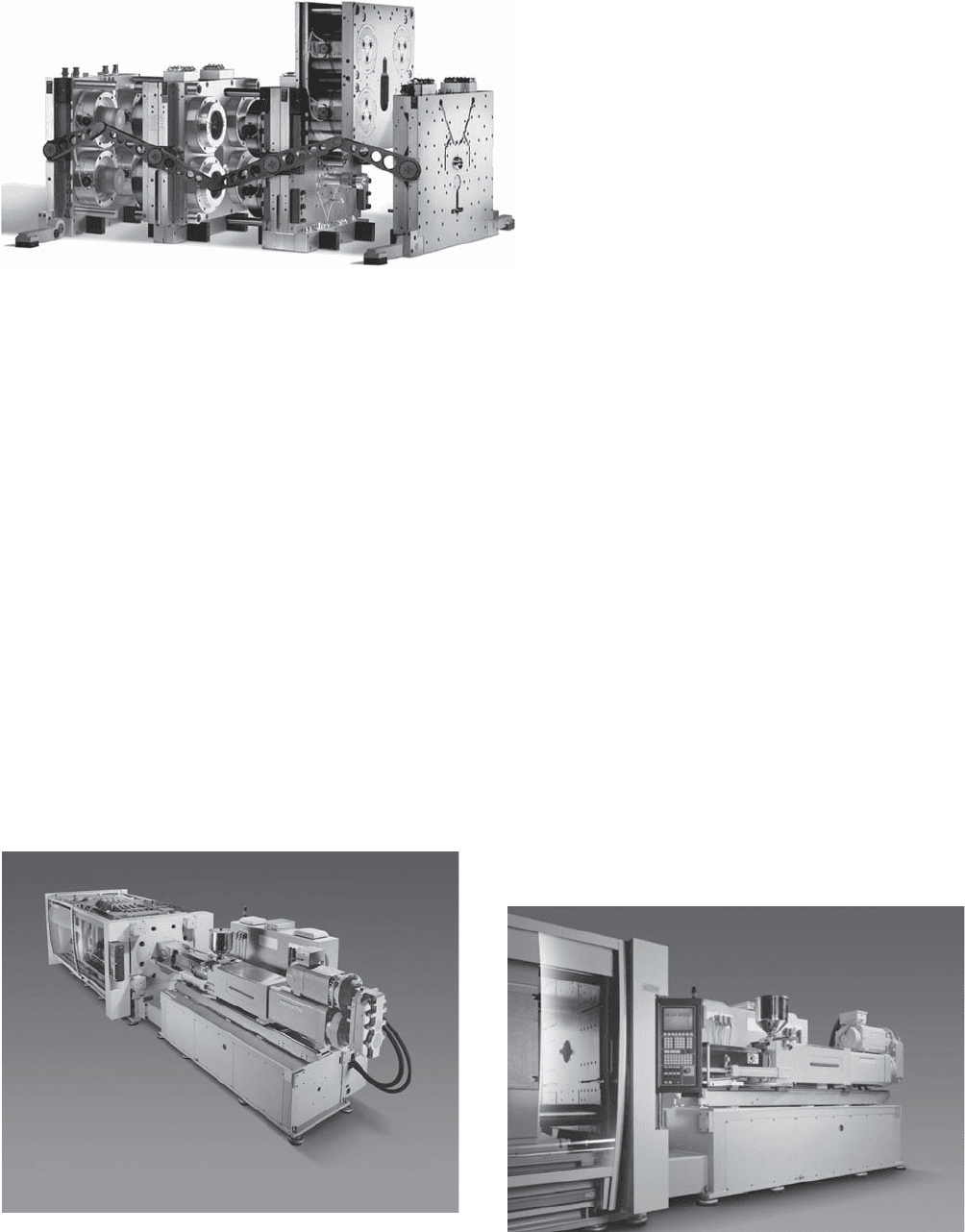
increasingly popular. Three- and four-level stack molds
have recently been introduced for thin-wall lids and contain-
ers to further increase machine productivity (see Figure 6).
THE THERMOPLASTIC INJECTION MOLDING MACHINE
A thermoplastic injection molding machine for Packaging
Applications can be described in seven parts:
1. The machine control and control architecture
2. The power plant
3. The injection unit
4. The clamp unit
5. The ejector mechanism
6. The base unit
7. Features specific to packaging applications
There are many different configurations of horizontal
clamp machines based on how they are powered. Hori-
zontal clamp machine varieties include:
. Hydraulic-operated machines with hydraulically dri-
ven clamps
Heat
exchanger
Cooling
water
Evacuated
chamber
Water/foam
Water
Figure 4. Evaporative cooling. (Photo courtesy of Ritemp Pty.
Ltd.)
Water
lines
Hot
spots
Cooled
spots
Figure 5. Gun-drilled cooling. (Photo courtesy of Ritemp Pty.
Ltd.)
INJECTION MOLDING FOR PACKAGING APPLICATIONS 589
. Hydraulic-operated machines with toggle-driven
clamps
. All-electric machines (only with toggle clamp)
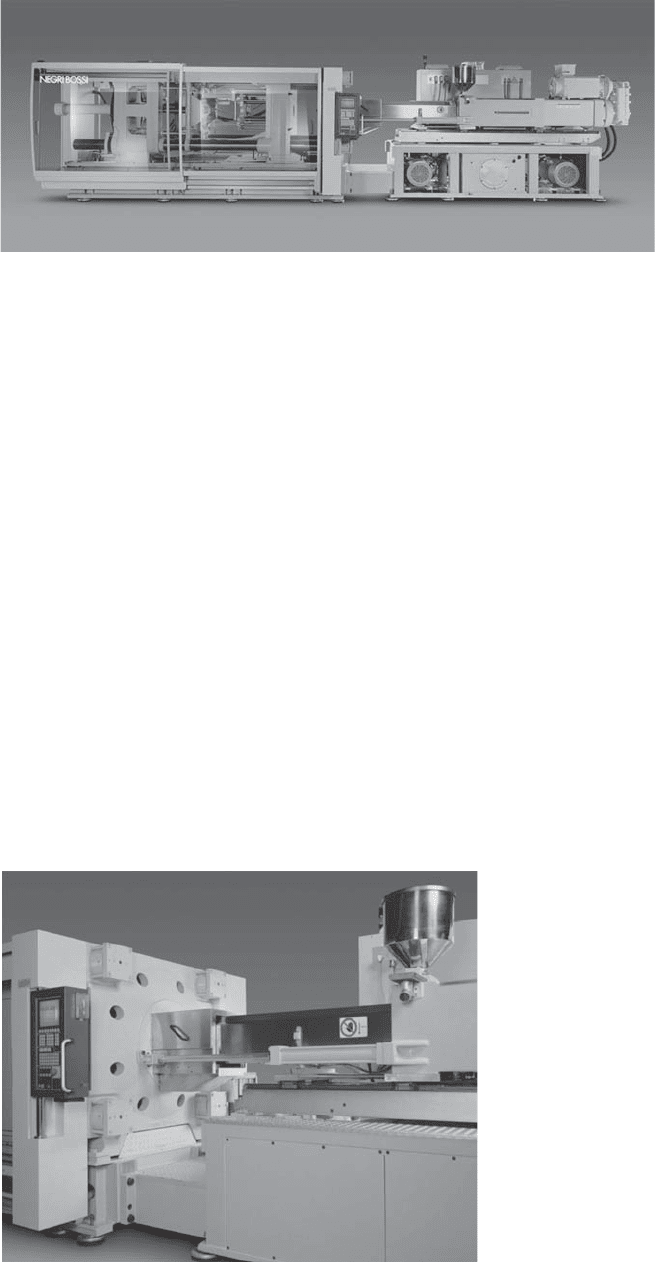
. Hybrid machines utilizing hydraulic clamp and elec-
tric screw drive (see Figure 7)
Add to the above the vertical clamp design and there are
quite a lot of models to choose from depending on the
molding application. This article will address the horizon-
tal machine group that is most common for packaging
applications.
The Machine Control and Control Architecture
The injection molding machine performs all functions to
operate a mold in a fully automatic way. The machine
control and the control architecture sets the way in which
all machine devices perform together in the operation of
the mold. There are various control architectures, depend-
ing on the manufacturer. Modern control solutions center
on ‘‘bus-type’’ controls that provide fully digital control
operation of smart devices like smart pumps, smart val-
ving, and digital transducers (see Figure 8). ‘‘Smart’’
means that devices carry their own electronics on-board
to communicate with the central industrial PC-based
controller. Wiring and overall machine complexity is
drastically reduced over traditional ‘‘analogue’’ not-smart
device control architectures. Diagnostics and maintenance
too is greatly simplified. The machine control carries all
the software programs of sequences and finite machine
control in the operation of the mold. Screen pages are
separated into their specific functions such as clamp,
injection, and ejection phases. Controls are intuitive and
user friendly.
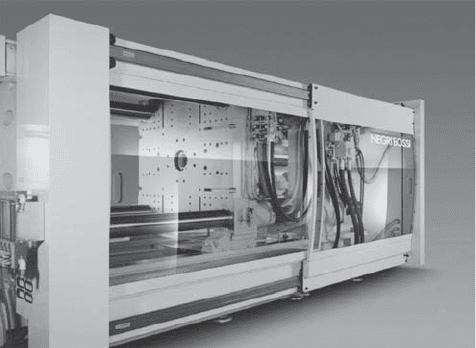
The Power Plant
The power plant is very important to the effective and
efficient operation of the injection molding machine (see
Figure 9). Modern trends toward the All-Electric machine
configuration is telling of the great need to reduce power
consumption and energy costs associated with injection
molding. The all-electric design, although more expensive
than its fully hydraulic machine counterpart, allows for
great power savings. Typically, as much as or more than
50% power savings is attributed to the All-electric design
versus hydraulic machine designs. Digital Bus-Type con-
trol architectures (even in hydraulic clamp/injection ma-
chines) as well provide energy savings due to the
Figure 6. A three-level, 12-cavity mold for 5-qt containers
utilizing a patented modular mold change feature. (Photo
courtesy of Top Grade Molds.)
Figure 7. Electric screw drive and hydraulic toggle clamp are
the main features of the machine shown. (Photo courtesy of Negri
Bossi.)
Figure 8. PC-based machine control with CanBus DIGITAL
control architecture. (Photo courtesy of Negri Bossi.)
590 INJECTION MOLDING FOR PACKAGING APPLICATIONS
reduction of machine components required. A ‘‘smart’’
hydraulic pump that controls its own pressure and flow
eliminates the need for a separate hydraulic manifold
block to perform the same function. This reduces not
only energy usage but also the number of components,
allowing for very cost-effective operation.
The Injection Unit. Raw plastic material from the resin
maker is processed by the injection unit of an injection
molding machine. It is the most critical device in the
control of the final plastic part’s quality. The process is
organized in sequences of the operation of the injection
unit as follows: injection shot size, speed, injection and
hold pressures, plasticizing recovery rate (melting/shear-
ing rate of the plastic as a function of screw rotational
speed), and backpressure (as a function of the resistance
pressure on the screw to melt the plastic during plastici-
zation). The injection unit also functions to move the
nozzle and apply pressure onto the mold. It does this via
‘‘carriage’’ hydraulic cylinders operating on both sides of
the injection unit (see Figure 10).
Determination of the injection pressure will depend on
the wall thickness of the part (t), the length of flow (L)of
the plastic resin from gate entry into the part to its final
stopping point, and the force of injection created by the
injection unit. The higher the L/t ratio (called the aspect
ratio), the greater the injection forces and pressures
required for injection. Typically, thin-walled packaging
applications require injection forces greater than
30,000 psi and very fast plasticizing rates. Most packag-
ing applications hover between 5 and 10 s of cycle time
(even o5-s cycle times) so rapid actions of the injection
unit are vital in meeting this requirement. The type of
injection unit used most commonly is the reciprocating
screw driven rotationally by an electric motor and linear
movement driven by hydraulic cylinders. To reach the
high speeds of injection, hydraulic accumulators (energy
storage devices) are used to instantaneously drive the
cylinders and therefore screw forward. The hydraulic
power plant of the machine is engineered to allow mold
opening and hydraulic ejection during the screw plasticiz-
ing mode. These ‘‘overlapping’’ motions in the sequence
are designed to reduce the cyle time to its minimum,
thereby maximizing machine and mold production output.
Every aspect of machine design is tailored to maximize
production output. Most often it is not the machine which
creates delays in the production of plastic parts. The mold
construction, quality, and the rate of part/mold cooling will
determine the final production output. Advances in mold
cooling technology as described in Figure 4 greatly reduce
cycle time and increase part production.
The Clamp Unit
The main purpose of the clamp unit is to hold the mold
closed under the force of plastic injection pressure that is
trying to force the mold open (see Figure 11). Its design
takes into consideration the objective of fast and precise
operation while protecting the mold from damage should a
plastic part get trapped from improper ejection or some
part of the mold somehow interferes with the proper and
complete mold closing sequence. This feature is called
simply ‘‘mold protection.’’
Clamp units come in two different operating types: the
toggle clamp (hydraulic or electrically operated) and the
fully hydraulic clamp. The toggle clamp’s advantages are
its fast operating speed and natural geometric motion of
high-speed acceleration, maximum velocity, controlled
deceleration to final mold closing, and sensitivity on
mold protection. The fully hydraulic clamp features
capabilities to mold deep-draw parts such as extra large
Figure 9. The power plant under the injec-
tion unit displays a double smart pump and
motor system on this 700-ton electric–hy-
draulic hybrid machine. The oil tank is
located between the smart pumps. The
guarding is partially removed from the in-
jection unit for this photo. (Photo courtesy of
Negri Bossi.)
Figure 10. The injection unit displayed here shows a stainless
steel purge guard over the heated barrel and hydraulic carriage
cylinders (both sides). (Photo courtesy of Negri Bossi.)
INJECTION MOLDING FOR PACKAGING APPLICATIONS 591
deep-draw containers and is usually engineered into
larger machines.
Clamp rigidity, precise alignment/parallelism, and op-
eration is of prime importance because of the extreme
forces generated to hold the mold closed during injection.
The machine’s stationary platen and moving platen’s
deflection is of great concern; as a result, the most
advanced metals, casting methods, and machining pro-
cesses are typically used in their construction in order to
minimize it.
The Ejector Mechanism
Molten thermoplastic resin, when cooled, shrinks onto the
‘‘core’’ of the mold and requires some force to eject it. This
can be done in two ways: (a) via an air blast originating
from the mold itself or (b) this in combination with
mechanical ejector rods operated by the machine which
in turn operate mold ejection surfaces. By their very
nature, packaging applications produce ultra-thin parts.
These ultra-thin parts in a relatively ‘‘warm’’ condition
fixed to the mold core can create a problem during ejec-
tion. The part could deform if only mechanical ejection is
used. Most thin-walled parts take advantage of the mold
air eject feature to break the vacuum created between the
part and the metal surface of the core.
The Base Unit
The importance of this part of the machine’s construction
should not be underestimated. The base unit houses all of
the major components described above. It carries the
weight of these large components and connects them
into one cohesive structure.
The base unit can be engineered in different ways, but
almost all designs center on the ‘‘box tubular steel’’ welded
constuction. This provides the necessary rigidity,
strength, and stage for the operation of all components.
Features Specific to Packaging Applications
Thus far the machine description has been universal.
Packaging applications demand features of the mold and
machine dedicated to it. The packaging mold has been
described in detail in this article. The packaging machine
needs further clarification on design features which sepa-
rate it from universal applications. Here is a summary and
description of those features required by packaging
applications:
. Hydraulic Accumulator-Assisted Injection. As de-
scribed earlier in this article, this feature increases
the velocity of injection in order to fill the cavity
completely in a thin-walled mold. Instantaneous
energy is directed to the injection unit to affect
o0.5- to 1.0-s injection times.
. Positive Nozzle Shut-off. This feature allows the
screw to rotate and plasticize resin while the clamp
is opening. It prevents drool out of the nozzle during
screw recovery/plasticizing.
. Independent Plasticizing (Mold Opening During
Plasticizing Phase). This feature allows faster cycle
times of the machine/mold operation.
. Independent Ejector Motion (Mold Opening and Ejec-
tion Simultaneously). This feature also allows fas-
ter cycle times of the machine/mold operation.
. High-Pressure Injection (30,000 psi or Greater). Pres-
sure is the result of restriction to flow. Due to the
thin-wall restriction of the mold, greater forces and
speeds of injection are required to completely fill the
cavity. The forces here are created by the accumula-
tor assisted injection described above. Keeping the
screw size as small as possible also aids in higher
injection pressures (pressure = force/area).
. Barrier Screw for Higher Plasticizing Rates. This
type of screw is sometimes called a ‘‘double-wave’’
screw. The flights of the screw are doubled for
greater shearing capacity and therefore greater
plasticing/melting output. Another benefit is the
greater mixing of the melt which aids in better
part quality and processability. Typically, barrier
screws are best suited for the polyolefin materials
such as polyethylene. A thermoplastic material in
high use for packaging applications.
. High-Flow Check Ring. The objective is to minimize
any restriction to the flow of plastic material. High-
flow check valves located on the tip of the screw do
just that.
. Magnetic Resin Filter under Hopper. Entry points of
the plastic into the mold are very small, in the area of
0.04 in. (1 mm) and smaller. Any foreign matter and
especially metal can damage the mold or get trapped
in the mold, creating flow restrictions. The magnetic
filter assists in removing these contaminants.
. Air Ejection Valves (for Mold Air-Eject Sequence). As
described earlier in this article, the plastic part
shrinks onto the mold core due to cooling and creates
an
air-lock that needs
to be broken for safe and
effective ejection of the part.
Figure 11. The clamp unit displayed here shows the moving
platen with T-slots for ease of mold mounting. (Photo courtesy of
Negri Bossi.)
592 INJECTION MOLDING FOR PACKAGING APPLICATIONS
. Hot Runner Temperature Controls. The hot runner
system in the mold requires temperature controls to
affect the heat energy directed to the molten plastic.
. Possible Hot Runner Valve Gate Hydraulic Valve and
Control. Periodically, a type of hot runner system
known as a Valve Gate System is required to posi-
tively shut off the plastic flow directly at the cavity
entry point (gate). This is done by a metal pin in the
flow of the plastic operated by a piston in the mold.
The control of the valve gate piston can be done
pneumatically or hydraulically. The machine would
then be fitted with a pneumatic or hydraulic valve to
activate the valve gate piston.
. Possible Parts Blow-Down after Ejection. Multicav-
ity molds eject parts that fall at the speed of gravity.
In order to quicken the speed of the machine/mold
operation (reduce cycle time), a blast of air directed
downward on the parts can be beneficial in reducing
the time it takes for the parts to clear the mold and
allow it to close unhindered.
. Increase Power Plant Horsepower. In order to supply
the instantaneous power requirements for pack-
aging applications, the machine’s power plant needs
to be engineered accordingly. Pumps, motors, and
valves must be sized properly and integrated with
the machine control architecture to create condi-
tions for ultra-fast and ultra-precise operation.
AUTOMATION FOR INJECTION MOLDING MACHINES
The process of injection molding does not end with the
part being ejected from the machine. Somehow the part
must get from the ejection sequence to the carton box in
which the part will be shipped, or on to a secondary
process such as subassembly with other parts. This pro-
cess is called ‘‘downstream part handling,’’ and there are
many ways to do this. Parts could drop directly into the
shipping box if there are no cosmetic abrasion concerns. It
is certainly the least expensive way without need of any
handling equipment. An operator could manually take
parts off a conveyor belt and stack them into the shipping
box? Or a better, more cost-effective way would be to
automate the process fully and eliminate the need for
costly manual labor while protecting the quality of the
part molded.
Automation can take on many different forms. It can
start right at the mold with specialized mold chutes
designed to carry the parts to another station that
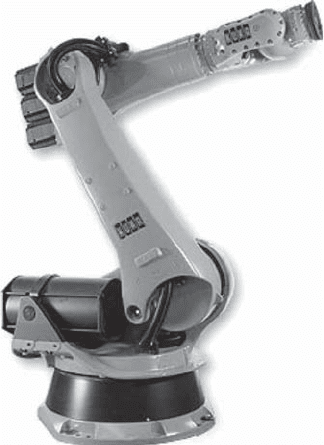
packs them into boxes. It could be various robotic equip-
ment such as three-axis or six-axis robots programmed
for sequenced action (see Figure 12). These robots
could stage a secondary process where parts are wrapped
or stacked or printed or any other process required.
Automation can perform quality control procedures
such as weighing, inspecting, dimensioning, and so on.
Indeed, every approach to automating plastic-molded
part production is a creative process, and the choices
available are extensive, impressive, and worthy of
investigation.
MONITORING AND SERVICING THE MACHINERY
Every second of production downtime costs money and
valuable resources in a molding company. There is a great
need to diagnose and monitor the machine operation
including visual imagery from wherever the production
manager is located, be it in the plant or out of town on
business or even at home in critical situations. It is
identically vital that the machine maker’s service techni-
cian access real-time machine data and visual imagery
from wherever they are in the name of responsive service
and uptime for their customer, the molder.
Internet technology has made the above scenario pos-
sible. Real-time data on the machine process is now
available via secure networks with access to any internet
location worldwide. This 21st-century technology is revo-
lutionizing the service, monitoring, and control of injection
molding machines. It makes the job of servicing machines
easier, faster, and better like never before. Problems get
diagnosed immediately via the internet through secure
levels of access. The manpower, tools, and parts needed to
make the fix are prepared ahead of the travel to the
machine’s location. The jobs are done effectively, effi-
ciently, and at minimum cost to the service company
and/or molder, depending on cause. For the first time in
the evolution of the injection molding machine, the custo-
mer and machine maker have the power over every aspect
of machine operation in realtime. One system made by a
well-known machine maker also allows real-time changes
to be made to machine parameters/settings remotely via
any internet location worldwide. This is by far the most
powerful service tool ever devised for injection molding
machines. See Figure 13 for a graphical explanation of a
unique remote teleservice system that works with a
Figure 12. Floor-mounted 6-axis articulating robot. Models also
come in platen-mounted designs. End of arm tooling not shown.
(Photo courtesy of KUKA Robotics.)
INJECTION MOLDING FOR PACKAGING APPLICATIONS 593

patented wireless communication system between ma-
chine and central PC.
BIBLIOGRAPHY
F. Johannaber, Injection Molding Machines—A User’s Guide, Carl
Hanser Verlag, Munich, 1985.
H. Rees, Understanding Injection Molding Technology, Carl Hanser
Verlag, Munich, 1994.
B. James, Ritemp Pty. LTD, Australia, An Introduction to the
Latest Development in Mold Cooling Technology, Gardner
Publications, New York, 2006.
T. Schwenk, Process and Design Technologies, Building a Better
Injection Mold, 2007.
R. Carter, Injection Molding, Wiley Encyclopedia, New York, 1997.
Contributors
R. Carter, Injection Molding, Wiley Encylopedia, 1997 (written
portions of the section entitled ‘‘The Thermoplastic Injection
Mould’’).
W. Stoddard, TecMar Group, Georgetown, Ontario, Canada (writ-
ten portions of the section entitled ‘‘The Thermoplastic Injec-
tion Mould’’ and the graphics: Chart 1, Figure 3: Evaporative
Cooling and Figure 4: Gun Drilled Cooling).
Top Grade Molds, Mississauga, Ontario, Canada (Figures 2, 3,
and 6).
KUKA Robotics, Clinton Township, Michigan, USA (Figure 12).
Negri Bossi Inc., Mississauga, Ontario, Canada (Figures 1, 7, 8, 9,
10, 11, and 13)
INKS
R. W. BASSEMIR
A. J. BEAN
Sun Chemical Corporation
INTRODUCTION
Printing ink is a mixture of coloring matter dispersed or
dissolved in a vehicle or carrier, which forms a fluid or
paste that can be printed on a substrate and dried.
Printing inks are used to decorate the exterior of virtually
every package and substrate used in packaging. Since
there are various substrates, a number of different print-
ing methods are required to satisfy the needs of this entire
market (1). In general, the inks required may be subdi-
vided into two classes: liquid inks and paste inks. The
liquid inks include those printed by the flexographic,
rotogravure, and screen process methods; the paste inks
include those printed by lithographic offset, letterset, and
letterpress (see Decorating; Printing).
Basically, all printing inks consist of a colorant (see
Colorants), which is usually a pigment but may be a dye,
and a vehicle that acts as a binder for the colorant and a
film former. Vehicles generally consist of a resin or poly-
mer and a liquid dispersant, which may be a solvent, oil,
or monomer. Many other additives are used to provide
some specific property or function to the ink or ink film.
Approximate viscosities and film thicknesses used in
different printing processes are given in Table 1. The
four key properties of ink are drying, rheology, color, and
end use.
LIQUID INKS
Flexographic Ink
Flexographic printing utilizes a rubber or plastic printing
plate and is essentially a typographic process, printing
from a raised area. The inks used are very low in viscosity
(see Table 1) and dry rapidly because of their relatively
high volatility. Since the printing press used has a very
simple ink distribution system, these volatile inks do not
cause problems in drying on the inking rollers. The
thickness of the ink film is controlled by the depth of
engraving used on the anilox inking roller. The commer-
cial speeds used for this type of printing range from 500 to
1000 ft/min (152–305 m/min). Flexographic ink accounts
for more than half of the ink utilized in decorative
packaging.
Flexographic inks may be subdivided into two general
classes: solvent-based and water-based. The volatile sol-
vents selected for the formulation must be chosen with
care, since they are in constant contact with the plate
elastomer. It is important to screen these ink solvents with
the plate and roller elastomers to ensure that no swelling
Figure 13. A graphical representation of a remote teleservice system utilizing patented wireless connectivity between machine and
central PC. Real-time monitoring, diagnostics, and real-time machine control changes can be made remotely via any internet location
worldwide. (Graphic courtesy of Negri Bossi.)
594 INKS

or attack of the surface takes place. In most cases, alcohols
are the material of choice for solvent-based flexographic
inks, with additions of lower esters and small amounts of
hydrocarbons. These are used as needed to achieve solu-
bility of the vehicle resin and proper drying of the ink film
at press speed. Solvent blends are required to achieve the
best balance of viscosity, volatility, and substrate wetting
and must also take into account EPA (Environmental
Protection Agency) requirements.
Water-based inks have increased in popularity because
of air pollution concerns and are being used in increasing
amounts for both absorbent and nonabsorbent substrates.
The solvent used in these inks is usually not 100% water.
They may contain as much as 20% of an alcohol to increase
drying speed, supress foaming, and increase resin compat-
ibility. The wetting of plastic substrates is also greatly aided
by the lower surface tension of the alcohol–water mixture.
The resins and polymers used in the flexo-ink vehicles
cover a wide range of chemistry and are selected to
achieve adhesion to various substrates or to confer resis-
tance properties to the dried ink film. A number of resin
classes and the substrates upon which they are generally
used are shown in Table 2. Note that the water-based
vehicles are listed in a separate portion of the table, since
they are generally emulsions or colloidal dispersions
rather than true solutions.
A generic formulation for an aqueous flexographic ink
(components amounts are in %, w/w) is as follows: pigment
dispersion, 35–50; emulsion vehicle, 25–35; solution
vehicle, 10–20; amine neutralizer, 0.5–1.5; wax emulsion
compound, 2–5; wax powder, 0–2; surfactant, 1–1.5; cross-
linking additive, 0–2; silica additive, 2–5; corrosion inhi-
bitor, 0–1; defoamer, 0–1, other additives, 0.25–0.5 (2).
Gravure Ink
Gravure printing utilizes an etched or engraved cylinder to
transfer ink directly onto the substrate. Because of the
mechanics of filling the very small cells, the viscosity of
gravure inks must be relatively low (see Table 1). This is
also required in order to transfer ink from the engraved
cells at high speeds. The rotogravure press uses a simple
inking system, where ink is applied directly to the gravure
cylinder and excess ink is scraped off with a doctor blade.
The ink-film thickness is determined by both the depth of
engraving and the area of the cells, because these two
factors determine the volume of ink transferred. Commer-
cial speeds vary from 800 to 1500 ft/min (244–457 m/min) or
more. Gravure ink is the second-largest category of packa-
ging inks. Together with flexographic ink, these two liquid
inks account for more than 80% of all packaging ink.
Rotogravure inks can also be classified as solvent-based
or water-based types. The solvent-based inks are not as
restricted by plate compatibility problems as are the
flexographic inks because the plate is metal and resistant
to nearly all solvents. Since a wider variety of solvents
can be utilized in manufacturing a rotogravure ink, a
much wider range of resin types and resin molecular
Table 1. Ink Viscosity and Film Thickness by Process
Process Viscosity, Poise (Pa s) Printed Film Thickness (mm)
Lithography 50–500 (5–50) 1–2
Letterpress 20–200 (2–20) 3–5
Flexography 0.1–1 (0.01–0.1) 6–8
Gravure 0.1–0.5 (0.01–0.05) 8–12
Letterset 30–300 (3–30) 1.5–3
Screen 1–100 (0.1–10) 20–100
Table 2. Liquid Ink Applications for Packaging: Flexographic and Gravure
Paper/paperboard Foil PE PP Vinyl PET Cellophane
Solvent Ink Systems
NC–maleic X X X X X
NC–polyamide X X X X X
NC–acrylic X X X
NC–urethane XX
NC–melamine X X
Chlorinated rubber X X
Vinyl X X
Acrylic X X X X X
ASP–acrylic X X
CAP–acrylic X X
Styrene X
Water Ink Systems
Acrylic emulsion X X X X X X X
Maleic resin dispersion X X
Styrene–maleic anhydride resins X X X X
NC, Nitrocellulose; ASP, alcohol-soluble propionate; CAP, cellulose acetate propionate.
INKS 595
weights can be utilized in achieving the desired ink
properties. This means that gravure inks for packaging
can be tailored for good adhesion to the widest selection of
substrates. Historically, there are 10 gravure inks cate-
gorized by the binders or solvents used: A, aliphatic
hydrocarbons; B, aromatic hydrocarbons; C, nitrocellu-
lose; D, polyamide resins; E, SS, nitrocellulose; M, poly-
styrene; T, chlorinated rubber; V, vinyls; W, water-based;
and X, miscellaneous. Many of these classifications are
blurring as blends of these materials are becoming more
common (1).
The resins and polymers used in packaging gravure
vehicles cover a wide range of chemistries and are chosen
to achieve adhesion to various substrates or to confer
specific properties to the finished ink film. These are listed
in Table 2.
Approximately 50% of all flexographic inks use water
as their primary solvent and diluent. Water-based gravure
inks are used widely for printing paper and paperboard
substrates, and their use for nonpaper substrates is
growing because of concern about air pollution. The for-
mulation of these inks is very similar to those used in
water-based flexography and the polymers are also very
similar. These are listed in a separate section of Table 2.
Main advantages of water inks include excellent press
stability, printing quality, heat resistance, absence of fire
hazard, and convenience of water for reduction and wash-
up. The main disadvantage of water inks is the increased
energy required for drying due to the high latent heat of
water. A significant problem that can occur with water-
based inks in gravure is the drying of the vehicle polymer
or resin in the engraved cells. This can occur during
shutdowns of the press. Some of these materials are not
readily resoluble once they have dried because they are
usually emulsions or colloidal dispersions in water. To
assist in the drying of water-based inks, the gravure
cylinders are usually engraved or etched with shallower
cells. A thinner ink film is applied, which contains less
water to evaporate. This also means, however, that the
amount of pigment in the press-ready ink must be higher
in concentration to achieve the same relative printing
density as the solvent-based ink.
Uses. Type C inks are the dominant group used in
packaging gravure. Type C is used for printing on foil,
paper, cellophane, paperboard, coated and uncoated paper,
glassine, acetate, and metallized paper. Type A and B are
used for gift wrapping paper. Type D inks have excellent
adhesion to many plastic films. This type ink is used in
foil, paper, and paperboard. Type E includes a wide variety
of inks and lacquers and some dye inks. They are often
used on paper and paperboard, some grades of cellophane
shellac, or nitrocellulose primed foil pouch stock glassine
and other coated speciality products. Type T inks show
extremely good resistance to alcohol and soap. They are
considered high-quality inks. Type W gravure inks, pri-
mers, and lacquers are used to comply with VOC emission
standards. Water inks are primarily used in packaging
gravure on board and paper. Type V inks are used for
printing vinyl films and Saran (1).
Screen Ink
Screen printing, which accounts for a relatively small
percentage of ink used in the packaging market, is used
on low-volume specialty items or where very thick films
are desired (see Table 1). Screen ink is included in the
liquid-ink section because of its paintlike rheology and
chemistry.
Screen inks are applied by squeegeeing the ink through
a stencil screen with a rubber blade. The inks must have
adequate flow to pass through the screen, but must also
have enough body to resist dripping and stringing when
the screen is lifted. For many years this was a hand-
printing operation, but has now become largely mecha-
nized due to the development of rotary screen technology
which allows screen units be inserted in-line with other
printing technologies on web-fed combination presses. The
two largest classifications of screen inks are solvent types
and plastisol types, although water-based, radiation-cur-
ing, and two-part catalytic systems are also available.
Substrates need not be flat, because oval and round forms
can be printed.
Lamination Inks
These inks must not interfere with the bond that is formed
when two or more films are bonded together to obtain a
structure that provides more resistance than is found in a
single film. Laminations are used in candy and food
wrappers. Resins used for this ink cannot exhibit any
tendency to retain solvent because this would contaminate
the product. In addition to polyamides, these inks contain
modifiers such as polyethylene resins, plasticizers, and
wax. Laminations are usually reverse-printed and end up
sandwiched between films. Water-based inks are being
tested for their functionality and ability to meet U.S. EPA
emission standards.
PASTE INKS
Offset Lithographic Ink
Lithographic printing uses a planographic plate in which
the ink-receptive image is chemically differentiated from
the nonimage area. Since these plates are constantly
wetted with a dampening solution, the inks must resist
the chemicals contained in these solutions without chang-
ing in their printing characteristics. The thickness of the
ink film in this process is 1–2 mm, which is the thinnest
film in any commercial process. Because of this, the
colorant concentrations in lithographic inks are generally
higher
than those found
in inks for other processes.
Lithographic inks generally have relatively high viscos-
ities due to the ink-distribution systems used on the press
equipment for this process. It is also common to find a
gelled consistency in the body of these inks because of the
need to obtain high printing resolution and faithful re-
production of the plate image. Image quality of half-tone
reproduction is extremely high.
Sheetfed Offset Lithography. A large segment of com-
mercial prinitng is done on sheet-fed presses almost
596 INKS
entirely by the litho process. Inks for these presses are
based on vehicles containing phenolic-modified, maleic-
modified, or unmodified rosin-ester resins dissolved in
vegetable-drying oils and diluted with hydrocarbon resins.
Special acrylic resins have been developed for use in
quickset inks, and they offer nonskinning properties and
excellent press stability. This process is widely used for
printing on packaging board, paper, metal, and plastic
sheets. The use of the offset blanket permits excellent
reproduction even on surfaces that are not entirely flat
owing to the compressibility of the blanket material. The
inks used for most conventional sheetfed printing are
dried by an oxidative process and may also be accelerated
by the use of infrared radiation. These inks set rapidly in a
matter of seconds, but are not truly dry for several hours.
In the case of metal, the inks are usually reactive only at
high temperatures of Z3001F(Z1491C), which are
achieved by passing the metal sheets through a heated
oven after removal from the press.
Drying of sheet-fed lithographic inks can be done with
ultraviolet radiation, which is applied by means of high-
powered mercury arc lamps immediately after printing.
This process is widely used in the production of packaging
that must be die cut and finished in-line, such as cartons
for cosmetics and alcoholic beverages. Ultraviolet drying of
the ink offers significant energy savings in metal decorat-
ing where it replaces long, energy-consuming ovens.
Web Offset Lithography. In web offset, the same litho-
graphic principles that are used in sheet-fed lithography
are applied to the printing of the substrate in the form of a
web. The web of the substrate is fed into the printing press
for decoration from a large roll. The printed substrate,
upon exiting the press, must be dried immediately so that
the finished product can either be rewound, sheeted, or
finished in-line. The most common method to dry the
printed ink immediately is the utilization of a high-tem-
perature oven that employs recirculated hot air at a
temperature of about 250–3501F(121–1771C). For this
reason, the handling of plastic substrates is generally not
possible because of the distortion of the substrates at these
high temperatures. Drying inks with ultraviolet or electron
beam radiation allows the printing of temperature-sensi-
tive substrates. Generally, web offset printing in packaging
is confined to paper and board printing. However, drying
technology utilizing radiation curing promises to offer the
packaging market the advantages of high-speed printing,
the quality of offset lithography, and the lower cost of offset
plates compared to gravure cylinders. Typical speeds for
web offset printing are 800–1200 ft/min (244–366 m/min).
Letterset Ink
This printing process, formerly known as dry offset, is a
combination of letterpress and offset in that the printing
plate uses raised images, but the printing on the substrate
is accomplished with a rubber blanket. Therefore, the inks
used in letterset generally have the viscosity and body of a
letterpress ink. The predominant use of letterset printing
in packaging is for the decoration of two-piece metal cans
(see Metal cans, fabrication). Plastic preformed tubs and
containers are also printed utilizing the letterset process on
a mandrel press. Two-piece can printing is accomplished on
special presses that produce at the rate of 1200 cans per
minute with up to five colors and a clear varnish. The inks
for beverage cans are generally dried by heat.
Ultraviolet drying is used by several metal-decorating
printers, primarily for beer cans. Ultraviolet is widely
used for curing plastic containers where thermal sensitiv-
ity is a serious problem and heat curing cannot be used.
The metal-decorating ovens used for thermal curing have
recently gone to short cycles that use temperatures of
6001F (3161C) for only a few seconds to cure the inks.
These inks are used primarily for ecological reasons (3).
Letterpress Inks
These inks are used primarily for printing corrugated
packaging (see Boxes, corrugated), although small
amounts are still used for folding-carton and multiwall-
bag (see Bags, paper) printing. Since letterpress uses
raised images, the inks are fairly heavy in body (Table
1), and the primary mechanism for drying is oxidative or
absorptive. The inks are generally formulated in a manner
similar to sheet-fed offset inks but with a slightly lower
viscosity. This printing method has been losing market
share to the other printing processes for a number of years
because of high preparatory and labor costs. This is
particularly true in corrugated printing, which is going
primarily to water-based flexography.
ENVIRONMENTAL CONCERNS
Speciality inks are a sector of the chemical industry.
Federal regulations fall under the auspices of the United
States Environmental Protecion Agency and the Depart-
ment
of Labor and
to a lesser degree the Food and Drug
Administration. Some states and voluntary guidelines
also impact ink.
In general, environmental concerns affect various in-
dustries involved with ink. These include the converting
industry that uses inks to produce packaging and printed
matter of all types and even extends to issues related to
the ultimate end-user companies whose printed or pack-
aged products are often distributed around the world.
Common environmental aims such as reducing air
pollution, use of renewable resources rather than crude-
oil based chemistries, biodegradable inks and coatings,
and the pressure to recycle waste materials back into the
raw materials supply impact the printing ink industry.
Over the past 20 years, new ink products have been
developed and will continue to be developed in response
to environmental issues.
The United States has been among the most highly
regulated countries in the world. Beginning in the 1970s
and continuing through the 1990s, there was a persistent
flow of regulations governing not only printing processes
but also the use and disposal of printed matter. A clear
historical account of the effect of antipollution laws and
the ink industry can be traced. Since the late 1980s,
Canadian, Asian, and European markets have had a
INKS 597