
Yam, Kit L. (ed.). The Wiley encyclopedia of packaging technology
Подождите немного. Документ загружается.


outsourcing are South East Asia, South Korea, and China.
The Philippines is a major source in Japan of printed
flexible packaging for pouches and flow wraps.
The solution to the cost base issue is to continue to
value-add packaging, while inventing and exploiting new
technologies in the process. Japan’s packaging industry
innovates with packaging and also commercializes pack
concepts from other countries. Toppan’s Cart-o-Can origi-
nates from Finland; it was developed and commercialized
by Lamican oy in Valkeakoski. This is a good example of
the Japanese commercial mentality to exploit, improve,
and get to market quickly.
The packaging industry leads globally in many consumer
pack areas; to highlight this fact, 3 examples are as follows:
. Print quality. The value of good quality print and the
exploitation the medium can offer (Image 3) is
underappreciated.
. Shaping of paperboard containers. Moving a
straight-sided carton into a curvy and feature-rich
pack has been a Japanese strength that has given an
added dynamic to what was once an unchanging
format (image 4).
. Light weighting of PET. This is a popular claim from
many countries, and Japan can claim important
success here especially with structural design and
the use of interlocking panels to create strength
(image 5).
Light weighting is a good example of Japan’s success
with materials application, but part of the pressure to
change is to increase savings because of expanding
raw material costs. As an example is a brand leader in
the bottle water market, ‘‘Tennensui’’ (brand owner &
producer Suntory), which was launched in March 2007,
Overview of production number and value of packaging machinery
2005 - final - 2006 - final - 2007 (incl. estim.)
Number Value Number Value Number Value
Grand Total 518,365
(97.2)
4501
(100.0)
492,647
(95.0)
4.665
(103.6)
494,537
(100.4)
4823
(103.4)
1. Packaging and packing machines
Total
516,662
(97.2)
4066
(100.8)
490.792
(95.0)
4.191
(103.1)
492,722
(100.4)
4324
(103,2)
Unit and inner packaging machine
Sub-Total
385,349
(98.2)
3253 (99.5) 367,501
(95.4)
3,354
(103.1)
367.744
(100.1)
3466
(103.4)
-Scaling machines 4070 205 4078 202 4128 213
-Filling machines 4429 397 4412 428 4544 448
-Bottling machines 2915 456 3222 496 3581 531
-Canning machines 160 29 158 18 163 18
-Pouch form/filling machines 7122 488 6996 512 6759 522
-Container form/filling machines 450 166 433 179 450 175
-Labeling machines 258,644 157 247,862 151 246,034 159
-Cartooning machines 331 64 305 61 335 69
-Overwrapping machines 18,493 236 18,748 233 19,707 250
-Sealing machines 57,087 164 50,821 184 50,711 188
-Shrink packaging machines 2898 112 2867 109 2840 119
-Vacuum packaging machines 6688 103 6734 116 7262 122
-Others 22,062 684 20,865 664 21,230 652
Outer packaging and packing machines
Subtotal
131,313
(94.4)
813 (106.0) 123,291
(93.9)
838 (103.0) 124,978
(101.4)
858 (102.4)
-Case landing machines 940 157 941 161 1118 174
-Case gluing machines 147 10 126 7 119 6
-Taping machines 3679 28 3662 26 3728 26
-Strapping machines 103,407 127 95,479 135 96,042 135
-Typing machines 3680 46 3530 52 3652 54
-Boxers 10,257 10 9078 9 9468 10
-Uncasers 17 3 20 4 25 6
-Others 9186 431 10,455 444 10,826 448
2. Bag making machines
Total
1265 (100.3) 274 (96.1) 1,308 (103.4) 287 (104.6) 1308 (100.0) 287 (100.0)
3. Paper and paper board converting
machines
Total
438 (82.3) 161 (89.0) 547 (124.9) 187 (116.2) 504 (92.1) 212 (113.5)
Production value in 100 million yen(\) ( ); Comparison with previous year (%).
628 JAPANESE PACKAGING
introduced a light-weighted 500 mL PET bottle at 25 g
with a new (and in some respects novel) shape that was
asymmetrical. This design was enhanced by a hewn ice
effect, and although it had good visual impact, standout,
and brand recognition at the point of sale (PoS), it proved
to be structurally weak. This was evident in the all-
important vending distribution system, where lateral
crushing became very evident. A modification to the bottle
structural design was necessary through adding a rib to
the base (launched in April 2008) to enhance strength.
The net result in weight saved was another 4 g at 21 g for
this 500-mL bottle.
Although 21 g is lightweight the current lightest weight
500-mL PET bottle is 18 g for ‘‘Pokari Sweat’’ (brand
owner and producer Otsuka Pharmaceutical), which is
an 11 g reduction over the previous pack. The values of
this bottle through shaping were challenged, and the well-
known square cross-sectioned-based bottle was replaced
by a conventional cylinder with strengthening ribs added
to the perimeter body. Otsuka Pharmaceuticals believes
they have reduced PET consumption for this bottle
(launched in 2007) by 2700 t per annum.
These weight reductions also demonstrated that the
brand values of a pack through shaping and surface
treatment are critical, if not paramount. Although serious
shape change has taken place to reduce weight, the
essence and recognition of the brand has not been lost in
these moves. For new brands coming on to the market, we
expect more use of surface facets that not only deliver
compression and lateral strength in a lightweight con-
tainer but have the facility deliver light-reflecting high-
lights to enhance standout at the PoS and add emotional
values to a packaged brand.
Changes in other materials have, like PET, been evolu-
tionary more than revolutionary, which is consistent with
the packaging industry by and large globally. Important in
this evolution has been Toppan, who have continued their
vapor disposition process created with GL films (silica
oxide) to produce a range of films called GX—hybrid
of thin film, disposition, and barrier coatings—with a
claimed barrier equivalent to aluminium foil. Toppan
have secured over 400 patents in the development of GX
films and with a market of some 12,000 t in 2005 and
Toppan seeking a 40% share, the prizes are high. This see-
through capability when compared with aluminium foil,
less heat to incinerate pushing down the dioxin emissions,
and other benefits like not infering with metal detection
equipment on the production filling line. Toppan’s classic
Japanese strategy of taking a long-term approach and
with GX following on from GL, the disposition and hybrid
process approach is set to continue in pursuit of offering a
higher barrier on a lower material base.
In the early 1990s, Japan was a leader in two-dimen-
sional (2-D) pouches, and the process is now copied around
the world, especially in the United States. Now, Japan has
fresh thinking in three-dimensional (3-D) pouches. In
image 6, there are two standup pouches with unique bases
that give extra stability and enhanced branding opportu-
nities; the pouch to the left has a double skirt, whereas the
pouch to the right base is made with a separate film piece.
Both approaches provide solutions to the issue of pouch
stability and competitiveness in that parameter when
compared with rigid containers.
Rigid containers in aluminium and steel have experi-
enced the introduction of shaping especially in three key
areas. First, the introduction of surface nonregistered
embossing, with aluminium beverage cans, adds enhanced
stand-out at PoS and tactile qualities in usage. Second, the
introduction of the two-piece bottle can for beverages has
been a significant development and is in wide distribution.
Paralleling that in steel has been the thee piece bottle can
for carbonated beverages, which has a smaller diameter
aperture and closure. And in steel, the shaping of three-
piece cans with conventional closures, which are used
primarily for beverages, especially ready-to-drink (RTD)
coffees, and with some skilled surface decoration and
embossing to match. (Image 7)
As a vehicle of coordination of developments, training,
and activity, the industry in effect sponsors The Japan
Packaging Institute (JPI), which is an organization paid
for by the industry and not by the members. This economic
approach has ensured a lively and active packaging
institute in Japan in a decade when many packaging
institutes have downsized or even disappeared.
The JPI is the voice of the industry on government
bodies; it puts forward plans to meet government regula-
tions, such as on waste, and also promotes its own initia-
tives, especially this decade, on waste, recycling, and
sustainability. In addition, the institute organizes the
industry’s biannual trade fair, Tokyo Pack and Conference,
which can draw in 200,000 visitors over a 5- day period.
JAPAN, PACKAGING, AND SUSTAINABILITY
In some respects, the concept of the three R’s (reduce,
recycle, and reuse) arrived late in Japan compared with
western countries. By the mid-1990s, and again in the
mid-2000s, the situation has changed, and Japan leads
with a different strategy and plans for packaging waste as
part of an overarching national strategy.
Japan’s approach to sustainability is embedded in The
Containers and Packaging Recycling Act, which was first
established in 1995 to meet the increasing need to reduce
the volume of solid waste and make full use of recyclable
resources by means of sorted collection, and to recycle
waste containers and wrapping. The key words at this
point in time are recyclable resources. A comprehensive
reassessment of the Act was started in 2004, with an
important
contribution from the
JPI, and the revised
Container and Packaging Recycling Act went into effect
just 2 years later in June 2006. The key points of the
revised act are as follows:
. Promote the establishment of a sustainable society
according to the three Rs of Reduce, Reuse, and
Recycle defined in the Basic Act for Establishing a
Recycling-Based Society
. Improve cost efficiency throughout society
. Encourage cooperation of all interested parties, in-
cluding the government, municipalities, business
enterprises, and citizens
JAPANESE PACKAGING 629

The key words at this stage are establishing a Recycling-
Based Society. There are several drivers for this state-
ment, and I want to highlight two. First, Japan is not rich
in natural resources (and this, coupled with over 85% of its
land being mountainous, plus constant earthquakes,
means that there is little to be had from the ground, trees
are extensively grown for commercial use). Second, the
share of post packaging in the municipal waste stream
was high at 60.6% when the original 1995 Act was passed.
By comparison, Europe is municipal packaging waste is
5% to 25%.
There has a been a steep change in thinking, and
packaging waste is considered to be a resource—a valu-
able resource—in its own right. The national plan is to
harvest that resource.
Operating principles are similar to Europe and North
America, where manufacturers and users assume responsi-
bility. The 2004 Act states that there are ‘‘specified business
entities’’: These are manufacturers who do the following:
. Use containers and wrapping for shipping their
products, including retailers and wholesalers who
use containers and wrapping for selling merchan-
dise, manufacturers of containers, importers who
import and sell merchandise in containers or wrap-
ping, and importers of containers.
. Have been assigned the responsibility of recycling
these containers and wrapping in accordance with
the volume that they manufacture or sell.
As in other countries, it is difficult for individual business
entities to collect waste containers and wrapping from
respective municipalities and recycle them on their own.
To provide an alternative, a government designated orga-
nization, The Japan Containers and Packaging Recycling
Association (JCPRA) was set up to operate the recycling
needs of businesses on behalf of the specified business,
to meet their statutory obligations. This is paid for by
the ‘‘business entities’’ on a fee basis to the JCPRA. The
JCPRA has a formidable board structure and is well
resourced. The legislation itself can be said to be modeled
on the French system of deposit–return and was designed
to limit the disruption of these existing systems, including
safeguarding the jobs of local government workers em-
ployed in waste management.
In addition, the consumer is expected to make a con-
tribution by sorting domestic packaging waste into
streams of glass, metal, paperboard, plastics, and PET
(as a separate plastics material). This strategy also in-
cludes the removal of debris on the container, which, if
with water, is a debatable environmental point.
In essence responsibilities can be tabulated as follows:
Consumers Sort packaging according to
municipal criteria
Municipalities Design and implement a
program for source-separated
collection of packaging
Prepare packaging materials for
market
Manufacturers, product
manufacturers (includes
importers)
Recycling of materials collected
by municipalities
Meeting the government set
targets
Develop recycling plants
Ultimately recycle all materials
from the waste stream
The national plan to implement this strategy is detailed
and impressive, and it sets test standards.
How is it working? It is fair to start by saying that the
industry fought to limit its responsibility under this
system. Yet, nearly two thirds of local governments and
municipalities had already implemented systems for se-
paration and collection of recyclable materials from house-
hold trash, prior to the law’s enactment.
Most municipalities or communities have introduced or
expanded curb-side recycling programs to meet these
requirements. This is paid for by the Municipal authority.
Once they have collected materials, municipalities must
prepare them for market. This preparation can include
washing collected bottles; removing contaminants, such as
caps and labels; and baling. In fact, Japan has some of the
most attractive curb-side containers for packaging waste
anywhere in the world (even when placed freely on the
pavement, it seems always to be neatly bundled and
stacked up for collection). Also segmented collection con-
tainers are every where, from the small convenience store,
to metro stations, to the big supermarkets.
Up-to-date information is not available, but in 2004 the
Ministry for the Environment states ‘‘that the number of
Municipalities conducting sorted collections has increased
with regard to every item except for steel and aluminum
cans* compared with 2002. The volume of waste collected
separately and recycled also increased with regard to
every item, except for and steel and aluminum cans, of
which consumption volume had decreased. This shows
that the system under this law is well recognized and has
taken root in society.
The volume of used PET bottles collected in 2003 was
approximately 110% that of 2002. The recovery rate of
used PET bottles, calculated by dividing the volume of
sorted collection by the volume of manufacturing, totaled
48.5% in 2003, and this rate steadily increased year by
year. Assessing trends
w
regarding the volume of wasted
PET bottles, which was derived from the difference be-
tween the separately collected volume of used PET bottles
* The number of municipalities conducting sorted collection and
recycling decreased, because the number of municipalities de-
creased by merger outnumbered the municipalities launched
sorted collection and recycling.
w
The voluntary collection of used PET bottles by businesses is
conducted in addition to sorted collection undertaken by munici-
pal governments. The figure here was estimated based on the
difference versus the volume of used PET bottles collected by
municipalities only. A survey conducted by the Council for PET
Bottle Recycling shows that the volume of wasted PET bottles
totaled approximately 171,000 t, which decreased by approxi-
mately 26,000 t compared with 1997, including approximately
54,000 t (collected rate was 60.9%) of used PET bottles collected by
businesses in 2003.
630 JAPANESE PACKAGING

and the manufactured volume, it was found that the
recycled volume increased by approximately 6% compared
with 2002, whereas the volume of waste decreased by
9000 t compared with 1998 figures.
The used plastic containers and packages other than
PET bottles and used paper containers and packages were
designated as additional items subject to the law in April
2000. In 2003, 4 years after this designation, the collected
volume of used plastic containers and packages and used
paper containers and packages increased 140% and 130%,
respectively, compared with 2002 figures.
The system is complex, and with the fees, quotas are
also imposed on the packaging supply chain at source as
part of funding this post consumer collection. The scale of
charges is determined by both weight and volume, and
this has driven innovation and technical development in
response. Reducing package weight has been an example
of this. It not only reduces the fees but also cuts other
related costs like distribution weight and cube efficiency.
The figures do not tell the whole story. Nearly all
Japan’s PET is shipped to China and selected South
East Asian countries for recycling (undermining some
serious new investment in this technology) for cost rea-
sons. Actual recycling rates per household are still below
that of the United States. But the system works, has a
different objective and ethic than other countries, and is
stimulating the packaging industry to create more sus-
tainable packaging and find new ways of meeting product
protection needs.
Also, in a move to underline this, in March 2008 the
government decided to promote Japan’s knowledge and
expertise to other countries under the scheme ‘‘Sound
Material-Cycle Societies’’.
OTHER DRIVERS OF PACKAGING CHANGE
Japan’s economic success has come with a premium; the
birth rate has steadily fallen, and the population is living
longer. It is now predicted that by 2025 over one third of
the population will be 65 or older. Coupled to this the life
expectancy prediction (Government 2006) is 79.0 years for
a man, second only to Greenland, and 85.8 years for a
woman, which is the highest life expectancy in the world.
This society will have packaging issues for a large
section of the population. Part of the solution is in the
2005 2006 2007 2008
Sales
volume
(tons)
Percentage
(%)
Sales
volume
(tons)
Percentage
(%)
Sales
volume
(tons)
Percentage
(%)
Sales
volume
(tons)
Percentage
(%)
Glass bottles 321,990 324,967 316,288 308,853
Colorless 96,514 100.0 102,046 100.0 95,172 100.0 93,832 100.0
From bottle to bottle 93,472 96.8 99,488 97.5 91,783 96.4 91,505 97.5
Others 3,042 3.2 2,558 2.5 3,389 3.6 2,327 2.5
Amber 117,455 100.0 115,727 100.0 112,690 100.0 111,561 100.0
From bottle to bottle 102,935 87.6 105,051 90.8 102,148 90.6 102,826 92.2
Others 14,520 12.4 10,676 9.2 10,542 9.4 8,734 7.8
Other Colors 108,020 100.0 107,194 100.0 108,426 100.0 103,460 100.0
From bottle to bottle 19,880 18.4 22,967 21.4 17,209 15.9 26,707 25.8
Others 88,140 81.6 84,227 78.6 91,217 84.1 76,753 74.2
PET bottles 143,032 100.0 106,445 100.0 111,847 100.0 121,500 100.0
Textiles 64,103 44.8 55,458 52.1 61,292 54.8 67,685 55.7
Plastic sheet 58,788 41.1 41,088 38.6 43,285 38.7 46,808 38.5
Bottles 12,134 8.5 6,493 6.1 3,915 3.5 3,278 2.7
Molded products 6,217 4.3 3,087 2.9 2,796 2.5 2,965 2.4
Others 1,790 1.3 319 0.3 559 0.5 761 0.6
Paper 26,471 100.0 28,093 100.0 27,083 100.0 26,660 100.0
Materials 24,894 94.0 26,689 95.0 25,813 95.3 25,125 94.2
Materials for other than
paper
223 0.9 47 0.2 197 0.7 262 1.0
Refuse Derived Fuel 1,354 5.1 1,357 4.8 1,073 4.0 1,274 4.8
Plastics 365,924 100.0 380,434 100.0 381,163 100.0 374,590 100.0
Plastics 364,991 99.7 379,589 99.7 380,353 99.8 373,812 99.8
Molding materials 88,852 24.2 131,256 34.5 149,678 39.3 171,475 45.8
Pyrolytic oil 6,993 1.9 4,389 1.2 4,258 1.1 2,730 0.7
Reducing agent in blast
furnaces
36,444 10.0 37,282 9.8 31,259 8.2 15,605 4.2
Chemical raw materials 174,061 47.6 152,103 40.0 138,626 36.4 137,320 36.7
for the coke oven
Synthetic gas 58,641 16.0 54,559 14.3 56,531 14.9 46,682 12.5
Tray 933 0.3 845 0.2 810 0.2 778 0.2
Molding materials 933 0.3 845 0.2 810 0.2 778 0.2
JAPANESE PACKAGING 631
underlining need to value add and to provide packs that
match an aging lifestyle. An aging population is likely to
consume more pharmacy products, and there are packa-
ging opportunities there.
Another part of the solution is in the concept of
universal design (UD). The theory of universal design is
advocated by the U.S.-based researcher Ronald L. Mace.
refers to the design of products, elements, or spaces that
can be used with equal effectiveness by anyone, from the
elderly or physically challenged, to children or pregnant
women, irrespective of the user’s abilities or degree of
dexterity.
The packaging industry and their designers are re-
sponding. Product manufacturer Kokko has an oblate-
shaped cup that is designed to make it easy for the elderly
to take medication. At the everyday product level, plastics
company Osaka Hososha, in conjunction with flexible
manufacturer Gunze, has developed a new sandwich
pack made from an easy opening heat seal of OPP film
produced by Gunze. This pack features two tabs on either
side of the pack, either of which is simply pulled in an
upward direction to open. The film separates smoothly
from the seal portion, leaving the label intact and enabling
the contents to be removed with ease without out the
fingers coming in contact with the filling.
There is a strong enough eco-ethic in Japan to have a
packaging effect. The application of cellulose-based fiber
has been enjoying a renaissance. Pressure-formed paper-
pulp compartmentalized trays as replacements for plastics
are now well established. They are well decorated and can
have an elaborate shaping. When Lion launched a pow-
dered detergent in a paper pulp bottle (image 2) not only
was that a remarkable feat but also they were confident
enough to supply a refill pouch as well.
Making use of waste packaging, Daiko Sangyo has
made a gift-wrapping cloth out of recycled PET bottles.
A company called Yutaka has developed tubs that are
edible. They are made from potato or sweet potato starch.
The tub can be an alternative for a small packs made from
paper or plastics. It can only be used where a barrier is not
required and the shelf life is short. Conventionally, this
type of edible wafer film becomes fragile when it dries,
which makes it difficult to form, but the Yutaka process
uses a controlled thickness of starch film and then forms it
at narrow temperature bands. The material is claimed to
be resistant to oil and moisture. Its potential is seen for
small baked goods like muffins and deli foods and for
boxed meals. The product is claimed to be sustainable as it
is a foodstuff in its own right from renewable plants and
does not need to be separated and disposed of.
Behind these developments, the environmental driver
is creating new improvements. Packaging company
Nagata has a liquid container that can be folded for
easy transportation and storage. The Giant paperboard
company Oji has developed a board product that uses the
leaves from green tea within its structure.
WHAT THE FUTURE MAY HOLD IN JAPAN FOR ITS
PACKAGING
Like many other countries and societies, Japan is at some-
thing of a crossroads with its packaging. It has a high cost
base, a complex but effective recycle packaging resource
strategy, a rapidly aging consumer market, and a relatively
large packaging sector, all in the context of potentially
severe global economic downturn starting in 2008–2009.
A prime key is in value adding with packaging, but in a
way that meets the demands of a changing and environ-
mentally aware society with the backing of government
sustainability legislation.
We see new packs emerging from fiber. Japan is
fortunate in that has a large forestry industry and an
inclination to be technologically innovative with cellulose
fiber. We predict that Japan will be a global leader in the
conversion of cellulose into new pack formats, and that it
will continue to perfect machines and paperboard materi-
als that can be shaped and made easy to open, easy to
dispense, and easy to reclose. Paperboard materials en-
gineering struggles with incorporating a barrier while
retaining some element of biodegradability or avoiding
complex, multilayered materials with this material.
Strength is in the packaging design base of paperboard
products and with the facility to create value-adding packs
without always increasing cost.
On the horizon is the development of high-function
resins—aliphatic polycarbonate—from carbon dioxide.
This work has been started with the objective to launch
the resins onto the market by 2012. The develop-
ment is a collaboration between the industry and the
universities.
When fully commercialized, it is judged to have the
potential to replace polyethylene (PE) and polypropylene
(PP) materials, which in turn account for 60% of the
worlds resin usage. If realized this would have the effect
of reducing CO
2
emissions by 30% when compared with
resins manufactured from oil.
The Japanese approach to packaging, society, and
commerce is different to that of most countries in the
world. It is flexible; it embraces and drives change, and
accepts constant change as a way of life. It has a culture
that can implement change faster than most.
Compared with other countries’ packaging sectors, in
changing and challenging economic and global warming
times, that skill base, with change, has the potential to
retain its leading edge with packaging.
632 JAPANESE PACKAGING
L
LABELS AND LABELING MACHINERY
STEVE WERBLOW
MICHA NOAH
Labels can be affixed to almost anything to indicate its
contents, nature, ownership, or destination. Labeling is
the art of applying or attaching the label to a particular
surface, item, or product (see also Tags).
Originally, labels were used merely to identify a pro-
duct or to supply information about the properties, nature,
or purpose of the items labeled. Today their use is often
required by legislation (1), and they are seen as sales and
marketing aids in the total design of a package or product.
In some cases, the labels have become products in
themselves.
TYPES OF LABELS AND MATERIALS
The range and variety of labels used, and the markets and
applications for them, are increasingly diverse. Materials
include paperboard, laminates, metallic foils, paper, plas-
tics, fabric, and synthetic substrates. These, in turn, may
be adhesive or nonadhesive. Even then, the range of
label materials can be further subdivided into a variety
of different types: coated or uncoated; pressure-sensitive
or heat-sensitive; conventional gummed or particle
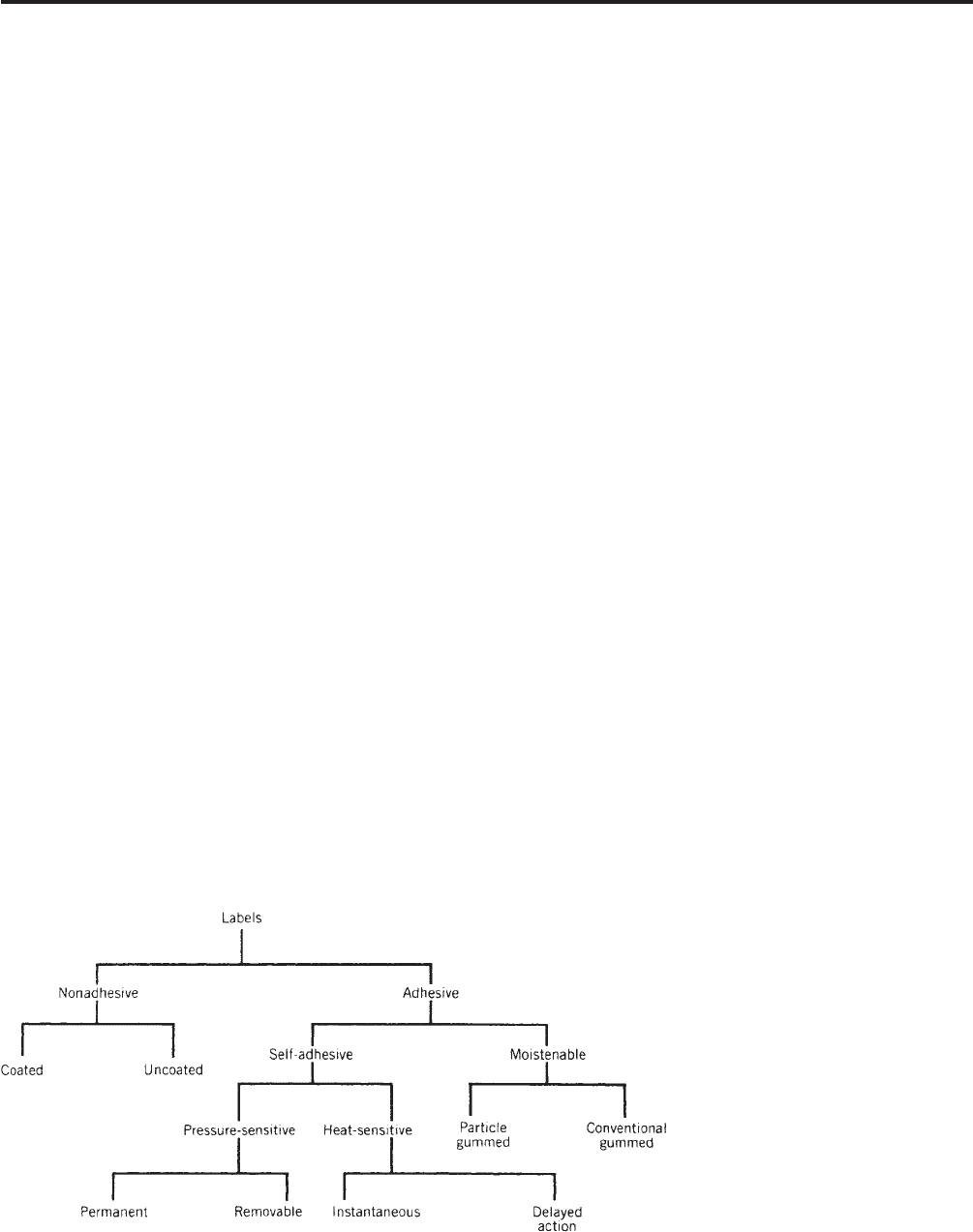
gummed (2). Figure 1 shows the main types of labels
and materials.
Of all the different types of labels, nonadhesive plain
paper labels applied by wet gluing tend to dominate
the total user market throughout the world. In recent
years, however, there has been a marked trend toward
self-adhesive pressure-sensitive labels. Newer methods of
labeling such as shrink sleeve, in-mold, and heat transfer
have also gained market acceptance (see Bands, shrink;
Decorating).
Overall, the U.S. pressure-sensitive (self-adhesive) roll
label market is growing at about 10–15% per year, with
some printers and market sectors showing growth of 20%
or more. The two main markets showing above average
growth are electronic data processing (EDP) labels and
prime labels.
Plain-Paper Labels
The conventional wet-glue plain-paper label is widely
used, particularly for large-volume items such as beer,
soft drinks, wines, and canned foods, where high label
application speeds, sometimes in excess of 80–100,000
labels per hour, are required.
Most of the papers used in this type of labeling are one-
sided coated grades, which make up the familiar can and
bottle labels, but a fair volume of uncoated grades is still
used. These tend to be limited to special effects, such as
colored papers, embossed papers, or antique laids for wine
labels, where particular characteristics are required (3).
Gummed-Paper Labels
Gummed-paper labels have been declining in usage in
recent years and are now limited mainly to applicat-
ions such as address labeling for cartons, point-of-sale
displays, and any labeling applications where automation
is either difficult or unnecessary. Two main types of
gummed labels are in use: conventional gummed and
particle gummed (4).
Conventional gummed labels are those that are made
up of a base support of paper coated on the reverse side
with a film of water-moistenable gum. On particle
gummed papers, the adhesive is applied in the form of
minute granules. This avoids problems of curling often
associated with conventional gummed papers. Most of the
Figure 1. The main types of labels and
materials.
633
newer applications for gummed papers require the proper-
ties of high-tack particle gummed papers, which offer
many advantages in terms of processing efficiency and
security of application.
Self-Adhesive Labels
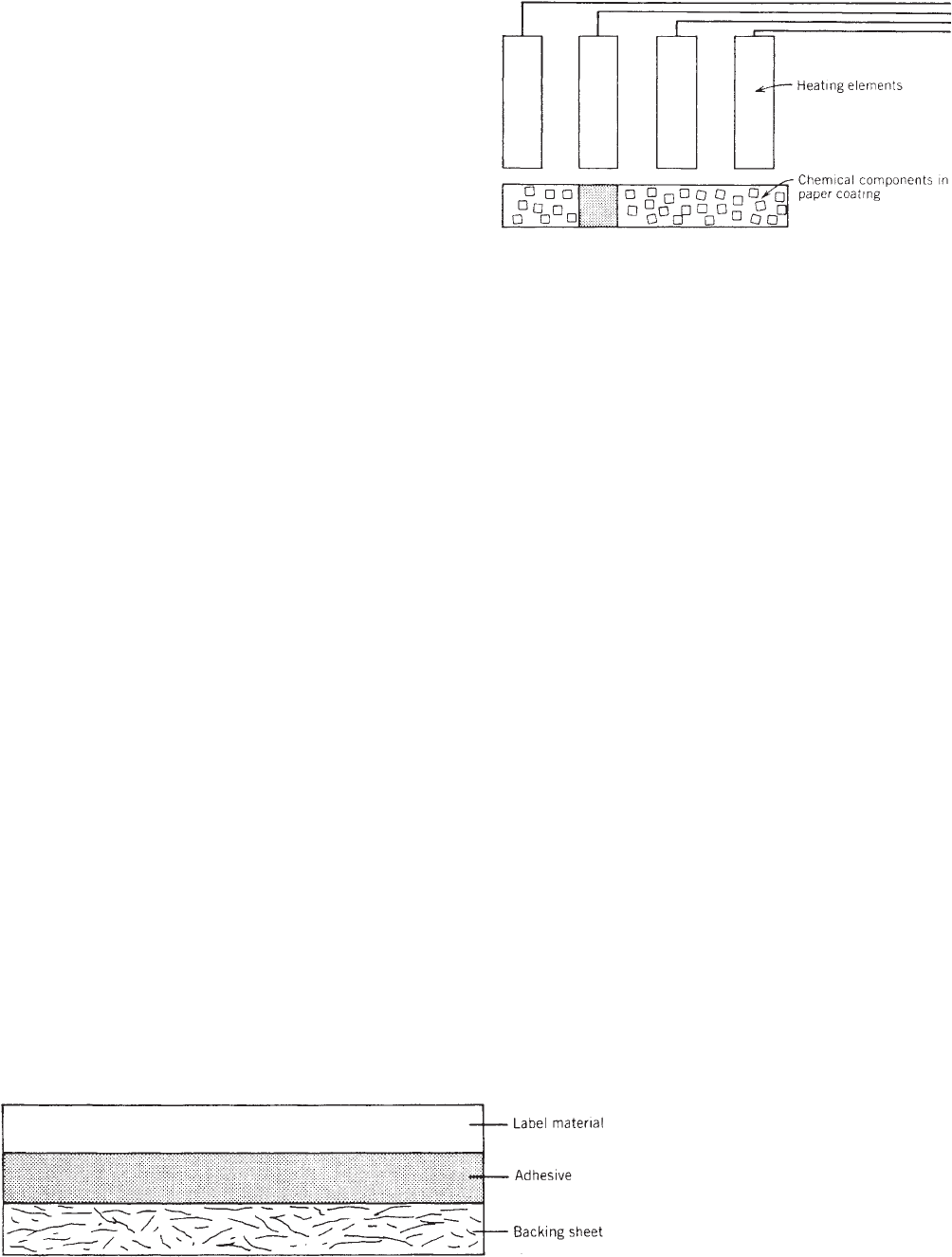
Self-adhesive label materials (see Figure 2) today range
from permanent to removable adhesive types, as well as a
whole range of special adhesive materials (see Adhesives).
Permanent adhesives are those that are required to
stay in position for a long time or for application to
surfaces that are round, irregular, or flexible. Because of
the strong adhesive ‘‘grab,’’ the label normally becomes
damaged or defaced if attempts are made to remove it.
Removable adhesives are those that can be removed
after a specified time without damage to the surface on
which they have been applied. Uses include short-term
food-packaging applications, point-of-sale or advertising
stickers, china, and ovenware, where the label should be
easy to remove before use.
Within the broad categories of permanent and remo-
vable self-adhesive labels, there is a wide variety of special
adhesive types to cover requirements such as water
removability, low- or high-temperature adhesion, ultra-
violet-light resistance, and high- and low-tack properties.
Adhesives, which at one time were largely solvent-based,
have moved rapidly in recent years to hot-melt or water-
based acrylic adhesives (5) (see Acrylics).
For all normal self-adhesive labeling requirements
(food and supermarket labels, retail/price marking labels,
etc.), surface papers in a variety of weights and finishes,
colors, and radiants are available. For special applications,
such as outdoor labels, instruction and nameplates for
appliances, underwater labels, ampules and vials, and
luxury-labeling of cosmetics and toiletries, there is a
wide range of nonpaper materials. These include metallic
foils and plastic films.
One of the most recent developments in self-adhesive
materials is a range of thermal imaging label facestocks,
which have become popular for in-store supermarket
labeling of meat and fish and fresh produce (fruit and
vegetables). These materials contain a surface coating of
chemicals that darken under the action of a heated print-
head (see Figure 3) (6), thereby providing clear price and
weight information and accurate scannable bar codes (7)
(see Codebar; Code marking and imprinting).
Almost all self-adhesive label materials are available in
sheet form, from paper merchants and suppliers, or, for
reel-fed conversion, from manufacturers and specialist
suppliers in roll form.
The main markets for self-adhesive labels in the United
States are basically segmented into three areas: industrial
labels (or primary and secondary labels used in retail,
wholesale, and industrial packaged goods), which make up
about 80% of the U.S. self-adhesive label market; EDP
labels (those used for marking/imprinting variable informa-
tion); and price-marking and imprinting (which addresses
label applications through handheld dispensers and the
whole range of imprint technology). Split into some of the
main market application areas, this includes promotional
labels, price labels, functional labels, office/retail labels,
nameplates, stickers, EDP labels, and prime labels .
Heat-Sensitive Labels
There are two basic types of heat-sensitive or heat-seal
labels: instantaneous and delayed-action. In the former,
heat and pressure are applied to the label to fix it directly
on to the product, whereas with delayed action, applied
heat turns the product into a pressure-sensitive item. No
direct heat is applied to the goods; and this clearly is vital
to some products, such as food.
Typical market applications for delayed-action heat-
sensitive label papers include pharmaceutical, price/
weigh, some glass-bottle, and rigid or semirigid plastic
container labeling. Instantaneous materials are used for
applications such as (a) end seals on biscuit or toilet tissue
packs and (b) labels on ‘‘pleat wrapped’’ articles (e.g.,
disinfectant pads, pies, cakes), as well as for some banding
applications (8).
In-Mold Labels
In-mold labels are printed on paper or synthetic papers
made of polyethylene (PE) or biaxially oriented plolypro-
pylene (BoPP). They are introduced into the container-
producing mold before the molten resin is added. The heat
Figure 2. Self-adhesive labels consist of three
main layers: the label-face material itself, the
pressure-sensitive adhesive coating, and a re-
lease coating on a backing material to prevent
the adhesive from sticking to the face material
in the reel or sheets.
Figure 3. The chemical components in the thermal label paper
coating combine and darken when activated by heat.
634 LABELS AND LABELING MACHINERY
of the resin fuses the heat seal layer of the label to the
container, combining label and container to create a sleek,
seamless no-label look, as if the graphics were screened
directly on the container.
Because they can be produced on high-qualit y roto-
gravure or rotary offset presses, in-mold labels can
deliver beautifully sharp and nuanced graphics, far sur-
passing the quality of direct-screened or dry-offset
printing.
In-mold labels are typically used where a no-label look
is desired, for flexible containers, or for applications in
which pressure-sensitive, glue-applied, or heat-seal labels
could be challenged by scuffing, freezing conditions,
grease, or solvents such as cleansers.
Shrink Sleeves
Shrink sleeves offer full 360-degree graphic space and
conform to the shape of nearly any rigid container when
heated. Because of their ability to conform to most con-
tours, shrink sleeves have gained tremendous popularity
on curved bottles and jars, as well as squeezable contain-
ers, all of which have traditionally been very difficult to
decorate with conventional labels.
Shrink sleeves are printed, then rolled and sealed into
a tube shape. On the packaging line, the tube is placed
over the container and sealed in a heat tunnel, where
controlled blasts of hot air or steam shrink the film onto
the container.
Designing graphics for shrink sleeve labels requires
software that compensates for the shape of the container.
Graphics look distorted as the sleeve material comes off
the press; when shrunk onto the container, it appears as
the designer planned.
Managing shrinkage is therefore of the utmost impor-
tance in designing and applying a shrink sleeve. The
process starts with material selection. High-quality film
is critical to obtaining good results, as is selecting film of a
material and gauge (thickness) that offers the appropriate
amount of shrinkage.
Poly(vinyl chloride) (PVC) tends to yield the most easily
controlled shrinkage, the lowest shrink temperature, and
the most cost-effective alternative.
Poly(ethylene terephthalate) gly (PETG) is signifi-
cantly more expensive, but can shrink far more, which
makes it appropriate for dramatic contours such as very
narrow-waisted or long-necked bottles. Where recycling is
important, PETG may be the favored choice, because PVC
on a PET container can be difficult to separate from PET
during the container recycling process.
Oriented polystyrene (OPS) is less expensive than
PETG, but its instability can make it difficult to handle,
print, and seal. However, it may be desired for its flex-
ibility and low vertical shrink, which makes it well-suited
for squeezable containers.
Poly(lactic acid) (PLA) offers a compostable alterna-
tive, but man y converters have been wary during PLA
shrink sleeves’ introductory years because shrink char-
acteristics have not been as well understood as with more
familiar films.
Shrink Sleeve Application
Shrink sleeves are applied by setting the tube-shaped
sleeve around the container and conveying the sleeve
and container through a heat tunnel, where they are
exposed to hot air or steam. The heat in the tunnel must
be set to a temperature at which the shrink sleeve film
shrinks at a controlled rate in order to ensure that the
sleeve covers the container evenly and conforms to each
contour. Shrink sleeve applicators and heat tunnels often
have to be fine-tuned—by adjusting temperature as well
as directing the nozzles or heating elements inside the
tunnel—to ensure that proper application and shrinkage
are occurring.
In most cases, the contours of the container and the
tight fit of the film are enough to ensure that a shrink
sleeve will remain in place throughout the package’s
useful life. However, for packages whose shape could allow
the sleeve to slip off—for instance, a yogurt cup or a simple
jar—a few dots of heat-activated adhesive applied on the
inside of the sleeve during the printing process can keep
the sleeve in place.
In-Mold Label Application
In-mold labels are applied during the creation of the
package itself, fusing the label to the container. In the
United States, blow molding is the most popular produc-
tion process, while injection molding is the dominant
technology in Europe.
During the container manufacturing process, a label is
held in place in the mold by vacuum or electrostatic forces.
Hot resin is injected or blown into the mold, forming the
container while fusing the label into its wall. In blow-
molding applications, the label contains a heat-activated
adhesive. In the injection-molding process, no adhesive is
necessary. In both cases, the label is integrated into the
wall of the container.
The high cost of molds has been a barrier to the wider
adoption of in-mold labeling. However, many companies
appreciate the opportunity to decorate packages during
the manufacturing process, eliminating the time, labor,
and equipment needed for a separate labeling step. The
look and performance of in-mold labels also has tremen-
dous appeal.
LABEL PRINTING
The main printing processes in use for label production
are flexography, letterpress, gravure, lithography, silksc-
reen, and, to a lesser extent, hot-foil stamping. This
applies for most types of labels whether printed flat or
from a reel (see Decorating; Printing).
Although the principles of each process remain the
same for reel- or sheet-fed printing, the selection of the
particular process and the cost factors in that decision are
different for each particular section of the label industry.
F
or example,
printing of sheet labels is done primarily by
lithography or gravure; but letterpress and flexography
are major processes for the production of reel-fed self-
adhesive labels.
LABELS AND LABELING MACHINERY 635
The fastest-growing technique of label printing is the
narrow-web roll label conversion of self-adhesive materi-
als using presses that may be printing and converting
webs as narrow as 2 in. (50 mm), ranging up to 250, 300, or
400 mm wide (9). These presses not only print substrates
up to 6, 8, 10, or more colors in one press pass but also
undertake flat-bed or rotary die cutting of the labels and
possibly UV varnishing, over-laminating with clear syn-
thetic films, removing matrix waste, slitting, fan-folding,
sprocket-hole punching, and so on, and, finally, rewinding
of the printed reel of labels ready for automatic application
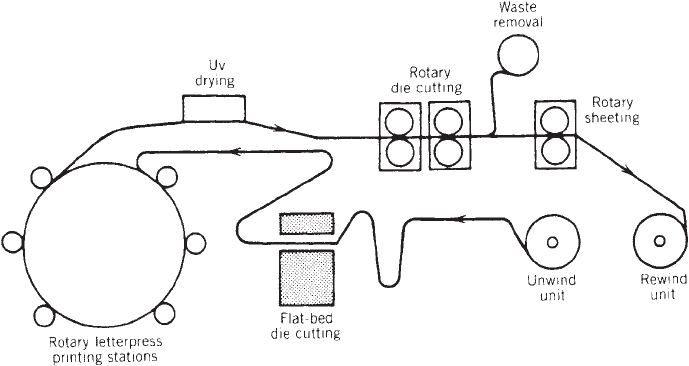
(10). A schematic diagram of a typical roll label printing
and converting press is shown in Figure 4.
PRINTING METHODS
Flexography
The main advantage of flexography, the most widely used
process for reel-fed label printing, is its output speed,
which is due to full rotary printing and machine die
cutting. In addition, spirit-based inks evaporate quickly,
allowing printing on a wide variety of substrates other
than paper (see Inks).
Owing to speed of output, flexo labels generally cost
less than labels printed by the other major processes.
Because presses can be purchased at a relatively low
capital cost, many of the smaller label printers use the
process. The presses do, however, vary enormously in
complexity. Equally important, the quality of the labels
produced depends greatly on the skill of the operator.
Letterpress
Although letterpress has declined in usage in the general
printing industry, it is a major process in the label
industry and gaining in popularity. It is the second most
popular process in the roll label industry after flexogra-
phy, and in some countries it is almost the only process
used.
The process has adapted well to the needs of the label
industry, giving good-quality reproduction and relatively
low-cost origination. Presses are available in flat (platen)
form, semirotary, or full-rotary letterpress (9).
The main advantage of letterpress is superior quality
and ability to hold accurate print definition throughout
the run. Solid- and fine-line printing are no problem,
because the inks are fully pigmented with excellent light-
fastness and color matching. Printing plates can be metal
or photopolymer.
The development of UV-cured inks has meant that
previously difficult or even impossible to print substances
such as vinyls and polyesters can now be ‘‘cured’’ using
polymer inks and UV lamps.
Gravure
The gravure process gives excellent quality and print
definition. With a very fast throughput it is best suited
to long runs where the high cost of originating printing
cylinders can be recovered.
Silkscreen
The unique method of applying ink through a screen gives
screen process an ink coverage that cannot be completely
matched by any other printing method (9). It will also
print on virtually any substrate.
The presses are made as complete screen printing
units, or a series of screen printing heads can be added
to suitable letterpress machines, giving a combination of
benefits.
Hot-Foil Stamping
Hot-foil stamping is generally done in one of two ways: by
complete hot-foil presses in their own right and by hot-foil
units set in-line onto an existing label press. The process
gives striking effects when combined with other processes
and is very much a designer’s medium (9).
LABELING
Once a label has been produced, it must be applied in the
correct position to a particular surface or product. The
Figure 4. Rotary letterpress roll label
press.
636 LABELS AND LABELING MACHINERY
label must be applied securely enough for it to remain
fixed in that position throughout the useful life of the
product or container. It must stand up to whatever condi-
tions it is likely to be exposed to and should also maintain
a good appearance. In the case of returnable bottles,
however, the label must be able to be removed easily
during the washing operation.
The labeling operation must also be able to meet produc-
tion requirements. On packaging lines, the labeling ma-
chine must be able to keep pace with the line, often at high
speeds, having minimum stoppages and downtime (11).
Some labels are applied to products or containers with
a simple handheld gun or dispenser; others are applied by
a semiautomatic or fully automatic labeling machine
suited to the particular type of label: wet-glue, pressure-
sensitive, or heat-seal (heat-sensitive).
Wet-Glue Labeling Machinery
Wet-glue labeling is the least expensive labeling system in
terms of label costs. There are many machines on the
market from the simple semiautomatic to the high-speed
advanced models for speeds of up to 600 containers per
minute. Straight line or rotary, vacuum transfer of the
label or transfer by picker plate, and allover gumming or
strip gumming all have a place and are used in many
industries, particularly in food, wine, and spirits plants.
New types of adhesives make glue labeling important
for plastic containers as well as glass. Hot-melt adhesive
can be used. Large labels are probably cheaper to apply
with wet glue than with a heat-seal or pressure-sensitive
system, and wet-glue labels are probably superior for
applying multiple labels to a range of containers, such as
liquor bottles.
Labels may be applied by hand or by semiautomatic or
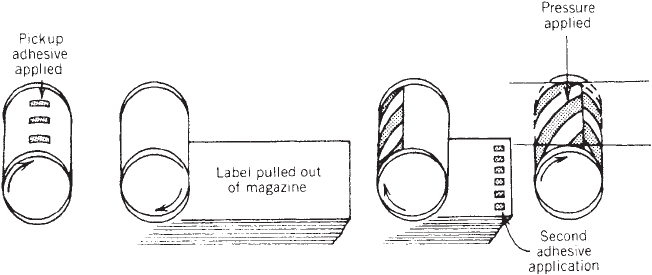
automatic machines (see Figure 5). There are many
different types of wet-glue labeling machines, but they
all have to perform the following functions:
1. Feed labels one at a time from a magazine.
2. Coat the labels with adhesive.
3. Feed the glued labels on to the articles to be labeled
in the correct position.
4. Ensure that the articles are held in the correct
position to be labeled.
5. Apply pressure to smooth the label on to the article
and press it into good contact.
6. Remove the article when it has been labeled.
If any of these operations are not performed at the right
times, with everything positioned accurately, the results
will be unlabeled articles, badly positioned, skewed, or
torn labels, and machine stoppages. Machines vary mainly
in the way they perform the various functions. For exam-
ple, some machines may use suction to remove labels from
the magazine, and others use the tack of the adhesive
itself (11).
The adhesives used for wet labeling fall into five main
classes: dextrin-based, casein-based, starch-based, syn-
thetic-resin dispersions, and hot melts.
Apart from the hot melts, all these adhesives are
waterborne. The speed at which they set depends, there-
fore, on the rate at which the water phase can be removed
by the absorbency of the label stock. If the water cannot
get away, they will not set.
Synthetic resin dispersions, of which the most widely
used are those based on poly(vinyl acetate) (PVA),
have the major advantage of faster setting, owing to
the ability of the polymer particles to draw together to
form a continuous film for the loss of much less water
than is the case with those adhesives based on natural
materials. They are used particularly in the labeling of
plastic bottles or coated glass, where normal dextrin,
casein, and starch adhesives have difficulty in producing
a permanent bond. They are limited to nonreturnable
bottles, however, as the dried film has considerable
resistance to water and cleaning fluids. One advantage
is a low initial tack, which restricts their application to
certain types of machines with sufficient brushing-on
capacity.
Hot melts are 100% solids, melting when heated and
setting almost instantaneously on cooling. They have high
initial tack, thus labels adhere to surfaces such as PVC
and polyethylene (PE) at high speeds, but are not suitable
for wet bottles. To select the correct adhesive for a
particular application, every factor of the operation must
be taken into account: the operating conditions, type, and
condition of the articles to be labeled, nature of the label
papers, transport and storage conditions, and any parti-
cular usage requirements (12).
Figure 5. Stages in the labeling of cans.
Adhesive is first applied to the container. As
the container rotates over the label magazine
it picks up its own label, which is then rolled
around it. A second adhesive application to
the trailing edge of the labels, followed by
pressure, completes the labeling operation.
LABELS AND LABELING MACHINERY 637