
Yam, Kit L. (ed.). The Wiley encyclopedia of packaging technology
Подождите немного. Документ загружается.

Pressure-Sensitive Labeling Machines
A pressure-sensitive adhesive is one that remains perma-
nently and aggressively tacky in the dry form and has the
ability to bond instantaneously to a wide variety of
materials solely by the application of light pressure. No
water, solvent, or heat is needed to activate these
materials.
Because the adhesive is permanently tacky, it would
stick to anything it contacted, so a backing sheet is
required to protect the adhesive layer until it contacts
the article to be labeled. The backing sheet is coated with a
release coating to prevent the label from sticking too
firmly to it (13).
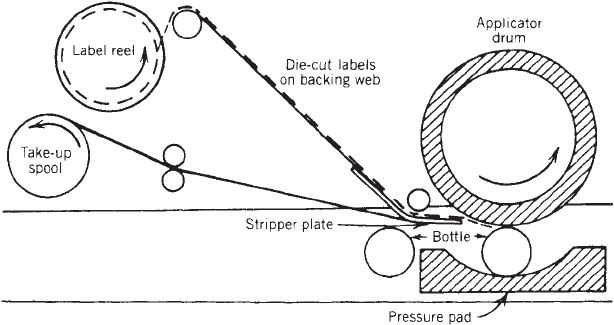
There are many different types of applicators, but they
all have one thing in common: a means of peeling the
labels away from the backing (see Figure 6). This is
usually accomplished by unwinding a reel of die-cut labels
and then pulling them under tension around a stripper
plate. As the backing is bent around a sharp angle, the
front edge of the label peels away. Once the labels have
been detached from the backing, there are various ways of
feeding them forward and pressing them onto the contain-
ers in the correct position. Containers may be fed forward
to an applicator drum where the label is transferred to it
under light pressure created by an applicator drum and
pressure pad. Alternatively, the label may be held in
position on a vacuum box or drum and released onto the
article when it is in the correct position, or it may be blown
onto the container by releasing the vacuum and applying
air pressure. The backing paper is then rewound on a
take-up spool (12).
Comparatively simple systems have been devised to
apply the label to the product. The choice ranges from a
dispenser that releases a label for hand application up to
high-speed automatic labelers. Labeling machines for
applying pressure-sensitive labels vary in complexity
according to the nature of the package to be labeled, the
number of labels to be applied at one time, and the speed
of application. There are, of course, semiautomatic labe-
lers for single-product medium-volume application.
Although pressure-sensitive labelers are available as
standard machines, they are usually readily customized
to meet special requirements. Generally, they are only
about one-third to one-half the cost of most competitive
labeling systems.
The advantages of pressure-sensitive labels are said to
be numerous. They are cleaner than other methods, less
wasteful than wet glue, and more easily controlled be-
cause they come in roll form so that labels cannot be mixed
up. A wide variety of adhesives for different surfaces is
available, and clear acetate, vinyl, or polyester film can be
used for ‘‘see-through’’ labels.
Heat-Seal Labeling Machines
Heat-seal labeling has most of the advantages of pressure-
sensitive labels but generally offers a lower label cost.
Heat-seal describes a plasticized paper which, when
heated by the machine, becomes sticky on its underside.
Labeling equipment for heat-seal ranges from simple aids
to automatic high-speed machines, giving the unique
advantage of being able to apply to many varied types of
surface labels that can be precision-placed, give allover
adhesion, and be perfectly clean when applied.
The machines free the user from mixing and adding
glue, selecting grades, controlling viscosity, and so on. The
absence of glue eliminates cleaning the machine, and
these savings give substantial increases in productivity
and reductions in maintenance expenses. The labels offer
a high degree of adhesion security that is useful, for
example, for bottles subjected to high humidity, or steam
of water saturation (14).
Of the two types of heat-seal paper, the delayed-action
type is best suited for machine operation. The ability of the
adhesive to remain tacky after removal of the heat source
allows the machine designer to separate the heat source
from the pressure application of the label. Thus the
heating plates can be simple whereas the pressure-apply-
ing devices can be of complex shapes, enabling a diverse
range of articles to be labeled, varying from flat to round
or irregular shapes (10).
LABEL OVERPRINTING MACHINERY
For certain label applications there is a requirement
to have a plain paper or preprinted label or labels
Figure 6. A common type of self-adhesive label
applicator.
638 LABELS AND LABELING MACHINERY
overprinted with price, price/weight, bar code, or other
variable information just prior to or at the point of
application. A variety of mechanical, electronic, or compu-
ter-based overprinting systems are available for such
operations. These are now widely used by department
stores, the retail and wholesale trade, industry, and even
some label producers.
Mechanical overprinting systems range from small
hand-operated machines with one or two wheelsets and
two type channels, to hand-operated and electronic ver-
sions used for price/description labeling with either con-
ventional or EDP-readable fonts (10).
The current trend in overprinting is away from mechan-
ical to totally electronic overprinters, which can now print
labels and tags without any form of marginal or sprocket-
hole punching. Free formating and graphics, as well as
alphanumeric information and bar codes, are now possible
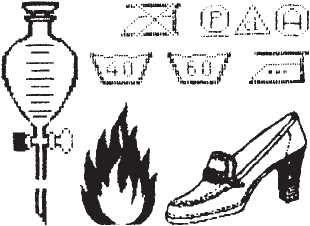
using such overprinting technology, the graphics being
keyboard entered and edited. Graphics suitable for repro-
duction include product outlines, such as shoes, laboratory
equipment, small hardware items, safety hazard designs,
and laundry symbols. Figure 7 shows examples of such
electronically produced and overprinted graphics.
BIBLIOGRAPHY
M. C. Fairley, ‘‘Labels and Labeling Machinery’’ in M. Bakker, ed.,
The Wiley Encyclopedia of Packaging Technology, 1st edition,
John Wiley & Sons, New York, 1986, pp. 424–430.
Cited Publications
1. A Guide to Legislation and Standards on Labelling (UK),
Labels & Labeling Data and Consultancy Services Ltd,
Potters Bar, Herts, UK, 1984.
2. D. G. N. Alder, ‘‘Label Papers and Their Uses,’’ Labels &
Labelling 14, 16 (1979).
3. ‘‘The Most Important Types of Paper for Beverage Labels,’’
Krones Manual of Labelling Technology, Hermann Kronseder
Maschinefabrik, Neutraubling, FRG, 1978, pp. 118–121.
4. A. Hildrup, ‘‘Review of the (UK) Gummed Paper Market,’’
Labels & Labelling Yearbook, 16, 23 (1981).
5. M. Fairley, ‘‘The Challenge for Water-Borne Adhesives,’’ La-
bels & Labelling, 19, 29 (1984).
6. M. Fairley and R. Brown, Thermal Labelling, Labels &
Labelling Data and Consultancy Services Ltd., Potters Bar,
Herts, UK, 1984.
7. M. Fairley, Bar Coding, Labels & Labelling Data and Con-
sultancy Services Ltd., Potters Bar, Herts, UK, 1983.
8. N. Henderson, ‘‘Trends and Developments in Heatseal Label
Materials,’’ Labels & Labelling Yearbook 16, 31 (1981).
9. M. Fairley, Label Printing Processes and Techniques, Labels &
Labelling Data and Consultancy Services Ltd., Potters Bar,
Herts, UK, 1984.
10. Labels—A Product Knowledge Book, National Business
Forms Association, Alexandria, VA, 1983.
11. Labelling Operations, Pira, The Research Association for the
Paper and Board, Printing and Packaging Industries,
Leatherhead, Surrey, UK, 1981.
12. E. Pritchard, ‘‘Labelling, and Labelling Systems,’’ Labels &
Labelling, 17, 16 (1982).
13. Labelling—Basic Principles, Pira, The Research Association
for the Paper and Board, Printing and Packaging Industries,
Leatherhead, Surrey, UK, 1980.
14. D. Miles, ‘‘Pre-adhesed Labelling,’’ Labels & Labelling, 16,20
(1981).
15. M. Noah, The Tadbik Group, personal communication (2008).
LAWS AND REGULATIONS, UNITED STATES
RALPH A. SIMMONS
Keller and Heckman
Washington, DC
There is no single body of law or regulations pertaining
to all aspects of the manufacture, distribution, and use
of packaging in the United States. Many different types
of federal, state, and even local laws and regulations
affect the packaging industry. These laws and regulations
can be separated into two broad categories: (a) those that
pertain directly to the packaging itself and (b) those that
pertain generally to manufacturing and commercial
transactions, including packaging among many other
products.
This article focuses on the former category of legal
requirements pertaining most directly to packaging.
These include health and safety regulations of packaging
materials, labeling requirements, and environmental laws
and regulations relating to the disposal of packaging.
FDA’S REGULATORY FRAMEWORK FOR PACKAGING
The Food and Drug Administration (FDA) has primary
regulatory authority in the United States over the safety
of packaging used for food, drugs, cosmetics, and medical
devices to the extent the products are in interstate com-
merce (which they almost always are).* The packaging for
these products is regulated by the FDA so that it does not
Figure 7. Electronically produced graphics are available on
electronic label overprinters.
* The U.S. Department of Agriculture (USDA) technically has
authority over packaging used in federally inspected meat and
poultry processing plants. However, in practice, USDA does not
independently evaluate the safety of packaging materials, defer-
ring to FDA on this issue.
LAWS AND REGULATIONS, UNITED STATES 639
cause the products themselves to become contaminated or
‘‘adulterated’’ in violation of the Federal Food, Drug and
Cosmetic Act.
The most extensive of FDA’s packaging regulations are
the ‘‘food-additive regulations,’’ which provide official per-
mission for the use of substances as food ingredients
(direct additives), and as components of food packaging
or other food-contact materials (indirect additives). The
FDA does not have regulations clearing specific materials
for use in packaging for drugs, medical devices, or cos-
metics. In the case of drugs and medical devices, packa-
ging materials are reviewed and approved by the FDA in
the context of approving the drug and medical-device
products themselves, if such approval is necessary. The
FDA does have a general requirement for tamper-resis-
tant packaging for over-the-counter (OTC) drugs. Suppli-
ers of packaging materials to drug and medical-device
manufacturers typically assist those manufacturers in
obtaining FDA approval by providing information on the
packaging to the FDA through a confidential drug or
device master file. Neither cosmetic products nor their
packaging are subject to premarket clearance by the FDA;
it is up to the cosmetics manufacturer and its packaging
suppliers to ensure that the products and packaging are
safe for their intended use.
Definition of Food Additive. The FDA’s regulation of
food packaging is based on Section 201(s) of the Federal
Food, Drug and Cosmetic Act. Section 201(s) of the Act
defines a food additive, in relevant part, as follows:
[A]ny substance the intended use of which results or may
reasonably be expected to result, directly or indirectly, in its
becoming a component y of any food y if such substance is
not generally recognized y to be safe under the conditions of
its intended use; except that such term does not include y
(4) any substance used in accordance with a sanction or
approval granted prior to the enactment of this paragraph
pursuant to this Act (4)
Section 409 of the Act requires that a food additive, as
defined above, must be the subject of an applicable food-
additive regulation.
w
Thus, substances used in food-
contact applications that, under their intended conditions
of use, may reasonably be expected to become components
of food are ‘‘food additives’’ and can be used only in
accordance with an applicable food-additive regulation
unless they are either (a) the subject of a prior sanction
or approval granted by FDA or the U.S. Department of
Agriculture (USDA) prior to the enactment of the Food
Additives Amendment of 1958 or (b) generally recognized
as safe (GRAS). If the substance is not reasonably ex-
pected to become a component of food under the intended
conditions of use, however, it is not a food additive within
the meaning of Section 201(s) of the Act, and may be used
as intended without the need for consultation with or prior
action by the FDA
The Food-Additive Regulations. The FDA’s food-additive
regulations, found in Title 21, Parts 170–197 of the Code of
Federal Regulations (CFR), cover both direct and indirect
additives. The term ‘‘direct food additive’’ commonly refers
to materials directly and intentionally added to foods to
perform a functional effect in the food. The term ‘‘indirect
food additive’’ generally refers to substances that are not
intended to, but nevertheless become, components of food
as a result of use in articles that contact food (e.g.,
substances used in packaging materials).
Over the years, indirect food-additive regulations have
been promulgated in response to individual food-additive
petitions with no overall structural scheme. This has led to
the existence of three general types of indirect food-additive
regulations: those that clear specific polymers (e.g., Section
177.1520, applicable to polyolefins), those that clear sub-
stances categorized by function (e.g., Section 178.3400,
applicable to emulsifiers and surface-active agents), and
those that list substances that may be used in specific types
of packaging (e.g., Section 176.170, applicable to compo-
nents of paper and paperboard). F or this reason, a great
deal of overlap among different regulations has occurred.
A major limitation on the types of substances that may
be listed in the food-additive regulations is the so-called
Delaney Clause of the Federal Food, Drug and Cosmetic
Act. The Delaney Clause prohibits the FDA from issuing
regulations permitting the use as food additives of sub-
stances that are ‘‘found to induce cancer when ingested by
man or animals’’ (1).
The FDA has mitigated the impact of the Delaney
Clause, however, by interpreting it to apply to the finished
food ingredient or food-contact material itself, not to
constituents or components of the food additive (e.g., the
Delaney Clause applies to polymers used to make food
packaging but not to monomers used to make the poly-
mers). This ‘‘constituents policy’’ is not set forth in any law
or regulations but is applied by the FDA in evaluating food
additive petitions, was described by FDA in an Advance
Notice of Proposed Rulemaking, and has been upheld by
the courts (2).
Prior-Sanction Exemption. The Federal Food, Drug
and Cosmetic Act specifically exempts from the definition
of a food additive any substance that is ‘‘prior-sanctioned,’’
which means any substance permitted for its intended use
by an FDA or USDA letter or memorandum written prior
to the Food Additives Amendment of 1958. Unfortunately,
no authoritative master list exists for the materials cov-
ered (3).
=
If a company has any such letters in its files or
knows of any relevant ones elsewhere, they can be relied
on, but the FDA interprets such letters narrowly.
‘‘Generally Recognized as Safe’’ Exemption. Another ex-
emption from the food additive definition pertains to
w
Food that contains an uncleared food additive is considered
‘‘adulterated’’ and would be subject to adverse FDA regulatory
action.
=
The Food Chemical News Guide, commonly known in industry
as the ‘‘Knife and Fork’’ book, contains listings of both direct and
indirect food additives and their status under the Food and Drug
Regulations; the ‘‘Knife and Fork’’ book also documents public
‘‘prior sanctioned’’ status of substances. The Guide is regularly
updated.
640 LAWS AND REGULATIONS, UNITED STATES
GRAS substances. Section 174.5(d)(1) of the Food Additive
Regulations states that substances generally recognized
as safe ‘‘among experts qualified by scientific training and
experience to evaluate their safety’’ are permitted to be
used as components of articles that contact food. Parts
182, 184, and 186 of the Food Additive Regulations
provide a listing of some substances that are considered
by the FDA to be GRAS, but the substances actually listed
in the regulations by no means constitute all substances
that are GRAS.
y
Section 182.1 of the Food Additive
Regulations makes it clear that the GRAS listings are by
way of illustration and do not represent an all-inclusive
list. Furthermore, the absence of a substance from the list
does not preclude a company from making a self-determi-
nation that its products are GRAS, where such a determi-
nation is supported by the available information.
The FDA has codified requirements for the classifica-
tion of food additives as GRAS under 21 CFR 170.30(a). As
stated in that provision, general recognition of safety must
be based on (a) scientific procedures or (b) in the case of a
substance used in food prior to January 1, 1958, through
experience based on common use in food. The general
recognition of safety requires a ‘‘common knowledge’’
about the substance throughout the scientific community
about the safety of substances directly or indirectly added
to food. For substances not widely used in food prior to
1958, general recognition of safety requires the same
quantity and quality of scientific evidence as is required
to obtain approval of a food additive regulation for the
ingredient. Unlike a food-additive petition, however, gen-
eral recognition of safety is ordinarily based on published
studies that may be corroborated by unpublished studies
and other data and information (4).
The exclusion of GRAS substances from the definition
of the term ‘‘food additive’’ means that such substances do
not require premarket clearance by the FDA. Any manu-
facturer who determines that a particular substance is
GRAS is free to market the substance without notification
to, or approval by the FDA. Obviously, if the FDA should
consider the manufacturer’s determination of GRAS sta-
tus to be erroneous, then the Agency can take appropriate
regulatory action; in such a case, the burden of proof
would fall on the FDA to demonstrate that the substance
is not GRAS. This is an unlikely consequence unless a real
public-health problem is presented.
A manufacturer who pursues a self-determined GRAS
position for a substance can also file a GRAS Affirmation
Petition (GRASP) with the FDA seeking the Agency’s
concurrence. In contrast to a Food Additive Petition, if a
GRASP is accepted by the FDA for filing, then the peti-
tioner may market the product while the petition under-
goes technical review because FDA has been informed of
the manufacturer’s determination that the product is
GRAS and has raised no objection. However, unlike a
Food Additive Petition, all materials submitted in support
of the GRASP become immediately available in full to the
public, and even manufacturing details cannot be kept
confidential. The requirements and type of information a
petitioner must supply for a GRASP are spelled out in 21
CFR y 170.35.
The ‘‘No-Migration’’ Exemption. One of the most impor-
tant means of establishing satisfactory FDA status for an
indirect additive is to establish a rational basis on which
to conclude that there is no reasonable expectation of the
substance becoming a component of food. If a substance is
not reasonably expected to become a component of food
under its intended conditions of use, it is not a food
additive by definition and, therefore, may be so used
without obtaining any FDA ‘‘approval.’’ Unfortunately,
the FDA has not provided definitive, objective criteria
for determining when a substance in a food-packaging
material may reasonably be expected to become a compo-
nent of food. Nevertheless, reliable guidance is available
from at least two different sources:
1. Ramsey Proposal. The first source of guidance is a
proposal circulated by the FDA as its response to
widespread criticisms by the food-packaging industry
at the National Conference for Indirect Additives held
in Washington, DC in February 1968. This so-called
Ramsey proposal would have acknowledged in a
regulation the propriety of the use, without the prior
promulgation of a food-additive regulation, of sub-
stances that will transfer from packaging or other
food-contact articles to food at levels no higher than
50 parts per billion (ppb); components of articles used
in contact with dry, nonfatty foods; and components of
articles intended for repeated use in contact with
bulk quantities of food. This would have applied to all
substances except those known to pose some special
toxicological concern, such as a heavy metal, which is
a known carcinogen, or something that produces toxic
reactions at levels of 40 parts per million (ppm) or less
in the diet of humans or animals. Although never
formally adopted, the standards in the Ramsey pro-
posal were deemed scientifically acceptable and have
been generally honored by the FDA either explicitly
or by its having taken no enforcement action in cases
where the criteria are met.
2. Monsanto v Kennedy. The second source of clarifica-
tion of the ‘‘food additive’’ statutory definition is
provided by a U.S. Court of Appeals decision. In
Monsanto v Kennedy, 613 F.2d 947 (D.C. Cir. 1979)
the FDA argued that any contact of a packaging
material with food must result in some transfer of
the packaging constituent to the contained food. The
Court rejected this argument and stated:
Congress did not intend that the component requirement
of ‘‘food additive’’ would be satisfied by y a mere finding
of any contact whatever with food.y For the component
element of the definition to be satisfied, Congress must
have intended the Commissioner to determine with a fair
degree of confidence that a substance migrates to food in
more than insignificant amounts (5).
Role of Extraction Studies. On the basis of the Ramsey
proposal and the Monsanto precedent, it is widely
y
Idem. The ‘‘Knife and Fork’’ book also documents filings and
status of petitions to FDA for listing of substances as GRAS in the
regulations.
LAWS AND REGULATIONS, UNITED STATES 641
accepted that if extraction testing properly simulating the
intended conditions of use for a potential additive does not
yield detectable migration of the additive or its compo-
nents at an appropriate analytical sensitivity, then the
substance is not reasonably expected to become a compo-
nent of food under these conditions and, thus, is not a food
additive within the meaning of Section 201(s) of the Act.
The industry generally considers a finding of ‘‘nonde-
tected’’ in a properly conducted migration study using
methods sensitive to the equivalent of 50 ppb of the
substance in contacted food to be a sound basis for
concluding that a substance is not a food additive. How-
ever, in some cases, it is necessary to make use of
analytical methodology that can detect as little as 10 ppb
or even 1 ppb to support a ‘‘no-migration’’ determination
because of the sensitive nature of the material being used,
such as a heavy metal or a substance for which there will
be a high level of use, such as milk or soda containers.
General Adulteration Provision. If the packaging mate-
rial is not reasonably expected to become a component of
food and is, therefore, not a food additive, it is still subject
to the nonadulteration provision of the Act. The FDA
sometimes refers to this as the general safety clause,
contained in Section 402 of the Act. This general prohibi-
tion against adulteration is the basis for the FDA’s ‘‘good
manufacturing practice’’ regulation, which requires that
‘‘[a]ny substance used as a component of articles that
contact food shall be of a purity suitable for its intended
use’’ (6). Fortunately, the same analysis that demonstrates
that a material will not become a component of food will
also satisfy the Act’s general safety requirements for food-
packaging material, specifically, that the packaging will
not adulterate the food by rendering it injurious to health.
The ‘‘Basic Resin Doctrine’’ Exemption. A significant
characteristic of the Food Additive Regulations is that
the FDA clears substances on a generic rather than a
proprietary basis. In the case of resins and polymers, as
long as the basic resin is listed in a regulation, is manu-
factured in accordance with good manufacturing prac-
tices, and complies with applicable limitations such as
stated extraction requirements, it is covered by that
regulation even though different manufacturers may
make the resin by different processes and employ different
catalysts, reaction control agents, and the like.
A ‘‘basic polymer’’ is the material that comes out of the
polymerization ‘‘kettle’’ or reactor, that is, the product that
results when the polymerization process has been carried
to commercial completion. Substances such as catalyst
residues, chain-transfer agents, minor comonomers, and
other materials required to produce the basic resin are
considered a part of it and are not subject to independent
regulatory consideration. The FDA’s basis for this princi-
ple is that, where a substance is used only in a small
quantity and either becomes part of the resin during
polymerization, or is washed from the resin at the conclu-
sion of polymerization, its potential for significant migra-
tion is minimal. In other words, there is no reasonable
expectation of migration, and therefore the substance is
not considered an independent food additive.
The basic polymer doctrine also reflects the practical
reality that the FDA cannot write generic regulations for
food-packaging materials that describe and specifically
clear every substance that might properly be a trace
component or contaminant of the packaging material as
a result of every manufacturing process that yields a
suitable resin. Because trace quantities of these ‘‘unregu-
lated substances’’ are not perceived to present a public-
health hazard, the FDA has wisely chosen not to subject
these substances to the burdensome preclearance provi-
sions of Section 409 of the Act that apply to food additives.
Generally speaking, it is reasonable to consider cata-
lysts and minor comonomers to be covered by the basic
polymer doctrine when used at levels of up to approxi-
mately 0.5%; between this level and 1%, the substance and
use in question must be evaluated on a case-by-case basis.
At levels above 1%, the basic polymer doctrine is not
considered applicable.
Even if a component of a food-contact material falls
within the basic-polymer doctrine, the finished food-
contact material must still satisfy the necessary purity
requirements of the Food Additive Regulations; that is, it
must be of a purity suitable for its intended use, as
required under 21 CFR y 174.5(a)(2). Obviously, if a
particular catalyst being used were to render a finished
food-contact material unsafe or unfit for its use, that
material would not satisfy the purity requirements.
The Housewares Exemption. The components of eating
utensils, receptacles, paper towels, or other kitchenware,
sold as such, are outside the scope of coverage of the Food
Additive Amendments of 1958, and therefore these pro-
ducts do not require premarket clearance by the FDA.
This has come to be called the ‘‘housewares’’ exemption.
This exemption is grounded on a declaration of intent in
the legislative history of the 1958 Food Additives Amend-
ment. The following statement appears in the official
record of the debate on the Amendment and was made
by the floor manager of the bill, The Honorable John Bell
Williams, Chairman of the House Subcommittee on
Health and Science:
I have been asked since the Committee report of the bill what
is meant by a substance ‘‘holding’’ food, as mentioned in the
bill. An example of what is meant by this would be a plastic
film or paper wrapper which surrounds the package of food.
This bill is not intended, for example, to give the Food and
Drug Administration the authority to regulate the use of
components of dinnerware or ordinary eating utensils (7).
The FDA has written many letters affirming this ex-
clusion. The exclusion of housewares from the need for
filing foodadditive petitions is a recognition that such
products generally do not give rise to any public-health
concern. However, the FDA does take action against
products falling within the housewares exemption in in-
stances involving migration of a substance, such as lead,
which has been proven to pose a true public health
concern.
Threshold of Regulation. The exemptions from the
FDA’s premarket clearance authority discussed so far all
642 LAWS AND REGULATIONS, UNITED STATES
have one important characteristic in common—a company
is entitled to determine for itself whether the exemptions
apply and whether no consultation with or concurrence by
the FDA is required. The FDA recently has adopted an
additional exemption that only the Agency itself may
apply, which is called the Threshold of Regulation.
In 1995, the FDA published the final rule establishing
the Threshold of Regulation, which is the FDA’s ‘‘process
for determining when the likelihood or extent of migration
to food of a substance used in a food-contact article is so
trivial as not to require regulation of the substance as a
food additive’’ (8). The ‘‘threshold’’ level is defined as a
dietary concentration of 0.5 ppb or less. The threshold for
substances that have been cleared by the FDA as direct
additives is that the indirect or packaging use must be
limited to 1% or less of the acceptable daily intake
established by the Agency for the direct use of the
substance. To be eligible for the exemption, the food-
contact material must not be a carcinogen and must not
contain carcinogenic impurities that are more potent than
a certain level defined in the regulation (the impurity
cannot have a TD
50
value of o6.25 mg/kg bw (body
weight) per day, with TD
50
defined as the feeding dose
that causes cancer in 50% of the test animals.
The FDA has reserved to itself the authority to grant
official exemptions from regulation under the Threshold of
Regulation Rule. However, in proposing the Rule, the FDA
explicitly recognized the continuing right of a company to
determine on its own ‘‘that a particular use of a substance
does not meet the definition of a food additive’’ (9). There-
fore, companies continue to be entitled to determine for
themselves whether the ‘‘no migration’’ exemption or any
of the other exemptions from the definition of ‘‘food
additive’’ apply to a particular intended use of a food-
packaging material.
The Food-Additive Petition Process. If none of the ex-
emptions from the FDA’s premarket food-additive regula-
tory authority is available for a packaging material, then
regulatory clearance must be obtained from the FDA
through a food-additive petition. Section 409(b) of the
Federal Food, Drug and Cosmetic Act permits any person
to petition the FDA for a regulation prescribing the
conditions under which an additive may be safely used.
The Act delineates generally the type of information to be
submitted in support of a petition and the procedures and
substantive parameters to be followed by the FDA in
considering a petition. Additional detail on these informa-
tion requirements and procedures is provided in Part 171
of the Food Additive Regulations.
Reduced to its fundamentals, a food-additive petition
must describe the substance to be cleared, provide an
estimate of the quantity that will enter the diet, and
demonstrate that this quantity will be safe. The Act re-
quires the FDA to act on a petition within 90 days, with one
extension for an additional 90 days available to the Agency.
In practice, few petitions are acted on in 18 months or less,
and most are under review for at least 2–3 years.
In 1995, several industry groups representing food
manufacturers and their packaging suppliers revived their
efforts to reform the legal system for food-additive
regulation by the FDA. The basic goals of this effort are
to replace the Delaney Clause with a negligible risk stan-
dard based on sound science and to require the FDA to
accelerate the process of reviewing food-additive petitions.
With respect to packaging materials, the proposed reforms
would replace the petition process with a premarket noti-
fication system. The FDAwould have 120 days to review the
data on a new packaging material. The material would be
permitted for use at the end of the 120-day period unless
the FDA objected on the basis of real safety concerns.
FDA Regulation of Recycled Materials for Food Packaging.
A specialized area commanding much attention in the
early 1990s has related to the recycling of postconsumer
waste materials, which includes their use in some cases to
make food packaging. There is no legal requirement to
obtain any special or new FDA ‘‘approval’’ for the use of
recycled material in food packaging. The FDA has no
special regulations governing recycled materials, with
the exception of a regulation on recycled paper that merely
restates the universal FDA requirement that all food-
contact materials must be suitably pure for their intended
use (10). The Agency generally regulates food-contact
materials on the basis of their composition, not on the
specific process by which they are manufactured or the
source of the raw materials. Any food-contact material
(whether plastic, glass, metal, or paper and whether virgin
or recycled) must meet the safety requirements of the Act
and the specifications and limitations of any food-additive
regulations applicable to the generic type of material (11).
Although no FDA approval is required for recycled
content in food packaging, the requirements of food compa-
nies for assurance that recycled materials are safe has
resulted in a common industry practice of seeking an official
blessing from the FDA, particularly with respect to recycled
plastics. These blessings take the form of so-called no-
objection letters from the FDA. The Agency generally
applies the ‘‘Threshold of Regulation’’ analysis to requests
for these letters, requiring a showing that any potential
contaminants in the recycled material have been reduced to
the ‘‘threshold’’ dietary concentration of 0.5 ppb or below.
ENVIRONMENTAL LAWS AND REGULATIONS
The Federal Role: Environmental Protection Agency (EPA).
The EPA, which is the primary federal agency responsible
for regulating waste disposal, has broad authority over the
management of solid waste under the Resource Conserva-
tion and Recovery Act (RCRA) (12),
z
as well as the Clean Air
Act (13), the Clean Water Act (14), and the Comprehensive
z
Under the complex RCRA statute, Congress has divided waste
management into two discrete universes: hazardous waste, which
is regulated under subtitle C of the statute (42 USC 6901), and all
other waste, which is regulated under subtitle D. Most packaging
waste is subject to subtitle D, which governs MSW. During the
past decade, most of EPA’s resources have been directed toward
toughening standards for land disposal of subtitle C hazardous
waste to make them commensurate with pollution controls al-
ready in place for air emissions and water discharges under the
Clean Air Act and Clean Water Act.
LAWS AND REGULATIONS, UNITED STATES 643
Environmental Response, Compensation and Liability Act
(15) (commonly referred to as ‘‘Superfund’’). This authority
includes the power to set standards for the design and
operation of landfills and incinerators and other modes of
waste disposal.
In general, EPA’s modus operandi for dealing with
solidwaste management issues, particularly issues con-
cerning packaging, has been to make recommendations,
such as on preferred options for waste disposal, but to
leave much of the actual regulation of waste to state and
local officials.
:
At this time, the EPA has no specific rules
governing the disposal of postconsumer packaging waste.
State Regulation. A few states have adopted bans or
other limitations on packaging that does not meet certain
standards of ‘‘environmental acceptability.’’ The criteria of
environmental acceptability in these proposals are typi-
cally that the packaging be recycled at a specified rate, be
reusable, or be made from recycled materials.
California enacted a law in October 1991 that pur-
ported to ban, as of January 1, 1995, rigid plastic contain-
ers that (a) are not composed of 25% postconsumer
material; (b) do not have a recycling rate of 25% (55% in
the case of PET containers, if measured separately); (c) are
not source-reduced by 10%; or (d) are not reusable or
refillable five times (16).
The statute contains significant waiver and exemption
provisions. The state will waive the postconsumer mate-
rial content requirement if it finds that (a) the containers
cannot meet the content requirement and remain in
compliance with FDA regulations or other state or federal
laws or regulations or (b) the use of containers meeting the
content requirement is ‘‘technologically infeasible.’’ The
statute also exempts containers for food, cosmetics, drugs,
medical devices, medical food, or infant formula.
Oregon has a statute nearly identical to California’s
(17). The Oregon law has a permanent exemption for food
packaging, except for beverage containers.
Wisconsin has a law purportedly requiring 10% re-
cycled content in plastic containers (18). However, this
law will go into effect for FDA-regulated products only if
the FDA has ‘‘approved’’ the use of recycled content
through a ‘‘formal’’ procedure. So far, FDA’s ‘‘no-objection
letter’’ approach to permitting recycled materials has not
been recognized by Wisconsin as a ‘‘formal’’ procedure.
Wisconsin also has banned recyclable packaging from
landfills and incinerators (19), but has been granting a
series of 1-year waivers for certain plastic packaging that
is not widely collected for recycling.
Nine states have deposit laws that place a surcharge
on certain beverage containers, and provide a refund
of the surcharge to consumers who return the containers
for recycling.** California has its own modified form of
deposit law, known as AB (Assembly Bill) 2020, under
which, in addition to collection and refund of deposits,
industry may be assessed fees on the basis of costs of
recycling.
CONTROL OF ALLEGED TOXIC SUBSTANCES IN
PACKAGING
State Restrictions on the Heavy-Metal Content of Packa-
ging. Eighteen states
ww
have enacted statutes restricting
lead, cadmium, mercury, and hexavalent chromium in
inks, dyes, pigments, adhesives, stabilizers, and other
components of packaging. These laws are based on model
legislation developed by the Coalition of Northeastern
Governors (CONEG).
California’s Proposition 65. Perhaps the most far-
reaching state environmental law directly affecting packa-
ging and other consumer products is California’s Safe
Drinking Water and Toxic Enforcement Act,
==
which is
popularly known as ‘‘Proposition 65.’’ Proposition 65,
approved by California voters as an initiative in 1986, is
a right-to-know law that requires companies to either
establish that their products are not likely to expose
any individual to a ‘‘significant’’ amount of any of over
400 chemicals, or to provide a ‘‘clear and reasonable’’
warning that the product contains a known carcinogen
or reproductive toxin. To avoid the warning requirement,
a manufacturer must establish that exposure to a chemi-
cal listed under Proposition 65 from a particular package
or other product presents ‘‘no significant risk.’’ The
state has established ‘‘no significant risk levels’’ for
some, but by no means all, of the substances listed under
Proposition 65.
LABELING
For most packaging, the requirements pertaining to label-
ing will depend on the nature of the product contained
within the package. Many products require only that the
labeling not be false or deceptive. This standard is en-
forced on a nationwide basis by the Federal Trade
Commission (FTC)
yy
and by appropriate authorities in
each state, enforcing the so-called ‘‘Little FTC Acts.’’
:
EPA advocates, but does not mandate, an integrated waste
management approach based, in order of preference, on (a) source
reduction, (b) recycling and composting, (c) incineration, and
(d) land disposal (EPA, 1989).
**
The nine states with deposite laws are Connecticut, Delaware,
Iowa, Maine, Massachusetts, Michigan, New York, Oregon, and
Vermont.
ww
The 18 states that have adopted versions of the CONEG heavy-
metals restrictions are Connecticut, Florida, Georgia, Illinois,
Iowa, Maine, Maryland, Minnesota, Missouri, New Hampshire,
New Jersey, New York, Pennsylvania, Rhode Island, Vermont,
Virginia, Washington, and Wisconsin.
==
California Health & Safety Code y 25249.5-.13.
yy
The FTC regulates false, deceptive, or misleading advertising
pursuant to authority granted the Agency under section 5 of the
Federal Trade Commission Act [15 USC y 45(a) (1)], which
prohibits unfair or deceptive acts and practices affecting inter-
state commerce. The Commission has interpreted the act as
essentially requiring companies to be able to substantiate the
truthfulness of both express claims and any inferences a reason-
able consumer is likely to draw from the express claim.
644 LAWS AND REGULATIONS, UNITED STATES
Certain products, however, are subject to special label-
ing laws and regulations, frequently for health or safety
reasons.
FDA Regulation. The FDA regulates the labeling on
packaging for foods, drugs, cosmetics, and medical devices.
The Federal Food, Drug, and Cosmetic Act prohibits the
‘‘misbranding’’ of FDA-regulated products. A product is
‘‘misbranded’’ if its labeling is ‘ ‘false or misleading, ’ ’ or if it
violates other specific statutory or regulatory requirements .
The FDA has issued separate regulations pertaining to
the labeling of foods, drugs, cosmetics, and medical de-
vices. The food labeling regulations are the most extensive
of the group and now include a requirement for nutrition
labeling on most food packages.
zz
Packaging and Labeling of Hazardous Materials. The U.S.
Department of Transportation (DOT) regulates the packa-
ging and labeling of hazardous materials for interstate
shipment (and has proposed extending its regulations
to intrastate shipments as well). The authorized types
of packaging and the required labeling vary according
to the degree of hazard presented by a particular
material (21).
ENVIRONMENTAL ADVERTISING AND LABELING
Federal and State Guidelines. Labeling and advertising
claims about the environmental attributes of packaging or
products are not subject to special laws or regulations at
the federal level or in most states. The permissibility of
particular claims generally is tested according to the ‘‘false
or deceptive’’ standard of the Federal Trade Commission
Act and similar state laws.
Both federal and state authorities have issued guide-
lines for applying the ‘‘false or deceptive’’ standard to
environmental labeling and advertising. In July 1992,
the FTC released its Guidelines for Environmental Mar-
keting Claims. The Guidelines address eight categories of
claims: general claims such as ‘‘environmentally friendly,’’
degradable claims, compostable claims, recyclable claims,
recycled content claims, source-reduction claims, refillable
claims, and ozone-safe/ozone-friendly claims. The FTC is
currently reviewing its Guidelines to determine whether
they should be modified to be more effective. The Guide-
lines do not have the force of law but are considered
authoritative statements of the way in which the FTC
will exercise its enforcement authority. A task force of
the state attorneys general also issued guidelines in 1991,
known as the Green Report II, addressing the same types
of claims covered by the FTC Guidelines, but taking
a more restrictive approach. In the absence of formal
regulations issued by the FTC, states can enforce stricter
limitations on environmental claims than would the
FTC.
State Regulation. A few states have actually adopted
laws or regulations limiting environmental claims
for products and packaging. Two states, California
and Indiana, enacted laws governing environmental
advertising, including use of such terms as ‘‘recycled’’
and ‘‘recyclable’’ (22). California’s law was challenged
in court as an infringement on commercial free speech
(23). Although most of the law was left intact when the
United States Supreme Court declined to hear the case,
California subsequently repealed the essential provisions
of the law. Indiana’s law as enacted was similar to
California’s, but the state now defers to the FTC’s
Guidelines.
Some states, such as New York and New Hampshire,
specifically restrict use of the terms ‘‘recycled’’ and ‘‘re-
cyclable’’ (24). Both New York and New Hampshire re-
strict the use of the term ‘‘recycled’’ to products containing
a certain minimum percentage of postconsumer material.
They also require significant levels of recycling for a
package or product to be labeled ‘‘recyclable.’’
BIBLIOGRAPHY AND NOTES
1. 21 United States Code (USC) y 248 (c) (3) (A).
2. 47 Federal Register 14464 (April 2, 1982); Scott v Food
and Drug Administration, 728 F.2d 322 (6th Cir. 1984).
3. Food Chemical News Guide, published by Food Chemical
News, Inc.
4. 21 Code of Federal Regulations (CFR) y 170.30 (b).
5. Monsanto v Kennedy, at 948; see also, C & K Manufacturing
& Sales Co. v Clayton Yeutter, 749 F. Supp. 8 (D.D.C. 1990).
6. 21 CFR y 174.5.
7. 104 Congressional Record 17,418 (1958).
8. 60 Federal Register 36582 (July 17, 1995).
9. 50 Federal Register 52720 (1993).
10. 21 CFR y 176.260.
11. A. Rulis, ‘‘FDA’s Current Thinking on Recycled Polymers for
Food-Contact Use,’’ presented at the GMA Environmental
Issues Conference on Solid Waste, Washington, DC, May 1,
1991.
12. 42 USC yy6901 et seq.
13. 42 USC yy7401 et seq.
14. 33 USC yy251 et seq.
15. 42 USC yy9601 et seq.
16. California Public Resources Code yy42300-42340.
17. Oregon Revised Statues yy459A.650-459A.665.
18. Wisconsin Statutes Annotated y 100.297.
19. Wisconsin Act 335 (1989).
20. Public Law Number 101-535, now found in 21 USC y 343.
21. See 49 CFR yy172.400-407 for the labeling requirements and
y 173.24 for the packaging requirements.
22. California Business and Professions Code y 17508.5; Burns
Indiana Code Annotated y 24-5-17-1.
23. The Association of National Advertisers, Inc., et al. v Lungren,
Docket No. C-92-0060, United States District Court for the
Northern District of California.
24. New York Environmental Conservation Law y 27-0717; New
Hampshire Revised Statutes Annotated y 149-N: 1.
zz
The nutrition lableing requirement was added to the Federal
Food, Drug and Cosmetic Act by the Nutrition Labeling and
Education Act of 1990.
LAWS AND REGULATIONS, UNITED STATES 645
General References
A. Schmidt, ‘‘Ideas and Reality in Actual Regulatory Experience,’’
Regul. Toxicol. Pharmacol. (Sept. 1988).
J. Heckman, ‘‘Fathoming Food Packaging Regulations,’’ 42 Food
Drug Cosmetic Law J. 38 (Jan. 1987).
Food and Drug Administration, A Food Labeling Guide, Sept.
1994.
LEAK TESTING
GEORGE W. ARNDT,JR.
Schreiber Foods Inc., Green
Bay, Wisconsin
INTRODUCTION
The function of a package is to protect products from
changes brought about by the outside environment. Prior
to the development of packaging, food-borne diseases
caused by pathogenic microorganisms were one of the
most serious problems faced by humans. Microorganisms
excrete enzymes that break down materials releasing
nutrients that they can absorb. Packaging made from
synthetic materials are generally resistant to microbial
enzymes and thus can serve as a barrier preventing the
attach of microbes. During prolonged dry periods, many
microorganisms survive inactively as spores. Bacteria,
yeast, and mold require water to feed, grow, and repro-
duce, so packages need to be maintained in a clean and dry
condition. Packages are inspected before they are filled for
evidence of water stains, foreign materials, and contam-
ination. Then packages may be washed or blown with
compressed air to remove dust-containing spores. Ther-
mal processing and chemical preservatives kill vegetative
microorganisms and many, but not all, spores. During
filling and closure, care must be exercised to assure
minimal contamination of package seals that would create
defects. Package defects form a pathway for microbial
penetration and infection. The quality control aspects of
packaging by processors focus upon sanitation and closure
integrity (see also Testing, Permeation and Leakage).
There are many ways to assess the microbial barrier of
packages. Since package styles, closures, and materials
differ widely, there is no universal test method. It is
necessary to evaluate various methods to determine one
that is reliable under the conditions of use.
DESCRIPTIONS OF TEST METHODS FOR PACKAGE
INTEGRITY
Below are brief descriptions of some methods for package
integrity testing. For detailed descriptions, see the Bacter-
iological Analytical Manual, 7th edition, published by the
FDA.
1. Air-leak testing involves pressure decay or mea-
surement of airflow rates.
2. Biotesting uses solutions with concentrations
greater than one million nonpathogenic microor-
ganisms per milliliter. Individual packages are
immersed and pressure, vacuum, or mechanical
flexing is applied to distort the package. Alterna-
tively, packages contained within a chamber
may be sprayed with an aerosol mist containing
microorganisms.
3. Burst testing may be used as a dynamic test where
the maximum force required to explode a package
is used as an index of seal strength, or as a static
test where packages are held at a fixed pressure to
determine if the package will maintain pressure for
a specific period of time.
4. Chemical etching separates or dissolves over-
laying materials to expose the sealant layer of
packages. This is useful for visual examination of
contaminated seals of plastic and paperboard
packages.
5. Compression testing is a burst test using pressure
applied to the outside of a package. Weak packages
will crush or burst, while stronger packages should
not.
6. Distribution testing is a simulation of forces that
are likely to be incurred by packages during sto-
rage and distribution. Tests include vibration, drop
testing, and compression in a laboratory having
controlled temperature and humidity. Simulated
abuse testing is useful for side-by-side comparison
of two or more package designs in order to deter-
mine if one package design is more fragile than
another. Simulation testing is preferred over ship-
ping tests because there are fewer variables and
results from simulated distribution testing are
generally reproducible.
7. Dye testing is used to determine if holes in
packages are present or not present. Water-soluble
dyes should be used with plastics or paperboard
packages, and solvent-based penetrating dyes
should be used with glass or metal packages.
8. Electesting is a nondestructive method for liquid
foods that change viscosity as they spoil. A shock
wave is created by shaking the package. The
amplitude and wavelength of the shock wave is
a characteristic of the viscosity of liquids. When
the device detects a signal response outside the
normal range, the package is rejected. Other tests
may be used to examine rejected packages for
leaks.
9. The electrolytic test uses electricity to determine
whether holes are present in plastic films, coatings,
and seals. The detector is an open circuit that uses
electrolyte or metal components of the package to
conduct electricity. Holes are indicated when the
circuit closes activating alarms. Liquid products
containing at least 1% salt, or a solution containing
1% table salt (NaCl) in tap water, may be used to
conduct electricity through very small holes in
packages having plastic layers. Breaks in the
646 LEAK TESTING
coatings of metal cans may be located using this
method. Porous coatings and breaks in coatings
expose metal to the product, and these are the
locations where corrosion can occur.
10. Gas leaks may be detected by mass spectrophot-
ometer or a gas chromatograph. Helium is a useful
tracer gas, because it moves readily through small
holes in packages. Sulfur hexafluoride is inert like
helium and may be used to detect, locate, and
measure small holes in packages in a nondestruc-
tive manner.
11. Incubation is a test that encourages the growth of
microorganisms that are present within packages.
Packages that swell as a result of microbial fer-
mentation of the product may be identified by
visual inspection. The test can be performed on
large numbers of packages while they are held in a
warm warehouse.
12. Light may be used to spot holes in packages.
Visible light is used to backlight packages and
reveal small holes. Polarized light can reveal areas
within transparent plastic heat seals that are not
fused or have different amorphous or crystaline
compositions. X-rays are used to detect foreign
materials such as stones and glass shards within
sealed packages. Lasers are used to measure
very small differences in package dimensions
that indicate a leak has allowed packages to
change shape. Laser shearography may be used
to measure the effect of stress on packaging
materials.
13. Machine vision may be used to measure critical
dimensions of packages traveling rapidly along
conveyors. Strobe lights stop the action as the video
image is digitized. The picture is compared to
images stored in computer memory. Parallel net-
works enable rapid comparison of images to stan-
dards. Nonconforming packages are sidelined for
inspection by technicians using other tests for
integrity.
14. Eddy-current meters sense the position of metal in
packages. Concave ends indicate retained vacuum.
Flat ends indicate packages have lost vacuum. The
profile of container ends is consistent when the
package, product, and filling conditions are rigor-
ously controlled. Proximity sensors may also be
used to measure the position of metal components
of packages when a force is applied. Those
packages that respond differently under stress
may be identified by this method.
15. Seam scopes are large-format low-power micro-
scopes. Mechanical or electronic measuring devices
may be used to measure critical dimensions. Spe-
cialized devices are designed for viewing cross
sections of metal can double seams. The dimen-
sions of very small holes may be measured using a
seam scope as a microscope.
16. Sound is a novel nondestructive testing method.
Rigid packages with internal vacuum may have
ends tight, like a drum. Tapping on a can end
reveals a difference in sound between a normal
can and one that has lost vacuum. Electromagnets
may be used to pull up can ends, which then snap
back. A transducer can register the sound for
analysis. Ultrasonics and laser acoustics may be
used to measure pressure within packages without
contact. Ultrasonic microscopy may be used to
evaluate defects between layers and stress pat-
terns in metals, and plastics.
17. Tensile testing is a term applied to laboratory
methods that stress packages or materials by pull-
ing to create tension. Plastic ends and metal pull
tabs on packages may be peel-tested. Composite
materials may be delaminated and the strength of
adhesion and cohesion measured. Glue bonds may
be evaluated using tensile tests. Pieces of metal or
film may be pull-tested to determine elasticity,
stretching, and break strength.
18. Vacuum may be used to test packages in many
ways. Packages dipped in soapy water to coat the
surface before being placed within a vacuum jar
will exhibit bubbles revealing the location and
approximate size of a leak. If the vacuum chamber
is filled with water and the package held below the
surface, a steady stream of bubbles in the water
may reveal the location of the leak on the package.
Vacuum decay within a closed vessel is a useful
method for measuring small leaks over a period of
time.
19. Visual inspection is the most common method of
package inspection. Holes as small as 100 mm may
be seen with unaided normal vision under ideal
lighting conditions. Unfortunately, inspectors
quickly fatigue and the best visual inspection is
only 85% effective.
SELECTING THE RIGHT TEST METHOD
Some test methods are specific to materials and others are
specific to the design of the package closure. No single test
method will work for all applications.
First, begin by collecting as many different package
defects as possible and group them according to their
public health significance. A three-class system for pack-
age defects is used in the United States:
1. Critical defect
a. Loss of the microbial barrier
b. Evidence of microbial growth within pack-
age holes, fractures, punctures, swelling and
leakage
2. Major defect
a. Might leak, but has not yet leaked
b.
Testing is
needed to determine whether packages
will leak
c. Weak seals, deformed double seams, deep
scratches, cracks, creases
LEAK TESTING 647