
Baker K.R. Optimization Modeling with Spreadsheets
Подождите немного. Документ загружается.

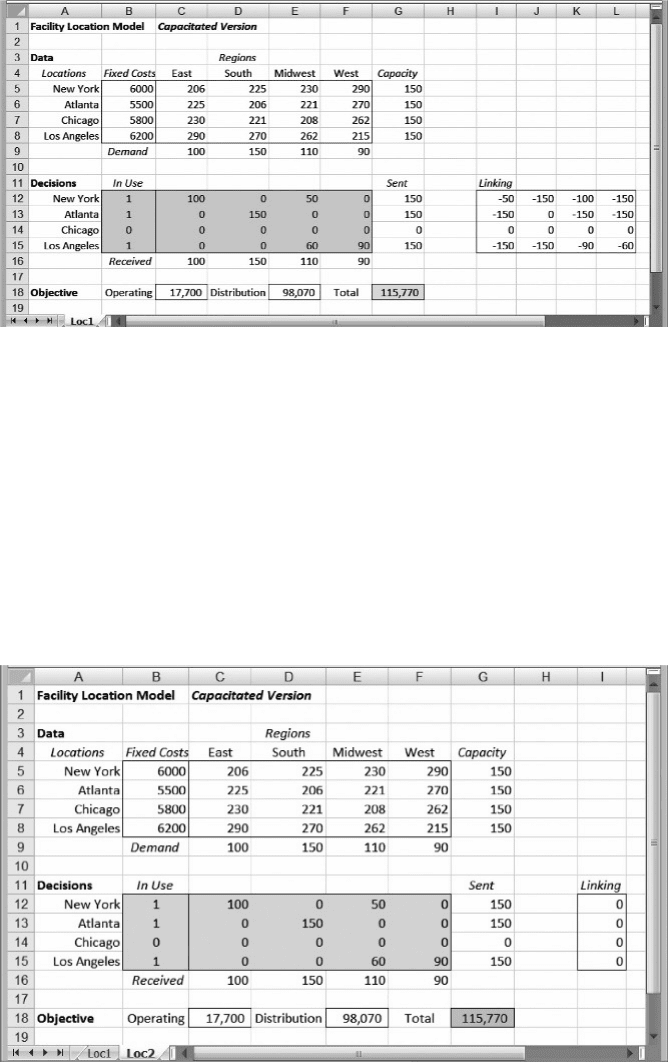
The streamlined version, shown in Figure 7.11, finds the same optimal solution
with a model formulation that contains half as many constraints. The specification
of the problem is as follows.
Objective: G18 (minimize)
Variables: B12:F15
Constraints: C16:F16 ≥ C9:F9
I12:I15 ≤ 0
B12:B15 = binary
Figure 7.10. Optimal solution for Example 7.3.
Figure 7.11. Alternative model for Example 7.3.
266 Chapter 7 Integer Programming: Logical Constraints
Two changes from the previous model are present. First, no explicit capacity con-
straints appear because these are combined with the linking constraints. Second,
one linking constraint appears (cells I12:I15) for each potential DC location, rather
than one for each combination of DC location and sales region. Its left-hand side is
expressed in the form
j
x
ij
– C
i
y
i
.
The facility location model can be thought of as the strategic version of the trans-
portation problem, in the sense that the warehouse or DC locations are treated as given
in the transportation problem but as choices in the facility location problem.
Associated with these choices are the fixed costs of operating a facility, and these
costs are incorporated into the model with the help of linking constraints.
7.4.2. Uncapacitated Version
In the classical uncapacitated facility location problem, no capacity constraints are
associated with the potential facility locations. In a supply-chain design setting, this
might be the case if capacities are completely flexible and can be determined after
the facility locations are selected. The model of the capacitated case can be adapted
to the uncapacitated case in different ways.
Perhaps the simplest way to represent the uncapacitated version of the model is to
use the capacitated version with very large capacities. For example, the capacity at
each facility location could be set equal to the sum of all demands. In symbols, this
means setting
C
i
=
j
d
j
In this formulation, capacity constraints do not inhibit the selection of facility locations
based on cost, and the linking constraints ensure correct accounting for the fixed oper-
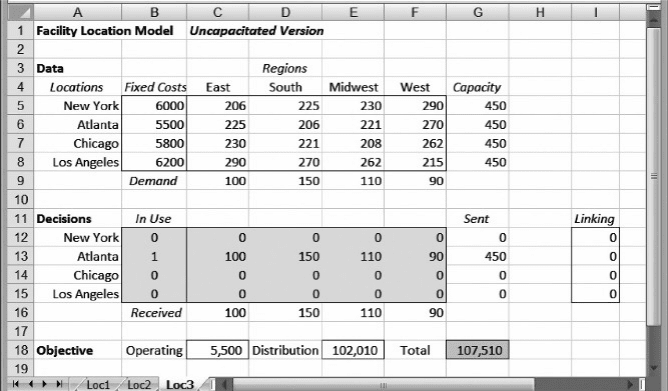
ating costs. Figure 7.12 shows the corresponding spreadsheet layout. The only change
(in the streamlined version) from the formulation of the capacitated model is the value
of 450, which appears in the role of capacity, in the range G5:G8. When we optimize
this model, we find that the minimum cost drops to $107,510, as shown in Figure 7.12,
and that the optimal configuration is to use only the Atlanta location. Without capacity
constraints, we anticipate that the optimal cost should be lower than the optimal cost
for the capacitated model. However, it may be surprising to find that the complete
relaxation of the capacity constraints leads to modest savings. Compared to the capaci-
tated version, the uncapacitated configuration saves $8260 (¼ 115,770 2 107,510) or
about 7 percent.
An alternative modeling approach is based on an insight about the nature of opti-
mal transportation patterns in the uncapacitated case. In the capacitated model of
Figure 7.11, for example, Midwest demand is met from two sources—New York
and Los Angeles. This kind of split would not occur in an optimal solution to the unca-
pacitated version of the problem because there is never an incentive to meet demand
from two sources. In the example, it is cheaper to supply Midwest sales from
New York than from Los Angeles, so there would be no reason to ship from Los
Angeles to the Midwest. (In fact, if the Atlanta location is in use, there is no reason
7.4. Linking Constraints: The Facility Location Model 267
to ship from New York, either.) A general property of the uncapacitated model is that
an optimum exists in which each demand is met from just one source. In particular,
demand should be met from the least expensive source among the facility locations
in the solution. Therefore, we don’t really need the x
ij
variables. Instead, we can define
u
ij
= 1 if facility i serves demand j
= 0 otherwise
In words, u
ij
indicates whether demand in region j is met from facility i. When u
ij
¼ 1,
we know that the corresponding distribution cost must be equal to (c
ij
d
j
)u
ij
, since the
entire demand quantity d
j
will be met from the one source. Accordingly, the (stream-
lined) formulation takes the following form.
Minimize z =
i
F
i
y
i
+
ij
(c
ij
d
j
)u
ij
subject to
i
u
ij
≥ 1(7.6)
j
u
ij
≤ ny
i
(7.7)
The number (n) of demand regions appears in (7.7) because it is the largest possible
value for the sum on the left-hand side. Finally, although the variables u
ij
take on
values of zero or one, we do not have to declare them as binary because the
Figure 7.12. Optimal solution for the unconstrained model.
268 Chapter 7 Integer Programming: Logical Constraints
optimization will always lead to a 0-1 solution when the u
ij
are treated as continuous
variables. Thus, we specify the model in Figure 7.13 as follows.
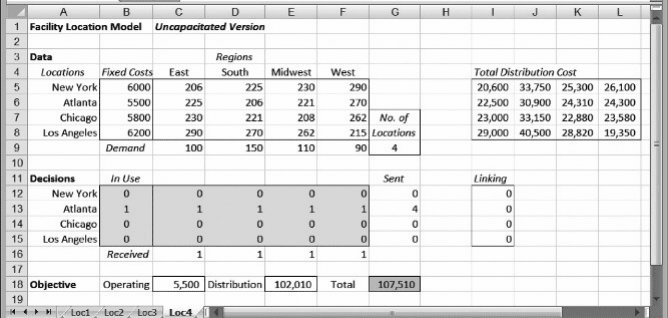
Objective: G18 (minimize)
Variables: B12:F15
Constraints: C16:F16 ≥ 1
I12:I15 ≤ 0
B12:B15 = binary
Figure 7.13 displays an optimal solution for the spreadsheet containing
the alternative unconstrained model. We can confirm the optimal total cost of
$107,510, and an opti mal design calling for a facility in Atlanta to supply the entire
set of demands. In the spreadsheet, the following changes have been made from the
model in Figure 7.12.
†
The “very large” capacities formerly in cells G5:G8 are no longer needed.
†
The Sent totals now show the number of regions served from a warehouse rather
than the quantity shipped.
†
A typical linking constraint follows the form of (7.7). For example, the formula
in cell I12 is now
=G12–$G$9
∗
$B12.
†
The Total Distribution Cost array in I5:L8 holds the terms (c
ij
d
j
) from the
objective function. These are calculated from the original array of unit
costs and demands in each region. Then, the Distribution component of
total cost in cell E18 is calculated with the Excel formula
=SUMPRODUCT(I5:L8,C12:F15).
The uncapacitated facility location problem is sometimes just the central portion
of a larger and more complicated design problem. One reason why it is desirable to use
Figure 7.13. Optimal solution for the alternative unconstrained model.
7.4. Linking Constraints: The Facility Location Model 269

u
ij
variables in the formulation is that other kinds of constraints, particularly logical
conditions, may apply to the potential facility locations. For example, suppose we
want to distribute to at most one customer location from New York. To achieve this
requirement, add the constraint u
11
+ u
12
+ u
13
+ u
14
≤ 1. As discussed earlier in
the chapter, logical constraints can often be developed in linear form with the help
of binary variables, or at least variables that behave as if they were binary.
We have examined two alternative modeling approaches to both the capacitated
and uncapacitated problems. These alternatives are based on the streamlined linking
constraint, using (7.5) in place of (7.3). One advantage of the streamlining is that
there are fewer elements on the spreadsheet, so the model is easier to build and
debug. However, there is a potential downside. The streamlined version may require
more computational effort than the original version to locate an optimum. This differ-
ence could be important in larger models, with perhaps dozens of facility locations and
hundreds of customer demands.
7.5. DISJUNCTIVE CONSTRAINTS: THE MACHINE
SEQUENCING PROBLEM
Scheduling and sequencing problems are notoriously difficult to solve, but some
progress is possible with the use of integer programming. In the basic machine-
sequencing problem, one processor (or machine) is available to process several
jobs. The jobs are all ready for processing at the outset (time zero), but the machine
can accommodate only one job at a time. The jobs are described by a processing
time ( p
j
for job j) and a due date (d
j
).
Depending on the sequence chosen, job j will start processing at time s
j
and com-
plete its processing at time s
j
+ p
j
. If a job completes after its due date, then the job is
said to be tardy, and its tardiness is measured by (s
j
+ p
j
)–d
j
. On the other hand, if a
job completes on or before its due date, then the job is on time, and its tardiness is zero.
In other words, a job’s tardiness may be zero, but it can never be negative. One way
of measuring schedule performance is to sum the tardiness of all jobs, thus computing
the total tardiness in the schedule. A common objective in scheduling is to minimize
total tardiness, as a means of quantifying the effectiveness of a schedule at meeting
due dates. The use of total tardiness as a performance measure prevents one job’s
earliness from offsetting another’s lateness, thereby focusing attention on jobs that
miss their due dates. Obviously, when total tardiness is zero, this means that all due
dates have been met.
As an example, Miles Manufacturing faces a version of the machine sequencing
problem.
EXAMPLE 7.4
Miles Manufacturing Company
Miles Manufacturing Company is a regionally focused production shop that fabricates metal
components for auto companies. Its scheduling efforts center around a large piece of equipment
that handles a variety of operations, such as drilling, shaping, polishing, and mechanical testing.
270 Chapter 7 Integer Programming: Logical Constraints

Work arrives at the machine in batches—each batch corresponding to a customer order—and the
information system provides data on the size of the order, how long it will take to process, and
when it is due (the due dates having been previously negotiated with customers). These due
dates, which apply to completion in the shop, are adjusted for the delivery time needed to put
the completed order in the customer’s hands. When several orders are waiting to be processed,
the supervisor looks for guidance on how the orders should be sequenced. The minimization of
total tardiness is an accepted criterion for a schedule.
This morning’s workload consists of six jobs, as described in the following table.
Job number 1 2 3 4 5 6
Processing time (hours) 5 7 9 11 13 15
Due date (hours from now) 28 35 24 32 30 40
The problem is to sequence the six jobs so that work can begin. With 60 total hours of work to
schedule, and a latest due date of 40, it is obvious that the jobs cannot all be finished on time, and
some tardiness will occur even in the best schedule. B
The optimization problem is to select a sequence for the jobs that minimizes total
tardiness. For decision variables we can use the job start times, s
j
. The key feasibility
constraints reflect the fact that, for any pair of jobs j and k, either k follows j or else
j follows k. In other words, either job j completes before k starts, or else job k com-
pletes before j starts. In symbols, either
s
j
+ p
j
≤ s
k
or s
k
+ p
k
≤ s
j
These are called disjunctive constraints, meaning that one or the other—but not
both—must hold for a solution to be feasible. To represent this requirement in an
integer program, we use the following pair of constraints
s
j
+ p
j
≤ s
k
+ M(1 − y
jk
)
s
k
+ p
k
≤ s
j
+ My
jk
where y
jk
is a binary variable and M represents a nonrestrictive large value, such as the
sum of all the processing times. When y
jk
¼ 1, the first constraint forces the start of job
k to be at least as late as the completion of job j, and the second constraint does not
restrict the choice of variables. On the other hand, when y
jk
¼ 0, the first constraint
does not restrict the choice of variables, and the second constraint forces the start of
job j to be at least as late as the completion of job k. In other words
y
jk
= 1 if job k follows job j, and zero otherwise.
y
kj
= 1 if job j follows job k, and zero otherwise.
We can also rewrite the constraint pair with all variables moved to the left-hand
side and parameters on the right-hand side, thus obtaining the following pair of con-
straints
s
j
− s
k
+ My
jk
≤ M − p
j
s
j
− s
k
+ My
jk
≥ p
k
7.5. Disjunctive Constraints: The Machine Sequencing Problem 271
Expressed this way, the left-hand sides of these conditions are identical, which allows
for some efficiency in building the spreadsheet model. In addition to the disjunctive
constraints, we need constraints that track the tardiness of job j, which is denoted
by t
j
. This can be accomplished by treating t
j
as a nonnegative decision variable
and imposing the following constraint
t
j
≥ s
j
+ p
j
− d
j
When job j is on time, the right-hand side of this constraint will be negative or zero, so
the tardiness variable t
j
will become zero because all variables are nonnegative by
assumption. Otherwise, the constraint will be tight (because the objective is to
make total tardiness as small as possible), and the tardiness variable t
j
will be equal
to the right-hand side. We can also write th is constrai nt with decision variables on
the left and parameters on the rig ht, as follows
s
j
− t
j
≤ d
j
− p
j
An algebraic statement of the entire model follows.
Minimize z =
t
j
subject to:
s
j
− s
k
+ My
jk
≤ M − p
j
, for all job pairs j , k
s
j
− s
k
+ My
jk
≥ p
k
, for all job pairs j , k
s
j
− t
j
≤ d
j
− p
j
, for all jobs j
A spreadsheet model for Miles Manufacturing is shown in Figure 7.14. The first
module of the spreadsheet contains the data for the problem. The next module contains
the three types of decision variables: start times (s
j
), tardiness values (t
j
), and binary
variables ( y
jk
, needed only for j , k). As usual, the decision variables are highlighted.
The third module is a one-cell module containing the objective function, which is just
the sum of the job tardiness values.
Although we need the variables y
jk
only for j , k, the worksheet also shows y
jk
for
j . k. In the worksheet, these values are not highlighted, signifying that they are not
decision variables. Instead, their values are calculated directly from the decision vari-
ables. For example, once we know the value of y
12
, then it follows that y
21
is its binary
complement.
The last module contains the constraints of th e problem. First, we see the LT
inequalities s
j
– t
j
≤ d
j
– p
j
. These are expressed in rows 22– 24, in the columns cor-
responding to the respective jobs. Next, we see the disjunctive constraints in rows
27–41. Each row contains a disjunctive pair, one expressed as an LT constraint and
the other expressed as a GT constraint, each with the same left-hand side. The left-
hand side appears in column G, while the right-hand sides appear in columns I and K.
272
Chapter 7 Integer Programming: Logical Constraints
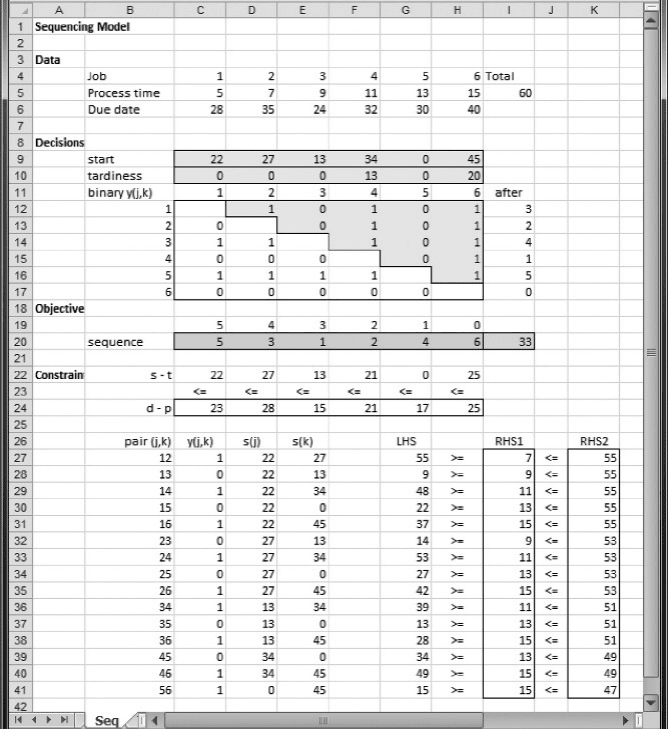
We specify the problem as follows.
Objective: I18 (minimize)
Variables: C9:H10,D12:H12,E13:H13,F14:H14,G15:H15,H16
Constraints: C22:H22 ≤ C24:H24
G27:G41 ≥ I27:I41
G27:G41 ≤ K27:K41
D12:H12 = binary
E13:H13 = binary
F14:H14 = binary
G15:H15 = binary
H16 = binary
Figure 7.14. Spreadsheet model for Example 7.4.
7.5. Disjunctive Constraints: The Machine Sequencing Problem 273
The worksheet in Figure 7.14 contains an optimal sequence. Although the order
of the start times tells us that an optimal sequence is given by 5-3-1-2-4-6, we can also
determine the sequence from the full array of y
jk
values. In cells I12– I17, we sum the
entries in the corresponding row of the array. This value tracks the number of jobs
following the job in that row. For example, three jobs come after job 1, indicating
that job 1 is third in sequence. We can then construct the optimal sequence in row
20 by using these numbers and the MATCH function. Thus, after downloading
processing times and due dates from the central information system and then using
an integer programming model, Miles Manufacturing can construct optimal sequences
on the supervisor’s spreadsheet.
The sequencing model is more general than Example 7.4 might suggest
because it can accommodate other objective functions as well. For example, instead
of minimizing the total tardiness in the schedule, we might instead want to minimize
the number of tardy jobs. In other situations, there could be a contractual penalty deter-
mined by a job’s delay, and the criterion could be minimization of delay penalties.
Sequencing problems with a variety of criteria can fit into this framework, where dis-
junctive constraints enable the problem to be solved as an integer linear program.
More generally, disjunctive constraints are appropriate whenever we encounter
situations in which we want at least one constraint out of a pair to apply. Suppose
we have a pair of LT constraints in our model
LHS
1
≤ RHS
1
LHS
2
≤ RHS
2
Suppose also that we wish to have at least one of these two constraints satisfied. We
can then represent the two constraints in our model as follows.
LHS
1
≤ RHS
1
+ My
LHS
2
≤ RHS
2
+ M(1 − y)
With the additional terms, the binary variable y determines which constraint will be
met automatically. When y ¼ 1, the right-hand side of the first constraint becomes
quite large, and the constraint is satisfied for any choice of the other variables in the
model. The right-hand side of the second constraint is unaffected, so the other vari-
ables must be chosen to be feasible in that constraint. When y ¼ 0, the right-hand
side of the second constraint becomes quite large, and the other variables must be
chosen to be feasible in the first constraint.
7.6. TOUR AND SUBSET CONSTRAINTS: THE
TRAVELING SALESPERSON PROBLEM
In the traveling salesperson problem (TSP), a sales rep has several customers to visit,
each in a separate city. The sales rep knows the distances between pairs of cities and
must plan a trip that visits each of the cities once and returns home. This type of trip is
called a tour. Specifically, the sales rep would like to plan a tour that has the minimum
total distance.
274
Chapter 7 Integer Programming: Logical Constraints
The given information in the TSP is an array of distances. In the literal version of
the problem, we might expect the distances to be symmetric—that is, the distance from
A to B should be the same as the distance from B to A. However, there are applications
where the distances need not be symmetric. For example, a paint booth may or may not
need cleaning between two successive products on the production line. If two succes-
sive items use the same color of paint, then there is no cleaning required. But if the
items require different colors, then there is a need to clean out the painting equipment.
The time required depends on the paint color just finishing and on the paint color about
to begin. The ( i, j)th entry in the data array represents the time required to clean the
equipment between color i and color j, and it need not be the same as the cleaning
time between j and i. In a complete cycle through the products, with one batch for
each color, the painting time is fixed, but the length of the schedule is minimized
when the total cleaning time is minimized. Total cleaning time is in turn the total
length of a tour in the array of cleaning times. As an example, consider the Douglas
Electric Cart Company.
EXAMPLE 7.5
Douglas Electric Cart Company
The Douglas Company assembles small electric vehicles which are sold for use on golf courses,
at university campuses, and in sports stadiums. In these markets, customers like to buy in a var-
iety of colors, so Douglas offers several choices. As a result, its manufacturing operations
include a sophisticated painting operation, which is separately scheduled.
Today’s schedule contains six colors (C1–C6) with cleaning times as shown in the table
below.
C1 C2 C3 C4 C5 C6
C1 –16632120 6
C2 57 – 40 46 69 42
C3 23 11 – 55 53 47
C4 71 53 58 – 47 5
C5 27 79 53 35 – 30
C6 57 47 51 17 24 –
The entry in row i and column j of the table gives the cleaning time required between product
lots of color Ci and color Cj. Each production run consists of a cycle through the full set of
colors, and the operations manager wishes to sequence the colors so that the total cleaning
time in a cycle is minimized. B
Returning to the traveling salesperson terminology, we refer to the colors in a pro-
duction cycle as cities, and we refer to the cleaning time objective as the total distance.
For example, if the painting schedule calls for the color sequence given by the cycle
1-2-3-4-5-6-1
then the total distance (cleaning time in the cycle) is 16 + 40 + 55 + 47 + 30 +
57 ¼ 245. We would like to know whether this is the minimum.
7.6. Tour and Subset Constraints: The Traveling Salesperson Problem 275