
Baker K.R. Optimization Modeling with Spreadsheets
Подождите немного. Документ загружается.

Alternativel y, using symbols, we write
TC = Fy + vx
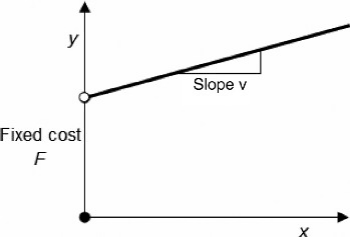
where F represents the fixed cost and v represents the unit (variable) cost. A sketch of
the total cost function is shown in Figure 7.4. The variables x and y are decision vari-
ables, wh ere x is a normal (continuous) variable and y is a binary variable. Constraints
in the linear program involve only the variable portion—that is, they involve only the
variable x, not the variable y. We also want the variables x and y to work consistently.
Specifically, we want to ensure that y ¼ 1 (so that we incur the fixed cost) whenever
x . 0, and we want to have y ¼ 0 (so that we avoid fixed cost) when x ¼ 0. To achieve
consistency in the two variables, we add the following linking constraint.
x ≤ My
where M represents some upper bound on the variable x.
To appreciate the linking constrai nt, imagine that Solver approaches the selection
of variables in two stages. In the first stage, bi nary variables (such as y) are set to either
0 or 1; then, in the second stage, continuous variables (such as x) are determined. The
two first-stage choices for the variable y provide us with the following possibilities in
the linking constraint
y = 1 so that x ≤ My becomes x ≤ M (meaning: x can be anything)
y = 0 so that x ≤ My becomes x ≤ 0 (meaning: x must be zero)
Thus, the variable x will be treated in a consistent way with the choice of y.In
particular, it is not possible to have y ¼
0 and x . 0. In words, we cannot avoid the
fixed cost if we wish to use x at a nonzero level.
In principle, the linking constraint does allow us to set y ¼ 1 and x ¼ 0. That is,
the model permits us to incur the fixed cost even without using the variable x.
However, Solver will not produce such a solution because it would always be less
costly to set y ¼ 0 and avoid the fixed cost completely.
As an example of the fixed cost structure, consider the product planning decision
at the Moore Office Products Company.
Figure 7.4. Total cost with fixed and variable components.
256 Chapter 7 Integer Programming: Logical Constraints
EXAMPLE 7.2
Moore Office Products Company
Moore Office Products has been producing and selling its goods in three product families (F1,
F2, and F3) and planning for those products using a product-mix type of linear programming
model. Each product family requires production hours in each of three departments. In addition,
each family requires its own sales force, which must be supported no matter how large or small
the sales volume happens to be. The parameters describing the situation are summarized in the
following table. Moore’s management is wondering whether it should continue to market all
three product families.
Hours required/1000 units family
Hours
F1 F2 F3 available
Department A 3 4 8 2000
Department B 3 5 6 2000
Department C 2 3 9 2000
Profit per unit ($) 1.20 1.80 2.20
Sales cost ($000) 60 200 100
Demand (000s) 300 200 50
B
At the heart of this situation lies a decision problem analogous to the product mix
example introduced in Chapter 2. The linear programming representation of the pro-
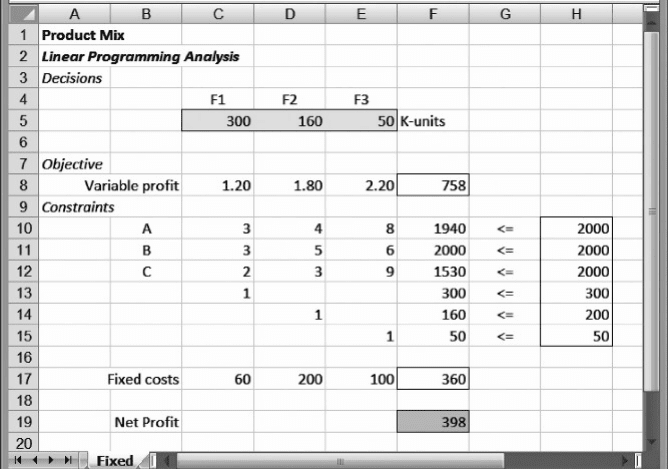
duct mix problem, without the fixed costs, is shown in Figure 7.5. By defining the x-
values in thousands, we have scaled the model so that the objective function is in thou-
sands of dollars. The optimal product mix calls for producing all three families, with
F1 and F2 at their demand ceilings, and F3 at a volume of 50,000. This product mix
creates $758,000 in variable profits, as computed in cell F8. If we subtract the total
fixed costs of $360,000, as computed in cell F17, we are left with a net profit of
$398,000, as computed in cell F19.
The linear programming solution might represent the situation in a firm that has
introduced and supported various new products over the years and now finds itself car-
rying out activities in three existing markets. The linear programming framework
suggests how to allocate capacity, provided that all three of the product families are
active. However, because fixed-cost considerations are not part of the linear program-
ming analysis, we have no basis for determining whether any one of the families
should be dropped. To make the model suitable for decisions of this kind, we must
integrate the implications for fixed costs.
To formulate the full problem at Moore Office Products as an integer program-
ming model, we make two changes in the product mix formulation. First, we write
the objective function with terms for both variable profit and fixed cost, as follows
Net profit = 1.20x
1
− 60y
1
+ 1.80x
2
− 200y
2
+ 2.20x
3
− 100y
3
where x
j
represents the volume for family j, in thousands, and
y
j
= 1ifx
j
is positive (and the fixed cost is incurred)
y
j
= 0ifx
j
is zero (and the fixed cost is avoided)
7.2. Linking Constraints: The Fixed Cost Problem 257
Net profit is measured in thousands due to the scaling of the x-variables and the scaling
of the fixed cost coefficients.
Next, we add linking constraints to ensure consistency between each of the
x– y pairs.
x
1
− My
1
≤ 0
x
2
− My
2
≤ 0
x
3
− My
3
≤ 0
Now we need to identify a large number to play the role of M. Essentially, we need a
number large enough that it will not limit the choice of these variables in any of the
other (demand and supply) constraints. For example, a value of 300 (thousand)
would work, since that represents the largest demand ceiling, and none of the volumes
could ever be larger.
Thus, when y
2
¼ 1, the linking constraint for family F2 becomes x
2
≤ 300; and
when y
2
¼ 0, the constraint becomes x
2
≤ 0. Similar interpretations apply to families
F1 and F3. These are valid linking constraints, but we can streamline the model
slightly. Instead of retaining separate constraints to represent the demand ceilings
and the linking relationships, we can let the linking constraint do “double duty” if
we choose a different value of M for each family and set it equal to the corresponding
demand ceiling. For example, the value of M selected for the F2 constraint could be
200 instead of 300. Then, when y
2
¼ 1, the constraint on the production volume for
Figure 7.5. Solution to Example 7.2 without fixed costs.
258 Chapter 7 Integer Programming: Logical Constraints
family F2 becomes x
2
≤ 200, which also serves as a demand ceiling. When y
2
¼ 0, the
constraint still becomes x
2
≤ 0, in which case the specific choice of M does not matter.
The streamlined model, in its entirety, is the following
Maximize z = 1.20x
1
− 60y
1
+ 1.80x
2
− 200y
2
+ 2.20x
3
− 100y
3
subject to:
3x
1
+ 4x
2
+ 8x
3
≤ 2000
3x
1
+ 5x
2
+ 6x
3
≤ 2000
2x
1
+ 3x
2
+ 9x
3
≤ 2000
x
1
− 300y
1
≤ 0
x
2
− 200y
2
≤ 0
x
3
− 50y
3
≤ 0
There are different ways to lay this model out in a spreadsheet. We could, for
instance, treat the xs and ys as six distinct variables and, in the traditional format,
build the spreadsheet with six columns on the left-hand side of the constraints.
Then, we could represent the constraints in the traditional format, as six rows, with
the usual SUMPRODUCT functions. An alternative is to pair the xs and ys that are
linked in successive rows, using just three columns (one for each product family).
Then we could associate the linking constraints with variable pairs and display
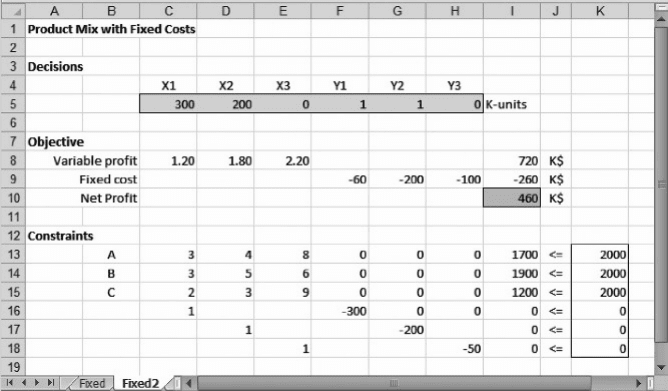
them in columns (one for each product family). Figure 7.6 shows the traditional
layout, and Figure 7.7 shows the alternative. In the latter, formulas in cells C16:E16
compute the left-hand side of the linking constraints. For example, the formula in
cell C16 reads:
¼ C5–C15
∗
C6.
Figure 7.6. Spreadsheet layout for Example 7.2.
7.2. Linking Constraints: The Fixed Cost Problem 259
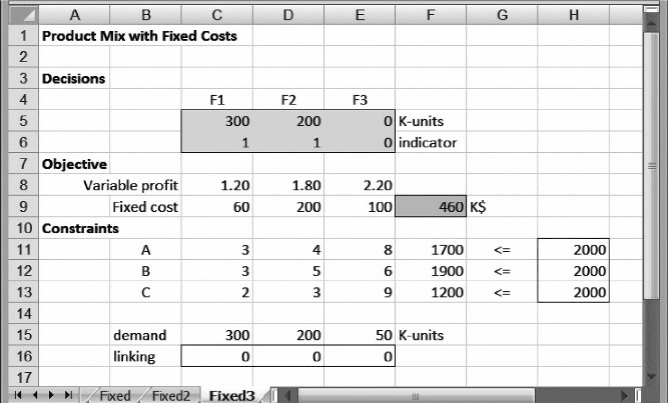
For the layout in Figure 7.7, we specify the model as follows.
Objective: F9 (maximize)
Variables: C5:E6
Constraints: F11:F13 ≤ H11:H13
C16:E16 ≤ 0
C6:E6 = binary
The optimal solution achieves a net profit of $460,000, which we can obtain by
setting the Integer Tolerance to zero. In order to attain this level of profits, Moore
Office Products must forego production of product family F3 and produce families
F1 and F2 up to their respective ceilings. In other words, the model detects that
family F3 does not pay its own way and that profits would be increased by not produ-
cing or selling that family at all. By using an integer programming model that incor-
porates fixed costs, Moore Office Products can conside r the implications of dropping a
product family. Such a possibility may be influenced by factors beyond profits in the
coming year, but the model helps to shape and quantify the economic considerations.
7.3. LINKING CONSTRAINTS: THE THRESHOLD
LEVEL PROBLEM
Sometimes we encounter situations where, in order to do business, we are required to
participate at a specified minimum level. In purchasing, for example, we might be able
to qualify for a discounted price if we buy in quantity. Thus, a condition in the problem
Figure 7.7. Alternative layout for Example 7.2.
260 Chapter 7 Integer Programming: Logical Constraints
dictates that a decision variable must be either zero or at least as large as a specified
threshold.
The existence of a threshold level does not require an alteration in the objective
function of a model, and it can be represented in the constraints with the help of
binary variables. Suppose we have a variable x that is subject to a specified minimum
requirement. Let m denote the threshold value of x if it is nonzero. Then we can capture
this structure in an integer programming model by including the following pair of
constraints
x ≥ my
x ≤ My
where, as before, M is a large number that is greater than or equal to any value x could
feasibly take. To see how these two requirements work, again imagine that Solver
approaches the selection of variables in two stages. In the first stage, the binary vari-
able y is set to either 1 or to 0; then, in the second stage, Solver determines x. The two
first-stage choices for the variable y provide us with the following possibilities in the
linking constraints.
y = 1 so that: x ≥ my becomes x ≥ m (meaning: x meets the threshold)
and: x ≤ My becomes x ≤ M (meaning: x can be anything)
y = 0 so that: x ≥ my becomes x ≥ 0 (meaning: x must be nonnegative)
and: x ≤ My becomes x ≤ 0 (meaning: x must be nonpositive)
Thus, when y ¼ 1, the constraints reduce to m ≤ x ≤ M, so that x must at least meet the
threshold level. When y ¼ 0, the constraints reduce to x ¼ 0. Thus, the pair x
and y will
behave consistently, and the threshold requirement will be respected.
As a brief illustration, suppose that in Example 7.2, materials for product family
F2 can be ordered from a major supplier only if the order supports an output level of
125 (thousand) or more. The model would need two constraints, as follows
x
2
≥ 125y
2
x
2
≤ 200y
2
This pair of linking constraints ensures that if x
2
. 0, then it must lie between 125
and 200.
7.4. LINKING CONSTRAINTS: THE FACILITY
LOCATION MODEL
In designing its distribution system, a firm wants to know how many distribution facili-
ties it should have and where they should be located. If we think about the “how many”
question, we can see a basic tradeoff. As the firm uses more and more facilities, it can
place the facilities close to customer locations and thus reduce its variable distribution
costs. However, larger overhead costs will occur due to operating a larger number of
7.4. Linking Constraints: The Facility Location Model 261
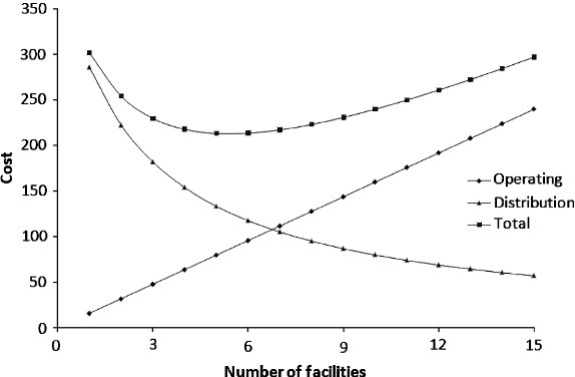
facilities. In the other direction, as the firm uses fewer and fewer facilities, it will
encounter larger and larger variable costs, but the costs of operating the facilities
will drop. Figure 7.8 shows this tradeoff graphically. The horizontal axis represents
the number of facilities in the system. As this number increases, the total cost of dis-
tribution drops, while the cost of operating the facilities increases. (The graph shows
this latter component as a straight line, as if each facility incurs the same operating cost,
but this is only for illustration.) The total cost in the problem is the sum of distribution
cost and operating cost, shown as the U-shaped function on the graph.
The graph in Figure 7.8 is only a conce ptual device to illustrate the main tradeoff
affected by the number of locations. Important details remain. For example, once we
choose the number of facilities, we must then determine which facilities to use.
Similarly, once we choose the facilities, we must still determine how to distribute
from those facilities to the customer locations in the most desirable way. This last pro-
blem we can now recognize as a transportation problem, which we examined in
Chapter 3. Thus, the graph hides two embedded problems: (1) selecting k out of the
m possible locations for facilities in the network and, (2) solving the transportation
problem that arises once the locations are selected.
This type of tradeoff arises in several situations, but perhaps the most familiar
application relates to the location of facilities in a distribution supply chain. For this
reason, the problem is known as the facility location problem (or sometimes, the
plant location problem, or the warehouse location problem). The essential tradeoff bal-
ances the fixed costs of operating discrete sources with the variable costs of providing
service from those sources. In the examples that follow, we distinguish between the
capacitated and uncapacitated version of the problem. The integer programming
model itself represents a variation on the incorporation of fixed costs and the use of
linking constraints.
Figure 7.8. Cost Tradeoff in facility location.
262 Chapter 7 Integer Programming: Logical Constraints
7.4.1. Capacitated Version
In the classical capacitated facility location problem, the system contains m potential
facility locations and n existing customer demand locations. For facility location i,we
know the capacity (denoted C
i
) and the fixed cost of operating the facility (F
i
). For each
customer location, we know the demand (d
j
) and the unit distribution cost (c
ij
) associ-
ated with satisfying demand at location j from capacity at facility i. In this problem
statement, we typically choose a time period, such as a month or a year, as the basis
for the facility costs and the demand quantities. For decision variables, we define
x
ij
= quantity sent from facility i to customer location j
y
i
= 1 if facility i is used in the design
y
i
= 0 otherwise
Then the optimization problem can be formulated algebraically as follows.
Minimize z =
i
F
i
y
i
+
ij
c
ij
x
ij
subject to
i
x
ij
≥ d
j
(7.1)
j
x
ij
≤ C
i
(7.2)
x
ij
≤ C
i
y
i
(7.3)
As stated, the problem contains a transportation model, represented by constraints
(7.1) and (7.2), along with the linking constraints in (7.3). The linking constraints
ensure that if we distribute from facility location i (i.e., x
ij
. 0 for some j), then we
incur the corresponding fixed cost F
i
in the objective function (by forcing y
i
to be
1). Conversely, if we want to avoid the fixed cost F
i
, then we must have y
i
¼ 0,
which prevents the use of facility location i.
The model contains mn variables x
ij
along with m variables y
i
, for a total of
m(n + 1) variables. There are n constraints of type (7.1), m constraints of type (7.2),
and mn constraints of type (7.3), for a total of mn + m + n.
A more streamlined version of the same problem replaces constraints (7.2) and
(7.3) with a single type of constraint
Minimize z =
i
F
i
y
i
+
ij
c
ij
x
ij
subject to:
i
x
ij
≥ d
j
(7.4)
j
x
ij
≤ C
i
y
i
(7.5)
7.4. Linking Constraints: The Facility Location Model 263
In this formulation, constraint (7.5) represents the linking constraint between the
binary variable y
i
and all of the quantities distributed from facility location i. This
same inequality serves as the capacity constraint as well: when y
i
¼ 1, the constraint
matches (7.2) above; when y
i
¼ 0, facility location i is not used, so there is no need to
constrain its capacity. This more streamlined model contains m(n + 1) variables, as
before, but now the number of constraints is just m + n, quite a bit smaller than in
the original model. To make the location model more concrete, we consider an
example.
EXAMPLE 7.3
Van Horne Appliance Company
The Van Horne Appliance Company is a manufacturer of home appliances with nationwide dis-
tribution. Van Horne is designing its supply chain from scratch, having purchased some smaller
companies in the last year. Its main candidates for distribution centers (DCs) are New York,
Atlanta, Chicago, and Los Angeles. Each of these locations can accommodate annual volumes
of up to 150,000 units, but they would require different levels of operating expense, as estimated
in the table below.
DC Location New York Atlanta Chicago Los Angeles
Annual cost (000s) $6000 $5500 $5800 $6200
One or more of these DCs will service Van Horne’s four sales regions (East, South, Midwest,
and West). For each combination of DC and sales region, Van Horne has estimated the average
transportation cost per thousand units shipped.
(To) region
(From) DC East South Midwest West Capacity
New York $206 $225 $230 $290 150,000
Atlanta 225 206 221 270 150,000
Chicago 230 221 208 262 150,000
Los Angeles 290 270 262 215 150,000
Requirement 100,000 150,000 110,000 90,000
The design problem facing the supply-chain manager at Van Horne is to determine which
DC locations to use, based on operating expense and total distribution cost. B
Figure 7.9 shows a worksheet for the model. The Data section contains an array
structured much like the transportation model, with rows for the potential DC locations
and columns for the sales regions. For each row, the capacity (in thousands) is entered
on the right-hand side of the array, in column G. For each column, the annual demand
(in thousands) is entered at the bottom of the array. Annual fixed costs (in thousands)
264
Chapter 7 Integer Programming: Logical Constraints
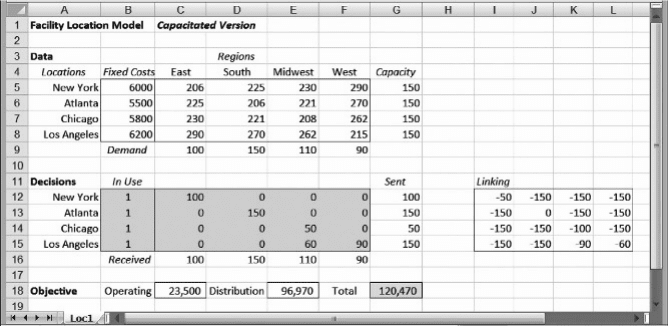
appear in column B, and the variable cost (per thousand) corresponding to each com-
bination of DC location and customer region appears in the range C5:F8.
The Decisions section of the spreadsheet contains an array for decision variables.
Column B holds the values of the y
i
variables. The preliminary solution shown in the
figure uses all four DC locations, so the entries in this column are all 1s. The range
C12:F15 contains a solution to the transportation subproblem that constitutes the
kernel of the model, although this solution may not be optimal. Finally, the array
I12:L15 contains the left-hand side of the linking constraints corresponding to
(7.3), expressed in the form x
ij
2 C
i
y
i
. Thus, the linking constraints are satisfied
when each element in this array is less than or equal to zero.
Finally, the Objective section contains the evaluation of costs. The total operating
cost in cell C18 and the total distribution cost in E18 are added to generate the total cost
in G18. The model specification is as follows.
Objective: G18 (minimize)
Variables: B12:F15
Constraints: G12:G15 ≤ G5:G8
C16:F16 ≥ C9:F9
I12:L15 ≤ 0
B12:B15 = binary
Solver finds an optimal solution that achieves a cost of $115,770 by using th e
New York, Atlanta, and Los Angeles DC locations, as shown in Figure 7.10. As
the transportation kernel shows, the optimal solution shi ps from New York to both
the East and Midwest and from Los Angeles to both the Midwest and West, while ship-
ping to the South from Atlanta. By formulating and solving an integer programming
model for its location problem, Van Horne can implement its national supply chain in
the most cost-effective fashion.
Figure 7.9. Spreadsheet model for Example 7.3.
7.4. Linking Constraints: The Facility Location Model 265