
Baker K.R. Optimization Modeling with Spreadsheets
Подождите немного. Документ загружается.

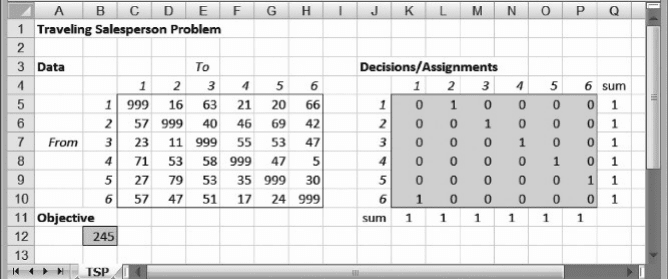
As a first cut at an optimization model, we define the following decision variables
x
ij
= 1 if the city pair (i, j) occurs on the tour.
x
ij
= 0 otherwise.
We can imagine an array of x
ij
variables in an array the same size as the table of dis-
tances, although we do not need to use the variables x
ii
on the diagonal. Next, we can
recognize that any tour must enter each city once and leave each city once. Therefore,
in order for the decisions to be feasible, only one of the entries in each row of the
decision array can equal 1 (one departure route from each city) and only one of the
entries in each column can equal 1 (one entry route into each city.) Another way to
state this requirement is that the sum along each row and the sum along each
column must be equal to 1. When we impose these constraints, we are essentially for-
mulating an assignment problem, as discussed in Chapter 3. (See Figure 3.6 for an
example.) The assignment problem requires a 1 in every row and a 1 in every
column, and its objective function is the SUMPRODUCT of the cost (distance)
array and the decision array.
To build a spreadsheet model for the optimization problem, we first enter the
given array of distances, as in Figure 7.15. To the right of the data we construct another
array for the decision variables x
ij
. For each entry in the table of cleaning times, we
have a corresponding decision variable. Along the diagonal of the distance array,
we have entered arbitrarily large distances, to discourage the use of decision variables
x
ii
. In the figure, we display the x-values corresponding to the cycle 1-2-3-4-5-6-1. The
objective function is the SUMPRODUCT of the data array and the decision array,
which for this sequence yields the value 245.
To find a solution, we specify the problem as follows.
Objective: B12 (minimize)
Variables: K5:P10
Constraints: Q5:Q10 = 1
K11:P11 = 1
Figure 7.15. Distance array and decision array for Example 7.5.
276 Chapter 7 Integer Programming: Logical Constraints
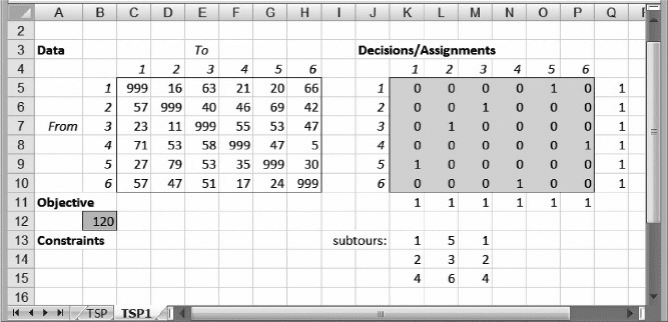
Figure 7.16 shows the result, which has an optimal objective function value of
120. Unfortunately, when we try to interpret the decision variables as a route for
the sales rep, we do not obtain a tour. Starting at city 1, the tour goes to city 5, but
then it returns to city 1. Alternatively, if we start at city 4, the tour goes to city 6
and then returns to city 4. We actually have three separate routes, called subtours,
but no tour that visits all the cities. The subtours are listed in rows 13–15 of the spread-
sheet, after Solver’s run. Evidently, the assignment problem constraints, which assure
an entry of 1 in every row and every column, are not sufficient to guarantee that we can
interpret the result as a tour. We must impose additional constraints. Adding con-
straints that create a tour does not sound like it will involve linear constraints, but it
is not difficult to accomplish, as we discuss next.
To proceed toward a solution, we have to add constraints that eliminate the
subtours we encountered. In the solution of Figure 7.17, suppose we focus on the
subtour involving cities 4 and 6. (If we can eliminate the subtour 4-6-4, that will sim-
ultaneously eliminate at least one of the other subtours. If we are fortunate, all three
subtours will be eliminated.) To prohibit the tour 4-6-4, we add the following
constraint
x
46
+ x
64
≤ 1
Assuming, for the moment, that the x-values are binary variables, this constraint states
that between the pair (4, 6), we can have at most one link on the tour. We place the left-
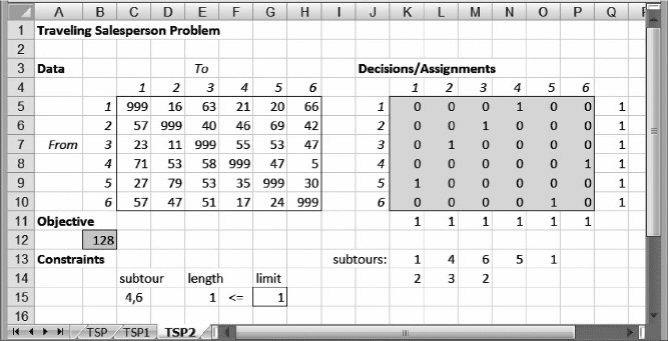
hand side of this constraint as a formula in cell E15 (under the heading “length”), and
we place the right-hand side in cell G15 (under the heading “limit”) as shown in
Figure 7.17. Now we can re-run the model with the additional constraint, hoping
that it will produce a tour.
Figure 7.16. Solution to the assignment model for Example 7.5.
7.6. Tour and Subset Constraints: The Traveling Salesperson Problem 277
This time, we specify the problem as follows.
Objective: B12 (minimize)
Variables: K5:P10
Constraints: Q5:Q10 = 1
K11:P11 = 1
E15 ≤ G15
Figure 7.17 shows the solution. The objective function increases from 120 to 128,
which is not surprising, given that we added a constraint to eliminate part of the pre-
vious solution. However, we still do not have a tour. Two subtours (1-4-6-5-1 and 2-3-
2) appear in the solution, so we must add another elimination constraint. For conven-
ience, we choose the smaller subtour and focus on 2-3-2. The appropriate constraint to
add is the following
x
23
+ x
32
≤ 1
We place the left-hand side in cell E16 and the right-hand side in G16, and we
again re-run the model, with the following specification.
Objective: B12 (minimize)
Variables: K5:P10
Constraints: Q5:Q10 = 1
K11:P11 = 1
E15:E16 ≤ G15:G16
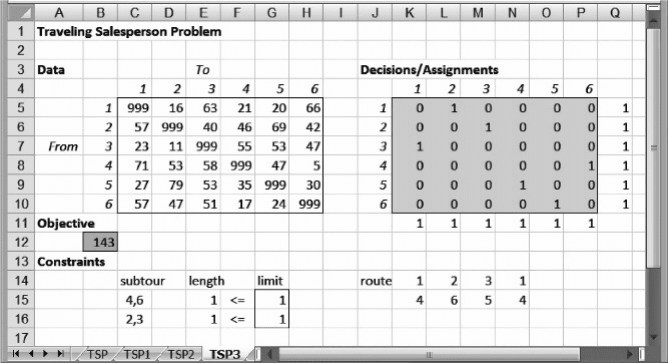
This time we obtain an objective function value of 143, and subtours of 1-2-3-1 and
4-6-5-4, as shown in Figure 7.18.
Figure 7.17. Solution for Example 7.5 with one elimination constraint.
278 Chapter 7 Integer Programming: Logical Constraints
Once more, we pursue the elimination strategy. Of the two 3-city subtours,
suppose we choose to eliminate 4-6-5-4. The constraint is as follows.
x
45
+ x
46
+ x
54
+ x
56
+ x
64
+ x
65
≤ 2
This constraint prohibits the subtour 4-6-5-4, and while we’re at it, the subtour 4-5-6-4.
In other words, we permit at most two links on the tour from the routes involving these
three cities. The left-hand side of the constraint includes all possible city pairs from the
set of cities on the subtour; the right-hand side of the constraint is one less than the
number of cities in the subtour. We use cells E17 and G17 for the new constraint
and re-run the model. This time the objective function increases to 147.5, with a non-
integer solution, as shown in Figure 7.19.
Therefore, we impose the requirement that all decision variables must be binary,
specifying the problem as follows.
Objective: B12 (minimize)
Variables: K5:P10
Constraints: Q5:Q10 = 1
K11:P11 = 1
E15:E17 ≤ G15:G17
K5:P10 = binary
Now that we are solving an integer programming problem, we must remember to
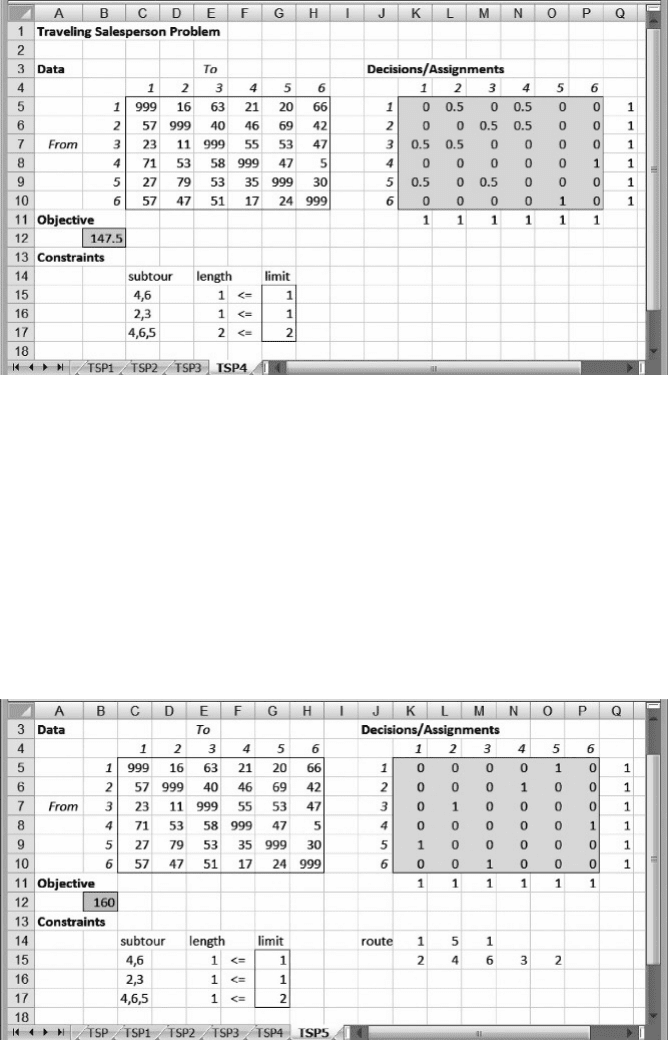
ensure that the Integer Tolerance is zero. Then we proceed with Solver. Figure 7.20
displays the solution, which contains two subtours and achieves an objective function
of 160.
Figure 7.18. Solution for Example 7.5 with two elimination constraints.
7.6. Tour and Subset Constraints: The Traveling Salesperson Problem 279
We pursue the elimination strategy one more time, eliminating the subtour 1-5-1.
Having updated the model as shown in Figure 7.21, we specify the problem as follows.
Objective: B12 (minimize)
Variables: K5:P10
Constraints: Q5:Q10 = 1
K11:P11 = 1
E15:E18 ≤ G15:G18
K5:P10 = binary
Figure 7.19. Solution for Example 7.5 with three elimination constraints.
Figure 7.20. Solution for Example 7.5 with integer requirements.
280 Chapter 7 Integer Programming: Logical Constraints
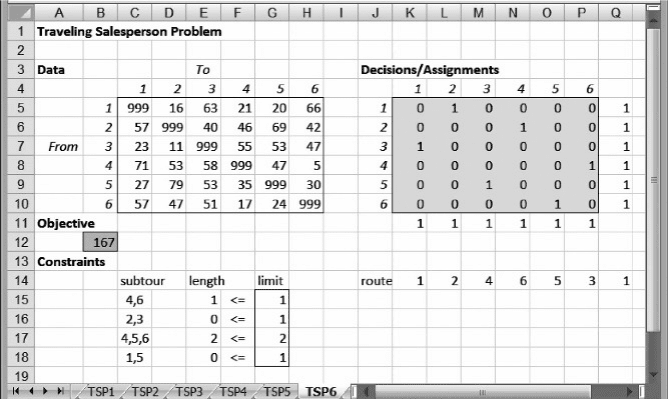
This time, the optimal solution provides a complete tour, 1-2-4-6-5-3-1, with a length
of 167, as shown in Figure 7.21. By using an integer programming approach, Douglas
Electric Cart Company can find the color sequence that requires the minimum cleaning
time in a production cycle, thus allowing the firm to make efficient use of its expensive
painting equipment.
The solution approach described here begins with an assignment model. The opti-
mal solution to the assignment model as a linear program is guaranteed to contain vari-
ables that are 0 or 1, as discussed in Chapter 3. However, the solution may or may not
represent a tour. If it does, we are fortunate, obtaining a solution to a potentially diffi-
cult model with a single use of linear programming. More likely, we find that the sol-
ution contains subtours. In that case, we pursue the strategy of imposing what are
known as subtour elimination constraints. One at a time, we can add a constraint
that prohibits a subtour found in the previous optimal solution. The subtour constraint
sums the values of all the decision variables involving the city pairs in the subtour, and
requires that the sum must be less than the number of cities on the subtour.
Each time we add a subtour elimination constraint, the objective function is likely
to increase, although sometimes it may stay the same. At some stage, we may have to
impose the requirement that all variables must be binary, but that is not necessary until
we encounter a linear programming solution containing fractions. Eventually, this
iterative procedure leads to an optimal solution to the TSP.
A reasonable question to ask is why add the constraints one at a time? Of course,
when we start out, we don’t know which subtours we need to eliminate. However, we
could add constraints that eliminate all possible subtours. The problem is that this may
be a very large number of constraints. If there are n cities in the original problem, then
the number of constraints that would eliminate all subtours is 2
n –1
– n – 1. Consider
Figure 7.21. Optimal solution for Example 7.5.
7.6. Tour and Subset Constraints: The Traveling Salesperson Problem 281
that when n is 12, the number of constraints is over 2000, not to mention that we would
find it very tedious to enter those constraints. The empirical finding seems to be that
only a very small fraction of the number of potential constraints is ever really
needed to obtain an optimal solution using the iterative procedure we have illustrated.
In our example, which contained six cities, we would have needed 25 constraints to
guarantee an optimal solution with one model, but we found that we needed only
four constraints when we implemented the one-at-a-time approach. (Most six-city pro-
blems require fewer than that.) Problems with 12, 15, or even 20 cities are usually
within the reach of spreadsheet-based solution approaches because the relatively
small number of elimination constraints actually needed is well within Solver’s
limits. The limiting factor is the time required to solve the necessary series of integer
programs en route to a final solution.
Applications of the TSP occur frequently in manufacturing and logistics, and
some very powerful solution methods, tailored to the TSP, have been developed for
repeated use or for tackling especially large versions. The main purpose here is to illus-
trate a complex logical constraint (the tour requirement) and to demonstrate that it is
possible to apply integer programming techniques effectively for nontrivial problem
sizes. Large-scale applications require prohibitive amounts of time from Solver, and
in those cases, it would be necessary to look elsewhere for a method specialized to
the TSP.
SUMMARY
The ability to treat variables as integer-valued, and, in particular, the ability to designate certain
variables as binary, opens up a wide variety of optimization models that can be addressed with
Solver. As illustrated in Chapters 6 and 7, Solver’s branch and bound capability can handle three
broad types of models.
†
The first type is one that resembles a linear program but with the requirement that certain
variables must be integer valued. In Solver, this requirement is added as a constraint.
†
The second type is one in which certain decisions exhibit an all-or-nothing structure,
reflecting actions that are indivisible. This is a role for a binary variable, which is
simply an integer-valued variable no less than zero and no greater than one. Such a vari-
able allows us to model the occurrence of yes/no choices and to use Solver, provided
that the structure of the model is linear in all other respects.
†
The third type is one in which binary variables are used to capture certain logical con-
straints in linear form. We don’t often think of logical constraints as being so closely
related to the inequalities of linear programs, so it takes some modeling practice to
appreciate how to make this connection. As the examples illustrate, binary variables
are useful in representing linking constraints for fixed costs, disjunctive constraints
for sequencing problems, and tour constraints for routing problems.
The categories that rely on binary variables include a number of well known combinatorial
problems. For many of these problems, large instances can take a great deal of time to solve,
282 Chapter 7 Integer Programming: Logical Constraints
whether the solution technique is based on an integer programming formulation or some other
approach. In the case of sequencing problems or TSPs, instances with more than 20 elements
might create a substantial computational burden for Solver, even though the sizes of the
examples in this chapter do not suggest any computational difficulty. In moving to a larger
scale, it may be helpful to reset the Integer Tolerance parameter to a more forgiving level,
such as 5 percent, while exploring the Solver’s response time. It may also be helpful to set a
generous time limit (Max Time) on the Engine tab of the task pane, in case the computational
burden is greater than anticipated.
EXERCISES
7.1. Moore Office Products (Revisited) Revisit the Moore Office Products example of this
chapter, where there have been some revisions in the problem’s data. The information is
summarized below.
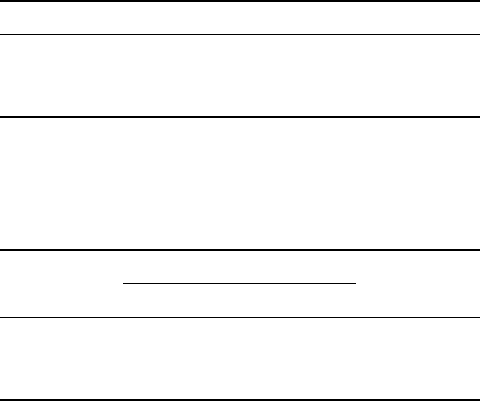
Family Demand Contribution Fixed cost
F1 290,000 $1.20 $60,000
F2 200,000 1.80 200,000
F3 50,000 2.30 55,000
Each product requires work on three machines. The standard productivities and capacities
are given below.
Machine
Hours per 1000 units
Hours
availableF1 F2 F3
A 3.205 3.846 7.692 1900
B 2.747 4.808 6.410 1900
C 1.923 3.205 9.615 1900
(a) Determine which products should be produced, and how much of each should be
produced, in order to maximize profit contribution.
(b) Suppose the demand potential for F3 is doubled. What is the maximum profit contri-
bution? How much of each product should be produced?
7.2. Selecting R&D Projects The Northeast Communications Company (NCC) is contem-
plating a research and development program encompassing eight major projects. The
company is constrained from embarking on all of the projects by the number of available
scientists (40) and the budget available for project expenses ($300,000). The following
table shows the resource requirements and the estimated profit for each project.
Exercises
283
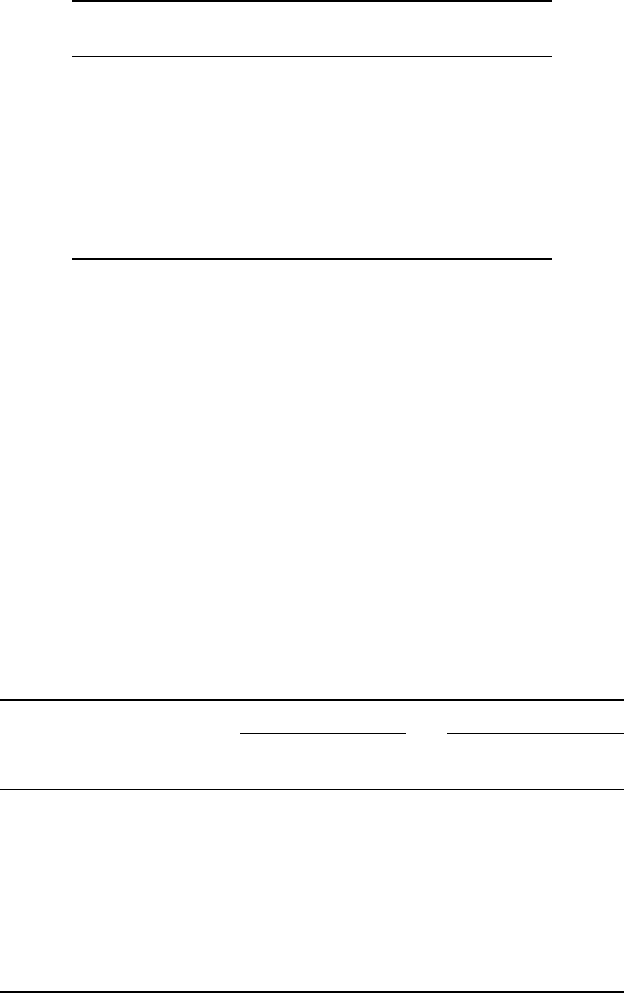
Expense Scientists Profit
Project ($000) required ($000)
160736
2 110 9 82
353829
447416
592756
685661
773848
865541
(a) What is the maximum profit, and which projects should be selected?
(b) Suppose that management determines that projects 2 and 5 are mutually exclusive.
What is the revised project portfolio and the revised maximum profit?
(c) Suppose that management also decides to undertake at least two of the projects invol-
ving consumer products. (These happen to be projects 5– 8.) What is the revised pro-
ject portfolio and the revised maximum profit?
7.3. Vendor Allocation with Price Breaks Universal Technologies, Inc. has identified two
qualified vendors with the capability to supply some of its electronic components. For the
coming year, Universal has estimated its volume requirements for these components and
obtained price-break schedules from each vendor. (These are summarized as “all-units”
price discounts in the table below.) Universal’s engineers have also estimated each ven-
dor’s maximum capacity for producing these components, based on available information
about equipment in use and labor policies in effect. Finally, because of its limited history
with Vendor A, Universal has adopted a policy that permits no more than 60% of its total
unit purchases on these components to come from Vendor A.
Vendor A Vendor B
Unit Volume Unit Volume
Product Requirement price required price required
1 500 $225 0–250 $224 0– 300
$220 250–500 $214 300– 500
2 1000 $124 0–600 $120 0–1000
$115 600–1000 (no discount)
3 2500 $60 0 –1000 $54 0–1500
$56
∗
1000– 2000 $52 1500 –2500
$51 2000 –2500
Total capacity (units) 2500 2000
∗
For example, if 1400 units are purchased from Vendor A, they cost $56 each, for a total of $78,400.
What is the minimum-cost purchase plan for Universal?
284 Chapter 7 Integer Programming: Logical Constraints
7.4. Incremental Quantity Discount In the previous exercise, suppose that Vendor A
provides a new price-discount schedule for component 3. This one is an “incremental”
discount, as opposed to an “all-units” discount, as follows.
Unit price ¼ $60 on all units up to 1000
Unit price ¼ $56 on the next 1000 units
Unit price ¼ $51 on the next 500 units
With the change in pricing at Vendor A, what is the minimum purchasing cost for
Universal, and what is the impact on the optimal purchase plan (compared to the one
in the previous exercise)?
7.5. Plant Location The Spencer Shoe Company manufactures a line of inexpensive shoes
in one plant in Pontiac and distributes to five main distribution centers (Milwaukee,
Dayton, Cincinnati, Buffalo, and Atlanta) from which the shoes are shipped to retail
shoe stores. Distribution costs include freight, handling, and warehousing costs. To
meet increased demand, the company has decided to build at least one new plant with
a capacity of 40,000 pairs per week. Surveys have narrowed the choice to three locations,
Cincinnati, Dayton, and Atlanta. As expected, production costs would be low in the
Atlanta plant, but distribution costs are relatively high compared to the other two
locations. Other data are as follows.
To distribution
Distribution costs per pair
from
Demand
(pairs/wk)centers Pontiac Cincinnati Dayton Atlanta
Milwaukee $0.42 $0.46 $0.44 $0.48 10,000
Dayton 0.36 0.37 0.30 0.45 15,000
Cincinnati 0.41 0.30 0.37 0.43 16,000
Buffalo 0.39 0.42 0.38 0.46 19,000
Atlanta 0.50 0.43 0.45 0.27 12,000
Capacity (pairs/wk) 32,000 40,000 40,000 40,000
Production cost/pair $2.70 $2.64 $2.69 $2.62
Fixed cost /wk $7000 $4000 $6000 $7000
(a) Assume that Spencer Shoe Company will keep operating at Pontiac and build a plant
at one of the three new alternatives. Which alternative will lead to the lowest total cost,
including production, distribution, and fixed costs, and what is the minimum weekly
cost?
(b) Assume that Spencer Shoe Company could start from scratch and operate any com-
bination of the four plants. Determine the plant locations that minimize total cost.
Compared to the result in part (a), how much weekly cost could be saved with the
optimal system design?
7.6. Landfill Location The Metropolis city council is examining four landfill sites as can-
didates for use in the city’s solid waste disposal network. The monthly costs per ton have
been estimated for operating at each site and for transportation to each site from the
Exercises
285