
Baker K.R. Optimization Modeling with Spreadsheets
Подождите немного. Документ загружается.

the 25 segments. (It’s possible, however, that no feasible combination can be found.)
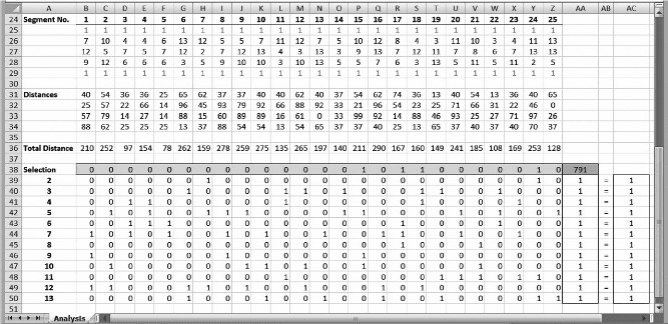
Although the initial set of decision variables shown in Figure 6.17 is infeasible, a
Solver run produces an optimal total distance of 791, as shown in Figure 6.18.
It is unlikely that the solution to the problem shown in Figure 6.18 is truly an
optimal solution to the overall problem because it is based on 25 randomly selected
segments. However, we can repeat the analysis by generating another set of ran-
domly selected segments and finding another solution. In fact, we can repeat this
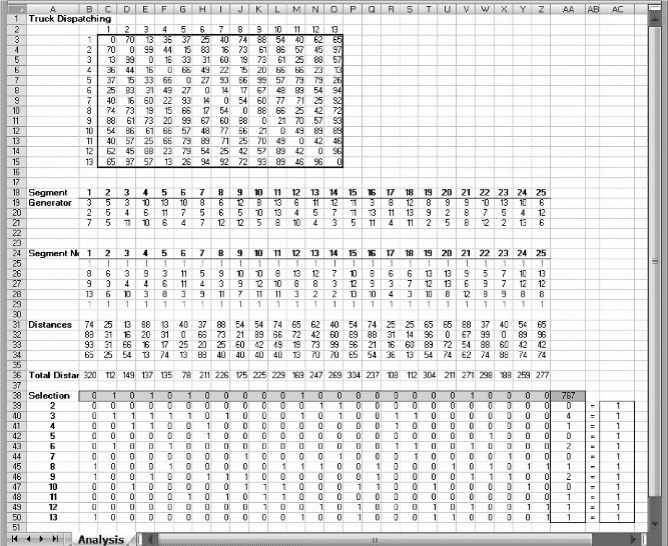
procedure several times. Figure 6.19 provides a view of the entire model, starting
with the distance array in rows 3– 15. Rows 19–21 contain a segment generator,
which consists of random locations. These selections are determined by the formula
=RANDBETWEEN (2,13). We can generate a new set of segments by pressing the
F9 key; then we can copy the data in rows 19–21 and paste the values into rows
26–28. The formulas in the spreadsheet find the individual distances between
locations by looking up values in the distance array, thus updating the objective func-
tion in cell AA38. The coefficients on the left-hand side of the constraints are binary
values corresponding to the numbers in the segments of rows 26–28. Thus, as soon as
we paste data into rows 26–28, the formulas in the spreadsheet update the set partition-
ing model. A Solver run finds a new optimal solution.
The revised model gives rise to a solution that may be better or worse than the
previous one. However, we can repeat the segment generating procedure several
times, saving the best solution encountered. In one set of trials, we repeated the
procedure a dozen times and generated a solution with a total distance of 720.
How good is the solution thus obtained? It is difficult to say for sure. However, the
repeated solut ion of a randomly generated subproblem seems to show considerable
potential for generating good solutions. In addition, we can strengthen our approach
in at least two ways. First, we can expand the model and include more segments.
Our 25-segment model gave rise to an integer programming model with 25 variables
and 12 constraints. It would not be difficult to solve problems containing 40 or 50 seg-
ments, and the sampling mechanism would likely be more effective. (An experiment
using 40 segments with about a dozen trials generated a solution with a value of 627.)
Figure 6.18. Optimal solution for the model.
236 Chapter 6 Integer Programming: Binary Choice Models
Second, we don’t have to limit ourselves to segments containing exactly three loca-
tions. By constructing the model with some two-location segments and some four-
location segments, we increase our chances of finding an asymmetric combination
that might work even better. (Another experiment along these lines generated a sol-
ution value of 625.)
In this example, it is important to recognize that a direct attempt to find an optimal
solution is likely to be impractical. If we tried to build a set-partitioning model contain-
ing all the possible segments, we would be facing the construction of a binary-choice
model with hundreds of millions of variables—well beyond the capabilities of Solver.
Perhaps we could imagine building a specialized algorithm tailored to the specific
problem we want to solve, but that approach has drawbacks, too. We would need
specialized code, and there would still be no guarantee that our algorithm would
converge in a reasonable amount of time. Relying on randomly-generated segments
may well be our best approach to finding at least a good solution.
6.8. THE ALGORITHM FOR SOLVING INTEGER
PROGRAMS
We can give a rough outline of the procedure that Solver uses to find solutions to
integer programming models, drawing on an example. For this purpose, we revisit
Figure 6.19. Improved solution for Example 6.7.
6.8. The Algorithm for Solving Integer Programs 237
Example 2.1 (Brown Furniture Company), in which the problem is to determine the
best allocation of resources to the production of chairs, desks, and tables. Suppose
the problem has changed slightly so that there are 1900 available hours of fabrication
capacity, 1850 of machining, and 1450 of assembly, along with 9600 square feet of
wood. The linear programming problem is as follows.
Maximize z = 16C +20D +14T
subject to
4C +6D +2T ≤ 1900
3C +8D +6T ≤ 1850
9C +6D +4T ≤ 1450
30C +40D +25T ≤ 9600
Now we require all variables in the solution to be integers—that is, we want the
number of chairs, desks, and tables to all be integers so that we can interpret the sol-
ution literally, as a viable schedule for the month.
When Solver tackles an integer programming problem, its first step is simply to
ignore the integer restrictions and treat the problem as a normal linear program.
This is called the relaxed problem, in the sense that the integer constraints are relaxed.
We refer to this linear program as problem P. If we are fortunate, the optimal solution
to this problem will contain integer decision variables and we will have solved the inte-
ger program. In this example, unfortunately, the optimal solution does not consist of
integers, and we obtain
Solution to P
C = 9.26, D = 227.8, T = 0
z
∗
= 4703.7
The value of the objective function is at least an upper bound on the best value we
could attain with integer values. No integer-valued solution could improve on the
solution to the relaxed problem, in which the integer constraints do not apply.
Solver recognizes that this solution is infeasible for the integer program and
creates two new linear programming problems to solve. The first, which we refer
to as P
1
, corresponds to the original problem, with the additional constraint D ≤
227. The second, referred to as P
2
, corresponds to the original problem, with the
requirement D ≥ 228. In other words, we select a noninteger variable in the optimal
solution and append one of two constraints: we force this variable to be either
no larger than the next lower integer, or no smaller than the next higher integer.
We could use an arbitrary rule to select which variable to constrain or a rule with
a little more intelligence. Here, we choose the variable that is closest to an
integer value.
The better of the solutions to the integer versions of P
1
and P
2
must be the optimal
solution to the original problem. The reason is that together the two problems
correspond to all feasible choices of integer decision variables, because they
exclude only the cases associated with D-values strictly between 227 and 228, none
238
Chapter 6 Integer Programming: Binary Choice Models
of which is an integer. The implication is that we can forget the original problem for
now and concentrate just on the two modified problems that replaced it, P
1
and P
2
.If
we can solve both of those as integer programs, we will have the solution we seek.
Next, Solver tackles P
1
. Intuitively, we might expect the optimal solution to con-
tain D at a value of 227 because it “wants” to be 227.8, but the additional constraint
prevents it from being that large. Indeed, that is the case, and we obtain the following
result.
Solution to P
1
C = 9.33, D = 227, T = 1
z
∗
= 4703.3
As we might expect, the additional constraint leads to a drop in the optimal objective
function. More importantly, we still weren’t lucky enough to produce an integer sol-
ution because C remains noninteger.
When Solver tackles P
2
(where D ≥ 228), the optimal solution is as follows
Solution to P
2
C = 8.67, D = 228, T = 0
z
∗
= 4698.7
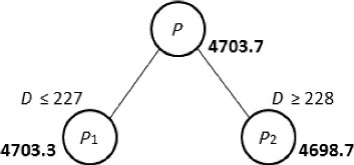
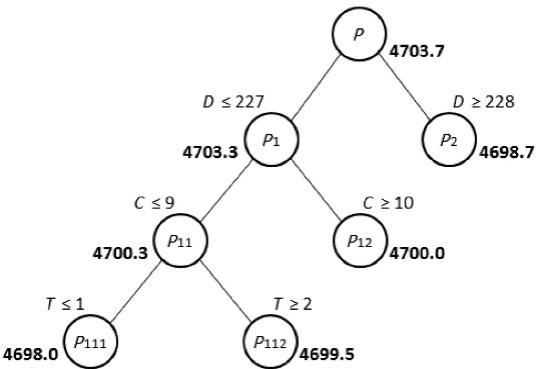
Having replaced the original problem with two modified problems, the status of
our search is shown in Figure 6.20. Here, each (linear programming) problem is rep-
resented by a node in the tree diagram. We say that we branch from the original pro-
blem P to the modified problems P
1
and P
2
. This means that we need only examine the
two replacement problems and not the original. In a sense, the search has been effec-
tive so far because we started with a model that generated two noninteger decision
variables, but now we are dealing with models that generate only one noninteger
decision variable.
Next, we select P
1
for branching. We recognize that the optimal solution is infeas-
ible for the integer version of P
1
because the value of C is noninteger. Hence, we create
two modified versions to solve, one in which we add the constraint C ≤ 9; the other in
which we add the constraint C ≥ 10. These bounds use the integers on either side of
the value of C in the optimal solution to P
1
. We refer to these problems as P
11
(with
Figure 6.20. First level of branching.
6.8. The Algorithm for Solving Integer Programs 239
C ≤ 9) and P
12
(with C ≥ 10). Now we can forget P
1
. The best among the solutions of
P
11
, P
12
, and P
2
will be the solution we seek.
When we solve P
11
we obtain the following result.
Solution to P
11
C = 9, D = 227, T = 1.17
z
∗
= 4700.3
The optimal solution is still noninteger, and the objective function has dropped
slightly from the value in P
1
. When we solve P
12
we obtain the following result
Solution to P
12
C = 10, D = 220, T = 10
z
∗
= 4700
Here, we have been fortunate, and the solution to the linear program contains
three integer-valued decision variables. It was not merely good fortune, of course:
The systematic choice of additional constraints helped lead us to an integer solution.
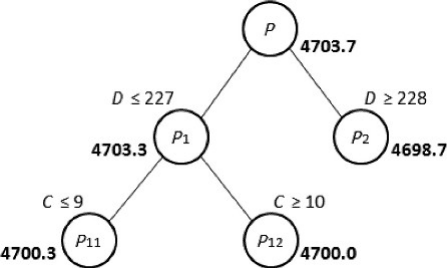
This solution is a feasible integer solution to the original problem. Now, the status
of our search is shown in Figure 6.21. In principle, we could pursue the search
from P
11
or P
2
.
Consider the linear program in P
2
and its objective function, which Solver has
optimized at 4698.7. The solution of P
2
is still not feasible for the integer program,
and the only way we can produce an integer-feasible solution is to impose additional
constraints. Thus, the value 4698.7 represents an upper bound on the best solution we
could find in this part of the search tree. When we add constraints to P
2
, its objective
function cannot get better, so it can be no larger than 4698.7. Since we have already
found an integer-feasible solution with an objective function value of 4700, there is no
reason to look for a feasible solution to P
2
because its objective function value could
not be as good as the 4700 we have already found. We say that we have fathomed the
Figure 6.21. Second level of branching.
240 Chapter 6 Integer Programming: Binary Choice Models
search tree below P
2
, in the sense that we have implicitly evaluated all the branches that
might emanate from P
2
and determined from the bound that none of the branches
could be as good as the feasible solution we have already encountered.
We turn next to P
11
. Its bound is 4700.3. Because this value is larger than that of
the best integer solution we have found, it is still possible that we could find a better
solution by branching from P
11
. Because the only noninteger decision variable in
P
11
is T ¼ 1.17, we branch to P
111
(adding the constraint T ≤ 1) and P
112
(adding the
constraint T ≥ 2), and we obtain the following results.
Solution to P
111
C = 9, D = 227, T = 1
z
∗
= 4698
Solution to P
112
C = 9, D = 226.4, T = 2
z
∗
= 4699.5
We now have enough information to identify the optimal solution to the original
problem. The sol ution to P
111
contains integer decision variables, but its objective
function is not as large as the integer-feasible solution to P
12
. In addition, we can
fathom P
112
because its upper bound is 4699.5, also not as large as the integer-feasible
solution to P
12
. The final status of our search is shown in Figure 6.22, where we can see
that the solution to P
12
turns out to be optimal.
For any integer programming problem, Solver begins with the relaxed (linear)
problem and finds the optimal solution to the corresponding linear program. If
Figure 6.22. Final status of tree search.
6.8. The Algorithm for Solving Integer Programs 241
all of the variables are integer, the solution to the integer program has been found. If
not, x
1
will turn out to be either an integer or a fraction. If it is a fraction, Solver replaces
the original problem with two derived problems (P
1
and P
2
), each with an additional
constraint that forces the solution away from the fractional value in the original. On
the other hand, if x
1
is an integer, Solver then examines x
2
. Two alternatives may
arise, depending on whether x
2
is an integer or a fraction. If it is a fraction, Solver
creates two derived problems containing additional constraints that force the solution
away from the fractional value of x
2
. Otherwise, Solver proceeds to examine x
3
, and
so on.
At each stage in this procedure, Solver maintains a list of unsolved problems.
This list is structured so that the best integer-feasible solution to the problems on
the list will be the optimal solution for the original model. One at a time, problems
are removed from the list and addressed by solving them as linear programs. Either
the solution will be integer-feasible, or the problem will be replaced by two other
problems, each containing an additional constraint. This procedure requires the
solution of a series of linear programs. The list might get quite long, but the proce-
dure ultimately produces an optimal solution with integer-valued decision variables.
The replacement of a problem on the list by two others is called branching. This
name comes from a tree-like diagram that traces the different problems (as in
Figure 6.22).
As we saw, it is possible to curtail the list of problems that have to be solved. Any
time we encounter an integer-feasible solution, the branching in that portion of the tree
is finished. Elsewhere, branching may lead to an infeasible linear program, which also
terminates branching. Otherwise, we can try to use the bounds to fathom certain
problems and also terminate the branching. Suppose that, at some stage of solving a
maximization problem, the list contains a problem with a value (upper bound) that
is worse than the value of the objective function in an integer-feasible solution already
encountered. Whenever the bound on a derived problem is worse than the value of a
known integer solution, then the derived problem may be removed from the list
because its solution could never be optimal. (The mirror image of this statement
holds when we are minimizing: in that case, whenever the bound on a derived problem
is higher than the value of a known integer solution, then we can remove the derived
problem from the list.)
The generic name for the overall procedure Solver uses is branch and bound,
reflecting the two mechanisms that guide the search. Branching replaces a problem
on the list with two problems that are, in some sense, closer to being solved as integer
programs. Bounding explores whether a particular problem could just be deleted from
the list because it offers no hope of finding an optimum. Nevertheless, the essence of
the procedure is to solve a number of linear programs, to replace one problem with two
whenever an integer constraint is violated, and to use bounds to remove problems from
the list in order to reduce the workload. Because this procedure relies on the solution of
many linear programs, it is as reliable a procedure as the linear solver on which it
depends. That is, the branch and bound procedure is guaranteed to produce a global
optimum.
242
Chapter 6 Integer Programming: Binary Choice Models
SUMMARY
The ability to treat variables as integer valued, and in particular, the ability to designate variables
as binary, opens up a wide variety of optimization models that can be addressed with Solver.
This chapter introduced two broad classes of models that can be handled effectively with
Solver. The first type of model is one that resembles a linear program but with the requirement
that certain variables must be integer valued. For the purposes of using Solver, this requirement
is added to the linear programming model as an additional constraint. The second type of model
is one in which certain decisions exhibit an all-or-nothing structure, representing actions that are
indivisible. Such decisions are modeled by binary variables, which are simply integer-valued
variables no less than zero and no greater than one. Binary variables allow us to model the occur-
rence of yes/no choices and to exploit Solver, provided that the structure of the model is linear in
all other respects.
In this second category, we explored three closely related model structures: set covering, set
packing, and set partitioning. In the basic form of these models, the objective function coeffi-
cients and the right-hand side constants are 1s, but generalizations are also possible, as illustrated
in some of the exercises at the end of this chapter.
In the next chapter, we examine a broader set of integer programming models, based on the
ability to represent logical constraints using binary variables. In those models, the logical con-
ditions do not seem linear, but they can be expressed in linear forms with the help of binary
variables.
EXERCISES
6.1. Callum Communications (Revisited) Revisit Example 6.1. Suppose that the objective
at Callum Communications is to minimize the number of employees, rather than to mini-
mize the total cost.
(a) What is the minimum number of employees needed at the call center?
(b) Does the solution in (a) achieve the minimum salary cost?
6.2. Make or Buy A sudden increase in the demand for smoke detectors has left Acme
Alarms with insufficient capacity to meet demand. The company has seen monthly
demand from its retailers for its electronic and battery-operated detectors rise to 20,000
and 10,000, respectively, and Acme wishes to continue meeting demand. Acme’s
production process involves three departments: Fabrication, Assembly, and Shipping.
The relevant quantitative data on production and prices are summarized below.
Monthly hours Hours/unit Hours/unit
Department available (electronic) (battery)
Fabrication 2000 0.15 0.10
Assembly 4200 0.20 0.20
Shipping 2500 0.10 0.15
Variable cost/unit $18.80 $16.00
Retail price $29.50 $28.00
Exercises
243
The company also has the option to obtain additional units from a subcontractor,
who has offered to supply up to 20,000 units per month in any combination of electronic
and battery-operated models, at a charge of $21.50 per unit. For this price, the subcontrac-
tor will test and ship its models directly to the retailers without using Acme’s production
process.
(a) Acme wants an implementable schedule, so all quantities must be integers. What are
the maximum profit and the corresponding make/buy levels?
(b) Compare the maximum profit in (a) to the maximum profit achievable without integer
constraints. Does the integer solution correspond to the rounded-off values of the
noninteger solution? By how much (in percentage terms) do the integer restrictions
alter the value of the optimal objective function?
6.3. Selecting an Investment Portfolio An investment manager wants to determine an opti-
mal portfolio for a wealthy client. The fund has $2.5 million to invest, and its objective is
to maximize total dollar return from both growth and dividends over the course of the
coming year. The client has researched eight high-tech companies and wants the portfolio
to consist of shares in these firms only. Three of the firms (S1 –S3) are primarily software
companies, three (H1 –H3) are primarily hardware companies, and two (C1 –C2) are
internet consulting companies. The client has stipulated that no more than 40 percent
of the investment be allocated to any one of these three sectors. To assure diversification,
at least $100,000 must be invested in each of the eight stocks. Moreover, the number of
shares invested in any stock must be a multiple of 1000.
The table below gives estimates from the investment company’s database relating to
these stocks. These estimates include the price per share, the projected annual growth rate
in the share price, and the anticipated annual dividend payment per share.
Stock
S1 S2 S3 H1 H2 H3 C1 C2
Price per share $40 $50 $80 $60 $45 $60 $30 $25
Growth rate 0.05 0.10 0.03 0.04 0.07 0.15 0.22 0.25
Dividend $2.00 $1.50 $3.50 $3.00 $2.00 $1.00 $1.80 $0.00
(a) Determine the maximum return on the portfolio. What is the optimal number of
shares to buy for each of the stocks? What is the corresponding dollar amount
invested in each stock?
(b) Compare the solution in which there is no integer restriction on the number of shares
invested. By how much (in percentage terms) do the integer restrictions alter the
value of the optimal objective function? By how much (in percentage terms) do
they alter the optimal investment quantities?
6.4. Production Planning for Components Rummel Electronics produces two PC cards, a
modem and a network adapter. Demand for these two products exceeds the amount that
the firm can make, but there are no plans to increase production capacity in the short run.
Instead, the firm plans to use subcontracting.
The two main stages of production are fabrication and assembly, and either step can
be subcontracted for either type of card. However, the company policy is not to subcon-
tract both steps for either product. (That is, if modem cards are fabricated by a
244 Chapter 6 Integer Programming: Binary Choice Models
subcontractor, then they must be assembled in-house.) Components made by subcontrac-
tors must pass through the shipping and receiving departments, just like components
made internally. At present, the firm has 5200 hours available in fabrication, 3600 in
assembly and 3200 in shipping/inspection. The production requirements, in hours per
unit, are given in the following table.
Product/mode Fab. Ass. Ship.
Modem, made entirely in-house 0.35 0.16 0.08
Network, made entirely in-house 0.47 0.15 0.12
Modem, fabricated by subcontractor – 0.18 0.10
Network, fabricated by subcontractor – 0.16 0.15
Modem, assembled by subcontractor 0.35 – 0.09
Network, assembled by subcontractor 0.47 – 0.14
The direct material costs for the modem cards are $3.25 for manufacturing and $0.50
for assembly; for network cards, the costs are $6.10 and $0.50. Subcontracting the man-
ufacturing operation costs $5.35 for modem cards and $8.50 for network cards.
Subcontracting the assembly operation costs $1.50 for either product. Modem cards
sell for $20, and network cards sell for $28. The firm’s policy, for each product, is that
at most 40 percent of the units produced can have subcontracted fabrication, and at
most 70 percent of the units can have subcontracted assembly.
(a) Determine the production and subcontracting schedule that will maximize profits,
given that Rummel Electronics wishes its schedule to contain an integer number of
units produced and subcontracted.
(b) Solve the problem without the integer restrictions. What is the solution? By how
much (in percentage terms) do the restrictions alter the value of the optimal objective
function?
6.5. Catering Logistics Jessica’s Catering Service bakes and delivers lasagnas to parties
and group meetings. In a typical week, Jessica has around 40 orders. Each order involves
a specific amount of the required lasagna in pounds. A small group would need about
20 lb, whereas a large group would need almost triple that amount. The following
table shows the different customer orders that have come in this week, grouped into
eight categories by weight.
Job type 12345678
Weight (lbs) 20 25 30 35 40 45 50 55
Number 10 5473921
Jessica has an inventory of 25 six-lb trays and 18 ten-lb trays. Although she appears to
have enough capacity in her trays, she would like to plan her orders so that the amount
of excess lasagna is kept to a minimum.
How many six-lb trays and ten-lb trays should Jessica use for each of the orders?
6.6. Location of Services The Division of Motor Wyoming (DMV) in Wyoming operates
several offices around the state. Citizens must travel to one of these offices to register a car,
Exercises
245