
Battarbee R.W., Binney H.A. (Eds.) Natural Climate Variability and Global Warming: A Holocene Perspective
Подождите немного. Документ загружается.

..
140
|
Jürg Beer and Bas van Geel
..
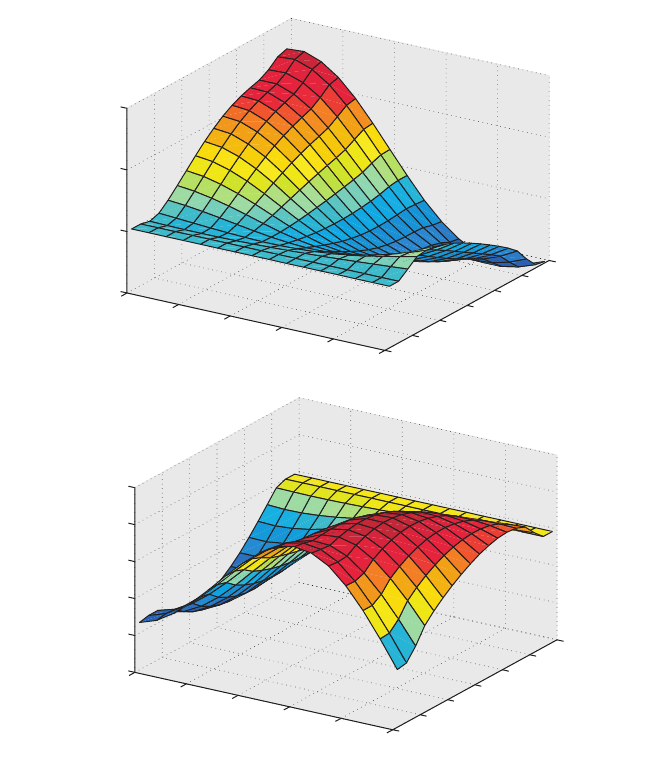
orbital forcing is slow. Nevertheless, the change in insolation over the past 12 000 years
is considerable and cannot be neglected (cf. Jansen et al., this volume). Figure 6.1a
shows the change in insolation in June for the Holocene period as a function of lat-
itude. At high latitude the change in insolation amounts to 54 W m
−2
. In Figure
6.1b the change in insolation is shown for December. In this case, the insolation
increases from the beginning of the Holocene and reaches a maximum between
4000 and 2000 years BP. The maximum change amounts to 37 W m
−2
. Orbital
forcing is the only forcing that is fully understood, and can be calculated not only
for the past but also for the future several million years (Berger and Loutre 2004).
Solar activity and solar forcing
Since the Sun drives the climate system, solar variability is obviously a serious
candidate for forcing climate change. This is especially so in view of the fact that the
–90
–60
–30
0
30
60
90
–3
–90
–60
–30
0
30
60
90
–3
0
3
6
9
12
–30
–20
–10
0
10
20
Age [kyr BP]
Latitude
Change in December insolation
0
3
6
9
12
–20
0
20
40
Latitude
Change in June insolation
Age [kyr BP]
Insolation (W m
–2
)
Insolation (W m
–2
)
(a)
(b)
Figure 6.1 Changes in
orbital forcing during the
Holocene (12 000 years BP to
3000 years in the future) for
the months June (a) and
December (b). The figures
show clear trends depending
on latitude. In June there is a
strong decreasing trend in the
north (a). In December, the
insolation on the Southern
Hemisphere first increases
and then reaches its
maximum between 2000 and
4000 cal. years BP before
decreasing again (b).
9781405159050_4_006.qxd 6/3/08 5:08 PM Page 140
Holocene climate change and solar and other forcings
|
141
..
Sun is a variable star showing considerable cyclic changes in its magnetic activity,
as expressed, for example, in the sunspot number.
In the past, many attempts have been made to ascertain whether the solar radi-
ation arriving at the top of the atmosphere at a distance of 1 astronomical unit
from the Sun is constant (denoted by the solar constant or total solar irradiance,
TSI). All the early attempts, however, failed due to the above-mentioned radiative
atmospheric processes. Only after it became possible to mount radiometers on
satellites outside the atmosphere was it discovered that the solar constant fluctuates
in phase with the magnetic activity of the Sun. It is possible to divide the measured
total solar irradiance (TSI) into three components: a background component, a
darkening component controlled by the sunspots, and a brightening component
related to the faculae, which overcompensate the negative effect of the sunspots
and lead to a positive correlation between TSI and solar activity (Fröhlich and
Lean 2004).
The instrumental data from almost the past three decades show that the change
of the TSI over an 11-year Schwabe cycle is about 0.1 percent, corresponding to
0.25 W m
−2
(the global mean value at the Earth’s surface), an estimate that is quite
small compared with the 3.7 W m
−2
estimated for a doubling of CO
2
. The variabil-
ity of the solar radiation, however, is strongly wavelength dependent and reaches
values of more than 100 percent in the UV part of the spectrum. Such large changes
in the spectral solar irradiance (SSI) strongly influence the photochemistry in the
upper atmosphere, and in particular the ozone concentration. Model calcula-
tions show that through dynamical coupling SSI changes can cause shifts in the
tropospheric circulation systems and therefore change the climate (Haigh and
Blackburn 2006).
From a climate perspective, changes in forcings on decadal and shorter time-
scales are less important, because many processes within the climate system
occur on much longer time-scales (e.g. the thermohaline circulation, build up of
ice-sheets). Therefore, the crucial questions are whether changes of TSI and SSI
occur on centennial and millennial time-scales, and how large these changes are.
These questions are still being debated. They can be answered in two steps: (i) how
variable is the Sun’s magnetic activity? (ii) how is this magnetic activity related to
TSI and SSI? As we will show, the magnetic variability is indeed larger on longer
time-scales. From the solar physics perspective, however, it is not yet clear if this is
also the case for the TSI and the SSI. On the other hand, paleoclimate reconstruc-
tions provide growing evidence for larger changes in solar forcing than has been
experienced during the past 30 years (Bond et al. 2001; Neff et al. 2001; Wang et al.
2005; Haltia-Hovi et al. 2007).
The longest historical record of solar activity is the sunspot record, which goes
back to 1610 when the telescope was invented. It shows the well-known 11-year
Schwabe cycle superimposed on a generally increasing trend from 1610 to the
present, which is interrupted by distinct periods of low solar activity (the Maunder
minimum of 1645–1715, and the Dalton minimum of 1795–1820).
To extend this record of solar activity beyond the era of direct observations we
have to rely on indirect proxy data. Such data can be derived from measurements
of the cosmogenic radionuclides
10
Be and
14
C in natural archives such as ice cores
..
9781405159050_4_006.qxd 6/3/08 5:08 PM Page 141
..
142
|
Jürg Beer and Bas van Geel
..
and tree rings (Beer et al. 1990; Stuiver et al. 1991; Muscheler et al. 2004).
Cosmogenic radionuclides are produced continuously in the atmosphere as a
result of the interaction of galactic cosmic rays with nitrogen and oxygen (Masarik
and Beer 1999). The higher the cosmic ray intensity, the larger the production rate,
and vice versa. The cosmic ray intensity is modulated by two magnetic effects: the
solar activity and the geomagnetic field. Depending on the magnetic activity, the
Sun emits plasma (solar wind) carrying magnetic fields into the heliosphere, which
acts as a shield and reduces the cosmic ray intensity. The second shielding effect is
due to the geomagnetic field, which prevents cosmic rays with too low an energy
from penetrating the atmosphere and producing cosmogenic radionuclides. After
production, the fate of the cosmogenic radionuclides depends on their geochem-
ical properties.
10
Be becomes attached to aerosols and is removed from the atmo-
sphere mainly by wet deposition within 1–2 years. Ice cores are excellent archives
to measure
10
Be and to reconstruct its production rate in the past. On the other
hand,
14
C forms
14
CO
2
and exchanges between atmosphere, biosphere, and ocean.
As a consequence of the large size of these reservoirs and the long residence times
(ocean: 1–2 kyr), the amplitude of an observed
14
C change in the atmosphere is
considerably smaller than the corresponding change in the production rate and the
14
C change is delayed. The ideal archive for the reconstruction of past
14
C changes
are tree rings.
Although the physics of the production processes in the atmosphere are well
understood, the transport from the atmosphere into the archives is rather complex
and has not yet been fully elucidated (Beer et al. 2002). Comparisons between
10
Be
and
14
C records show that during the Holocene the production signal was domin-
ant and system effects generally can be neglected in a first-order approach. This
means that both
10
Be and
14
C provide an independent record of the cosmic ray
intensity of the past. To extract the solar component from this signal the geo-
magnetic effect has to be removed. This can be achieved by taking into account
the changes in the geomagnetic field intensity derived from archeomagnetic and
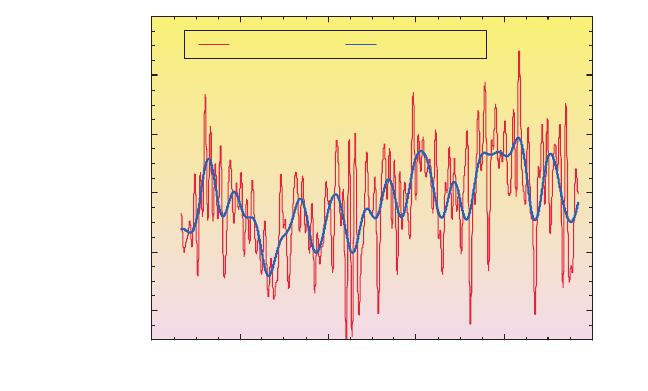
paleomagnetic measurements. The result is a record of the solar modulation func-
tion Φ (Figure 6.2) (Vonmoos et al. 2006). Φ=0 means a completely quiet Sun, a
condition that has probably never occurred. Φ=1000 MeV corresponds to an
active Sun as typical for a solar cycle maximum during recent times. The Φ-record
is characterized by a long-term trend superimposed on which are short-term
fluctuations. These short-term fluctuations can be divided into cyclic and episodic
features. The cyclic features show periodicities around 11 years (Schwabe cycle),
80 years (Gleissberg cycle), 205 years (DeVries or Suess cycle), and 2200 years
(Halstatt cycle) (Stuiver and Braziunas 1993).
Most episodic features are strong negative spikes corresponding to so-called
grand solar minima, periods when the Sun was very quiet as during the Maunder
minimum. It should be noted that the record does not cover the past 300 years BP.
The mean Φ value of the past five decades is about 700 MeV. This means that
we are presently in a period of high solar activity, and that in the past there were
periods with considerably lower solar activity. Similar conclusions were obtained
by Solanki et al. (2004). Whether these large changes of activity are also reflected in
9781405159050_4_006.qxd 6/3/08 5:08 PM Page 142
Holocene climate change and solar and other forcings
|
143
..
the TSI and SSI is not known. Therefore we prefer not to speculate about the cor-
responding forcing in W m
−2
. There is clear evidence for larger changes from
paleoclimatic records, as we will show below. Most authors have used the Δ
14
C
record as an indicator of past solar activity. However, Δ
14
C reflects the deviation of
the atmospheric
14
C content relative to a standard value, so it also contains a long-
term geomagnetic and a system component which perturbs the solar signal to
some extent. Consequently, the
10
Be flux and the
14
C production rate are better
proxies, although they still contain a geomagnetic component.
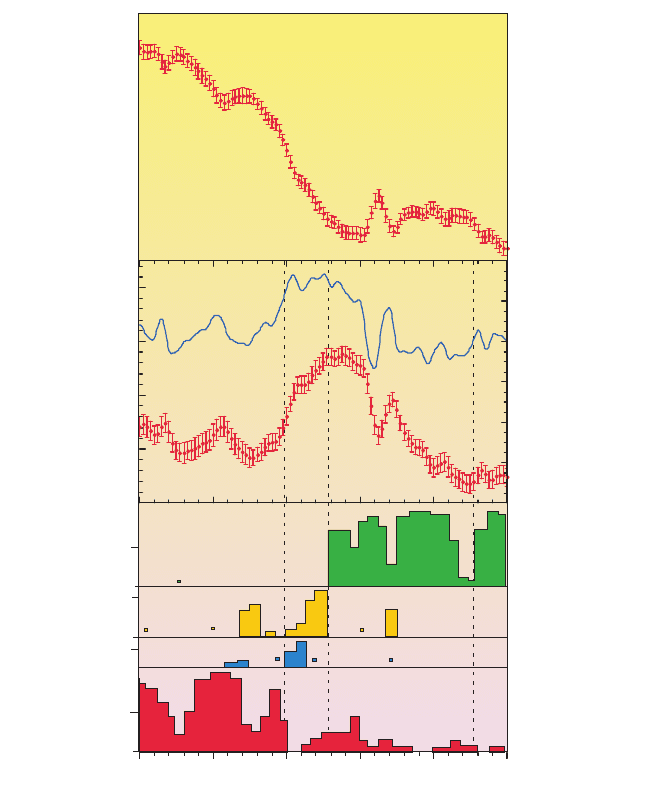
In Figure 6.3, the x-axis is based on tree ring counting. At 850 bc in Figure 6.3a, a
rapid decrease of the radiocarbon age occurs followed by a plateau. The decrease
corresponds to the Δ
14
C rise in Figure 6.3b (red data points). The blue curve in
Figure 6.3b depicts the changes in the radiocarbon production that are needed
to cause the observed Δ
14
C fluctuations. Note the difference in the amplitudes
(ca. 40 percent in production, ca. 2 percent in Δ
14
C) and the lag of the Δ
14
C peak by
about 20 years relative to the production. These system effects are caused by the large
14
C reservoirs (ocean, atmosphere, biosphere) and the exchange between them.
Volcanic forcing and ice cores
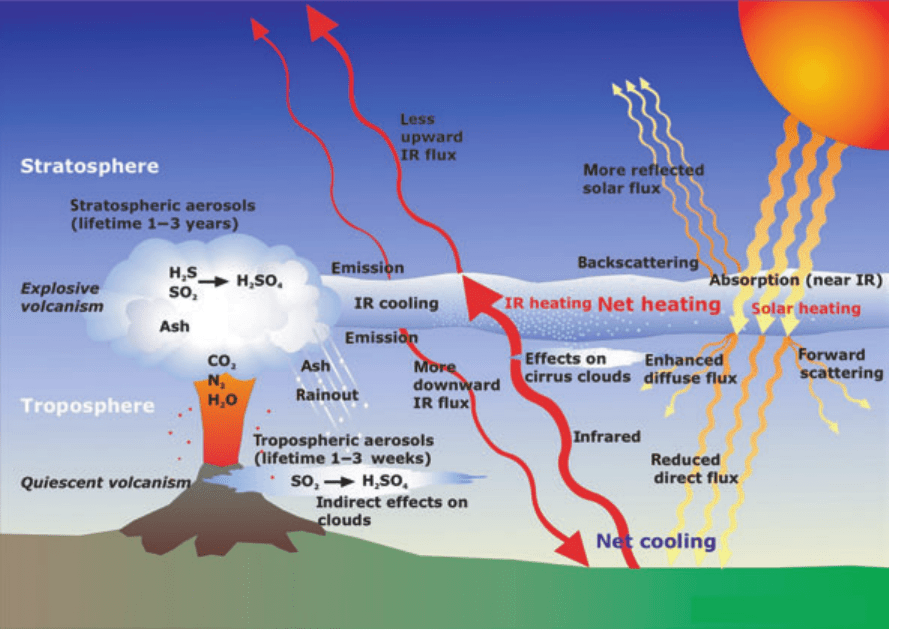
Volcanic eruptions are the main cause of strong short-term (annual) climate forc-
ing. The injection of large amounts of gases (SO
2
, CO
2
, H
2
O, N
2
) and dust into the
atmosphere perturbs the radiative balance via enhanced absorption and scattering
of solar radiation leading to a warming in the upper atmosphere and a cooling in
the lower atmosphere (Figure 6.4). Due to the short tropospheric lifetime (1–3
weeks) the injection of gases must reach the stratosphere (lifetime: 1–3 years) to
become globally active. The most important substance is SO
2
, which oxidizes
quickly to H
2
SO
4
. Beside volcanic eruptions, there are other comparatively stable
..
0
200
400
600
800
1000
02000400060008000
10 000
low-pass 100 low-pass 500
Φ
[MeV]
A
g
e (cal yr BP)
Figure 6.2 Reconstruction of
the solar modulation function
Φ covering the period
9300–340 cal. years BP.
Φ
depends on the intensity of
the solar open magnetic field,
which reduces the cosmic ray
flux and therefore the
production rate of
cosmogenic radionuclides.
This record is based on
10
Be
data from the GRIP ice core
and shows short-term as well
as long-term fluctuations. The
average solar activity of the
past few decades corresponds
to a value of 700 MeV. The
data have been low-pass
filtered with cut-off
frequencies of 1/(100 years)
and 1/(500 years).
9781405159050_4_006.qxd 6/3/08 5:08 PM Page 143
..
144
|
Jürg Beer and Bas van Geel
..
–10
0
10
20
0.6
0.8
1
1.2
1000 900 800 700 600 500
2400
2500
2600
2700
2800
2900
0
0
0
20
50
50
0
50
Dendro a
g
e (BC)
Volume percentage
Δ
14
C (per mil)
Radiocarbon age (BP)
14
C production (rel. units)
Sphagnum
imbricatum
Sphagnum
papillosum
Sphagnum
cuspidatum
Sphagnum
sect. acutifoli
a
(a)
(b)
(c)
Figure 6.3 (a) The
14
C calibration curve for the period
1000–500 bc. The horizontal axis shows the calendar age.
The vertical axis shows the
14
C age in BP (BP: before 1950).
The calibration curve is based on mainly decadal
14
C
measurements of exactly dated (dendrochronology) wood.
Fluctuations of the curve are caused by changes of the
cosmic ray intensity due to fluctuations in solar activity. (b)
Δ
14
C is the deviation of the atmospheric
14
C/
12
C ratio from
a standard value in ‰ as calculated from the data of the
calibration curve. The blue curve depicts the changes in the
radiocarbon production that are needed to cause the
observed
Δ
14
C data. The Δ
14
C curve provides information
about the
14
C production rate and the carbon system in the
past. The interval ca. 850–750 bc represents the phase of
extreme climate at the start of the Sub-atlantic. The “
14
C-
clock” accelerates during that period (300
14
C “years” in
about 100 calendar years). The Δ
14
C curve shows a sharp
rise of atmospheric radiocarbon, related to a temporary
decline in solar activity. (c) Changes in species composition
of Sphagnum during the Sub-boreal–Sub-atlantic transition
in Engbertsdijksveen, a raised bog (after van Geel et al.
1996). Sphagnum species of the section acutifolia prefer
relatively dry and warm climatic conditions. Sphagnum
cuspidatum and S. papillosum prefer a relatively high water
table. Sphagnum imbricatum prefers high air humidity and
cool conditions. A major change started ca. 850 bc, when
solar activity showed a temporary decline (a fast increase of
Δ
14
C).
9781405159050_4_006.qxd 6/3/08 5:08 PM Page 144
Holocene climate change and solar and other forcings
|
145
..
sources of SO
2
such as the marine biota producing dimethylsulfide, and nonerup-
tive volcanic emissions. Figure 6.4 is a schematic overview of the main processes
involved in volcanic forcing (Fischer 2003, 2005).
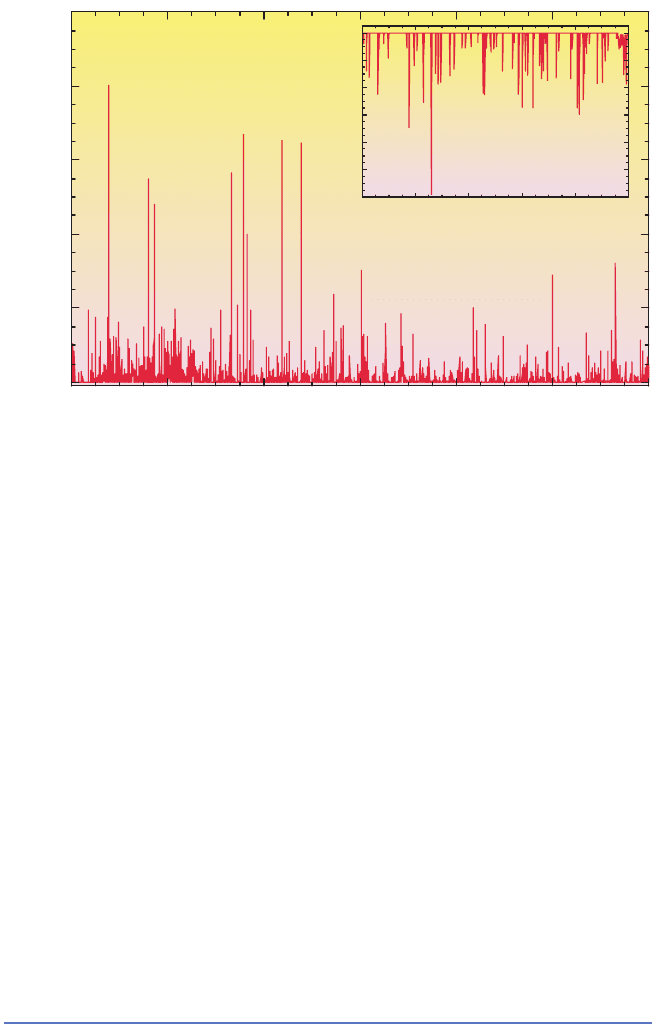
Ice cores are an important source of information on volcanic eruptions. Figure 6.5
shows a record of volcanic sulfate derived from the GISP2 ice core (Zielinski and
Mershon 1997). Using additional information about the volcanoes responsible for
the emissions, Crowley (2000a) estimated the corresponding forcing for the past
1000 years (inset in Figure 6.5). The very sharp peaks indicate that the sulfate is
rapidly removed from the atmosphere. Bay et al. (2004) linked volcanic ash layers
in Siple Dome (Antarctica) with the onset of millennium-scale cooling recorded in
a Greenland ice core and interpreted the results as evidence for a causal connection
between volcanism and millennial climate change. The high volcanic activity
during the main deglaciation of the early Holocene suggests that ice-sheet unload-
ing and/or sea-level rise was responsible for increased volcanism during that
period. One of the difficulties in quantifying the volcanic forcing is that with-
out additional information it is impossible to distinguish between regional
tropospheric and global stratospheric eruptions. Whereas one single eruption can
..
Figure 6.4 Schematic overview of the main atmospheric processes related to volcanic forcing (Fischer 2003, 2005). (From
Robock (2000), plate 1.)
9781405159050_4_006.qxd 6/3/08 5:08 PM Page 145
..
146
|
Jürg Beer and Bas van Geel
..
change weather patterns significantly over a 1–2 year period, a series of eruptions
may have a long-term climatic effect. Castellano et al. (2004) compared millennial
scale volcanic frequencies against δD in the EPICA-Dome-C ice core; they found
no clear evidence for a close relationship between climatic change and volcanism.
Oscillations in the ocean system
An abrupt cold period occurred around 8200 calendar years BP in the North
Atlantic area. It lasted for ca. 300 years and in Greenland ice-core records it is
characterized by a reduction in temperature greater than 1°C, a decrease in ice
accumulation rate, increasing wind speeds, and a drop in atmospheric methane
levels (Wiersma and Renssen 2006, and references therein). A slowing down of
the thermohaline circulation as a result of a freshwater perturbation has been
proposed as the cause of the event. The slowdown resulted in a decrease of the
northward heat transport in the North Atlantic Ocean, leading to pronounced
cooling. The proglacial Laurentide Lakes in front of the Laurentide ice sheet were
most probably the source of the freshwater pulse (Clarke et al. 2003). Model–data
comparisons by Goosse et al. (2002) and Wiersma and Renssen (2006) confirm the
catastrophic drainage of Laurentide Lakes as a forcing mechanism.
Reactions of the climate system to forcings
It is well known that the climate system shows variability on vastly different
time-scales. It is not yet clear as to what extent this variability is caused by internal
processes within the climate system, and which role the different forcing factors
play. The results of climate model experiments indicate significant internal
0
200
400
600
800
1000
0200040006000800010 00012 000
–12
–10
–8
–6
–4
–2
0
1000 1200 1400 1600 1800 2000
Forcing [W m
–2
]
Year [AD]
A
g
e [yr BP]
Volcanic sulfate [ppb]
Figure 6.5 A record of
volcanic sulfate
concentrations in ppb derived
from H
2
O
4
measurements on
the GISP2 ice core (Zielinski
and Mershon 1997) covering
the past 12 000 calendar years.
The inset shows an estimate of
the sulfate-induced forcing in
Wm
−2
by Crowley (2000a).
Note that the forcing can be
very strong, but does not last
long (1–2 years).
9781405159050_4_006.qxd 6/3/08 5:08 PM Page 146
Holocene climate change and solar and other forcings
|
147
..
variability, as well as a significant sensitivity to solar, volcanic, and greenhouse
gas forcing (see Goosse et al., this volume; Claussen, this volume). During the
Holocene, greenhouse gases did not vary greatly. Volcanic aerosols remain in the
atmosphere for only a few years. Therefore, as the focus here is on climate change
on decadal to millennial time-scales, we are principally concerned with solar
forcing, although we need to recognize that multiple volcanic eruptions can cause
climatic effects also on decadal time-scales (Crowley 2000b). There is a rapidly
growing number of examples pointing to the Sun as a major forcing factor during
the Holocene (Beer et al. 2000, 2006). Here we discuss evidence for solar-induced
climate change based on records from various natural archives.
Peat deposits and climate change
Holocene peat deposits, especially the rainwater-fed raised bogs such as those in
north-west Europe, are natural archives of climate change (cf. also Verschuren and
Charman, this volume). Climate-related changes in precipitation and temperature
are reflected in the changing species composition of the peat-forming vegetation
(Figure 6.3c). Plant remains can be identified and, by using ecological information
about peat-forming species, changes in species composition of sequences of peat
samples can be interpreted as evidence for changing local hydrologic conditions,
often linked to climate change. The degree of decomposition of the peat-forming
plants is also related to former climatic conditions (peat decomposes more under
drier conditions; wetter climatic conditions allow plant remains to be preserved
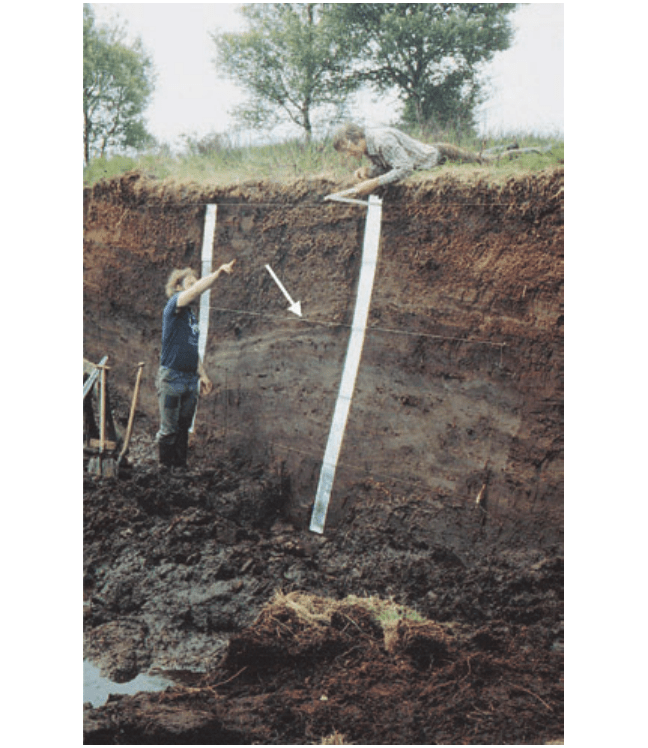
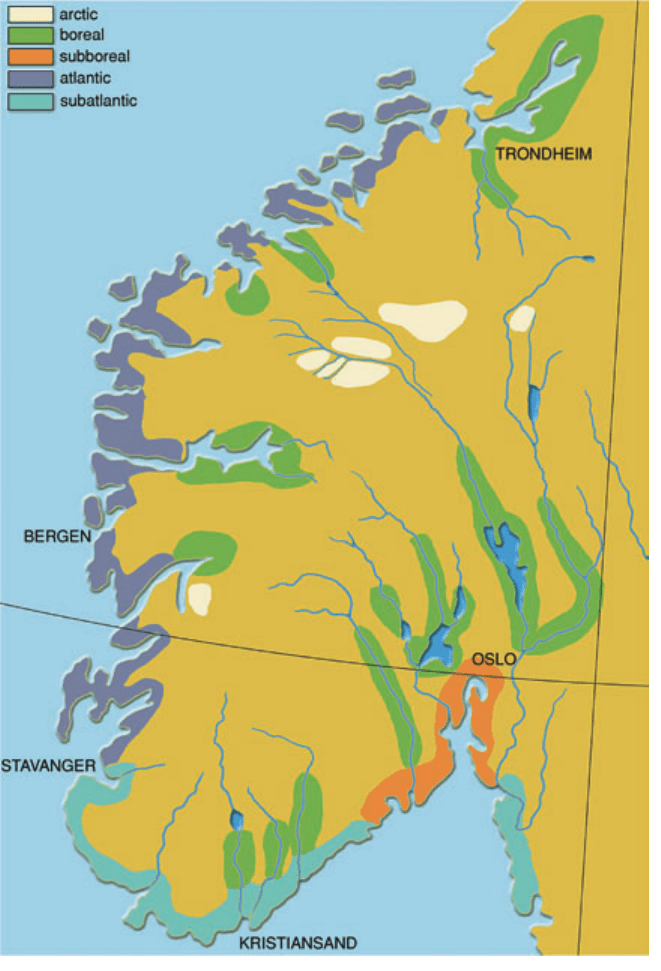
better; Figure 6.6). Blytt and Sernander sub-divided the Holocene in alternating
periods, which were supposed to represent differing climatic conditions (Blytt,
1882; Sernander 1910) (Figure 6.7; Birks, this volume). Later researchers found the
Blytt–Sernander sub-division to be too simple, but the so-called Sub-boreal–Sub-
atlantic transition of the Blytt–Sernander scheme, which occurred around 850 bc,
is a consistently observed abrupt and intense climate shift. In north-west Europe,
there is strong peat-stratigraphic and archaeological evidence that the climate
changed from relatively dry and warm to cooler, wetter conditions (Figures 6.3 and
6.6; van Geel et al. 1998). The radiocarbon method is generally used for dating of
Holocene climate-induced shifts in peat deposits. Calibration of a single radiocar-
bon date usually yields an irregular probability distribution of calendar ages, quite
often over a long time-interval. This is problematic in paleoclimatological studies,
especially when a precise temporal comparison between different climate proxies
is required. Closely spaced sequences of (uncalibrated)
14
C dates from peat
deposits, however, display wiggles that can be fitted to the wiggles in the radiocar-
bon calibration curve. The practice of dating peat samples using
14
C “wiggle-match
dating” has greatly improved the precision of radiocarbon chronologies since its
application by van Geel and Mook (1989). By wiggle-matching
14
C measurements,
high precision calendar age chronologies for peat sequences can be generated
(Blaauw et al. 2003), which show that mire surface wetness increased together with
rapid increases of atmospheric production of
14
C during the early Holocene, the
Sub-boreal–Sub-atlantic transition (Figure 6.3b: a sharp increase of
14
C production
..
9781405159050_4_006.qxd 6/3/08 5:08 PM Page 147
..
148
|
Jürg Beer and Bas van Geel
..
and evidence for wetter conditions in Figure 6.3c), and the Little Ice Age (Wolf,
Spörer, Maunder, and Dalton minima of solar activity). Peat records show that this
phenomenon occurred in The Netherlands (Kilian et al. 1995; van Geel et al. 1998;
van der Plicht et al. 2004), the Czech Republic (Speranza et al. 2003), and the UK
and Denmark (Mauquoy et al. 2002). The production of radiocarbon is regulated
by solar activity, and therefore periods of increased mire surface wetness have been
interpreted as evidence for solar forcing of climate change (the effects of sudden
declines in solar activity).
Lake sediments, glacier variations, and solar activity
Denton and Karlén (1973) linked the radiocarbon record with geologic data
such as the extension of glaciers and made important conclusions about the solar
Figure 6.6 Sampling a
profile in the former raised
bog area of Bargerveen
(Drenthe, The Netherlands).
The Sub-boreal–Sub-atlantic
transition is indicated by an
arrow. (Photograph by Bas
van Geel. Left, D.G. van
Smeerdijk; right, W.A.
Casparie.)
9781405159050_4_006.qxd 6/3/08 5:08 PM Page 148
Holocene climate change and solar and other forcings
|
149
..
forcing of climate change. Magny (2004, 2007) published a long record of Holocene
climate-related water table changes in lakes in south-eastern France and adjacent
Switzerland. The lake-level fluctuations closely correspond to the atmospheric
14
C
fluctuations and therefore also to the history of solar activity (Figure 6.8). Lake
levels were low during periods of high solar activity (low values of Δ
14
C and Φ),
whereas high lake-stands occurred when solar activity was low. Holzhauser et al.
..
Figure 6.7 Map of southern
Norway (after Blytt 1882)
showing areas characterized
by specific vegetation types
related to differences in
temperature and
precipitation. This pattern
was the modern reference for
Axel Blytt in his work sub-
dividing the Holocene.
9781405159050_4_006.qxd 6/3/08 5:08 PM Page 149