
Battarbee R.W., Binney H.A. (Eds.) Natural Climate Variability and Global Warming: A Holocene Perspective
Подождите немного. Документ загружается.

..
160
|
Jürg Beer and Bas van Geel
..
Patterson R.T., Prokoph A. & Chang A. (2004) Late Holocene sedimentary
response to solar and cosmic ray activity influenced climate variability in the NE
Pacific. Sedimentary Geology, 172(1–2), 67–84.
Pudovkin M.I. & Raspopov O.M. (1992) The mechanism of action of solar activity
on the state of the lower atmosphere and meteorological parameters (a review).
Geomagnetism and Aeronomy, 32, 593–608.
Raspopov O.M., Shumilov O.I., Kasatkina E.A., Jacoby G. & Dergachev V.A.
(1997) The Cosmic Ray Influence on Cloudy and Aerosol Layers of the Earth and
Connection of Solar Cycle Lengths to Global Surface Temperature. Preprint 1694,
Physical-Technical Institute of Russian Academy of Sciences, St.-Petersburg,
20 pp.
Renssen H., van Geel B., van der Plicht J. & Magny M. (2000) Reduced solar activ-
ity as a trigger for the start of the Younger Dryas? Quaternary International,
68–71, 373–383.
Robock A. (2000) Volcanic eruptions and climate. Reviews of Geophysics, 38(2),
191–219.
Schibler J., Jacomet S., Hüster-Plogmann H. & Brombacher C. (1997) Economic
crash in the 37th and 36th centuries cal. BC in Neolithic lake shore sites in
Switzerland. Anthropozoologica, 25/26, 553–570.
Sernander R. (1910) Die schwedischen Torfmoore als Zeugen postglazialer Klimasch-
wankungen. Die Veränderungen des Klimas seit dem Maximum der Letzten
Eiszeit, Stockholm.
Solanki S.K., Usoskin I.G., Kromer B., Schussler M. & Beer J. (2004) Unusual activ-
ity of the Sun during recent decades compared to the previous 11 000 years.
Nature, 431(7012), 1084–1087.
Speranza A., van Geel B. & van der Plicht J. (2003) Evidence for solar forcing of cli-
mate change at ca. 850 cal BC from a Czech peat sequence. Global and Planetary
Change, 35(1–2), 51–65.
Stager J.C., Ryves D., Cumming B.F., Meeker L.D. & Beer J. (2005) Solar variability
and the levels of Lake Victoria, East Africa, during the last millennium. Journal
of Paleolimnology, 33(2), 243–251.
Stuiver M. & Braziunas T.F. (1993) Sun, ocean, climate and atmospheric
14
CO
2
, an
evaluation of causal and spectral relationships. The Holocene, 3, 289–305.
Stuiver M., Braziunas T.F., Becker B. & Kromer B. (1991) Climatic, solar, oceanic
and geomagnetic influences on Late-Glacial and Holocene atmospheric
14
C/
12
C
change. Quaternary Research, 35, 1–24.
Svensmark H. & Friis-Christensen E. (1997) Variation of cosmic ray flux and
global cloud coverage – a missing link in solar-climate relationships. Journal of
Atmospheric and Terrestrial Physics, 59(11), 1225–1232.
Van der Plicht J., van Geel B., Bohncke S.J.P., et al. (2004) The Preboreal climate
reversal and a subsequent solar-forced climate shift. Journal of Quaternary
Science, 19(3), 263–269.
Van Dorland R. (Ed.) (2006) Scientific Assessment of Solar Induced Climate Change.
Netherlands Environmental Assessment Agency, Bilthoven, 154 pp.
9781405159050_4_006.qxd 6/3/08 5:08 PM Page 160
Holocene climate change and solar and other forcings
|
161
..
Van Geel B. & Berglund B.E. (2000) A causal link between a climatic deterioration
around 850 cal BC and a subsequent rise in human population density in NW-
Europe? Terra Nostra, 7, 126–130.
Van Geel B. & Mook W.G. (1989) High-resolution
14
C dating of organic deposits
using natural atmospheric 14C variaitions. Radiocarbon, 31, 151–156.
Van Geel B. & Renssen H. (1998) Abrupt climate change around 2650 BP in
North-West Europe: evidence for climatic teleconnections and a tentative
explanation. In: Water, Environment and Society in Times of Climatic Change
(Eds A.S. Issar & N. Brown), pp. 21–41. Kluwer Academic Publishers,
Dordrecht.
Van Geel B., Buurman J. & Waterbolk H.T. (1996) Archaeological and palaeo-
ecological indications of an abrupt climate change in The Netherlands, and evid-
ence for climatological teleconnections around 2650 BP. Journal of Quaternary
Science, 11(6), 451–460.
Van Geel B., van der Plicht J., Kilian M.R., et al. (1998) The sharp rise of Δ
14
C ca.
800 cal BC: possible causes, related climatic teleconnections and the impact on
human environments. Radiocarbon, 40(No. 1), 535–550.
Van Geel B., Raspopov O.M., Renssen H., van der Plicht J., Dergachev V.A. &
Meijer H.A.J. (1999) The role of solar forcing upon climate change. Quaternary
Science Reviews, 18(3), 331–338.
Van Geel B., Heusser C.J., Renssen H. & Schuurmans C.J.E. (2000) Climatic
change in Chile at around 2700 BP and global evidence for solar forcing: a
hypothesis. The Holocene, 10(5), 659–664.
Van Geel B., Renssen H. & van der Plicht J. (2001) Evidence from the past: solar
forcing of climate change by way of cosmic rays and/or by solar UV? In:
Workshop on Ion–Aerosol–Cloud Interactions (Ed. J. Kirkby), Vol. CERN 2001–
007, pp. 24–29. Conseil Européen pour la Recherche Nucléaire (European
Council for Nuclear Research), Geneva.
Van Geel B., Bokovenko N.A., Burova N.D., et al. (2004a) Climate change and the
expansion of the Scythian culture after 850 BC: a hypothesis. Journal of
Archaeological Science, 31(12), 1735–1742.
Van Geel B., Shinde V. & Yasuda Y. (2004b) Solar forcing of climate change and a
monsoon-related cultural shift in western India around 800 cal. yrs BC. In:
Monsoon and Civilization (Eds Y. Yasuda & V. Shinde), pp. 275–279. Roli
Books, New Delhi.
Verschuren D. & Charman D. (this volume) Latitudinal linkages in late-Holocene
moisture-balance variation. In: Global Warming and Natural Climate Vari-
ability: a Holocene Perspective (Eds R.W. Battarbee & H.A. Binney), pp. 189–231.
Blackwell, Oxford.
Verschuren D., Laird K.R. & Cumming B.F. (2000) Rainfall and drought in equa-
torial east Africa during the past 1100 years. Nature, 403(27 January 2000),
410–414.
Versteegh G.J.M. (2005) Solar forcing of climate: evidence from the past. Space
Science Reviews, 120, 243–286.
..
9781405159050_4_006.qxd 6/3/08 5:08 PM Page 161
162
|
Jürg Beer and Bas van Geel
..
Vonmoos M., Beer J. & Muscheler R. (2006) Large variations in Holocene solar
activity – constraints from
10
Be in the GRIP ice core. Journal of Geophysical
Research D, 111, doi:10.1029/2005JA011500.
Wagner G., Livingstone D.M., Masarik J., Muscheler R. & Beer J. (2001) Some
results relevant to the discussion of a possible link between cosmic rays and the
Earth’s climate, Journal of Geophysical Research, 106(D4), 3381–3388.
Wang Y.J., Cheng H., Edwards R.L., et al. (2005) The Holocene Asian monsoon:
Links to solar changes and North Atlantic climate. Science, 308(5723), 854–857.
Wiersma A.P. & Renssen H. (2006) Model-data comparison for the 8.2 ka BP
event: confirmation of a forcing mechanism by catastrophic drainage of
Laurentide Lakes. Quaternary Science Reviews, 25, 62–88.
Wu Y.H., Lucke A., Jin Z.D., et al. (2006) Holocene climate development on the
central Tibetan plateau: a sedimentary record from Cuoe Lake. Palaeogeography,
Palaeoclimatology, Palaeoecology, 234(2–4), 328–340.
Xiao S., Li A., Liu J.P., et al. (2006) Coherence between solar activity and the East
Asian winter monsoon variability in the past 8000 years from Yangtze River-
derived mud in the East China Sea. Palaeogeography, Palaeoclimatology,
Palaeoecology, 237, 293–304.
Zielinski G.A. & Mershon G.R. (1997) Paleoenvironmental implications of the
insoluble microparticle record in the GISP2 (Greenland) ice core during the
rapidly changing climate of the Pleistocene-Holocene transition. Geological
Society of America Bulletin, 109(5), 547–559.
9781405159050_4_006.qxd 6/3/08 5:08 PM Page 162

..
7
Climate of the past
millennium: combining
proxy data and model
simulations
Hugues Goosse, Michael E. Mann, and Hans Renssen
Keywords
Climate reconstructions, past millennium, model results, proxy data, forced climate vari-
ability, internal climate variability, NAO, ENSO, data assimilation
Introduction
By studying the climate of the past millennium in great detail, it is possible to ana-
lyze the impact of human activities during the past few centuries compared with
natural driving forces, such as volcanic eruptions and solar variations, and internal
variations related only to the complex dynamics of the climate system itself. An
optimal analysis is obtained when proxy data and model results are combined.
Proxy data provide the “ground truth” (e.g. Mann et al. 1998; Jones and Mann
2004; Luterbacher et al. 2004; Moberg et al. 2005), whereas models can be used to
interpret the observed changes, in particular to analyze the mechanisms respons-
ible for the observed response of the climate system to changes in external forcing
(e.g. Crowley 2000; Shindell et al. 2001; Stott et al. 2001; Bertrand et al. 2002; Bauer
et al. 2003; Goosse et al. 2005b). The majority of past studies have been heavily
biased towards one or other of these two particular ways of analyzing past changes,
while only briefly discussing (if at all) the other. Our goal here is to show that very
interesting insights and synergies could be gained from a combined analysis of
proxy records and model results.
Model results and proxy data can be complementary in several ways. First, proxy
data can be used to evaluate the validity of model results (e.g. Shindell et al. 2001;
Bertrand et al. 2002; Bauer et al. 2003; Goosse et al. 2005a). This is a necessary step
before any analysis of model results, but it is not a trivial task, as any discrepancy
between model results and data could be due not only to model deficiencies but
9781405159050_4_007.qxd 6/3/08 4:44 PM Page 163

..
164
|
Hugues Goosse et al.
..
also to several other processes. The uncertainties in the forcing history could have
an impact on model results. Proxy data record a climatic signal but also include a
component of nonclimatic noise that is difficult to estimate. Furthermore, proxy
records could be influenced by regional or local changes whereas model results
provide information at a spatial scale of hundreds of kilometers. Second, model
results could be used to provide information on the climatic signal that is recorded
by the proxy data, disentangling the contribution of various climatic variables. For
instance, changes in ground surface temperature are influenced by variations in
surface temperature, snow cover, and changes in surface vegetation. Model results
include an estimate of variations of all such variables and could thus help in the
interpretation of the recorded variations in proxy data (e.g. González-Rouco et al.
2003; Mann and Schmidt 2003). Additionally, models provide a physically con-
sistent and complete set of data that could be used to test the method applied to
reconstruct past changes from proxy data with incomplete temporal and spatial
coverage (e.g. Rutherford et al. 2003; von Storch et al. 2004; Mann et al. 2005b).
Finally, evidence deduced from proxy data and models can be combined to
describe and analyze the causes of past changes. All these elements will be illus-
trated below.
Reviews have extensively described recent work on the past millennium climate
(e.g. Jones and Mann 2004), and we therefore provide only some general informa-
tion about proxy records, reconstructions, and model simulation below to give an
introduction to the subject. In subsequent sections, reconstruction methods are
tested using synthetic time-series derived from model results; reconstructions and
model results are used to detect the role of various forcings at the hemispheric scale
and changes at regional scale are discussed; and some considerations are presented
about promising techniques that could allow the direct assimilation of proxy
records in models, providing a single estimate of past changes and of the mechan-
isms responsible for those changes based on all the available information.
Proxy data and proxy reconstructions
The lack of widespread instrumental climate records prior to the mid-19th century
requires that we turn to “proxy data” in our attempts to reconstruct how the climate
has changed over past centuries. When, as is typically the case in studies of the past
millennium, our interest is primarily in annually resolved climate variations, we
must turn to “high-resolution” climate proxy data, such as tree rings, corals, ice
cores, and historical documentary records. Mann et al. (1998) assembled a net-
work of 415 annually resolved proxy data (predominantly dendroclimatic), for use
in reconstructing temperature patterns over the past 1000 years. More recently,
Mann et al. (submitted) have assembled a much larger network of 1209 annual
and decadally resolved proxy data consisting of tree rings (including 105 gridded
maximum latewood density or “MXD” tree-ring series – see Briffa et al. 2001),
corals and sclerosponge series, ice cores, lake sediments, speleothems, historical
9781405159050_4_007.qxd 6/3/08 4:44 PM Page 164
Climate of the past millennium
|
165
..
documentary series, and a set of 89 gridded European surface temperature recon-
structions back to ad 1500 that are based on a composite of proxy, historical, and
early instrumental data (Luterbacher et al. 2004). The spatial distribution of the
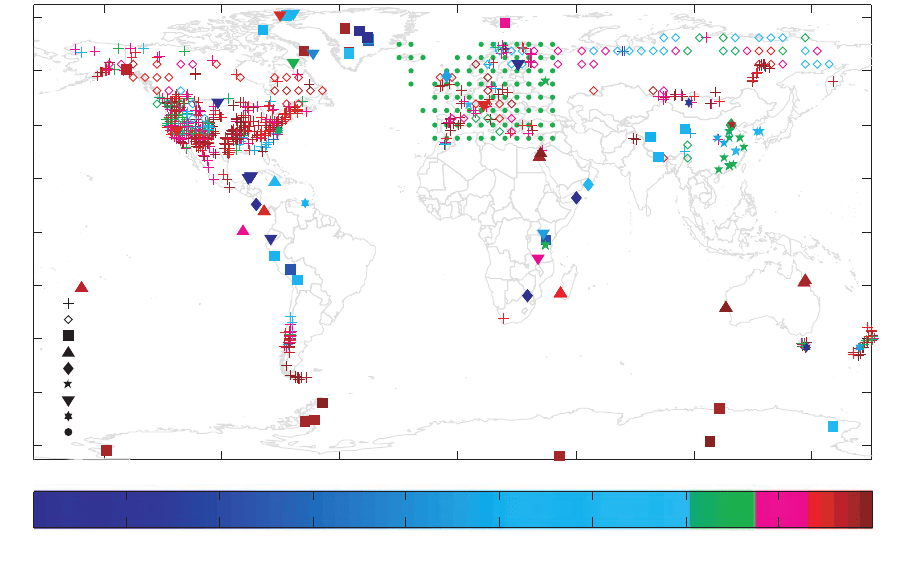
proxy data is shown in Figure 7.1.
Most previous proxy data studies have focused on hemispheric or global mean
temperature (an example of one reasonably representative reconstruction is
shown later in Figure 7.3), although some studies have also attempted to recon-
struct the underlying spatial patterns of past surface temperature changes at global
(e.g. Mann et al. 1998) and regional (e.g. Luterbacher et al. 2004) scales, and other
fields such as regional sea-level pressure, and North American drought. Other
studies have focused on the reconstruction of particular climate indices such as the
North Atlantic Oscillation (NAO) and related Arctic Oscillation (AO), the Pacific
Decadal Oscillation (PDO), and Atlantic Multi-decadal Oscillation (AMO), and
indices such as the Southern Oscillation Index (SOI) and Niño3 index, which
attempt to describe the variability in the El Niño–Southern Oscillation (ENSO)
phenomenon. An extensive review is provided by Jones and Mann (2004).
Most reconstructions of hemispheric or global mean temperatures or of climate
indices have employed the “Composite Plus Scale” (CPS) methodology, where a
selection of natural climate “proxies”, such as tree rings, ice cores, or corals, are
..
50 100 150
Tree ring
MXD
Ice core
Coral
Speleothem
Document
Sediment
Composite
Luterbacher
0 200
–150
80
60
40
20
0
–20
–
40
–
60
–
80
–100 –50
0
400 600 800 1000 1200 1400 1600 1800
Figure 7.1 Spatial distribution of high-resolution climate proxy data. Nine different proxy types are denoted with different
symbols. Starting date of proxy record is indicated by color scale.
9781405159050_4_007.qxd 6/3/08 4:44 PM Page 165

..
166
|
Hugues Goosse et al.
..
first standardized, then composited to form a regional or hemispheric mean tem-
perature series (cf. Jones and Mann 2004). More recently, methodological adjust-
ments have been applied to the CPS method, including the use of proxies selected
specifically for their retention of low-frequency variability (Esper et al. 2002;
Mann and Jones 2003) or the inclusion of low-resolution (decadal or centennial-
scale) proxies that might be well-suited to reconstructing low-frequency climate
variability (Moberg et al. 2005). In the latter case, one must take care during the
standardizing and compositing process to ensure that the low-frequency com-
ponent is not artificially inflated relative to the higher-frequency component
(Mann et al. 2005b).
An alternative is the climate field reconstruction (CFR) approach, which com-
bines information from multiple proxy records in reconstructing the underlying
spatial patterns of past climate change (e.g. Mann et al. 1998; Luterbacher et al.
2004; Rutherford et al. 2005). In this case, hemispheric or global means, as well as
any climate indices of interest, are computed directly from the reconstructions of
the underlying spatial field. A key advantage of the CFR approach is that the spatial
reconstructed patterns can be directly compared with model-predicted patterns of
climate responses to forcing (Shindell et al. 2001, 2004; Waple et al. 2002). Climate
field reconstruction methods typically make use of both local and nonlocal infor-
mation by relating predictors (i.e. the long-term proxy climate data) to the tem-
poral variations in the large-scale patterns of the spatial field of interest. Such an
approach takes greater advantage of the potential climate information in the proxy
data-set. Two good examples are the close link between drought-sensitive tree
rings from the western USA and surface temperature patterns in the Pacific Ocean,
and ice-core records from Greenland which are closely tied to the behavior of the
NAO, which influences cold-season temperature patterns over North America and
Eurasia. These relations can be exploited in climate reconstructions. Climate field
reconstruction approaches depend more on assumptions about the stationarity
of relationships between proxy indicators and large-scale climate patterns than
simpler methods such as CPS. Investigations using synthetic proxy data (“pseudo-
proxies”), however, suggest that these assumptions are likely to hold well for the
range of variability inferred over the past one or two millennia. These investiga-
tions, which are described in more detail below, demonstrate that CFR methods
are quite skilful in independent tests of their fidelity.
Models and climate forcing
Numerous simulations devoted to the study of the past millennium climate have
been performed using Energy Balance Models (EBMs; e.g. Free and Robock 1999;
Crowley 2000; Hegerl et al. 2003), general circulation atmospheric models coupled
to a simplified ocean model (e.g. Shindell et al. 2001; Waple et al. 2002), Earth
Models of Intermediate Complexity (EMIC; e.g. Bertrand et al. 2002; Bauer et al.
2003; Gerber et al. 2003, Goosse et al. 2005a), as well as comprehensive
9781405159050_4_007.qxd 6/3/08 4:44 PM Page 166
Climate of the past millennium
|
167
..
Atmosphere–Ocean General Circulation Models (AOGCMs; e.g. Cubasch et al.
1997; González-Rouco et al. 2003, 2006; Widmann and Tett 2003). Such types of
model have also been used to study other periods of the Holocene (cf. Crucifix, this
volume; Claussen, this volume).
To reproduce the observed changes, climate models have to be driven by recon-
structions of past variations in external forcings. These forcings can be grouped
into two categories: natural and anthropogenic. The main radiative perturbations
of purely natural origin over the past millennium are related to changes in solar
irradiance (cf. Beer and van Geel, this volume) and the release of aerosols into the
atmosphere during explosive volcanic eruptions. Orbital forcing, which is domin-
ant on longer time-scales (cf. Crucifix, this volume), plays a weaker role during
the past millennium. The largest radiative perturbation induced by human activity
is related to the increase in greenhouse gas concentrations in the atmosphere. The
increase in the atmospheric aerosol load is associated with a significant radiative
forcing, particularly close to the main industrialized regions (e.g. Boucher and
Pham 2002). These two forcings are mainly restricted to the past 250 years, with
a strong amplification during the past 50 years. The rate of land-use change has
also increased during the latter period, although in some regions its impact is
significant throughout the past millennium (Ramankutty and Foley 1999) and
earlier (cf. Oldfield, this volume).
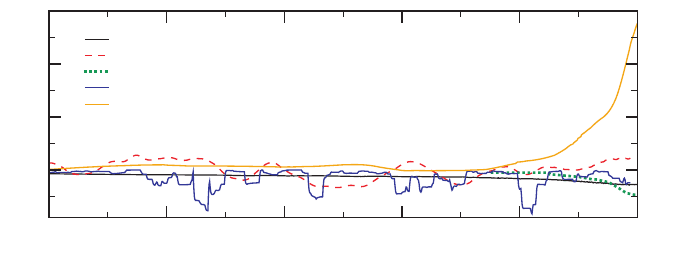
Figure 7.2 shows typical reconstructions of external forcings during the past
millennium. The uncertainties in these forcings are relatively large, except for the
one associated with the increase in greenhouse gas concentrations. The majority of
the forcings have to be reconstructed from indirect sources such as the amount
of sulfates in ice cores for volcanic activities or of cosmogenic isotopes for solar
irradiance (cf. Beer and van Geel, this volume). In addition, the magnitude of
the negative aerosol forcing depends on numerous complex phenomena and the
estimates of the present-day aerosol forcing range from nearly zero to more than
2Wm
−2
(e.g. Andreae et al. 2005). This illustrates that the time evolution of the
past radiative forcing, as well as its magnitude, is not well constrained.
Some model simulations include only a small number of the forcings mentioned
above (generally one), the goal being to understand precisely the mechanism
behind the response to a particular forcing (e.g. Shindell et al. 2001, 2004; Waple
..
1000 1200 1400 1600 1800 2000
Time (years)
0
1
2
3
Land-use
Solar
Aerosols
Volcanos
Greenhouse gas
Radiative forcing (W m
–2
)
Figure 7.2 Typical history of
past radiative changes, as used
in Goosse et al. (2005a). The
evolution of solar irradiance
follows the reconstruction of
Lean et al. (1995) extended
back in time by Bard et al.
(2000). The effect of
volcanism is derived from
Crowley (2000). The forcing
due to change in land-use is
based on Ramankutty and
Foley (1999), using a linear
interpolation before 1700 as
in Brovkin et al. (2006). Only
the direct effect of sulfate
aerosols due to anthropogenic
activity is taken into account
here so the green curve is a
lower bound for this forcing
(e.g. Andreae et al. 2005). A
25-year running mean has
been applied to all the time
series.
9781405159050_4_007.qxd 6/3/08 4:44 PM Page 167
..
168
|
Hugues Goosse et al.
..
et al. 2002; Goosse and Renssen 2004; Mann et al. 2005a). Other simulations that
try to reproduce the observed climate evolution tend to include all the important
forcings. They all take into account at least the solar, volcanic, and greenhouse gas
forcings, and some simulations include a more exhaustive list of forcings, account-
ing for the effect of land-use change, anthropogenic aerosols, and orbital forcing.
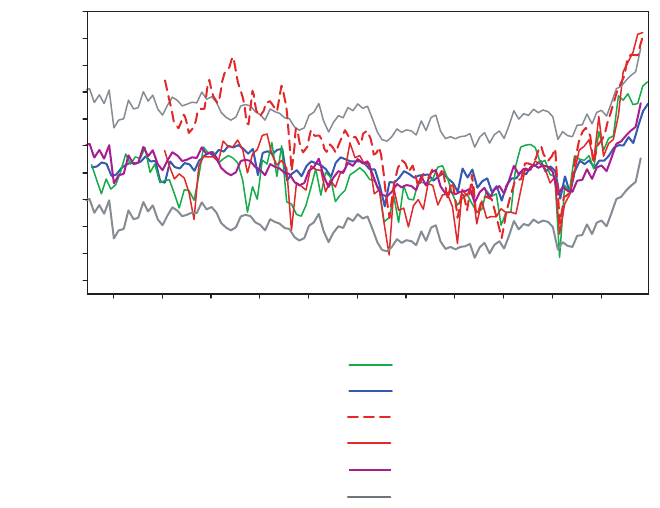
Figure 7.3 displays the annual mean temperature averaged over the Northern
Hemisphere in such simulations using various three-dimensional climate models.
The model results are in the range of the uncertainty associated with the recon-
structions, showing generally colder temperatures during the 16–19th centuries
and a larger warming during the 20th century. Nevertheless, differences between
the models can be noticed, attributable to different factors. Firstly, the simulations
use different reconstructions of past forcing changes. For solar radiations, despite
the relatively large range in the reconstructions, recent model simulations tend to
use similar reconstructions. The selection of the reconstruction of past solar irradi-
ance has thus a weak impact on the differences shown in Figure 7.3 (Goosse et al.
2005b; Osborn et al. 2006). Models that do not include the anthropogenic aerosol
forcing (such as the simulations using the ECHO-G model) simulate a much larger
warming during the 20th century than the models that take into account this
important forcing.
Secondly, the choice of initial conditions can play a role. This is illustrated in
Figure 7.3 by the two simulations performed with the ECHO-G model that use the
same forcing but in one case start from warm conditions (simulation ERIK) in year
1000 ad and in the other case from colder conditions (simulation ERIK2). In
CCSM
ECBILT-CLIO-VECODE
ECHO-G (ERIK)
ECHO-G (ERIK2)
Jones and Mann (2004)
Jones and Mann (2004) +/– 2 STD
900 1000 1100 1200 1300 1400 1500 1600 190018001700
1.2
1.0
0.8
0.6
0.4
0.2
0.0
–0.2
–0.4
–0.6
–0.8
Time (years)
Annual mean
temperature anomaly (°C)
Figure 7.3 Annual mean
temperature anomaly
averaged over the Northern
Hemisphere in simulations
performed with two
AOGCMs (CCSM, Ammann
et al., cited in Jones and Mann
(2004) in green, and ECHO-
G, González-Rouco et al.
2003, 2006) and in one three-
dimensional Earth model of
intermediate complexity
(ECBILT–CLIO–VECODE,
Goosse et al. (2005a) in blue).
The two simulations
performed in ECHO-G (ERIK
and ERIK2, dashed red and
red respectively) differ only in
their initial conditions, ERIK
using one that is probably too
warm. The reconstruction of
Jones and Mann (2004) is in
magenta, with the
reconstruction plus and
minus two standard
deviations in grey. The time
series are grouped in 10-year
averages. The reference period
is 1500–1850. This reference
period was chosen to
eliminate possible problems
related to initial conditions
and to the strong differences
of specified anthropogenic
forcing in the 20th century.
9781405159050_4_007.qxd 6/3/08 4:44 PM Page 168
Climate of the past millennium
|
169
..
ERIK, because of the selected warm initial state, the temperature drifts during
several centuries towards colder temperatures until it becomes close to ERIK2, and
the other simulations, around 1500. It is not possible to define precisely from
observations the conditions that should be used to start a model in 1000 ad, but
longer simulations starting in 850 ad or covering the past two millennia do not show
warm conditions similar to the ones used in ERIK. The initial conditions used
in ERIK2 and the subsequent evolution of temperature appear more reasonable
than the ones of ERIK, although the lack of tropospheric aerosols in ERIK2 is
still problematic for the realism of the simulation during the 20th century or the
evaluation of the net changes in temperature from the pre-industrial to modern
intervals.
Finally, different models use different grids and methods for the numerical
resolution of the equations as well as different representations of some physical
processes governing the evolution of the climate system, with a potential impact
on the response of the model to a radiative perturbation. The behavior of models
is often summarized by a few important characteristics, but this is a strong
simplification of the complex behavior of three-dimensional models. Model sens-
itivity is classically defined by the change in global mean temperature between a
controlled experiment using present-day conditions and an equilibrium experi-
ment in which the atmospheric CO
2
concentration is doubled. The efficiency
of the heat uptake by the ocean also plays an important role in the model response.
In simple models, this could be related to bulk parameters such as an effective
heat diffusion in the ocean (e.g. Hegerl et al. 2006; Osborn et al. 2006), whereas
in more sophisticated models, the link with model parameters is much more
complex. In Figure 7.3, such differences in model characteristics are likely re-
sponsible for the weaker temperature changes in ECBILT-CLIO-VECODE than
in ECHO-G and CCSM, with the former model having relatively weak climate
sensitivity.
At the hemispheric scale, precise model–data comparisons are difficult because
of the uncertainties associated with the reconstructions, the forcing, and model
formulation. As a consequence, an agreement between model and data is usually
not a stringent test of the model results. At the regional scale, an additional
difficulty is related to the large role played by the internal variability of the climate
system, whereas at the hemispheric scale, the evolution of the system is largely
imposed by the changes in the external forcing. As discussed later, the character-
istics of some well-known modes of climate variability such as ENSO or NAO could
be influenced by the forcing. Nevertheless, a large fraction of the variability of these
modes is purely chaotic, related to internal dynamics, and cannot be related to any
change in external conditions.
At regional scales, the internal variability of the system could easily mask the
forced response. This is probably the main reason why the so-called Medieval
Warm Period (covering roughly the period ad 900–1200) is not a synchronous
phenomenon in all regions of the globe (e.g. Hughes and Diaz 1994; Bradley et al.
2003; Goosse et al. 2005a). The net effect of all forcings probably tended to induce
warmer conditions during the period, but, depending on the sign of the anomalies
..
9781405159050_4_007.qxd 6/3/08 4:44 PM Page 169