
Battarbee R.W., Binney H.A. (Eds.) Natural Climate Variability and Global Warming: A Holocene Perspective
Подождите немного. Документ загружается.

..
10
|
H. John B. Birks
..
Christian Vaupell (1821–1862; Figure 2.3) continued investigations on pine
megafossils in Denmark. In addition to providing an ecologic explanation for the
causes of long-term forest succession, he examined the width of the tree-rings of
the buried pines. He concluded (1857) that the pines had not grown in cold condi-
tions, as Steenstrup had proposed in his forest history, but that the pines had
grown under warm but dry conditions. Vaupell suggested therefore that there had
been changes not only in moisture (to explain the changes in peat stratigraphy)
but also in temperature (to explain the changes in tree composition and growth)
during the Holocene. The Swedish paleobotanist A.G. Nathorst (1850–1921;
Figure 2.4) investigated plant macrofossils in the clays underlying the peat in
southern Sweden (Nathorst, 1870) and subsequently elsewhere in Europe
(Nathorst, 1892). He was the first to find remains of arctic plants such as Dryas
octopetala, Salix polaris, and S. reticulata, plants that today are confined to high
(a)
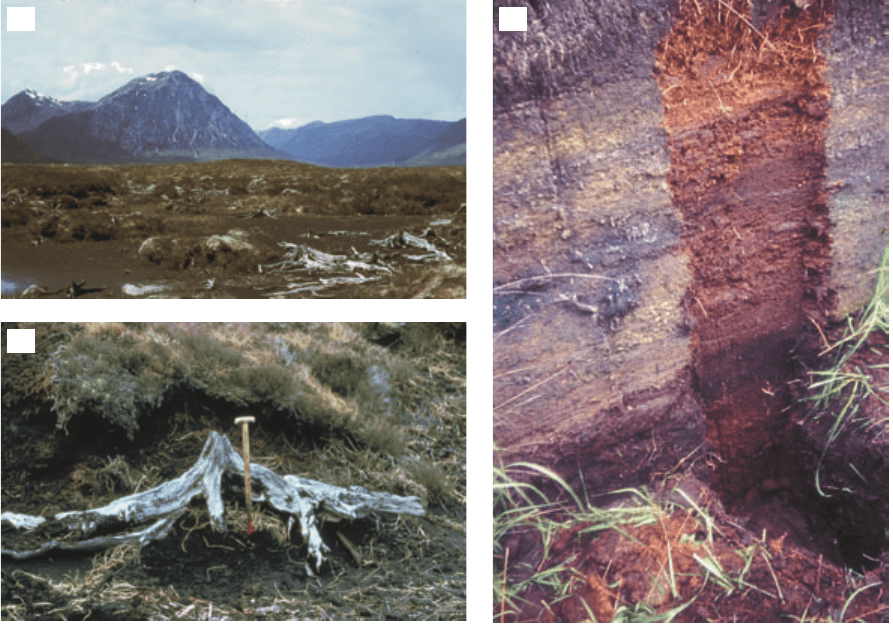
Figure 2.1 (a) Fossil pine stumps on Rannoch Moor,
western Scotland. These stumps are about 4000 years old
(Birks 1975). (b) Fossil pine stump at Cooran Lane,
Galloway, south-west Scotland. This stump is about
6000 years old (Birks 1975). (c) The “Grenzhorizont” or
(b)
(c)
(c)
major recurrence surface at Chat Moss, Lancashire, north-
west England. There is a conspicuous change from dark,
humified peat to pale, less decomposed peat. This transition
is radiocarbon-dated to about 2600 years ago.
(Photographs: John Birks.)
9781405159050_4_002.qxd 6/3/08 3:51 PM Page 10
Holocene climate research
|
11
..
latitudes and/or high altitudes. With these discoveries Nathorst transformed
peat-stratigraphic and macrofossil research and early ideas about climate change
(Holmboe 1921). Temperature change immediately became recognized as the
major factor influencing the history of plants and animals since the last Ice Age as a
result of Nathorst’s macrofossil studies. The final acceptance of the Ice Age theory
..
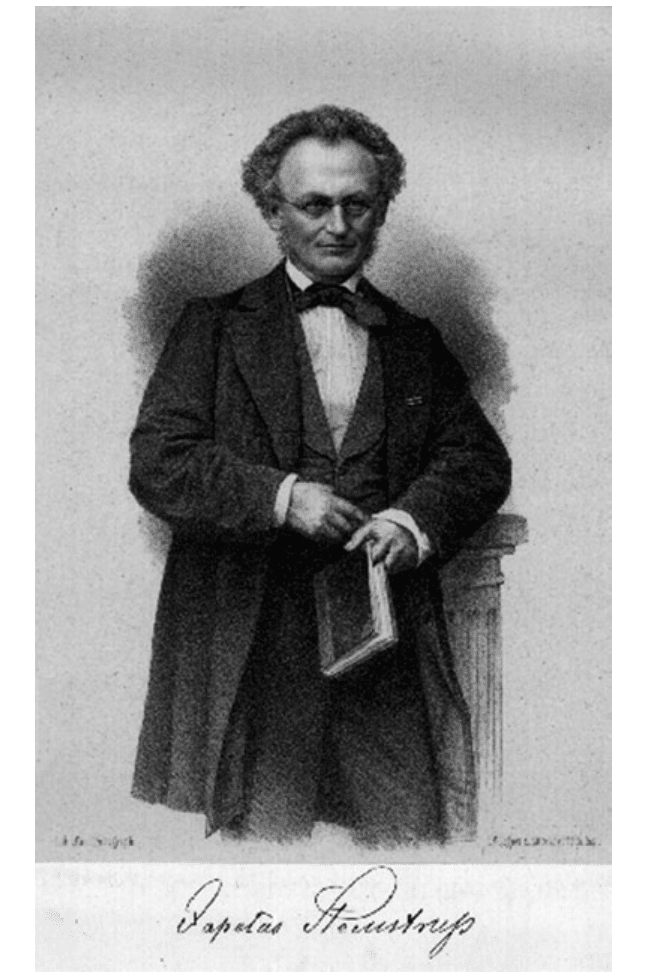
Figure 2.2 Japetus
Steenstrup (1813–1897),
a Danish scientist who
pioneered the study of plant
and animal remains preserved
in peat as a means of
reconstructing past
environmental change and
who provided one of the first
explanations for how pine
trees could once grow on
Danish peat bogs. (With
permission from the Royal
Library, Denmark.)
9781405159050_4_002.qxd 6/3/08 3:51 PM Page 11
..
12
|
H. John B. Birks
..
by geologists at the same time also contributed greatly to climate change occupying
a key role in Quaternary research (Iversen 1973).
The idea that there had also been changes in temperature during the Holocene
was investigated in detail in Sweden in the early 20th century. Sweden is ideal for
such studies as there are marked south–north gradients in summer warmth today
and hence well-defined northern geographic limits of many thermophilous plants
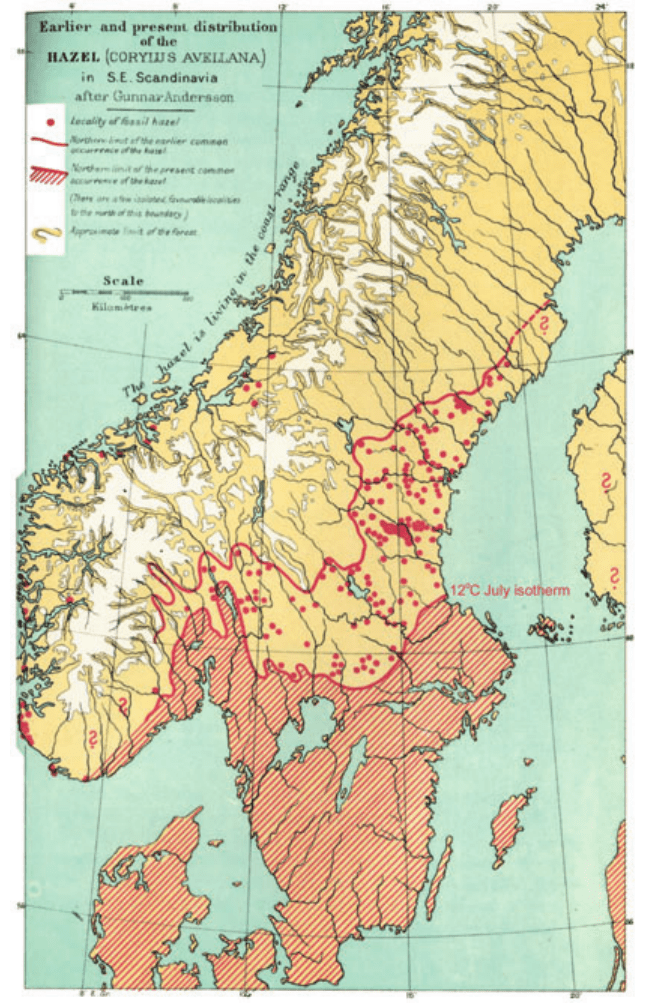
and animals. Gunnar Andersson (1865–1928) discovered plant macrofossils
(seeds, fruits, nuts, leaves, etc.) preserved in peat bogs. Finds of fossil nuts of
Corylus avellana (hazel) well north of the present range of hazel suggested that the
climate had once been warmer than today (Figure 2.5). The present-day northern
limit of hazel coincides closely with the mean July temperature isotherm of 12°C
today, whereas fossil nuts occurred as far north as the present-day July isotherm of
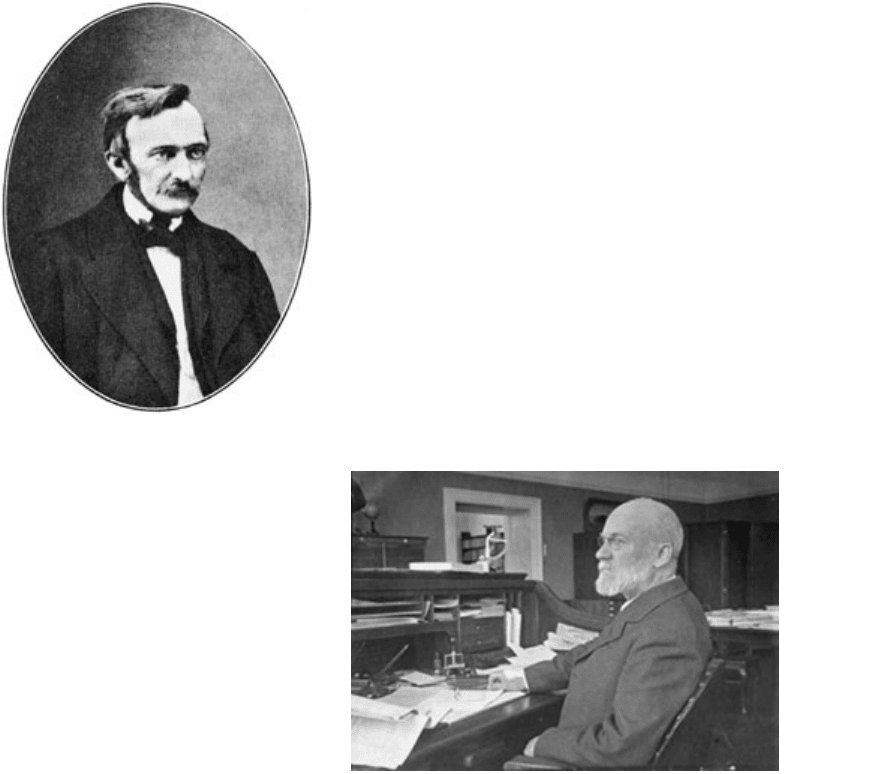
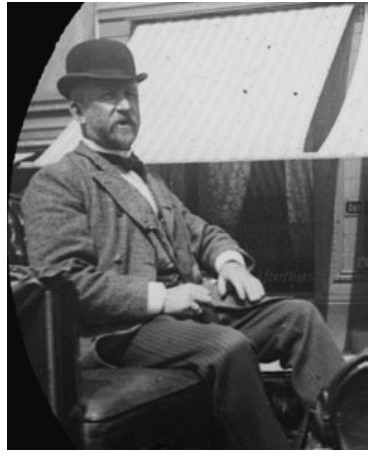
Figure 2.3 Christian Vaupell (1821–1862), a Danish scientist
who pioneered the use of tree-rings in fossil pine stumps as a
means of inferring past conditions of temperature and
moisture. (Picture from Iversen 1973. Copyright: Geological
Survey of Denmark and Greenland.)
Figure 2.4 Alfred Gabriel
Nathorst (1850–1921), a Swedish
paleobotanist who studied plant
macrofossils in late-glacial and
Holocene deposits in Scandinavia
and elsewhere in Europe. His
discovery of the remains of
arctic–alpine plants in the
clays below Holocene peats
highlighted the large changes
in temperature that occurred at
the onset of the Holocene.
(Photographer: Thor G. Halle,
1916. The Swedish Museum of
Natural History.)
9781405159050_4_002.qxd 6/3/08 3:51 PM Page 12
Holocene climate research
|
13
..
9.5°C, suggesting a change in July temperature of 2–2.5°C. On the basis of these
and related investigations, Andersson (1902, 1909) emphasized changes in sum-
mer temperature and presented the idea of one long early- to mid-Holocene
period with a “higher-than-today” temperature comparable with the modern
..
Figure 2.5 The present-day
distribution (red cross-
hatching) of Corylus avellana
(hazel) in Denmark and
Sweden in relation to the
mean July temperature
isotherm of 12°C and the
distribution of fossil hazel
nuts (red dots) of early- or
mid-Holocene age. (From
Wright 1936. Reproduced
with permission of Palgrave
Macmillan.)
9781405159050_4_002.qxd 6/3/08 3:52 PM Page 13
..
14
|
H. John B. Birks
..
concept of the Holocene thermal maximum. Support for this idea came from
discoveries of macrofossils of Cladium mariscus (saw-sedge), Carex pseudocyperus
(cyperus sedge), Trapa natans (water-chestnut), Emys orbicularis (European pond
tortoise), and other warmth-demanding plants and animals well north of their
present northern limits in Europe.
In Norway, Axel Blytt (1843–1898; Figure 2.6), perhaps influenced by the work
of Dau (1829), Steenstrup (1841), and Vaupell (1857), interpreted tree layers in
peat bogs and changes from dark, humified to pale, fresh peat (Figure 2.1c) as
evidence for alterations between dry (continental = Boreal) and wet (oceanic =
Atlantic) periods (Blytt, 1876). He proposed an elaborate theory for the immigra-
tion of the Norwegian flora and its various floristic elements during these oceanic
and continental periods. Blytt assumed that the floristic elements of the present-
day flora of Norway (e.g. boreal, atlantic) had immigrated during successive
climatic periods, with the arctic element first and the sub-atlantic element last
(Mangerud et al. 1974). In light of the present-day distributions of these elements,
Blytt proposed that the boreal and sub-boreal elements had immigrated during
periods of continental climate, whereas the atlantic and sub-atlantic elements had
immigrated during periods of oceanic climate. In this early work Blytt used the
terms boreal and atlantic to refer to floristic elements and not to phases within the
Holocene. He widened their use in 1893 after Sernander’s early publications.
The Swedish botanist Rutger Sernander (1866–1944; Figure 2.7), who had strong
interests in both climate history and plant geography (Fries 1950), combined the
Swedish ideas of summer-temperature changes with Blytt’s (1881) moisture
changes to propose the famous Blytt–Sernander four periods of post-glacial
time (Sernander, 1893, 1894, 1908, 1909, 1910 – see Table 2.1). Sernander (1889)
initially used the concepts of Blytt’s “atlantiska period” and “sub-boreala period”
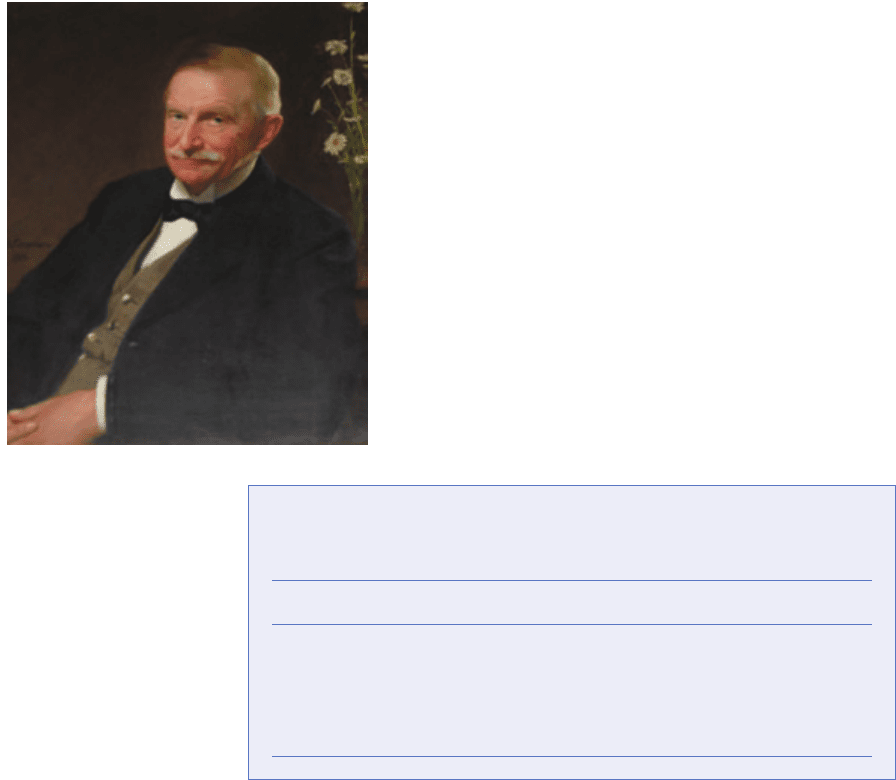
Figure 2.6 Axel Blytt (1843–1898), a Norwegian botanist
who proposed a series of alternating wet and dry periods based
on peat-stratigraphic changes and used these periods to
explain the history of the Norwegian flora. (Photograph by
Carl Størmer with permission from the Norwegian Museum
of Science and Technology.)
9781405159050_4_002.qxd 6/3/08 3:52 PM Page 14
Holocene climate research
|
15
..
to link Blytt’s floristic terms atlantic, sub-boreal, etc. to Blytt’s descriptions of peat
stratigraphy in Norway and Blytt’s associated climatic interpretations (Mangerud
et al. 1974). Later Sernander (1890) used all Blytt’s floristic terms for successive
time periods, characterized by a different climate based on Blytt’s peat investiga-
tions. Blytt (1893) then applied his own floristic terms to his peat-stratigraphic
layers, thereby introducing the sub-atlantic peat-bed, the sub-boreal stump layer,
the atlantic peat-bed, etc. (Mangerud et al. 1974).
The Blytt–Sernander paradigm of Holocene climate change, in the form that
later became widespread, was probably fully established by Sernander (1894) in his
doctoral thesis at the University of Uppsala (Mangerud 1982). In this remarkable
monograph, Sernander first discussed the basis for dating and correlation of geologic
sequences. He regarded the stratigraphic sequences based on plant macrofossils
..
Figure 2.7 Rutger Sernander (1866–1944), a Swedish
botanist and Quaternary geologist who expanded Blytt’s ideas
into the Blytt–Sernander scheme for Holocene climate history
(see Table 2.1) that became the major paradigm for Holocene
climate until about 1960. (From unknown Internet source
that is no longer on line.)
Table 2.1 The Blytt–Sernander division of the Holocene as proposed by Sernander
(1890, 1894). The Pre-Boreal was added by Fægri (1940) for the earliest Holocene with a
cool–sub-arctic climate
Period Inferred climate Approximate age (years BP)
Sub-Atlantic Cool, wet 0–2500
Sub-Boreal Warm, dry 2500–5000
Atlantic Warmest, wet 5000–8000
Boreal Warm, dry 8000–10 000
Pre-Boreal Cool, sub-arctic >10 000
9781405159050_4_002.qxd 6/3/08 3:52 PM Page 15

..
16
|
H. John B. Birks
..
and megafossils described by Steenstrup (1841) as the basis for Holocene climate
change in Scandinavia. However, in contrast to other researchers at that time,
Sernander doubted that vegetational changes in, for example, Denmark could be
synchronous with changes in, for example, north-central Sweden because plant
spread over several hundred kilometers must have required a long time. Sernander
thus sought other methods to try to determine the age of these changes. In terms of
climate history, Sernander accepted Blytt’s observations and interpretations and
wrote (Sernander, 1894, p. 71 – translated from Swedish)
“We introduce therefore to the peat bog-sequences in Gotland the terms of Blytt, from
the top downwards: sub-atlantic, sub-boreal, atlantic, and boreal beds, and we will
also use these names for the time periods corresponding to the beds.”
An approximate chronology for these periods was proposed based on correlations
with archaeology, sea-level changes (Littorina and Ancylus transgressions), and
the Swedish varve chronology of Gerard de Geer (1858–1943) by Sernander (1894)
(see Table 2.2). The change from the Sub-Boreal to the Sub-Atlantic was thought
by Sernander to be an abrupt climate change, even a catastrophe, the Fimbulwinter
of the Sagas (Iversen 1973).
The 1910 International Geologic Congress in Stockholm was, according to Knut
Fægri (personal communication 1995), a major event in the dissemination and
Table 2.2 Sernander’s (1894) correlation scheme for the Holocene (modified from
Mangerud 1982)
Sea-level
phase
Littorina
Ancylus
Polar Sea
Peat bogs in southern
Scandinavia
(Steenstrup,
Nathorst, et al.)
Spruce zone
Oak zone
Pine zone
Aspen zone
Dryas zone
Gotland vegetation
history
Spruce
Oak
Pine
Pine
Dryas
with
Salix polaris
Period
Sub-Atlantic
Sub-Boreal
Atlantic
Boreal
Sub-Arctic
Arctic
Correlations
Littorina
transgression
maximum
Ancylus Lake
transgression
maximum
Cladium
Carex
pseudocyperus
Iris pseudacorus
Northern
salix
Betula nana
Dryas
9781405159050_4_002.qxd 6/3/08 3:52 PM Page 16
Holocene climate research
|
17
..
acceptance of the Blytt–Sernander classification scheme. Interestingly there was
close co-operation at this time between Sernander and Lennart von Post (the
founder of pollen analysis – see below) and they organized a major excursion to
Swedish peat bogs (von Post and Sernander 1910). After 1910, the Blytt–Sernander
scheme was widely used in Scandinavia for many decades without any major
change in its meaning or interpretation (Mangerud et al. 1974; Mangerud 1982).
Fægri (1940) introduced the term Pre-Boreal as a unit between the Boreal and the
Younger Dryas of the late-glacial (Table 2.1).
A major conflict and acrimonious debate ensued for about 20 years between the
“grand old men” (Lundqvist 1965) of Swedish post-glacial climate research,
namely Gunnar Andersson and Rutger Sernander. A rapid polarization of ideas
developed between the Blytt–Sernander scheme with its alternating dry and wet
periods and rapid climate change and Andersson’s more uniform, gradually rising
temperature curve, a thermal maximum, and subsequent decrease. The debate was
partly one of scientific personalities (Fries 1950; Danielsen et al. 2000) and partly
one about research techniques (Iversen 1973). Andersson’s approach was based
exclusively on macrofossils whereas the Blytt–Sernander scheme was based on peat
stratigraphy and megafossils. The conflict between the two Swedish schools was
not satisfactorily resolved until another Swede, Lennart von Post (1946), proposed
that post-glacial climate history involved both broad-scale temperature changes
(Andersson) and finer-scale precipitation changes (Blytt–Sernander). This new
paradigm did not develop until the development of pollen analysis, which will be
discussed in the next section.
As part of the Andersson–Sernander debate, Samuelsson (1916) analyzed the
northern limit of hazel in Sweden in considerable detail and showed that summer
temperature was far from uniform along the limit today. He showed that a lower
summer temperature could be compensated for by a longer growing season, and
he modeled the climatic demands of hazel in terms of both summer temperature
and the length of the growing season. He proposed that both summer and winter
temperatures, and hence the length of the growing season, may have changed
during the Holocene. This idea was followed up in detail by Iversen (1944) using
pollen analysis and by Hintikka (1963) in plant geography.
During the early part of the 20th century, the Blytt–Sernander scheme became
the dominant paradigm for Holocene climate history and many peat and mega-
fossil stratigraphies in Scotland, central Europe, and the Alps were interpreted in
terms of the Blytt and Sernander model (e.g. Samuelsson 1910; Gams and
Nordhagen 1923). As peat stratigraphies were examined in more detail, several
recurrence surfaces (changes from dark, humified to fresh, unhumified peat –
Figure 2.1c) were identified by Granlund (1932), suggesting several shifts in mois-
ture during the late Holocene. Granlund proposed at least two “Sub-Atlantic”
climate phases during Sernander’s Sub-Boreal period and after Sernander’s
Fimbulwinter the climate changed twice over to the Sub-Boreal type and then
again to the Sub-Atlantic. Von Post (1946) summarized Granlund’s (1932)
modification of the Blytt–Sernander paradigm as follows:
..
9781405159050_4_002.qxd 6/3/08 3:52 PM Page 17
..
18
|
H. John B. Birks
..
“Granlund’s work showed that the post-glacial warm period did not end abruptly
with a climatic catastrophe about 500 bc, as supposed by Sernander; but that instead
of this event we must suppose a gradually advancing climatic deterioration spread
over at least 4000 years. This process was, however, not continuous. Just in the same
way as, during autumn, summer gradually changes to winter during repeated alterna-
tions between days of summer warmth and wintry cold, so the climate falls and rises
from the warm period to the present time, through the bronze age, iron age, and our
so-called historic time, swaying between fimbul winters and phases which were echoes
of the glorious climate of the stone age.”
In other words, the accepted paradigm by the 1930s based on peat stratigraphy
and megafossils was of alternating wet and dry phases but perhaps with increased
variability and several short-lived climate shifts in the late Holocene and with a
mid-Holocene warm period.
Independently of the Scandinavian botanists and peat stratigraphers, the
paradigm of a Holocene climate optimum or thermal maximum had already been
presented by Thomas F. Jamieson (1829–1913; Figure 2.8) in his study of the fossil
molluscan fauna of mid-Holocene estuarine clays in central Scotland (Wright
1936). Jamieson found species that do not occur as far north as Scotland today. The
Irish naturalist Robert Lloyd Praeger (1865–1963) reached similar conclusions in
his studies of estuarine clays and raised beaches in Northern Ireland, as did W.C.
Brøgger (1900/01) in the Oslo Fjord (Wright 1936). Mitchell (1976) discusses
whether W.B. Wright’s (1936) dedication in his second edition of The Quaternary
Ice Ages to “R. Lloyd Praeger, Discoverer of the Climatic Optimum” is appropriate,
given Jamieson’s pioneer work in 1865 that Praeger cites frequently in his Irish
studies of 1887 and 1892. Perhaps credit for the discovery of the climatic optimum
should be given to T.F. Jamieson in 1865, and not to Praeger, Brøgger, or Andersson.
In retrospect, the advances made by Dau, Steenstrup, Vaupell, Andersson,
Jamieson, Praeger, Blytt, Sernander, Brøgger, and Granlund in reconstructing
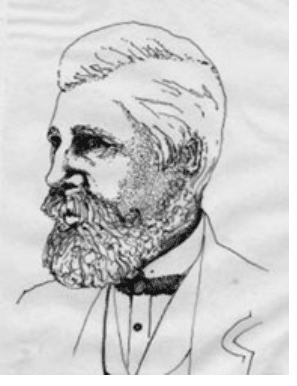
Figure 2.8 Thomas F. Jamieson (1829–1913), a Scottish
geologist who discovered the mid-Holocene climatic
optimum or thermal maximum in his investigations of
Mollusca preserved in estuarine clays in central Scotland.
(Picture from www.fettes.com/(Artist anknown.))
9781405159050_4_002.qxd 6/3/08 3:52 PM Page 18
Holocene climate research
|
19
..
Holocene climate change were very remarkable, given the very limited range of
techniques then available. A flavor of the excitement of these early investigations
based around peat stratigraphy and macrofossils can be obtained from Godwin
(1978, 1981) and Mitchell’s (1990) autobiographies. It was not until the develop-
ment of pollen analysis that the different views of Andersson and Sernander could
be satisfactorily reconciled and the Holocene climate history reconstructed for
other parts of the world where peat stratigraphy is not always possible. I will return
to modern detailed studies of peat stratigraphy later when I discuss paleolimno-
logy, paleohydrology, and evidence for hydrologic changes during the Holocene.
The study of peat stratigraphy in Scandinavia was largely ignored after the devel-
opment of pollen analysis as a tool for reconstructing Holocene climate change.
It was not until the mid-1970s that peat stratigraphy was revived in Scandinavia
using new techniques for estimating peat humification, detecting changes in bog
moisture using testate amoebae, and establishing detailed chronologies by radio-
carbon dating (e.g. Aaby and Tauber 1975; Aaby 1976). These new studies sug-
gested consistent shifts from dry to moist conditions with a periodicity of 260 years
over the past 5500 years.
The study of plant macrofossils and megafossils in north-west Europe was
similarly ignored for about 70 years. Hilary Birks (1975) re-examined buried
pine stumps (Figure 2.1) in Scottish blanket bogs using pollen analysis, peat
stratigraphy, plant macrofossils, and radiocarbon dating and showed that the
temporal patterns of pine stumps were considerably more complex than pre-
dicted from the application of the Blytt–Sernander scheme to Scottish peats
by Samuelsson (1910). In recent decades Kullman (e.g. 1998a,b 2000, 2002) has
studied tree megafossils and macrofossils in several areas of the Swedish moun-
tains and has made spectacular discoveries of Picea and Pinus remains in the early
Holocene and the late-glacial, of thermophilous trees in the early Holocene, and of
Larix sibirica in the Swedish Mountains in the early Holocene. Larix sibirica today
is found 1000 km to the east in Russia. The finds of its cones and wood (Kullman
1998a) suggest major changes in its distribution since the early Holocene and its
extinction from Fennoscandia. These studies and others (see Birks 2005; Birks et al.
2005) emphasize the importance of integrated studies involving detailed plant
macrofossil and megafossil analyses, pollen analysis, lithostratigraphic investiga-
tions, and radiocarbon dating if the complex patterns of tree spreading and climate
change in the early Holocene are to be unraveled.
Pollen analysis
The Swedish geologist Lennart von Post (1884–1951; Figure 2.9) presented in 1916
the technique of pollen analysis at the 16th Scandinavian meeting of natural
scientists in Christiania (now Oslo) and demonstrated its potential as a technique
for relative dating and for reconstructing past vegetation and past climate.
Although the original idea of pollen analysis can be attributed to the Swedish
botanist Gustaf Lagerheim (1860–1926), it was von Post who had the vision of
..
9781405159050_4_002.qxd 6/3/08 3:52 PM Page 19