
Benson М. The Philosophy of Leibniz
Подождите немного. Документ загружается.

150
The
Philosophy
of
Leibniz
while
that between words
and
their denotations
is
indirect, mediated
by the
relevant concepts. Words
are
symbols
for
thoughts
and
only indirectly refer
to
whatever objects,
if
any, these thoughts
may be
about.
This
holds
for
proper
names
as
well
as for all
other
types
of
expression.
It is not the
case,
Leibniz would say, that
we
succeed
in
directly associating
a
proper
name with
a
definite individual
and
then,
as we
discover properties
of
that individual,
gradually
build
up a
concept
or
intension
to go
with
the
name. Rather,
to the
extent that
we
understand what
we are
saying when
we use the
name,
we
already have some sort
of
concept attached
to the
name,
and
then
we
gradually narrow down
the
range
of
possible individuals
who
could
fall
under
the
concept.
We
form
the
concept
X by
learning
the use of the
expression
X
as a
part
of the
language,
and not by
abstracting qualities
from
what
we may
take
to be the
designatum
of
X.
From this point
of
view,
it is not as
though
we
know
from
the
start exactly which individual
we are
talking about,
and as
though over time
we
find
out
more
and
more attributes
of
that individual
and
can
intelligibly speculate
as to
what would have happened
if
that very same
individual
had had
properties other than
the
ones
he
does have.
Now,
it
might
be
supposed that,
at
least
in
very favorable though artificial
circumstances,
we can
(and
do)
indeed manage
to
attach
a
proper name
to a
definite
individual
and
then,
as we
discover
the
properties
of
that individual,
use the
name
in
making true assertions, including counterfactual conjectures,
about
it. So I
might point
to
somebody
or
something
and
say,
"By
'Nixon'
I
mean this
man;
now, what
if
Nixon
had not
resigned
the
presidency?"
Of
course, with almost
all the
proper names
we use
(including, needless
to
say,
the
cherished example "Nixon")
we
have never carried
out any
such
deictic
or
dubbing performance.
But
even when
we
have,
it is by no
means
clear that
by
using
a
name introduced
in
this
way we can
formulate
an
intel-
ligible
question about what would have happened
if
some individual
had had
attributes
other than
the
ones
he
does have.
For
Leibniz
will
ask, "Exactly
which
individual
are you
talking about?"
It
will
be of no
avail
to
resume
the
pointing
while reiterating,
with
whatever emphasis,
THIS
MAN,
for
Leib-
niz's question amounts
to
"Who
is
this
man
?"
We can
hardly claim that
by
pointing
we
have singled
out and
identified
a
particular individual,
if at the
same time
we
have
to
admit that there
may be
many individuals such that,
for
all
we
know,
any one of
them might have been
the one in
front
of us at the
time
when
we did the
pointing.
In
introducing
a
name
or
making
an
identification,
the
demonstrative pronoun "this"
is
effective
only
to the
extent that
the
speaker
and the
audience
can
distinguish
the
intended object
from
the
rest
of
the
objects
in the
world.
As
mentioned earlier, Leibniz
is
willing
to go the
whole
way in
this direction
and
argue that even
in the
case
of our own
indi-
vidual
concepts,
to say
nothing
of
those
of
others,
we
have only confused
experience,
so
that
in a
real sense
we do not
even know precisely
who we
ourselves
are.
36
36
Cf.GII46(M50).
Cross-
World
Identity
151
At any
rate, whatever
the
right
view
about these matters
may be, we
should
take note that Leibniz agrees with
his
opponents
on one
important
point, namely, that
proper
names, unlike such descriptions
as
"The
first
man,"
are
what
are
today called "rigid
designators";
37
they designate
the
same
thing
in
every possible world
in
which they designate anything.
But for
Leib-
niz
this
is
because
no
proper name designates anything
in
more than
one
pos-
sible
world.
37
Kripke
(1972),
269-70.
IX
"Two
Great Principles"
and
Two
Lesser Ones
In
sections
31
and 32 of the
Monadology,
Leibniz
says:
Our
reasonings
are
based upon
two
great principles:
the
first,
the
Principle
of
Con-
tradiction,
by
virtue
of
which
we
judge that
false
which involves
a
contradiction,
and
that
true which
is
opposed
or
contradictory
to
the
false;
and the
second,
the
Principle
of
Sufficient
Reason,
by
virtue
of
which
we
observe that there
can be
found
no
fact
that
is
true
or
existent,
or any
true proposition, without there being
a
sufficient
reason
for
its
being
so and not
otherwise, although
we
cannot know these reasons
in
most
cases.
1
Similarly,
in the
Theodicy:
I
have remarked
...
that there
are two
great principles,
namely,
that
of
Identity
or
of
Contradiction, which says that
of two
opposed propositions
one is
true
and the
other
is
false,
and
that
of
Sufficient
Reason,
according
to
which there
is no
true
proposition
for
which anyone with
the
requisite knowledge
to
fully
understand
it
could
not see the
reason.
2
and
There
are
two
great principles
of our
reasoning;
one is the
Principle
of
Contradic-
tion,
which asserts that
of two
contradictory propositions
one is
true
and one is
false;
the
other
is the
Principle
of
Determining
Reason,
that nothing ever happens
without
there being
a
eause
or at
least
a
determining reason
for
it...
.
3
In
interpreting
these
two
principles,
Couturat
and
others
4
have
suggested
that
the
first
amounts
to the
claim
that
every
analytic
proposition
is
true,
1
G
VI
612
(L
646);
G
VII
309.
2
G
VI
413-14
(H
418-9).
1
G VI
127.
There
are
literally
dozens
of
other references
in the
Leibnizian
corpus
to
these
"two
great principles."
4
CL213-17;R
v.
Rescher(1979)
23ff.,
in
a
variation
on
this,
has
the
principle
of
Sufficient
Reason
as
"Every true
proposition
is
analytic,"
the
principle
of
Identity
as
"Every
finitely
analytic
152
"Two Great
Principles"
and Two
Lesser
Ones
153
while
the
second asserts that every true proposition
is
analytic,
so
that
both
together
are
equivalent
to the
statement that
in
every true proposition
the
concept
of the
predicate
is
contained
in the
concept
of the
subject. With this
suggestion
in
mind,
let us now
take
a
closer look.
1 The
Principle
of
Identity
or of
Contradiction
The
first
thing that meets
the eye
when
we
survey
the
passages
in
which
Leibniz states this principle
is
that
he
pays
no
attention whatever
to a
number
of
distinctions that today would
be
thought important
or
even essential.
Clearly,
he
regards
all the
following
statements
as
alternative formulations
of
a
single law:
1 A
proposition
cannot
be
true
and
false
at the
same
time.
5
2 A
proposition
is
either true
or
false.
6
3 A is A and
cannot
be
non-A
.
7
4
Of a
pair
of
contradictories,
one is
true
and one is
false.
8
5 The
same
thing
cannot
be and not
be.
1J
Indeed,
in one
text
he
seems
to
include under
the
same heading almost
the
entire theory
of
truth
and
falsity:
First
of
all,
I
assume that
every
judgment (that
is,
affirmation
or
negation)
is
either
true
or
false
and
that
if the
affirmation
is
true
the
negation
is
false,
and if the
negation
is
true
the
affirmation
is
false; that what
is
denied
to be
true—truly,
of
course—is
false,
and
what
is
denied
to be
false
is
true;
that
what
is
denied
to be
affirmed,
or
affirmed
to
be
denied,
is to be
denied;
and
what
is
affirmed
to be
affirmed
and
denied
to be
denied
is
to be
affirmed. Similarly,
that
it is
false that what
is
false should
be
true
or
that
what
is
true
should
be
false;
that
it is
true
that
what
is
true
is
true,
and
what
is
false false.
All
these
are
usually
included
in one
designation,
the
principle
of
contradiction
}°
Perhaps
it is not too
surprising that
in
view
of the
obviousness
and
seem-
ing
triviality
of
Tarski equivalences like
'"Snow
is
white'
is
true
if and
only
if
snow
is
white," most
of
these
multifarious
formulations would appear
to
Leibniz (and
to
many others)
to
amount
to the
same thing.
But it is
more
puzzling
that such formulations
as "A is A
"
or
"Every identical proposition
is
true
and its
contradictory
is
false"
1
'
should
be
considered equivalent
to the
rest
of
them.
There
is no
doubt, however, that this
was
Leibniz's view.
In
many
places
he
uses phrases like "the principle
of
Contradiction
or,
what
amounts
to the
same thing, that
of
Identity,"
and he
indicates
in
other ways
that
for him the two
principles
coalesce.
12
proposition
is
necessarily
true,"
and the
principle
of the
Best
as
"Every
infinitely
analytic pro-
position
is
contingently
true."
5
G
VII
355
(L
677).
"
A.6.6.361-62.
9
Grua
20.
7
G
VII
355
(L
677).
10
G VII 299 (L
225).
8
G
VI
127.
"
G
VII
309.
12
GIV359(L385);G
V 14; G VII
309,
355 (L
677);
G
VI
413;
C 1.
154
The
Philosophy
of
Leibniz
Actually,
it is not
difficult
to see why
Leibniz
might look
at
things
in
this
way.
We
have only
to
keep
in
mind that,
for him the
proposition
'A
is
B'
(essential)
is
equivalent
to the
generalized conditional
'If
something
is
A,
then
it is
B\
Thus, taking "Nothing both
is A and is not A
"
as the
principle
of
Contradiction,
and "A is A
"
as the
principle
of
Identity,
we see
that while
the
former
is
equivalent
to "If
something
is
A,
then
it is not
nol-A,"
the
latter
is
equivalent
to "If
something
is
A,
then
it is
A,"
and
that these last
are
plainly
equivalent
to one
another.
I do not
vouch
for the
soundness
of
this line
of
argument,
but I do
believe that
it
accurately reflects Leibniz's
way of
thinking
about
the
matter.
13
We
have seen
(in
chapter
7)
that
the
principle
of
Identity plays
a
central
role
in one of
Leibniz's ways
of
defining
necessary
and
contingent truth.
He
says
that
'A
is
B'
is a
necessary truth
if, and
only
if, by
means
of a
finite
series
of
definitional
replacements
in A and B it can be
reduced
to the
form
'A
^A
2
...
A
n
is
B
1
B
2
...
B
m
',
where each
B
t
is one of the
A
f
's.
(Or,
equivalently,
it is
necessary
if and
only
if its
contradictory,
'A
is not
B',
can by
such replace-
ments
be
brought
to a
form
in
which some component
of the
predicate
is the
complement
of
some component
of the
subject.)
It is
therefore clear that
Leibniz wishes
his
principle
of
Identity
to
cover
not
only propositions
of the
form
"A is
A,"
but
also
those
of
such
forms
as
"AB
is
A,"
"ABC
is
AC," and,
generally,
"A
^A
2
...
A
n
is
B
1
B
2
...
B
m
,"
where every
E
L
is one of the
^4/s.
Hence,
if we are to
judge
by the use to
which Leibniz puts this principle,
its
content
is, as
Couturat
has
asserted, that every
explicitly
analytic subject-
predicate proposition
is
true.
The
word "explicitly" must
be
added here
because
we are not
told, either
by
Leibniz
or by any of his
modern expositors,
whether
the
propositions obtained
at the
successive steps
of
this sort
of
reduction
are or are not to be
considered identical
with
the
original
proposition—for
example, whether
the
proposition "Bachelors
are un-
married"
is or is not the
same proposition
as
"Unmarried
men are un-
married."
2.
The
Principle
of
Sufficient
Reason
The
second "great principle"
so
often
cited
by
Leibniz
is
that
of
Sufficient
Reason: Nothing comes
to
pass without
a
reason
(nihilfit
sine
ratione).
As
with
the
principle
of
Contradiction,
so
this principle, too,
is put
forward
in
many
different
versions that
are by no
means obviously equivalent.
In
addi-
tion
to the
five
formulations already quoted, here
are a few
more:
There
must
be a
sufficient
reason
for
anything
to
exist,
for any
event
to
occur,
for
any
truth
to
obtain.
14
13
Cf.PLR61.
14
G
VII
419
(L
717).
"Two
Great
Principles"
and Two
Lesser Ones
\
5
5
Nothing occurs
for
which
it
would
be
impossible
for
someone
who had
enough
knowledge
of
things
to
give
a
reason adequate
to
determine
why the
thing
is as it is and
not
otherwise.
15
There
is no
proposition (other than identicals)
in
which
the
connection between
subject
and
predicate
cannot
be
distinctly
explained.
16
The
principle
that
a
reason
must
be
given
is
this:
that
every
true
proposition
not
known
per se has an a
priori proof,
or
that
a
reason
can be
given
for
every truth,
or, as is
commonly
said, everything
has a
cause.
17
Nothing exists without
a
reason.
For
nothing exists without
the
aggregate
of all its
requisites.
(A
requisite
is
that without which
the
thing cannot exist;
the
aggregate
of all
requisites
is the
full
cause
of the
thing.)
18
Nothing exists without
a
reason,
or
there
is no
effect
without
a
cause.
19
Whether
this principle plays
as
great
a
role
in
"all
our
reasoning"
as
Leibniz
seems
to
think
it
does
20
is
open
to
question.
But
there
is no
question
that
he
uses
it
frequently
in his own
philosophizing.
21
Some
of the
arguments
in
which
it
appears are,
in
very condensed form,
as
follows:
1.
On
absolute
space.
If
space were absolute, there would
be no
reason
why
the
physical universe should
be
oriented
as it is
rather than
in
some
other way,
for
example, with east
and
west reversed. Therefore,
space
is not
absolute.
22
2.
On
absolute time. Similarly,
if
time were absolute,
God
would
have
had no
reason
to
begin
the
world
at one
time rather than another.
Therefore, time
is not
absolute
and the
world
is
eternal.
23
3.
On
atoms.
If God had
created
two
things that
differed
solo
numero,
he
would have
had no
reason
to put one of
them
in one
place
and the
other
in
another, rather than vice versa. Therefore, there
do not
exist
two
things that
differ
solo numero,
and
such atomic theories
as
postu-
late
the
contrary
are
false.
24
4.
On the
existence
of
God.
God
exists,
for
otherwise there would
be no
sufficient
reason
why
this possible world rather than some other
exists.
25
15
G
VI
602
(L
639).
16
C513.
17
G
VII
309:...
etprincipium
reddendae
rationis,
quod scilicet
omnis
propositio vera,
quae
per se
nota
non
est,
probationem
recipit
a
priori, sive quod omnis veritatis reddi ratio potest,
vel
ut
vulgo
ajunt,
quod
nihilfit
sine causa.
Cf. VII
301.
18
Grua267.
19
C
519.
Other
statements
are
at
C
11,
25. For a
really early statement
of the
principle,
see
Plato,
Timaeus,
28a4-6.
20
See
G
VII
301.
21
The
principle appears
in
Leibniz's works from
the
very beginning;
cf.
A.6.1.490
(from
1668),
A.2.1.23
(from
1669).
See O.
Saame's
edition
of
Confessio
Philosophi,
145 n. 28.
22
G VII 364 (L
682);
cf.
GII
515,
III
595.
23
Grua270;G11515.
24
C
519
(L
268).
25
G VI 603 (L
639);
cf. G VII 356 (L
677-78).
GII
424:
If no
series were best,
God
would
have created nothing,
for he
cannot
act
without
a
sufficient
reason.
156
The
Philosophy
of
Leibniz
5.
On
Archimedes'
De
Aequilibrio.
Archimedes,
in his
book
De
Aequilibrlo,
was
obliged
to
make
use of a
particular case
of the
great
principle
of
Sufficient
Reason.
He
takes
it for
granted that
if
there
be a
balance
in
which everything
is
alike
on
both sides,
and
if
equal weights
are
hung
on the two
ends
of
that balance,
the
whole
will
be at
rest.
This
is
because
no
reason
can be
given
why one
side should
go
down rather
than
the
other.
26
In
chapter
8 we
have seen that Leibniz also employs
the
principle
in a
series
of
arguments
of the
form: there
is no
reason
for
P;
therefore,
not-/
J
.
Presumably such arguments
are
enthymemes
for
arguments
of the
form:
either
P or
not-/
J
;
if P,
then there
is a
sufficient
reason
for P; but
there
is no
sufficient
reason
for P;
therefore,
not-/
J
.
We
have earlier noticed
two
examples
of
this sort
of
reasoning:
...
It
follows,
also,
that
if he had had
other
circumstances
this
would
not
have been
our
Adam,
but
another,
because
nothing
prevents
us
from
saying
that
this
would
be
another.
He is,
therefore,
another.
27
...
If, in the
life
of any
person,
and
even
in the
whole
universe,
anything
went
differ-
ently
from
what
it
has,
nothing
would
prevent
us
from
saying
that
it was
another
person
or
another possible
universe
which
God had
chosen.
It
would
then indeed
be
another
individual.
28
In all of his
uses
of the
principle
it is
evident that Leibniz tacitly places
limits
on the
kinds
of
reasons that
are to be
considered.
In the
argument con-
cerning
the
balance,
for
example,
it is
assumed that
the
only relevant reasons
would
refer
to
physical features
of the
balance,
the
weights,
and the
surrounding environment. Indeed,
it is
clear that
not
even
all
such features
are
regarded
as
relevant. After all, everything can't
be
"alike
on
both
sides"
of
the
balance,
or
else,
on
Leibnizian principles, there wouldn't
be two
sides.
So,
some features must
be
excluded. Thus,
the
tacit conditions
of the
Archime-
dean
argument would presumably
be
violated
if, the
equal weights being
made
of
iron,
a
magnet that
is
close
to one
side
of the
balance causes that side
to go
down.
We are
also
left
to
wonder,
in
this case
and in
similar cases,
why
Leibniz's principle
does
not
call
for a
sufficient
reason
for
balance
as
well
as
for
imbalance.
He
seems
to
assume gratuitously that
if the
equal weights (and
by
what criterion
are
they equal?)
do not
balance, that calls
for an
explana-
tion, whereas
if
they
do
balance, nothing more need
be
said about
it.
Similarly,
in the
arguments about space
and
time, only "internal" proper-
26
G VII 356 (L
677),
301 (L
227);
C 519 (L
268), 402.
At C 514
Leibniz argues that
Euclid's axiom that
the
results
of
adding
equals
to
equals
are
equal also follows
from
the
princi-
ple
because
no
reason could
be
given
for
their being diverse!
27
GII
42
(M
46).
Cf.
C374(P64n.
1).
28
GII
53 (M
59-60).
At
GII
43 (M
46),
in a
similar argument,
he
draws
a
weaker conclu-
sion:
"...
there must
of
necessity
be a
reason
for the
true
statement...
that
1 who was in
Paris
am
now in
Germany.
For if
there
is no
reason,
one
would
be as
justified
in
saying that
it is
another
person."
"Two
Great
Principles"
and Two
Lesser Ones
157
ties
of the
universe—properties
that would
be the
same
no
matter when
or
where
it was
located—were
to be
considered
by
God.
No
doubt speculation
in
these matters
is
best
left
to the
theologians,
but one
might suppose that
God, like
any
ordinary workman, would
act to
produce
an
artifact when
and
only when
he
felt
that
he was
quite ready.
And
when
a
workman feels that
he
is
quite ready
is
surely
not
determined exclusively
by the
design
and
materials
of
the
contemplated product.
In
any
case, when
the
possible reasons
are
restricted
in
this way,
the
principle that there must
be a
sufficient
reason
for
whatever happens seems
to
lose whatever vague
plausibility
it has
when
it is
stated
simpliciter.
We
should take note, however, that
in
most
of the
aforementioned appli-
cations
the
relevant individuals
are not
simple substances. Perhaps
the
prin-
ciple
applies
to
aggregates only
by
weak analogy with
the way it
applies
to
monads.
And in the
latter connection,
at
least,
it
seems intended merely
as a
corollary
of the
definition
of
truth,
or of the
Predicate-in-Subject axiom,
as
has
been
argued
by
Couturat, Rescher,
and
Parkinson.
In
support
of
this
interpretation,
Parkinson
29
quotes Leibniz's remark that
the
principle
of
Sufficient
Reason
"is
contained
in the
definition
of
truth
and
falsity,"
and he
points
to
such passages
as the
following:
It is
evident, therefore, that
all
truths—even
the
most
contingent—have
an a
priori
proof,
or
some reason
why
they
are
truths
rather than not.
And
this
is
just
what
is
meant when
it
commonly said that nothing happens
without
a
cause,
or,
that there
is
nothing
without
a
reason.
30
Thus,
the
sufficient
reason
for the
truth
of
"Caesar crossed
the
Rubicon,"
for
example, would
be
found
in the
complete individual concept
of
Caesar,
involving
perhaps
that
he was
angry with Pompey, that
he
considered
a
good
offense
to be the
best
defense,
and so
on.
31
In
other words, anyone
who
really
knew
who
Caesar was, that
is, who
knew
in
full
what kind
of
individual
he
was,
would know
why he
chose
to
cross
the
Rubicon; and,
in
general,
to
dis-
cover
the
reason
for the
truth
of the
essential proposition
'A
is
B'
is to
analyze
the
concept
A far
enough
to
reveal
the
concept
B as
contained
in
it.
32
In
contingent truths, where
the
analysis would
go on to
infinity,
we
mortals
can
only achieve
a
probable opinion, presumably
by
analyzing
the
subject
term
to a
point where
we can
discern some sort
of
tendency.
The
root
of all
this
is,
once again, Leibniz's idea that every question
can be
resolved into
a
question
of
which
individuals exist
or of
what would
be the
case
if
this
one or
that
one did
exist.
We
might
ask
ourselves: what's wrong
with
this idea, anyway? Well,
for
one
thing,
it
seems
to
make
it
impossible
for
anyone
to be
mistaken about
the
29
PLR66.
3(1
G VII
301,
as
translated
by
Parkinson.
Cf. G IV
436-37
(L
310-11),
C
405,
519.
31
C 26: If
Peter
acts
differently
from Paul,
the
reason
for
this
can
only
be
found
in
Peter-ness
and
Paul-ness.
32
G II 46 (M
50):
To say
that
the
predicate
is in the
subject
is to say
that
there
is
always
something
to be
conceived
in the
subject which serves
to
explain
why
this predicate
pertains
to it.
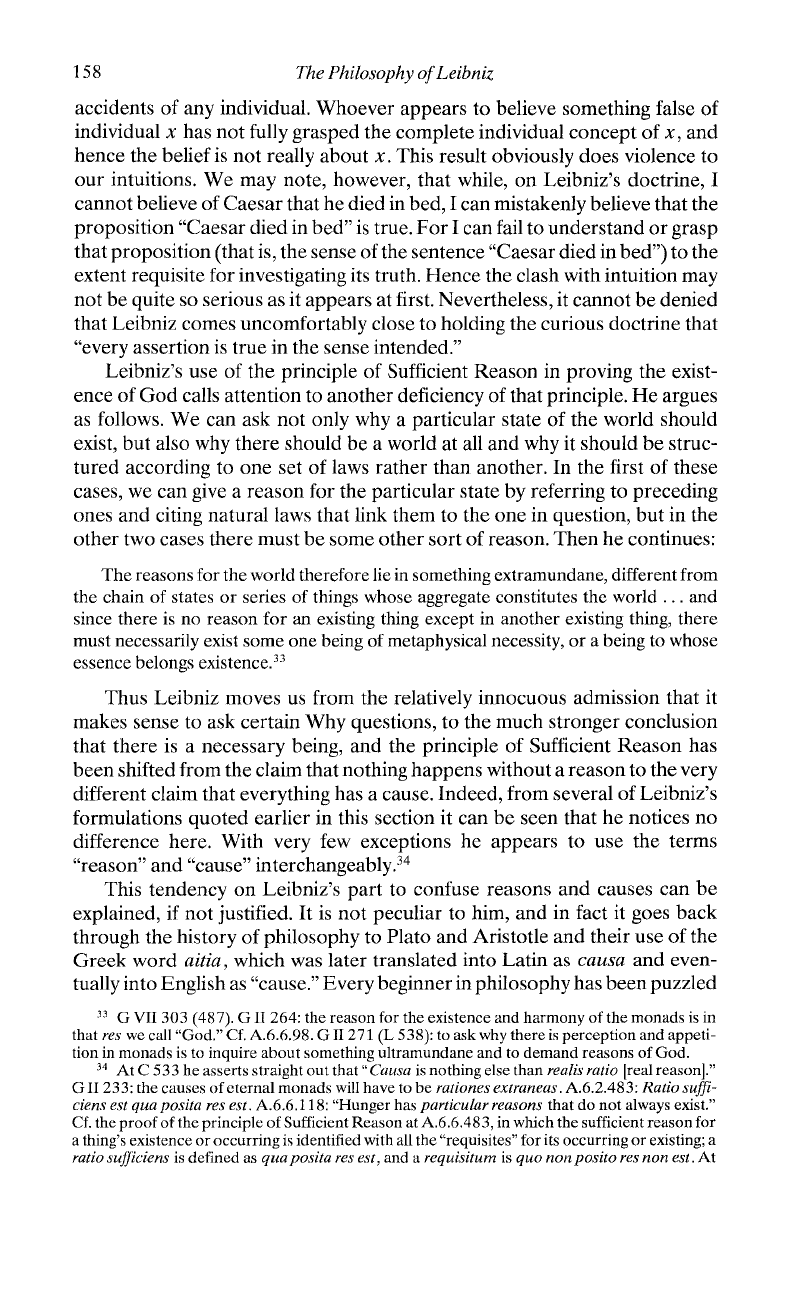
158
The
Philosophy
of
Leibniz
accidents
of any
individual. Whoever appears
to
believe something false
of
individual
x has not
fully
grasped
the
complete individual concept
of
x,
and
hence
the
belief
is not
really about
x.
This result obviously
does
violence
to
our
intuitions.
We may
note, however, that while,
on
Leibniz's doctrine,
I
cannot believe
of
Caesar that
he
died
in
bed,
I can
mistakenly believe that
the
proposition "Caesar died
in
bed"
is
true.
For I can
fail
to
understand
or
grasp
that proposition (that
is, the
sense
of the
sentence "Caesar died
in
bed")
to the
extent requisite
for
investigating
its
truth.
Hence
the
clash with intuition
may
not
be
quite
so
serious
as it
appears
at
first.
Nevertheless,
it
cannot
be
denied
that
Leibniz comes uncomfortably close
to
holding
the
curious doctrine that
"every
assertion
is
true
in the
sense intended."
Leibniz's
use of the
principle
of
Sufficient
Reason
in
proving
the
exist-
ence
of God
calls attention
to
another deficiency
of
that principle.
He
argues
as
follows.
We can ask not
only
why a
particular state
of the
world should
exist,
but
also
why
there should
be a
world
at all and why it
should
be
struc-
tured
according
to one set of
laws rather than another.
In the
first
of
these
cases,
we can
give
a
reason
for the
particular state
by
referring
to
preceding
ones
and
citing natural laws that link them
to the one in
question,
but in the
other
two
cases
there
must
be
some other sort
of
reason.
Then
he
continues:
The
reasons
for the
world therefore
lie in
something extramundane,
different
from
the
chain
of
states
or
series
of
things whose aggregate constitutes
the
world
...
and
since
there
is no
reason
for an
existing thing except
in
another existing thing, there
must
necessarily exist some
one
being
of
metaphysical necessity,
or a
being
to
whose
essence belongs
existence.
33
Thus Leibniz moves
us
from
the
relatively innocuous admission that
it
makes
sense
to ask
certain
Why
questions,
to the
much stronger conclusion
that
there
is a
necessary being,
and the
principle
of
Sufficient
Reason
has
been
shifted
from
the
claim that nothing happens without
a
reason
to the
very
different
claim that everything
has a
cause. Indeed,
from
several
of
Leibniz's
formulations
quoted earlier
in
this section
it can be
seen that
he
notices
no
difference
here. With very
few
exceptions
he
appears
to use the
terms
"reason"
and
"cause"
interchangeably.
34
This tendency
on
Leibniz's part
to
confuse reasons
and
causes
can be
explained,
if not
justified.
It is not
peculiar
to
him,
and in
fact
it
goes back
through
the
history
of
philosophy
to
Plato
and
Aristotle
and
their
use of the
Greek word
aitia,
which
was
later translated into Latin
as
causa
and
even-
tually
into English
as
"cause."
Every beginner
in
philosophy
has
been puzzled
33
G VII 303
(487).
G
II
264:
the
reason
for the
existence
and
harmony
of the
monads
is in
that
res we
call
"God."
Cf.
A.6.6.98.
GII
271
(L
538):
to ask why
there
is
perception
and
appeti-
tion
in
monads
is to
inquire about something ultramundane
and to
demand reasons
of
God.
34
At C 533 he
asserts straight
out
that"Causa
is
nothing else than
realis
ratio [real
reason]."
Gil
233:
the
causes
of
eternal monads
will
have
to be
mtiones
extmneas.
A.6.2.483:
Ratio
suffi-
cient
est qua
posita
res
est.
A.6.6.118:
"Hunger
has
particular reasons that
do not
always
exist."
Cf.
the
proof
of the
principle
of
Sufficient
Reason
at
A.6.6.483,
in
which
the
sufficient
reason
for
a
thing's existence
or
occurring
is
identified
with
all the
"requisites"
for its
occurring
or
existing;
a
ratio
sufficiens
is
defined
as qua
posita
res
est,
and a
requisition
is quo
non
posito
res
non
est.
At
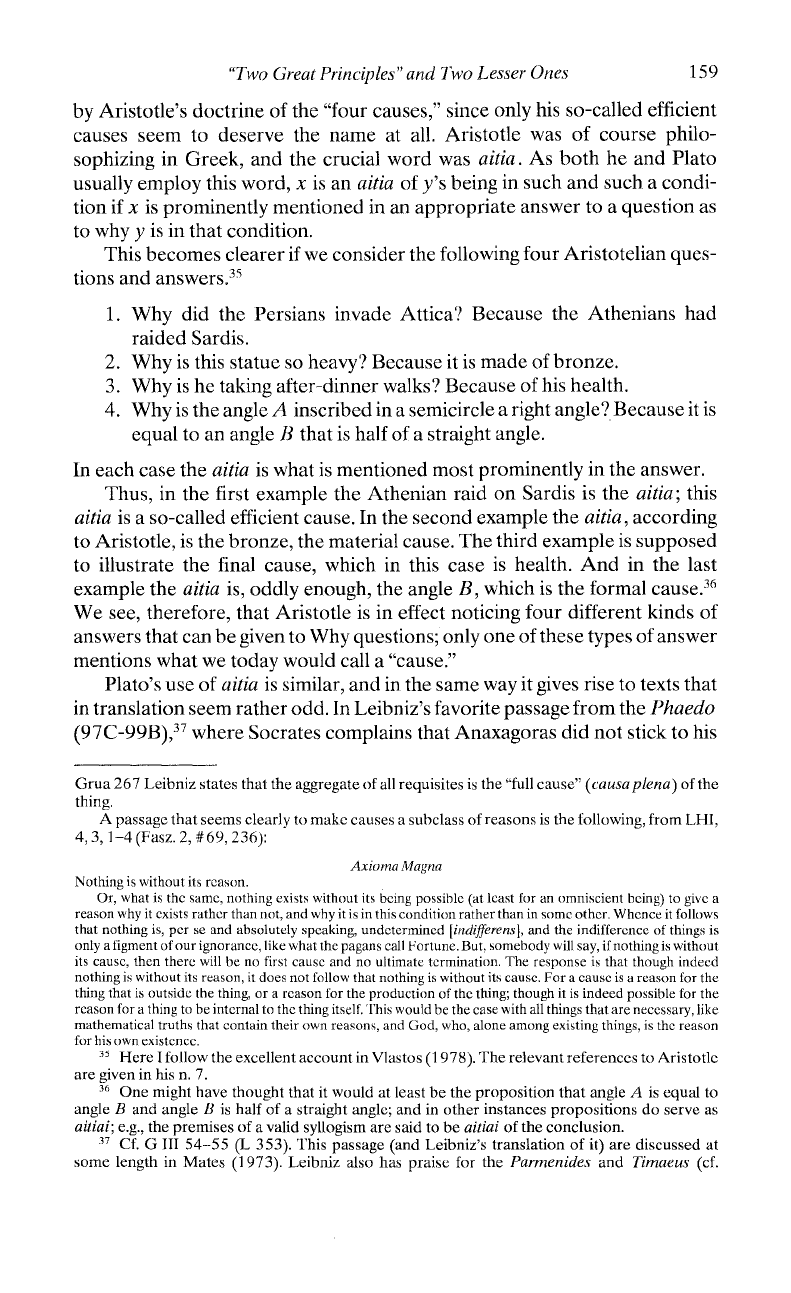
"Two
Great
Principles"
and Two
Lesser Ones
159
by
Aristotle's doctrine
of the
"four
causes," since only
his
so-called
efficient
causes seem
to
deserve
the
name
at
all.
Aristotle
was of
course philo-
sophizing
in
Greek,
and the
crucial word
was
aitia.
As
both
he and
Plato
usually
employ this word,
x is an
aitia
of
y's
being
in
such
and
such
a
condi-
tion
if x is
prominently mentioned
in an
appropriate answer
to a
question
as
to why y is in
that condition.
This becomes clearer
if we
consider
the
following
four
Aristotelian ques-
tions
and
answers.
35
1.
Why did the
Persians invade Attica? Because
the
Athenians
had
raided Sardis.
2. Why is
this statue
so
heavy?
Because
it is
made
of
bronze.
3. Why is he
taking after-dinner
walks?
Because
of his
health.
4. Why is the
angle
A
inscribed
in a
semicircle
a
right angle? Because
it is
equal
to an
angle
B
that
is
half
of a
straight angle.
In
each
case
the
aitia
is
what
is
mentioned most prominently
in the
answer.
Thus,
in the
first
example
the
Athenian raid
on
Sardis
is the
aitia; this
aitia
is a
so-called
efficient
cause.
In the
second example
the
aitia,
according
to
Aristotle,
is the
bronze,
the
material cause.
The
third example
is
supposed
to
illustrate
the
final
cause, which
in
this case
is
health.
And in the
last
example
the
aitia
is,
oddly enough,
the
angle
B,
which
is the
formal
cause.
36
We
see, therefore, that Aristotle
is in
effect
noticing four
different
kinds
of
answers
that
can be
given
to Why
questions; only
one of
these types
of
answer
mentions what
we
today would call
a
"cause."
Plato's
use of
aitia
is
similar,
and in the
same
way it
gives rise
to
texts that
in
translation seem rather odd.
In
Leibniz's favorite passage from
the
Phaedo
(97C-99B),
37
where Socrates complains that Anaxagoras
did not
stick
to his
Grua
267
Leibniz
states
that
the
aggregate
of all
requisites
is the
"full
cause"
(causaplena)
of the
thing.
A
passage
that
seems
clearly
to
make
causes
a
subclass
of
reasons
is the
following, from
LHI,
4,3,1-4
(Fasz.
2,
#69,
236):
Axioma
Magna
Nothing
is
without
its
reason.
Or,
what
is
the
same,
nothing
exists
without
its
being
possible
(at
least
for an
omniscient
being)
to
give
a
reason
why it
exists
rather
than
not,
and why it is in
this
condition rather
than
in
some
other.
Whence
it follows
that
nothing
is,
per
se and
absolutely
speaking,
undetermined
[indifferens],
and the
indifference
of
things
is
only
a
figment
of our
ignorance,
like
what
the
pagans
call
Fortune. But, somebody
will
say,
if
nothing
is
without
its
cause,
then there
will
be no
first
cause
and no
ultimate
termination.
The
response
is
that though indeed
nothing
is
without
its
reason,
it
does
not
follow
that
nothing
is
without
its
cause.
For a
cause
is a
reason
for the
thing
that
is
outside
the
thing,
or a
reason
for the
production
of
the
thing;
though
it is
indeed possible
for the
reason
for a
thing
to be
internal
to
the
thing
itself.
This
would
be the
case
with
all
things
that
are
necessary,
like
mathematical
truths
that
contain
their
own
reasons,
and
God, who, alone among
existing
things,
is
the
reason
for
his own
existence.
35
Here
I
follow
the
excellent
account
in
Vlastos
(1978).
The
relevant
references
to
Aristotle
are
given
in his n. 7.
36
One
might
have
thought
that
it
would
at
least
be the
proposition
that
angle
A is
equal
to
angle
B and
angle
B is
half
of a
straight
angle;
and in
other
instances
propositions
do
serve
as
aitiai;
e.g.,
the
premises
of a
valid
syllogism
are
said
to be
aitiai
of the
conclusion.
37
Cf. G
Iff
54-55
(L
353).
This
passage
(and
Leibniz's
translation
of it) are
discussed
at
some
length
in
Mates
(1973).
Leibniz
also
has
praise
for the
Parmenides
and
Timaeus
(cf.