
Benson М. The Philosophy of Leibniz
Подождите немного. Документ загружается.

230 The
Philosophy
of
Leibniz.
time.
As
concerns time,
the
central notion
is
obviously that
of
simultaneity.
We
should like
an
analysis
of
that relation
as
holding between
a
pair
of
monad
states
or of
states
of
bodies. But,
so far as I
know,
the
only explication that
Leibniz
offers
is the
following:
If
a
number
of
states
of
things
are
posited
to
exist which involve
no
opposition, they
are
said
to
exist
simultaneously.
Thus
we
deny that what occurred
last
year
and
what
occurred this year
are
simultaneous,
for
they involve incompatible states
of the
same
thing.
13
Now,
as was
obvious
in our
model
of the
possible worlds,
any two
monad
states
of the
same monad
are
incompatible; that
is, in
every case there
will
be
at
least
one
simple property
P
such that
one
state contains
P and the
other
contains
the
complement
of P. So the
stated criterion yields
the
trivial
result
that
no two
monad states
of the
same monad
will
be
simultaneous. Pre-
sumably
the
same holds
for the
states
of
bodies.
But
what
is
needed
is a
criterion
for the
simultaneity
of the
states
of
differ-
ent
things. With this,
Leibniz
gives
us no
help.
Rescher
14
has
suggested that,
given
two
monads
A and
B,
a
state
s,
of
A is
simultaneous with
the
uniquely
determined state
s
2
of 6
that
is
most similar
to s
t
;
but I
have
not
been able
to
find
any
text supporting this. Another suggestion
would
be to
define
a
pair
of
states
as
simultaneous
if
they "reflect"
one
another
in
some special (perhaps,
particularly
simple) way. This
is how we
arranged things
in the
model.
Leibniz does give
us a
criterion, such
as it is, for
determining which
of two
states
is
prior
and
which
is
posterior:
If
one of two
states which
are not
simultaneous involves
a
reason
for the
other,
the
former
is
held
to be
prior,
the
latter
posterior.
My
earlier state involves
a
reason
for the
existence
of my
later
state.
And
since
my
prior state,
by
reason
of the
connection
between
all
things, involves
the
prior
state
of
other things
as
well,
it
also involves
a
reason
for the
later state
of
these other things
and is
thus prior
to
them.
Therefore,
whatever exists
is
either
simultaneous
with other existences
or
prior
or
posterior}
5
Since
any
given state
of a
monad
reflects,
expresses, determines,
all
other
states
of
that monad,
future
and
past,
15
the
phrase "involves
a
reason for,"
as
used
in
this account
of
prior
and
posterior, must mean something other than
"express"
and its
synonyms.
I
suspect that Leibniz
is
once again
confusing
reasons
and
causes,
as was
discussed earlier.
13
GM VII 18 (L
666);
F
482.
14
Rescher
(1979),
85:
Rescher's chapter
"Space
and
Time: Motion
and
Infinity"
is far and
away
the
best available account
of
this entire subject.
15
GM VII 18 (L
666).
LH IV vii C
71-72 (Fasz.
1,
#54,
170-71):
"That
is
prior
by
nature
which
is
more simple
to
understand
...
of two
contradictory singular states. That which
is
prior
by
nature
is
called prior
in
time:'
Cf. LH IV vii B 2, 37
(Fasz.
1,
#37,
128-29).
G VI 215 (H
238): "The objection
is
raised that
it is
necessary
ex
hypothesi
for the
future
to
happen,
as it is
necessary
ex
hypothesi
for the
past
to
have happened.
But
there
is
this difference, that
it is not
possible
to act on a
past
state—that
would
be a
contradiction—but
it is
possible
to
produce some
effect
on the
future."
16
GIV
433 (L
308):
"There
are at all
times
in the
soul
of
Alexander traces
of all
that
has
hap-
pened
to him and
marks
of
all
that will happen
to him and
even traces
of all
that happens
in the
universe...."
Space
and
Time
231
If,
however,
in a
concession
to
ordinary usage, Leibniz
is
allowing
the
causal relation
to
hold
not
only between successive states
of one
monad
or
body
but
also, especially
in the
case
of
bodies, between states
s
l
and
s
2
of
different
things, then
the
above-quoted criterion
for
prior
and
posterior
would
apparently
justify
our
defining
one
state
as
simultaneous with another,
if
and
only
if it is
neither prior
nor
posterior
to it.
For,
as he
indicates,
his
doctrine
of the
universal interconnections
of
things implies
(1)
that
if a
state
S]
of A
involves
a
reason
for (or
cause
of) a
state
s
2
of
B,
then every state
simultaneous with
s
{
also involves
a
reason
for (or
cause
of)
every succeeding
state
of
that monad. Rescher
17
notes that
in
Process
and
Reality
Whitehead
utilized
this
way of
defining "simultaneity." Perhaps Leibniz could
follow
suit;
of
course,
the
quoted
criterion
for
prior
and
posterior already contains
the
term "simultaneous,"
but in a
seemingly inessential way.
For
space, too,
he
gives
us no
specific
characterization
or
analysis
of the
order
to
which
he
refers.
We
shall
see in the
next section that
he
thought
he
could
define
a
wide variety
of
geometric
figures
in
terms
of a
single quater-
nary
distance relation that holds among
x,y,z,
and u
when
x is as far
from
y
as
z is
from
u. It
would
be
interesting
to
have
at
least some hints
of
just what
sorts
of
individual accidents
he
thought
x, y, z, and u
must have
in
order
to
stand
in
that relation.
When
all is
said
and
done, what
is
most clear about Leibniz's views
on
space
and
time
is
that
he
considers
the
spatial
and
temporal relations
of
things
in the
actual world
to be
completely determined
in
each case
by the
individual
accidents
of the
relata.
In
deciding
to
create
those
particular
things,
God eo
ipso
decided
how
they would
be
spatially
and
temporally
related
to one
another.
18
Other possible worlds have other
"spaces"
and
"times,"
but
there
is no
distance between
the
things
in the
nonactual worlds
and
those
in
ours, nor, presumably,
is
their
any
simultaneity relation between
the
different
time series.
That other possible worlds have their
own
times
and
spaces
is
stated
explicitly
in an
opuscule written
in
1686.
19
Leibniz
first
notes,
in a
manner
reminiscent
of
Berkeley
and
Hume, that
we can
make judgments about
the
existence
of
physical objects only
on the
basis
of
what
he
calls "the congru-
ence"
of
perceptions.
20
It is by our
awareness
of the
lack
of
such congruence
that
we
distinguish between
our
waking
and our
dreaming experiences.
Further,
he
explains that
"to
perceive
congruently
is to
perceive
in
such
a way
that
a
reason
can be
given
for
everything
and
everything
can be
predicted."
21
17
Rescher (1979),
105
n. 2.
18
G VII 405 (L
707): "Thus
it
appears
how we are to
understand
that
God
created
things
at
what
time
he
pleased,
for
this
depends upon
the
things
which
he
resolved
to
create.
But
things
being
once
resolved
upon,
together
with
their
relations,
there
remains
no
longer
any
choice
about
the
time
and the
place,
which
of
themselves
having
nothing
in
them
real,
nothing
that
can
distinguish
them,
nothing
that
is at all
discernible."
19
Jag
105-18.
20
Jag
106.
21
Jag
108.
232 The
Philosophy
of
Leibniz
Then, repeating that
"we
call body whatever
is
perceived
congruently,"
he
continues:
and [we
call]
space
that which makes many perceptions cohere
with
one
another
at the
same
time—for
example,
I go by one
route
to a
certain place,
by
another
to
another,
and by a
third
to a
third,
and so on;
then, assuming
the
unity
of
space
I
calculate
how
much
time
it
will take
me to go
from
one of the
remaining
places
to
another.
The
idea
of
space,
therefore,
is
that
by
which...
we
separate
the
place and,
as it
were,
the
world
of
dreams
from
ours....
It
follows
that
a
perception
is
different
from
the
cause
of its
con-
gruence.
And it
follows
further,
on the
assumption that there
are
minds
having
percep-
tions
not
congruent with ours, that there
can be an
infinity
of
other spaces
and
other
worlds
which
are
such that there
is no
distance between them
and
ours.
And as the
world
and
space
of
dreams
differ
from
ours,
so too
they could have other
laws
of
motion....
Whoever asks whether there could
be
another world
and
another space
is
just
asking whether there
are
[better, could
be]
minds having nothing
in
common
with
our
own.
22
In
the New
Essays,
too, Leibniz says that space
and
time concern
the
possible
as
well
as the
actual.
23
We
have seen that although each monad
has in
some metaphorical sense,
"ut
sic
dicam,"
a
"point
of
view," Leibniz prefers
to say
that
the
proper
in-
habitants
of
space
are
bodies,
not
monads.
24
Further,
he
holds that space
and
time
are
continuous,
from
which
he
infers
that their parts, which
(by the
definition
of
"part") must
be
homogeneous with them,
are
also continuous.
As
continuity implies infinite divisibility, their parts must also
be
infinitely
divisible.
Leibniz seems
to
suppose
further
that whatever
is in
space occupies
a
part
of
space
and
must itself
be
infinitely
divisible;
of
course, only bodies,
not
monads,
satisfy
this
condition.
25
He
does agree, however, that
in a
deriva-
tive
sense
a
monad
can
have
a
position
in
phenomenal space through that
of
the
body
it
dominates.
26
Perhaps this
is the key to
reconciling some
of the
apparent inconsistencies
in his
account.
As for the
dispute with Newton,
one of the
clearest
and
most succinct
22
Jag
114.
23
A.6.6.153-54.
GIV
491:
Space
is an
order
of
possibles
as
well
as of
actuals.
24
Russell
(R
122) appears
to be
correct
in
asserting that when Leibniz
was
young,
he
regarded
minds
as
occupying points
in
space, while later
he
denied this.
In
support, Russell cites
G II 372
(where Leibniz himself says
as
much)
and
G152-54,
61.
Typical statements
of the
later
view
are
GII
444 (L
602):
"In
themselves monads have
no
situation
[situs]
with respect
to
each
other, that
is, no
real
order
which
reaches
beyond
the
order
of
phenomena,"
and
GII
370:
"I do
not
consider
it
fitting,
however,
to
think
of
souls
as if
they were
in
points."
Cf.,
on the
other
hand,
GII339(L255):"A
simple substance, though
it has no
extension
in
itself,
yet has
position, which
is
the
foundation
of
extension,
since extension
is the
simultaneous continuous repetition
of
posi-
tion."
Cf.
GII253
(L
531).
Other
relevant texts
are
GII451
(L
604),
G III
357,623,
G
VII366
(L
683),
C
15.
For
contrary evidence,
see G
VI107
(H
128),
where
Leibniz implies that
different
possible worlds
are
obtained
by
filling
time
and
space
in
different
ways,
and G
VI54
5 (L
5
90).
In
sec.
8 of the
Monadology
(G VI
608), which
was
written
in
1714,
Leibniz
seems again
to
imply
that monads exist
in
space,
or, at
least,
if
monads
were
indistinguishable, then "when
motion occurred, each
place
would always only receive
the
equivalent
of
what
it had
before,
and
one
state
of
things would
be
indistinguishable
from
another."
25
Cf.PLR164ff.
26
GII
253
(L
531).
Space
and
Time
233
statements
of the
Leibnizian objection
to the
notion
of
absolute space
and
time
is
found
in the
third letter:
I
say, then, that
if
space
was an
absolute being,
there
would something happen
for
which
it
would
be
impossible
there
should
be a
sufficient
reason. Which
is
against
my
axiom.
And I can
prove
it
thus. Space
is
something absolutely uniform and, without
the
things
placed
in it, one
point
of
space
does
not
absolutely
differ
in any
respect whatso-
ever
from
another point
of
space.
Now
from
hence
it
follows (supposing space
to be
something
in
itself,
besides
the
order
of
bodies among
themselves)
that 'tis impossible
there should
be a
reason
why
God, preserving
the
same situations
of
bodies
among
themselves, should have placed them
in
space
after
one
certain particular manner
and
not
otherwise;
why
everything
was not
placed
the
quite contrary way,
for
instance,
by
changing east into west.
But if
space
is
nothing else
but
that
order
or
relation,
and is
nothing
at all
without bodies
but the
possibility
of
placing them, then those
two
states,
the one
such
as it now is, the
other
supposed
to be the
quite contrary way, would
not at
all
differ
from
one
another.
Their
difference
therefore
is
only
to be
found
in our
chi-
merical
supposition
of the
reality
of
space
in
itself.
But in
truth
the one
would
be
exactly
the
same thing
as the
other, they being absolutely indiscernible,
and
con-
sequently
there
is no
room
to
inquire
after
a
reason
of the
preference
of the one to the
other.
27
Actually,
this statement seems
to
contain
two
interwoven arguments,
one
showing
that
the
supposition
of
absolute space would violate
a
form
of the so-
called principle
of
Sufficient
Reason,
and the
other showing that
it
would
violate
the
principle
of the
Identity
of
Indiscernibles. Since Leibniz thought
that
the
principle
of the
Identity
of
Indiscernibles
followed
from
the
principle
of
Sufficient
Reason,
28
it is not
surprising that
he
mentions both
of
them here.
The
first
argument
is as
follows.
To
suppose, with Newton, that space
exists
independently
of the
bodies that
are
located
in it is to
suppose that
at
the
creation
of the
physical world
God did
something without having
a
suffi-
cient
reason; namely,
he
placed
the
universe
in
space
in its
present orienta-
tion
rather than
in
some other that would have conserved
all the
relative
distances
and
directions
of the
constituent bodies.
The
second argument,
more interesting
to us
because
it is
less theological,
is
that
if
Newton's view
is
correct,
at
least
two
distinct states
of
affairs
were possible: one, that
the
physical universe
be
situated
in
space
in its
present orientation;
the
other, that
it
should instead
be in the
situation that would result
from
rotating
it 180
degrees around
a
north-south
axis
while keeping
all
internal spatial relations
the
same.
But the
consequent
is
false,
for the
supposedly distinct states
of
affairs
would
be
indiscernible
and
hence identical.
Similarly,
Leibniz says,
if God
changed
the
size
of
everything
in the
same
proportion,
the
bodies
we use as
measures would
be
equally
affected
with
all
the
rest,
and
hence
we
could
not
know
how
much things
had
been changed.
The
implication again
is
that
the
supposed change
is
chimerical,
and
that
the
two
hypothetical states
are
identical.
29
Leibniz carries over
the
same arguments
in the
case
of
time.
To
suppose
27
G
VII
364
(L
682).
28
G VII 372 (L
687).
2
*
GM
VII
276.
234 The
Philosophy
of
Leibniz
that
God
might have created
the
same world some millions
of
years sooner,
he
says,
is to
suppose that
God
might
do
something without
a
reason,
and it is
also
to
suppose that
at the
Creation
God had
before
him
various distinct
but
indiscernible
possibilities.
30
Likewise,
the
supposition that time could
be
stretched, with
all
durations increased proportionally,
is a
vacuous hypo-
thesis,
and it is
absolutely impossible
for
there
to be
times
in
which nothing
is
happening.
31
In
other formulations
of the
arguments that depend
on the
Identity
of
Indiscernibles, Leibniz comes close
to
employing what
is now
called
the
Verifiability
criterion
of
meaning:
I
have
demonstrated
that
space
is
nothing
else
but an
order
of the
existence
of
things,
observed
as
existing
together;
and
therefore
the
fiction
of a
material
finite
uni-
verse
moving
forward
in an
infinite
empty
space
cannot
be
admitted.
It is
altogether
unreasonable
and
impracticable.
For, besides
that
there
is no
real space
out of the
material
universe,
such
an
action
would
be
without
any
design
in it; it
would
be
work-
ing
without
doing
anything,
agenda
nihil
agere.
There
would
happen
no
change
which
could
be
observed
by any
person
whatsoever.
32
Again,
"Motion does
not
indeed depend upon being observed;
but it
does
depend upon
it
being possible
to be
observed.
There
is no
motion when
there
is
no
change that
can be
observed.
And
when there
is no
change that
can be
observed, there
is no
change
at
all."
33
And,
"There
is no
mark
or
difference
whereby
it
would
be
possible
to
know that this world
was
created
sooner."
34
In
all
these passages Leibniz seems clearly
to be
implying
that
any
circum-
stance
not
observable
in
principle
is a
circumstance that cannot
exist.
35
This
is
not
quite
the
Verifiability criterion
of
meaning,
but
note that Leibniz, like
many
other philosophers before
and
since,
often
supposes that there
are no
such
things
as
impossible
concepts
and
hence that
the
linguistic forms pur-
porting
to
express such concepts
are in
fact
meaningless.
In
still
other texts, Leibniz asserts
flatly
that there
was no
time before
the
world
began,
"so
that
the
question
why it did not
begin sooner
is
otiose."
36
1
suppose
that
he
would
not
have cared much whether
the
propositions (better,
sentences)
in
question
are
classified
as
nonsense
or as
necessarily
and
trivially
false.
There
is, of
course, more
to
Leibniz's doctrine about space, time,
and
motion than
the
mere assertion that they
are
relative. Like
all
other relations,
these
kinds
of
relation
are
purely ideal, founded
on the
accidents
of the
par-
ticulars
related.
37
For
example,
if we can say
truly that
'A
is two
feet
from
B',
3(1
G VII 373 (L
688);
cf. G VII 364 (L
682-83),
GII
515.
31
G
VII
415
(L
714).
32
G
VII
395-96
(L
700).
33
G
VII
403
(L
705).
34
G
VII
404-5
(L
705-6).
35
Jag
14
(December
1675):
"To be
\esse\
is
nothing
else
than
to be
capable
of
being per-
ceived
[percipi
posse]."
36
Grua270.
37
G VII 396 (L
701).
For
Leibniz,
of
course, when objects
are in
relative motion,
it
makes
Space
and
Time
235
then
there must
be
some (nonrelational) qualities
of A and B
(and possibly
other bodies) that make this proposition true.
But
unfortunately
we are
given
no
details
or
even clues
as to
how,
in
general, propositions about space, time,
and
motion
are to be
reduced
to
propositions ascribing qualities
to the
bodies
concerned. (Paradoxically, Newton, though seemingly defeated
in his
argu-
ment with Leibniz about these matters, with
his
famous bucket experiment
provided
an
empirical criterion,
the
shape
of the
surface
of the
water
in the
bucket,
for
determining whether
the
water
was in
motion
or at
rest—
seemingly
just
the
sort
of
property
for
which
Leibniz
was
asking.)
Finally, with respect
to
relativity
we
must note with
Rescher
38
that
Leibniz
can
hardly
be
regarded
as a
precursor
of
Einstein
and
modern rela-
tivity
theory,
for
such notions
as
that
the
duration
of a
time interval between
two
events depends
on the
frame
of
reference
in
which
the
events
are
observed,
or
that
the
inertia!
mass
of a
body
is
different
for
observers whose
velocities
relative
to
that body
are
different,
are
completely
foreign
to
Leibniz's
way of
thinking.
2.
Analysis Situs
Writing
in the
summer
of
1716
to des
Bosses, Leibniz adds
an
interesting
comment
to his
usual point about
the
relativity
of
space:
If
someone tries
to
conceive
the
whole
universe
moved
in
space
while
the
distances
of
things
from
one
another
are
preserved,
he
will
not
succeed,
for
absolute space
is
something
imaginary
and
there
is
nothing
real
in it
except
the
distance
of
bodies
,
39
Perhaps this
view—that
given
the
distances
of
things
from
one
another,
all
other spatial
facts
about them
are eo
ipso
determined—is
part
of
what moti-
vated Leibniz
to
create
his
analysis
situs,
a
scheme
for
reducing
all
geometri-
cal
propositions
to
propositions about
the
distance
of
points
from
one
another.
In
an
early letter
to
Huygens
40
he
indicates
his
dissatisfaction with
the
usual
algebraization
of
geometry,
and he
says
that what
is
needed
is a
nota-
tion that directly expresses situs (the situation
of
points relative
to one
another)
in the way
that algebra expresses magnitude. With
an
appropriately
no
literal
sense
to ask
which
of
them
are
really
in
motion
and
which
really
at
rest.
But he has a
cri-
terion
to
explain ordinary usage,
in
which
we do ask
such questions.
GII
473:
"That
object
is
said
to
be
moved
which
has in it the
cause
of
change
of
position,
or
from which
a
reason
can be
given
for
its
exchange
of one
position
for
another—and
if it
yields
a
sufficient
reason, then
it
alone
is in
motion
and the
others
are at
rest, while
if it
yields less than
a
sufficient
reason,
all are in
motion
at
once."
He
clearly
has in
mind
examples such
as a
ship moving relative
to the
sea.
Cf. G
VII400-
401
(L
703-4).
38
Rescher
(1979),
84.
39
GII
515.
This
was one of the
last
letters
Leibniz wrote.
At the
close
he
apologizes
to des
Bosses
for his
shaky handwriting.
40
GMII17ff.
(L
248
ft).
236 The
Philosophy
of
Leibniz
designed calculus utilizing such
a
notation,
it
would
be
possible
to
prove
geometrical theorems simply, directly,
and
rigorously, instead
of via the
com-
plications
of
analytic
geometry
and the
sloppy
inferences
from figures
and the
informal
explanatory remarks that accompany ordinary geometrical proofs.
Leibniz
says
that
he has
found
such
a
notation.
He
tells Huygens that
he is
apprehensive lest
his
idea
of an
analysis situs
be
lost
if he
does
not
have
the
time
to
carry
it
out,
and for
that reason
he is
sending along
"an
essay which
seems
to me to be
important
and
which
will
at
least
suffice
to
make
my
plan
more plausible
and
easier
to
understand."
He
adds, "If, therefore, some
cir-
cumstance prevents
its
perfection
at
present, this essay
will
serve
as a
witness
to
posterity
and
give occasion
for
someone else
to
carry
it
through."
In the
accompanying
essay
41
Leibniz explains
the
mutual "situation"
(situs)
of a
finite
set of
points
in
three-dimensional Euclidean space essen-
tially
as
follows.
The
points
x^,
x
2
,
...
,
x
n
have
the
same situation among
themselves
as the
corresponding points
y
{
,
y
2
,
...
,
y
n
have among
themselves—in
symbols
jc
l5
x
2
,..
.,x
n
*
y
{
,y
2
,
• •
.,;y
n
—if
and
only
if
the
figure
obtained
by
joining with straight lines
all
pairs
of
points
jc
;
,
JC
y
is
congruent with
the
figure
obtained
by
joining
all
corresponding pairs
of
points
y
h
y
t
.
For
example,
the
vertices
of the
triangle
ABC in
that order have
the
same situa-
tion
as the
corresponding verticles
of the
triangle DEF, that
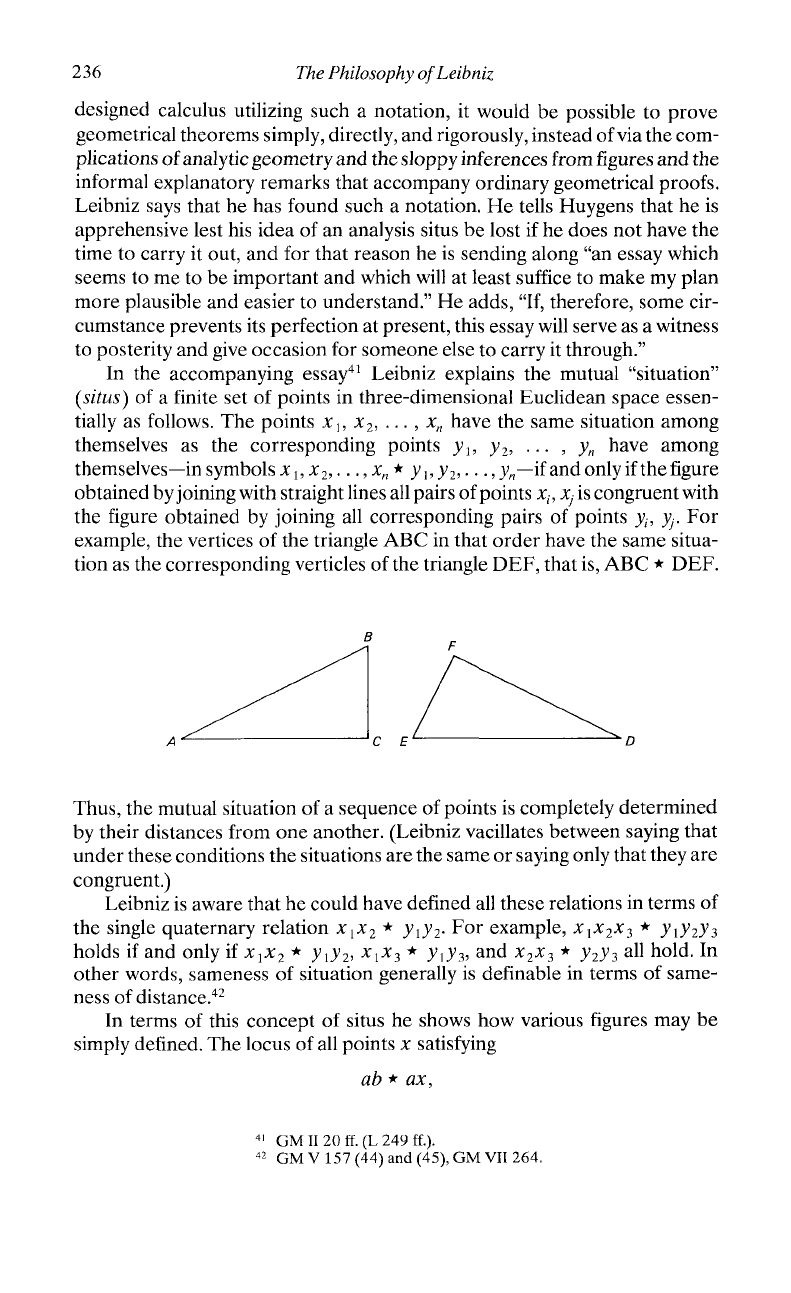
is, ABC *
DEF.
Thus,
the
mutual situation
of a
sequence
of
points
is
completely determined
by
their distances from
one
another. (Leibniz vacillates between saying that
under these conditions
the
situations
are the
same
or
saying only that they
are
congruent.)
Leibniz
is
aware that
he
could have defined
all
these relations
in
terms
of
the
single quaternary relation
x
l
x
2
*
y\y-i-
For
example,
x
l
x
2
x
3
*
y^-iy?,
holds
if and
only
if
x-
[
x
2
*
yiy
2
,
*i*3
*
y\y?»
and
x
2
x
3
*
y
2
y
3
all
hold.
In
other words, sameness
of
situation generally
is
definable
in
terms
of
same-
ness
of
distance.
42
In
terms
of
this concept
of
situs
he
shows
how
various figures
may be
simply
defined.
The
locus
of all
points
x
satisfying
ab
* ax,
41
GMII
20 ff.
(L
249
ff.).
42
GM
V
157
(44)
and
(45),
GM
VII
264.
Space
and
Time
237
where
a and b are
given distinct points,
is the
surface
of a
sphere whose
center
is the
point
a and
whose radius
is the
line
ab.
The
locus
of all
points
x
such
that
ax*
bx,
where again
a and b are
distinct points,
is a
plane bisecting
the
line
ab and
perpendicular
to it. For any
three
non-colinear
points
a, b, c, the
locus
of all
points
x
such that
ax
* bx *
ex
is
a
straight
line.
43
And a
circle
is the
locus
of all
points
x
satisfying
abc
*
abx,
where again
a, b, c are
three distinct points.
The
center
of
this circle
will
lie on
the
line
ab,
and the
circle
will
be in a
plane perpendicular
to
that line.
Using these definitions, Leibniz demonstrates some theorems about
intersections.
44
Typical
is the
following
proof
of the
theorem that
the
inter-
section
of a
plane
and a
sphere
is a
circle.
45
Let the
point
a be the
center
of the
sphere;
let the
line
ab be
per-
pendicular
to, and
bisected
by, the
intersecting plane;
and let c be any
point
on the
intersection
of the
sphere
and the
plane. Thus this intersection
is the
locus
of all
points
x
such
that
ax * bx and ac *
ax.
Since
c
lies
on the
inter-
section,
we
have
ac
*
be.
Now,
suppose
(1)
ax*
bxandac*
ax.
Then
be
* ax
(since
ac *
be),
and
hence
be*
bx.
Adding
to
this
the
trivial
ab *
ab,
we
have
the
three congruences
ab *
ab,
be
* bx, ac *
ax,
from
which
follows,
by
"composition,"
46
(2\
^
'
abc*
abx.
Therefore,
(1)
implies (2),
and the
locus
of all
points
satisfying
(1) is
included
in
the
locus
of all
points
satisfying
(2), which latter
is a
circle. Leibniz omits
43
At GM
VII262
he
defines
'x
lies
on the
straight line
ab'
as
'(y)((xa
*
ya
& xb * yb)
->
x =
y)'
or as
'(y)((abx
+
aby)
-»
x
=
y)'.
44
Cf.C550.
45
GM II
24-25
(L
253). Leibniz ignores
the
limiting cases.
4
"
See n. 42
above.
238 The
Philosophy
of
Leibniz
the
argument
to
show that, conversely,
(2)
implies
(1),
perhaps regarding
it as
too
trivial.
Huygens
was not
impressed
by
this.
At
first
he did not
even bother
to
reply,
but
after
another letter
from
Leibniz
he
responded with
the
observa-
tion that
the
theorems Leibniz
had
managed
to
prove were
not
exactly news
to
geometricians;
and in a
fatherly
tone
he
advised
him to
quite wasting
his
valuable
time
on
such things. Leibniz wrote back that
his
calculus
had two
great advantages:
First,
with
this
calculus
I can
express
perfectly
the
whole
nature
and
definition
of
the
figure
(which
algebra
can
never
do,
for,
saying
that
x
2
+
y
2
=
a
2
is the
equation
of a
circle,
it has to
explain
by a
diagram
what
x and y
are,
that
is,
that
they
are
straight
lines
perpendicular
to one
another
and
that
one
comes
from
the
center
of
the
circle,
the
other
from
the
circumference).
1 can do
this
for all
figures,
for all of
them
can be
defined
in
terms
of
spheres, planes,
circles,
and
straight
lines,
for
which
I
have
already
done
it. The
points
of the
other
curves
can
always
be
found
by
means
of
straight
lines
and
circles.
Also,
every
machine
is
only
a
certain
figure,
which
I can
describe
with
this
notation,
and I can
explain
the
change
of
situation
it
makes,
that
is, its
movement.
Second,
when
one can
express
perfectly
the
definition
of a
thing,
one can
also
find
all
its
properties.
This
notation
will
serve
well
for
finding
beautiful
constructions,
because
the
construction
and the
calculus
correspond—though
I do not
claim
that
by
means
of
it
one can
always
find
the
very
most
beautiful
construction.
I
confess,
however,
that
argumentation
is
ineffective
here,
and
that
it
would
be
more appropriate
to do
these
things
than
to
prove
them
feasible.
47
Huygens
was
still
not
persuaded,
and
after
one
more
try
Leibniz gave
up
on
him.
But the
Nachlass contains numerous other letters
in
which,
over
the
remainder
of his
life,
Leibniz tried
to
convince some
of his
other correspond-
ents (for example,
Tschirnhaus,
Arnauld, Jakob Bernoulli, Placcius,
Remond,
and
L'Hospital)
48
of the
value
of his
calculus.
He
also wrote several short essays about
it.
In
one of
these
he
achieves
some additional generality
by
introducing, along with
the
relation
of
congru-
ence
or
sameness
of
situation, that
of
similarity.
49
This
is
defined
in
terms
of
the
more general notions
of
quantity
(or
magnitude)
and
quality. Leibniz
explains that
a
quantitative sameness
or
difference
of two
things
is one
that
can
only
be
ascertained
by
observing them together
or by
comparing each
with
some third thing, whereas
a
qualitative sameness
or
difference
can be
ascertained
by
observing them
singly.
50
If two
things
differ
at
all, they
differ
in
quantity
or in
quality
or in
both. Therefore,
if two
different
things
do not
differ
in
quality, they
differ
only
in
quantity
and
hence
can be
distinguished
from
one
another
only
by
observing them together
or by
comparing them
with
a
third thing.
Leibniz defines things
as
similar
if
they
do not
differ
in
quality,
and as
47
GM
ii
30-31.
48
References
to
these letters
are
given
on pp.
614-15
of
Freudenthal
(1954).
49
GMV
178-83
(L
254-58).
50
GM
VII18-19
(L
667).
Space
and
Time
239
equal
if
they
do not
differ
in
quantity.
51
Since
form
(shape)
is the
only quality
of
geometric
figures,
a
pair
of
such
figures
will
have
the
same
shape
if and
only
if
they
cannot
be
distinguished
without observing
them
together
or
compar-
ing
them with another
figure.
52
Figures
are
congruent
if
they
are
similar
and
equal.
53
It
follows,
Leibniz says, that
if two
geometric
figures
are
similar, every
ratio
of
parts
in the one
will
be the
same
as the
ratio
of the
corresponding
parts
in the
other; otherwise
a
distinction would appear even when each
was
viewed
by
itself.
54
For
instance,
a
pair
of
nonsimilar
triangles might
be
singly
distinguishable because
in one of
them,
but not in the
other,
the
ratio
of the
longest
to the
shortest side
is
2:1.
On the
basis
of
these explanations, Leibniz endeavors
to
establish such
very
general propositions
as
that
the
perimeters, areas,
and
volumes
of
similar
figures
are
proportional
to the
lengths, squares,
and
cubes
of the
corresponding sides.
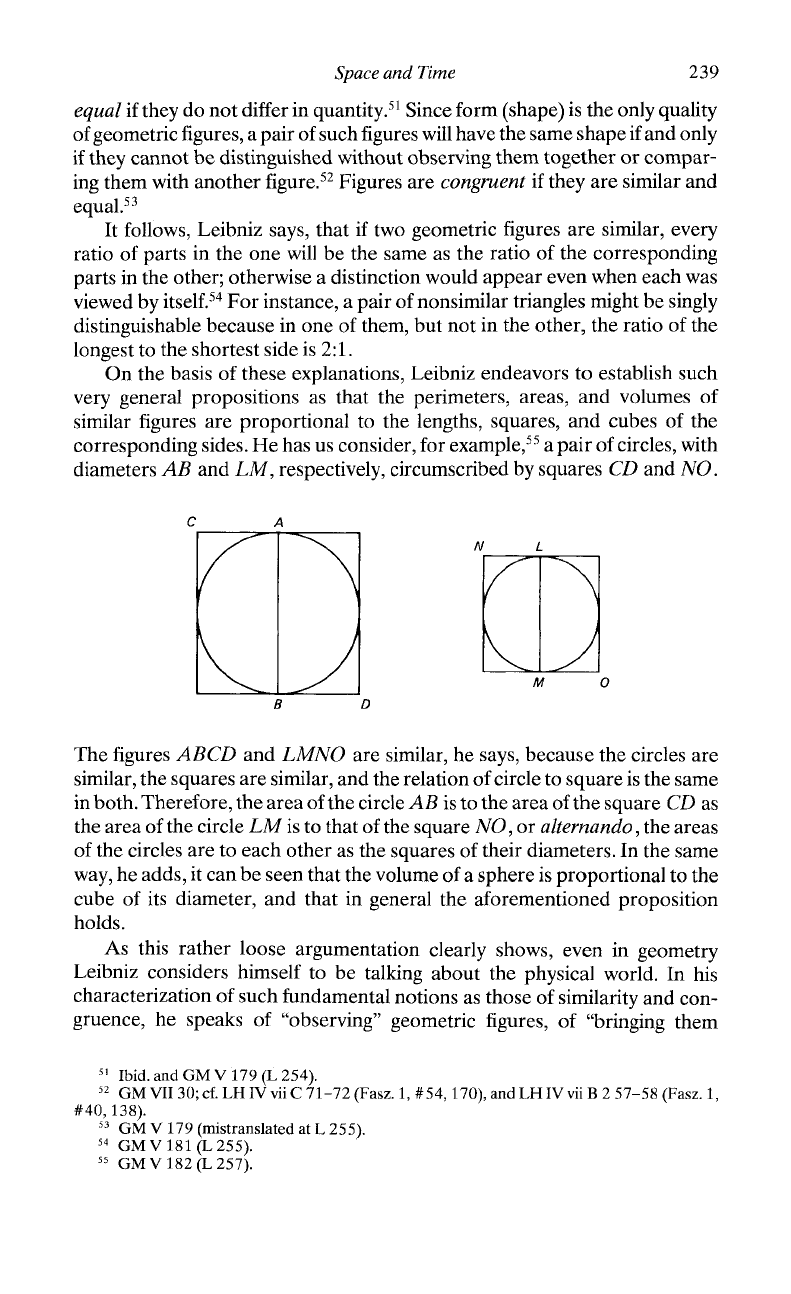
He has us
consider,
for
example,
55
a
pair
of
circles,
with
diameters
AB and LM,
respectively, circumscribed
by
squares
CD and
NO.
The
figures
ABCD
and
LMNO
are
similar,
he
says, because
the
circles
are
similar,
the
squares
are
similar,
and the
relation
of
circle
to
square
is the
same
in
both.
Therefore,
the
area
of the
circle
AB is to the
area
of the
square
CD as
the
area
of the
circle
LM is to
that
of the
square
NO,
or
alternando,
the
areas
of
the
circles
are to
each other
as the
squares
of
their diameters.
In the
same
way,
he
adds,
it can be
seen that
the
volume
of a
sphere
is
proportional
to the
cube
of its
diameter,
and
that
in
general
the
aforementioned proposition
holds.
As
this rather
loose
argumentation clearly shows, even
in
geometry
Leibniz considers
himself
to be
talking about
the
physical world.
In his
characterization
of
such fundamental notions
as
those
of
similarity
and
con-
gruence,
he
speaks
of
"observing" geometric
figures,
of
"bringing them
51
Ibid,
and
GM
VI79
(L
254).
52
GM VII 30; cf.
LHIV
vii C
71-72
(Fasz.
1,
#54, 170),
and
LHIV
vii B 2
57-58
(Fasz.
1,
#40,138).
53
GMV 179
(mistranslated
at
L
255).
54
GMV181(L255).
55
GMV182(L257).