
Boults Е. Illustrated history of landscape design
Подождите немного. Документ загружается.

67
15th CENTURY / CENTRAL ASIA
Clavijo described
many royal fetes
e garden is very
d with many
others that
throughout are
paths…. In the
ce here was built a
und plan of which
In Islam, as in many other r
eligions,
paradise is symbolized as a garden.
A chahar-bagh is often called a para-
dise garden (its runnels representing
the rivers of milk, honey, water, and
wine mentioned in the Quran), but
the symbolic geometry predates
the advent of Islam. In pre-Islamic
Persian iconography, crossed axes
represented the four corners of the
world, marked with a spring at its
center. The evolution of the chahar-
bagh as a model of paradise parallels
the etymology of the English word
paradise: its Greek root, parade-
isos (park) derives from the Persian
pairidaeza (walled enclosure). The
elaborate paradise gardens of the
Mughal Empire in India and Kashmir,
founded by Babur, are described in
chapter fi ve.
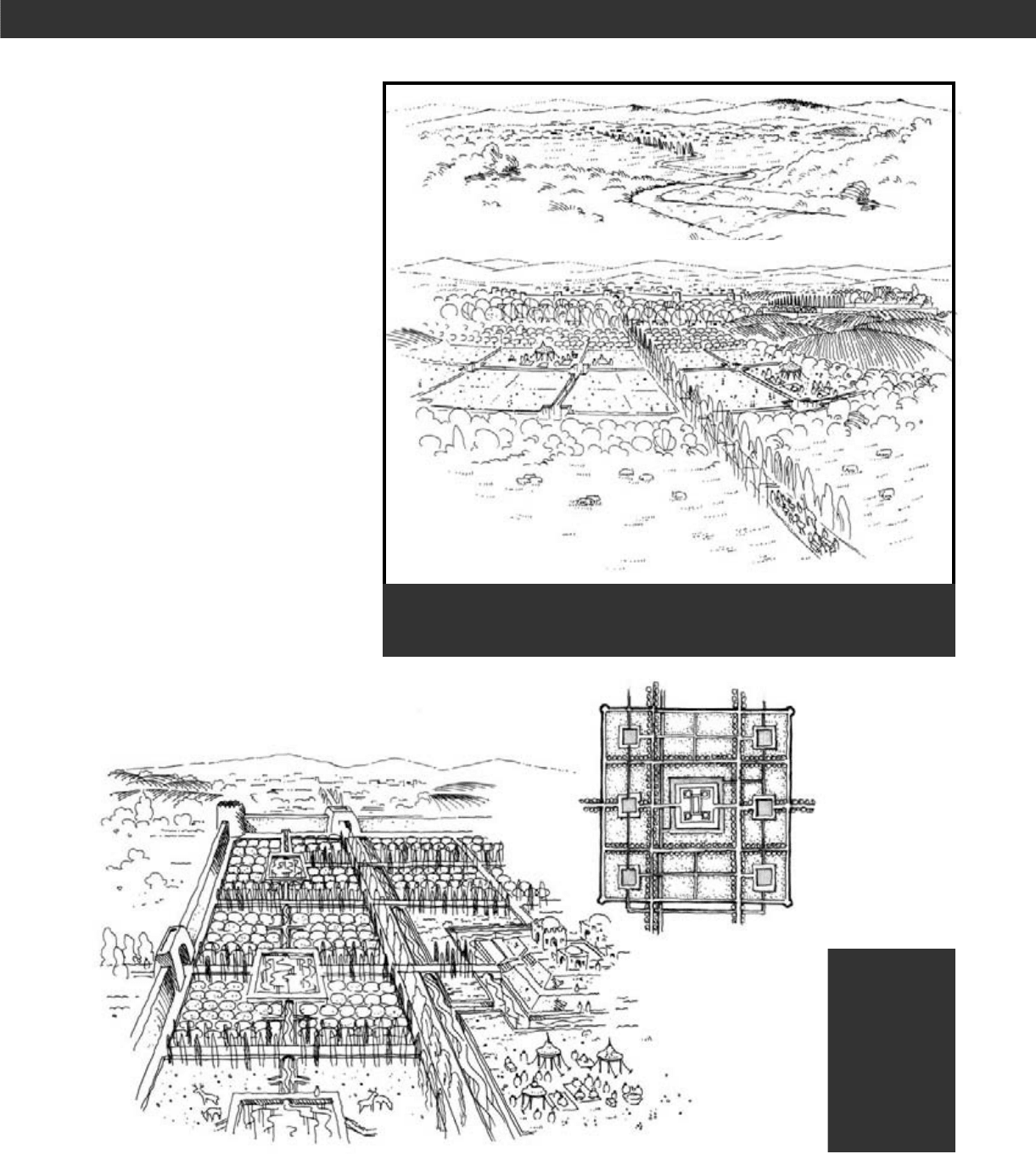
TRANSOXIAN VALLEY: Clavijo described the city of Herat: “It stands in the plain,
and on all sides the land is well irrigated by streams and water channels, while round
and about the city there are orchards with many homesteads.”
12
68
15th CENTURY / ITALY
CURIOUS MINDS, BROADENED VISTAS
Italy was the locus of transformation
from the close-mindedness of medieval
thinking to the expansiveness represen-
tative of 15th-century thought. Many
factors contributed to this cultural
shift. Geographically, the Italian penin-
sula benefi ted from connections to both
the East and the West. New ideas and
goods entered Italy as a result of the
Crusades. As the economy changed,
feudal estates dissolved, enabling land
ownership by the rising middle class.
Florence was the center of humanist
thought, the cradle of early Renais-
sance activity. Humanism described
a trust in human intellect, a belief
in the creative abilities and rational
capacities of human beings. The focus
of inquiry was not so much on the
next world, on the nature of God or
of heaven, but on the present context
of earthly life and on the social and
political relationships of the real world.
People’s views of nature changed ac-
cordingly. Humanists believed that the
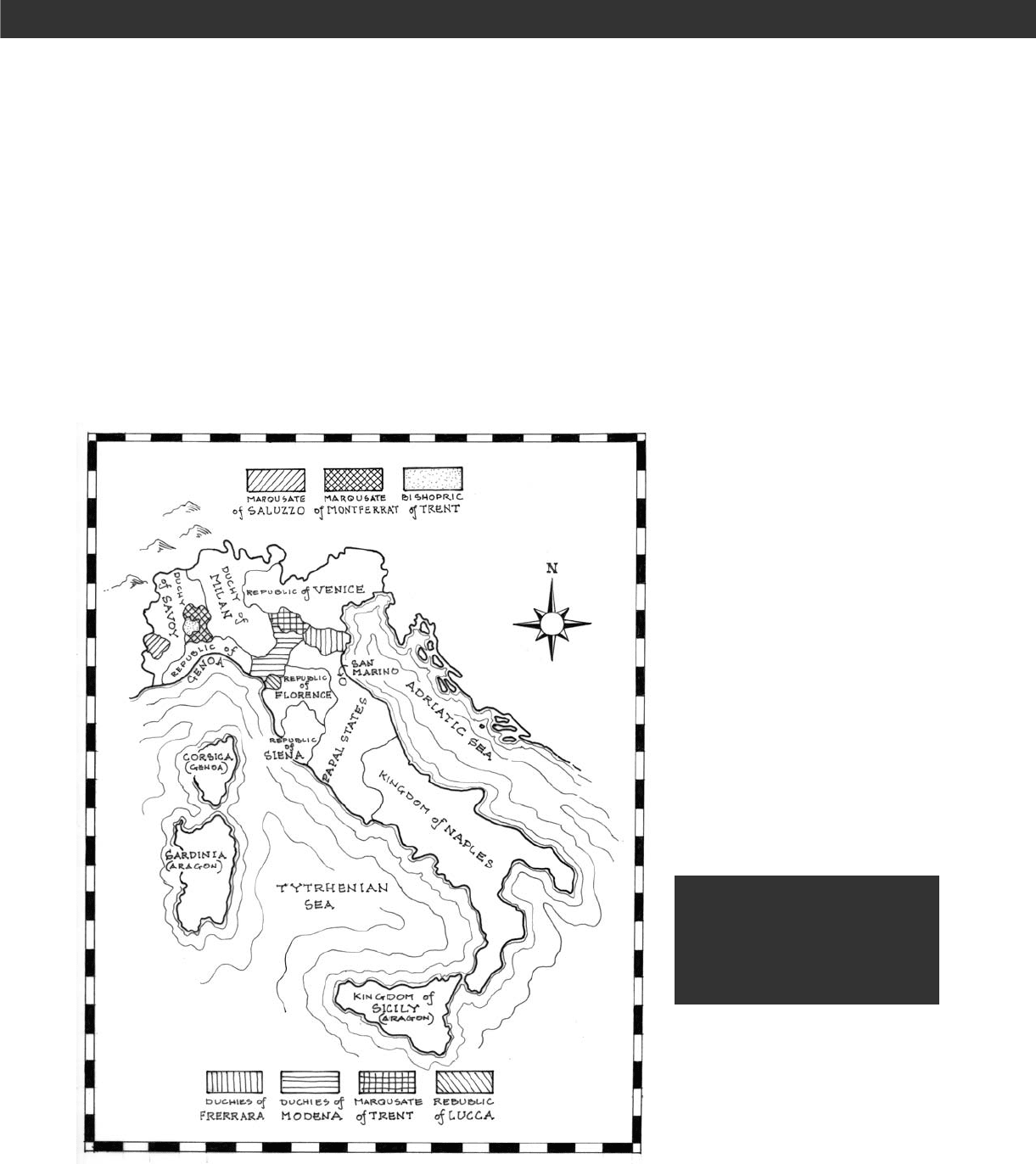
CITY-STATES: In 16th-century Italy,
political fragmentation led to the
establishment of independent city-
states, where identities were defi ned
regionally and power resided with
wealthy families.
divine could be perceived in the order
of nature. Gardens could be composed
to express that order, and landscapes
could be appreciated for their scenic
value. Gardens focused outward.
The rebirth of classical forms of edu-
cation and inquiry that characterized
the Renaissance was in part a result
of the infl ux of Greek scholars who left
Constantinople after the Ottoman
conquest in 1453. In addition, Nicholas
V, a humanist pope who governed from
1447–1455, sought to restore Rome to
its former glory. Ancient Roman ruins,
newly excavated, served as valuable
sources of inspiration.
Humanist ideals were also expressed
by sculptors and painters, who
achieved lifelike modeling of form.
The development of linear perspec-
tive led to an awareness of spatial
volume. Order and geometry became
the bases of design. Leon Battista
Alberti (1404–1474) wrote influential
treatises based on the teachings of
antiquity, and defined beauty as a
harmony of parts. In his ten books
on architecture, De re aedificatoria,
Alberti restated Pliny the Younger’s
theories on villa design: hillside eleva-
tions should be exploited for views, air,
and sunlight.
14
69
15th CENTURY / ITALY
THE VILLA AS
AN EXPRESSION
OF HUMANIST
IDEALS
The 15th-century garden opened itself
to the landscape, relieved of its func-
tion as food source, hunting ground, or
sanctuary. House and garden formed a
single unit, related through geometry,
proportion, and use. Loggias and porti-
cos provided architectural transitions
between inside and outside spaces.
Later Renaissance gardens contained
sculpture and more refi ned architectural
settings, as illustrated in the Hypnero-
tomachia Poliphili, a 15th-century novel
attributed to Francesco Colonna, a
Dominican monk.
The villa suburbana, consisting of house,
garden, and agricultural component,
embodied the ideal of country living as
promoted by Alberti. Visual links from
the garden to the surrounding land-
scape, and from the villa to the city,
were important contextual references
from a humanistic perspective.
15
Nature
was understood in terms of varying
levels of organization, from uncultivated
to controlled, with emphasis on humans
at the center. A conceptual framework
of the villa acknowledged the close
relationship between wild woods (“fi rst
nature”), orchards or vineyards (“second
nature”), and ornamental fl ower gardens
(“third nature”).
16
FLORENCE:
EPICENTER OF
CULTURE
Florence, the center of the wool and cloth
trade, was the cultural capital of 15th-
century Europe. Merchants accumulated
great wealth, and banking became a
major industry. The Medici family emerged
as the controlling force in Florentine
affairs, with power assumed initially by
Cosimo the Elder (1389–1464). Cosimo
was a great patron of the arts and sup-
porter of humanistic studies. His efforts
to gather around him the great minds of
the day at his country estates led to the
consideration of the villa suburbana as a
place for productive leisure. The escape
from the city to the countryside (the
concept of villeggiatura) embodied both
the classical values of otium (withdrawal)
and negotium (engagement). The Medici
villas at Careggi and Fiesole serve as
good examples of early Renaissance
gardens that functioned as philosophical
retreats.
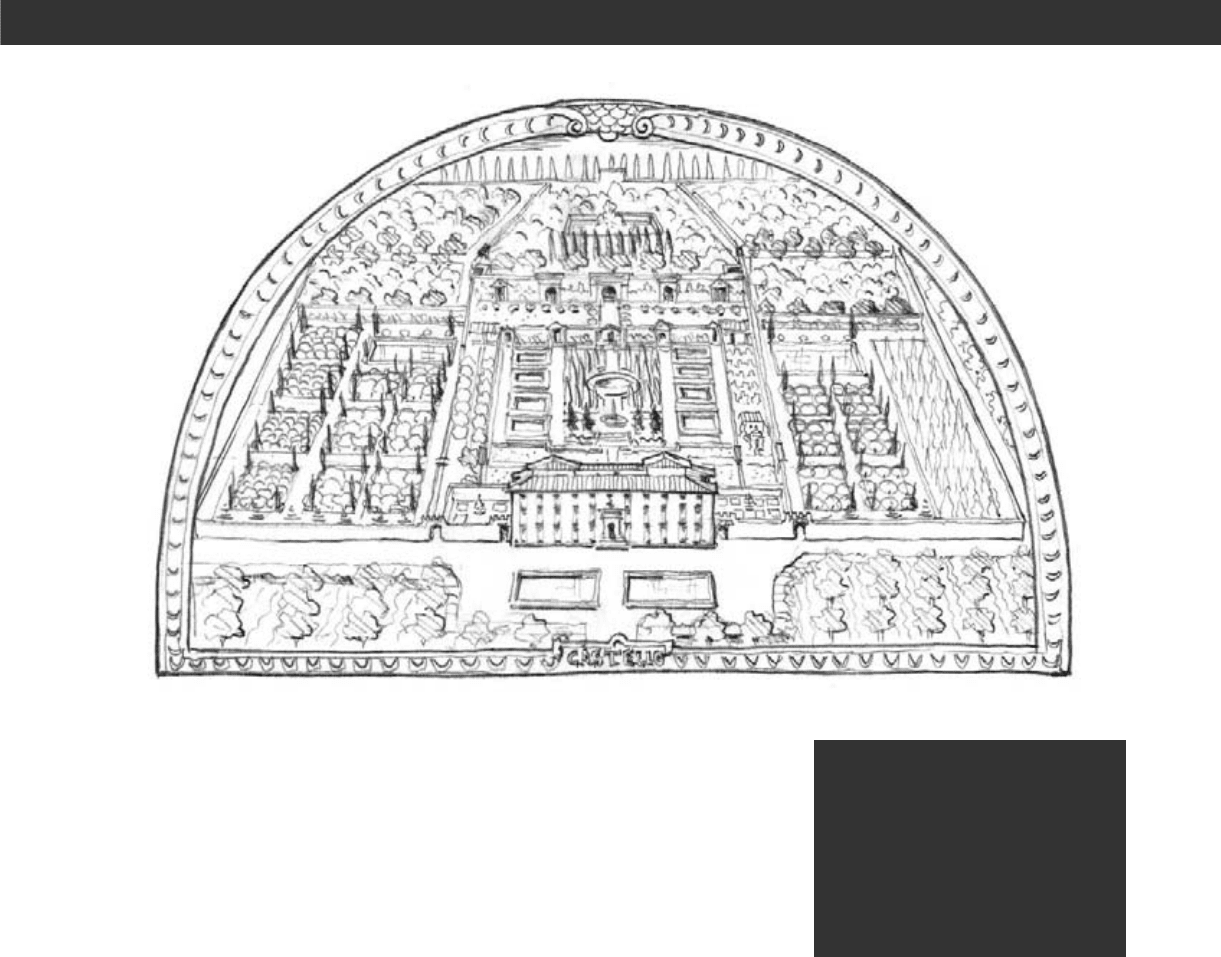
UTENS LUNETTE: Grand Duke Ferdi-
nand I commissioned Flemish artist
(and Italian citizen) Giusto Utens to
paint detailed portraits of his land
holdings in 1599. The 14 canvas lu-
nettes document the Medici family’s
power and presence in the region and
are an important visual source of
information for landscape historians.
70
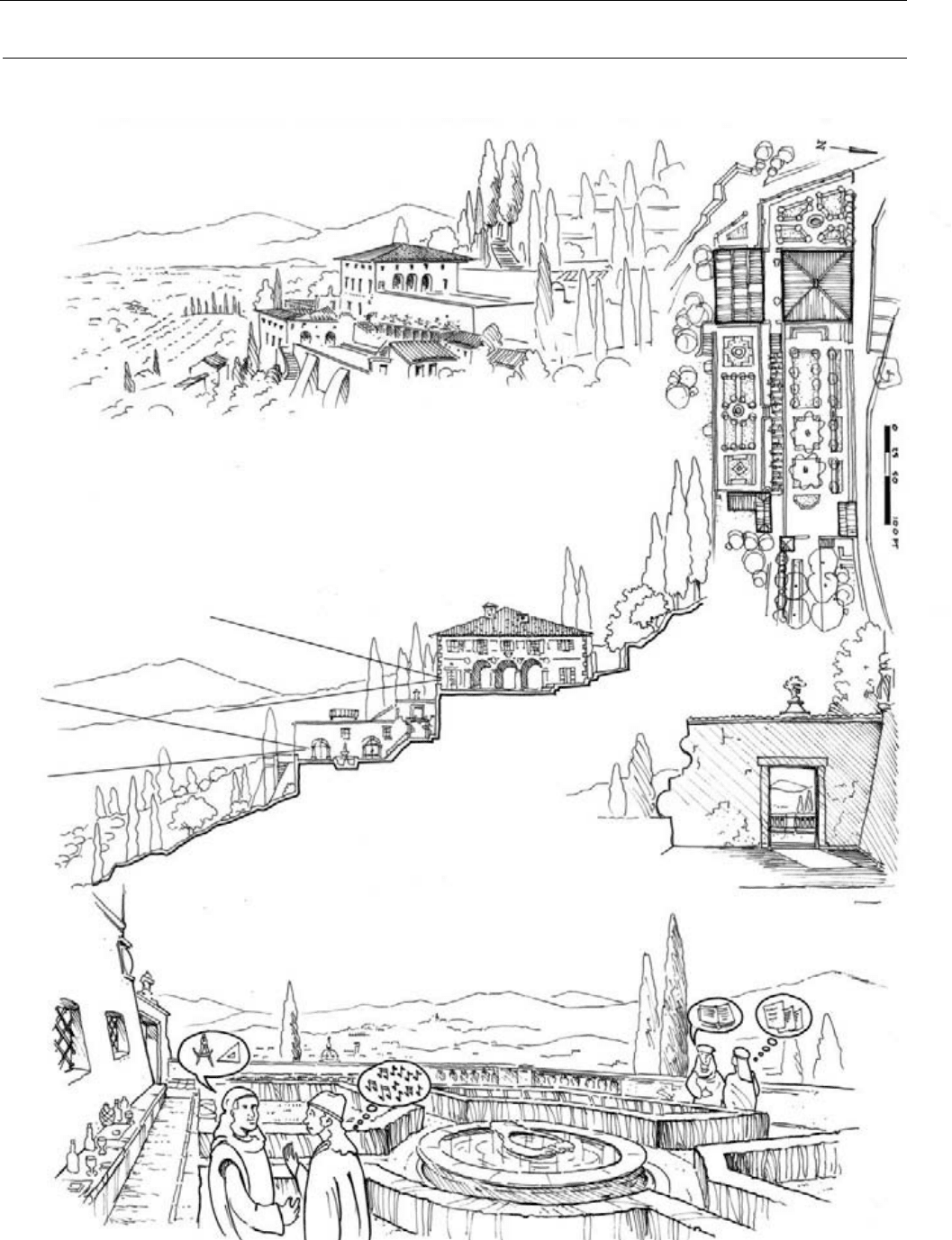
The Villa Medici at Careggi
CASE STUDY:
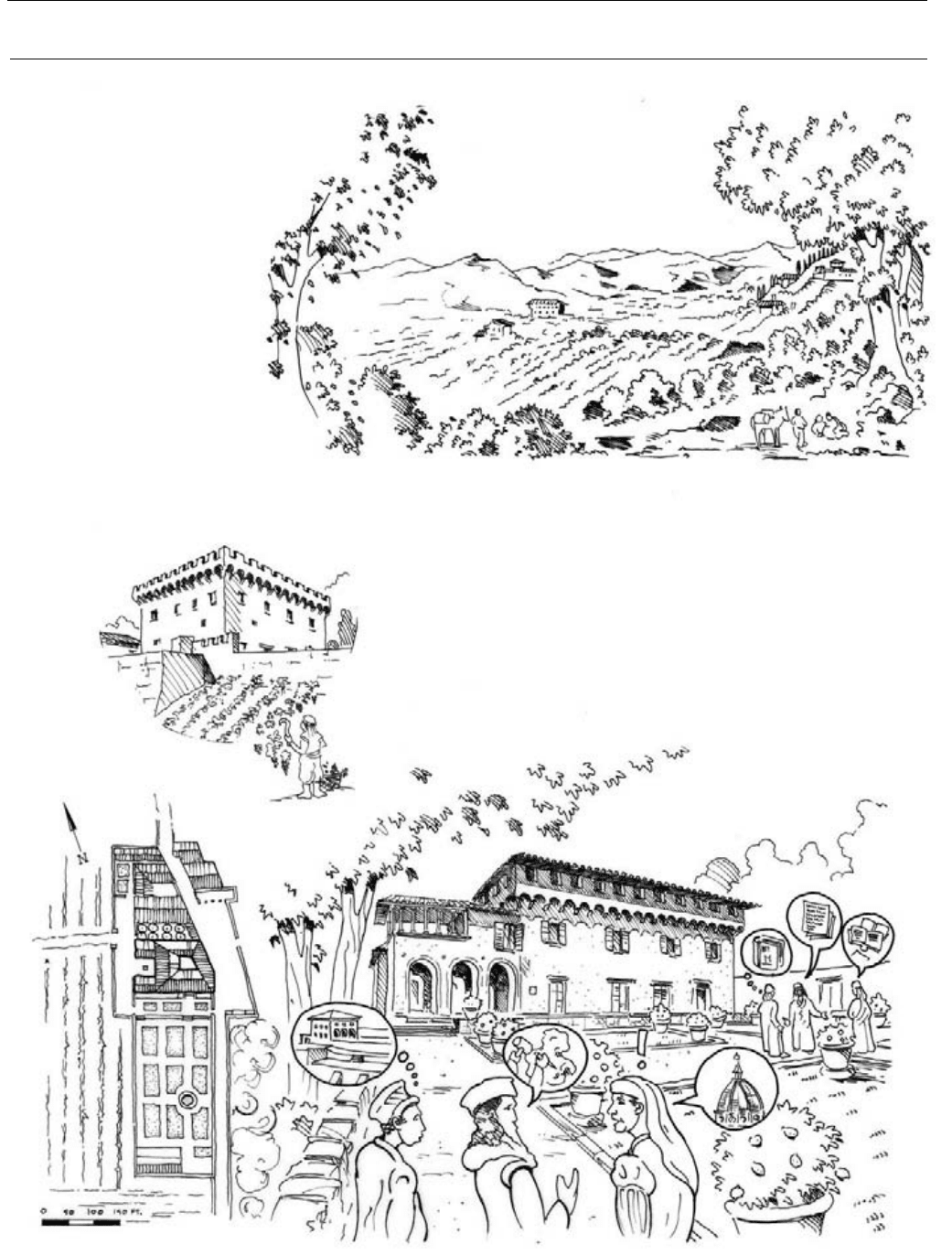
The renovation of the Villa Medici
at Careggi shows how the typical
medieval castle and farmstead
evolved into the distinct plan-
ning ideal of the villa suburbana.
Cosimo hired Michelozzo di
Bartolommeo (1396–1472) to
remodel an existing medieval
castle according to new human-
ist impulses. In about 1457,
Michelozzo removed the fortifi ed
towers and added a double log-
gia that defi ned a small private
garden space. House and garden
were integrated. The idea of the
villa was now fully formed.
The garden at Careggi was the site of Cosimo’s original Platonic Academy,
where he went to “cultivate not his fi elds, but his soul.”
17
Marsilio Ficino, the
mathematician, scholar, and proprietor of Careggi for Cosimo, was instru-
mental in promoting Florence as a center of classical scholarship.
71
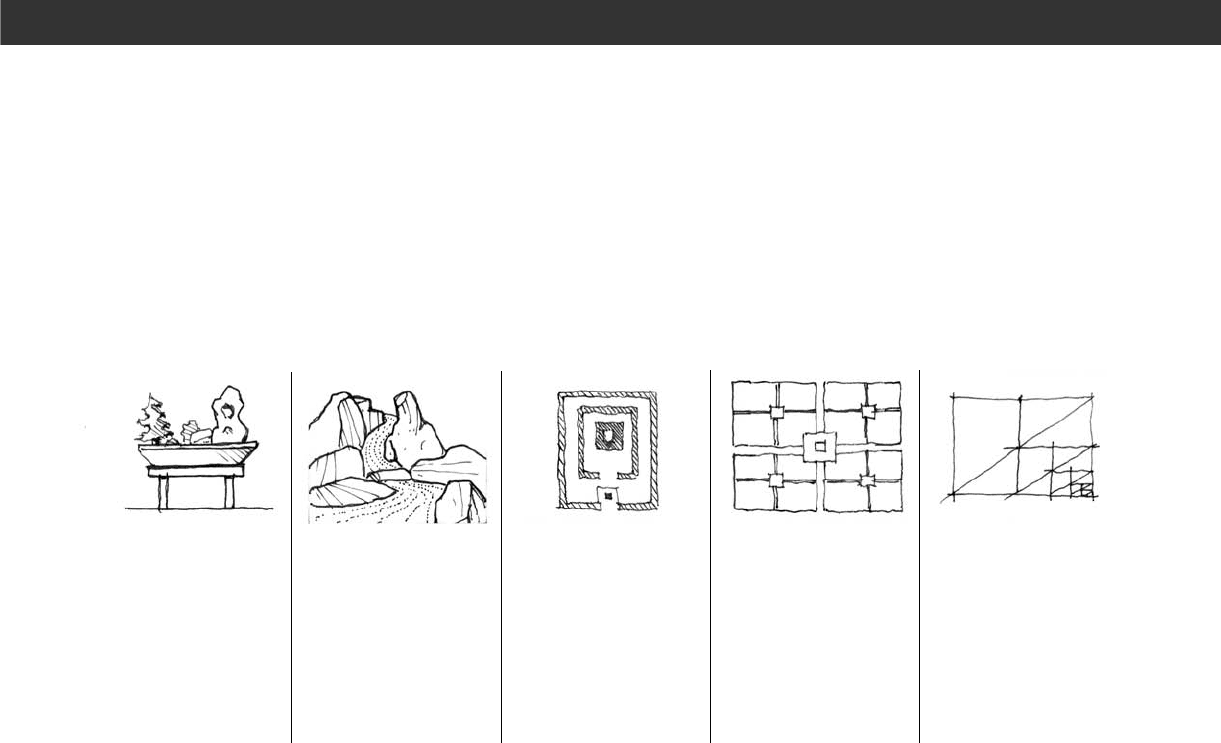
The Villa Medici at Fiesole
CASE STUDY:
Michelozzo was again commissioned by Cosimo for the new
construction of the Villa Medici at Fiesole, which was completed
in 1461 and remains an excellent example of an early Italian
Renaissance villa. He engineered the steep site “in rapport” with
the landscape so views are possible from many angles, conferring
a sense of openness to the gardens.
18
The architect created two south-facing terraces; a pergola at the base of the
40-foot wall that retains the upper terrace provides an intermediate level.
Living spaces opened to each terrace, but access between levels was through
an interior stairway. There is no courtyard. An enclosed “secret garden” on the
west side of the house affords views to Florence and the surrounding agri-
cultural fi elds. The hortus conclusus of the Middle Ages became the giardino
segreto of the Renaissance, where Cosimo’s grandson, Lorenzo the Magnifi cent
(1449–1492) relocated the Platonic Academy after Cosimo’s death.
The full development of the Italian Renaissance villa, wherein
organizing geometries, architectural details, and water fea-
tures served to create a unifi ed site plan, occurred in the 16th
century and is discussed in the next chapter.
72
SUMMARY
Intellectual horizons expanded along with political territories in the 15th century. The landscape became manageable as horticul-
tural practices improved and designers better comprehended site planning principles. Landscape spaces were ordered in service
to human desires: as aids to meditation, as places of repose, and as signifi ers of an idealized agrarian model.
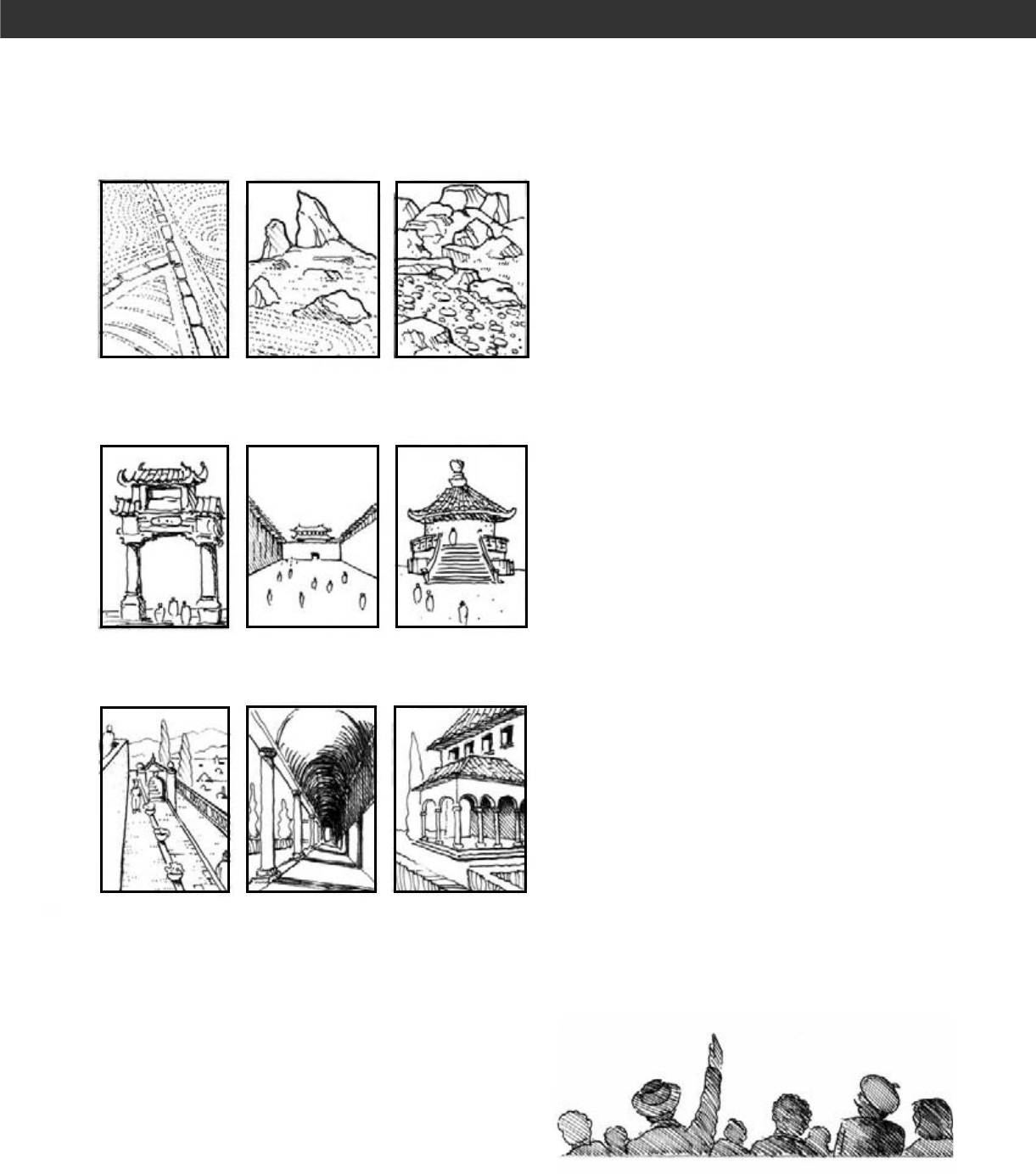
DESIGN PRINCIPLES
REDUCTION
Tray landscapes elimi-
nate the unessential
to create a powerful
minimalist aesthetic.
ABSTRACTION
Kare sansui gardens
express the charac-
teristics of rivers and
streams using a selec-
tive language of stone
and sand.
HIERARCHY
Nested geometries
concentrate power at
the center, as illus-
trated by the plan of
the Forbidden City.
SYMMETRY
Perpendicular axes
subdivide space in a
chahar-bagh, or four-
square garden.
PROPORTION
According to Alberti,
the parts must equal
the whole—nothing
can be added or taken
away without destroy-
ing the integrity of the
design.
15th CENTURY
/ CONCLUSION
73
BOOKS
T
HE BIRTH OF VENUS, by Sarah Dunant
T
HE LADY AND THE UNICORN, by Tracy Chevalier
T
HE PRINCE, by Niccolo Machiavelli
T
RES RICHES HEURES DU DUC DE BERRY, by the Limbourg
Brothers
FILMS
1492: CONQUEST OF PARADISE (1992)
H
ENRY V (1989)
H
UNCHBACK OF NOTRE DAME (1939)
J
OAN OF ARC (1948)
T
OWER OF LONDON (1939)
PAINTINGS AND SCULPTURES
BRANCACCI CHAPEL, frescoes by Masaccio (1424)
D
AVID, by Donatello (1425)
G
ATES OF PARADISE (DOORS TO THE FLORENCE BAPTISTERY),
by Lorenzo Ghiberti (1425–1452)
P
ORTRAIT OF GIOVANNI ARNOLFINI AND HIS WIFE, by Jan van
Eyck (1434)
S
AN MARCO CONVENT, frescoes by Fra Angelico (1436)
B
ATTLE OF SAN ROMANO, by Paolo Uccello (1445)
M
AGI CHAPEL (PALAZZO MEDICI-RICCARDI), frescoes by
Benozzo Gozzoli (1460)
T
HE BIRTH OF VENUS, by Sandro Botticelli (1482)
S
T. FRANCIS IN ECSTASY, by Giovanni Bellini (1485)
M
ANTIQ AL-TAIR (THE LANGUAGE OF BIRDS), Timurid
miniature (1486)
DESIGN VOCABULARY
ZEN GARDENS
Raked sand and Rocks
IMPERIAL CITIES
Gates, Courts, and Platforms
ITALIAN VILLAS
Terraces, Loggias, and Porticos
F
o
r further exploration
15th CENTURY
/ CONCLUSION
75
16th CENTURY
C
umulative changes in the 16th century marked the gradual transition to the modern era. Political power was
consolidated across many parts of the globe as individual countries formed distinct national identities. Defi ni-
tive monarchies emerged in Europe and England; Japan was unifi ed during the reigns of three successive gener-
als; and the Mughal empire spread across parts of Central Asia and India. The Reformation and Counter-Reformation
marked a period of commitment to ideals in western Europe. Individual creative pursuits were valued by society; art-
ists gained prestige. All these factors infl uenced the design of the built landscapes examined in this chapter.
For Europeans, the 15th century was a time to celebrate the rediscovery of nature. In the 16th century, nature be-
came constructed. The idea of the garden as a “third nature” was implicit in more defi ned styles. Rome was the new
authority for Renaissance gardening, art, and architecture. Italian styles spread across the continent and beyond.
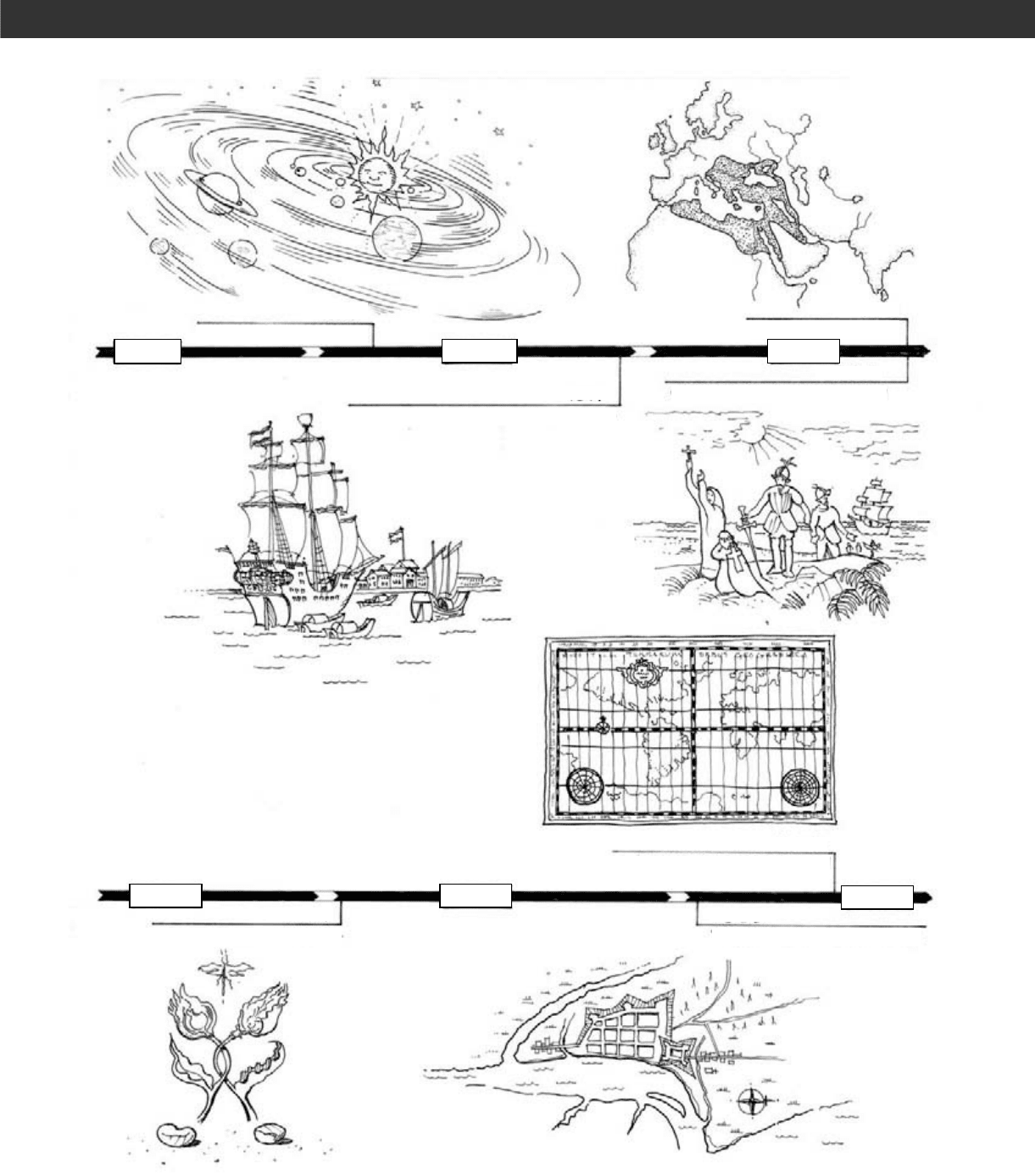
76
16th CENTURY / A BRIEF CHRONOLOGY
1500
1510
1520
1550 1560
1570
1508
1521
1521
1517
1569
1554
1565
DE REVOLUTIONIBUS
OTTOMAN EMPIRE
CORTES CONQUERS MEXICO
PORTUGUESE TRADING NETWORKS
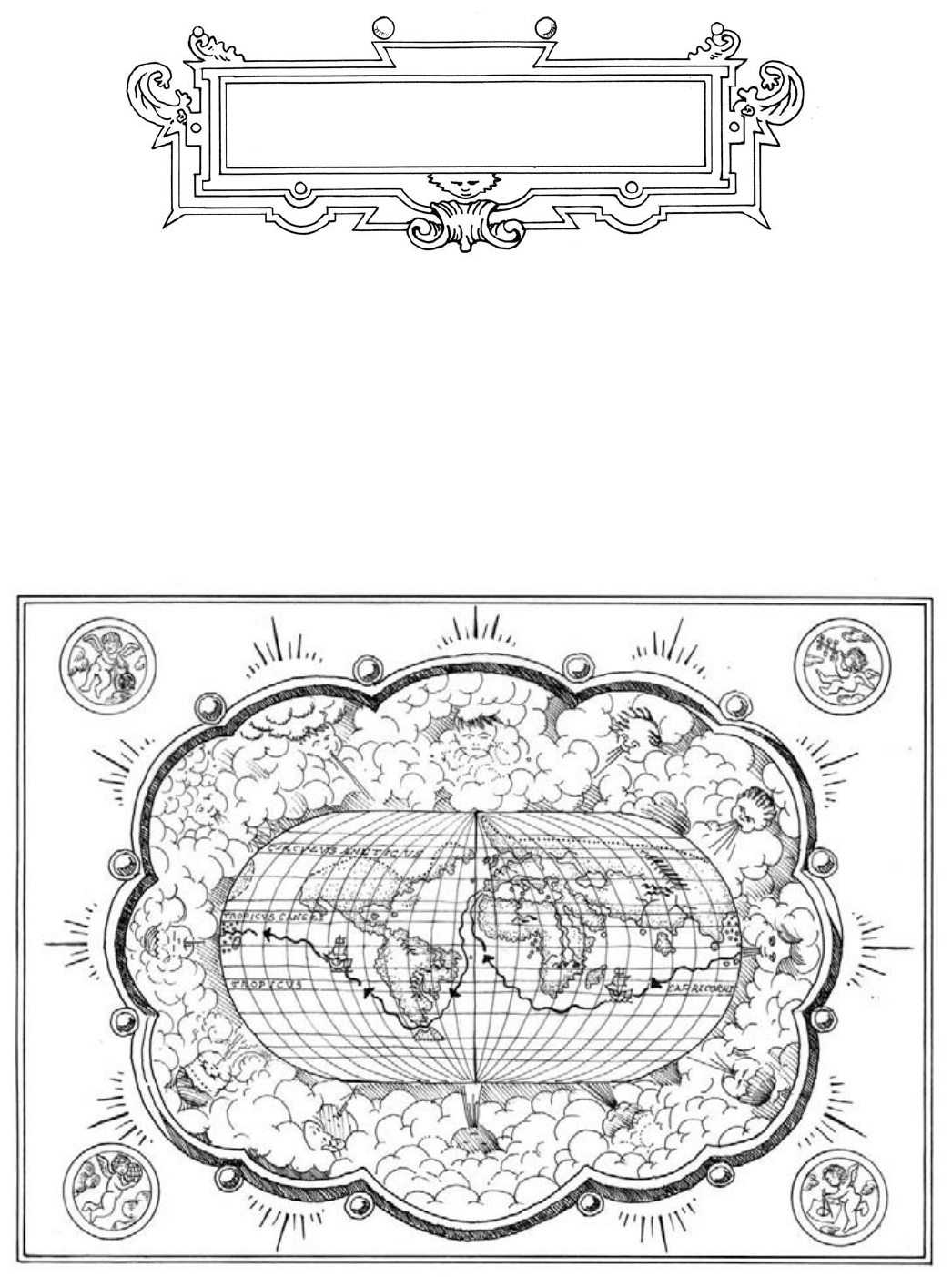
MERCATOR PROJECTION
TULIPS REACH EUROPE
ST. AUGUSTINE, FLORIDA