
Boults Е. Illustrated history of landscape design
Подождите немного. Документ загружается.

87
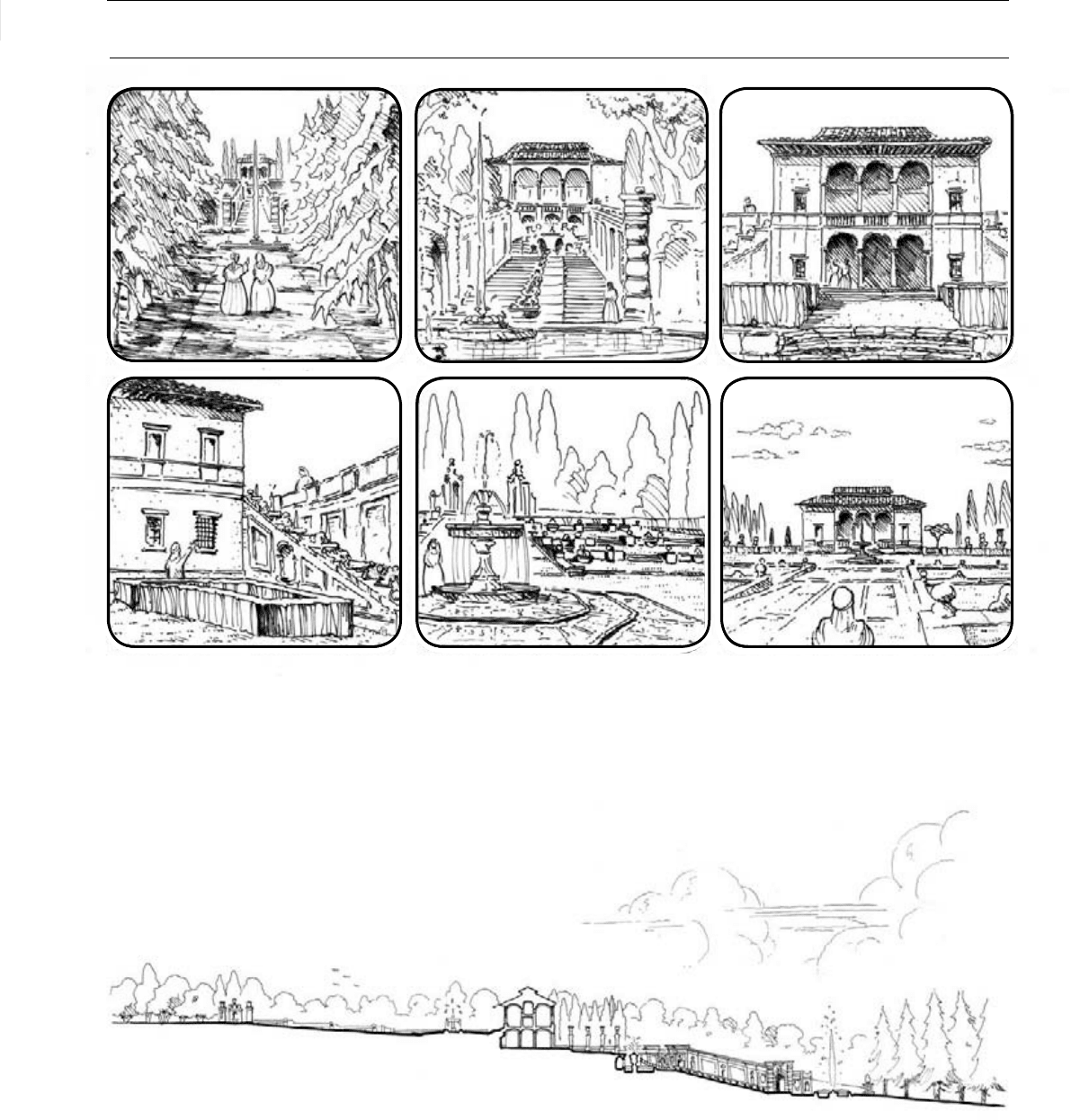
WATER AXIS: Similar in plan to the garden at Villa Lante, the barchetto at Villa Farnese is
arranged symmetrically about an axis and punctuated by a series of water features.
BAROQUE DANCE: The architectural emphasis of the 17th-century additions to the barchetto at Villa Farnese, Caprarola, intro-
duced a more Baroque design vocabulary based on movement and drama.
VISUAL NARRATIVE: Villa Farnese
88
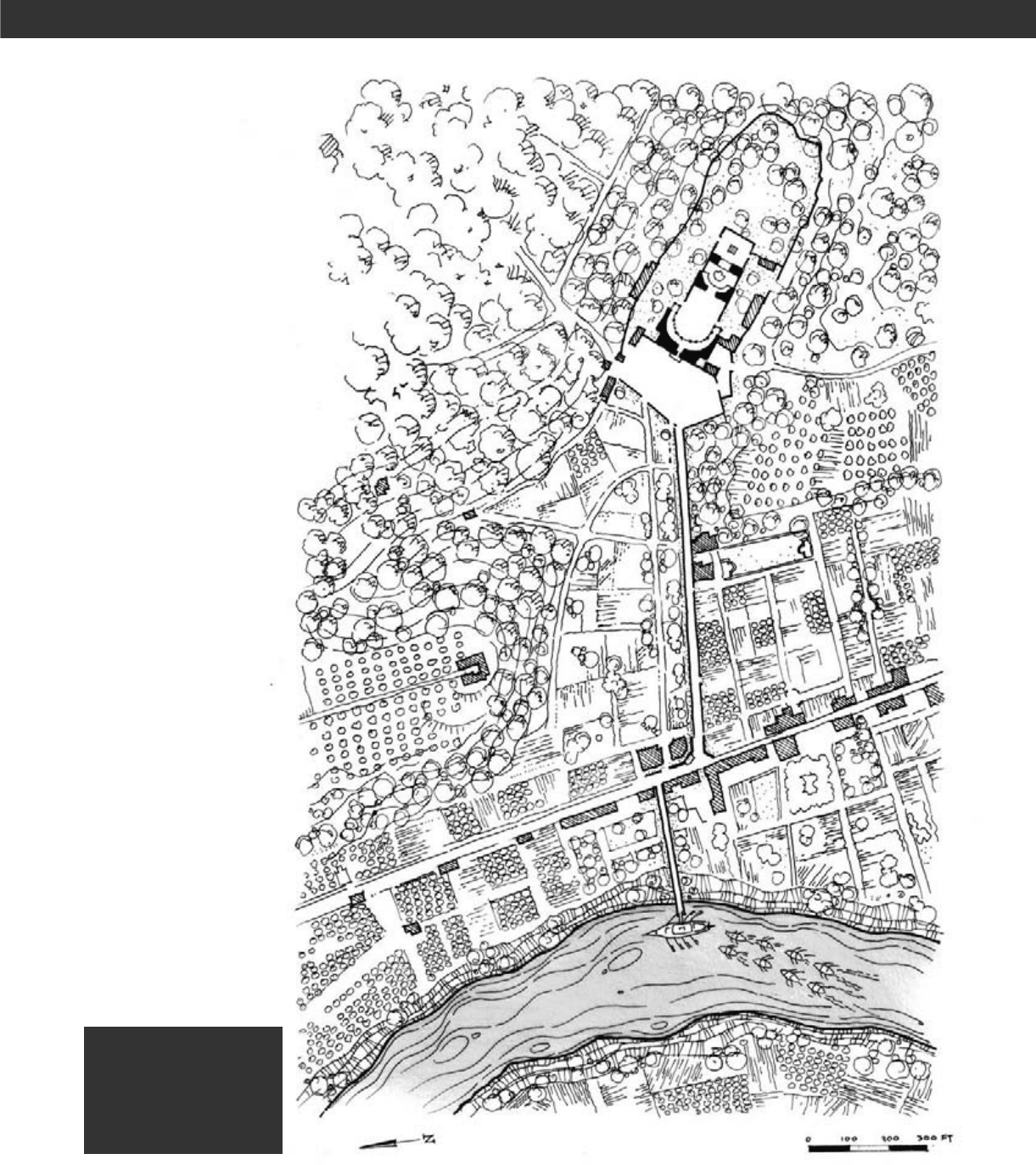
VILLA GIULIA, RO
Cardinal Giovanni Maria
del Monte enlarged his d
retreat, a villa suburban
outside the city walls, in
when he was elected Pop
Julius III. Many great art
are believed to have had
in its design: Giorgio Vas
Michelangelo, Bartolome
Ammannati, and Vignola
linear site plan of Villa Gi
aligns with a shallow valle
natural low spot amid ac
woods, orchards and vine
A long allée connected th
to a mooring on the Tibe
A series of telescoping
courtyards frame the g
space. A large semicircu
portico defi nes the fi rst
race. Views continue thr
a central loggia to a rea
loggia and garden terrac
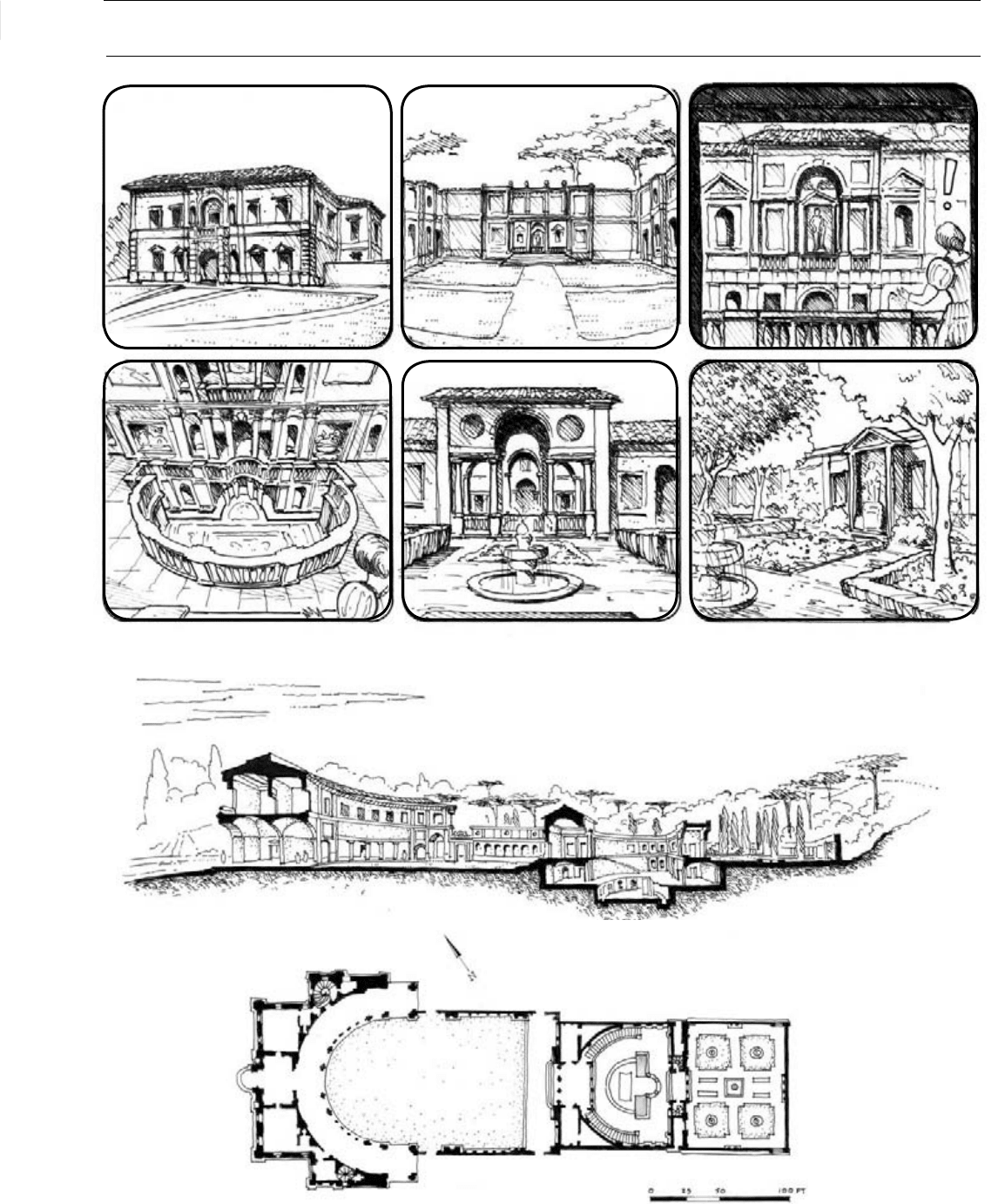
From the central loggia,
is surprised to discover
the next courtyard is su
and a nymphaeum is rev
at an even lower level. Th
semicircular form of the
tico is echoed by the cu
stairs that lead to the
courtyard. Access to th
nymphaeum itself is thr
hidden stairs. The water
channel around the peri
of the nymphaeum was
the acqua vergine after
ancient aqueduct that r
beneath the property. F
graceful caryatids supp
the upper-level court.
VILLA GIULIA: The garden
seen in the context of
the barco illustrates the
important Renaissance
concept of “composed”
nature.
6
16th CENTURY
/ ITALY
89
Villa Giulia, Rome
CASE STUDY:
SECTION ELEVATION: The tension created between the horizontal sight
line and the vertical circulation is characteristic of Mannerist design.
SURPRISE AND DELIGHT: Along the axially arranged space, elements are screened from view, creating a sense of drama.
FORMS REPEAT:
A dynamic three-
part division of
space occurs in
both plan and
section.
9090
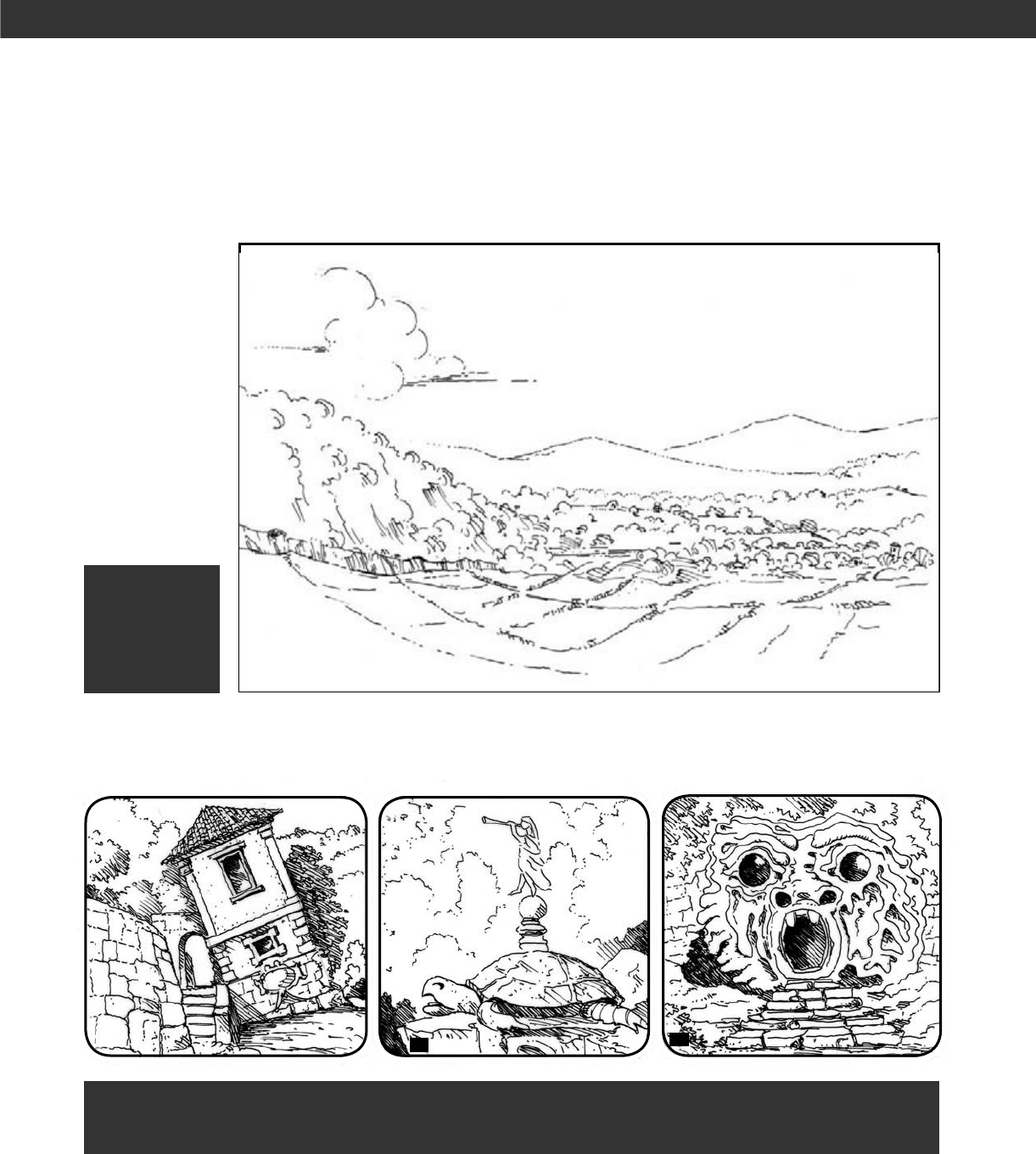
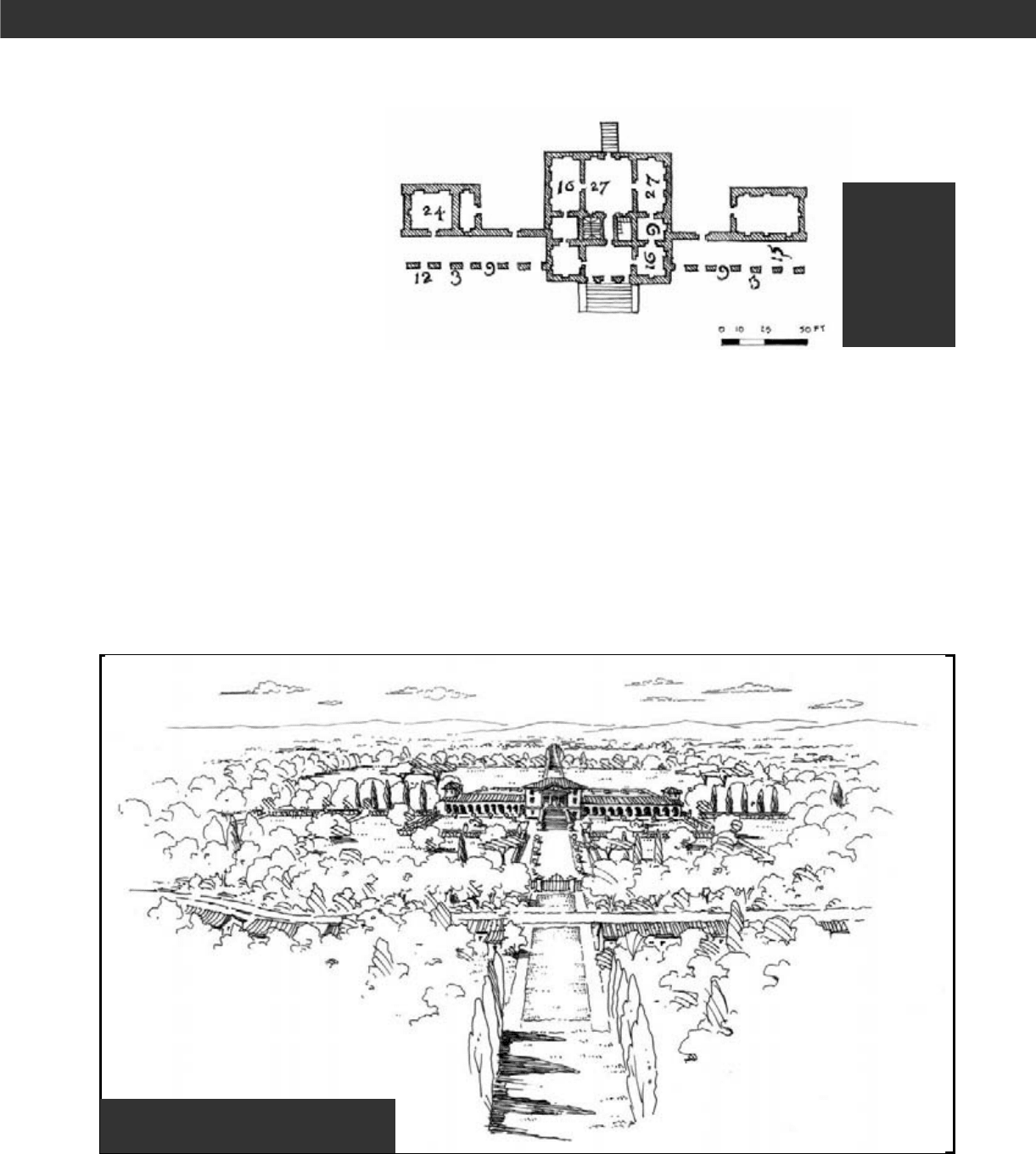
SACRO BOSCO, BOMARZO
The most extreme example of Manner-
ist distortion can be seen in the Sacro
Bosco (sacred wood) of Count Orsini,
constructed at Bomarzo from 1552–
1583. Colossal sculptures, some carved
out of the stone on the site, dot the
valley below the count’s hilltop palace. No
linear narrative connects these surreal
sculptural events. Inscriptions allude to
literary themes, but the meaning of this
fantasyland is unclear. The park has been
variously understood as a critique of
SACRO BOSCO,
BOMARZO: The
terrain is largely
unaltered in
Count Orsini’s
sacred wood.
Renaissance order and hierarchy, or an in-
terpretation of literary works such as the
Hypnerotomacchia Poliphili, and Orlando
Furioso, a story about a man who went
mad after the loss of his lover (Orsini’s
wife died young).
7
The park is known today
as the Park of the Monsters.
GARDEN OF THE MONSTERS: A) Tilted House—Is the house leaning or the world tilting? B) Fame Rides a Turtle—
Fame, like haste, is made slowly; C)Hell’s Mouth—“Ogni pensiero vola” (Leave every care, you who enter here), a reference to
Dante’s Gates of Hell, is inscribed on the entry to this grotto with built-in bench and picnic table.
B
C
16th CENTURY
/ ITALY
91
Different forces affected the develop-
ment of the Renaissance garden in the
Venetian Republic. New trade routes
established by the increasingly power-
ful European monarchies devastated
Venice’s economy. Attention turned
toward the reclamation of agricultural
lands in the Veneto region.
Villas of the Veneto are year-round
residences and working farms. Andrea
Palladio gained a reputation as the
preeminent architect of the ideal
agrarian villa. He interpreted the
classical Roman design vocabulary
as a function of space and mass,
realized through a rational geo-
metric order. He modeled his four
books of architecture, I Quattro Libri
dell’Architettura (1570), on Serlio’s
practical treatise, similarly illus-
trated with plans and elevations.
8
Palladian architecture is synonymous
with a harmony of part to whole. Pal-
ladio developed precise ratios for the
heights and widths of rooms, and ap-
plied the same system to the design of
building facades. He arranged func-
tional spaces hierarchically, typically
around a central unit, resulting in bilat-
eral symmetry and an A-B-A rhythm.
His villas incorporated elements from
traditional farm buildings—dovecotes,
long arcaded loggias, stucco fi nish over
brick—and were set amid agricultural
fi elds, staking their claim in the fl at
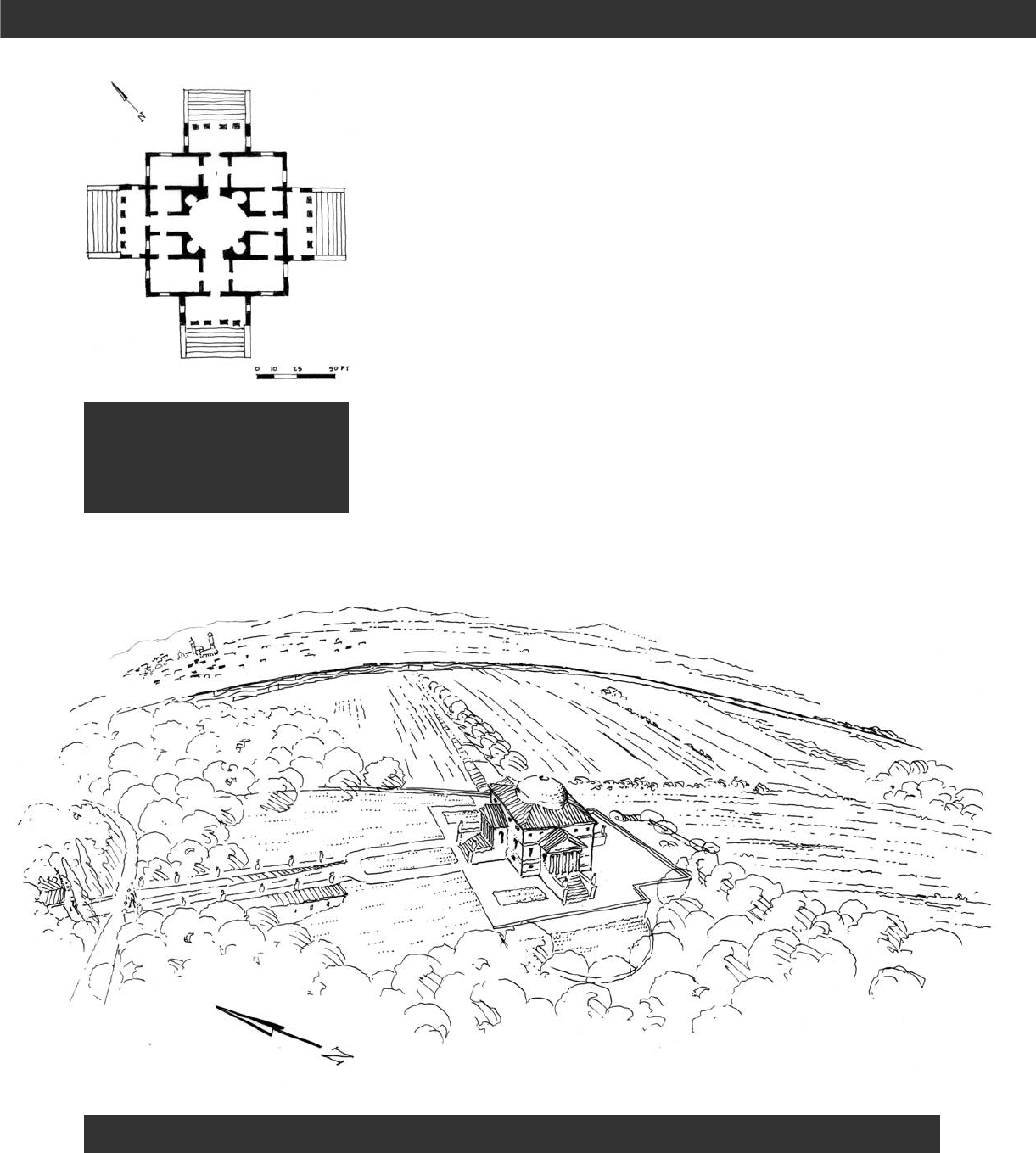
VILLA EMO, FANZOLO: The villa stretches
out as an elongated cross-axis.
PALLADIAN VILLAS
PALLADIAN
HARMONY:
Plan and
elevation
were unifi ed
by the same
proportional
relationships.
Veneto plain. Views of the produc-
tive landscape were welcomed. Typical
Palladian elements included a square
hall, a loggia, a pedimented “temple”
front, and steps that led directly to
the piano nobile. Plinths and platforms
elevated buildings above the ground
plane. Exterior ornamentation was
sober, but interior surfaces were lav-
ishly decorated. Avenues and vistas
engaged front and rear courtyards;
site planning, rather than garden
design, was Palladio’s hallmark.
16th CENTURY
/ ITALY
16th CENTURY
/ ITALY
ARCHITECTURE CONTROLS LANDSCAPE: The Villa Rotonda was carefully sited by Palladio to frame unique views in each direction.
VILLA EMO, FANZOLO
Villa Emo, built in 1564, is a one-story
structure with a temple front and a
paved entry ramp. Wings extend from
both sides of the central block and
have an attached colonnade. Long
allées define a perpendicular axis and
organize the site. The rear courtyard
forms a large rectangle.
Of all Palladio’s villas, Villa Emo seems
to relate most directly to its agricul-
tural context through its low profile
and extended arms. Architecture and
landscape feel perfectly balanced.
VILLA ROTONDA, VICENZA
Constructed from 1566–1570 on a hill-
top very near the town of Vicenza, Villa
Rotonda has no agricultural component
and most likely functioned as a daytime
retreat or entertainment villa. The villa,
raised on a platform, occupies the site
with authority. The plan is rotated
from a true north-south alignment,
permitting sunlight to enter each room.
Alterations, particularly to the central
dome, were made by Vincenzo Scamozzi
after Palladio’s death.
The square villa displays quadripar-
tite symmetry about a round central
hall, with four identical porticos. The
repetition of the classical Greek
temple front on all four sides is un-
usual; rather than creating a hier-
archical marking of the entrance, it
denotes an equality of experience. The
dominant axis becomes vertical—the
visitor’s eye moves up, through the
dome. The form of Villa Rotonda was
to become an icon in the imagination
of future generations of architects
and designers.
VILLA ROTONDA, VICENZA: The
square temple front attached to a
spherical volume of interior space
was inspired by the Pantheon in
Rome.
92
93
16th CENTURY
/ FRANCE AND ENGLAND
CHATEAUX
OF THE LOIRE
VALLEY
France in the 16th century was not
as politically fragmented as Italy. Af-
ter the collapse of the feudal system,
power was centralized in an absolute
monarchy. Gardens became outsized
expressions of royal authority.
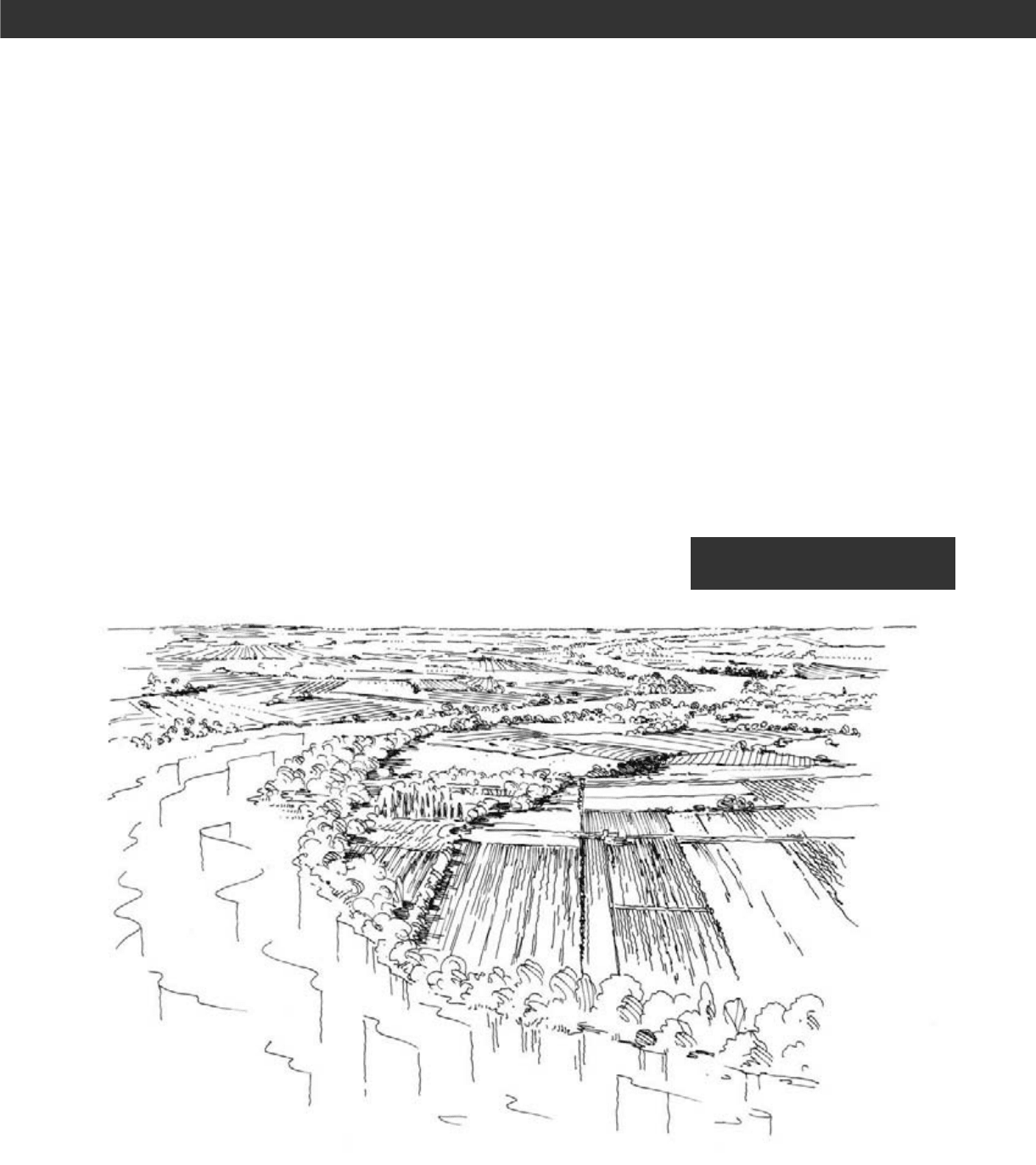
The Loire Valley is flatter, more
densely wooded, and more spacious
than the landscape around Rome and
Tuscany. French gardens were sprawl-
ing, complex arrangements of ground-
plane features. Defensive moats
typically surrounded the chateaux
of the Loire Valley. When the intro-
duction of gunpowder made fortified
medieval castles obsolete and inde-
fensible, the moats, still essential for
good drainage, were incorporated into
gardens as ornamental canals.
Renaissance gardens in France were
mostly additions to existing medieval
chateaux, which were year-round dwell-
ings, not summertime retreats. Space
LOIRE VALLEY: Royal estates were
situated in the Loire valley.
RENAISSANCE GARDENS IN FRANCE
AND ENGLAND
was limited, constrained by the moat
and the confi guration of the forti-
fi ed castle. The axial arrangements of
Italian gardens were ill suited to these
irregular spaces. Landowners developed
gardens as separate entities, built on
adjacent properties not directly related
to the house.
The designs of 16th-century French
gardens are known today through the
engravings of Jacques Androuet du Cer-
ceau. His book, Les plus excellents basti-
ments de la France (1576 and 1579),
contained illustrations of important
chateaux and their gardens.
As foreign powers made claim to
Italian territories, and Italian art-
ists fled Rome after the sack, clas-
sical organizing principles spread
throughout Europe in the latter part
of the 16th century. The new vocabu-
lary of design expressed the regional
and cultural characteristics unique
to each country.
94
16th CENTURY
/ FRANCE
AMBOISE
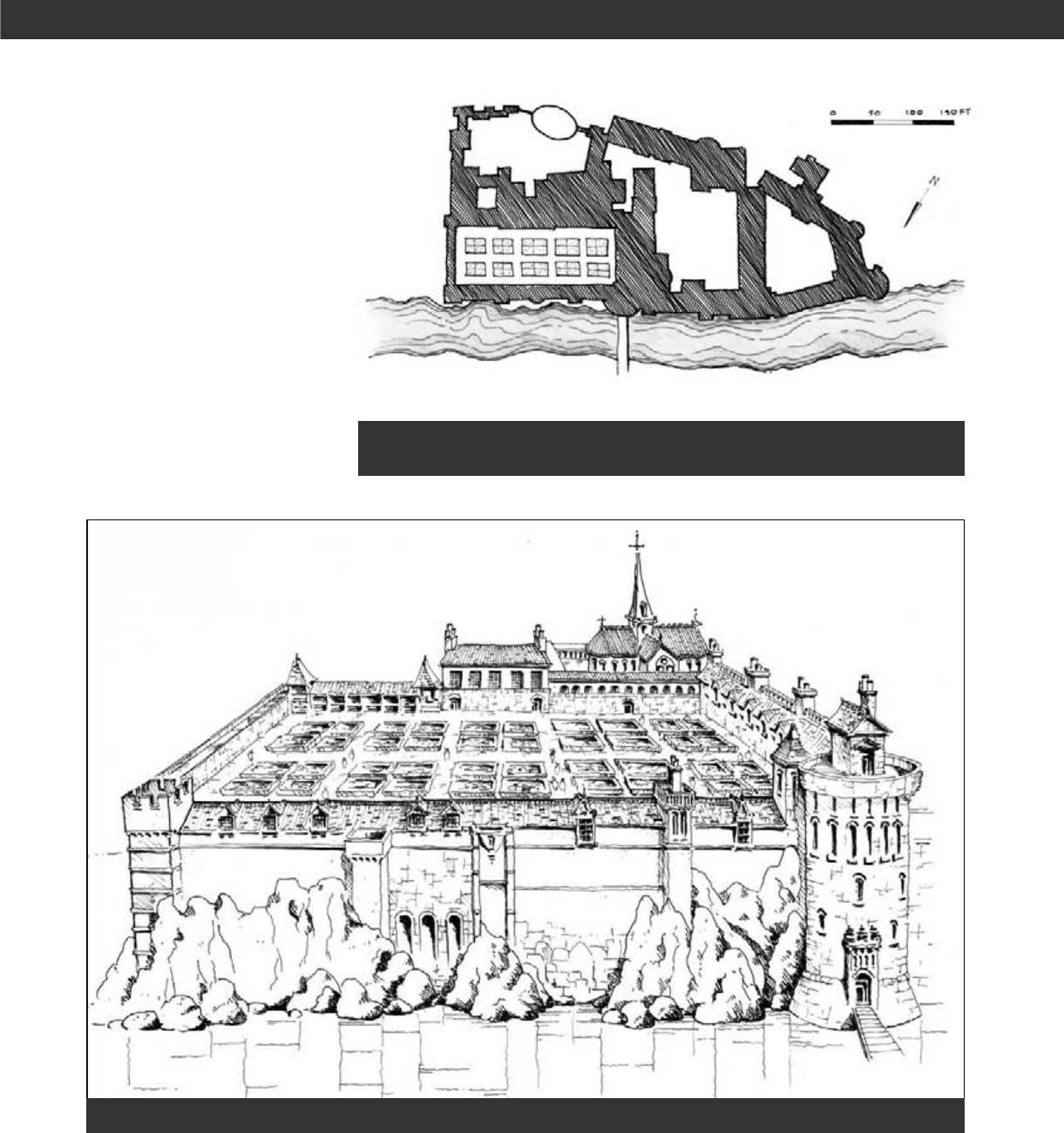
King Charles VIII of France invaded
southern Italy in 1494, asserting
his ancestral right to the Kingdom
of Naples. His victory was of minor
political consequence, but it was
enormously infl uential in bringing
Italian Renaissance design ideas to
France. He returned to his country
with Italian artifacts, artists, and
craftsmen. Charles VIII enlarged his
garden at Amboise according to the
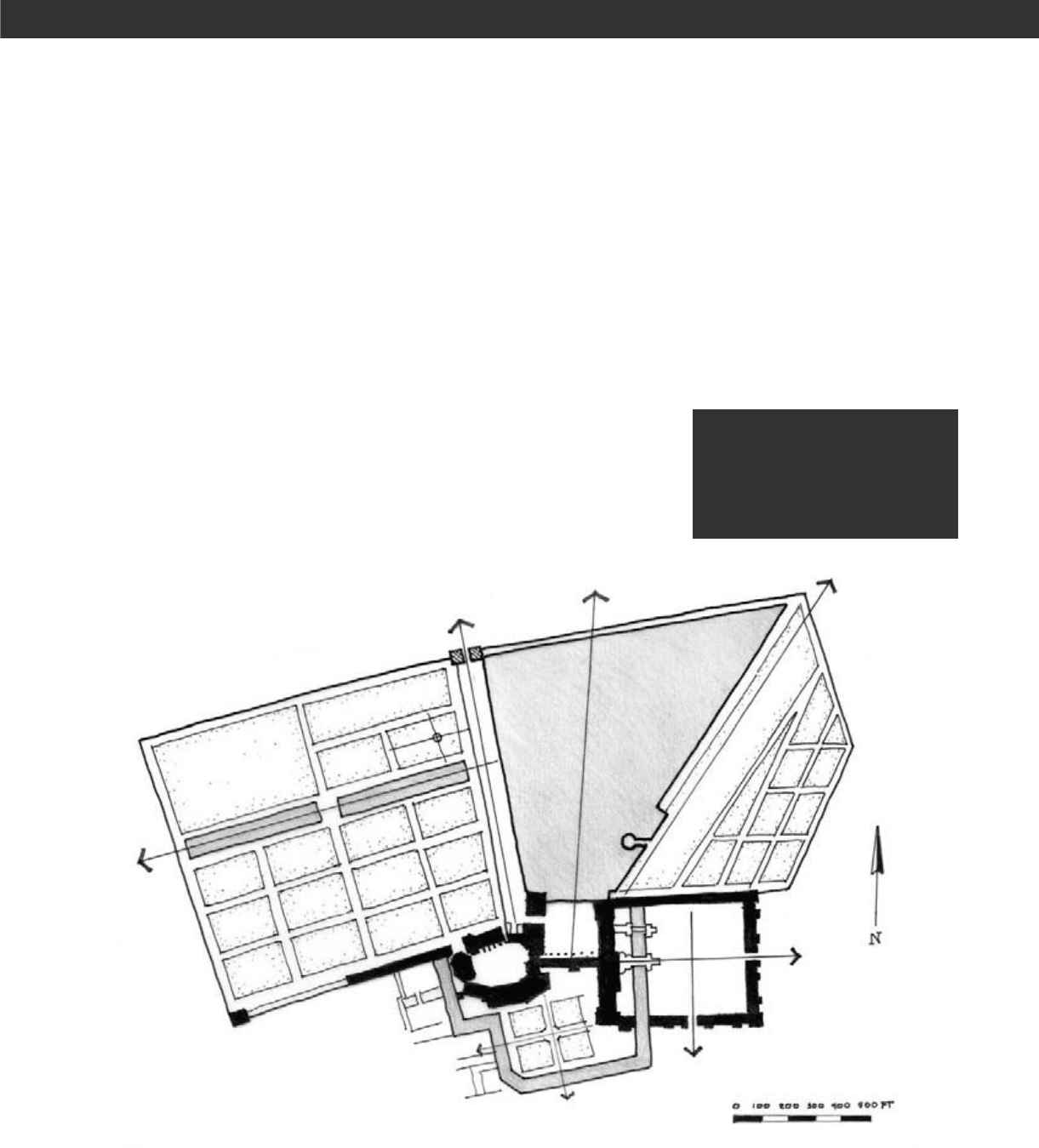
new style, adding 10 compartments
and a central water feature along
a high terrace within the chateau
walls. A gallery along the long side
of the rectangular plan defi ned the
edge of the garden and afforded
views of the Loire.
FRENCH RENAISSANCE: The chateau at Amboise was redesigned by Italian artists
and craftsmen.
AMBOISE: A garden terrace with 10 symmetrical compartments, called parterres, enhanced the medieval castle.
95
BLOIS
Charles VIII was succeeded by his
cousin Louis XII, who not only carried
on with Charles’s gardening ambi-
tions, but also married his wife. Louis
completed work at Amboise, and
moved the court to Blois.
The garden consisted of three ter-
races. The main rectangular terrace
comprised 10 garden compartments
arranged in two long rows. A central
pathway led to a bridge across a
moat that connected to the chateau.
A fountain within a wooden pavil-
ion marked the intersection of two
crossing pathways. The lower terrace
is believed to contain one of the first
orangeries in France.
9
(The gardens
were known for their wide variety of
fruits and vegetables.) In 1505, Louis
added an upper terrace, probably as
an expanded kitchen garden.
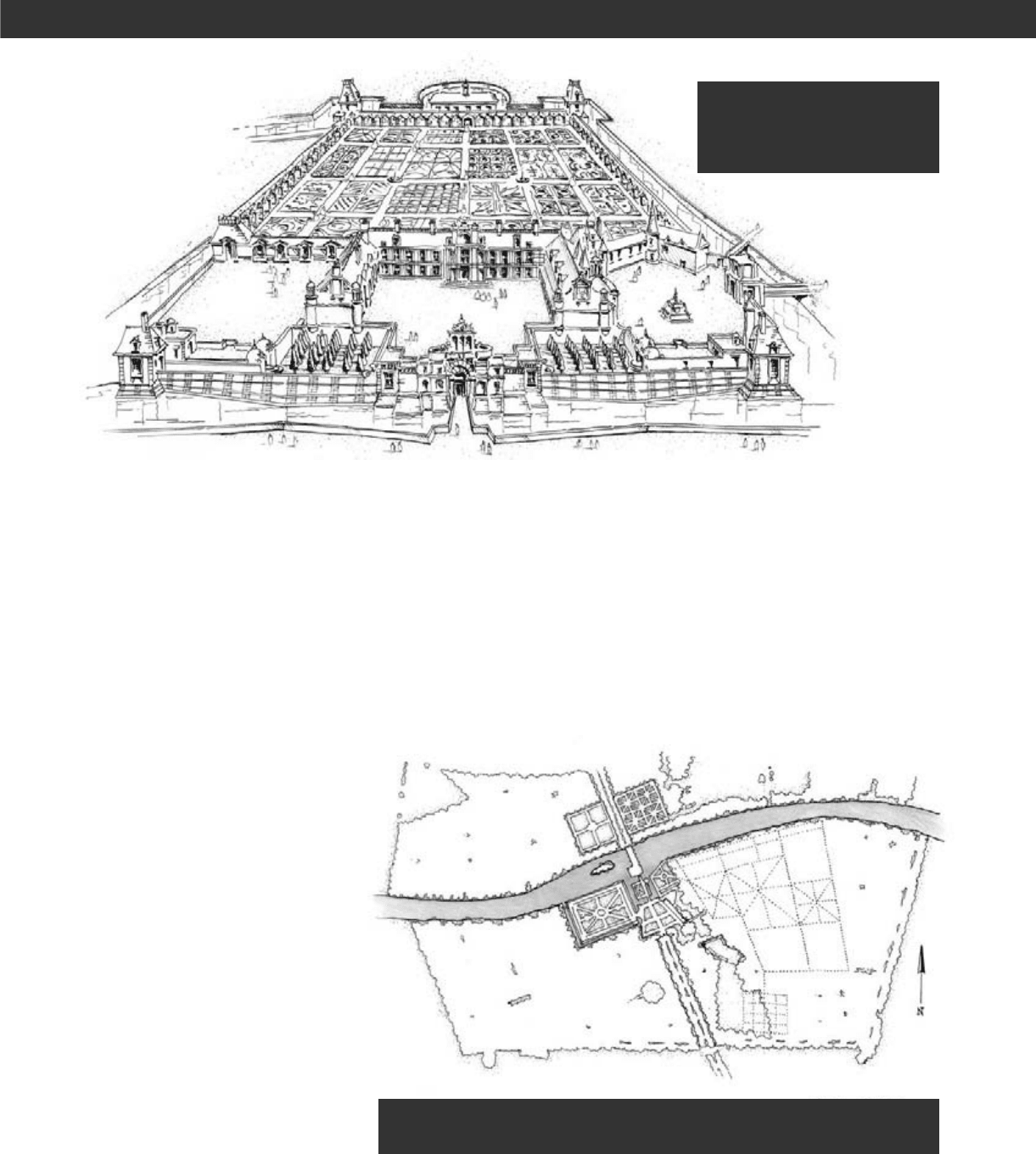
FONTAINEBLEAU: Although no
comprehensive site plan unifi es the
various additions to Fontainebleau,
sight lines and fl at planes of water
extended the garden out into the
landscape.
FONTAINEBLEAU
When Francis I assumed the throne
in 1515 upon the death of his uncle
Louis XII, he moved the court to
Fontainebleau, near Paris, disdaining
the country estates of the Loire Val-
ley. His rebuilding of the chateau has
been much altered over time, but the
basic structure of the grounds was
established in this era. The difference
in the scale and variety of landscape
spaces, particularly those defined by
water, initiated a new phase in French
garden design.
The Fountain Court, framed by the
old castle, stretched out in front
of a new transverse wing. Directly
across from the Fountain Court was
a large trapezoidal lake. An allée of
elms on one side of the lake bordered
an orchard and recreational fields.
On the other side of the lake was a
compartment garden of ornamental
and utilitarian plants.
The reign of Francis I coincided with
the second wave of Italian infl uence in
France. The French court developed into
a cultural center, attracting many of
the great Italian Renaissance artists,
including Serlio, Vignola, Primaticcio,
and Leonardo da Vinci, who died in
France in 1519. Modifi cations made to
Fontainebleau, most notably during the
17th century, refl ected the changing
styles and tastes of its royal owners.
16th CENTURY
/ FRANCE
96
16th CENTURY
/ FRANCE
CHENONCEAUX: Site plan showing formal garden terraces and traces of wood-
land allées.
Diane had created a large garden ter-
race on the north bank of the river, to
the east of the forecourt, with com-
partments of fl owers, vegetables, and
fruit trees. When Henry died in 1559, his
wife Catherine de’ Medici took over the
chateau from Diane de Poitiers. Cath-
erine continued making improvements
at Chenonceaux. A second-story gallery
was added to the bridge, resulting in the
scenic composition recognizable today.
She also planted a garden terrace on
the west side of the forecourt.
Catherine’s legacy included the rees-
tablishment of the garden as a venue
for spectacles and theatrical enter-
tainments. Her lavish parties, which
often served political ends, were well
recorded.
10
The idea of the garden as
theater was expanded upon by the court
aristocracy in the 17th century.
ANET: Landscape was framed
by architecture as in the Italian
models. Harmony and symmetry
were created by the axial scheme.
ANET
Francis I was succeeded in 1547 by
Henry II. Henry hired Philibert de
l’Orme to redesign the chateau at
Anet for his mistress Diane de Poit-
iers. De l’Orme had studied in Rome
and developed a symmetrical scheme
for the chateau and garden.
A large entry court, called the Court of
Honor, was defi ned by the three wings of
the chateau, and bordered on two sides
by small plantations, courtyards, and
pavilions. Behind the house a semicircular
staircase descended to a large garden
of compartments, framed on three sides
by a gallery and surrounded by a moat.
Twin towers marked the far corners of
the garden. A pavilion within a semicircu-
lar pool terminated the central axis and
echoed the form of terrace stairs. De
l’Orme developed an iconographic program
around the theme of Diana the huntress.
CHENONCEAUX
Diane de Poitiers was also in resi-
dence at Chenonceaux. The castle at
Chenonceaux is located directly on the
river Cher. During the reign of Henry II,
Philibert de l’Orme built a bridge to link
the chateau to the south bank of the
river. A long allée of elms leading to the
castle was planned at this time, as was
a garden on the opposite bank.